Bielefelder Chickens: Autosexing Breed Profile and Care
By Dr. Zubair Khalid, DVM, MS, PhD ·
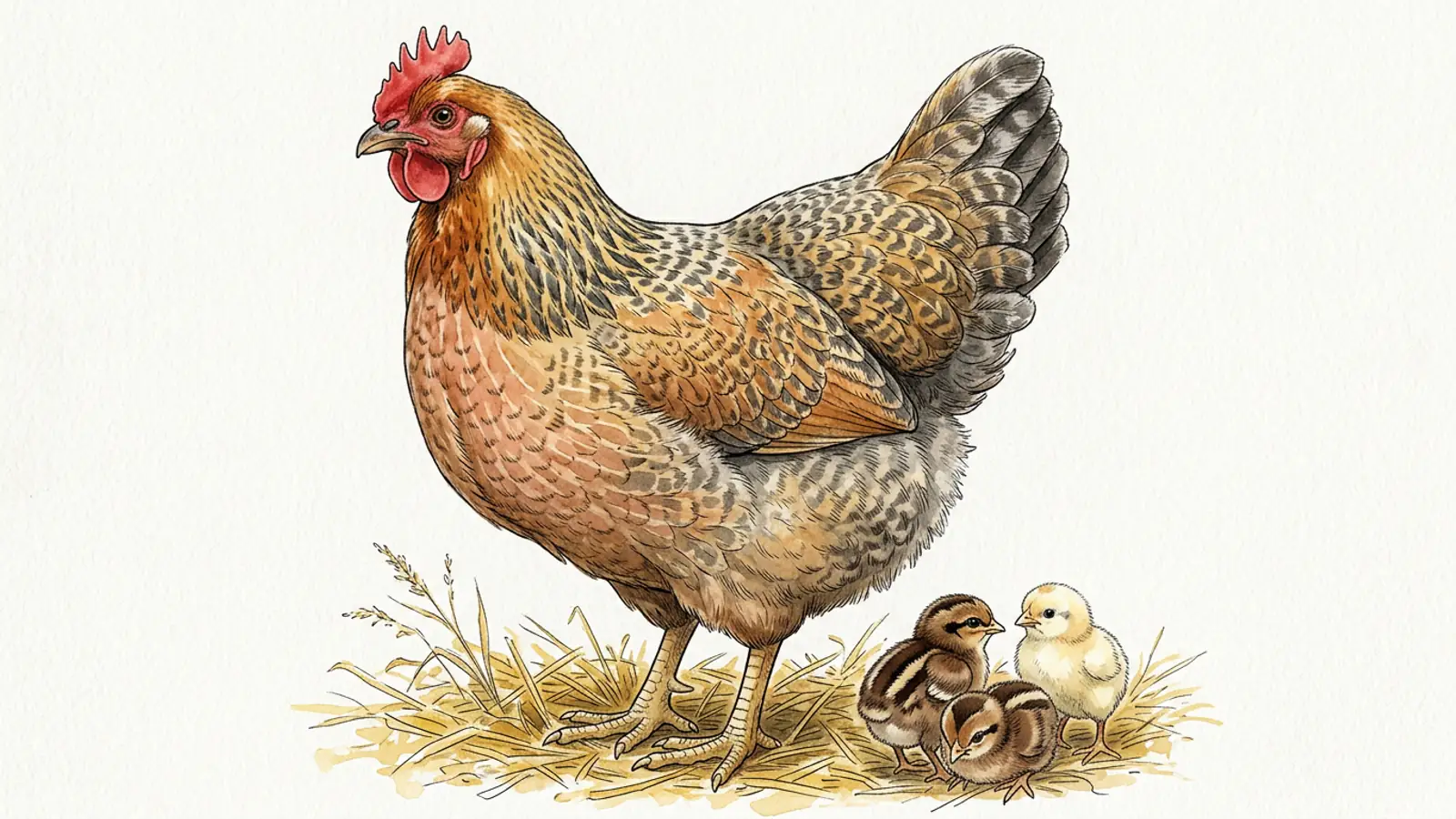
The Bielefelder is a large, heavy German chicken breed developed around the city of Bielefeld by Gerd Roth in the 1970s [1]. It is best known for autosexing, a genetic system that lets a hatchery or owner sort day-old chicks by sex using down color and pattern rather than vent sexing or DNA testing [2][1]. The breed combines a calm, approachable temperament with brown egg production, a substantial body size, and good cold tolerance, which makes it a strong candidate for backyard flocks in northern climates. Hens are steady layers of large brown eggs, roosters are heavy and upright, and chicks hatch with sex-specific markings that are visible within hours of drying off.
This article covers the breed's history, its autosexing genetics, appearance, temperament, housing and care needs, feeding, health screening, and how to find stock. It also explains how autosexing differs from sex-link hybrids, a distinction that matters to anyone planning a breeding program. This article is educational and is not a substitute for veterinary diagnosis or treatment.
Key Takeaways
- The Bielefelder is a large German chicken breed developed near Bielefeld by Gerd Roth in the 1970s, known for autosexing, brown eggs, and cold hardiness.
- Bielefelder autosexing comes from the sex-linked barring gene on a crele background, letting owners sort day-old chicks by down color and pattern instead of vent sexing.
- Male Bielefelder chicks hatch lighter with a diffuse light head spot, while female chicks are darker with chipmunk-like stripes and a dark eye line, visible once down is dry.
- Bielefelder hens lay roughly 185 to 230 large brown eggs a year, and mature roosters weigh about 8.5 to 12 lb while hens weigh about 6.5 to 9.5 lb.
- Unlike sex-link hybrids, Bielefelders breed true, so Bielefelder roosters mated to Bielefelder hens produce chicks that sex at hatch generation after generation without separate parent lines.
At a Glance
| Attribute | Detail |
|---|---|
| Origin | Bielefeld, Germany, developed by Gerd Roth in the 1970s [1] |
| Primary purpose | Dual-purpose, brown egg layer, autosexing [2][3] |
| Sexing method | Autosexing by down color and pattern at hatch [2][1] |
| Size | Large, heavy breed; hatcheries list mature roosters at about 8.5 to 12 lb and hens at about 6.5 to 9.5 lb [2][3] |
| Temperament | Calm and approachable [3][1] |
| Egg color | Brown, large; hatcheries list about 185 to 230 eggs a year [2][3] |
| Cold hardiness | Good, suited to cold climates [3][1] |
| Foraging | Active forager when given range access [3] |
| Plumage | Crele pattern with sex-linked barring [4][1] |
| Recognition | Recognized in Germany; not accepted into the American Poultry Association Standard of Perfection [2][3] |
History and Origin of the Bielefelder Chicken
The Bielefelder was created in the 1970s by Gerd Roth, a German breeder working near the city of Bielefeld [1]. Roth's goal was a large, hardy, dual-purpose chicken that laid well and could be sexed at hatch. He built the breed from a mix of established European and American stock, and the resulting bird carries the crele color pattern with sex-linked barring, which is the genetic foundation of its autosexing behavior [4][1].
The breed spread slowly outside Germany at first. It arrived in North America through specialty hatcheries and small breeders, and several US hatcheries now list it as a standard offering for backyard flocks [2][3][5]. Greenfire Farms, a US breeder, describes a Silver Bielefelder line and notes the breed's autosexing trait as a central selling point [4]. Cackle Hatchery markets the breed specifically as an auto-sexing brown egg layer [2], and Murray McMurray Hatchery lists the Bielefelder among its standard breeds [3]. Hoover's Hatchery also carries the breed [5].
Recognition status differs by country. In Germany, the breed is recognized within the German poultry standards system, which is where it was first standardized [3]. In the United States, the Bielefelder has not been accepted into the American Poultry Association Standard of Perfection, although a North American breed club promotes it [2][3]. The autosexing trait is consistently described across hatchery and breeder listings [2][3][4][1][5]. Owners who plan to show birds should confirm the current recognition status with the specific breed club or show organization they intend to enter, because standards and recognition lists change over time.
Why the Bielefelder Is an Autosexing Breed
Autosexing is the ability to determine the sex of a day-old chick from its down color and pattern, without handling the vent or waiting weeks for comb development [2][1]. In the Bielefelder, this trait comes from the sex-linked barring gene working against a crele background.
The Genetics Behind Autosexing
The sex-linked barring gene is carried on the sex chromosome, which is why it produces different visual results in male and female chicks [6][7]. Barring is a feather pattern gene that creates alternating light and dark bands, and it interacts with the underlying plumage color to produce the crele pattern seen in adult Bielefelders [4][1].
What Autosexing Looks Like in Bielefelder Chicks
In practice, Bielefelder chicks separate into two visual groups at hatch. Male chicks are lighter in down color and carry a diffuse light spot on the head. Female chicks are darker, with clear chipmunk-like stripes down the back and a dark line through the eye [2][1][3]. The difference is visible once the down is dry, and it holds because the barring gene is sex-linked and the crele background provides enough contrast for the pattern to read clearly.
Table of Chick Sexing Features
| Feature | Male Bielefelder Chick | Female Bielefelder Chick |
|---|---|---|
| Down color | Lighter overall [2][1] | Darker overall [2][1] |
| Head marking | Diffuse light spot on the head [2][1] | No light head spot; dark line through the eye [1][3] |
| Striping | Less defined | Clearer, more defined stripes [2][1] |
| Reliability | Visible once down is dry [2][1] | Visible once down is dry [2][1] |
| Genetic basis | Sex-linked barring on crele background [6][7][4] | Sex-linked barring on crele background [6][7][4] |
This table reflects the pattern described in breed and hatchery documentation. Individual chicks can vary, and a chick that is ambiguous at hatch should be rechecked as feathers come in.
Autosexing Versus Sex-Link Hybrids
Autosexing and sex-link hybrids both let a poultry keeper identify chick sex at hatch, but they are not the same thing, and the difference matters for anyone who wants to breed.
A sex-link hybrid is a first-generation cross between two different breeds, engineered so that the male and female chicks inherit different color or pattern genes from their parents [8]. The classic examples use a gold-factor male crossed with a silver-factor female, or a non-barred male crossed with a barred female. The offspring sex cleanly at hatch, but the parent stock must be maintained as two separate lines, and the hybrid chicks do not breed true. If you cross two sex-link hybrids, the autosexing effect disappears in the next generation.
An autosexing breed is different. The Bielefelder carries the sex-linked barring gene as a stable part of its genome, along with the crele pattern that makes the barring visible [6][7][4][1]. Because the trait is fixed in the breed, Bielefelder roosters mated to Bielefelder hens produce Bielefelder chicks that sex at hatch, generation after generation. You do not need to maintain separate parent lines. You do not need to buy new hybrid stock each year. The autosexing trait is part of the breed itself.
This is the practical advantage that makes autosexing chicken breeds attractive to small flock owners. A Bielefelder flock can be self-sustaining, and every hatch produces chicks that can be sorted by sex on day one. The trade-off is that autosexing breeds are less common than sex-link hybrids, and the color patterns that make autosexing work are specific to each breed. The Bielefelder's crele pattern is one of the cleaner examples, which is part of why the breed has held its reputation.
Appearance of the Bielefelder Chicken
The Bielefelder is a large, heavy bird with a crele plumage pattern and sex-linked barring [3][4][1]. Crele is a pattern that combines barring with a warm ground color, producing a bird with distinct light and dark banding across the body. The overall impression is a substantial, well-feathered chicken with a broad body and a confident stance.
The Bielefelder Rooster
The Bielefelder rooster is the more striking of the two sexes. He carries the crele pattern with strong barring, a full tail, and a heavy body [3][4]. Roosters are noticeably larger than hens, which is consistent with the breed's reputation as a heavy dual-purpose bird [3]. The rooster's coloring is typically brighter and more contrasted than the hen's, and his comb and wattles are well developed. Because the breed is autosexing, a rooster can be identified at hatch by his lighter down and diffuse head spot, long before his adult plumage develops [2][1].
Roosters of heavy breeds can be assertive, but the Bielefelder is consistently described as calm and approachable [3][1]. That temperament makes the rooster easier to manage than many other large-breed males, though any rooster should be handled with basic caution around children and unfamiliar visitors.
The Bielefelder Hen
The Bielefelder hen is a large, deep-bodied bird with the same crele pattern, though her barring is often softer and her overall color slightly more muted than the rooster's [3][4]. She is a brown egg layer, and the breed is marketed as a brown egg producer by multiple hatcheries [2][3]. Hatcheries list roughly 185 to 230 large brown eggs a year [2][3], and production varies by line, age, and management.
Hens are described as calm and easy to handle [3][1]. They are good foragers when given range access [3], and their heavy body and dense feathering support cold tolerance [3][1]. A Bielefelder hen in good condition is a substantial bird, and her size means she needs more space and more feed than a lightweight layer breed.
Silver Bielefelder
Greenfire Farms lists a Silver Bielefelder line [4]. The silver designation refers to a color variety within the breed, and the autosexing trait is retained in that line [4]. Owners interested in a specific color variety should confirm with the breeder which line they are buying, because color varieties can be managed as separate breeding groups.
Temperament and Behavior
The Bielefelder is consistently described as calm and approachable [3][1]. That temperament shows up in a few practical ways.
First, Bielefelders tend to be less flighty than lightweight Mediterranean breeds. They are not prone to panicked flight, and they settle into a routine quickly. Second, they tolerate handling better than many large breeds, which makes them a reasonable choice for a family flock where children may be involved. Third, roosters are described as calm, which reduces the management burden in a mixed flock [3][1].
Foraging behavior is another strength. The breed is described as an active forager when given range access [3]. A Bielefelder flock on pasture will work the ground for insects, seeds, and plant material, which supplements commercial feed and keeps the birds occupied. Foraging also reduces boredom, which in turn reduces feather pecking and other behavioral problems in confined flocks.
The breed's calm nature does not mean it is sedentary. Bielefelders are large birds, and they need room to move. A confined Bielefelder in a small run will be less content than one with access to a larger area or pasture. Plan for space accordingly.
Housing, Space, and Cold Hardiness
The Bielefelder is a heavy breed with dense feathering, and it is described as cold hardy [3][1]. That combination makes it a good fit for northern climates where lightweight breeds struggle in winter.
Cold hardiness in chickens depends on feather coverage, body condition, and housing. A Bielefelder's dense plumage and large body mass help it retain heat. The breed's heavy feathering also means it is less vulnerable to frostbite on exposed skin than breeds with sparse feathers, though combs and wattles can still be affected in extreme cold. Good ventilation without drafts, dry bedding, and unfrozen water are the basics of winter management for any flock.
Space requirements scale with body size. A heavy breed needs more floor area per bird than a lightweight breed, both in the coop and in the run. Crowding a heavy breed increases the risk of feather pecking, foot problems, and respiratory disease. Provide perches that are wide enough and low enough for a heavy bird to use comfortably, and provide nest boxes that are large enough for a Bielefelder hen to enter and turn around.
Heat is the bigger risk for a heavy, densely feathered breed. Bielefelders in hot climates need shade, airflow, and cool water. Watch for open-mouth breathing and wing holding during heat events, and provide multiple water stations so a dominant bird cannot block access.
Feeding and Nutrition
Feeding a Bielefelder is not different in kind from feeding any backyard chicken. The difference is quantity. A heavy breed eats more than a lightweight breed, and a laying hen has higher nutrient demands than a non-laying bird.
A complete commercial layer ration formulated for backyard poultry provides the base of the diet. The ration should match the bird's life stage. Growing chicks need a starter or grower ration, and laying hens need a layer ration with appropriate calcium for eggshell production. Free-choice calcium in the form of oyster shell is standard practice for laying flocks, and it lets hens regulate their own intake.
Foraging supplements the ration when birds have range access [3]. Foraged insects, seeds, and greens add variety and some nutrition, but they should not replace a balanced ration. Treats and scratch grains should be a small fraction of the diet, because too much scratch dilutes the protein and mineral content of the complete feed.
Fresh, clean water is the most important nutrient. A heavy laying hen drinks more than a lightweight bird, and water intake rises in heat. Check waterers daily, and clean them regularly to prevent biofilm and pathogen buildup.
Common Health Problems and Screening
The Bielefelder is a chicken, and chickens are subject to the same health problems as any backyard breed. There is no known disease unique to the Bielefelder, but the breed's size and feathering create some practical risks.
Size-Related Risks
Heavy breeds carry more weight on their feet and legs, which increases the risk of footpad lesions and leg problems when bedding is wet or perches are inadequate. Keep bedding dry, provide wide perches, and inspect feet regularly. Heavy hens can also develop prolapse or egg-binding issues, and any hen that strains without producing an egg, or that shows a prolapsed tissue mass, needs prompt veterinary attention.
Feather and Skin Risks
Dense feathering can hide external parasites. Mites and lice can build up under heavy plumage before an owner notices. Part the feathers at the vent and under the wings during routine checks, and look for moving parasites, eggs, or skin irritation. External parasites are treatable, but the treatment must be appropriate for a laying flock, and some products have withdrawal periods for eggs. A veterinarian can advise on product selection.
Respiratory and Reproductive Risks
Respiratory disease spreads quickly in confined flocks, and a heavy breed in a crowded coop is at higher risk. Good ventilation, dry litter, and quarantine of new birds are the basics of prevention. Reproductive problems such as egg yolk peritonitis, salpingitis, and internal laying are common in aging hens of any breed, and they present with vague signs such as a swollen abdomen, lethargy, and reduced laying. These conditions require veterinary diagnosis.
Screening and Routine Care
Routine screening for a backyard flock includes regular physical checks, monitoring of feed and water intake, and inspection of droppings for changes. A veterinarian who works with poultry can perform a physical examination, assess body condition, and recommend diagnostic testing when indicated. There is no breed-specific screening test for the Bielefelder. Owners should establish a relationship with a poultry-experienced veterinarian before a problem arises.
Biosecurity is part of routine care. New birds should be quarantined before introduction. Visitors who keep poultry should not walk into your coop in the same shoes they wore in their own. These measures reduce the risk of introducing disease to a flock.
Lifespan and Long-Term Care
There is no well-documented breed-specific lifespan for the Bielefelder, so owners should expect the typical range for a well-managed backyard chicken. What matters more than a number is the quality of care over time.
A heavy breed benefits from weight management as it ages. An overweight hen lays less and moves less, and she is more prone to foot and leg problems. Monitor body condition by feeling the breastbone and the keel, and adjust feed quantity if a bird is carrying too much fat. Older hens also need more calcium support and more frequent health checks, because reproductive problems become more common with age.
Roosters can live long lives in a well-managed flock, but a rooster-to-hen ratio that is too high causes stress and feather damage in hens. Watch for over-mating, bare backs, and skittish behavior in hens, and adjust the ratio if problems appear.
Finding a Responsible Breeder or Rescue
The Bielefelder is available from several US hatcheries, including Cackle Hatchery [2], Murray McMurray Hatchery [3], and Hoover's Hatchery [5]. Greenfire Farms lists a Silver Bielefelder line [4]. These are commercial sources, and buying from a hatchery is the most common route for a backyard flock.
A responsible breeder, whether a hatchery or a small farm, will provide healthy chicks, clear information about the line, and honest answers about the parent stock. Ask about the autosexing rate in the line, because a line that has drifted can produce ambiguous chicks. Ask about vaccination status and health testing. Ask whether the breeder maintains the breed as a closed flock, which reduces the risk of introducing disease.
Rescue is a less common route for this breed because it is not a high-volume commercial bird, but it is possible. Breed-specific rescue groups and general poultry rescue organizations sometimes have Bielefelders or Bielefelder crosses available. A rescued bird may have an unknown history, so a veterinary examination and a quarantine period are prudent before introduction to an existing flock.
Who Should Not Get a Bielefelder
The Bielefelder is not the right choice for every situation.
Owners with very limited space should not get a heavy breed. A Bielefelder needs more room than a bantam or a lightweight layer, and a small coop will create welfare problems. Owners in extremely hot climates should think carefully about a densely feathered heavy breed, because heat stress is a real risk. Owners who want maximum egg production per pound of feed should look at lightweight layer breeds, because a heavy dual-purpose breed eats more to produce a similar number of eggs.
Owners who want a bird that can be handled constantly by young children should supervise interactions regardless of breed. The Bielefelder is calm [3][1], but any chicken can scratch or peck, and a large rooster can injure a small child even without aggression.
Owners who cannot commit to a long-lived animal should not get any chicken. A backyard flock is a multi-year commitment, and rehoming a large breed is harder than rehoming a common layer breed.
Limitations and When to Contact a Veterinarian
This article is educational and is not a substitute for veterinary diagnosis or treatment. Individual birds vary, and a breed profile cannot tell you what is happening with your specific chicken.
Contact a veterinarian who works with poultry if you see any of the following.
- A hen that strains without producing an egg, or that has a visible tissue mass at the vent.
- A bird that stops eating or drinking, or that loses weight.
- Open-mouth breathing, wheezing, or a discharge from the eyes or nostrils.
- A swollen abdomen, a pale comb, or a sudden drop in laying across the flock.
- Lameness, a swollen foot, or a footpad lesion that does not improve with dry bedding.
- External parasites that persist after treatment, or skin irritation that worsens.
- Sudden deaths in the flock, or multiple birds affected at once.
- Any wound from a predator or a flockmate that is deep, bleeding, or contaminated.
A veterinarian can examine the bird, run diagnostic tests, and recommend treatment. For a flock problem, a veterinarian may also recommend a flock-level investigation, including necropsy of a dead bird, which can identify the cause quickly.
Frequently Asked Questions
What is a Bielefelder chicken?
The Bielefelder is a large German chicken breed developed around Bielefeld by Gerd Roth in the 1970s [1]. It is known for autosexing, brown eggs, a calm temperament, and cold hardiness [2][3][1].
Are Bielefelder chicks autosexing?
Yes. Bielefelder chicks can be sexed at hatch by down color and pattern. Males are lighter with a diffuse spot on the head, and females are darker with clearer stripes [2][1].
How do you sex Bielefelder chicks?
Look at the down color and the head pattern once the chick is dry. Males are lighter with a diffuse head spot, and females are darker with clearer striping [2][1]. The difference comes from the sex-linked barring gene on a crele background [6][7][4].
Is the Bielefelder a good egg layer?
The Bielefelder is a brown egg layer [2][3]. Hatcheries list roughly 185 to 230 large brown eggs a year, and production varies by line, age, and management.
Are Bielefelder chickens cold hardy?
Yes. The breed is described as cold hardy, which makes it a good fit for northern climates [3][1]. Dense feathering and a heavy body support cold tolerance.
Are Bielefelder roosters aggressive?
The breed is described as calm and approachable, including roosters [3][1]. Any rooster should still be handled with basic caution around children and unfamiliar visitors.
What is the difference between autosexing and sex-link hybrids?
Autosexing breeds carry the sex-linked trait as a stable part of the breed, so they breed true. Sex-link hybrids are first-generation crosses that must be recreated each year from separate parent lines [8].
Where can I buy Bielefelder chickens?
US hatcheries that list the breed include Cackle Hatchery [2], Murray McMurray Hatchery [3], and Hoover's Hatchery [5]. Greenfire Farms lists a Silver Bielefelder line [4].
Related Articles
- Raising Chickens for Eggs: Breed Selection, Care, and Egg Production
- Chicken Breeds for Beginners: Eggs, Housing, Climate, and Flock Welfare
- Small-Scale Chicken Farming: Breeds, Housing, and Flock Management
- Indigenous and Specialty Chicken Breeds: Farming Kadaknath, Kuroiler, and Native Breeds
- Bumblefoot in Chickens: Recognition, Treatment, and Prevention
- Silver Appleyard Ducks: Breed Profile and Care
- How Long Do Chickens Live? Lifespan by Breed and Care
- Dominique Chickens: America's Oldest Breed and How to Keep Them
Sources
- Bielefelders and Other Autosex Chickens (gaildamerow.com)
- Bielefelder Chicks - Auto-Sexing Brown Egg Layers (cacklehatchery.com)
- Murray McMurray Hatchery - Bielefelder (mcmurrayhatchery.com)
- Silver Bielefelder (greenfirefarms.com)
- Bielefelder - Hoover's Hatchery (hoovershatchery.com)
- Isolation and fixation of the sex-linked barring feather gene from white leghorn for chick sexing.
- Insights into the mechanism underlying feather pattern formation of sex-linked barring in Chinese native chickens.
- The use of blue-splashed white down in color sexing crosses.