Barred Rock Chicken: Breed Traits and Care
By Dr. Zubair Khalid, DVM, MS, PhD ·
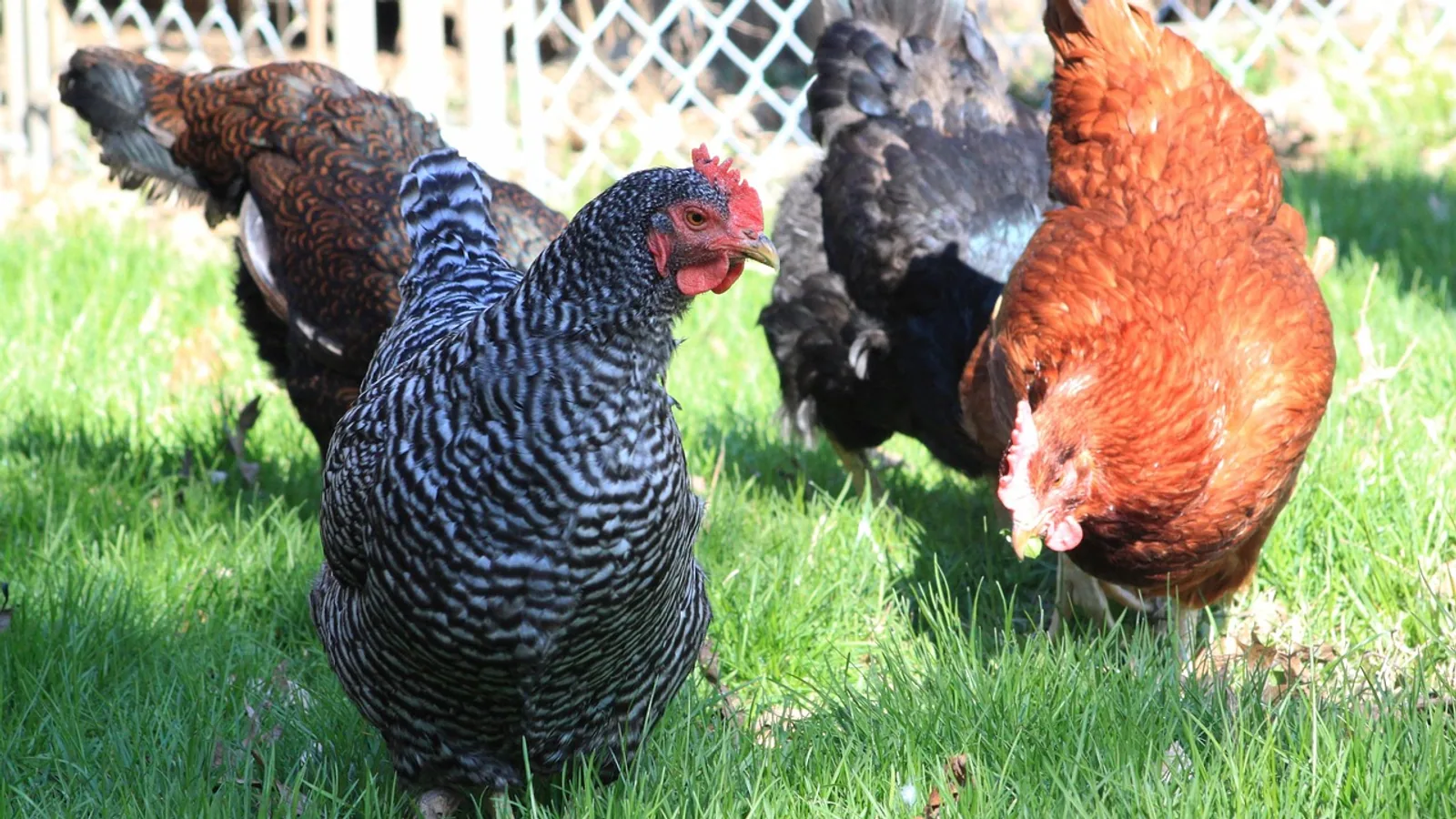
The Barred Rock is the barred variety of the Plymouth Rock, a dual-purpose American breed developed in the nineteenth century for both meat and brown eggs. A mature hen weighs roughly 2.7 to 3.2 kg and a rooster 3.6 to 4 kg, and a well-managed hen lays about 200 to 280 brown eggs per year at 58 to 62 g each. The breed reaches point of lay around 18 to 22 weeks. Its most useful trait for a small flock is that barred plumage is sex-linked, so a chick can be sexed at hatch by the head spot and leg color. Barred Rocks are calm, cold-hardy, and adaptable, which makes them a strong choice for a first backyard flock or a mixed laying flock. This article covers breed history, appearance, temperament, egg production, the hen versus rooster comparison, feeding, housing, and the health problems owners should watch for.
This article is educational and is not a substitute for veterinary diagnosis or treatment.
At a Glance
| Trait | Detail |
|---|---|
| Breed class | Dual-purpose (meat and brown eggs) |
| Origin | United States, Plymouth Rock breed group |
| Plumage | Barred, black and white, sex-linked pattern |
| Hen weight | 2.7 to 3.2 kg |
| Rooster weight | 3.6 to 4 kg |
| Egg production | 200 to 280 brown eggs per year |
| Egg weight | 58 to 62 g |
| Point of lay | 18 to 22 weeks |
| Temperament | Calm, docile, adaptable |
| Cold hardiness | Good |
| Primary use | Backyard eggs and home meat |
| Sexing at hatch | Yes, by head spot and leg color |
| Lifespan | Productive laying for several years with good husbandry |
What Is a Barred Rock?
The Barred Rock is not a separate breed. It is the barred color variety of the Plymouth Rock, and the two names are used interchangeably in backyard poultry. The Plymouth Rock breed also includes other color varieties such as the White Plymouth Rock and the Columbian Plymouth Rock. All of these share the same breed foundation and are grouped as dual-purpose birds in poultry breeding programs.
The distinction matters because the barred pattern is a specific genetic trait, not a general description of any black-and-white chicken. The barred pattern is produced by the sex-linked barring gene, which was first identified in chickens in 1908 and has been studied for more than a century [1]. The gene sits on the Z chromosome, which is the sex chromosome in birds. Because roosters carry two Z chromosomes (ZZ) and hens carry one Z and one W chromosome (ZW), the barring gene behaves differently in the two sexes. This is the genetic basis for chick sexing in the breed.
A Barred Rock hen and rooster are both barred, but the pattern differs between them. Roosters carry two copies of the barring gene and show wider white bars, which gives them a lighter overall appearance. Hens carry one copy and show narrower white bars, so they look darker and more sharply striped. This difference is visible from a young age and becomes clearer as the birds mature.
History and Purpose of the Plymouth Rock
The Plymouth Rock was developed in the United States in the 1800s as a farm chicken that could supply both meat and eggs. It became one of the most popular American breeds in the early twentieth century and was later used as a parent breed in commercial broiler production. The White Plymouth Rock in particular appears repeatedly in modern genetics research as a founder of commercial broiler lines.
That history shows up in the scientific literature. The White Plymouth Rock has been used as a high-growth parent in crosses with native Japanese breeds to map the genes that control muscle weight and early growth [2][3]. It has also been used as a parental breed in crosses with the Shamo and other breeds to study growth and carcass traits [4][5]. A long-term selection experiment at the University of Arkansas ran for 38 generations of divergent selection for eight-week body weight in White Plymouth Rocks, which demonstrates how much genetic variation for growth exists within this breed group [6]. The Plymouth Rock is also one of the standard breeds included in genomic studies of chicken diversity and selection [7][8].
The Barred variety was the original Plymouth Rock color and remains the most recognizable. Its dual-purpose role is still relevant for backyard flocks. The Barred Plymouth Rock is grouped with other dual-purpose breeds in egg production research, and studies of clutch traits and egg number have characterized its laying pattern alongside breeds such as the Rhode Island Red and the White Leghorn [9]. That research confirms the Barred Rock as a productive layer within the dual-purpose category rather than a high-output commercial layer.
Appearance and the Barring Pattern


The barred pattern is an alternating series of black and white bars across each feather. The pattern runs across the whole body, including the neck, back, wings, and tail. The overall effect is a bird that looks like it is wearing fine horizontal stripes. The legs are typically yellow, and the beak and eyes are consistent with the breed standard.
The barring gene does more than create a pattern. Research on the developing feather follicle in the Barred Plymouth Rock found that melanocytes, the pigment-producing cells, undergo premature cell death in the regions of the feather that appear white [1]. The white bars are not simply unpigmented areas where pigment production was switched off. The cells that would have produced black pigment die off in those zones. This is a useful detail for owners because it explains why the pattern is stable and does not fade or change with diet.
The genetic mapping work located the barring gene to a region on the distal long arm of the Z chromosome and narrowed the causal mutation to a small region containing a handful of known genes [1]. The practical takeaway for a flock owner is that barring is inherited in a predictable sex-linked way, which is why the breed can be sexed at hatch.
Head Spot and Leg Color for Sexing Chicks
Barred Rock chicks can be sexed at hatch using two features. Male chicks typically have a larger, more defined white spot on the top of the head, and their legs are lighter, often with a yellowish cast. Female chicks typically have a smaller, less defined head spot and darker legs with a dusky wash. The head spot is the more reliable of the two features, and the leg color is used as a secondary check.
This method works because the barring gene is on the Z chromosome. A male chick receives a Z chromosome from each parent, and a female chick receives a Z from the father and a W from the mother. The difference in gene dosage produces the visible difference in the head spot and leg color. This is the same principle behind commercial sex-linked chick sexing, and it is one of the reasons the Barred Rock remains popular for small flocks that want to raise pullets for eggs.
Sexing accuracy from head spot and leg color is high but not perfect. Owners who need certainty should confirm sex as the birds mature by watching for comb development, hackle feathers, and saddle feathers.
Temperament and Behavior
Barred Rocks are generally calm, docile, and easy to handle. They tolerate confinement well, which suits small yards and suburban coops. They are also cold-hardy, and their dense barred plumage helps them through winter. They forage actively when given the chance and adapt to a range of management systems.
The breed's behavior has been studied in the context of domestication. A comparison of red junglefowl, White Plymouth Rock chickens, and their reciprocal crosses found large differences between the parental lines in fearfulness toward humans, and those differences were only slightly reduced in the intercross generations [10]. That study also found that traits related to reproduction showed heterosis, while growth-related traits showed considerable additive genetic variation. For an owner, the practical point is that the Plymouth Rock group, including the Barred Rock, is a domesticated breed with a long history of living alongside people, and its temperament reflects that history.
Individual birds vary. Some Barred Rock hens are friendly and will eat from the hand, while others stay more reserved. Roosters can be protective of the flock, and some become assertive with people during breeding season. Owners who keep a rooster should handle the bird regularly from a young age and watch for any escalation in aggression.
Egg Production
A healthy Barred Rock hen lays about 200 to 280 brown eggs per year, with each egg weighing roughly 58 to 62 g. Production begins around 18 to 22 weeks of age. Egg numbers decline gradually with age, and hens typically lay best in their first and second laying years.
The laying pattern of the Barred Plymouth Rock has been characterized in research on clutch traits. A study of six chicken breeds, including the Barred Plymouth Rock, measured daily egg production up to 50 weeks of age and found that egg number and average clutch length in the Barred Plymouth Rock were higher than in a synthetic dwarf breed and an indigenous breed [9]. The same study found that clutch length was positively correlated with egg number but not with age at first egg [9]. In plain terms, hens that lay in longer uninterrupted sequences tend to produce more eggs overall.
Heritability estimates for egg production traits come from work on related breeds. A study of Rhode Island Red and White Plymouth Rock lines under tropical conditions estimated heritability for age at first egg, body weight at first egg, egg weight at first egg, egg number over the first 17 weeks of lay, and average egg weight [11]. The estimates for egg number were moderate, which means both genetics and management influence how many eggs a hen produces. Nutrition, lighting, and stress management all affect laying.
For a backyard flock, the practical target is to provide consistent feed, clean water, and a stable photoperiod so the hen can express her genetic potential. Hens that are underfed, overcrowded, or exposed to sudden temperature swings will drop in production.
Hen Versus Rooster: A Comparison Table
The differences between a Barred Rock hen and rooster are visible in the plumage pattern, the comb, the body size, and the feathering on the neck and tail. The table below summarizes the main points owners use to tell the two apart.
| Feature | Hen | Rooster |
|---|---|---|
| Barring width | Narrow white bars, darker overall | Wide white bars, lighter overall |
| Comb | Smaller, often single and upright | Larger, more prominent single comb |
| Body size | 2.7 to 3.2 kg | 3.6 to 4 kg |
| Hackle feathers | Short, rounded neck feathers | Long, pointed hackle feathers |
| Saddle feathers | Absent or minimal | Long, pointed saddle feathers over the tail |
| Tail | Shorter, more compact | Longer, with curved sickle feathers |
| Legs and spurs | No spurs or small spurs | Spurs usually present |
| Behavior | Calmer, focused on laying and foraging | More alert, may be protective or assertive |
| Primary role | Egg production | Flock protection and breeding |
The barring difference is the most reliable early clue. A young Barred Rock cockerel shows wider white bars and a lighter overall look than a pullet of the same age. As the bird matures, the hackle and saddle feathers confirm the sex. A Barred Rock chicken rooster also develops a larger comb and, in most cases, visible spurs.
Owners searching for information on a barred rock rooster or a barred rock cockerel should note that the terms describe the same bird at different ages. A cockerel is a male under one year of age, and a rooster is a male over one year. The plumage and body traits are the same, but the cockerel is still growing into his adult size and feathering.
Barred Rock Versus Dominique and Cuckoo Marans
Three breeds are commonly confused with the Barred Rock: the Dominique, the Cuckoo Marans, and other barred or cuckoo-patterned birds. The confusion is understandable because all three show a barred or cuckoo pattern, but the breeds differ in origin, comb type, and other traits.
The Dominique is an older American breed with a rose comb, while the Barred Rock has a single comb. The Dominique is also smaller and has a different body shape. The Cuckoo Marans is a French breed known for dark brown eggs, and its pattern is a cuckoo type rather than the crisp barred pattern of the Plymouth Rock. Cuckoo Marans hens also lay a much darker egg than the Barred Rock.
The most reliable way to separate the breeds is to look at the comb, the egg color, and the overall body type. A single comb, yellow legs, and a medium brown egg point to the Barred Rock. A rose comb points to the Dominique. A very dark brown egg points to the Marans. Owners who buy chicks from a hatchery or breeder should confirm the breed name and ask about the parent stock.
Housing and Space
Barred Rocks are medium to large birds, so they need adequate space. Crowding increases stress, reduces egg production, and raises the risk of feather pecking and disease spread. A general rule for backyard flocks is to provide enough roost space for every bird to perch without touching, and enough floor space for each bird to move freely. Owners should check local ordinances for any minimum coop or run dimensions, because rules vary by municipality.
Ventilation matters as much as space. Ammonia buildup from droppings irritates the respiratory tract and predisposes birds to respiratory disease. A coop with high vents and a dry floor reduces ammonia and keeps litter dry. In cold climates, ventilation should be maintained without creating drafts directly on the birds.
Nesting boxes should be dark, quiet, and lined with clean bedding. One box for every four to five hens is a reasonable target. Hens that are crowded at the nest box may lay on the floor, which increases the risk of dirty or cracked eggs.
Feeding Considerations
Barred Rocks are dual-purpose birds, so they need a diet that supports both body maintenance and egg production. A complete poultry feed formulated for laying hens provides the protein, energy, calcium, and micronutrients the bird needs. Owners should not rely on scratch grain as a primary feed because it is low in protein and calcium.
Calcium is the nutrient most often mismanaged in backyard flocks. Laying hens mobilize large amounts of calcium to build eggshells, and a deficiency leads to weak shells and, over time, bone problems. A complete layer feed with adequate calcium is the standard approach. Oyster shell can be offered free-choice so hens can adjust their own intake. Young birds that are not yet laying should not receive the same calcium level as active layers, because excess calcium can damage the kidneys of growing birds.
Clean water should be available at all times. Water intake affects feed intake, and a hen that drinks less will eat less and lay fewer eggs. In winter, owners should check that water is not frozen. In summer, water should be shaded and refreshed often.
Treats and scraps should make up only a small part of the diet. Overfeeding treats dilutes the nutrient balance of the complete feed and reduces egg production. A common guideline is to keep treats under about ten percent of daily intake, with the rest coming from a balanced ration.
Grooming and Routine Care
Barred Rocks are low-maintenance in the grooming sense. They do not need bathing under normal conditions, and their dense plumage sheds dirt reasonably well. Owners should check birds regularly for external parasites such as mites and lice, especially around the vent and under the wings. A bird that is restless, losing feathers outside a normal molt, or showing pale combs should be examined.
Feather molt is a normal annual event. Hens typically stop laying during molt and regrow feathers over several weeks. Protein and energy needs rise during molt, and a complete feed supports that recovery. Owners should not force production during molt.
Beak and nail care is usually not needed if birds have access to foraging and abrasive surfaces. Overgrown beaks or nails can occur in confined birds, and a veterinarian can trim them if needed.
Health Problems to Watch For
Barred Rocks are a hardy breed, but they are not immune to the common problems of backyard poultry. Owners should monitor for the following categories of disease and consult a veterinarian when signs appear.
Respiratory Disease
Respiratory signs include sneezing, nasal discharge, swollen eyes, and labored breathing. These signs overlap with several diseases, and a veterinarian should evaluate the flock rather than the individual bird alone. Ventilation, litter management, and biosecurity reduce the risk.
Reproductive and Egg-Laying Problems
Hens can develop problems related to egg production, including egg binding, prolapse, and internal laying. A hen that strains, sits hunched, or stops laying suddenly should be examined. These conditions can become life-threatening quickly, and early veterinary care improves the outcome.
External and Internal Parasites
Mites, lice, and internal worms are common in backyard flocks. Owners should inspect birds regularly and treat according to a veterinarian's recommendation. Overuse of antiparasitic drugs can lead to resistance and residue problems in eggs, so treatment should be targeted and timed correctly.
Nutritional and Metabolic Problems
Calcium deficiency, obesity, and fatty liver are linked to diet and management. A balanced layer ration, controlled treats, and adequate exercise reduce the risk. A hen that is overweight may have trouble laying and is more prone to reproductive problems.
Genetic and Breed-Related Considerations
The Plymouth Rock breed group has been studied extensively for growth and carcass traits, and some of that work identifies genetic loci that influence body weight and muscle development [2][3][12]. Research on pulmonary hypertension syndrome, also called ascites, used a cross between broiler dam lines originating from the White Plymouth Rock breed and identified quantitative trait loci associated with the condition [13]. Ascites is primarily a problem in fast-growing broiler lines and in birds raised at high altitude or in cold conditions. Barred Rocks are not fast-growing broilers, so their risk is lower than that of commercial meat birds, but owners at high altitude should still provide good ventilation and avoid overfeeding.
Avian leukosis virus subgroup E elements have been identified in the White Plymouth Rock genome, and some insertions affect production traits and appearance [8]. This is background genetics rather than a disease diagnosis, and it does not mean every Barred Rock carries a problem. Owners who breed birds should discuss testing and selection with a veterinarian.
Screening and Veterinary Care
There is no single screening panel for backyard chickens. A veterinarian familiar with poultry can perform a physical examination, evaluate the flock history, and recommend testing based on signs. Fecal testing for internal parasites, a check for external parasites, and a review of nutrition and housing are reasonable starting points. Owners should establish a relationship with a poultry veterinarian before a crisis, because finding one during an emergency is harder.
Lifespan and Longevity
A Barred Rock hen can live and lay for several years with good husbandry. Peak egg production occurs in the first one to two laying years, and production declines gradually after that. Many owners keep hens as pets after laying slows, and the birds remain active and hardy. Roosters can also live for many years, though temperament and flock dynamics may require management.
Lifespan depends on genetics, nutrition, housing, and access to veterinary care. Predation and disease are the most common causes of premature loss in backyard flocks. Secure housing and good biosecurity extend the productive life of the flock.
Finding a Responsible Breeder or Rescue
Owners should buy from a breeder or hatchery that can describe the parent stock, the health history of the flock, and the vaccination status of the chicks. A responsible source will answer questions about the breed, provide records, and allow the buyer to see the birds or the facility. Breed-specific clubs and poultry associations can help identify breeders who follow breed standards.
Rescue is also an option. Many backyard chickens are surrendered when owners move, lose interest, or face local restrictions. Rescued birds may have unknown health histories, so a veterinary examination and a period of quarantine before introducing them to an existing flock are prudent. Quarantine reduces the risk of bringing disease into a healthy flock.
Owners should avoid buying birds from sources that cannot provide basic health information or that keep birds in unsanitary conditions. The cost of a cheap chick is small compared with the cost of treating a flock-wide disease outbreak.
Who Should Not Get a Barred Rock
Barred Rocks suit most backyard flock owners, but they are not the right choice for everyone. The breed is not suited to owners who want a small, quiet, ornamental bird for an apartment or a very small patio. It is a medium to large chicken that needs space, and its egg production and foraging behavior are best supported by a yard or a run.
Owners who cannot commit to daily feeding, watering, and health checks should not keep chickens of any breed. Owners in areas with strict ordinances that prohibit roosters should plan to keep only hens, and they should confirm the sex of chicks before purchase. Owners who want a bird that lays very large or unusually colored eggs should look at breeds developed for that purpose, because the Barred Rock produces medium to large brown eggs rather than specialty eggs.
Owners who are not prepared to handle a sick or injured bird, or to pay for veterinary care, should reconsider. Backyard chickens are livestock and pets at the same time, and they need the same level of commitment as any other animal.
Limitations and When to Contact a Veterinarian
This article is educational and is not a substitute for veterinary diagnosis or treatment. Individual birds need individual assessment, and a veterinarian who examines the bird can provide advice that no article can.
Contact a veterinarian promptly if a bird shows any of the following:
- Labored breathing, open-mouth breathing, or a purple comb
- A sudden drop in egg production across the flock
- Nasal or eye discharge, sneezing, or facial swelling
- A hen that strains, sits hunched, or cannot pass an egg
- Bloody droppings, watery droppings, or a sudden change in droppings
- A bird that stops eating or drinking for more than a day
- Visible parasites, feather loss outside a normal molt, or skin lesions
- Lameness, swelling in a leg or foot, or an inability to stand
- A bird that separates itself from the flock and sits puffed up
- Any wound, bite, or predator injury
Call a veterinarian who treats poultry if the flock has multiple sick birds, if a bird is not improving after a day or two, or if you are unsure what you are seeing. Early intervention is almost always easier and less expensive than waiting.
Frequently Asked Questions
What is a Barred Rock chicken?
A Barred Rock is the barred color variety of the Plymouth Rock, a dual-purpose American breed kept for brown eggs and meat. It is medium to large, calm, and cold-hardy.
How do you tell a Barred Rock hen from a rooster?
The rooster has wider white bars and a lighter overall look, a larger comb, long pointed hackle and saddle feathers, and usually spurs. The hen has narrower bars, a darker appearance, a smaller comb, and no saddle feathers.
Can you sex Barred Rock chicks at hatch?
Yes. The barring gene is on the Z chromosome, so male chicks typically have a larger head spot and lighter legs while female chicks have a smaller head spot and darker legs.
How many eggs does a Barred Rock lay?
A healthy hen lays about 200 to 280 brown eggs per year, each weighing roughly 58 to 62 g, starting around 18 to 22 weeks of age.
How big does a Barred Rock get?
A mature hen weighs about 2.7 to 3.2 kg and a rooster about 3.6 to 4 kg. They are medium to large birds and need adequate coop and run space.
Is a Barred Rock the same as a Dominique?
No. The Dominique is a separate breed with a rose comb, while the Barred Rock has a single comb. The two are often confused because both have a barred pattern.
Are Barred Rock roosters aggressive?
Temperament varies by individual. Some roosters are calm and protective, while others become assertive during breeding season. Regular handling from a young age helps, and owners should watch for any escalation.
Do Barred Rocks do well in cold weather?
Yes. Their dense barred plumage and hardy constitution make them a good choice for cold climates, provided the coop is dry and well ventilated without drafts.
Related Articles
- Raising Chickens for Eggs: Breed Selection, Care, and Egg Production
- Calico Cat: Fascinating Facts, Personality Traits & Complete Care Guide
- Do You Need a Rooster for Hens to Lay Eggs?
- Hairless Cat: Care, Health, and Breed Guide
- Silkie Chicken Care Guide
- Bantam Chicken Care Guide
- Bantam Breed Chickens: Care and Characteristics
- Bully Pit Mix: Breed Traits, Health, and Care
Sources
- Genetic mapping of the sex-linked barring gene in the chicken.
- Mapping QTLs for Breast Muscle Weight in an F(2) Intercross between Native Japanese Nagoya and White Plymouth Rock Chicken Breeds.
- QTL analysis for early growth in an intercross between native Japanese Nagoya and White Plymouth Rock chicken breeds using RAD sequencing-based SNP markers.
- Genetic mapping of quantitative trait loci affecting growth and carcass traits in F2 intercross chickens.
- Mapping of Quantitative Trait Loci for Growth and Carcass-Related Traits in Chickens Using a Restriction-Site Associated DNA Sequencing Method.
- Long-term divergent selection for eight-week body weight in white Plymouth rock chickens.
- Dissecting Selective Signatures and Candidate Genes in Grandparent Lines Subject to High Selection Pressure for Broiler Production and in a Local Russian Chicken Breed of Ushanka.
- Short communication: diversity of endogenous avian leukosis virus subgroup E elements in 11 chicken breeds.
- Characterization of clutch traits and egg production in six chicken breeds.
- Asymmetries, heterosis, and phenotypic profiles of red junglefowl, White Plymouth Rocks, and F(1) and F(2) reciprocal crosses.
- Genetic parameters for egg production traits in purebred and hybrid chicken in a tropical environment.
- Mapping quantitative trait loci affecting chicken body size traits via genome scanning.
- Genetic mapping of quantitative trait loci affecting susceptibility in chicken to develop pulmonary hypertension syndrome.