Female Betta Fish Care and Tank Setup
By Dr. Zubair Khalid, DVM, MS, PhD ·

Female betta fish care rests on three pillars: a heated, filtered, covered tank with stable water chemistry, a social plan that matches her actual temperament, and daily observation for aggression, appetite change, and abnormal posture. A single female can thrive in a well-run tank of her own. A group of females can also work, but only when the tank is large enough, planted enough, and watched closely enough to interrupt bullying before it becomes injury. The biggest mistake new owners make is assuming that because she is female, she is peaceful and undemanding. Decades of selection for fighting ability in this species have shaped female behavior too [1].
This article is educational and is not a substitute for veterinary diagnosis or treatment.
At a Glance: Female Betta Care Checklist
| Item | Target or action | Notes |
|---|---|---|
| Water temperature | 27 to 28 °C (80.6 to 82.4 °F) | The range used in a documented controlled betta breeding setup [2] |
| pH | 7.2 to 7.5 | Same documented setup [2] |
| Dissolved oxygen | 4 to 6 mg/L | Same documented setup [2] |
| Ammonia | 0 mg/L | Same documented setup. Any readable ammonia is a problem [2] |
| Lid | Secure top cover | Bettas are surface breathers and jumpers. A secure cover was specified in the breeding protocol [2] |
| Filtration and aeration | Gentle flow | Gentle aeration and filtration were used in the same system [2] |
| Decor | Smooth pebbles, live or silk plants, Indian almond leaf | The documented setup included all three [2] |
| Housing plan | Solitary, or a carefully managed female group | Group housing is possible but depends on rearing history and tank design [3] |
| Diet | Carnivorous, with live or frozen invertebrates | Moina and Artemia feature in documented culture protocols [2][4] |
| Daily check | Appetite, breathing rate, fin condition, aggression | Behavior changes often precede visible disease [5] |
Five actions to take today:
- Measure the tank and confirm it holds enough water to buffer temperature swings.
- Set the heater and verify with a separate thermometer before the fish goes in.
- Fit a lid with no gaps around the filter or heater cord.
- Establish the filter cycle so ammonia reads zero before stocking.
- Decide in advance where a bullied or sick female will go if the group plan fails.
Female Betta Fish Are Not Beginner Disposables
The Siamese fighting fish has been selectively bred for fighting ability for hundreds of years, which produced the male aggression the species is famous for. More recent breeding has targeted coloration, fin morphology, and body size [6]. What owners often miss is that selection for winning males has carried female aggression along with it. In a controlled comparison, females from a line selected for staged fights were more aggressive than wild-type females, and aggressive behavior correlated across male and female siblings from the same line. That correlation points to shared genetic and physiological mechanisms behind aggression in both sexes [1].
Practical takeaway: a female betta is not a mild-mannered alternative to a male. She is a territorial, visually driven, individually variable fish that can be every bit as combative as a male in a heavily selected line [1].
Sex in this species is also less simple than it looks. Sex determination in Betta splendens is female-homogametic and male-heterogametic, and androgen treatment from the first day of feeding can masculinize genetic females, producing fish that are sexually functional and that sire all-female offspring when mated with normal females [7]. Testosterone manipulation combined with social conditions has also been linked to sex reversal in female bettas [8]. For owners, the practical point is modest but real: unusually male-like behavior, a large bubble nest, or a sudden change in body shape in a fish sold as female is worth noting rather than dismissing.
Reading Female Betta Behavior
Aggression is individual, not uniform
Behavioral profiles differ between the sexes in ways that matter for housing. In a study of 100 females and 50 males classified by boldness, sociability, and aggression, males clustered with aggression while females clustered with boldness. Female mate choice was influenced by male profile and color, and females preferred bold, nonaggressive red males [9]. A female's own boldness therefore shapes how she explores the tank, how quickly she feeds, and how she responds to a new tank mate.
Social preferences exist and are measurable
Female fighting fish do not treat all companions as interchangeable. Body coloration and group size both influenced social partner preferences in female bettas [10], and both males and females show measurable social partner preferences [11]. Males, however, showed a stronger preference for conspecific females than females showed for conspecific males when offered a choice between Betta splendens and the related Betta imbellis [12]. In a group tank, this means females may consistently favor or avoid particular tank mates, and those preferences can shift as group size changes.
Bettas watch, and they learn from what they see
Female Siamese fighting fish will perform a response to gain visual access to a reinforcer, which is a formal way of saying they pay close attention to visual events in their environment and will work for them [13]. That is useful for enrichment and a warning about chronic visual exposure to another betta across a glass divider.
Rearing history shapes adult aggression
Environment during development matters as much as genetics. In one study, bettas hatched and raised in groups in an enriched environment showed lower aggression as adults than other adult fish, and group-raised adults of both sexes could be housed in groups. The timing of isolation was also important: fish isolated as subadults showed more threatening behavior, while fish isolated as juveniles showed more fighting behavior [3]. If you plan a female group tank, group-reared stock has a behavioral head start. If you plan a solitary tank, understand that early isolation can amplify aggression later.
Social context changes the interaction itself
Pairs of bettas do not behave the same way when a third fish is watching. Exposure to 17α-ethinylestradiol disrupted the audience effect on male-female interactions, meaning the presence of an observer changed how the pair interacted and that hormonal exposure interfered with the pattern [14]. Owners see a version of this daily: a female's behavior in a pair is not the same as her behavior in a group, and behavior in a group is not the same as behavior in a crowded tank.
Female Betta Fish Tank Setup: Equipment, Water, and Decor
Tank size and shape
The best available reference point comes from a controlled breeding setup in which one male and one female were maintained in a glass aquarium measuring 46 × 22 × 22 cm with a calculated gross capacity of 22.26 L [2]. That is roughly a 6-gallon footprint at the small end of what a single adult betta can occupy. Larger water volume is easier to keep stable, and a female group needs substantially more space than a single fish because the volume has to absorb waste from several fish and provide enough room for a low-ranking female to leave a conflict.
Shape matters too. Long, shallow footprints give more horizontal swimming room and more usable surface area for gas exchange than tall, narrow columns of the same volume.
Lid and cover
A secure top cover is not optional. The documented breeding system included a secure top cover [2]. Bettas are surface-oriented fish that gulp air, and a female that clears the rim will desiccate quickly. Fit a lid with cutouts or mesh panels for cords, and check that a determined jumper cannot push through a gap around the filter outlet.
Filtration and aeration
Gentle aeration and filtration were used in the documented setup [2]. Female bettas do not tolerate heavy current well, and a filter that turns the tank into a whirlpool forces constant swimming and burns energy. Aim for visible surface movement without a strong directional jet. A sponge filter driven by a small air pump, or a small adjustable internal filter, suits a single-female tank.
Heating and temperature
Hold the water at 27 to 28 °C (80.6 to 82.4 °F), the range maintained in the documented betta breeding system [2]. Use a heater rated for the actual water volume plus a margin, and verify with a separate thermometer placed at the opposite end of the tank. A heater with a built-in thermostat that fails in the on position can cook a small tank overnight, so a second thermometer and a daily glance at it are cheap insurance.
Water chemistry
The documented parameters are pH 7.2 to 7.5, dissolved oxygen 4 to 6 mg/L, and ammonia 0 mg/L [2]. Ammonia zero is the hard number. Ammonia is the waste product that builds up fastest in a small, warm, fed tank, and any readable ammonia means the biological filter is not keeping up or has been damaged. Dissolved oxygen above roughly 4 mg/L matters because bettas breathe at the surface, and a tank with poor surface movement at high temperature combines low oxygen with high metabolic demand.
| Parameter | Documented target | Test method |
|---|---|---|
| Temperature | 27 to 28 °C | Thermometer at both ends of tank |
| pH | 7.2 to 7.5 | Liquid test kit |
| Dissolved oxygen | 4 to 6 mg/L | Oxygen test kit, or infer from surface movement and behavior |
| Ammonia | 0 mg/L | Ammonia test kit, checked at least weekly in a new tank |
Decor, plants, and cover
The documented setup used smooth pebbles, aquatic plants, and an Indian almond leaf [2]. Plants do double duty: they break lines of sight in a group tank and give a low-ranking female somewhere to retreat. Indian almond leaves are widely used in betta culture, and the leaf in the breeding system was part of a setup that also included clean floating bubble wrap as a spawning surface [2].
Avoid sharp-edged plastic plants, rough ceramic ornaments, and any decor with holes a fish can wedge into. Long-finned females are prone to fin damage from abrasive surfaces, and a fish that tears a fin on decor creates an open wound in warm, bacteria-rich water.
Setting Up the Tank: A Step-by-Step Sequence
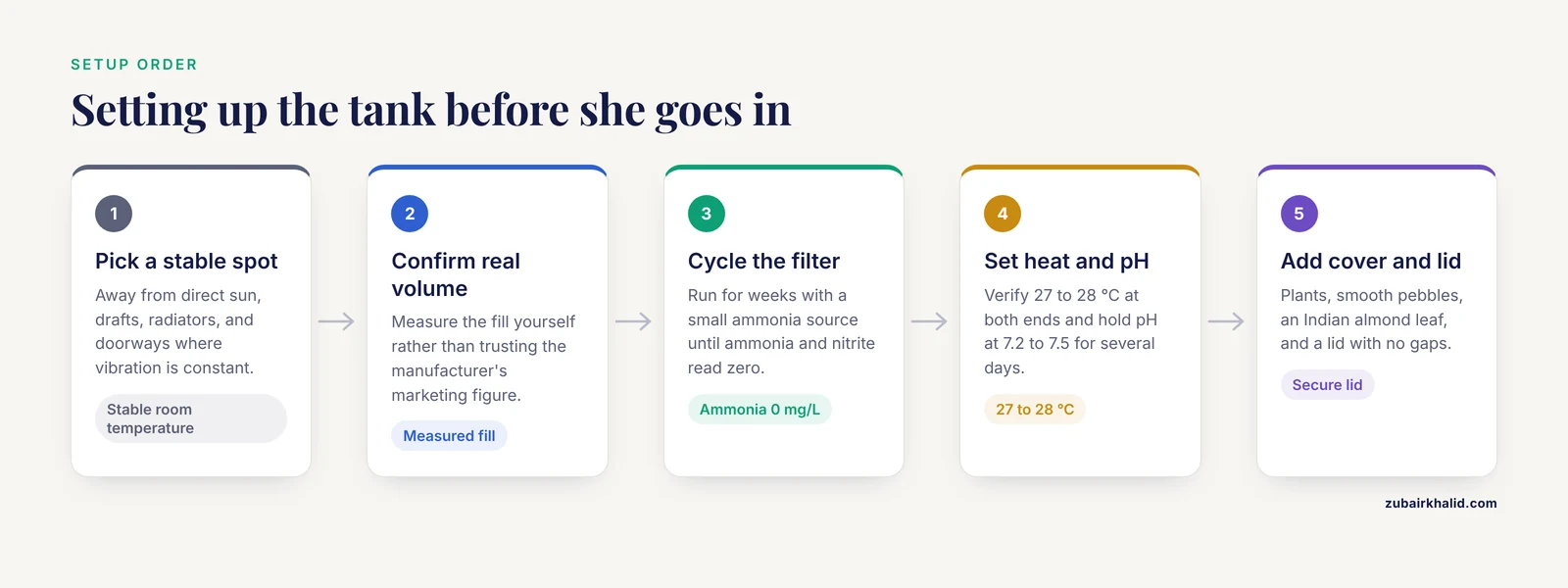
- Choose a location away from direct sun, drafts, radiators, and doorways where vibration is constant. Stable room temperature reduces heater workload.
- Confirm the tank volume with a measured fill rather than the manufacturer's marketing figure.
- Rinse substrate and decor with water only, never soap.
- Install the filter and heater, then fill the tank and start the filter running.
- Cycle the tank before adding the fish. Run the filter for weeks, feed the cycle with a small ammonia source, and test until ammonia and nitrite read zero. The target that matters is the documented ammonia value of 0 mg/L [2].
- Set the heater and verify temperature at both ends of the tank with a separate thermometer, targeting 27 to 28 °C [2].
- Adjust pH into the 7.2 to 7.5 range and confirm it holds for several days.
- Add plants, smooth pebbles, and an Indian almond leaf, and confirm the lid fits with no gaps [2].
- Float the bag to equalize temperature, then release the fish, keeping the tank lights off for the first few hours.
- Test ammonia daily for the first two weeks and note appetite and behavior at each feeding.
Water Quality and Maintenance Routine
A female betta tank is a small, warm, closed system, and small systems drift fast. Set a routine you will actually follow.
- Test ammonia at least weekly, and after any death, medication, filter cleaning, or overfeeding event. The target is 0 mg/L.
- Test pH and temperature at the same time and record them. A pH that drifts out of the 7.2 to 7.5 band signals a problem with buffering or with accumulated waste.
- Replace a portion of the water on a regular schedule and match the replacement water temperature to the tank. Sudden temperature shifts in either direction stress a betta.
- Clean filter media gently, in tank water rather than under the tap, and never replace all the biological media at once.
- Remove uneaten food. Decomposing food is the fastest route to an ammonia spike.
- Keep a written log. A log turns "she seems off" into a timeline you can hand to a veterinarian.
Housing Options: Solitary, Sorority, or Community
A single female in her own tank
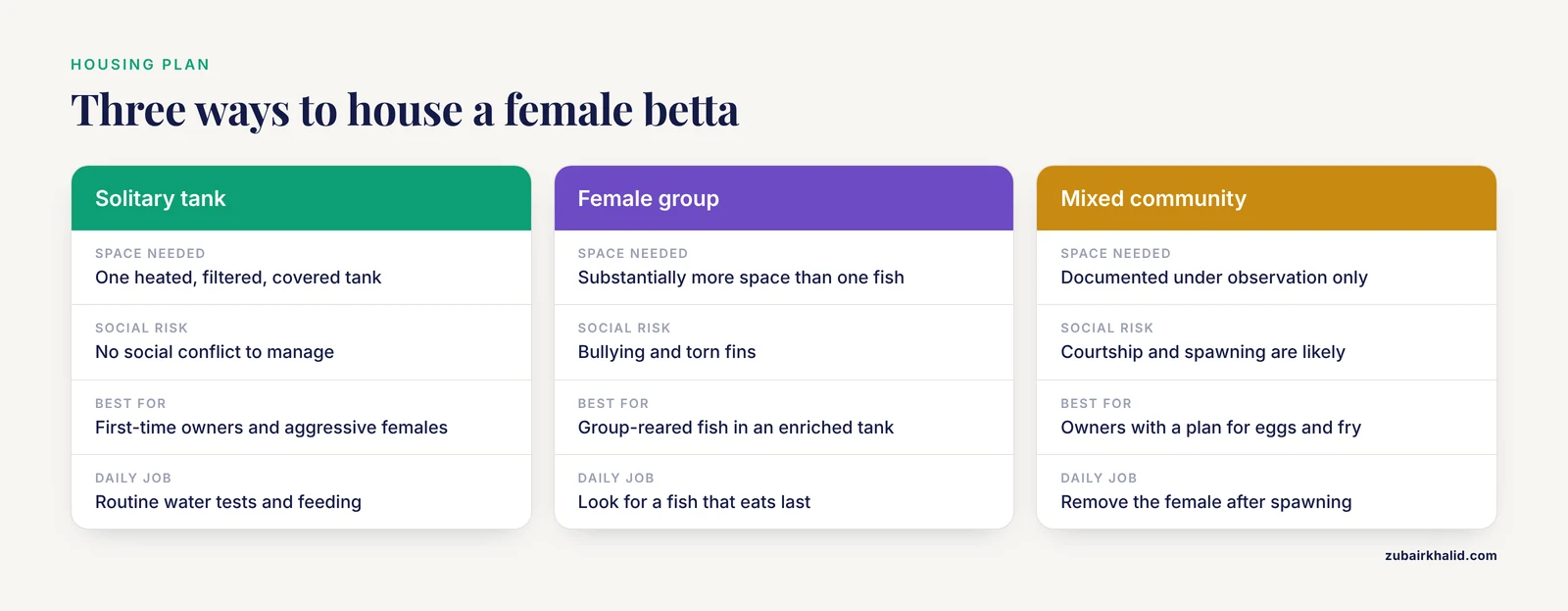
This is the most reliable plan. One female, one well-planted, heated, filtered, covered tank, and no social conflict to manage. It suits a first-time owner, a fish with a history of aggression, and any female you cannot observe closely every day.
A female-only group, often called a sorority
Group housing of females is possible, and the research base is more encouraging than hobby folklore suggests, with conditions. Adults raised in groups in an enriched environment showed lower aggression and could be housed in groups [3]. A stable community of adult male and female Siamese fighting fish has also been documented, which shows that stable social housing is achievable in principle.
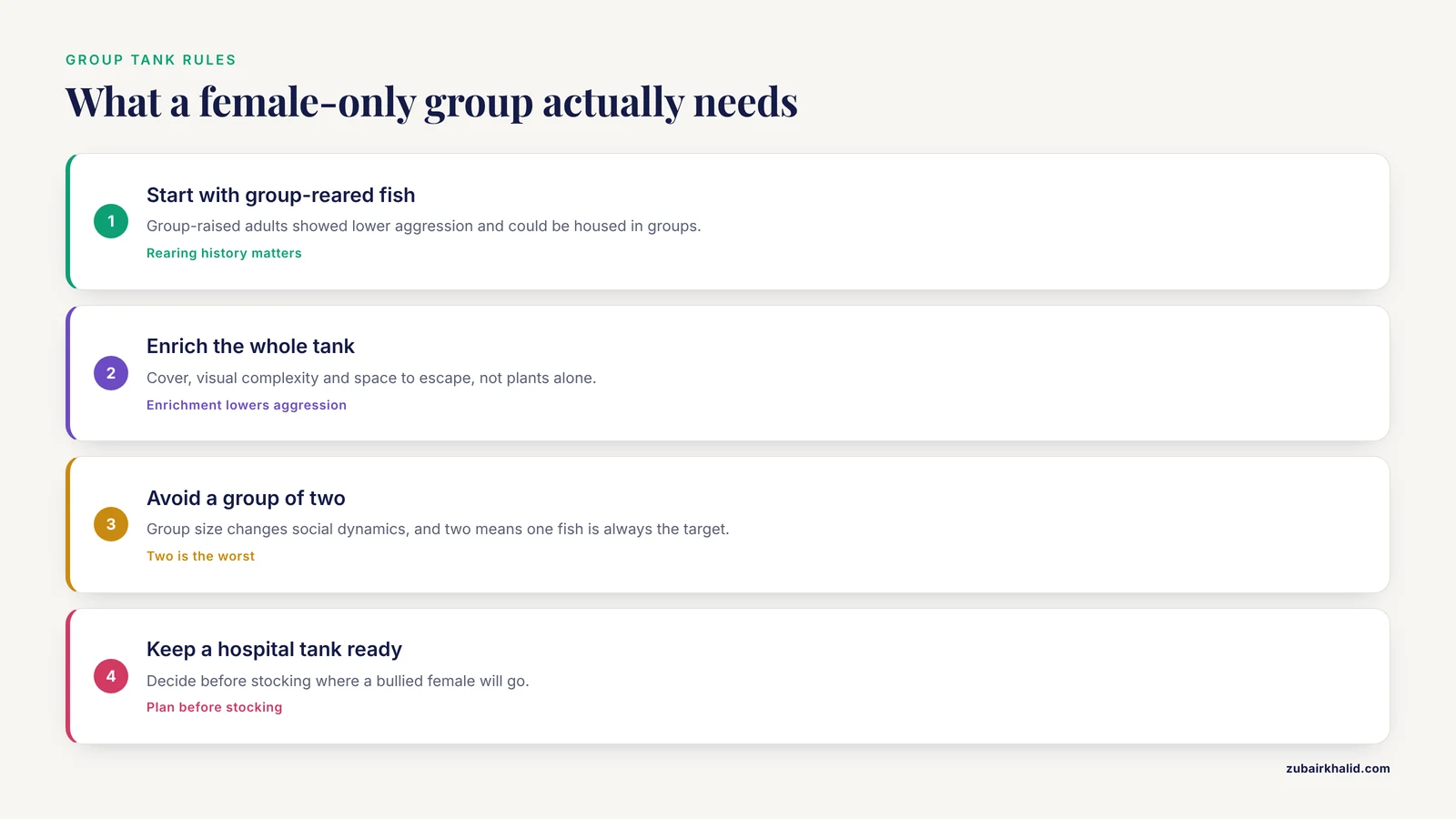
What a female-only group requires:
- Group-reared or group-acclimated fish where possible. Rearing conditions change adult aggression levels [3].
- An enriched tank. Environmental enrichment reduced aggression in the study, and enrichment is not just plants. It is cover, visual complexity, and space to escape.
- Enough group size to diffuse aggression. Group size altered social partner preferences in females [10], and a group of two is the worst of all options because one fish is always the target.
- Visual breaks. Dense planting and hardscape that break sight lines across the tank.
- A daily observation habit. Look for a fish that stays in one corner, eats last, or has torn fins. Those are the fish to remove.
- A ready hospital or solitary tank. Decide before stocking where a bullied female goes.
Aggression in females is real, measurable, and in fighter lines it can exceed wild-type levels [1]. A sorority is a managed social system, not a peaceful one.
Mixed-sex and community tanks
Mixed housing has been documented under observation, but it carries two risks. First, a male's preference for conspecific females is strong [12], so pairing and courtship are likely. Second, spawning is likely, and in the documented breeding protocol the female was removed immediately after spawning [2]. An owner who puts a male and a female together without that plan ends up with eggs, fry, and an exhausted female.
Community tanks with non-betta tank mates introduce another kind of risk. A female betta is a bold, food-motivated fish [9], and long-finned tank mates and slow-moving species are easy targets. Choose tank mates by adult size, swimming level, and temperament, and treat the betta as the territorial center of the tank rather than as a background fish.
Why the betta cup is not a tank
A fish sold in a small cup is in temporary holding, not housing. Any container that cannot hold a heater, a filter, and a lid cannot deliver the documented conditions of 27 to 28 °C, ammonia 0 mg/L, and stable pH [2]. The purchase price of a proper tank is the real cost of keeping the fish.
Feeding Female Bettas
Betta splendens is carnivorous, and Proteobacteria dominate the gut bacterial community of healthy, carnivorous bettas across age groups [4]. In controlled culture work, fish were fed Moina macrocopa [4], and a breeding protocol conditioned a pair for 10 days on high-quality Artemia before spawning [2]. Live and frozen invertebrates therefore match the biology far better than a plant-based flake staple.
Practical feeding rules:
- Feed small amounts and watch the fish eat. A female that refuses food is your earliest health signal.
- Vary the diet across live, frozen, and quality prepared foods, and remove anything uneaten.
- Do not feed immediately after a water change or a tank move, when appetite is naturally suppressed.
- Watch body condition weekly. A female carrying eggs has a fuller abdomen, and a swollen abdomen that persists without eggs is a reason to call a veterinarian.
Plant compounds in the diet are a common worry. In mature female bettas, the phytoestrogens β-sitosterol and genistein did not significantly alter steroid levels or gonad development, and only a pharmacologic dose of β-sitosterol affected opercular flaring behavior [15]. The study's own conclusion was that phytoestrogen effects may be less acute in mature female Betta splendens than in other fish species [15]. That places soy content well below water quality and temperature on the list of things that actually matter.
Enrichment and Behavioral Welfare
A female betta with nothing to look at and nothing to do is a stressed fish in a bare tank. Behavioral welfare rests on three practical levers.
Environmental complexity. Enrichment during rearing lowered adult aggression in both sexes [3]. Apply the same logic to the adult tank: plants, leaf litter, shaded corners, and open swimming space in the middle.
Visual variety without chronic confrontation. Females will work for visual access to a reinforcer [13], which tells you they find visual events interesting. Use that selectively. Brief, supervised views of a mirror or a neighboring fish can be stimulating. A permanent glass-to-glass view of another betta is a permanent territorial threat.
Predictable routine. Feed at the same times, keep the light schedule steady, and do maintenance on a schedule. Predictability is welfare.
Recognizing a Healthy Female and Spotting Trouble Early
A healthy female betta is alert, eats eagerly, holds her fins up rather than clamped, breathes at a steady rate, and patrols the tank. She may flare at her reflection and she may be first to the food.
Signs that warrant action:
- Refusing food for more than a day or two
- Hovering at the surface and gulping repeatedly
- Clamped fins held close to the body
- Lethargy or resting on the bottom
- Torn fins, missing scales, or bite marks
- A swollen abdomen that does not resolve
- Buoyancy problems, including floating nose-down or sinking
- Dull or patchy color in a fish that was previously bright
Two background points are worth telling your veterinarian. Blood cell morphology and hematology differ between male and female Siamese fighting fish, so sex belongs in the clinical history [16]. And the gut bacterial community of bettas shifts with age, with Pseudomonas dominating in young fish and Plesiomonas enriched in adult males at 24 weeks [4], which is one reason abrupt diet changes can unsettle digestion.
Contaminants, Medications, and Water Source
Female betta behavior is sensitive enough that sublethal exposures show up as personality change rather than obvious disease. That is a useful thing to know when a fish "just seems different."
- Arsenic. A 96-hour exposure to 100 µg/L arsenic caused female bettas to lose their preference for red males and increased anxiety-like behavior. Anxiety and color preference were negatively correlated, and the increase in anxiety-like behavior occurred without a rise in cortisol [5]. Behavior changed without a measurable stress hormone signature.
- Fluoxetine. Fluoxetine exposure altered boldness in female Siamese fighting fish [17] and altered reproductive performance in female fighting fish. Male aggression studies use females as a priming stimulus precisely because male courtship and aggression are linked [18].
- Ethinylestradiol. Exposure to 17α-ethinylestradiol disrupted the audience effect on male-female interactions [14].
For owners, the practical conclusions are simple. Know what is in your source water, use a water conditioner appropriate to your municipal supply, never flush unused medications, and never treat a tank with a drug unless a veterinarian has examined the fish and prescribed it.
Common Mistakes
- Buying a bowl. A bowl cannot hold a heater, filter, and lid, so it cannot deliver stable temperature or zero ammonia [2].
- Skipping the heater. Room temperature is not 27 to 28 °C in most homes.
- No lid. A secure top cover is part of the documented setup [2].
- Assuming females are peaceful. Fighter-line females can be more aggressive than wild-type females [1].
- A sorority of two or three in a small tank. Group size changes social dynamics [10], and small groups in small volumes concentrate aggression.
- Adding a male "for company." Males strongly prefer conspecific females [12], and spawning follows.
- Stocking before the filter is cycled. Ammonia must read 0 mg/L.
- Treating the tank instead of diagnosing the fish. Fluoxetine and estrogenic compounds measurably change female betta behavior [17][14], which is exactly why medications belong under veterinary direction.
- Ignoring behavior change because the fish looks fine. Anxiety-like behavior changed in arsenic-exposed females without a cortisol rise [5]. Behavior is data.
Limitations and When to Contact a Veterinarian
This article describes general care and the biology behind it. Individual fish differ, and a veterinarian who can examine your fish, review your water test results, and take a history is the only reliable source of diagnosis.
Contact a veterinarian or an aquatic animal health professional promptly if you see any of the following:
- No food intake for more than 48 hours
- Labored breathing, gasping at the surface, or hanging at the surface continuously
- Rapidly worsening fin damage, wounds, or bite marks from a tank mate
- Abdominal swelling that persists or grows
- Loss of buoyancy control, listing, or inability to stay upright
- Any confirmed ammonia or nitrite reading above zero that persists after a water change [2]
- A sudden change in behavior or color that lasts more than a few days [5]
If more than one fish in a group tank is affected, treat it as a system problem first. Test the water, check the heater, check the filter, and then call.
Related Guides
- Betta Fish Natural Habitat and Behavior: Beyond the Bowl: Explains wild behavior and why natural conditions matter
- Common Betta Fish Diseases and How to Treat Them: Helps identify and treat common betta illnesses early
- How Long Do Betta Fish Live? A Lifespan Guide: Sets realistic lifespan expectations for long-term care planning
- Senior Betta Fish Care: Aging Signs, Diet, and Comfort: Covers aging signs and comfort care for older females
- Betta Fish Care: Fin rot bacterial infection treatment protocol: Details fin rot treatment if abrasions become infected
- Betta Fish Care: Ich white spot disease treatment protocol: Useful if white spots or rapid illness appear
- Betta Fish and Shrimp: Tank Mates or Snacks?: Explains whether shrimp are safe community tank mates
- 10 Gallon Fish Tank: Best Fish, Stocking Ideas, and Setup: Helps size a larger tank for a female group
Frequently Asked Questions
Can female betta fish live together?
Yes, but only in a carefully managed group tank with enough space, dense visual cover, and daily observation. Group-raised fish in an enriched environment showed lower aggression and could be housed in groups [3], and stable mixed communities have been documented. A group of two is the riskiest configuration.
What size tank does a female betta need?
A single female needs a tank large enough to hold a heater, filter, lid, and thermometer with stable water. A documented breeding system used a 22.26 L aquarium for a pair [2]. Go larger for a group.
Do female bettas need a heater?
Yes. The documented temperature range for Betta splendens is 27 to 28 °C (80.6 to 82.4 °F), which is above typical room temperature [2].
Do female bettas build bubble nests?
Some do, and a large nest from a fish sold as female is worth noting. Sex determination in this species is female-homogametic, and androgen exposure can masculinize genetic females [7]. Testosterone manipulation and social conditions have also been linked to sex reversal in females [8].
What should I feed a female betta?
Feed a carnivorous diet built on live and frozen invertebrates. Moina macrocopa and Artemia appear in documented culture protocols [2][4]. Vary the diet and remove uneaten food.
How do I tell if a female betta is stressed?
Look at behavior first: appetite loss, clamped fins, surface hovering, hiding, and a sudden change in boldness. Behavioral shifts can precede any measurable stress hormone change [5].
Are female bettas less aggressive than males?
Usually, but not reliably. Females from a line selected for fighting were more aggressive than wild-type females, and aggression correlated across male and female siblings [1].
Can a female betta live with a male?
Only with a plan. Stable mixed communities have been documented, but males strongly prefer conspecific females [12] and spawning is likely. In the documented breeding protocol the female was removed immediately after spawning [2].
Sources
- Artificial selection for male winners in the Siamese fighting fish Betta splendens correlates with high female aggression
- Small-Scale Breeding and Early Fry Culture of Betta splendens Using Artemia Nauplii: A Case Study from Government Arts & Science College (A), Kamareddy, Telangana, India
- Timing of isolation from an enriched environment determines the level of aggressive behavior and sexual maturity in Siamese fighting fish (Betta splendens)
- Siamese Fighting Fish (Betta splendens Regan) Gut Microbiota Associated with Age and Gender
- Ecologically relevant arsenic exposure alters female mate preference and anxiety-like behavior in Betta splendens
- Care and Use of Siamese Fighting Fish (Betta splendens) for Research.
- Masculinization of fighting fish, Betta splendens Regan, using synthetic or natural androgens
- Sex reversal in female Betta splendens as a function of testosterone manipulation and social influence.
- Individual differences guide mate choice in the fighting fish (Betta splendens).
- The effect of body coloration and group size on social partner preferences in female fighting fish (Betta splendens).
- Social partner preferences of male and female fighting fish (Betta splendens).
- Male preference for conspecific mates is stronger than females' in Betta splendens.
- Visual reinforcement in the female Siamese fighting fish, Betta splendens.
- Acute exposure to 17α-ethinylestradiol disrupts audience effect on male-female interactions in Betta splendens.
- Phytoestrogens β-Sitosterol and Genistein Have Limited Effects on Reproductive Endpoints in a Female Fish, Betta splendens
- Haematology, morphology and blood cells characteristics of male and female Siamese fighting fish (Betta splendens)
- Fluoxetine exposure impacts boldness in female Siamese fighting fish, Betta splendens
- Fins of Fury or Fainéant: Fluoxetine impacts the aggressive behavior of fighting fish (Betta splendens).