Betta Fish Enrichment Ideas That Match Natural Behavior
By Dr. Zubair Khalid, DVM, MS, PhD ·
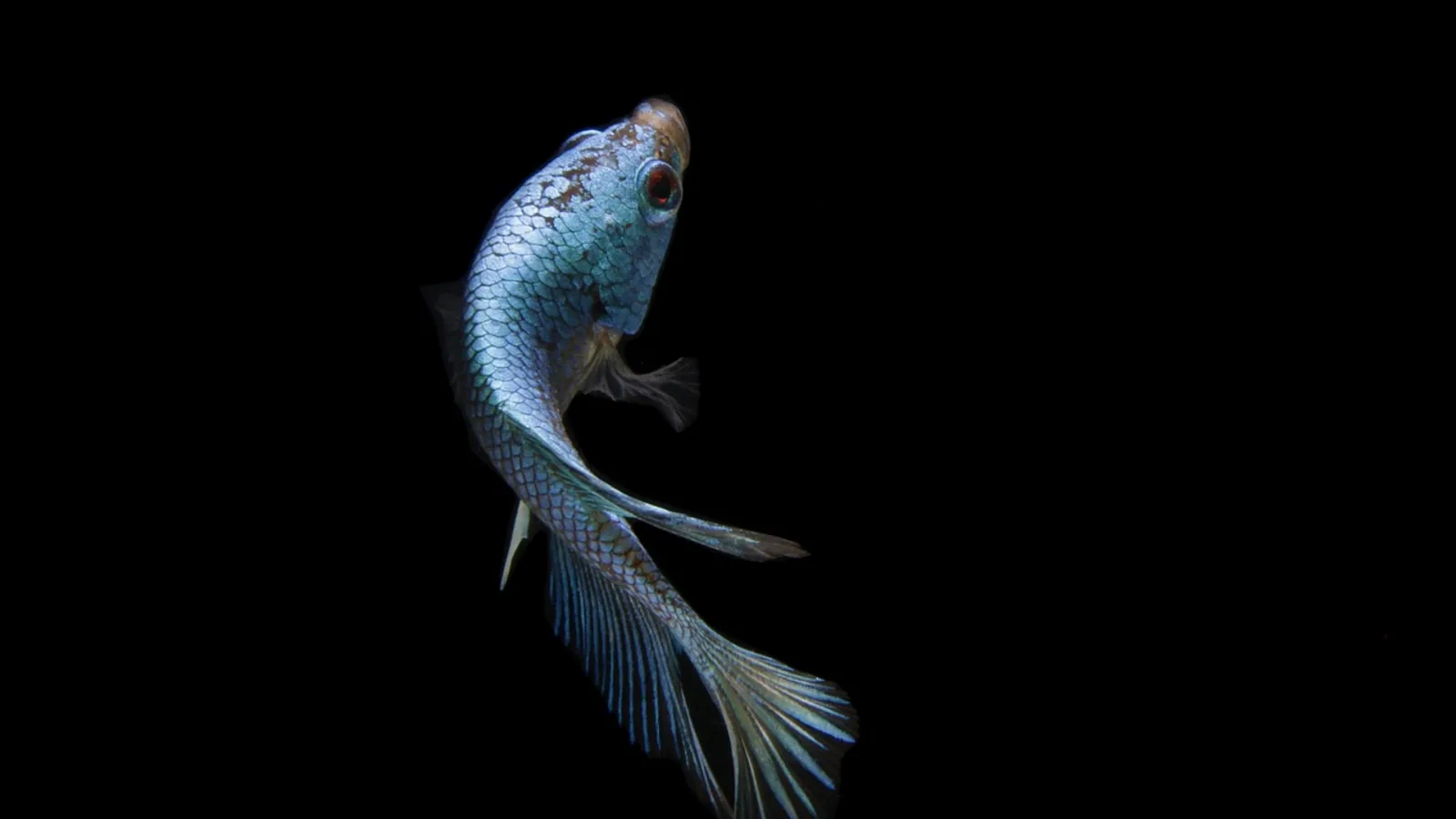
The most effective betta fish enrichment ideas come down to four things: enough space to swim, dense plant cover, a layout that encourages exploring and foraging, and a calm visual environment built around green tones rather than red. Research on Siamese fighting fish (Betta splendens) shows that fish kept in bare, tiny containers swim far less than fish given room and structure, and that the small fishbowls still sold in many pet stores actively suppress normal swimming behavior [1]. Enrichment is not decoration. It is the difference between a fish that spends its day patrolling, resting, and foraging and a fish that sits motionless in a corner of a half-gallon bowl.
This guide translates the published research into a practical plan. You will learn what enrichment actually means for this species, how to recognize a bored or understimulated betta, which items earn their place in the tank, and how to build simple DIY enrichment that matches natural behavior instead of fighting it.
This article is educational and is not a substitute for veterinary diagnosis or treatment.
At a Glance: Betta Enrichment Checklist
Use this table as a starting checklist. Every item can be put in place within a week, most within a single afternoon.
| Enrichment item | Behavior it supports | How to start today |
|---|---|---|
| Tank of at least 10 liters (about 2.6 gallons), larger if possible | Full expression of swimming behavior | Upgrade out of any bowl or container under 10 L [1] |
| Live aquatic plants such as Egeria densa (Elodea) | Cover-seeking, exploring, resting among leaves | Add a bunch of hardy live plants to the midground and background [2] |
| Gravel substrate and large rocks | Swimming, exploring, cover from sightlines | Add a rinsed gravel bed and two or three large, smooth rocks [1] |
| Green-toned background or surroundings | Preference, relaxed use of the whole tank | Attach a green background or place the tank near green decor [3] |
| Avoid red visual environments | Avoidance behavior, better feed intake in preferred colors | Swap red gravel, backgrounds, or lighting for green or neutral tones [3] |
| Varied layout with sightline breaks | Foraging, patrolling, reduced tension in multi-fish settings | Rearrange decor monthly and create visual barriers |
| Larger horizontal space if keeping any fish in groups | More foraging, fewer aggressive displays | Size up from a 10 L to a 38 L or larger footprint before considering groups [1] |
Why Enrichment Matters for Betta Fish
Betta splendens became a household pet because males can be housed alone in tiny volumes without immediate harm. That convenience shaped an entire retail industry of fishbowls and vases, and it also created a welfare problem. A peer-reviewed behavioral study published in Animal Welfare recorded individual male bettas in containers ranging from 0.5 L bowls to 208 L aquaria, both bare and enriched with gravel, large rocks, and live plants. The fish in 0.5 L bowls spent less time swimming than fish in the 10, 38, and 208 L tanks. Fish in enriched containers, regardless of size, showed more instances of swimming than fish in bare containers. The authors concluded that a minimum of a 10 L aquarium is needed for bettas to show their full range of swimming behavior [1].
Swimming is not trivial for a fish. Reduced voluntary swimming means reduced exploration, reduced foraging, and reduced expression of the activity patterns a healthy betta displays. A fish that never swims is not calm. It is restricted.
Stress research adds another layer. A study on juvenile bettas reared individually in very small confinement volumes found molecular stress responses, including changes in stress-related gene expression in the first days of confinement, even though standard blood measures looked normal. The authors noted that confinement produces a transient molecular stress response and that mitigation strategies can reduce it [4]. The practical takeaway for owners is simple. Small, bare, unchanging environments are not neutral for this species. They are measurable stressors, and enrichment is the corrective.
Enrichment also matters when more than one fish is present. In the same behavioral study, pairs of male bettas in larger aquaria showed fewer approaches and aggressive displays and more foraging bouts than pairs in smaller tanks, although attacks were not eliminated [1]. Space and structure change behavior in ways you can observe.
The Foundation: Space Before Toys
The best toy for a betta fish is a tank that allows normal movement. Before spending a dollar on decorations, confirm the enclosure itself meets the behavioral floor described in the research.
A 10 L aquarium is the documented minimum for full swimming expression [1]. Ten liters converts to roughly 2.6 US gallons, so a standard five-gallon tank falls slightly short of that threshold while a ten-gallon tank comfortably exceeds it. When you can, go larger. The study compared 10, 38, and 208 L volumes and found the behavioral differences between small and large containers directly, with fish in small containers swimming less [1].
Horizontal footprint matters as much as volume. Bettas are surface-oriented fish that patrol along plant edges and across open lanes. A long, shallow tank gives more usable swimming distance per liter than a tall, narrow column of the same volume. When you plan your layout, think in terms of a route the fish can swim, not a display case.
One caution deserves its own paragraph here. Some owners see the finding that larger tanks reduced aggression between paired males and conclude that two males can coexist with enough space. The study does not support that conclusion. Attacks persisted even in the largest enclosures tested, which is why males of this species should not be housed together, a point also reflected in standard husbandry guidance for this species [1]. Enrichment improves welfare within appropriate housing. It does not override the species' territorial biology.
Signs of a Bored Betta Fish
The clearest sign documented in controlled research is reduced swimming. Fish in small, bare containers spent measurably less time swimming than fish in larger, enriched environments [1]. In a home aquarium, the same pattern shows up as a fish that hovers in one spot, rarely crosses the tank, and shows little interest when you approach.
Watch for these practical indicators during a normal week:
- Little to no voluntary movement across the tank during the day.
- No visible foraging or searching behavior at feeding time beyond snapping at food that lands directly in front of the fish.
- Positioning that never changes, day after day, in the same corner or behind the same filter.
- No reaction to rearranged decor or newly introduced objects.
- A fish that only moves to surface for air, which bettas do naturally, and otherwise stays still.
Because bettas are also prone to several illnesses that cause lethargy, treat any sudden change from active to inactive as a health question first, not an entertainment question. A lethargic betta with clamped fins, appetite loss, or visible lesions needs an aquatic veterinarian, not a new ornament. The World Aquatic Veterinary Medical Association and the Merck Veterinary Manual both maintain pet fish resources that can help you locate qualified fish health support.
Best Toys and Enrichment Items for Betta Fish
"Toys" for fish are best understood as functional structures. An item earns its place if it supports one of the behaviors documented for this species: swimming, foraging, cover-seeking, or resting. Here is how the main categories stack up against the evidence.
Live Plants and Natural Cover
Live plants are the strongest-evidence enrichment item for this species. In a choice study, adult bettas of both sexes were offered compartments containing natural Egeria densa (Elodea), artificial Elodea, a plain white environment, and a plain green environment. Both sexes showed a gradation of preference across the compartments, and both demonstrated a clear preference for environments with natural plants over the alternatives [2].
That preference has practical weight. Fish in the study used their chosen environment when given the option, which tells you that natural plant cover is something the fish works to obtain, not just background scenery [2]. Egeria densa is also a beginner-friendly plant that grows readily under standard aquarium lighting, making it an easy first choice for a betta tank.
A second finding from the same research team is worth knowing. When female bettas were housed with the plant enrichments over a longer performance trial, the enrichments did not change standard performance measures such as growth [2]. The correct interpretation is not that plants do nothing. It is that the behavioral preference for plants exists independent of production outcomes, which is exactly what you expect when an animal values an environment for its own sake.
Plan for three kinds of plant structure: tall plants along the back and sides for edge-patrolling, mid-level plants for cover, and floating or surface plants for the shaded resting spots bettas naturally seek. Leave open swimming lanes between them.
Rocks, Gravel, and Hardscape
The behavioral study that established the space findings used gravel, large rocks, and live plants as its enrichment package, and fish with those additions swam more than fish in bare containers [1]. Gravel substrate gives the tank a floor the fish can explore and supports rooted plants. Large, smooth rocks create sightline breaks, which reduce constant visual contact between tankmates in any multi-fish setup and give a single betta a richer territory to patrol.
Selection criteria are straightforward. Choose aquarium-safe stone with smooth edges, rinse thoroughly before use, and avoid sharp rock formations near the surface where bettas rest. Skip painted or glitter-covered ornaments of unknown origin, since their coatings are not something the fish chooses and their safety is not something you can verify.
Feeding Enrichment and Foraging
Foraging is a natural behavior for this species, and it responds directly to environment. Pairs of male bettas in larger aquaria performed more bouts of foraging than pairs in smaller tanks [1]. You can encourage foraging by varying where and how food appears rather than always dropping it in the same open spot. Scatter a portion of the food across the surface on one day, place some near a plant cluster on another, and let the fish search.
Environmental conditions also affect appetite directly. Juvenile bettas reared in their preferred environmental color ate more feed over a 56-day trial than fish in other conditions, which links the visual environment to one of the most basic welfare indicators, consistent feeding behavior [3]. If your betta eats well and searches for food, your enrichment is working at the level that matters most.
Visual Enrichment: Background Color
This is the enrichment category most owners have never considered. In a two-part study, bettas of both sexes were offered environments in red, blue, yellow, green, and white. They spent more time in the green environment and avoided the red environment, regardless of sex. In the follow-up trial, rearing juveniles in their preferred color increased feed intake [3].
For a home aquarium, this translates into concrete choices. A green background, green-adjacent decor, and planting-heavy aquascapes align with the documented preference. Red gravel, red backdrops, and intense red lighting work against it. If your betta currently sits in a red-themed tank and rarely moves, the color of the environment is a variable you can change in ten minutes, and it is one of the few enrichment factors with feed-intake data behind it [3].
Mirrors deserve a brief, honest note. Flaring at a mirror is an aggressive display, and aggressive displays are the behavior pattern this species shows toward rival males [1]. Because repeatedly triggering territorial display behavior is an individual welfare question rather than an established daily enrichment practice, treat mirrors as something to discuss with an aquatic veterinarian before making them part of a routine.
How to Keep a Betta Fish Entertained: A Step-by-Step Setup
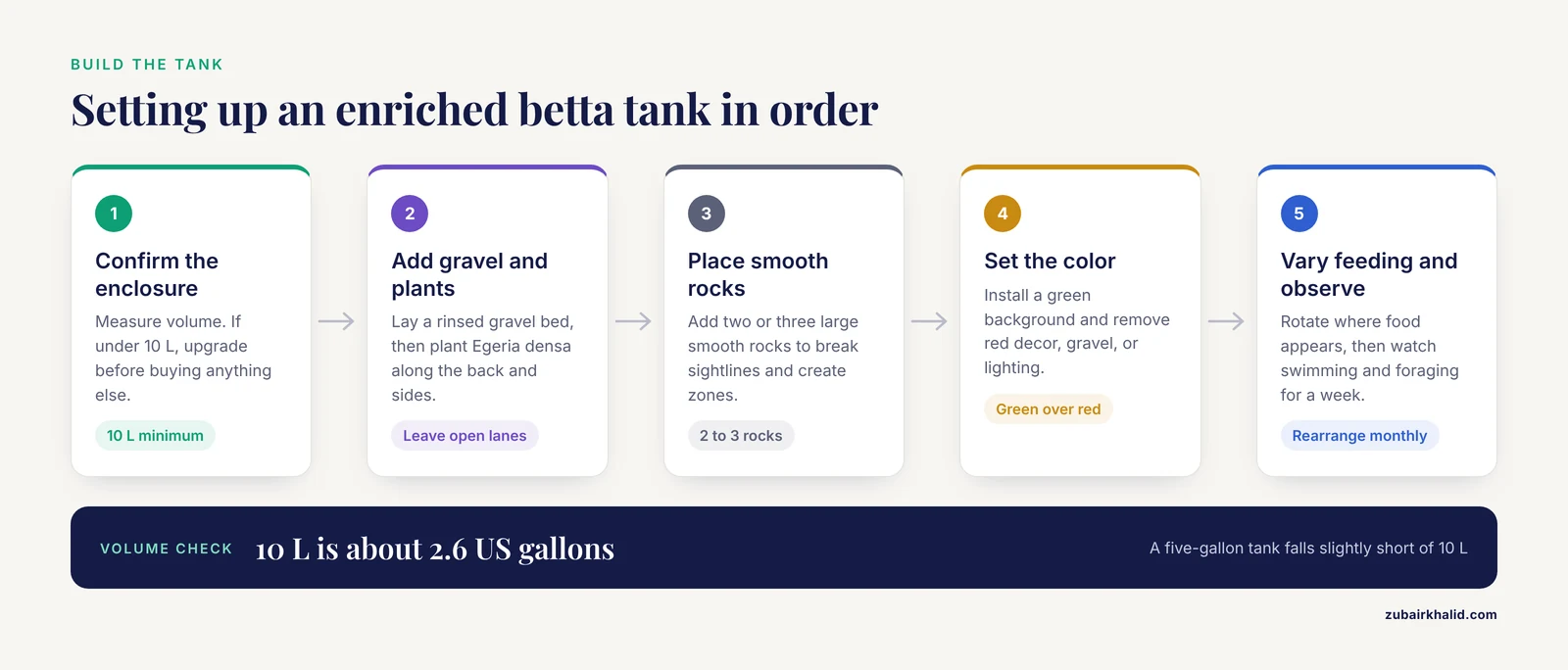
Here is a practical sequence for building an enriched tank from scratch, or for upgrading a tank that already holds a bored fish.
- Confirm the enclosure. Measure your tank volume. If it is under 10 L (under about 2.6 gallons), upgrade first. Nothing else on this list compensates for insufficient space.
- Add substrate. Lay a rinsed gravel bed across the bottom. This completes the enriched-condition package the research used and anchors live plants [1].
- Plant the background and edges. Place hardy plants such as Egeria densa along the back and sides, leaving the front third and at least one open swimming lane [2].
- Position hardscape. Add two or three large, smooth rocks to break sightlines and create distinct zones within the tank [1].
- Set the visual environment. Install a green background or position the tank against green-toned surroundings. Remove or replace red decor and lighting.
- Vary the feeding routine. Rotate where food appears so the fish searches rather than waits at a fixed spot.
- Observe for a week. You are looking for more time spent swimming, more surface and mid-level use, and active foraging. These are the same behavioral measures the research used to judge environment quality [1].
- Rearrange monthly. A modest decor reshuffle once a month gives a patrolling fish a new territory to map without destabilizing the tank.
DIY Betta Fish Enrichment
DIY betta fish enrichment does not require specialty products. The enrichment in the published studies consisted of gravel, large rocks, and live plants, which are among the cheapest items in the fishkeeping aisle [1]. Build your DIY plan around functions the fish actually performs.
The planted edge. Anchor bunches of live plants in clusters along the back wall, spacing them so the fish can weave between stems. If a bunch grows faster than expected, divide it and replant half elsewhere to create a second edge zone.
The rock territory. Arrange two or three large smooth stones so they form a partial wall. Leave gaps the fish can swim through. A partial wall creates a hidden zone behind it and a patrol route around it, both of which give the fish decisions to make.
The forage map. Keep a simple rotation in your head or on your phone: surface scatter on Monday, plant-cluster placement on Wednesday, open-lane placement on Friday. The goal is to make food something the fish locates, using the foraging behavior the research documented [1].
The color swap. Cut a green matte background to size, or repaint the back exterior of the tank with aquarium-safe exterior paint applied to the outside glass. If the current background is red, this single change addresses a documented avoidance response [3].
The rearrangement ritual. Once a month, shift one rock and one plant cluster. Do not strip the tank, since removing all cover at once removes the security the fish relies on. Move a small fraction, let the fish re-map its territory, and watch it patrol.
Every DIY item should pass the same three checks before it goes in the water: no sharp edges, no coatings or glues not rated for aquarium use, and no structure so dense that the fish cannot reach the surface to breathe air, which bettas do naturally.
Common Mistakes to Avoid
- Keeping a betta in a bowl. Small fishbowls suppress swimming behavior in this species. The research compared 0.5 L bowls directly with proper aquaria and found the behavioral cost clearly [1].
- Building a bare minimal tank. Some owners mistake an empty tank for easy maintenance. Fish in enriched containers swam more than fish in bare ones, even at the same volume [1].
- Stopping at the minimum size. Ten liters is a floor, not a target. Behavioral measures continued to differ across the larger volumes tested [1].
- Assuming two males can share a large tank. Larger enclosures reduced approaches and displays between paired males but did not stop attacks [1].
- Ignoring color. Red environments were actively avoided by bettas in controlled choice tests [3]. A red-heavy aquascape is working against the fish.
- Choosing artificial plants over natural ones when both are possible. Bettas of both sexes preferred natural plants when given the choice [2].
- Confusing boredom with illness. Reduced activity can signal disease. Rule out health problems before concluding the fish simply needs more entertainment.
Welfare and Safety Points
Enrichment changes the tank environment, and every change carries basic safety obligations. Rinse all substrate and hardscape before introduction. Quarantine new plants if you source them from tanks with unknown health status. Keep water conditions stable, because an enriched environment built on unstable water helps nothing. Maintain surface access at all times so the fish can breathe air at the surface. And remember that welfare encompasses the whole enclosure. The confinement study showed that even short periods in very small volumes produced molecular stress responses in this species, which is a useful fact for transport days and temporary holding situations as well as for permanent housing decisions [4].
For general fish health standards, the AVMA maintains aquatic animal health guidance and pet-owner resources, and the World Aquatic Veterinary Medical Association provides directories for locating fish veterinarians. If you plan a major husbandry change for a fish with existing health problems, review the plan with a qualified aquatic veterinarian first.
Limitations and When to Contact a Veterinarian
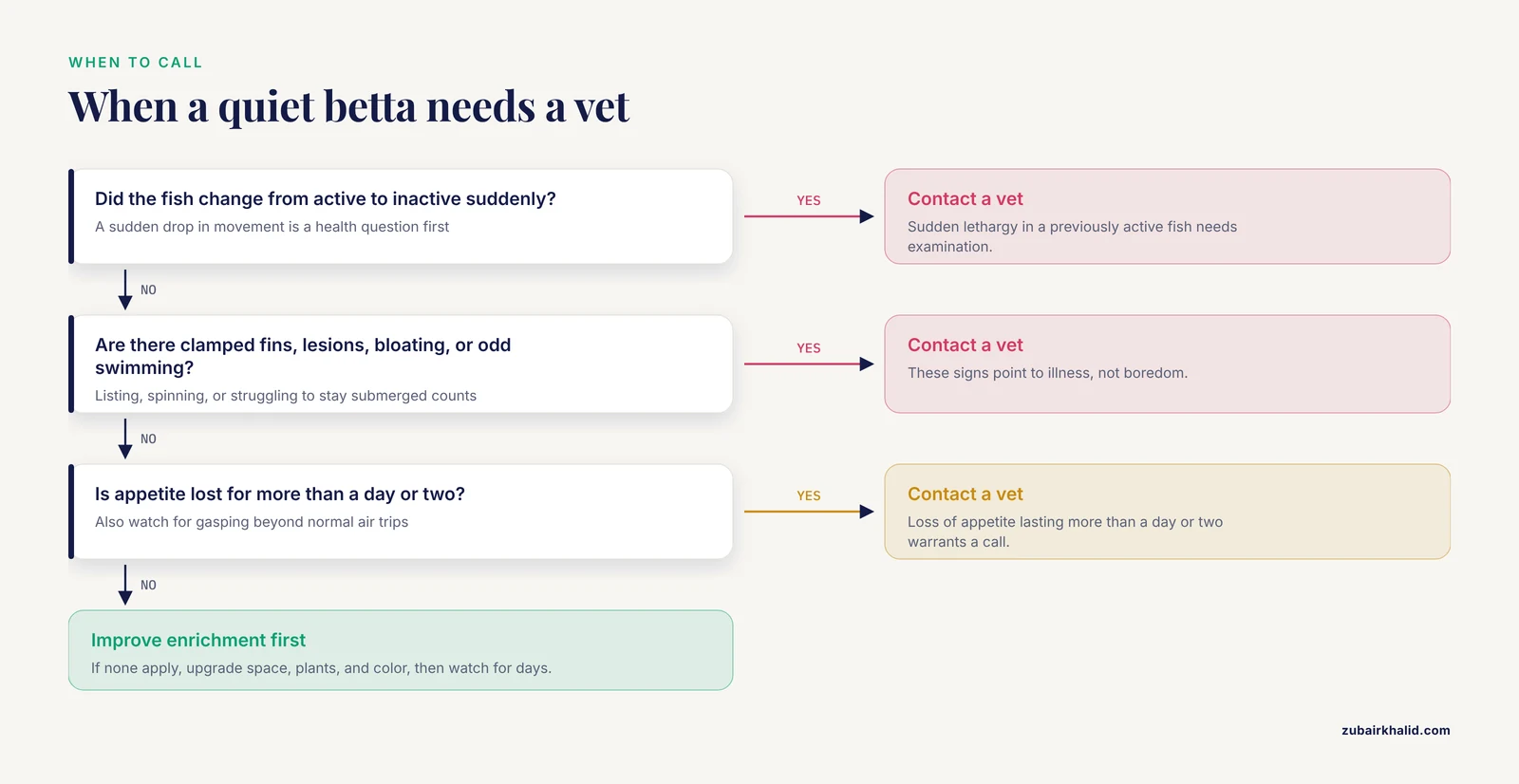
Individual cases need a veterinarian, and the studies summarized here describe group averages, not guarantees for any single fish. Contact a veterinarian promptly, ideally one with aquatic experience, if you observe any of the following:
- Loss of appetite lasting more than a day or two.
- Clamped fins, frayed fins, visible lesions, bloating, or abnormal swimming such as listing, spinning, or struggling to stay submerged.
- Sudden lethargy in a previously active fish.
- Rapid gill movement or gasping at the surface beyond the fish's normal air-breathing trips.
- Signs of aggression or injury between any tankmates.
- Any behavior change that does not resolve within days of an enrichment or environment improvement.
These escalation criteria matter because the same outward sign, reduced movement, can indicate either an understimulating environment or systemic disease, and only an examination can distinguish the two.
Frequently Asked Questions
How big should a betta fish tank be?
At least 10 liters, which is about 2.6 US gallons, based on the volume at which bettas show their full swimming behavior in controlled comparisons. Larger volumes showed continued behavioral benefits in the same research [1].
What are the best toys for betta fish?
The best items are functional structures: live plants for cover, smooth rocks and gravel for exploration and sightline breaks, and varied feeding placement to encourage foraging. These are the enrichment categories supported by published behavioral research on the species [1], [2].
Do betta fish get bored?
Bettas show measurable behavioral suppression, specifically reduced swimming, in small bare containers compared with larger enriched ones, which is the research-based basis for describing fish in those conditions as under-stimulated [1].
What color environment do bettas prefer?
Bettas of both sexes preferred green environments and avoided red ones in choice testing, and fish reared in their preferred color ate more feed [3].
Are live plants better than artificial plants for bettas?
Yes, on preference. Adult bettas of both sexes chose environments with natural plants, such as Egeria densa, over artificial plants and plain compartments when given the choice [2].
Can two male betta fish live together in a large tank?
No. Even in enclosures far larger than typical home tanks, paired males continued to attack, although approaches and displays decreased with space [1].
How can I keep my betta fish entertained on a budget?
Use the same enrichment package the research used: gravel, large smooth rocks, and hardy live plants, plus a green background and varied feeding placement. These are low-cost items that produced measurable behavioral improvements, [3].
How long can a betta stay in a small temporary container?
Keep temporary confinement as brief as possible. Even short confinement in very small volumes produced molecular stress responses in juvenile bettas, though standard blood measures remained unchanged and levels returned to baseline over the study period [4].
Sources
- Life in a fishbowl: Space and environmental enrichment affect behaviour of Betta splendens.
- Environmental Enrichment with Aquatic Plants: Impact of the Environment of Choice on Performance of Bettas.
- Environmental Color of Preference Increases Feed Intake of Bettas (Betta splendens).
- Effects of Confinement Rearing and Sodium Chloride Treatment on Stress Hormones and Gene Expression in Siamese Fighting Fish (Betta splendens).