Python vs R for Reproducible Research: A Practical Guide
By Dr. Zubair Khalid, DVM, MS, PhD ·

Python is a general-purpose programming language that excels at software engineering, machine learning, and data pipelines, while R is a language built by and for statisticians that excels at statistical modeling, graphics, and publication-ready reporting. The practical rule of thumb is this: choose R when the heart of your project is statistical analysis or bioinformatics and the output is a paper or report, choose Python when the heart of the project is a machine learning pipeline, image or sensor data processing, or software that has to keep running after the paper is published, and learn both if your field expects you to read other people's code, because most modern research groups use a mix.
This guide is a research software comparison written for graduate students, lab scientists, and analysts deciding which language to commit to. It explains what reproducibility actually demands from a tool, describes each language on its own terms, compares them on the criteria that decide real projects, walks through worked scenarios, and lists the mistakes that most often break reproducible workflows.
What "Reproducible Research" Requires From a Language
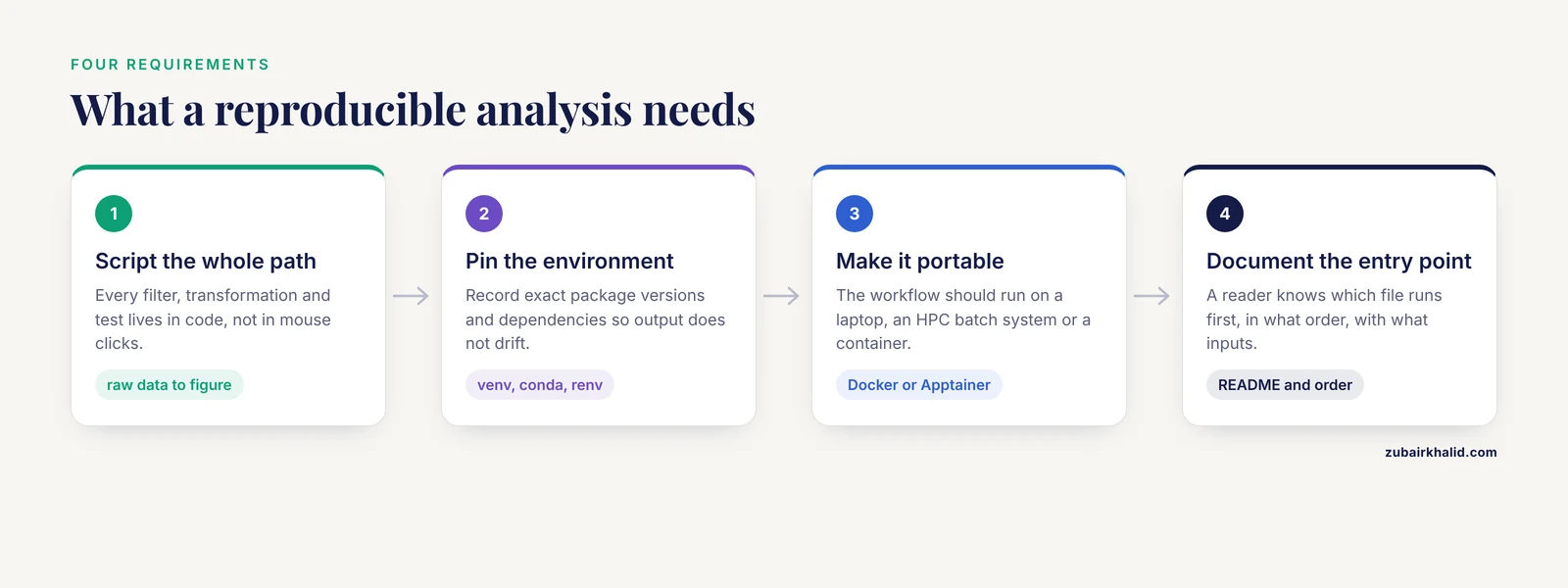
Reproducible research means that another person, or you six months from now, can rerun your analysis on the same data and get the same numbers. Four ingredients make that possible, and each one puts a demand on your choice of language.
- Code that runs from raw data to final figure. Every transformation, filter, and statistical test lives in a script, not in a set of mouse clicks.
- A pinned environment. The exact package versions and their dependencies must be recorded. A script that worked with pandas 1.5 can silently produce different output with pandas 3.0.
- Portable execution. The workflow should run on a collaborator's laptop, on a high-performance computing (HPC, a shared cluster of compute nodes) batch system, or in a container with minimal modification.
- A documented entry point. A reader should know which file to run first, in what order, and with what inputs.
The environment is the part researchers underestimate most. Real scientific workloads depend on scheduler directives, environment modules, shared filesystems, and site-managed software trees that are rarely captured in portable form, which is why tools that trace a running job and generate a container recipe automatically are now being built for shell, compiled C, Python, R, and GPU workloads alike. Both languages suffer from this problem, and both benefit from the same fixes, which are covered later in this article.
One more clarification helps frame the rest of this guide. Researchers distinguish replicability (a new study with new data reaches the same conclusion) from reproducibility (the same data and code give the same result). Language choice mostly affects the second. If the original trained model behind a published method was never released, or key implementation details were never written down, no amount of careful tooling brings that analysis back, a problem documented in tuberculosis gene signature research where original training data and model details were simply unavailable to later users [2].
Python for Reproducible Research: Strengths and Typical Uses
Python started as a general-purpose scripting language and grew into the default language of machine learning and data engineering. That history shapes its reproducibility profile in three ways.
Software engineering discipline. Python projects borrow conventions from professional software development: package structures, unit tests, continuous integration, version control hooks, and packaging tools such as pip and conda. When your "analysis" is really a piece of software that will be reused, scheduled, or deployed, these conventions carry you a long way. Research groups that ship tools rather than one-off analyses tend to end up in Python for this reason.
Machine learning and deep learning. The dominant frameworks, including scikit-learn, PyTorch, and TensorFlow, are Python-first. A recent clinical prediction study comparing seven algorithms, from logistic regression to LightGBM and artificial neural networks, developed its models using R and Python together, which reflects the current reality that gradient boosting and neural network libraries are easiest to reach from Python [3]. Radiomics work shows the same pattern. PySERA, an open-source Python framework for standardized radiomics feature extraction, implements 557 features, reports greater than 94 percent compliance with the Image Biomarker Standardization Initiative (IBSI, an international standard defining how image features must be computed so results match across software), and connects directly to scikit-learn, PyTorch, TensorFlow, and MONAI for downstream modeling [4].
Large-scale and sensor data pipelines. When data arrives continuously, in awkward formats, or in volumes that need parallel processing, Python's standard library and ecosystem handle it well. Three recent examples show the range:
- The mobgap package re-implemented a validated wearable-sensor mobility pipeline, originally spread across MATLAB, R, and Python, as a single open-source Python package to overcome licensing, reproducibility, and accessibility problems, and re-validated it against gold-standard references across six clinical cohorts [5].
- The disdrodb package standardizes processing of disdrometer (an instrument that measures properties of falling precipitation particles) data through a modular three-level pipeline that converts heterogeneous raw files into analysis-ready netCDF4 products [6].
- An open-source Python framework for high-throughput cancer drug screening data standardizes storage, drug name normalization, dose-response modeling including IC50 and EC50 calculations, and cohort-level summaries, replacing the fragmented ad hoc scripts that had hindered reproducibility in that field [7].
Interfaces that keep scripts central. Python's GUI story is weaker than R's, but recent tools show a workable pattern: methylEZ, a cross-platform Python/Tkinter graphical interface for bisulfite sequencing analysis, explicitly preserves transparent, script-first execution by generating validated samplesheets and ready-to-run commands for an established pipeline rather than hiding the analysis behind clicks [8].
When to use Python
Choose Python when most of these are true:
- Your project involves machine learning, deep learning, or computer vision.
- You are processing images, signals, sensor streams, or large files that need efficient handling.
- The analysis must run repeatedly, automatically, or on a cluster, in other words it behaves like software.
- Your collaborators, or the labs you want to join, maintain Python tools.
- You may move into data science or bioinformatics industry roles, where Python demand is broader.
R for Reproducible Research: Strengths and Typical Uses
R was created by statisticians, and it shows in three structural advantages.
Statistics first, not statistics bolted on. Linear models, mixed models, survival analysis, generalized additive models, and classical hypothesis tests are one line of R with sensible defaults. In Python, equivalent models often live in several packages with inconsistent interfaces. If the intellectual core of your project is a statistical model and you need to iterate on model specification quickly, R is usually faster and less error-prone.
The Bioconductor ecosystem. For genomics, transcriptomics, epigenomics, and single-cell analysis, Bioconductor provides thousands of peer-reviewed packages built on shared data structures. Much of the reference tooling for gene set enrichment analysis (GSEA, a family of methods that score whether a predefined set of genes behaves consistently in an experiment), including methods such as ssGSEA, GSVA, PLAGE, Singscore, and Zscore, is R-based. A large cross-validation study of 19 tuberculosis blood-transcriptional signatures across 24 transcriptomic datasets used these gene set scoring methods and re-built original models to test whether scoring the signature genes alone could stand in for the original trained model, and it published an open-access software implementation of all 19 original models so future users would not face the missing-details problem that had blocked earlier comparisons [2]. A follow-up analysis in BMC Infectious Diseases reported that for many signatures, predictions from gene set scoring methods were highly correlated and statistically equivalent to the original models [9]. That whole line of work, which now serves as a template for making a fragmented literature reproducible, was built on R methods.
Reproducible reporting as a first-class feature. R Markdown and its successor Quarto weave narrative text, code, and results into one document, so the paper draft and the analysis cannot drift apart. Shiny turns an R analysis into an interactive web tool without web development skills. The National Animal Nutrition Program, which maintains a feed composition database with more than 4 million records and an animal performance database with more than 500,000 observations, modernized its infrastructure with Shiny-based decision tools and hybrid R/Python workflows specifically to enhance interoperability, provenance tracking, and end-to-end reproducibility [10].
Package curation for pipelines. The moiraine R package, developed to build reproducible multi-omics integration pipelines, automates preprocessing and formatting so different integration methods can be applied to the same dataset and compared, and its developers archived a snapshot on Zenodo (a repository that assigns persistent identifiers to code) so a specific version can always be retrieved [11]. This pattern, package plus Zenodo snapshot plus versioned release, is a reproducibility template any language can copy, but R's packaging culture makes it routine.
When to use R
Choose R when most of these are true:
- Your analysis centers on statistical modeling, epidemiology, or classical biostatistics.
- You work in genomics or another omics field where Bioconductor is the reference implementation.
- The main deliverable is a report, thesis, or manuscript with figures that must regenerate automatically.
- You need to turn an analysis into an interactive tool for collaborators quickly.
- Your field's key methods papers publish R code, which is common in ecology, genetics, and clinical biostatistics.
Side-by-Side Comparison: Python vs R for Reproducible Research
The table below is the core of this research software comparison. It compares the two languages on the dimensions that actually decide projects.
| Criterion | Python | R |
|---|---|---|
| Design origin | General-purpose programming language | Language designed for statistical computing |
| Statistics | Good coverage across libraries, inconsistent interfaces | Deepest statistical ecosystem, coherent formula syntax |
| Machine learning | Dominant, scikit-learn, PyTorch, TensorFlow | Strong for tabular data, weaker for deep learning |
| Bioinformatics | Growing (Biopython, scanpy) | Reference ecosystem (Bioconductor) |
| Image, signal, and sensor pipelines | Strong (NumPy, SciPy, domain packages) | Possible but less common |
| Data wrangling | pandas and similar tools | dplyr and the tidyverse, highly consistent |
| Graphics and publication figures | Matplotlib, seaborn, plotly | ggplot2, widely considered the standard for statistical graphics |
| Reproducible documents | Jupyter notebooks, Quarto | R Markdown, Quarto |
| Interactive apps | Streamlit, Dash | Shiny |
| Environment management | venv, pip, conda, lock files | renv, packrat, lock files |
| Containers | Standard, well supported | Standard, well supported |
| Typical failure mode | Statistical errors from hand-rolled or mismatched implementations | Fragile software engineering, harder deployment at scale |
| Career flexibility | Broadest, spans research, data science, and software | Concentrated in statistics, biostatistics, and omics |
Neither column wins on reproducibility alone. Both languages can produce fully reproducible work, and both can produce irreproducible chaos. What differs is which tasks each language makes easy and which it makes awkward.
Comparing the Criteria That Decide Real Projects
Environment and dependency management
This is where most reproducibility failures happen regardless of language. Python offers venv for isolated environments, pip with pinned requirements.txt files, and conda or mamba for environments that mix Python with compiled libraries. R offers renv, which records exact package versions per project and restores them later. Both languages run inside Docker or Apptainer (formerly Singularity) containers, and both are supported by environment-capture tools. The defcon tool, for example, instruments an existing HPC batch script, traces the runtime environment, and generates a Singularity definition file that reconstructs the observed execution environment, with Python and R workloads among its evaluated cases [1]. Practical guidance: whichever language you pick, learn its lock-file tool in your first week. An analysis without pinned versions is not reproducible, whatever language it is written in.
Statistical correctness and method availability
Reproducibility includes implementing the right method, not just the same method twice. R's advantage here is real. Methods papers in biostatistics and genomics release R packages, and those packages are often the canonical implementation. If you need a published mixed model, a survival analysis with time-dependent covariates, or a specific gene set scoring method, R frequently has it years earlier and with the original authors' involvement. Python's ecosystem catches up for popular methods but can lag for specialized ones. The reverse also holds. Open Bandit Pipeline, a Python library that standardizes implementation and evaluation of off-policy evaluation methods (techniques for estimating how a new decision policy would have performed using data collected under a different policy), exists because the field needed standardized, reproducible benchmarks and no comparable package filled that role [12].
Machine learning workflow integrity
Reproducible machine learning has its own traps, including data leakage, nondeterministic training, and undocumented preprocessing. A recent clinical prediction study illustrated good practice: 37 candidate predictors were reduced by feature selection performed strictly on the training set, hyperparameters were tuned with 5-fold cross-validation, and models were evaluated on an independent validation set, with seven algorithms developed using R and Python [3]. Notice that the language was not the deciding factor. The study design was. Python gives you better tooling for tracking experiments and serving models, R gives you cleaner statistical framing of the same comparison.
Cross-language and cross-platform consistency
Some projects demand that the same analysis run identically on different platforms. A cross-sectional evaluation of AI-generated medical references used a Reference Hallucination Score across 3,150 references from three chatbots and built its statistical evaluation framework for cross-platform application, publishing the analysis so other groups could rerun it [13]. The lesson generalizes: reproducibility across platforms requires that your statistical code, not just your intent, be portable. Both languages achieve this, but only when paired with pinned dependencies, because a difference in one library version can change numerical output.
Interoperability between the two languages
You do not always have to choose. The reticulate package lets R call Python code and pass data between the two, and Jupyter notebooks can run R kernels. The National Animal Nutrition Program adopted hybrid R/Python workflows as an explicit infrastructure strategy for interoperability and provenance tracking [10]. A methodological guide for researchers using large language models for text annotation in the social sciences and humanities provides parallel step-by-step Python and R examples throughout, covering prompt design, evaluation of annotations, and reproducible workflow management, on the premise that both communities need the same methodological care [14].
Worked Scenarios
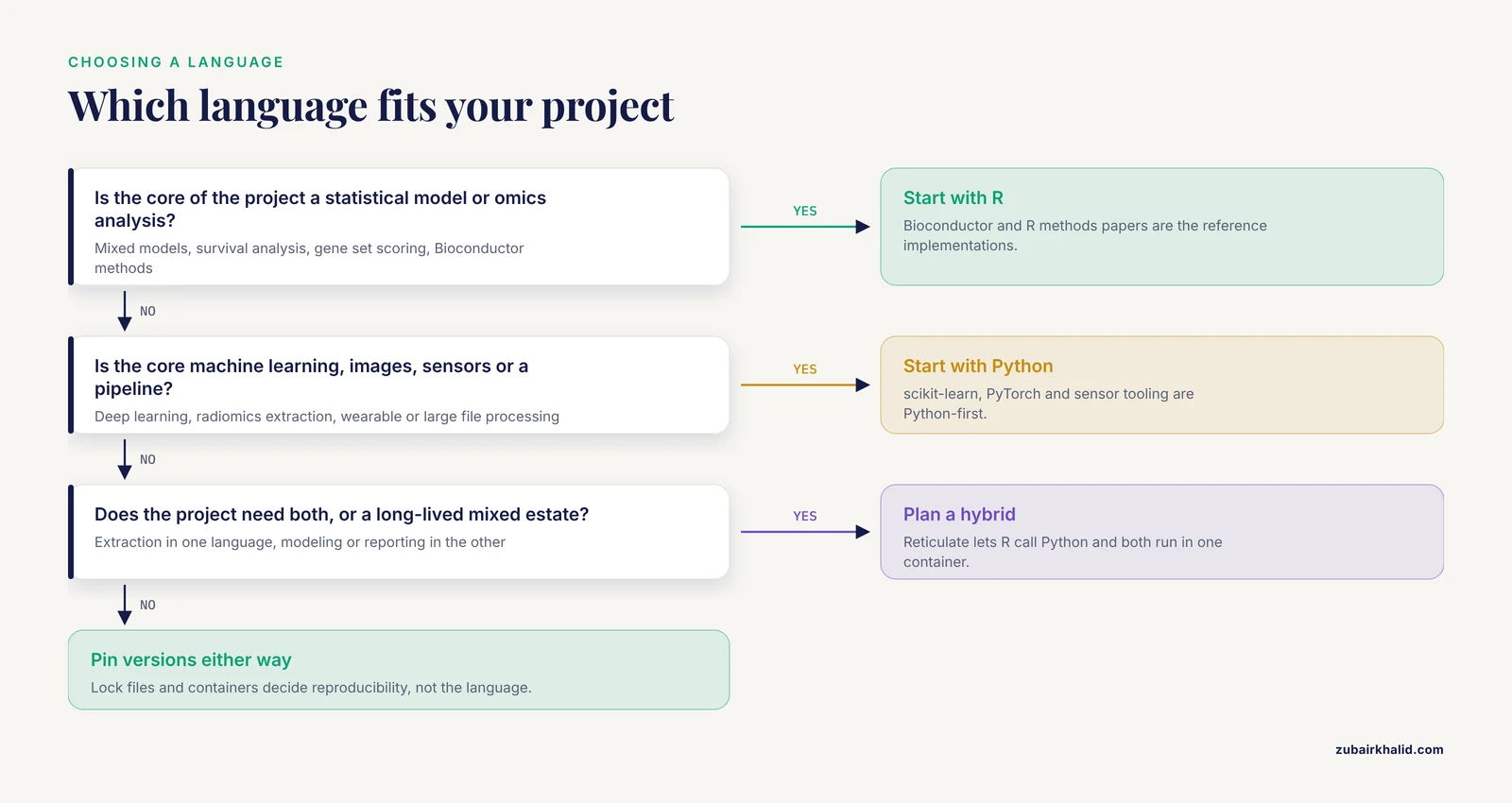
Scenario 1: RNA-seq differential expression and pathway analysis for a thesis. Choose R. You will live in Bioconductor packages, gene set scoring methods such as ssGSEA and GSVA are R-native, and the publication figures come out of ggplot2 inside an R Markdown or Quarto document. If your study touches published gene signatures, follow the tuberculosis-signature model: check whether the original authors released their model, use an open implementation where one exists, and validate any substitute method against the original before trusting it [2].
Scenario 2: A wearable sensor study producing digital mobility outcomes for a clinical trial. Choose Python. The mobgap project exists precisely because the original pipeline, spread across MATLAB, R, and Python with licensing constraints, could not be reproduced or extended easily. Its Python re-implementation matched or exceeded the original validation performance, estimating walking speed with an absolute error of 0.10 m/s and an intraclass correlation coefficient of 0.81 across six clinical cohorts [5]. Sensor and time-series pipelines of this kind are Python's home turf.
Scenario 3: A radiomics biomarker study heading toward a clinical prediction model. Choose Python, with a footnote. Feature extraction with IBSI-compliant tools such as PySERA is Python-native and connects directly into PyTorch or MONAI modeling stacks [4]. The final prediction model itself could be fit in either language, and a mixed approach is defensible, but keeping extraction and modeling in one environment removes a class of interface errors.
Scenario 4: A multi-omics integration project comparing several published methods. Choose R. moiraine was built for exactly this situation, wrapping heterogeneous integration tools in one reproducible pipeline with standardized inputs, shared visualizations, and side-by-side robustness comparisons [11]. Reimplementing each tool's preprocessing by hand in a different language is where reproducibility usually dies.
Scenario 5: A lab with a long-lived national database, legacy models, and new web tools. Plan a hybrid. The NANP example shows the mature end state, hybrid R/Python workflows, Shiny decision tools, a formal process for routing technical issues in widely used models back to original developers, and consistent versioning across releases [10]. The takeaway for a student is that large research software estates almost never settle on one language, so reading both is a career asset.
Scenario 6: A batch pipeline on an institutional HPC cluster. Language matters less than environment capture. Whether your scripts are Python, R, or a mix, adopt containers from the start and, where available, tooling that records the actual execution environment rather than a hand-maintained list of packages [1].
Common Mistakes and Limitations
- Treating a notebook as a finished workflow. Jupyter and R Markdown notebooks are excellent for exploration and reporting, but hidden execution order, stale cells, and undeclared state make them fragile as the sole artifact. Export a linear script or pipeline as the canonical run, and keep the notebook for narrative.
- Not pinning versions. Recording "used Python 3.12" or "used R 4.x" is not enough. Package versions, and for compiled languages the underlying libraries, must be locked. Renv, conda lock files, or a container image are the minimum.
- Substituting a different method without validation. When the original implementation of a published model is unavailable, researchers reach for a proxy such as gene set scoring. That substitution can be legitimate, and the tuberculosis-signature work showed statistical equivalence for many signatures, but equivalence must be demonstrated per signature, not assumed [9].
- Assuming published code is runnable. Missing original training data, undocumented model details, and inadequate released software are recurring reasons published analyses cannot be reproduced, and this affects R and Python papers alike [2]. Budget time to get someone else's code running before you build on it.
- Hiding the analysis behind a GUI. Point-and-click tools lower the entry barrier but often destroy reproducibility. Prefer tools that generate or preserve the underlying script, as methylEZ does by exporting ready-to-run commands alongside its graphical interface [8].
- Depending on proprietary software silently. Licensed toolboxes and site-specific installations impair portability, a problem documented when independent teams tried to reproduce robotics system-identification results across execution platforms. In practice this means preferring open-source equivalents when the science allows, and documenting any proprietary dependency explicitly when it does not.
- Manual curation between steps. Copy-pasting results from one tool into another, or reformatting spreadsheets by hand, is the single most common reproducibility break in empirical studies of failed workflows. The drug-screening framework mentioned earlier was created because fragmented, manual workflows had become the norm in that field [7].
- One language per career dogma. The honest answer to "python or r for reproducible research" is that the question is usually about the project, not the career. Learn one language deeply, learn to read the other, and adopt the one a specific project demands.
A final limitation applies to the topic itself. Tool popularity shifts quickly, and any statement about which ecosystem is growing faster dates fast. The structural differences described here, statistics-first versus engineering-first, are stable. Market-share claims are not.
Frequently Asked Questions
Should I learn Python or R first as a biology researcher?
Learn the one your current project or lab actually uses, because you will get help and reusable code there. If you genuinely have a free choice and your work is statistics-heavy, start with R. If your work leans toward machine learning or data pipelines, start with Python.
Is Python or R better for reproducible research?
Neither language is inherently more reproducible. Reproducibility comes from pinned package versions, containers, version control, and scripted pipelines, all of which both languages support well. Choose on the basis of what your analysis needs, not on reproducibility claims.
When to use Python instead of R in a research project?
Use Python when the project is machine learning or deep learning work, image or sensor data processing, large-scale data pipelines, or software that must run automatically in production. Use R when statistical modeling, genomics methods, or publication-grade reporting dominate.
Can I use Python and R together in one project?
Yes, and many research programs do. R can call Python through the reticulate package, both languages run inside the same container, and hybrid R/Python workflows are now an explicit strategy in large research infrastructures for interoperability and provenance tracking.
Do Jupyter or R Markdown notebooks make my research reproducible by themselves?
No. Notebooks document and communicate an analysis, but hidden cell order, unrecorded package versions, and manual state make them unreliable as the only artifact. Pair the notebook with a locked environment and a linear, top-to-bottom script that runs the full analysis from raw data.
What is the best software for researchers who want reproducible workflows?
There is no single best package, only a best stack for your project: one scripting language chosen to fit your analysis type, a version-control system such as Git, an environment manager (venv or conda for Python, renv for R), a container runtime such as Docker or Apptainer, and a persistent archive such as Zenodo for released code.
Sources
- defcon: From HPC Batch Scripts to Container Definitions for Reproducible Research Computing
- Comparison of gene set scoring methods for reproducible evaluation of multiple tuberculosis gene signatures
- Comparison of seven machine learning models for predicting prolonged PACU length of stay: performance evaluation and identification of key influencing factors
- PySERA: Open-source standardized python library for automated, scalable, and reproducible handcrafted and deep radiomics.
- Mobgap: A State-of-the-Art Python Framework for Reproducible Estimation and Algorithm Validation of Digital Mobility Outcomes from a Single Wearable Device.
- disdrodb: an open-source Python package for standardized processing, sharing, and analysis of disdrometer data
- Abstract 5509: A computational framework for reproducible analysis of cancer drug screening data.
- methylEZ: a graphical user interface for differential methylation analysis in bisulfite sequencing data.
- Comparison of gene set scoring methods for reproducible evaluation of tuberculosis gene signatures
- PS7-15. National Animal Nutrition Program (NANP): Harmonized Databases, Reproducible Modeling, and Artificial Intelligence-enabled Knowledge Synthesis for Animal Nutrition Research.
- moiraine: an R package to construct reproducible pipelines for the application and comparison of multi-omics integration methods
- Open Bandit Dataset and Pipeline: Towards Realistic and Reproducible Off-Policy Evaluation
- A reproducible statistical evaluation framework for large-sample assessment of AI-generated medical references: cross-platform application of the reference hallucination score
- A Methodological Guide on Using Large Language Models for Reproducible Text Annotation in the Social Sciences and Humanities with Python and R