Stoichiometry: Mole Ratios and Worked Problems Step by Step
By Dr. Zubair Khalid, DVM, MS, PhD ·
Stoichiometry is the quantitative relationship between reactants and products in a chemical reaction, expressed through the coefficients of a balanced chemical equation. It lets chemists and biologists predict exactly how much of each substance is consumed or produced in any chemical transformation.
This accounting matters everywhere chemistry meets life. When a researcher reports that an enzyme converts one molecule of substrate into one molecule of product, or that ten molecules of NADPH are consumed for each molecule of substrate oxidized, that is stoichiometry in action [1][2]. The same rules govern industrial synthesis, pharmaceutical manufacturing, clinical diagnostic assays, and the design of molecular-scale structures [3]. Without stoichiometry, a balanced equation is just a recipe with no quantities, and a laboratory reaction is guesswork.
What Stoichiometry Means in Chemistry and Biology
The word comes from the Greek "stoicheion" (element) and "metron" (measure). In practice, stoichiometry is the arithmetic of chemical change. A balanced equation such as:
2 H2 + O2 → 2 H2O
contains three kinds of information. It identifies the substances. It gives the coefficients, the numbers in front of each formula (2, 1, and 2). And it defines the mole ratios: 2 mol H2 to 1 mol O2 to 2 mol H2O.
The coefficients are not masses. They are mole counts. Two molecules of hydrogen react with one molecule of oxygen to give two molecules of water, and the same ratio holds for moles. Two moles of H2 react with one mole of O2 to give two moles of H2O.
Stoichiometry is a direct consequence of the law of conservation of mass. Atoms are neither created nor destroyed in a chemical reaction, only rearranged. That is why the equation must be balanced: the same number of each type of atom must appear on both sides. The coefficients that achieve this balance are the source of every mole ratio.
The Mole as the Unit of Counting
A mole is Avogadro's number, 6.022 × 10^23, of particles. Chemists use moles because atoms and molecules are too small to count individually. Weighing a sample in grams and converting to moles is a way of counting particles indirectly. The conversion factor is the molar mass, the mass in grams of one mole of a substance, numerically equal to its formula weight in atomic mass units.
For water, the molar mass is 18.015 g/mol. For carbon dioxide, it is 44.009 g/mol. For glucose, C6H12O6, it is 180.156 g/mol. These numbers come from the periodic table and are used in every stoichiometry calculation.
Stoichiometry in Enzyme Research
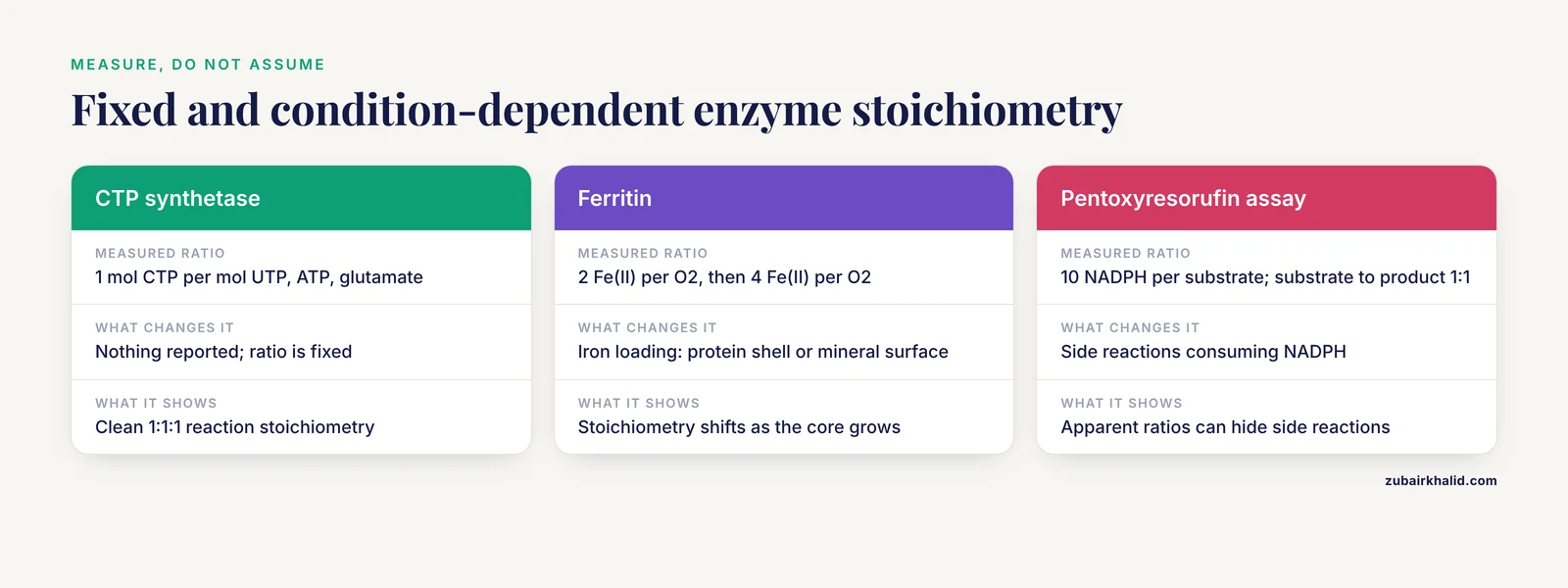
Biochemists use the same logic to characterize enzymes. The stoichiometry of an enzyme reaction is the fixed ratio of substrates consumed and products formed per round of catalysis. A substrate is the molecule an enzyme acts on. Calf liver CTP synthetase, for example, forms 1 mol of CTP from UTP while cleaving 1 mol of ATP to ADP and forming 1 mol of glutamate from glutamine [2]. That clean 1:1:1 ratio defines the reaction and matches the stoichiometry of the bacterial enzyme [2].
Stoichiometry can also reveal mechanism. Horseradish peroxidase compound I is reduced to the native enzyme by exactly 1 molar equivalent of p-cresol, even though the catalytic cycle requires 2 electrons [5]. A molar equivalent here means one mole of p-cresol per mole of compound I. That result showed that p-cresol behaves as a 2-electron reductant. It also explained why adding only half an equivalent of p-cresol stops the reduction at compound II at high pH [5].
Sometimes stoichiometry changes with conditions. In ferritin, the iron oxidation stoichiometry shifts from 2 Fe(II) per O2 at low iron loading, with hydrogen peroxide as the product, to 4 Fe(II) per O2 at high loading, with water as the product [6]. The ratio is not fixed by the enzyme alone. It depends on whether the protein shell or the growing mineral surface dominates the oxidation chemistry [6].
The Mole Ratio: The Core Tool
The mole ratio is the conversion factor derived from the coefficients of a balanced equation. It is the bridge between one substance and another in a calculation.
For the ammonia synthesis reaction:
N2 + 3 H2 → 2 NH3
the useful mole ratios include 1 mol N2 to 3 mol H2, 1 mol N2 to 2 mol NH3, and 3 mol H2 to 2 mol NH3.
Mole ratios come only from the balanced equation, never from the chemical formulas themselves. The ratio 1:3:2 comes from the coefficients, and it is valid only because the equation is balanced.
How to Write a Mole Ratio
- Balance the equation first.
- Identify the two substances you are converting between.
- Take their coefficients from the balanced equation.
- Write the ratio so that the unit you want to cancel is on the bottom.
For the ammonia reaction, converting moles of H2 to moles of NH3 looks like this:
moles NH3 = moles H2 × (2 mol NH3 / 3 mol H2)
The coefficient of NH3, which is 2, goes on top. The coefficient of H2, which is 3, goes on the bottom so that "mol H2" cancels. The result is in moles of NH3.
How to Solve Stoichiometry Problems Step by Step
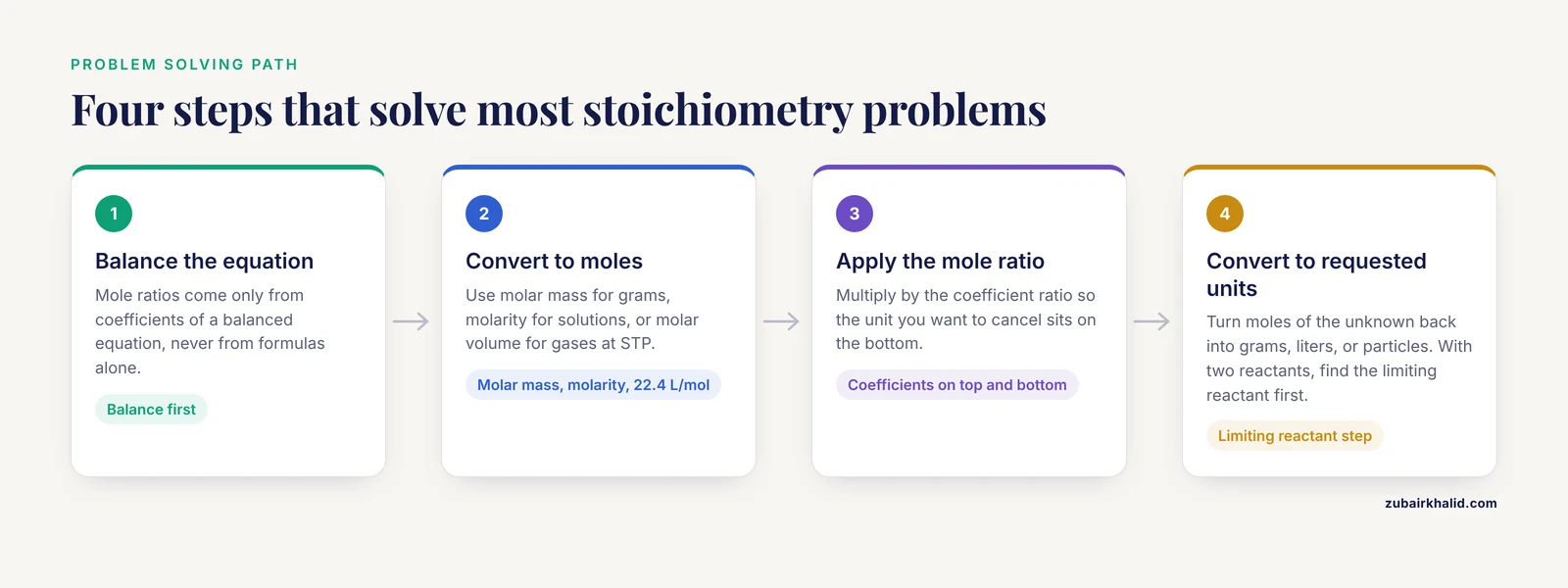
Most stoichiometry problems follow the same path. The general method, sometimes called the mole method, has four steps:
- Write and balance the chemical equation.
- Convert the given quantity to moles using molar mass, molarity (moles per liter of solution), or molar volume (the volume occupied by one mole of gas at a given temperature and pressure).
- Multiply by the mole ratio to convert moles of the known substance to moles of the unknown substance.
- Convert moles of the unknown to the requested units, usually grams, liters, or particles.
When a reaction has two or more reactants, add a step between steps 3 and 4: identify the limiting reactant, then base all product calculations on it. The next section covers that case in detail.
Worked Problem 1: Mass to Mass
Question: How many grams of water form when 4.00 g of hydrogen gas burns in excess oxygen?
Step 1. Write the balanced equation:
2 H2 + O2 → 2 H2O
Step 2. Convert grams of H2 to moles. The molar mass of H2 is 2.016 g/mol.
4.00 g H2 × (1 mol H2 / 2.016 g H2) = 1.98 mol H2
Step 3. Use the mole ratio. From the equation, 2 mol H2 produce 2 mol H2O, which is a 1:1 ratio.
1.98 mol H2 × (2 mol H2O / 2 mol H2) = 1.98 mol H2O
Step 4. Convert moles of water to grams. The molar mass of H2O is 18.015 g/mol.
1.98 mol H2O × 18.015 g/mol = 35.7 g H2O
Answer: 35.7 g of water form.
Notice that the mole ratio step is the only place where the balanced equation enters the calculation. Everything else is unit conversion.
Worked Problem 2: Mole to Mole with a Non-1:1 Ratio
Question: How many moles of ammonia can be produced from 1.50 mol of nitrogen gas?
The balanced equation is:
N2 + 3 H2 → 2 NH3
moles NH3 = 1.50 mol N2 × (2 mol NH3 / 1 mol N2) = 3.00 mol NH3
Answer: 3.00 mol of ammonia.
Worked Problem 3: Solution Stoichiometry
Question: What volume of 0.500 M HCl is needed to neutralize 25.0 mL of 0.250 M NaOH?
Step 1. Write the balanced equation:
HCl + NaOH → NaCl + H2O
Step 2. Convert the known quantity to moles. Molarity is moles per liter, so:
0.250 M NaOH × 0.0250 L = 0.00625 mol NaOH
Step 3. The mole ratio of HCl to NaOH is 1:1, so 0.00625 mol of HCl is required.
Step 4. Convert moles of HCl to volume using its molarity:
0.00625 mol HCl / 0.500 M = 0.0125 L = 12.5 mL
Answer: 12.5 mL of 0.500 M HCl.
Worked Problem 4: Gas Stoichiometry
Question: What volume of oxygen gas at STP is needed to completely burn 4.00 g of methane, CH4?
Step 1. Write the balanced equation:
CH4 + 2 O2 → CO2 + 2 H2O
Step 2. Convert grams of methane to moles. The molar mass of CH4 is 16.043 g/mol.
4.00 g CH4 / 16.043 g/mol = 0.249 mol CH4
Step 3. Use the mole ratio. The equation shows 2 mol O2 per 1 mol CH4.
0.249 mol CH4 × (2 mol O2 / 1 mol CH4) = 0.499 mol O2
Step 4. Convert moles of O2 to volume. At STP (standard temperature and pressure, 0 °C and 1 atm), one mole of any ideal gas occupies 22.4 L.
0.499 mol O2 × 22.4 L/mol = 11.2 L O2
Answer: 11.2 L of oxygen gas at STP.
Limiting Reactant and Theoretical Yield
In most real reactions, reactants are not present in exact stoichiometric proportions. One reactant runs out first. That reactant is the limiting reactant, also called the limiting reagent. It determines the maximum amount of product that can form. The other reactants are said to be in excess.
The theoretical yield is the maximum mass of product calculated from the limiting reactant using the mole ratio. The actual yield is the mass of product actually recovered in the laboratory, which is almost always lower because of incomplete reactions, side reactions, and losses during purification. Percent yield compares the two:
percent yield = (actual yield / theoretical yield) × 100
Worked Problem 5: Finding the Limiting Reactant
Question: 5.00 g of N2 and 5.00 g of H2 react to form ammonia. Which reactant is limiting, and what is the theoretical yield of NH3?
Step 1. Write the balanced equation:
N2 + 3 H2 → 2 NH3
Step 2. Convert both masses to moles. The molar mass of N2 is 28.014 g/mol, and the molar mass of H2 is 2.016 g/mol.
5.00 g N2 / 28.014 g/mol = 0.178 mol N2 5.00 g H2 / 2.016 g/mol = 2.48 mol H2
Step 3. Compare the mole ratio. The reaction needs 3 mol of H2 for every 1 mol of N2. For 0.178 mol of N2, the required H2 is:
0.178 mol N2 × (3 mol H2 / 1 mol N2) = 0.535 mol H2
The supply of H2 is 2.48 mol, which is more than 0.535 mol. Therefore N2 is the limiting reactant and H2 is in excess.
Step 4. Calculate the theoretical yield from the limiting reactant:
0.178 mol N2 × (2 mol NH3 / 1 mol N2) = 0.357 mol NH3 0.357 mol NH3 × 17.031 g/mol = 6.08 g NH3
Answer: N2 is limiting, and the theoretical yield is 6.08 g of NH3.
Worked Problem 6: Percent Yield
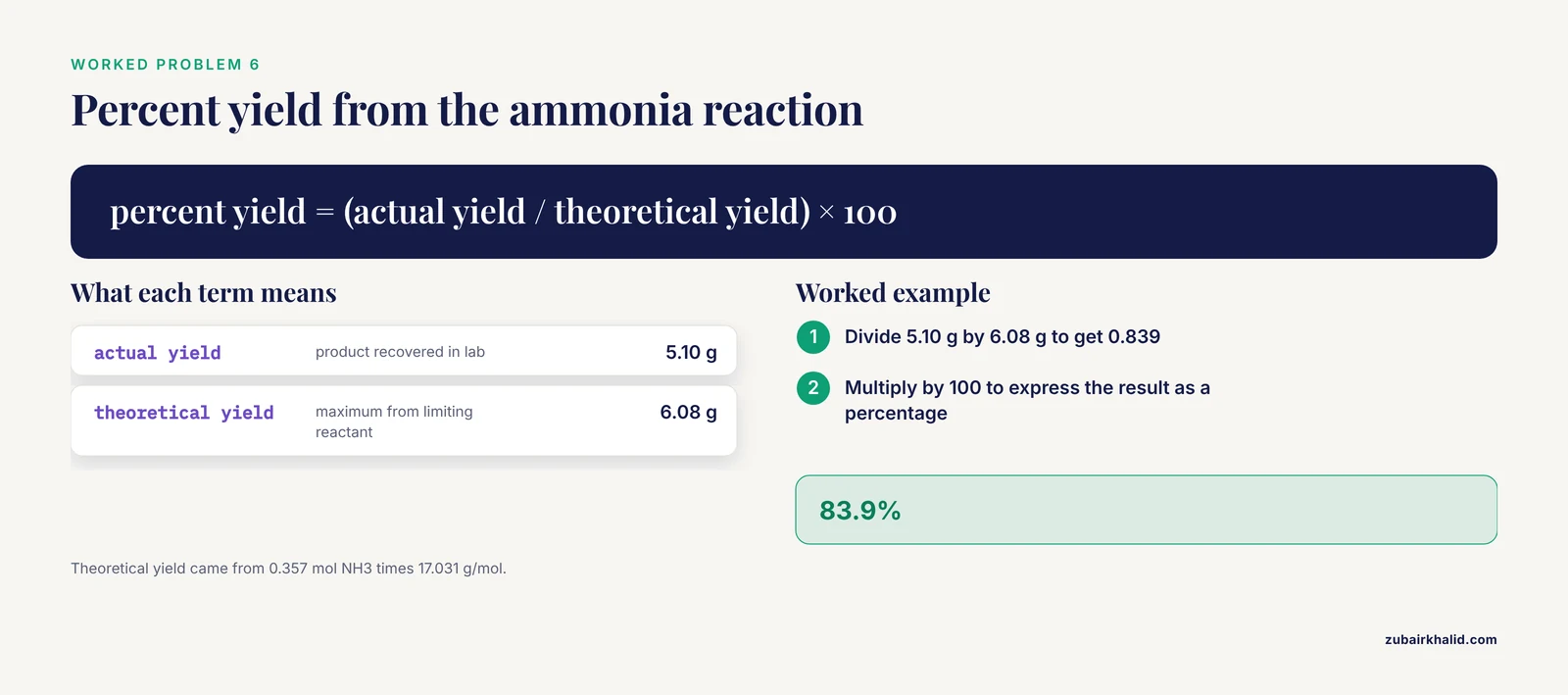
Question: If the reaction above actually produces 5.10 g of NH3, what is the percent yield?
percent yield = (5.10 g / 6.08 g) × 100 = 83.9%
Answer: 83.9%.
A faster way to find the limiting reactant is to divide each reactant's mole amount by its coefficient in the balanced equation. The smallest quotient corresponds to the limiting reactant. For problem 5:
N2: 0.178 / 1 = 0.178 H2: 2.48 / 3 = 0.827
Since 0.178 is smaller, N2 is limiting. This shortcut works because it normalizes each reactant to the reaction's own requirements.
Summary Table: Key Stoichiometry Terms
| Term | Definition | What it answers |
|---|---|---|
| , - | , - | , - |
| Stoichiometry | The quantitative relationship between reactants and products in a balanced chemical reaction | How much of each substance is consumed or produced? |
| Mole ratio | The ratio of coefficients between two substances in a balanced equation | How many moles of B react with or form from a given number of moles of A? |
| Limiting reactant | The reactant that is completely consumed first, stopping the reaction | Which reactant runs out first? |
| Theoretical yield | The maximum product mass calculated from the limiting reactant | What is the best possible outcome? |
| Actual yield | The mass of product actually recovered from the reaction | What did the experiment really give? |
| Percent yield | Actual yield divided by theoretical yield, times 100 | How efficient was the reaction? |
Stoichiometry in Enzymes and Biological Systems
Enzyme kinetics and stoichiometry are studied together because the rate of a reaction depends on substrate concentrations, while the stoichiometry defines how those concentrations change over time [7]. Knowing the stoichiometry of an enzyme reaction is a prerequisite for any kinetic or mechanistic interpretation. Without a correct stoichiometric ratio, an enzyme assay cannot convert a measured rate of product formation into a rate of substrate consumption, and kinetic constants such as Km and Vmax lose their meaning [7].
Measuring Reaction Stoichiometry in the Laboratory
Researchers measure enzyme stoichiometry by tracking substrates and products at the same time. In a study of cytochrome P450 2B1, the authors monitored pentoxyresorufin consumption, resorufin formation, NADPH consumption, and NADP formation in a single reaction mixture using continuous spectral analysis [1]. They found that 10 molecules of NADPH were consumed for every molecule of pentoxyresorufin converted to resorufin, while the substrate-to-product ratio was exactly 1:1 [1]. The extra NADPH consumption reflected oxidation of endogenous substrates in the microsomal preparation, a finding that only emerged because all four species were measured simultaneously [1].
The lesson is that the apparent stoichiometry of a biological reaction can be distorted by side reactions. The 1:1 ratio of substrate to product held even in the presence of inhibitors, but the NADPH-to-substrate ratio changed, revealing that the electron donor was also being consumed by other processes [1].
Stoichiometry That Changes With Conditions
Ferritin offers a second instructive case. At low iron loading, the oxidation of Fe(II) by O2 follows a 2:1 stoichiometry with hydrogen peroxide as a product:
2 Fe2+ + O2 + 4 H2O → 2 FeOOH + H2O2 + 4 H+
At high iron loading, the stoichiometry rises to 4 Fe(II) per O2, and water replaces hydrogen peroxide as the reduced oxygen product [6]. The change reflects a shift from a protein-dominated mechanism to a mineral-surface-dominated mechanism as the iron core grows [6]. For students, the lesson is that stoichiometry is an experimentally determined quantity, not something to assume from a formula alone.
Stoichiometry in Assay Design and Molecular Assembly
Quantitative immunoassays depend on reaction stoichiometry to relate a measured signal to an amount of analyte. The amplified enzyme-linked immunosorbent assay (a-ELISA) was characterized in part by the stoichiometry of the soluble immune complex, because the signal depends on how many enzyme labels are bound per antibody-antigen complex [4]. A reproducible and known stoichiometry is what makes the assay quantitative.
At the single-molecule level, the alpha-complementation reaction of E. coli beta-galactosidase has been studied one molecule at a time, revealing the stoichiometry of the complementation event directly [8]. Single-molecule methods can expose heterogeneity that bulk measurements average out.
Stoichiometry also guides the design of molecular nanostructures. Researchers have used an enzyme-inhibitor pair based on cellular retinoic acid binding protein II to assemble multi-protein megamolecules in one-pot reactions, with exact control over the placement and stoichiometry of protein domains within a single molecule [3]. The sulfur fluoride exchange click chemistry they used reacts with a second-order rate constant of about 3,600 M^-1 s^-1, a measure of how quickly the inhibitor attaches to the protein, and the orthogonal assembly chemistries allow each domain to be placed in a defined ratio [3]. In biosensor design, the stoichiometry of coimmobilized enzymes on a surface affects overall reaction efficiency, as shown for acetylcholinesterase and choline oxidase on gold nanoparticles [9].
Other Enzyme Stoichiometry Examples
- Benzoyl-CoA reductase, a key enzyme of anaerobic aromatic metabolism, couples the dearomatization of benzoyl-CoA to ATP hydrolysis, and its ATP stoichiometry has been characterized alongside its electron paramagnetic resonance (EPR) properties [10].
- Biotin synthase from E. coli uses S-adenosylmethionine in a stoichiometry that was established by isolating an enzyme-generated intermediate [11].
- Phenylalanine hydroxylase reaction stoichiometry depends on enzyme concentration, ionic strength, and temperature, showing that even a defined enzyme reaction can have condition-dependent stoichiometry [12].
- Glycerol oxidase, an enzyme used for glycerol quantification, had its reaction stoichiometry characterized during purification [13].
- Bovine serum amine oxidase contains two carbonyl cofactors per enzyme dimer, and this stoichiometry supports an aminotransferase mechanism [14].
- Recombinant avian HMG-CoA synthase matched the native enzyme in acylation stoichiometry, meaning it bound the same number of acetyl groups per enzyme molecule, validating its use in mechanistic studies [15].
- Dopamine beta-hydroxylase incorporates a substoichiometric amount of radiolabel from p-hydroxybenzyl cyanide, about 30% relative to enzyme subunits, which pointed to two distinct modes of inhibition [16].
These examples show the range of questions stoichiometry answers in biochemistry: how many electrons move, how many ATP molecules are consumed, how many cofactors are bound, and how many substrate molecules are converted per catalytic cycle.
Common Mistakes and Limitations
Students make the same stoichiometry errors repeatedly. Here are the ones worth checking for.
Using coefficients as masses. The coefficients 2, 1, and 2 in 2 H2 + O2 → 2 H2O are mole counts, not grams. A 2 g sample of H2 does not react with 1 g of O2. Convert to moles before applying the mole ratio.
Skipping the balanced equation. The mole ratio is meaningless if the equation is unbalanced. Balance first, then extract the ratio.
Converting grams directly to grams. There is no direct conversion factor between the mass of one substance and the mass of another. The only valid path is mass to moles, mole ratio, then moles back to mass.
Calling the smallest mass the limiting reactant. The limiting reactant is determined by moles and coefficients, not by mass. In problem 5, the two reactants had equal masses, but N2 was limiting. A reactant with a small mass can still be in excess if it has a large molar mass and a small coefficient.
Confusing theoretical yield with actual yield. Theoretical yield is a calculation, not a promise. Real reactions lose product to side reactions, incomplete conversion, and purification steps. Percent yield is the honest comparison.
Assuming stoichiometry is always fixed. Enzyme reaction stoichiometry can change with conditions. The ferritin example above shows a shift in the iron-to-oxygen ratio as the mineral core grows [6], and the pentoxyresorufin study shows that NADPH consumption can include side reactions [1]. In biological systems, measure the stoichiometry rather than assuming it.
Rounding too early. Carry extra digits through the calculation and round only at the final answer. Rounding 1.98 mol of H2 to 2.0 mol before multiplying changes the final answer in problem 1.
Forgetting units. Write units in every step and check that they cancel. The unit left at the end tells you whether the setup is correct.
Limitations of Stoichiometry
Stoichiometry predicts quantities, not outcomes. It assumes the reaction proceeds exactly as written, with no side reactions, no incomplete conversion, and no losses. It also assumes pure substances; a reagent labeled 98% pure contains less of the active compound than its mass suggests, and the calculation must be corrected for purity.
Stoichiometry says nothing about how fast a reaction proceeds. Kinetics is a separate layer of information. A reaction can have perfect stoichiometry and still be too slow to be useful. In biological systems, stoichiometry must be interpreted alongside enzyme activity, substrate availability, and competing reactions that consume the same substrates [1].
Quick Review
- Stoichiometry is the mole-based accounting of chemical reactions, derived from the coefficients of a balanced equation.
- The mole ratio is the conversion factor between any two substances in a balanced equation.
- The universal problem-solving path is: balance, convert to moles, apply the mole ratio, convert to the requested units.
- The limiting reactant is the one that runs out first, and it sets the theoretical yield.
- Percent yield equals actual yield divided by theoretical yield, times 100.
- In enzyme biochemistry, stoichiometry is an experimentally measured quantity that reveals electron counts, ATP use, cofactor binding, and reaction mechanism.
- Stoichiometry can change with reaction conditions, so it must be measured, not assumed.
Stoichiometry with Liquids: Using Density and Percent Purity
Liquid reactants are often measured by volume, but mole ratios require moles. Convert volume to mass with density, correct for purity, then divide by molar mass.
mass of sample = volume × density mass of pure substance = mass of sample × (percent purity / 100) moles = mass of pure substance / molar mass
Worked example
How many moles of pure ethanol are in 10.0 mL of 95% ethanol? The density is 0.789 g/mL and the molar mass is 46.07 g/mol.
10.0 mL × 0.789 g/mL = 7.89 g sample 7.89 g × 0.95 = 7.50 g ethanol 7.50 g / 46.07 g/mol = 0.163 mol ethanol
Common mistake
Do not treat volume as mass. Milliliters measure volume, not grams. A density conversion is required before moles, and purity must be applied before the mole ratio. Forgetting either step overstates the amount of reacting substance.
Converting Between Grams, Moles, and Particles with Avogadro's Number
Moles sit at the center of every conversion. Divide grams by molar mass to reach moles, then multiply moles by 6.022 × 10^23 to reach particles. Working backward, divide particles by Avogadro's number to reach moles, then multiply by molar mass to reach grams.
Example: How many molecules are in 9.00 g of water? The molar mass of 18.015 g/mol gives 0.4996 mol H2O. Multiplying by Avogadro's number: 0.4996 × 6.022 × 10^23 = 3.01 × 10^23 molecules.
Particle Pitfalls
- A particle may be a molecule or an atom. One mole of H2O holds 6.022 × 10^23 molecules but 1.204 × 10^24 hydrogen atoms, since each molecule carries two.
- Avogadro's number converts moles to particles, never grams to particles. Always pass through moles.
- Do not attach Avogadro's number to a mass or a volume. The 22.4 L/mol factor applies only to gases at STP.
In a stoichiometry problem, convert particles to moles before applying the mole ratio.
Atom Economy and Green Chemistry: Stoichiometry in Process Design
Atom economy is the percentage of reactant mass that ends up in the desired product: (molar mass of product / sum of reactant molar masses) × 100. The E-factor is the mass of waste per mass of product. Both derive from the balanced equation. Atom economy is theoretical; E-factor captures actual waste including solvents.
Worked example: two routes to propylene oxide. Route A: propylene + H2O2 → propylene oxide + H2O. Atom economy = 58/(42+34) × 100 = 76%. Route B: propylene + Cl2 + Ca(OH)2 → propylene oxide + CaCl2 + H2O. Atom economy = 58/(42+71+74) × 100 = 31%. Route A wastes less.
High atom economy matters because it reduces waste, lowers material costs, and eases purification. In industry, high atom economy and low E-factor mean a greener, cheaper process. It also reduces the energy and resources spent on separating product from waste.
Related Guides
- How to Calculate the Amount of DNA for Ligation Reactions: Insert-to-Vector Ratios: Calculate DNA ligation insert-to-vector molar ratios with practical worked guidance
- DNA Ligation Reaction Setup: Optimizing Insert-to-Vector Ratios and Reaction Conditions: Optimize DNA ligation reaction ratios and conditions with setup tips
- Types of Data: Nominal, Ordinal, Interval, Ratio: Understand ratio as a data measurement level for clearer interpretation
- Levels of Measurement: Nominal, Ordinal, Interval and Ratio: Review nominal, ordinal, interval, and ratio measurement levels
- Interpreting A260/A280 and A260/A230 Ratios for Nucleic Acid Purity: Interpret nucleic acid purity ratios from A260/A280 and A260/A230 readings
- Calcium-to-Phosphorus Ratios in Reptile Diets: Apply calcium-to-phosphorus ratio concepts to reptile diet formulation
Frequently Asked Questions
What is stoichiometry in simple terms?
Stoichiometry is the math of chemical reactions. It uses the coefficients of a balanced equation to calculate how much of each reactant is needed and how much of each product forms.
How do you find the mole ratio?
Balance the chemical equation, then take the coefficients of the two substances you are converting between. Write them as a fraction with the unit you want to cancel on the bottom.
What are the steps to solve a stoichiometry problem?
Write and balance the equation, convert the given quantity to moles, multiply by the mole ratio, then convert moles of the unknown to the requested units. If there are two reactants, identify the limiting reactant before calculating the product.
How do you identify the limiting reactant?
Convert every reactant to moles, divide each by its coefficient in the balanced equation, and compare. The reactant with the smallest quotient is limiting. Alternatively, pick one reactant and calculate how much of the other it would need. If the supply is insufficient, the first reactant is limiting.
What is the difference between theoretical yield and actual yield?
Theoretical yield is the maximum product mass calculated from the limiting reactant. Actual yield is what you recover in the laboratory. Percent yield is actual yield divided by theoretical yield, times 100.
Why does stoichiometry matter in biology and medicine?
Every enzyme-catalyzed reaction has a defined stoichiometry that reveals how many substrate molecules are converted, how many electrons move, and how many cofactors are consumed [2][5]. Clinicians and researchers use that information to design diagnostic assays, interpret signals, and build molecular structures with exact composition [4][3].
Sources
- A novel approach to study the activity and stoichiometry simultaneously for microsomal pentoxyresorufin-O-dealkylase reaction
- Cytidine 5'-triphosphate synthetase of calf liver. Size, polymerization, and reaction stoichiometry.
- Development of an Enzyme-Inhibitor Reaction Using Cellular Retinoic Acid Binding Protein II for One-Pot Megamolecule Assembly.
- Characterization of the soluble immune complex (EIC) of the amplified enzyme-linked immunosorbent assay (a-ELISA) and an evaluation of this assay for quantitation by reaction stoichiometry.
- Stoichiometry of the reaction between horseradish peroxidase and p-cresol.
- Iron oxidation chemistry in ferritin. Increasing Fe/O2 stoichiometry during core formation.
- Reaction Kinetics and Stoichiometry
- Stoichiometry of the α-complementation reaction of Escherichia coli β-galactosidase as revealed through single-molecule studies.
- Coimmobilization of acetylcholinesterase and choline oxidase on gold nanoparticles: stoichiometry, activity, and reaction efficiency.
- Benzoyl-CoA reductase (dearomatizing), a key enzyme of anaerobic aromatic metabolism. A study of adenosinetriphosphatase activity, ATP stoichiometry of the reaction and EPR properties of the enzyme.
- Biotin synthase from Escherichia coli: isolation of an enzyme-generated intermediate and stoichiometry of S-adenosylmethionine use.
- The effect of enzyme concentration, ionic strength, and temperature on the stoichiometry of the phenylalanine hydroxylase reaction.
- Formation and Purification of a New Enzyme, Glycerol Oxidase and Stoichiometry of the Enzyme Reaction
- An investigation of bovine serum amine oxidase active site stoichiometry: evidence for an aminotransferase mechanism involving two carbonyl cofactors per enzyme dimer.
- Avian 3-hydroxy-3-methylglutaryl-CoA synthase. Characterization of a recombinant cholesterogenic isozyme and demonstration of the requirement for a sulfhydryl functionality in formation of the acetyl-enzyme reaction intermediate.
- Alternate substrates of dopamine beta-hydroxylase. III. Stoichiometry of the inactivation reaction with benzyl cyanides and spectroscopic investigations.