Limiting Reactant: How to Find It
By Dr. Zubair Khalid, DVM, MS, PhD ·
The limiting reactant is the substance in a chemical reaction that runs out first, and it sets the maximum amount of product that can form. Every other reactant present in a larger relative amount is called an excess reactant, and some of it remains unreacted when the reaction stops.
This distinction matters because real reactions are rarely run with the exact proportions written in a balanced equation. One reactant is consumed before the others, and that reactant controls the yield. If you know how to find the limiting reactant, you can predict how much product will form, how much of each excess reactant will be left over, and whether a process is efficient enough to run at scale.
Limiting Reactant Definition
A chemical reaction rearranges atoms. The balanced equation shows the ratio in which molecules or moles of substances combine. That ratio is the stoichiometry of the reaction. In the reaction 2 H₂ + O₂ → 2 H₂O, two moles of hydrogen gas combine with one mole of oxygen gas to make two moles of water. The numbers 2, 1, and 2 are the stoichiometric coefficients.
The mole is the chemist's counting unit. One mole contains about 6.022 × 10²³ particles, a number called Avogadro's constant. When you measure a mass in grams, you are measuring a count of molecules, and the molar mass is the conversion factor between the two. For example, one mole of oxygen gas, O₂, has a mass of 32.0 grams.
When you mix reactants, the balanced equation tells you how much of each is required. If you provide exactly the right amounts, all reactants are consumed at the same time. If you provide more of one than the equation requires, that one is in excess. The reactant present in the smallest relative amount, compared with what the equation requires, is the limiting reactant.
A sandwich analogy makes this concrete. Suppose each sandwich needs two slices of bread and one slice of cheese. You have 10 slices of bread and 4 slices of cheese. The bread supports 5 sandwiches (10 divided by 2). The cheese supports 4 sandwiches (4 divided by 1). Cheese is the limiting ingredient. When the cheese runs out, 2 slices of bread remain. The cheese determines how many sandwiches you can make.
The same logic applies to molecules. The limiting reactant is not the one with the smallest mass or the smallest number of moles. It is the one that runs out first after you account for the stoichiometric coefficients.
| Feature | Limiting reactant | Excess reactant |
|---|---|---|
| Amount present | Less than the required ratio | More than the required ratio |
| Consumption | Completely consumed | Some remains unreacted |
| Role | Determines maximum product | Does not affect maximum product |
| After reaction | Zero moles remain | Positive moles remain |
Why the Limiting Reactant Matters
In industry, reactants cost money. A plant that makes ammonia may deliberately use an excess of the cheaper reactant to push the reaction further and ensure the expensive reactant is used completely. Which reactant is limiting is an economic decision. Percent yield and atom economy are the practical measures of this. A process that uses a scarce catalyst or an expensive reagent will make that substance the limiting reactant by design, so that none of it is wasted.
In materials science, the ratio of reactants controls the properties of the final material. Rosenquist and colleagues designed an injectable collagen hydrogel for sealing corneal perforations. They reported that the mechanical properties of the hydrogel could be fine-tuned by adjusting the reactant stoichiometries [1]. If the cross-linker runs out first, fewer cross-links form and the gel is softer. If the collagen runs out first, the network cannot form as many connections. The limiting reactant concept guides how the material is formulated.
In biochemistry, the stoichiometry of a modification can change a protein's function. Knowing how many phosphate groups attach to a protein tells you whether a modification reaction is limited by the protein substrate or by the phosphate donor. The measurement methods used to obtain that number are discussed later in this guide.
Even the outcome of a reaction can depend on which reactant is available. Gillet and colleagues studied chiral symmetry breaking, the process by which a reaction of achiral molecules produces an excess of one handed form of a product. They found that the spatial distribution of an achiral reactant concentration can control which handed form wins [2]. In a local region where the reactant is depleted, that reactant limits the reaction and steers the outcome.
How to Find the Limiting Reactant
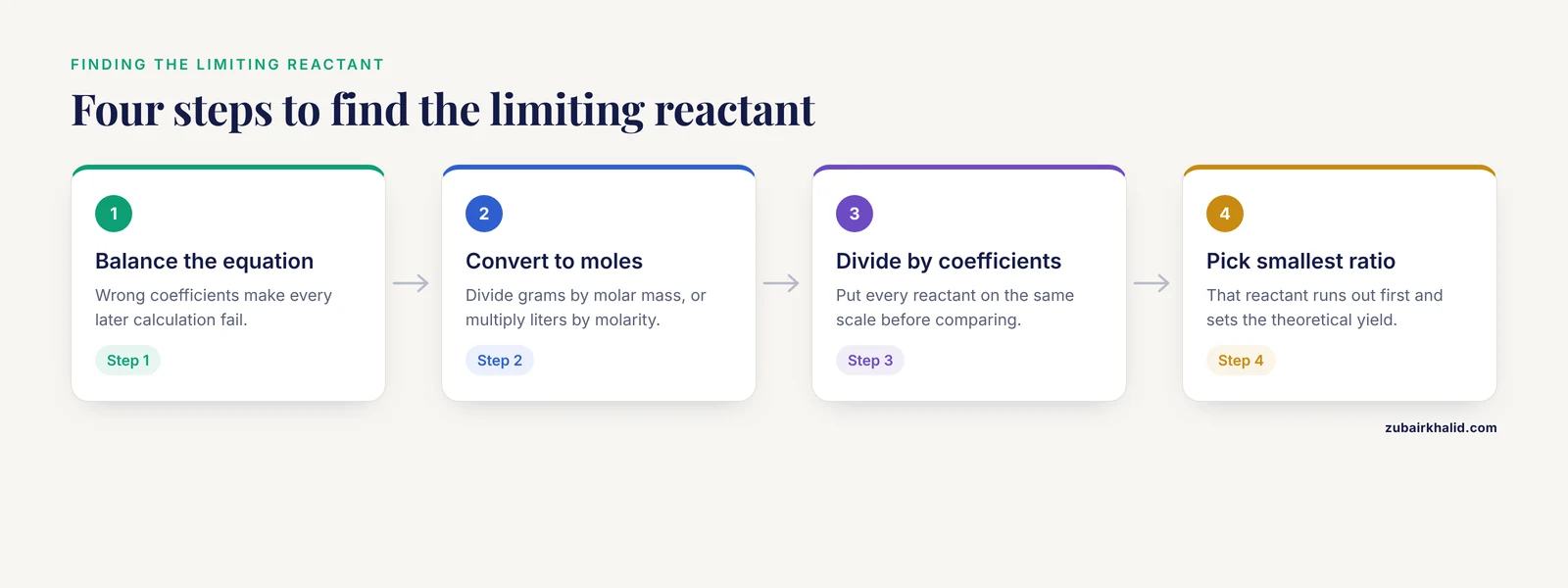
Here is a four-step method that works for any balanced chemical reaction.
Step 1. Write and balance the chemical equation. If the equation is not balanced, the coefficients are wrong and every later calculation fails.
Step 2. Convert the given amount of each reactant to moles. For a mass in grams, divide by the molar mass. For a solution, multiply the volume in liters by the molarity. For a gas at standard temperature and pressure, divide the volume by 22.4 liters per mole.
Step 3. Divide the moles of each reactant by its stoichiometric coefficient. This step is the one students skip most often. The result is a direct comparison of each reactant on the same scale.
Step 4. The reactant with the smallest ratio is the limiting reactant. The others are excess reactants.
Worked example. Ammonia is made from nitrogen and hydrogen:
N₂ + 3 H₂ → 2 NH₃
Start with 28.0 g of N₂ and 10.0 g of H₂.
Molar masses: N₂ = 28.0 g/mol, H₂ = 2.02 g/mol.
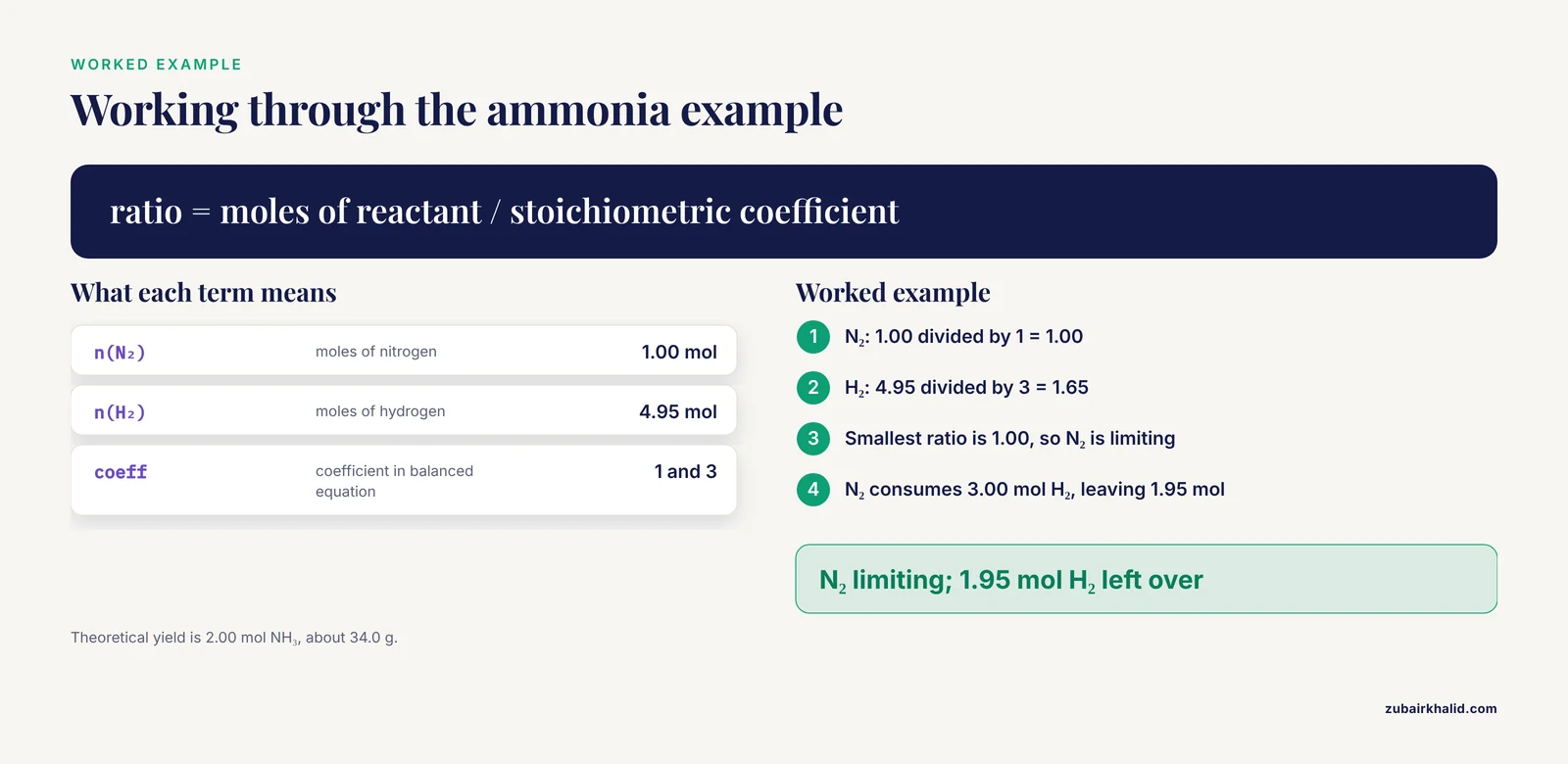
Moles of N₂ = 28.0 g divided by 28.0 g/mol = 1.00 mol. Moles of H₂ = 10.0 g divided by 2.02 g/mol = 4.95 mol.
Divide by coefficients: N₂: 1.00 divided by 1 = 1.00. H₂: 4.95 divided by 3 = 1.65.
The smallest ratio is 1.00, so N₂ is the limiting reactant. The reaction stops when all 1.00 mol of N₂ is consumed. That consumes 3.00 mol of H₂, so 4.95 minus 3.00 = 1.95 mol of H₂ remains.
The theoretical yield of ammonia is based on the limiting reactant: 1.00 mol N₂ × (2 mol NH₃ / 1 mol N₂) = 2.00 mol NH₃. Mass of NH₃ = 2.00 mol × 17.0 g/mol = 34.0 g.
Alternative method. Instead of dividing all reactants by their coefficients, you can pick one reactant and calculate how much of the other reactant is needed to react with it completely. Compare that required amount with the amount you actually have. If you have more than needed, the other reactant is limiting. If you have less than needed, the picked reactant is limiting. This method gives the same answer as the ratio method. It is especially useful when you only have two reactants.
Limiting Reactant and Excess Reactant
The limiting reactant and the excess reactant are two sides of the same comparison. Once you identify the limiting reactant, you can calculate exactly how much of each excess reactant is left over.
Method for leftover excess:
- Use the balanced equation to find how many moles of the excess reactant the limiting reactant consumes.
- Subtract that from the starting moles of the excess reactant.
- Convert the remaining moles back to grams if needed.
In the ammonia example, 1.00 mol of N₂ consumes 3.00 mol of H₂. Starting with 4.95 mol, the leftover is 1.95 mol, about 3.94 g.
A note on the word "excess." In everyday language, excess means too much. In chemistry, an excess reactant is simply the one that is not limiting. It is not wasted in principle. In industry, an excess reactant is often recycled after the reaction, so the apparent waste is recovered.
The theoretical yield is the maximum product mass calculated from the limiting reactant. The actual yield, what you really collect in the lab, is usually smaller. Percent yield is:
Percent yield = (actual yield divided by theoretical yield) × 100%
A percent yield below 100% can result from incomplete reactions, side reactions, product lost during transfer, or an equilibrium that stops short of full conversion.
Limiting Reactant Examples
Example 1. Combustion of hydrogen. 2 H₂ + O₂ → 2 H₂O
Start with 4.0 g H₂ and 32.0 g O₂. Moles H₂ = 4.0 divided by 2.02 = 1.98 mol. Moles O₂ = 32.0 divided by 32.0 = 1.00 mol.
Divide by coefficients: H₂: 1.98 divided by 2 = 0.99. O₂: 1.00 divided by 1 = 1.00.
H₂ is limiting. The reaction consumes 0.99 mol O₂, leaving 0.01 mol, about 0.32 g. The theoretical yield of water is 1.98 mol, about 35.6 g.
Example 2. Formation of aluminum chloride. 2 Al + 3 Cl₂ → 2 AlCl₃
Start with 10.0 g Al and 10.0 g Cl₂. Moles Al = 10.0 divided by 26.98 = 0.371 mol. Moles Cl₂ = 10.0 divided by 70.90 = 0.141 mol.
Divide by coefficients: Al: 0.371 divided by 2 = 0.185. Cl₂: 0.141 divided by 3 = 0.047.
Cl₂ is limiting. The reaction consumes 0.094 mol Al, leaving 0.277 mol, about 7.47 g. The theoretical yield of AlCl₃ is 0.094 mol, about 12.5 g.
Example 3. Real materials follow the same logic. The collagen hydrogel developed by Rosenquist and colleagues can be molded in situ and retains its shape in solution for at least one year [1]. The ratio of collagen to cross-linker determines how many cross-links can form, and that ratio is a limiting reactant calculation in practice.
How Stoichiometry Is Determined in the Laboratory
Before you can identify a limiting reactant, you need to know the stoichiometric ratio of the reaction. When that ratio is unknown, chemists determine it experimentally.
One classic method is the method of continuous variation, also called Job's method. You prepare a series of solutions in which the total amount of the two reactants stays constant but the mole fraction of each reactant changes. The mole fraction is the fraction of one reactant relative to the total amount of both reactants. You measure a property that reflects the amount of product, such as absorbance, and plot it against the mole fraction. The maximum of the plot occurs at the stoichiometric ratio.
Olson and Bühlmann extended Job's method to distinguish between 1:1 complex association, 2:2 complex association, and displacement reactions such as A + B forming C + D [3]. Their approach uses the sum of normalized values from the Job plot and compares it with theoretical predictions. This matters for limiting reactant work because a displacement reaction has a different stoichiometric relationship than a simple association. Using the wrong relationship would lead you to identify the wrong limiting reactant. Job plots are common in supramolecular chemistry, where researchers study host-guest complexes. The stoichiometry of a host-guest complex tells you how many guest molecules bind to each host, which is exactly the kind of ratio you need before you can decide which component limits the assembly.
In biochemistry, stoichiometry is often measured directly by elemental analysis. Ciavardelli and colleagues measured the stoichiometry of protein phosphorylation by quantifying phosphorus and sulfur with inductively coupled plasma mass spectrometry [4]. The ratio of phosphorus to sulfur reveals how many phosphate groups are attached per protein molecule. That ratio is a stoichiometric fact, and it tells you which substrate is consumed in the modification reaction.
Limiting Reactant Practice Problems
Problem 1. Iron rusts according to 4 Fe + 3 O₂ → 2 Fe₂O₃. If you start with 55.8 g Fe and 32.0 g O₂, which is the limiting reactant?
Answer. Moles Fe = 55.8 divided by 55.8 = 1.00 mol. Moles O₂ = 32.0 divided by 32.0 = 1.00 mol. Divide by coefficients: Fe = 1.00 divided by 4 = 0.25. O₂ = 1.00 divided by 3 = 0.33. Fe is limiting.
Problem 2. For 2 Na + Cl₂ → 2 NaCl, you mix 46.0 g Na with 71.0 g Cl₂. Which reactant is in excess?
Answer. Moles Na = 46.0 divided by 23.0 = 2.00 mol. Moles Cl₂ = 71.0 divided by 71.0 = 1.00 mol. Divide by coefficients: Na = 2.00 divided by 2 = 1.00. Cl₂ = 1.00 divided by 1 = 1.00. Neither is limiting. The reactants are in exact stoichiometric proportion, and both are fully consumed.
Problem 3. For 2 H₂ + O₂ → 2 H₂O, start with 5.0 mol H₂ and 2.0 mol O₂. What is the theoretical yield of water in moles?
Answer. Divide by coefficients: H₂ = 5.0 divided by 2 = 2.5. O₂ = 2.0 divided by 1 = 2.0. O₂ is limiting. Theoretical yield = 2.0 mol O₂ × (2 mol H₂O / 1 mol O₂) = 4.0 mol H₂O.
Problem 4. For the reaction N₂ + 3 H₂ → 2 NH₃, start with 2.0 mol N₂ and 6.0 mol H₂. What is the theoretical yield of ammonia in moles?
Answer. Divide by coefficients: N₂ = 2.0 divided by 1 = 2.0. H₂ = 6.0 divided by 3 = 2.0. The ratios are equal, so the reactants are perfectly matched. Theoretical yield = 2.0 mol N₂ × (2 mol NH₃ / 1 mol N₂) = 4.0 mol NH₃.
For more practice, look for a limiting reactant worksheet from a university chemistry department. Most general chemistry textbooks include a set of limiting reactant problems with answer keys. Work through them by hand before using any calculator.
Using a Limiting Reactant Calculator
A limiting reactant calculator automates the four-step method. You enter the balanced equation and the masses or moles of each reactant, and the calculator returns the limiting reactant, the excess reactant, the leftover mass, and the theoretical yield.
The calculator is only as good as the inputs. If the equation is not balanced, or if you enter the wrong molar mass, the answer will be wrong. Always verify a calculator result by hand at least once. The method is simple enough that a pocket calculator and a piece of paper are all you need. Olson and Bühlmann noted that their extended Job plot method requires nothing more than a pocket calculator [3], which is a reminder that stoichiometry questions do not require specialized software.
Common Mistakes and Limitations
Mistake 1. Comparing masses instead of moles. Grams do not tell you how many particles are present. Convert to moles first.
Mistake 2. Forgetting to divide by the stoichiometric coefficient. The reactant with the most moles is not necessarily the excess reactant. In the ammonia example, H₂ had more moles than N₂, but H₂ was still the excess reactant only after dividing by 3.
Mistake 3. Using an unbalanced equation. Every stoichiometric calculation depends on correct coefficients.
Mistake 4. Assuming the reactant with the smallest mass is limiting. In the aluminum chloride example, Al had a smaller mass than Cl₂, but Cl₂ was the limiting reactant.
Mistake 5. Ignoring the difference between theoretical yield and actual yield. The limiting reactant sets the theoretical maximum, but real reactions often produce less.
Limitations of the concept. The limiting reactant model assumes the reaction goes to completion and that no side reactions occur. In reality, many reactions reach equilibrium before all of the limiting reactant is consumed. The model also assumes every mole of reactant is available to react. In heterogeneous systems, such as a solid metal reacting with a gas, surface area and mixing can limit the rate even when the stoichiometric amount is present. In biochemical systems, enzymes can be saturated, and the idea of a limiting reactant is replaced by the idea of a rate-limiting step. For a specific experiment, consult your instructor or a qualified chemist before relying on a calculated limiting reactant.
Quick Review
- The limiting reactant is the reactant completely consumed first in a chemical reaction.
- It determines the maximum amount of product, called the theoretical yield.
- The excess reactant is present in a greater relative amount and remains after the reaction stops.
- To find the limiting reactant, balance the equation, convert all amounts to moles, divide each by its coefficient, and choose the smallest result.
- The limiting reactant is not the one with the smallest mass or the smallest number of moles.
- Leftover excess reactant is found by subtracting the consumed amount from the starting amount.
- Percent yield compares actual yield to theoretical yield.
Limiting Reactant in Solution: Molarity, Dilution, and Titrations
When reactants are dissolved in solution, you do not weigh them directly. Instead, you measure a volume of solution with a known concentration. The concentration is usually given as molarity, M, which is moles of solute per liter of solution. To find the moles of a reactant, multiply the volume in liters by the molarity:
moles = molarity × volume (in liters)
This conversion is the solution equivalent of dividing a mass by molar mass. Once you have moles, the limiting reactant method is unchanged: divide each reactant's moles by its stoichiometric coefficient and compare the ratios.
Worked Example
Lead(II) nitrate reacts with potassium iodide to form lead(II) iodide:
Pb(NO₃)₂ + 2 KI → PbI₂ + 2 KNO₃
You mix 25.0 mL of 0.200 M Pb(NO₃)₂ with 30.0 mL of 0.150 M KI. Which reactant is limiting?
First convert volumes to liters: 25.0 mL = 0.0250 L, and 30.0 mL = 0.0300 L.
Moles of Pb(NO₃)₂ = 0.0250 L × 0.200 M = 0.00500 mol. Moles of KI = 0.0300 L × 0.150 M = 0.00450 mol.
Divide by coefficients: Pb(NO₃)₂: 0.00500 ÷ 1 = 0.00500. KI: 0.00450 ÷ 2 = 0.00225.
The smaller ratio is KI, so potassium iodide is the limiting reactant. The reaction stops when all 0.00450 mol of KI is consumed, and 0.00275 mol of Pb(NO₃)₂ remains unreacted.
A Common Dilution Mistake
The most frequent error is using the volume in milliliters directly in the formula. If you multiply 25.0 mL by 0.200 M, you get 5.00, but the unit is millimoles, not moles. That is fine if every reactant is expressed in millimoles, but students often mix units, comparing millimoles of one reactant with moles of another. Always convert every volume to liters before multiplying, or explicitly keep all amounts in millimoles. A second mistake is confusing the concentration of the stock solution with the concentration after dilution. If you dilute a solution, the number of moles of solute does not change; only the volume changes. Use the dilution equation M₁V₁ = M₂V₂ to find the new concentration, then use that concentration to find moles for the limiting reactant calculation.
Titrations as Limiting Reactant Applications
A titration is a controlled limiting reactant experiment. A solution of known concentration, the titrant, is added from a burette to a solution of unknown concentration, the analyte. The titrant reacts with the analyte until the reaction is complete. Before the equivalence point, the titrant is the limiting reactant: every drop is consumed, and analyte remains. After the equivalence point, the analyte is limiting and the titrant is in excess. The equivalence point is the exact stoichiometric ratio, where neither reactant is limiting.
The volume of titrant needed to reach the equivalence point gives the moles of titrant added. Using the balanced equation, you convert those moles to moles of analyte, then divide by the analyte volume to find its molarity. The same four-step limiting reactant method applies, but here the unknown is the concentration of the analyte rather than the amount of product. This is why titration calculations are essentially limiting reactant problems in reverse: you know the amount of one reactant at the point where the other is just consumed, and you use that to solve for the unknown.
Limiting Reactant with Gases: Volumes, Pressure, and Temperature
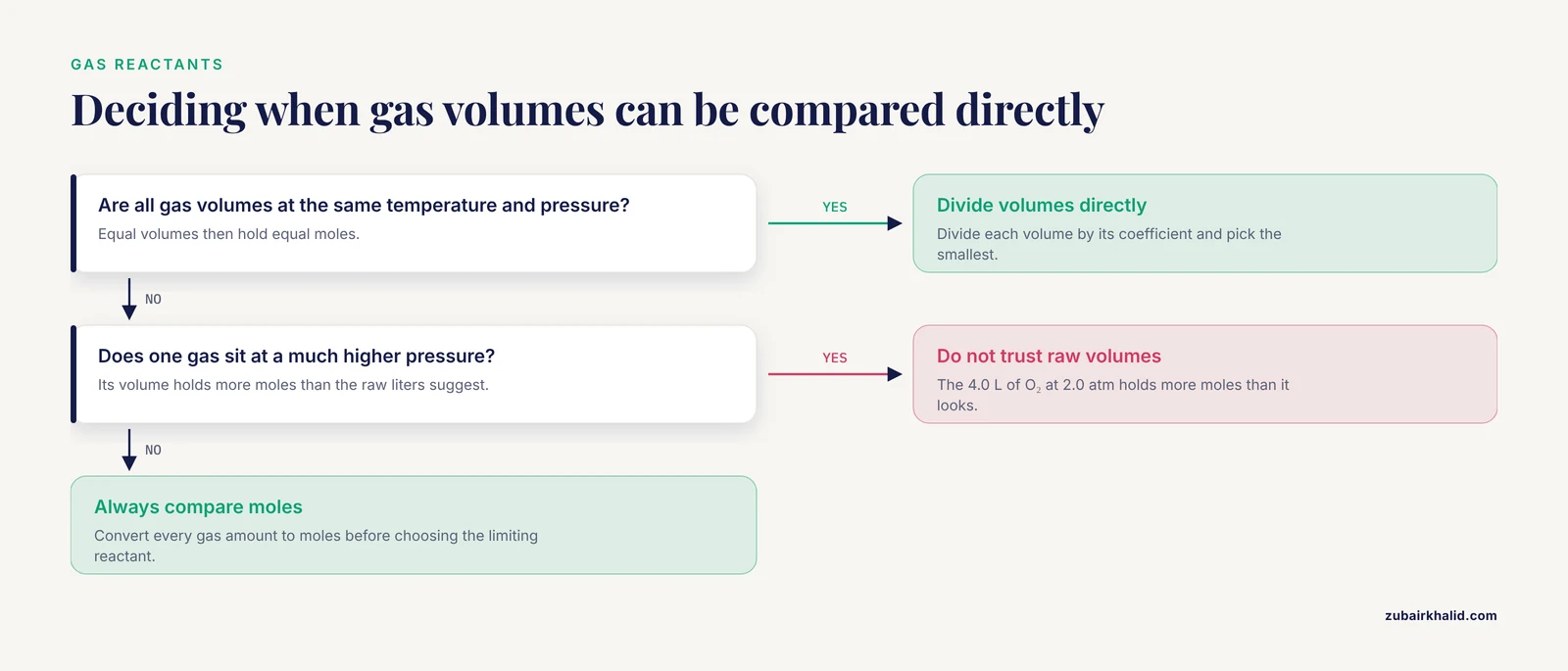
Gas-phase limiting reactant problems often look simpler than they are because volumes are easy to measure. A volume is not a mole count unless the gas conditions are specified. The ideal gas law connects them: PV = nRT, where P is pressure, V is volume, n is moles, R is the gas constant, and T is absolute temperature. Use it to convert each gas amount to moles before comparing reactants.
At the same temperature and pressure, equal volumes of different gases contain equal numbers of moles. For a reaction written entirely in gases, such as N₂ + 3 H₂ → 2 NH₃, volume ratios then match mole ratios. If every gas volume is measured at the same T and P, you can divide each reactant volume by its coefficient and choose the smallest result. That shortcut fails when the gases are measured under different conditions.
Worked example with different pressures
Consider 2 H₂ + O₂ → 2 H₂O. You have 10.0 L of H₂ at 0.50 atm and 4.0 L of O₂ at 2.0 atm, both at 300 K. Use R = 0.08206 L atm mol⁻¹ K⁻¹.
- H₂: n = (0.50 atm)(10.0 L) / (0.08206 × 300) = 0.203 mol
- O₂: n = (2.0 atm)(4.0 L) / (0.08206 × 300) = 0.325 mol
Divide by coefficients:
- H₂: 0.203 / 2 = 0.102
- O₂: 0.325 / 1 = 0.325
H₂ is the limiting reactant. The reaction consumes 0.102 mol O₂, leaving 0.223 mol O₂. The theoretical yield of water is 0.203 mol, because 2 mol H₂ produces 2 mol H₂O.
The common mistake
Comparing the raw volumes gives 10.0 / 2 = 5.0 for H₂ and 4.0 / 1 = 4.0 for O₂. That comparison makes O₂ look limiting, but it ignores pressure. The O₂ is at four times the pressure of the H₂, so its 4.0 L contains more moles than the raw volume suggests. Always convert to moles when pressure or temperature differs. The same error occurs when one gas is measured at room temperature and another at an elevated temperature, or when a volume is reported at STP and another at reaction conditions.
For gas reactants, write the balanced equation, convert every volume to moles with PV = nRT, divide each mole value by its coefficient, and identify the smallest ratio. Use the direct volume shortcut only when all gas volumes are measured at the same temperature and pressure.
Limiting Reactant with Impure Reactants and Percent Purity
Reagents in the laboratory and in industry are rarely pure. A bottle labeled "iron ore" contains iron oxide mixed with gangue, the waste rock. A reagent grade chemical may contain water or other impurities. The balanced equation describes the reaction of pure substances, so before you can find the limiting reactant you must know how much of the sample is actually the reactant.
Percent Purity and True Moles
Percent purity is the mass fraction of the desired substance in the sample, expressed as a percentage. For a sample with a percent purity of P, the pure mass is:
pure mass = sample mass × (P / 100)
For example, a 100 g sample that is 95% pure contains 95 g of the desired substance and 5 g of impurities. Convert the pure mass to moles using the molar mass. Only the pure portion participates in the reaction. The impurities are spectator material; they do not consume the other reactant or contribute to product.
Worked Example: Iron Ore Reduction
A metallurgist reduces iron(III) oxide with carbon monoxide:
Fe₂O₃ + 3 CO → 2 Fe + 3 CO₂
A 1000.0 g sample of iron ore is 50.0% Fe₂O₃ by mass. It is reacted with 300.0 g of pure CO. Which reactant is limiting?
First find the true mass of Fe₂O₃:
pure Fe₂O₃ = 1000.0 g × 0.500 = 500.0 g
Moles of Fe₂O₃ = 500.0 g / 159.7 g/mol = 3.13 mol Ratio for Fe₂O₃ = 3.13 / 1 = 3.13
Moles of CO = 300.0 g / 28.01 g/mol = 10.71 mol Ratio for CO = 10.71 / 3 = 3.57
Using the ratio method from the earlier section, the smallest ratio is 3.13, so Fe₂O₃ is the limiting reactant. The reaction consumes 3.13 × 3 = 9.39 mol of CO, leaving 10.71 - 9.39 = 1.32 mol of CO unreacted.
Common Mistake: Treating the Whole Sample as Pure
The most common error is to use the total sample mass as if it were all reactant. In this example, using 1000.0 g as the mass of Fe₂O₃ gives 1000.0 / 159.7 = 6.26 mol, a ratio of 6.26. That is larger than the CO ratio of 3.57, so you would wrongly conclude that CO is limiting. The error changes the limiting reactant, the theoretical yield, and the leftover amount.
Always check the label or the problem statement for a purity value. If the purity is given as a percentage, convert it to a decimal before multiplying. If the purity is not given, you may assume the sample is pure, but in real processes that assumption is rarely valid. Impurities can also be reactive. If an impurity reacts with one of the reactants, it must be included in the stoichiometric calculation separately. For most introductory problems, however, impurities are inert and simply dilute the sample.
Related Guides
- Photosynthesis Equation: Reactants, Products and What It Means: Provides another balanced equation example with reactants and products
- Cellular Respiration Equation: Reactants, Products and Formula: Another balanced biological equation for comparing stoichiometry examples
- Sample Datasets for Practice: Where to Find and How to Use Them: Provides practice datasets, though not chemistry-specific
- Where to Find Free Bioinformatics Datasets
- How to Find Annealing Temperature for PCR: A Practical Guide
Frequently Asked Questions
What is the limiting reactant?
The limiting reactant is the substance in a chemical reaction that is used up first. When it is gone, the reaction stops, and no more product can form. The maximum product mass it allows is the theoretical yield.
How do I find the limiting reactant?
Balance the equation, convert every reactant amount to moles, divide each mole value by its stoichiometric coefficient, and identify the smallest result. That reactant is the limiting reactant.
What is the difference between a limiting reactant and an excess reactant?
The limiting reactant is completely consumed and controls product formation. The excess reactant is present in a larger relative amount and some of it remains unreacted when the reaction stops.
Can a reaction have two limiting reactants?
Yes, when reactants are mixed in exactly the stoichiometric ratio, all of them are consumed at the same time. In that special case, every reactant is limiting and none is in excess.
How does a limiting reactant calculator work?
It performs the same steps you do by hand. You enter a balanced equation and the amounts of each reactant, and it converts to moles, divides by coefficients, and reports the limiting reactant and theoretical yield. You should verify its output by hand.
Why does the limiting reactant matter in real life?
It determines how much product a reaction can make, which controls cost, efficiency, and material properties. In industry and materials science, choosing which reactant is limiting is a deliberate design decision.
Sources
- An Injectable, Shape-Retaining Collagen Hydrogel Cross-linked Using Thiol-Maleimide Click Chemistry for Sealing Corneal Perforations.
- Control of chiral symmetry breaking: Interplay between achiral reactant concentration and diffusive asymmetries.
- Getting more out of a Job plot: determination of reactant to product stoichiometry in cases of displacement reactions and n:n complex formation.
- Protein phosphorylation stoichiometry by simultaneous ICP-QMS determination of phosphorus and sulfur oxide ions: a multivariate optimization of plasma operating conditions.