Mutually Exclusive Events: Definition, Formula and Examples
By Dr. Zubair Khalid, DVM, MS, PhD ·
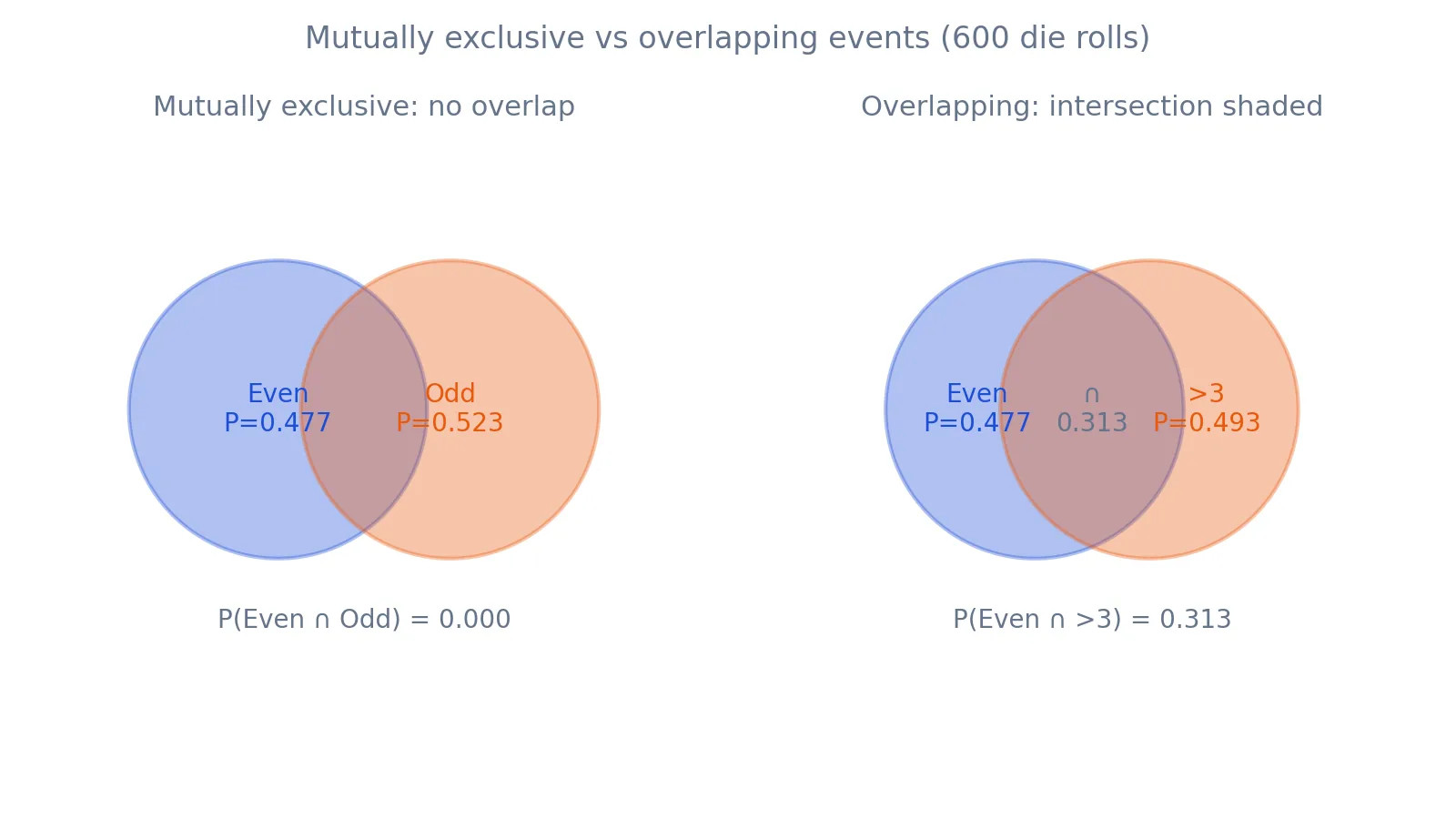
Two events are mutually exclusive when they cannot happen at the same time. If you know one happened, the other did not. The formal test is simple: the probability that both occur together is zero, written $P(A \cap B) = 0$ [1].
That single condition is the whole idea, but applying it correctly takes a bit of care. This article gives you the mutually exclusive definition, the formula, a worked example with real numbers, and the mistakes that trip people up.
Quick Answer
- Mutually exclusive events cannot occur at the same time, so they share no outcomes [1].
- The test is $P(A \cap B) = 0$, where $\cap$ means "and" [1].
- When events are mutually exclusive, the addition rule simplifies to $P(A \cup B) = P(A) + P(B)$ [1].
- When they are not, you must subtract the overlap: $P(A \cup B) = P(A) + P(B) - P(A \cap B)$ [2].
- Mutually exclusive is not the same as independent. Two events can be one, both, or neither [3].
What Mutually Exclusive Means
In plain language, mutually exclusive means "if one happens, the other cannot." A single coin flip cannot land heads and tails at once. A student cannot be a freshman and a sophomore at the same time [1]. Those pairs are mutually exclusive.
The precise statistical definition is about shared outcomes. Two events $A$ and $B$ are mutually exclusive if they have no outcomes in common, which means the intersection $A \cap B$ is the empty set and $P(A \cap B) = 0$ [1][4].
The word "mutually" matters. It describes a relationship between two or more events, not a property of one event alone. You always ask whether this event and that event can co-occur.
A useful contrast: "freshman" and "sophomore" are mutually exclusive, but "freshman" and "business major" are not, because one student can be both [1]. The second pair overlaps, so it fails the test.
How It Works
The mechanism is set intersection. The intersection of $A$ and $B$, written $A \cap B$, is the set of outcomes that belong to both events [1]. If that set is empty, the events are mutually exclusive.
$$P(A \cap B) = 0 \quad \text{means } A \text{ and } B \text{ are mutually exclusive}$$
Here is what each symbol means:
| Symbol | Meaning |
|---|---|
| $A$, $B$ | Two events you are comparing |
| $\cap$ | "And", the intersection of two events [1] |
| $\cup$ | "Or", the union of two events [1] |
| $P(A \cap B)$ | Probability both events happen together |
| $P(A \cup B)$ | Probability at least one of them happens |
The general addition rule is:
$$P(A \cup B) = P(A) + P(B) - P(A \cap B)$$
When $A$ and $B$ are mutually exclusive, the last term is zero, so the rule collapses to $P(A \cup B) = P(A) + P(B)$ [1]. That shortcut is convenient but easy to misuse. It is safest to write the full rule with the intersection and then set the intersection to zero only when you have confirmed it is zero [1].
Worked Example
The dataset is a frequency table of 600 fair six-sided die rolls, generated with a fixed seed, with parity and a "greater than 3" flag recorded for each face.
| face | count | parity | gt3_flag |
|---|---|---|---|
| 1 | 109 | odd | <=3 |
| 2 | 98 | even | <=3 |
| 3 | 97 | odd | <=3 |
| 4 | 93 | even | >3 |
| 5 | 108 | odd | >3 |
| 6 | 95 | even | >3 |
The steps, with the computed values:
- Total rolls: $n = 600$.
- Even rolls: $n(\text{Even}) = 286$, so $P(\text{Even}) = 286/600 = 0.4767$.
- Odd rolls: $n(\text{Odd}) = 314$, so $P(\text{Odd}) = 314/600 = 0.5233$.
- Rolls greater than 3: $n(>3) = 296$, so $P(>3) = 296/600 = 0.4933$.
- Even and odd together: $n(\text{Even} \cap \text{Odd}) = 0$, so $P(\text{Even} \cap \text{Odd}) = 0/600 = 0.0000$. These events are mutually exclusive.
- Even and greater than 3 together: $n(\text{Even} \cap >3) = 188$, so $P(\text{Even} \cap >3) = 188/600 = 0.3133$. These events overlap, so they are not mutually exclusive.
For comparison, the theoretical probability of an even roll above 3 on a fair die is $2/6 = 0.3333$, since faces 4 and 6 qualify. The observed 0.3133 sits close to that, which is what you expect from 600 rolls.
import numpy as np
rng = np.random.default_rng(42)
rolls = rng.integers(1, 7, size=600)
even = rolls % 2 == 0
odd  = rolls % 2 == 1
gt3  = rolls > 3
P_even = even.mean()
P_odd  = odd.mean()
P_gt3  = gt3.mean()
P_even_and_odd = (even & odd).mean()
P_even_and_gt3 = (even & gt3).mean()
print(f"P_even={P_even:.4f}, P_odd={P_odd:.4f}, P_gt3={P_gt3:.4f}, P(Even∩Odd)={P_even_and_odd:.4f}, P(Even∩>3)={P_even_and_gt3:.4f}")
Output:
P_even=0.4767, P_odd=0.5233, P_gt3=0.4933, P(Even∩Odd)=0.0000, P(Even∩>3)=0.3133The Even versus Odd pair is disjoint, with an intersection probability of exactly 0.000. The Even versus greater-than-3 pair overlaps, with an intersection probability of 0.313. If you want more practice with the disjoint case, see disjoint events, which is the same concept under a different name.
How to Interpret It
Read the intersection probability first. If it is zero, the events cannot co-occur, and any outcome you observe belongs to at most one of them. If it is greater than zero, some outcomes belong to both, and you must account for that overlap whenever you combine the events.
The size of the overlap tells you how much double-counting you would introduce by naively adding probabilities. In the die example, adding $P(\text{Even}) + P(>3)$ gives $0.4767 + 0.4933 = 0.9700$, but the true probability of at least one of the two is $0.9700 - 0.3133 = 0.6567$. The subtraction removes the rolls counted twice.
Mutual exclusivity is a property of the events as you defined them, not of the underlying random process. Redefine the events and the answer can flip. "Even" and "greater than 3" overlap, but "even" and "odd" never do.
When to Use It
Use the mutually exclusive check whenever you are combining probabilities with "or" or "and." It tells you whether the simple addition rule applies or whether you need the full version with the subtraction term [2].
It is also the right check before building a probability tree or a contingency table, since disjoint branches behave differently from overlapping ones. If you are computing a conditional probability, the mutually exclusive definition tells you something useful too: if $A$ and $B$ are mutually exclusive and both have nonzero probability, then $P(A \mid B) = 0$, because $A$ cannot occur once $B$ has occurred. The conditional probability formula covers that case in detail.
Do not use it as a substitute for independence testing. Mutual exclusivity says nothing about whether one event changes the probability of another in a causal or informational sense. It only says they cannot co-occur.
Mutually Exclusive vs Independent
These two terms are often confused because both describe a relationship between events. They answer different questions.
| Feature | Mutually Exclusive | Independent |
|---|---|---|
| Core question | Can both happen at once? | Does one change the other's probability? |
| Formal condition | $P(A \cap B) = 0$ [1] | $P(A \mid B) = P(A)$ [3] |
| Typical example | Even and odd on one roll | Two separate rolls of a die [3] |
| Can both hold? | Only if one event has probability zero | Yes, in that special case |
| Effect on addition rule | Subtraction term drops out [1] | No effect on the addition rule |
A quick way to remember the difference: mutual exclusivity is about overlap in outcomes, independence is about influence between events [3]. Two events with nonzero probability that are mutually exclusive are automatically dependent, because knowing one occurred tells you the other did not.
Common Mistakes
- Treating "mutually exclusive" and "independent" as synonyms. They are different conditions [3]. Fix: check the intersection probability for exclusivity and the conditional probability for independence.
- Assuming events are mutually exclusive without checking. If you do not know whether $A$ and $B$ are mutually exclusive, assume they are not until you can show otherwise [3]. Fix: compute or inspect $P(A \cap B)$ before simplifying the addition rule.
- Dropping the subtraction term by habit. Using $P(A \cup B) = P(A) + P(B)$ on overlapping events overstates the result. Fix: always write the full rule first, then set the intersection to zero only when it truly is zero [1].
- Judging exclusivity from the labels instead of the outcomes. "Freshman" and "business major" sound unrelated but overlap [1]. Fix: list the outcomes in each event and look for shared members.
- Forgetting that exclusivity depends on how you define the events. The same data can produce disjoint or overlapping events depending on the categories you choose. Fix: state your event definitions explicitly before testing.
- Confusing "or" with exclusive or. In statistics, "A or B" means A, B, or both, unless stated otherwise [1]. Fix: read "or" as "and/or" when applying the union rule.
Limitations
Mutual exclusivity is a binary label, and it hides how close two events are to overlapping. Two events with a tiny intersection probability and two with a large one both fail the test, even though they behave very differently in practice. The label alone does not tell you how much the subtraction term matters.
The concept also says nothing about the size of the events. Two mutually exclusive events can each have probability 0.5, or one can have probability 0.001. Exclusivity only describes whether they share outcomes, not how likely they are. Finally, mutual exclusivity is defined for the events you specify. Change the categories, the time window, or the population, and the answer can change, so the label is only as good as your event definitions.
Frequently Asked Questions
What is the mutually exclusive definition in simple terms?
Two events are mutually exclusive if they cannot both happen at the same time. If one occurs, the other does not. In probability notation, this means $P(A \cap B) = 0$, so the events share no outcomes [1][4].
What is the formula for mutually exclusive events?
The defining condition is $P(A \cap B) = 0$ [1]. When that holds, the addition rule simplifies to $P(A \cup B) = P(A) + P(B)$, because the intersection term drops out [1]. For non-mutually-exclusive events, you keep the subtraction: $P(A \cup B) = P(A) + P(B) - P(A \cap B)$ [2].
Can two events be both mutually exclusive and independent?
Only in a special case. If $A$ and $B$ are mutually exclusive and both have nonzero probability, they are dependent, because knowing one occurred tells you the other did not [3]. They can be both only when at least one event has probability zero.
How do I check whether two events are mutually exclusive?
List the outcomes in each event and look for any outcome that appears in both. If the lists share nothing, the events are mutually exclusive [1]. With data, compute the count of observations in both events. If that count is zero, the events are mutually exclusive, as the die example shows.
Does mutually exclusive mean the events are unrelated?
No. It means they cannot co-occur, which is a statement about shared outcomes, not about cause or influence [3]. Two events can be mutually exclusive and still be strongly related, such as "rolls a 1" and "rolls a 6" on a single die.
References
- 3.1.5: Union and Intersection - Mathematics LibreTexts
- 4.7: Chapter 4 Formulas - Statistics LibreTexts
- 3.2: Independent and Mutually Exclusive Events - Statistics LibreTexts/03%3A_Probability/3.02%3A_Independent_and_Mutually_Exclusive_Events)
- 3.3: Independent and Mutually Exclusive Events - Statistics LibreTexts
Further Reading
- NIST/SEMATECH e-Handbook of Statistical Methods
- OpenStax. Introductory Statistics 2e
- Krzywinski M, Altman N (2013). Importance of being uncertain. Nature Methods