Disjoint Events: Definition and Probability Examples
By Dr. Zubair Khalid, DVM, MS, PhD ·
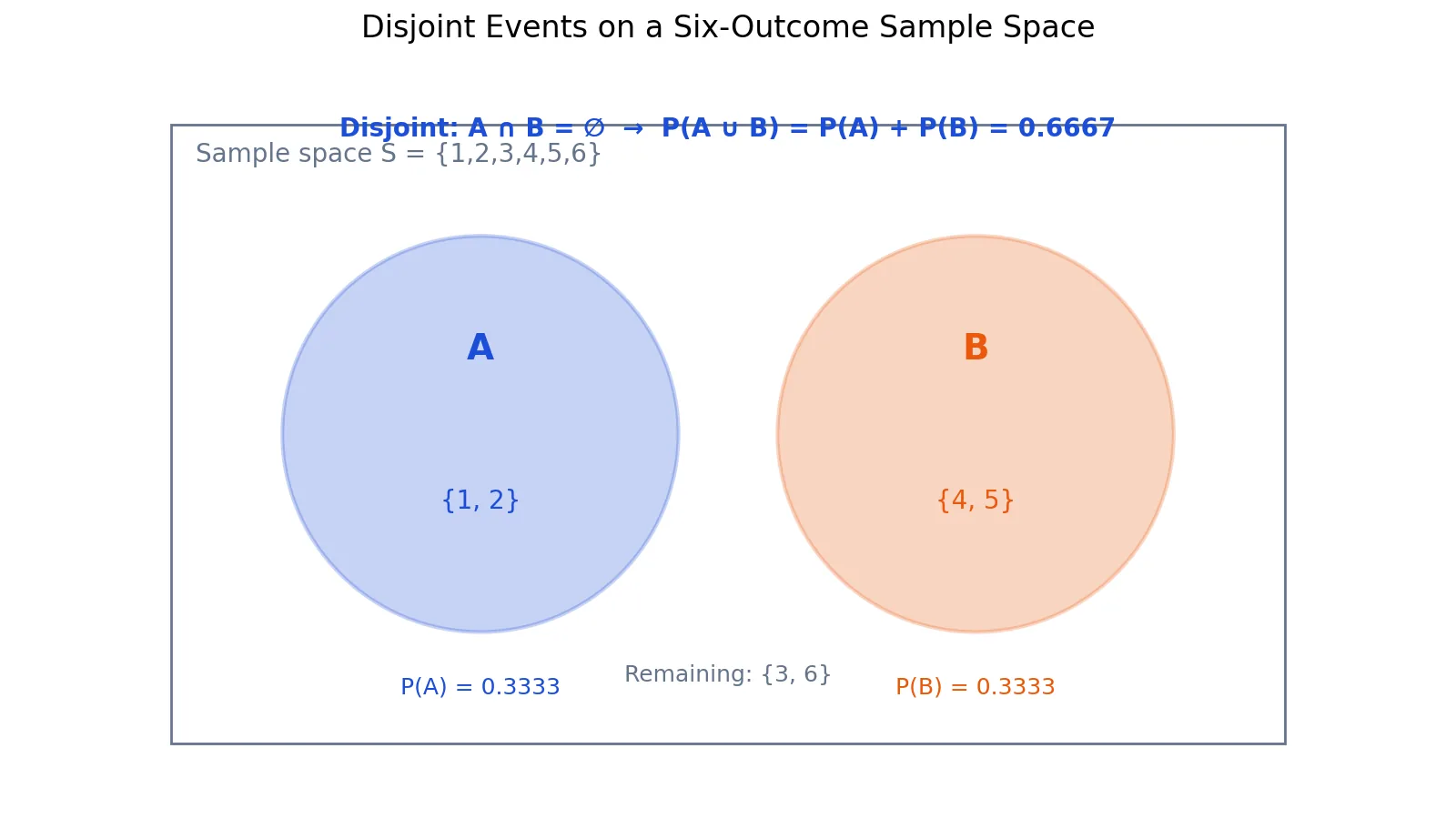
Disjoint events are events that cannot occur at the same time. If two events are disjoint, their intersection is empty, so the probability that both happen is zero. That single fact makes the disjoint definition one of the most useful shortcuts in basic probability.
Quick Answer
- Two events are disjoint when they share no outcomes, so $A \cap B = \emptyset$.
- The probability of both occurring is zero: $P(A \cap B) = 0$.
- For disjoint events, the addition rule simplifies to $P(A \cup B) = P(A) + P(B)$.
- Disjoint is the same idea as mutually exclusive. The two terms are used interchangeably.
- Disjoint events cannot be independent unless at least one of them has probability zero.
What Disjoint Events Mean
In plain language, disjoint events are outcomes that rule each other out. If one happens, the other cannot. Rolling a 1 and rolling a 4 on the same die are disjoint because a single roll produces exactly one face.
The precise statistical definition: events $A$ and $B$ are disjoint if and only if their intersection is the empty set.
$$A \cap B = \emptyset$$
This is the same condition used for mutually exclusive events, and the disjoint definition applies to any number of events. A collection of events is pairwise disjoint when every pair shares no outcomes. A collection is collectively exhaustive when the events together cover the entire sample space.
The sample space itself is the set of all possible outcomes. For a fair six-sided die, $S = \{1, 2, 3, 4, 5, 6\}$. Any two non-overlapping subsets of $S$ are disjoint.
How It Works
Probability for disjoint events rests on the addition rule. For any two events:
$$P(A \cup B) = P(A) + P(B) - P(A \cap B)$$
Each symbol means the following.
| Symbol | Meaning |
|---|---|
| $A$, $B$ | Events, or sets of outcomes |
| $A \cap B$ | The intersection, outcomes in both events |
| $A \cup B$ | The union, outcomes in either event |
| $P(A)$ | Probability that event $A$ occurs |
| $P(A \cap B)$ | Probability that both events occur |
When $A$ and $B$ are disjoint, $P(A \cap B) = 0$, so the subtraction term disappears:
$$P(A \cup B) = P(A) + P(B)$$
This is why disjointness matters. It turns a general formula into simple addition. You can add probabilities directly without worrying about double-counting shared outcomes.
For discrete outcomes, probability is the count of favorable outcomes divided by the size of the sample space. The NIST/SEMATECH e-Handbook describes discrete probability functions as assigning each value a probability between zero and one, with all probabilities summing to one [1]. That sum-to-one property is what guarantees at least one outcome must occur.
Worked Example
The dataset is 20 rolls of a fair six-sided die, recorded as a deterministic sequence of faces.
| roll_index | face |
|---|---|
| 1 | 3 |
| 2 | 1 |
| 3 | 5 |
| 4 | 2 |
| 5 | 6 |
| 6 | 4 |
| 7 | 1 |
| 8 | 3 |
| 9 | 5 |
| 10 | 2 |
| 11 | 6 |
| 12 | 4 |
| 13 | 2 |
| 14 | 5 |
| 15 | 1 |
| 16 | 6 |
| 17 | 3 |
| 18 | 4 |
| 19 | 2 |
| 20 | 5 |
Define two events. Event $A$ is rolling a 1 or a 2. Event $B$ is rolling a 4 or a 5.
| Step | Value |
|---|---|
| Sample space $S$ | $S = \{1, 2, 3, 4, 5, 6\}$, $\lvert S \rvert = 6$ |
| Event $A$ | $A = \{1, 2\}$, $\lvert A \rvert = 2$ |
| Event $B$ | $B = \{4, 5\}$, $\lvert B \rvert = 2$ |
| Intersection $A \cap B$ | $A \cap B = \emptyset$, $\lvert A \cap B \rvert = 0$ |
| Disjoint check | $A \cap B = \emptyset$, so $A$ and $B$ are disjoint |
| $P(A)$ | $\lvert A \rvert / \lvert S \rvert = 2/6 = 0.3333$ |
| $P(B)$ | $\lvert B \rvert / \lvert S \rvert = 2/6 = 0.3333$ |
| $P(A \cap B)$ | $0/6 = 0.0000$ |
| Addition rule | $P(A \cup B) = P(A) + P(B) - P(A \cap B)$ |
| $P(A \cup B)$ | $0.3333 + 0.3333 - 0.0000 = 0.6667$ |
| Simplified (disjoint) | $P(A \cup B) = P(A) + P(B) = 0.3333 + 0.3333 = 0.6667$ |
| Empirical check (20 rolls) | count of $A$ or $B$ = 14, frequency = $14/20 = 0.7000$ |
The theoretical probability is $0.6667$, which is $4/6$. The empirical frequency from the 20 rolls is $0.7000$. The two differ because 20 rolls is a small sample, and random variation is expected. As the number of rolls grows, the empirical frequency tends toward the theoretical value.
Here is the same calculation in Python.
A = {1, 2}
B = {4, 5}
S = {1, 2, 3, 4, 5, 6}
P_A = len(A) / len(S)
P_B = len(B) / len(S)
P_A_and_B = len(A & B) / len(S)   # 0 because disjoint
P_A_or_B = P_A + P_B - P_A_and_B
print(round(P_A_or_B, 4))  # 0.6667
Output:
0.6667How to Interpret It
The result $P(A \cup B) = 0.6667$ means that on a single roll, there is about a 66.67 percent chance of landing on a 1, 2, 4, or 5. The remaining probability, $0.3333$, belongs to the outcomes 3 and 6, which are outside both events.
Notice that the two probabilities add cleanly because the events do not overlap. If $A$ and $B$ shared an outcome, adding them would count that outcome twice, and you would need to subtract the overlap. Disjointness removes that step.
The empirical frequency of $0.7000$ is a reminder that probability describes long-run behavior, not a guarantee for any small batch. Fourteen of the twenty rolls landed in $A$ or $B$, slightly above the expected two-thirds.
When to Use It (and when not to)
Use the disjoint addition rule when you can confirm the events share no outcomes. This comes up often in card games, dice, survey categories, and any situation where outcomes fall into separate buckets.
Use it when you want the probability of "either this or that" and the two options cannot both be true. A respondent cannot be in two exclusive income brackets at once. A single card cannot be both a heart and a spade.
Do not use it when events can overlap. If you want the probability of drawing a heart or a face card, those events share outcomes, so you must subtract the intersection. For overlapping events, the general addition rule and conditional probability are the right tools.
Do not assume disjointness just because two events look different. Always check the intersection. Two events can seem unrelated yet share outcomes.
Disjoint Events vs Independent Events
These two ideas are often confused, but they describe different things. Disjointness is about whether events can occur together. Independence is about whether one event changes the probability of the other.
| Feature | Disjoint Events | Independent Events |
|---|---|---|
| Can occur together | No | Yes |
| Intersection probability | $P(A \cap B) = 0$ | $P(A \cap B) = P(A) \times P(B)$ |
| Effect of one on the other | One rules out the other | One does not change the other |
| Typical example | Rolling a 1 or a 4 | Two separate coin flips |
A key consequence: disjoint events with positive probability are never independent. If $A$ happens, $B$ becomes impossible, so $A$ clearly changes the probability of $B$. Independence requires that knowing one event tells you nothing about the other.
Common Mistakes
- Treating disjoint events as independent. If two events cannot co-occur, they are dependent by definition. The fix is to check whether $P(A \cap B)$ equals $P(A) \times P(B)$, which it cannot when both probabilities are positive and the events are disjoint.
- Adding probabilities for overlapping events. Adding $P(A) + P(B)$ when the events share outcomes double-counts the overlap. The fix is to subtract $P(A \cap B)$.
- Assuming disjointness without checking. Two events may look separate but share an outcome. The fix is to list the outcomes of each event and compare them directly.
- Confusing disjoint with exhaustive. Disjoint events do not have to cover the whole sample space. The fix is to verify that the union equals $S$ before calling a set of events exhaustive.
- Forgetting that disjointness applies to the events, not the outcomes. Individual outcomes are always disjoint from each other, but events are sets of outcomes. The fix is to define events as sets and test their intersection.
- Ignoring sample size when comparing to observed data. A small sample can deviate from the theoretical probability. The fix is to use more trials before judging whether the model fits.
Limitations
The disjoint addition rule only works when the intersection is truly empty. If you apply it to overlapping events, you overstate the probability of the union. The error equals the size of the overlap, which can be large when events share many outcomes.
Disjointness also says nothing about whether events are equally likely. Two disjoint events can have very different probabilities. The rule handles the addition, but you still need a correct model for each individual probability. For continuous distributions, the picture changes, since the probability at any single point is zero and probabilities are measured over intervals [1]. That makes the probability distribution the right frame instead of counting outcomes.
Frequently Asked Questions
What is the disjoint definition in probability?
Two events are disjoint when they have no outcomes in common, so their intersection is the empty set. This means they cannot both occur in the same trial. The probability of both happening is therefore zero.
Are disjoint and mutually exclusive the same thing?
Yes. Disjoint and mutually exclusive describe the identical condition: $A \cap B = \emptyset$. The terms are interchangeable, and textbooks use both. Some sources prefer mutually exclusive, while others prefer disjoint.
Can disjoint events be independent?
No, not when both have positive probability. If $A$ and $B$ are disjoint and $P(A) > 0$, then knowing $A$ occurred means $B$ cannot occur, so $P(B \mid A) = 0$. Independence would require $P(B \mid A) = P(B)$, which fails unless $P(B) = 0$.
How do you find the probability of disjoint events?
Add their individual probabilities. For disjoint $A$ and $B$, $P(A \cup B) = P(A) + P(B)$. If you are counting equally likely outcomes, divide the count of favorable outcomes by the total number of outcomes in the sample space.
What is the difference between disjoint and exhaustive events?
Disjoint means the events do not overlap. Exhaustive means the events together cover the entire sample space. A set of events can be disjoint without being exhaustive, exhaustive without being disjoint, both, or neither. When events are both disjoint and exhaustive, their probabilities sum to one.
References
Further Reading
- NIST/SEMATECH e-Handbook of Statistical Methods
- OpenStax. Introductory Statistics 2e
- Krzywinski M, Altman N (2013). Importance of being uncertain. Nature Methods
- Krzywinski M, Altman N (2013). Significance, P values and t-tests. Nature Methods
- Wasserstein RL, Lazar NA (2016). The ASA Statement on p -Values: Context, Process, and Purpose. The American Statistician