Example of a Ratio: Definition and Real Data Examples
By Dr. Zubair Khalid, DVM, MS, PhD ·
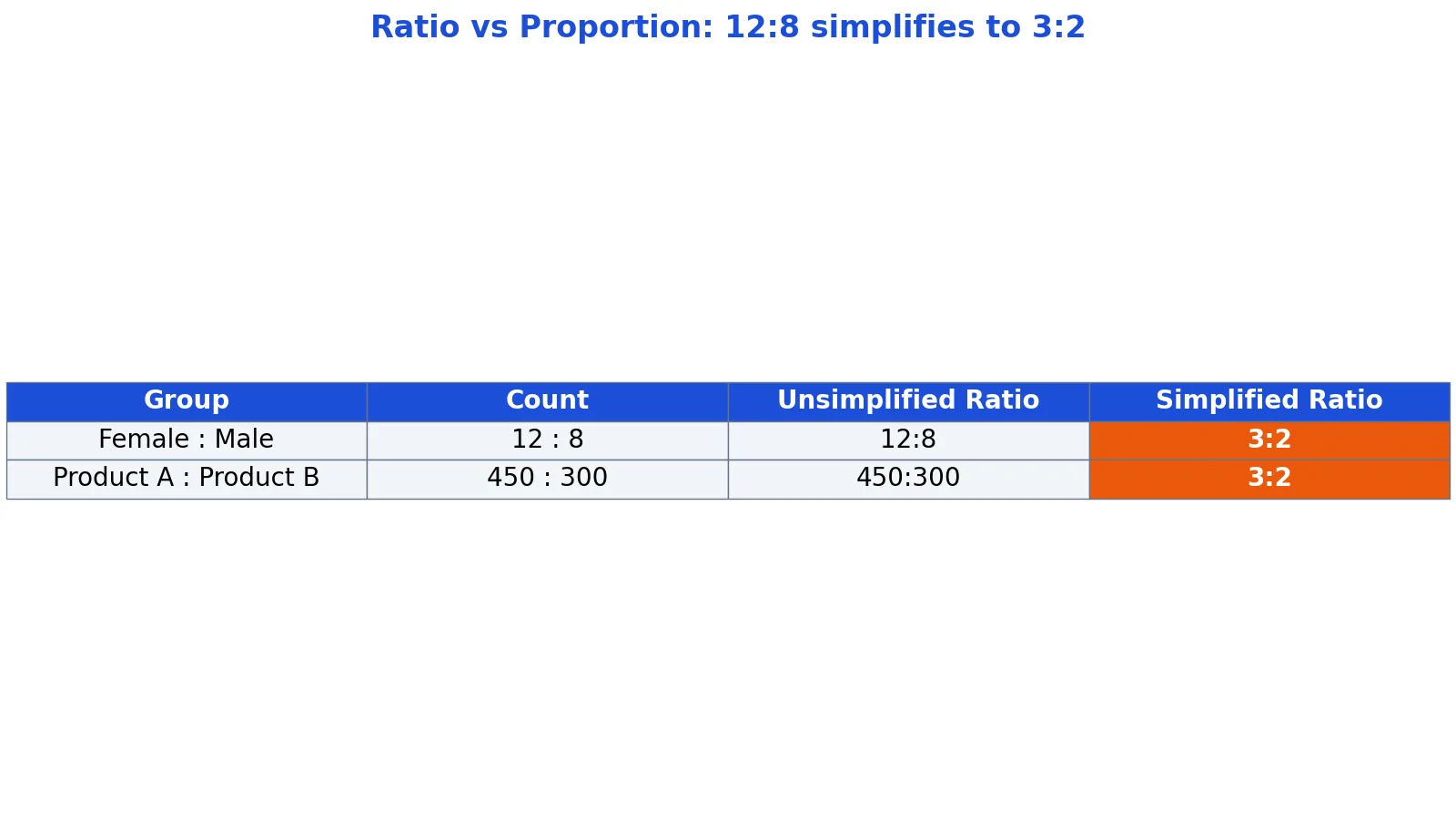
A ratio compares two quantities of the same kind, and a simple example of a ratio is 12 females to 8 males in a class, which simplifies to 3:2. Ratios are written with a colon, as a fraction, or in words, and they stay meaningful only when you know what the two parts represent. This article walks through a real dataset, simplifies the ratios step by step, and shows where a ratio ends and a proportion or a rate begins.
Quick Answer
- A ratio compares two quantities, written as $a:b$, $\frac{a}{b}$, or "a to b" [1].
- Ratios can be part-to-part (females to males) or part-to-whole (females to the whole class).
- Simplify a ratio by dividing both parts by their greatest common divisor, so 12:8 becomes 3:2.
- A proportion is a part-to-whole comparison expressed as a decimal or fraction, like 12/20 = 0.6000.
- A rate compares two quantities with different units, like 450 sales over 2 months = 225 sales per month.
What a Ratio Means
In plain terms, a ratio tells you how much of one thing there is relative to another. If a class has 12 females and 8 males, the ratio of females to males is 12 to 8. That single statement captures the relative size of the two groups without telling you the total.
The precise statistical definition is a quotient that expresses the relative magnitude of two quantities measured in the same units [1]. When the two quantities share units, the ratio is a pure number with no unit attached. When they do not share units, the result is usually called a rate or a density instead [1]. That distinction matters because it changes how you read the number. A ratio of 3:2 says nothing about how many people are in the room. A rate of 225 sales per month says exactly how fast something is happening.
Ratios appear constantly in data work. Population density (people per unit area), gasoline consumption (distance per unit of fuel) and velocity (distance per unit time) divide quantities with different units, which is why they are usually called rates [1]. Each one compresses two measurements into a single comparable figure.
How It Works
The mechanism is division. For two quantities $a$ and $b$, the ratio is:
$$a:b = \frac{a}{b}$$
Each symbol means the following:
- $a$ is the first quantity, called the antecedent.
- $b$ is the second quantity, called the consequent.
- The colon in $a:b$ is read as "to" and signals a comparison, not a division you must carry out.
To simplify, find the greatest common divisor (GCD) of $a$ and $b$, then divide both parts by it:
$$a:b = \frac{a}{g} : \frac{b}{g}, \quad g = \gcd(a, b)$$
The GCD is the largest whole number that divides both $a$ and $b$ with no remainder. Simplifying does not change the value of the ratio, only how it looks. The ratio 12:8 and the ratio 3:2 describe the same relationship.
A proportion uses the same division but a different denominator. Instead of comparing one part to another part, you compare one part to the total:
$$\text{proportion} = \frac{\text{part}}{\text{whole}}$$
A rate divides two quantities with different units and keeps the units in the answer, which is why a rate reads as "per" something.
Worked Example
The dataset below holds gender counts for a class and monthly sales counts for two products.
| Group | Count |
|---|---|
| Female | 12 |
| Male | 8 |
| Product A | 450 |
| Product B | 300 |
Step 1: Count each group. There are 12 females and 8 males.
Step 2: Write the unsimplified ratio. Females to males is 12:8.
Step 3: Find the GCD. The GCD of 12 and 8 is 4.
Step 4: Divide both parts by the GCD. 12/4 : 8/4 = 3:2. The simplified female-to-male ratio is 3:2.
Step 5: Compute the proportions. The whole class is 12 + 8 = 20. The proportion female is 12/20 = 0.6000, and the proportion male is 8/20 = 0.4000. Notice that these two proportions add to 1, which is what part-to-whole comparisons do.
Step 6: Repeat for the sales data. Product A sold 450 units and Product B sold 300 units, so the unsimplified sales ratio is 450:300. The GCD of 450 and 300 is 150, so the simplified sales ratio is 3:2.
Step 7: Compute the rates. Over 2 months, Product A sold 450/2 = 225.0000 units per month, and Product B sold 300/2 = 150.0000 units per month.
Here is the code that produced the ratio and proportion values:
from math import gcd
f, m = 12, 8
g = gcd(f, m)
print(f'{f}:{m} simplifies to {f//g}:{m//g}')  # 3:2
print(f'Proportion female = {f}/{f+m} = {f/(f+m):.4f}')  # 0.6000
Output:
12:8 simplifies to 3:2
Proportion female = 12/20 = 0.6000
The table below collects the results.
| Measure | Value |
|---|---|
| Female-to-male ratio (unsimplified) | 12:8 |
| Female-to-male ratio (simplified) | 3:2 |
| Proportion female | 0.6000 |
| Proportion male | 0.4000 |
| Sales ratio (unsimplified) | 450:300 |
| Sales ratio (simplified) | 3:2 |
| Rate, Product A per month | 225.0000 |
| Rate, Product B per month | 150.0000 |
How to Interpret It
Read a ratio as a relative comparison, not an absolute count. A 3:2 ratio of females to males could describe a class of 5 people, a class of 20, or a class of 2,000. The ratio alone cannot tell you the size of the group, so always report the underlying counts alongside it.
Read a proportion as a share of the whole. The proportion female of 0.6000 means 60% of the class is female. Proportions always fall between 0 and 1 when the parts are non-negative and sum to the whole.
Read a rate as a speed or intensity. Product A moving 225 units per month is faster than Product B at 150 units per month. The two rates keep the same 3:2 relationship as the sales totals because both products were measured over the same 2 months, but only the rates tell you how fast each product sells.
When you compare ratios across groups, check that the units and the definitions match. Comparing a female-to-male ratio to a sales ratio is meaningless because the underlying quantities are unrelated. If you are working with different measurement scales, review types of data: nominal, ordinal, interval, ratio to confirm which comparisons are valid.
When to Use It (and when not to)
Use a ratio when you want to compare two quantities of the same kind and the total is not the focus. Ratios are the natural choice for part-to-part comparisons like win-to-loss records, ingredient mixes, or the female-to-male split in the example above.
Use a proportion when the total matters. If you need to know what share of a class, budget, or population falls into a category, a proportion communicates that directly. The article what is a proportion covers the formula and the part-to-whole logic in more detail.
Use a rate when the two quantities have different units and you want a per-unit figure. Sales per month, miles per gallon, and cases per 1,000 people are all rates.
Avoid ratios when the two quantities are measured on incompatible scales or when the denominator can be zero. A ratio with a zero denominator is undefined, and a ratio between unrelated variables invites false comparisons. If your data are counts of categories, start with quantitative data examples to confirm the variable types before you divide anything.
Ratio vs Proportion
The closest related idea is the proportion. Both use division, but they answer different questions.
| Feature | Ratio | Proportion |
|---|---|---|
| Comparison type | Part to part | Part to whole |
| Example from the dataset | 12:8, simplified to 3:2 | 12/20 = 0.6000 |
| Typical notation | $a:b$ or $\frac{a}{b}$ | $\frac{\text{part}}{\text{whole}}$ |
| Range | Any non-negative value | 0 to 1 for non-negative parts |
| Units | Same units, cancels out | Same units, cancels out |
| Question answered | How do the two groups compare? | What share of the total is this group? |
A rate is the third member of this family. It divides quantities with different units and keeps a unit in the result, like 225 sales per month. For a deeper look at ratios built from probability, see the likelihood ratio test.
Common Mistakes
- Confusing a ratio with a proportion. Writing "the ratio of females is 0.6000" mixes the two. Fix it by saying "the proportion of females is 0.6000" and reserving "ratio" for part-to-part comparisons like 3:2.
- Forgetting to simplify. Leaving 12:8 unsimplified is not wrong, but 3:2 is easier to compare across groups. Fix it by dividing both parts by their GCD.
- Dropping the underlying counts. A 3:2 ratio hides whether the group has 5 people or 5,000. Fix it by reporting the raw counts next to the ratio.
- Dividing by zero. A ratio with a zero consequent is undefined. Fix it by checking the denominator before you compute, and report "undefined" or "not applicable" when it is zero.
- Comparing ratios with different units. A female-to-male ratio and a sales ratio cannot be compared directly. Fix it by confirming both ratios use the same kind of quantity.
- Treating a rate as a ratio. Saying "the ratio of sales is 225 per month" mislabels a rate. Fix it by calling it a rate and keeping the "per month" unit.
Limitations
A ratio compresses two numbers into one, and that compression loses information. You cannot recover the original counts from a simplified ratio, so a report that shows only 3:2 leaves the reader unable to judge the sample size or the precision of the estimate. Always pair a ratio with the raw counts.
Ratios also mislead when the denominator is small or unstable. A ratio built on 2 observations can swing wildly with one new data point, while the same ratio built on 2,000 observations is stable. Ratios of averages, such as a ratio of two means, inherit the uncertainty of both means and should be reported with confidence intervals when the data come from a sample. Finally, a ratio says nothing about causation. Two quantities can form a tidy ratio without any real relationship between them.
Frequently Asked Questions
What is an example of a ratio in everyday life?
A class with 12 females and 8 males gives a female-to-male ratio of 12:8, which simplifies to 3:2. Recipes, sports records, and map scales all use ratios in the same way. Any time you compare two quantities of the same kind, you are working with a ratio.
How do you simplify a ratio?
Find the greatest common divisor of both parts, then divide each part by it. For 12:8, the GCD is 4, so 12/4 : 8/4 gives 3:2. The simplified ratio describes the same relationship as the original.
What is the difference between a ratio and a rate?
A ratio compares two quantities with the same units, so the units cancel and you get a pure number. A rate compares quantities with different units and keeps a unit in the answer, like 225 sales per month. The sales ratio of 450:300 simplifies to 3:2, while the rate for Product A is 225 units per month.
Can a ratio be written as a fraction?
Yes. The ratio $a:b$ is equivalent to the fraction $\frac{a}{b}$, and both forms are common in statistics. Just remember that a ratio written as a fraction still compares two parts, not a part to a whole, unless you deliberately choose the total as the denominator.
Is a proportion the same as a ratio?
No. A proportion is a part-to-whole comparison, like 12/20 = 0.6000, while a ratio is a part-to-part comparison, like 12:8. They use the same division operation but different denominators, which is why the two numbers differ even when they come from the same dataset.
References
Further Reading
- NIST/SEMATECH e-Handbook of Statistical Methods
- OpenStax. Introductory Statistics 2e
- Krzywinski M, Altman N (2013). Importance of being uncertain. Nature Methods
- Krzywinski M, Altman N (2013). Significance, P values and t-tests. Nature Methods
- Wasserstein RL, Lazar NA (2016). The ASA Statement on p -Values: Context, Process, and Purpose. The American Statistician
Related Articles
- Quantitative Data Examples: Definition and Types
- What Is a Proportion? Definition, Formula and Examples
- Negative Correlation Examples: Definition and Real Data Cases
- Dataset Examples: Types of Data Sets With Real Samples
- Likelihood Ratio Test: Definition, Formula and Examples
- Statistical Questions Examples: How to Write Them