Is Prickly Pear Cactus Toxic to Cats? Spine and Sap Risks
By Dr. Zubair Khalid, DVM, MS, PhD ·
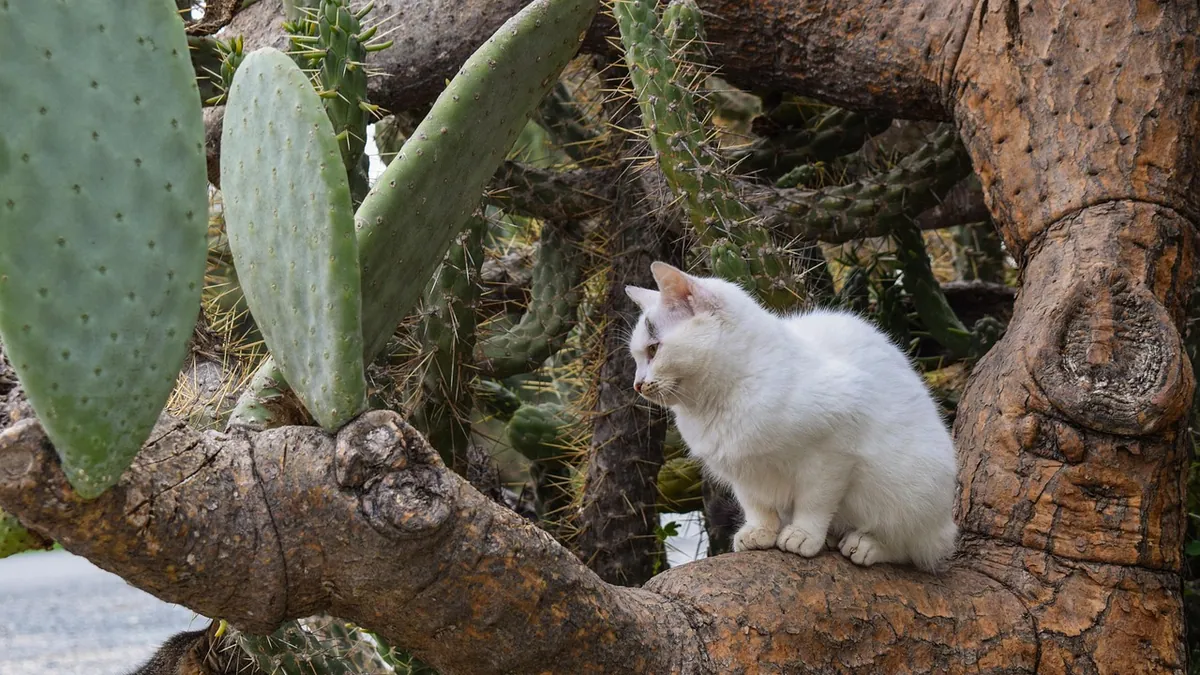
Is prickly pear cactus toxic to cats? No. Prickly pear (Opuntia) cactus is not considered chemically toxic to cats, so eating a small amount of the plant is unlikely to poison your cat. The real danger is physical: the spines and tiny barbed glochids can lodge in skin, eyes, mouth, and paws and cause serious injury.
This article is educational and is not a substitute for veterinary diagnosis or treatment.
Quick Answer
- Prickly pear cactus is not chemically toxic to cats. The problem is mechanical injury from spines and glochids, not poison.
- Glochids are tiny barbed spines that embed in tissue and are very hard to remove. They have been found penetrating the conjunctiva and cornea of a cat's eye [1].
- A cat that chews, rubs, or steps on a prickly pear can develop drooling, pawing at the face, squinting, limping, or skin wounds.
- If you see a spine in your cat's eye, do not try to remove it yourself. Eye injuries from cactus spines need same-day veterinary care.
- Call your veterinarian, the ASPCA Animal Poison Control Center at (888) 426-4435, or Pet Poison Helpline at (855) 764-7661 if your cat ate plant material or has spines stuck in the mouth or throat.
Is Prickly Pear Cactus Toxic to Cats?
No, prickly pear cactus is not known to be chemically toxic to cats. There is no established toxic principle in Opuntia species that poisons cats the way, for example, lilies or sago palms do. If your cat nibbles a pad or a flower, the main concern is stomach upset from eating plant fiber, not poisoning.
That said, "not toxic" does not mean "safe to have around." Prickly pear is one of the more hazardous houseplants and garden plants for a curious cat because of its spines. The injury risk is real and can be severe.
If you are checking your home for dangerous plants, it helps to understand the difference between chemical toxicity and physical hazards. For a broader look at which plants actually poison cats, see What Plants Can Be Toxic To Cats and Plants Toxic To Cats.
Which Parts and Products Matter
- Spines. The large, obvious spines on prickly pear pads can puncture skin, paws, and the mouth. They cause pain and can break off under the skin.
- Glochids. These are the tiny hair-like spines clustered at the base of the larger spines. They are barbed and detach easily, so they stick in whatever touches them [1].
- Pads and flowers. Eating these is not expected to cause poisoning, but the fiber can cause vomiting or diarrhea.
- Fruit. Prickly pear fruit is edible for people, but it still carries glochids on the outside. A cat that bites into it can get spines in the mouth and lips.
- Prepared products. Peeled fruit, juice, jams, and supplements are not a poisoning risk in the amounts a cat might lick, but they are not cat food and offer no benefit.
Opuntia Toxic to Cats: The Toxic Principle and What It Does
There is no toxic principle in prickly pear cactus that harms cats. The harm comes from the physical structure of the spines.
The glochids are the key problem. Under light microscopy and in vivo confocal microscopy, glochids from prickly pear cactus were shown to be heavily barbed [1]. That barbed shape is why they are so hard to pull out. They catch on tissue the way a fishhook catches on skin. Once embedded, they can keep working deeper with movement, and they can drag bacteria into the wound.
In the eye, glochids can penetrate the conjunctiva and cornea. A published case series described a cat and three dogs with cactus-induced keratoconjunctivitis, meaning inflammation of the conjunctiva and cornea caused by cactus spines [1]. All of the animals had one-sided eye problems, and the spines were described as linear and microscopic, which means they were easy to miss on a quick look [1]. One case had bacterial growth from the eye along with keratomalacia, which is softening of the cornea [1].
So the "toxic principle" question has a simple answer. There is no poison. There is a mechanical foreign body that causes pain, inflammation, and infection risk.
Signs of Cactus Spine Injury in Cats
Signs depend on where the spines landed. Watch for these:
Eyes
- Squinting, holding one eye closed, or excessive blinking
- Redness, tearing, or thick discharge from one eye
- Pawing at the face or rubbing the eye against furniture
- Cloudiness or a blue-gray haze over the cornea
- Sensitivity to light
Eye signs often appear within hours of contact and can worsen quickly if the cornea is damaged.
Mouth, Lips, and Tongue
- Drooling or foaming
- Pawing at the mouth
- Reluctance to eat or drink
- Swelling of the lips or tongue
- Visible spines or bristles on the lips or gums
Paws and Skin
- Limping or holding up a paw
- Licking or chewing at one spot
- Small red or swollen areas, sometimes with a visible spine
- A cat that suddenly refuses to walk on a certain surface
Nose and Throat
- Sneezing, pawing at the nose, or nasal discharge
- Coughing, gagging, or difficulty swallowing if spines are in the throat
Timeline
Mechanical signs usually show up fast, often within minutes to a few hours of contact. Eye and skin inflammation tends to be worst in the first 24 to 48 hours. If a spine stays embedded, signs can persist or worsen over days as inflammation and infection develop. There is no delayed poisoning syndrome to watch for, because there is no toxin.
What to Do Right Now
- Move your cat away from the plant. Keep your cat calm and contained in a carrier or small room.
- Do not pull spines out of the eye. Never use tweezers, tape, or your fingers near the eyeball. You can push the spine deeper or scratch the cornea.
- Check the mouth and paws with good light. If you can see a spine on the lip or a paw pad and it lifts out easily with clean tweezers, you can remove it. Stop if your cat struggles or if the spine is deep.
- Do not induce vomiting unless a veterinarian tells you to. Vomiting will not help with spines, and it can push them into the throat or cause more damage on the way up.
- Call for guidance. Contact your veterinarian, the ASPCA Animal Poison Control Center at (888) 426-4435, or Pet Poison Helpline at (855) 764-7661. Poison control lines are useful even when the issue is mechanical, because they can help you decide how urgent the situation is.
- Go to a veterinarian the same day for eye signs. Any squinting, redness, or cloudiness after cactus contact needs an exam [1].
If you are unsure whether a plant in your home is a hazard, What Kind Of Plants Are Harmful To Cats walks through common problem plants.
Veterinary Treatment for Cactus Spine Injuries
Your veterinarian will start with a full exam, including a careful eye exam if the eye is involved. Because glochids are microscopic, they can be missed without magnification [1]. Your vet may use a slit lamp, fluorescein stain to check for corneal ulcers, or other magnification to find spines.
Treatment depends on where the spines are:
- Eye. If a spine is embedded in the conjunctiva or cornea, surgical extraction may be needed, along with medical therapy such as antibiotics, anti-inflammatory drops, or lubricants [1]. In the published case series, three of four animals had foreign body extraction plus medical treatment, and one was treated with medical therapy alone [1].
- Skin and paws. Your vet may remove visible spines, flush the area, and prescribe antibiotics if infection is likely. Soaking the paw can help soften tissue and loosen superficial spines.
- Mouth and throat. Spines in the mouth may be removed under sedation so your cat stays still and safe. Deep spines in the throat may need imaging to locate.
- Medication. Your veterinarian calculates any drug dose from your cat's weight and health status. Do not give human pain relievers to a cat, because several are toxic to cats.
Outlook After a Cactus Injury
The outlook is good when the injury is caught early and the spines are removed. In the reported case series, the animals responded to treatment, though one had corneal softening and bacterial involvement that made the case more complicated [1].
The main risks that affect recovery are:
- Spines left in place. They keep causing pain and inflammation and can migrate deeper.
- Infection. A foreign body in the eye or skin is a pathway for bacteria.
- Corneal damage. Deep ulcers or corneal softening can lead to scarring and vision problems if not treated promptly.
If your cat only brushed against the plant and has no spines you can see, watch closely for 24 to 48 hours. Call your vet if any sign appears.
Prevention and Safer Alternatives
The simplest prevention is to keep prickly pear cactus out of reach or out of the house entirely.
- Place plants where cats cannot get to them. A high shelf is not enough if your cat can jump. Use a closed room or a hanging planter with no nearby launch points.
- Pick up fallen spines and pads. Glochids can stick to floors, rugs, and furniture and then transfer to paws and skin.
- Do not let your cat chew on any cactus. Even spineless varieties can have small bristles.
- Choose cat-safe plants instead. Spider plants, Boston ferns, and certain palms are common alternatives. Always confirm a plant's safety before bringing it home.
- Check bouquets and arrangements. Cactus cuttings sometimes appear in mixed planters.
For a room-by-room list of plants to avoid, see House Plants Toxic To Cat and What Plants Are Toxic To Cats Indoor.
Limitations and When to Contact a Veterinarian
Individual cases vary, and only a veterinarian who examines your cat can tell you how serious the injury is. Use these guidelines:
Emergency now (go to a veterinary hospital):
- A spine is in or near the eye, or your cat is squinting and cannot open the eye
- The eye looks cloudy, blue, or has a visible defect
- Your cat is gagging, coughing, or having trouble breathing
- Your cat is drooling heavily and cannot swallow
- Your cat is in severe pain, crying, or unable to walk
Same day:
- Any eye redness, tearing, or discharge after cactus contact [1]
- Limping that does not improve within an hour
- Visible spines in the mouth, lips, or paw pads that you cannot remove
- Swelling, redness, or discharge at a spine site
Routine visit (within a day or two):
- A few superficial spines on the coat or skin with mild irritation
- Mild drooling that stops on its own
- You are not sure whether your cat actually touched the plant
Frequently Asked Questions
Can my cat die from eating prickly pear cactus?
Death from prickly pear cactus is very unlikely because the plant is not chemically toxic. The serious risks are eye damage, airway obstruction, and infection from embedded spines. A cat with a spine in the eye or throat needs urgent care, but most cases recover well with treatment.
Are the little fuzzy spots on prickly pear dangerous?
Yes, those fuzzy spots are glochids, and they are the most dangerous part of the plant. They are barbed and microscopic, so they embed deeply and are hard to see and remove [1]. They can penetrate the eye and cause keratoconjunctivitis [1].
My cat licked the cactus but seems fine. Should I still call the vet?
Call your veterinarian for advice, especially if you cannot see the whole mouth and tongue. Glochids can be too small to spot at home, and signs may take a few hours to appear. If your cat starts drooling, pawing at the mouth, or squinting, go in the same day.
Can I use tweezers to remove a cactus spine from my cat's eye?
No. Never use tweezers or tape near the eyeball. You can scratch the cornea or push the spine deeper. Eye spines often need surgical extraction by a veterinarian under magnification [1].
Is aloe vera or another home remedy safe to put on a spine wound?
No. Do not apply human creams, oils, or home remedies to a cat's skin or eye. Some ingredients are toxic to cats, and anything applied near the eye can worsen corneal damage. Keep the area clean and let your veterinarian decide on treatment.
Related Articles
- What Plants Can Be Toxic To Cats
- Plants Toxic To Cats
- What Kind Of Plants Are Harmful To Cats
- House Plants Toxic To Cat
- What Plants Are Toxic To Cats Indoor
- Are Snake Plants Toxic To Cats
- Are Cactus Plants Toxic to Cats? Orchid, Coral, and More
- Is Christmas Cactus Toxic to Cats? Holiday Safety
- Is Moon Cactus Toxic to Cats? Grafted Cactus Safety
References
- Cactus-induced keratoconjunctivitis in Texas: A case series of three dogs and one cat. Veterinary ophthalmology, 2020.