Cat-Safe Flowers for Pet-Safe Homes
By Dr. Zubair Khalid, DVM, MS, PhD ·
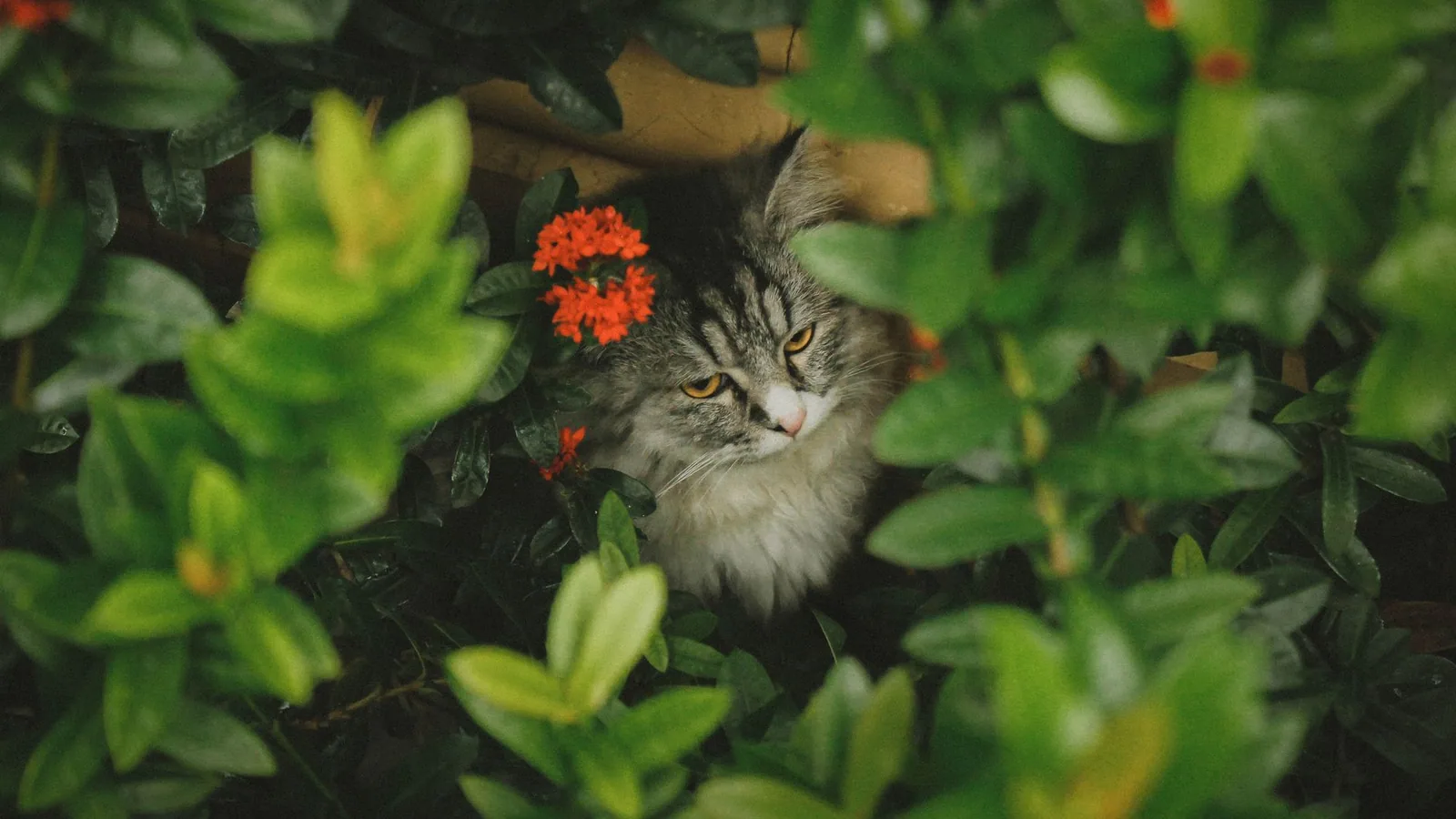
Cat-safe flowers are not a single product category. They are flowers that have been identified to species, checked against feline toxicity information, and placed where a cat cannot chew, lick, or groom them. The safest rule is simple. A flower is a candidate for a cat home only after its botanical name is confirmed and a veterinarian or animal poison service has cleared it for cats.
That answer is less satisfying than a list of "safe" bouquet flowers, but it matches the actual risk. Common flower names are inconsistent. A single bouquet can contain several species, fillers, and pollen-bearing stamens. Cats explore with their mouths and groom their coats. A flower that is harmless to a person can be hazardous to a cat.
This article is educational and is not a substitute for veterinary diagnosis or treatment.
At a Glance
| Action | Why it matters |
|---|---|
| Identify every flower by genus and species | Common names such as "lily" cover both kidney-toxic and heart-toxic plants [1] |
| Exclude true lilies, daylilies, and lily of the valley from cat areas | These plants cause severe feline toxicity [1] |
| Exclude Dracaena houseplants and cut stems | Dracaena species are associated with cat poisoning [2] |
| Do not treat "edible for humans" as "safe for cats" | A review of 119 flower species found toxic compounds in 87% [3] |
| Use a physical barrier, not training alone | Cats can reach flowers on counters, tables, and shelves |
| Photograph the plant label and keep a sample | Identification drives veterinary triage |
| Call a veterinarian or animal poison service after any known exposure | Early advice matters more than waiting for symptoms |
What Cat-Safe Flowers Really Means
The phrase cat-safe flowers describes a process, not a botanical family. No flower is universally safe for every cat, and no bouquet label can replace species-level identification. A florist may use a trade name. A garden center may label a plant by color or season. A herbal product may contain more than one flower species.
The first filter is the scientific name. A plant listed only as "lily" is not enough information. True lilies in the genus Lilium and daylilies in the genus Hemerocallis have caused kidney injury in cats [1]. Lily of the valley, Convallaria, is also called a lily but contains cardiac glycosides similar to digitalis [1]. These are different toxic syndromes. A cat owner who relies on the word "lily" can make the wrong decision in both directions.
The second filter is feline-specific data. Human food use, dog tolerance, and rat toxicity studies do not create a cat-safe label. Some flowers contain toxic compounds, and safety depends on the species and the part eaten. That overlap shows why "people eat it" is not a safety test for a cat. Tea flower extracts have been evaluated for mutagenicity and acute and subchronic toxicity in rats without toxicological concern in that model [4]. That is useful toxicology, but it does not establish safety for cats.
The third filter is physical separation. Even a low-risk flower can cause gastrointestinal upset if a cat chews a large amount. Pollen can fall onto surfaces. Vase water can contain water-soluble plant material. A cat-safe home keeps the arrangement out of the cat's reach, not merely "high enough for now."
Why Flowers Pose a Special Risk to Cats
Cats investigate new objects by sniffing, batting, and mouthing. A bouquet on a dining table is at nose level when a cat jumps onto a chair. A houseplant on a windowsill is in a resting spot. Dracaena plants are common indoor landscaping plants, and the odor released when leaves or flowers are damaged can promote chewing by companion animals [2]. That is a realistic exposure pathway. The plant is not hidden in a garden. It is in the room where the cat rests.
Lily toxicity is especially unforgiving. The whole plant is toxic, including petals, stamens, leaves, and pollen [1]. As little as two leaves or part of a single flower has resulted in deaths [1]. The exact toxic dose and the precise toxins responsible for renal damage are unknown [1]. A cat that walks through a bouquet and grooms pollen off its coat has a plausible exposure. A cat that drinks vase water has another. The water-soluble fraction of the lily is nephrotoxic [1].
Other flowering plants produce chemical defenses that matter in a pet home. Aconitum napellus produces alkaloids in pollen and nectar, and the alkaloids in pollen are more diverse and more concentrated than those in nectar [5]. Erysimum species produce ancestral glucosinolates and novel cardenolides as defenses [6]. These are not decorative details. They explain why a flower can be beautiful to people and chemically active to a cat.
High-Risk Flowers to Keep Out of Cat Homes
| Plant group | Examples | Feline concern | Practical rule |
|---|---|---|---|
| True lilies and daylilies | Lilium, Hemerocallis | Kidney injury, whole plant toxic including pollen [1] | Do not keep in cat homes |
| Lily of the valley | Convallaria | Cardiac glycosides similar to digitalis [1] | Do not keep in cat homes |
| Dracaena | D. fragrans, D. surculosa, D. sanderiana | Cat poisoning reported, plant material and odors promote chewing [2] | Rehome or block access |
| Aconitum | Aconitum napellus | Toxic alkaloids in pollen and nectar [5] | Do not use as a cut flower |
| Erysimum | Wallflower species | Cardenolides and glucosinolates [6] | Keep away from cats |
| German chamomile products | Matricaria recutita | Adulteration with toxic lookalike plants [7] | Verify source and species |
| Cannabis and hemp flowers | Cannabis sativa | Fungal and mycotoxin contamination possible [8] | Keep out of cat areas |
This table is not a complete toxic plant list. It is a minimum exclusion list for a cat home. The plants in it are either documented feline hazards or examples of flower products with known contamination and identification problems. A florist bouquet can contain any of them as a focal flower or a filler.
How to Choose Cat-Safe Flowers
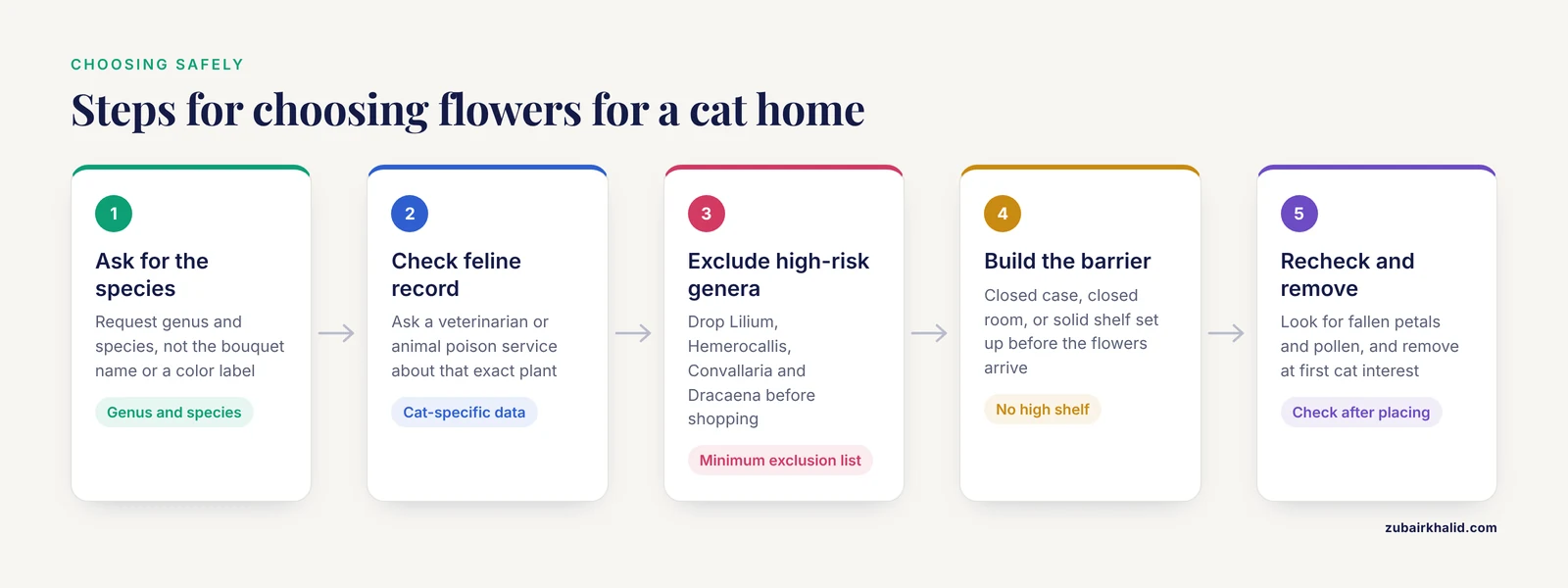
1. Start with the botanical name
Ask for the genus and species, not the bouquet name. Use a botanical reference to confirm the name, such as the Royal Horticultural Society encyclopedia of plants and flowers [9]. If the seller cannot provide a scientific name, treat the flower as unidentified. Unidentified flowers do not belong in a cat home.
2. Check the feline toxicity record
Ask a veterinarian or animal poison service about the exact plant. Do not rely on a dog toxicity list. Do not rely on a human edible flower list. Do not rely on a single web search. The question is specific. Is this genus, species, and cultivar toxic to cats by chewing, pollen, or vase water?
3. Exclude the known high-risk genera
Remove Lilium, Hemerocallis, Convallaria, and Dracaena from the plan before shopping [1]. If a mixed bouquet contains one of these, the whole bouquet is a cat hazard. Removing the visible flower is not enough because pollen and plant fragments remain.
4. Treat "edible" as irrelevant
A Danish review of 23 flowers used by restaurants and local producers found that nine contained compounds with toxic or potentially toxic effects if eaten, two contained unidentified toxic compounds, and four were flowers from plants with potentially toxic compounds in other plant parts or related species [10]. Human culinary use is not a feline safety certificate.
5. Buy from a supplier who can identify the plant
A supplier who can provide the scientific name is more useful than a supplier who offers a color name. Mixed bouquets are harder to verify because each stem, filler, and foliage type needs identification. A single-species arrangement is easier to check, but it is still not automatically safe.
6. Plan the physical barrier before the flowers arrive
Choose a closed display case, a room the cat cannot enter, a hanging planter with no trailing parts at cat height, or a shelf with a solid barrier. The barrier must prevent access to flowers, fallen petals, pollen, leaves, and vase water. A vase on a high table is not a barrier if the cat can jump onto the table.
7. Recheck the arrangement after it is placed
Look for loose stamens, dropped petals, and leaves near the vase. Cats can reach items that fall to the floor. A flower that is safe in the vase can become a floor-level chew toy after one bump.
8. Remove the arrangement at the first sign of cat interest
Chewing is not a failure of training. It is normal cat behavior. If a cat is repeatedly targeting an arrangement, remove the arrangement. Do not rely on bitter sprays, reprimands, or "the cat learned a lesson."
Verification Checklist Before Bringing Flowers Home
Use this checklist for every new flower, even if the species looks familiar.
- The seller provided a genus and species name.
- A botanical reference confirms the name [9].
- A veterinarian or animal poison service has cleared that species for cats.
- The arrangement contains no Lilium, Hemerocallis, Convallaria, or Dracaena [1][2].
- No member of the arrangement is known only by a common name.
- The flowers will be placed behind a physical barrier.
- The cat cannot reach fallen petals, pollen, leaves, or vase water.
- A photo of the label and a sample stem are kept for identification.
- The cat has no history of chewing plants, or the barrier accounts for that behavior.
- The arrangement will be removed if the cat shows interest.
If any item is unchecked, do not bring the flowers into the cat's living space.
Toxic Lookalikes and Adulteration
Flower identification is not a cosmetic issue. German chamomile, Matricaria recutita, is widely used in herbal products, and its raw material is prone to deliberate and unintentional adulteration by morphologically similar flowers [7]. Some of those adulterants are potentially toxic [7]. A product labeled "chamomile" is therefore not proof that the material is only Matricaria recutita.
Lily identification has the same problem. Many plants are called lilies. True lilies and daylilies are nephrotoxic to cats, while lily of the valley causes cardiac glycoside toxicity [1]. Hybrids add another layer of confusion [1]. The public often cannot correctly identify the plants in their own homes [1]. That finding is a warning for every cut flower arrangement. The label on the bouquet is not a botanical identification.
Plant identification apps are a useful first step and a poor final authority. Researchers have specifically tested plant identification apps for toxic plants, which reflects a known accuracy problem in this exact task [11][12]. An app can suggest a genus. It cannot replace a veterinary toxicology assessment for a cat that has already chewed the plant.
Edible Flowers for People Are Not Cat Food
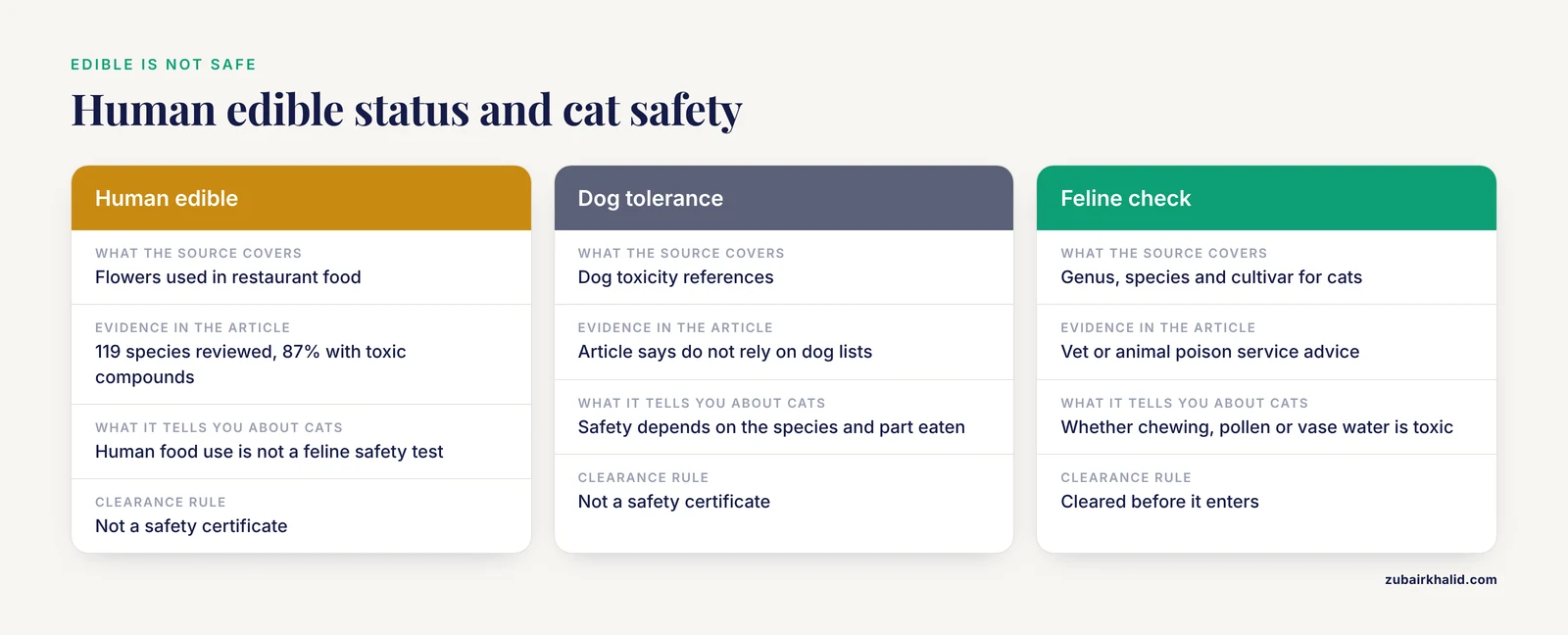
Edible flowers have a place in human cuisine. They do not have a place in cat feeding. A review of 119 flower species found that 87% contain toxic compounds, and 97% have reported medicinal uses [3]. Many of those medicinal uses involve specific molecules and controlled doses, not a cat eating a stem.
The Danish restaurant review is a useful reality check. Of 23 flowers reviewed, nine contained toxic or potentially toxic compounds, two contained unidentified toxic compounds, and four were from plants with potentially toxic compounds in other parts or related species [10]. Those flowers were being used in food service. The review still found a striking lack of chemical and toxicological data for many of the proposed flowers [10].
Even well-studied flowers are not automatically cat-safe. Calendula officinalis flowers have been chemically characterized for bioactive properties [13]. That research is about chemistry and biological activity, not about feline safety. Edible flowers from wild plants can also contain antinutrients [14]. Nutrient content does not cancel a toxic compound.
Handling and Arrangement Safety
Keep the entire arrangement inaccessible. That includes the vase water. Lily toxicity involves a water-soluble fraction that is nephrotoxic [1]. A cat that drinks from a vase is not making a harmless mess. It may be exposed to plant material that has leached into the water.
Place flowers in a room the cat cannot enter, or behind a solid barrier. Avoid open shelves above litter boxes, food bowls, or cat beds. Those are places where a cat spends time and where dropped pollen is likely to land on fur, bedding, or food.
Dispose of trimmed stems, leaves, and petals in a closed trash can. Do not leave them on a counter or in an open bin. A cat can retrieve plant material from a bin. The same applies to floral foam, wrappers, and ribbons. These are not food, and they are not cat toys.
Common Mistakes
Using a common name as a safety check. "Lily" can mean a kidney-toxic Lilium, a heart-toxic Convallaria, or a plant with no lily relationship at all [1].
Assuming pollen is harmless. Lily pollen is toxic, and the whole plant is toxic [1]. A cat can groom pollen off its coat.
Assuming edible flowers are cat-safe. Human food reviews of flowers have found toxic compounds in a large share of species [3][10]. Human edible status is not a feline safety study.
Trusting a plant identification app as the final word. Apps have been specifically studied for toxic plant identification accuracy [11][12]. Use them to generate a name, then verify it.
Keeping a toxic plant "out of reach." Cats jump. Pollen falls. Vase water spills. A barrier is not the same as a high shelf.
Forgetting houseplants. Dracaena is a common indoor plant, and cats have been poisoned by chewing it [2]. Cut flowers are not the only exposure.
Ignoring mixed bouquets. A single toxic filler can contaminate the arrangement. German chamomile products can be adulterated with toxic lookalikes [7]. The same principle applies to mixed floral products.
If a Cat Ate a Flower
Call a veterinarian or an animal poison service immediately. Do not wait for symptoms. Identify the plant if possible. Take a photo of the flower, the label, and the remaining stems. Keep a sample in a sealed bag for the veterinarian.
Follow the veterinarian's instructions about vomiting and home care. Do not give home remedies, human medicines, or food-based "detox" products. The exact toxic dose and the precise toxins are unknown for lily poisoning in cats [1]. That uncertainty is a reason for urgent professional advice, not a reason to experiment at home.
Watch for salivation, vomiting, anorexia, and depression [1]. Any of these signs after a known toxic plant exposure needs veterinary assessment. A cat that has chewed a lily should be seen even if it looks normal. The quick onset of clinical signs suggests rapid absorption [1].
Welfare and Safety Points
A cat-safe home does not forbid flowers. It sets a clear boundary between decorative plants and cat access. Cats need safe spaces, enrichment, and predictable routines. A bouquet is not enrichment. It is an environmental object that some cats will investigate.
Provide acceptable chewing options that are not toxic plants. Keep plant material out of food and water bowls. Do not use flowers as cat toys. Do not assume a cat will ignore a new arrangement because it has ignored others.
If a cat is persistently chewing plants, discuss the behavior with a veterinarian. The answer may involve enrichment, barrier placement, or a review of the cat's environment. Punishment is not a safety plan.
Limitations and When to Contact a Veterinarian
No article can clear an individual plant for an individual cat. Species identification, cultivar, plant part, amount chewed, and the cat's health status all matter. A veterinarian who examines the cat and reviews the exposure is the right source of advice.
Contact a veterinarian or an animal poison service right away if:
- A cat chewed, licked, or groomed pollen from any Lilium or Hemerocallis [1].
- A cat chewed Convallaria, Dracaena, Aconitum, or Erysimum [1][2].
- A cat drank vase water that held a toxic plant [1].
- A cat has vomiting, drooling, loss of appetite, lethargy, or depression after flower exposure [1].
- A cat has a known kidney problem, is pregnant, is very young, or is on medication.
- The plant cannot be identified.
- More than one cat may have been exposed.
Do not induce vomiting unless a veterinarian instructs you to do so. Do not wait for symptoms if a known toxic plant was involved.
Holiday and Gift Plants: Seasonal Flower Risks for Cat Homes
Holiday plants arrive with a different risk profile than a cut-flower bouquet. They are usually gifts, so the recipient did not choose the species. The tag may carry a seasonal name rather than a botanical identification. The same rule applies as for cut flowers: identify the plant to species before it enters a cat home. Most flower species contain toxic compounds, and seasonal gift plants are no exception [3].
| Plant | Toxic principle | Highest-risk part | Typical signs after ingestion |
|---|---|---|---|
| - | - | - | - |
| Amaryllis (Hippeastrum) | Lycorine and related alkaloids | Bulb | Vomiting, drooling, diarrhea, abdominal pain |
| Azalea and rhododendron (Rhododendron) | Grayanotoxins | All parts, including flowers | Drooling, vomiting, weakness, collapse |
| Cyclamen (Cyclamen) | Saponins | Tuber | Vomiting, diarrhea; large amounts can affect heart rhythm |
| Kalanchoe (Kalanchoe) | Bufadienolides | All parts | Vomiting, diarrhea; cardiac effects possible |
| Tulip (Tulipa) | Tulipalin A and B | Bulb | Drooling, vomiting, diarrhea |
| Poinsettia (Euphorbia pulcherrima) | Diterpenoid esters in milky sap | Broken stems and leaves | Mouth irritation, drooling, mild vomiting |
| Mistletoe (Phoradendron, Viscum) | Viscotoxins, lectins | Berries | Vomiting, diarrhea; large amounts can affect heart rate and blood pressure |
| Holly (Ilex) | Saponins | Berries | Vomiting, diarrhea, drooling |
Bulbs deserve special attention. Amaryllis and tulip bulbs contain the highest concentration of toxin in the plant. A bulb that falls out of a pot, sits in a gift bag, or is stored for spring planting is an accessible chew object. A single bite can cause drooling and vomiting.
Wrapping is a separate hazard. Cellophane, ribbon, and foil are not absorbed toxins, but a cat that chews ribbon can develop a linear foreign body that requires surgery. Remove all decorative wrapping before placing the plant, and dispose of it in a closed bin.
Dropped parts matter more with holiday plants than with cut flowers. Holly and mistletoe berries fall onto tables and floors, and a single berry can cause vomiting. Check the area under the plant daily and remove fallen leaves, flowers, and berries.
Call a veterinarian after any known ingestion of azalea, cyclamen, kalanchoe, mistletoe, or any bulb, because signs can progress beyond vomiting. Poinsettia and holly usually cause mild gastrointestinal upset, but any ingestion still warrants a call. Do not wait for symptoms. Bring the plant, a photo, or a sample for identification.
Bouquet Fillers, Foliage, and Floral Foam: Checking the Hidden Parts
A bouquet is not cleared because its focal flowers are cleared. Fillers, greenery, and mechanics are separate exposures. Cats can chew a green stem, groom pollen from a filler flower, or pull foam and ribbon from the vase. Each item needs identification and a physical barrier.
Check the green parts by species
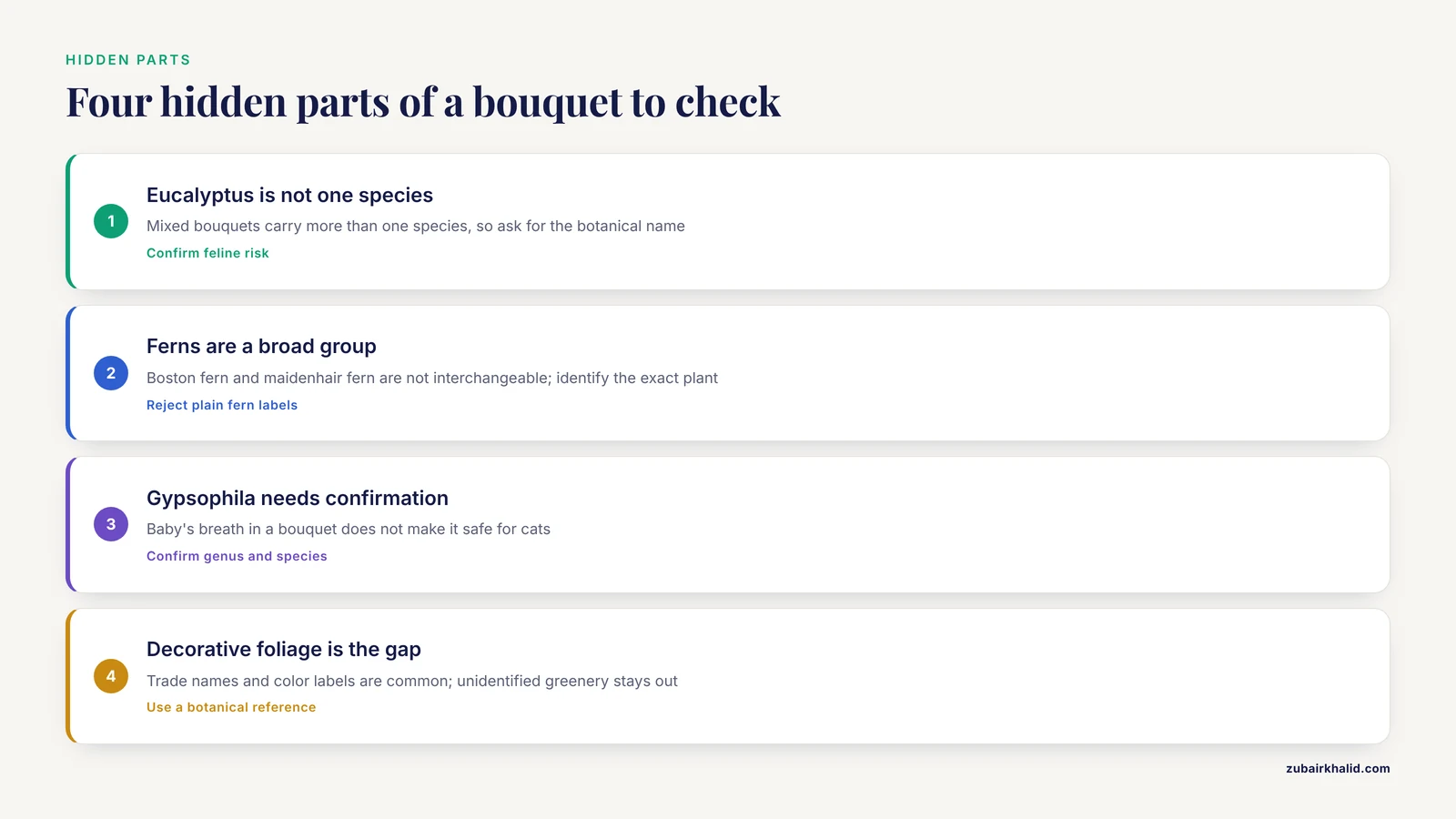
| Component | Check | Clearance rule |
|---|---|---|
| - | - | - |
| Eucalyptus | Ask for genus and species | Not a safe filler by default |
| Ferns | Identify exact species | Reject greenery labeled only "fern" |
| Gypsophila | Confirm genus and species | Baby's breath is not automatically safe |
| Decorative foliage | Obtain botanical name | Unknown stems stay out |
Eucalyptus sold in mixed bouquets comes in more than one species. "Eucalyptus" is not a species check. Ask for the botanical name and confirm feline risk with a veterinarian or animal poison service.
Ferns are a broad group. Boston fern, maidenhair fern, and other plants sold as ferns are not interchangeable. Identify the exact plant.
Gypsophila, often called baby's breath, needs species-level confirmation. Its presence in a bouquet does not make it safe for cats.
Decorative foliage is the most common gap. Florists may use trade names or color labels. Use a botanical reference such as the RHS encyclopedia to confirm a name [9]. Unidentified greenery stays out of cat areas.
Floral foam, ribbon, and dropped pieces
Floral foam is not food and not a cat toy. A cat that bites foam can swallow crumbs that irritate the gut or cause obstruction. Keep foam out of reach and dispose of trimmed pieces in a closed bin.
Ribbons and wire introduce another risk. Chewed ribbon can become a linear foreign body. Loose wire, pins, and foam crumbs belong in the trash, not on a table or floor.
Dropped petals, leaves, and filler flowers matter because cats reach floor level. A safe stem in the vase can become a chewable object after one bump.
Clear the whole arrangement
Whole-arrangement clearance means every stem, filler, foliage type, and mechanical item is either verified and inaccessible or removed. Removing one visible flower is not enough when pollen and plant fragments remain; for lilies, all plant parts and pollen are toxic [1]. If one filler fails identification or clearance, the arrangement fails for a cat home. Call a veterinarian or animal poison service after any known chewing or ingestion.
Pesticides, Preservatives, and Dyes on Cut Flowers: What Owners Should Ask
Cut flowers are grown for appearance, not for food safety. Ornamental growers may use pesticides and growth regulators that are not approved for food crops, and residue limits for produce do not apply to bouquets. A clean-looking flower can still carry residues on petals, leaves, and stems.
Exposure Routes: Vase Water and Chewed Stems
Vase water is the main hidden route. Water-soluble residues and preservative compounds leach from cut stems into the water, and cats drink from vases or groom water off their paws. The same principle applies to plant toxins: the water-soluble fraction of lilies is nephrotoxic, so vase water is not a safe drink [1]. Preservative packets contain biocides and acidifiers meant to control bacteria, not to be swallowed.
Chewed stems are the second route. Systemic pesticides move inside plant tissues, so the interior of a stem is not residue-free. Cats bite stems directly, and damaged plant material can release odors that encourage further chewing [2].
Dyes add another layer. Some flowers are spray-dyed or dip-dyed after harvest. The dye may be labeled food-grade, but the carrier solvent and concentration are not tested for feline safety. Wrapping, ties, and ribbons are not plant material, but cats chew them too, and swallowed pieces can cause blockage.
What to Ask the Supplier
Ask these questions before buying:
- Was this flower grown with systemic or contact pesticides?
- Was a post-harvest dip, spray, or dye applied?
- What is in the preservative packet, and can the cat reach it?
- Are these flowers from a food-safe grower or an ornamental grower?
- Can wrapping and ties be removed before the arrangement enters the home?
If the supplier cannot answer, treat the flowers as chemically unknown.
When to Call a Veterinarian
Call a veterinarian or animal poison service if a cat chews a treated stem, drinks vase water containing a preservative packet, bites into a packet, or develops drooling, vomiting, or lethargy after contact with a bouquet. Do not wait for symptoms; the exact pesticide or preservative may not be identifiable.
Related Guides
- Can Cats Eat Zinnias? Pet Safety for This Flower: Specific flower safety check for a common garden bloom
- Is Hyacinth Toxic to Cats? Bulbs, Flowers and Smell: Toxic bulb flower guide for high-risk seasonal blooms
- Is Bird of Paradise Toxic to Cats? Leaves and Flowers: Specific toxic-flower check for a popular ornamental plant
- What Flowers Are Toxic to Cats: Broad toxic-flower overview to screen bouquet choices
- Cat Nausea and Vomiting: Safe Home Treatment: Covers vomiting and nausea signs seen after plant exposure
- Cat Diarrhea Home Treatment: What Is Safe: Explains safe diarrhea care and red flags after ingestion
Frequently Asked Questions
Are roses cat-safe flowers?
No flower is automatically cat-safe. A rose may be lower risk than a lily, but the exact species, any toxic filler flowers in the arrangement, and the cat's access still matter. Confirm the arrangement with a veterinarian or poison service before placing it in a cat area.
Are lilies safe if the cat only sniffs them?
No. Lily pollen is toxic, and the whole plant is toxic, including petals, stamens, leaves, and pollen [1]. A cat can ingest pollen while grooming.
What flowers should never be in a cat home?
At minimum, exclude Lilium, Hemerocallis, Convallaria, and Dracaena [1]. Also avoid any flower that cannot be identified to species.
Are edible flowers safe for cats?
No. Human edible flowers can contain toxic compounds, and reviews of flower species have found toxic compounds in a large share of them [3][10]. Edible for people does not mean safe for cats.
Can I use a plant identification app to check a flower?
Use an app only as a first step. Plant identification apps have been tested for toxic plant accuracy, and they are not a substitute for botanical confirmation or veterinary advice [11][12].
Is pollen from flowers dangerous to cats?
Yes for some plants, especially lilies. Lily pollen is part of the toxic plant material, and grooming can move it from the coat to the mouth [1].
What should I do if my cat ate a flower?
Call a veterinarian or animal poison service immediately. Identify the plant, keep a sample, and follow professional instructions. Do not induce vomiting unless a veterinarian tells you to.
Are dried flowers or floral water safe for cats?
Do not assume they are safe. Dried flowers concentrate plant material, and vase water can contain water-soluble toxins [1]. Herbal flower products can also be adulterated with toxic lookalikes [7].
Sources
- Lily toxicity in the cat.
- Mechanisms of the toxic effects of Dracaena compounds on cats and the concept of therapeutic measures (literature review)
- Exploring Plants with Flowers: From Therapeutic Nutritional Benefits to Innovative Sustainable Uses
- Occurrence of Functional Molecules in the Flowers of Tea (Camellia sinensis) Plants: Evidence for a Second Resource
- Male flowers of Aconitum compensate for toxic pollen with increased floral signals and rewards for pollinators
- Independent evolution of ancestral and novel defenses in a genus of toxic plants (Erysimum, Brassicaceae)
- Near-infrared spectroscopy combined with chemometrics for quality control of German chamomile (Matricaria recutita L.) and detection of its adulteration by related toxic plants
- Fungal and mycotoxin contaminants in cannabis and hemp flowers: implications for consumer health and directions for further research
- The Royal Horticultural Society encyclopedia of plants & flowers
- Are wild and cultivated flowers served in restaurants or sold by local producers in Denmark safe for the consumer?
- Swipe Right: a Comparison of Accuracy of Plant Identification Apps for Toxic Plants
- Validation of a Plant Identification Application Using Digital Images of Toxic Plants
- Chemical characterization and bioactive properties of two aromatic plants: Calendula officinalis L. (flowers) and Mentha cervina L. (leaves).
- Content of Nutrient and Antinutrient in Edible Flowers of Wild Plants in Mexico