Are Acorns Poisonous to Dogs? Oak Toxicity and Blockage Risk
By Dr. Zubair Khalid, DVM, MS, PhD ·
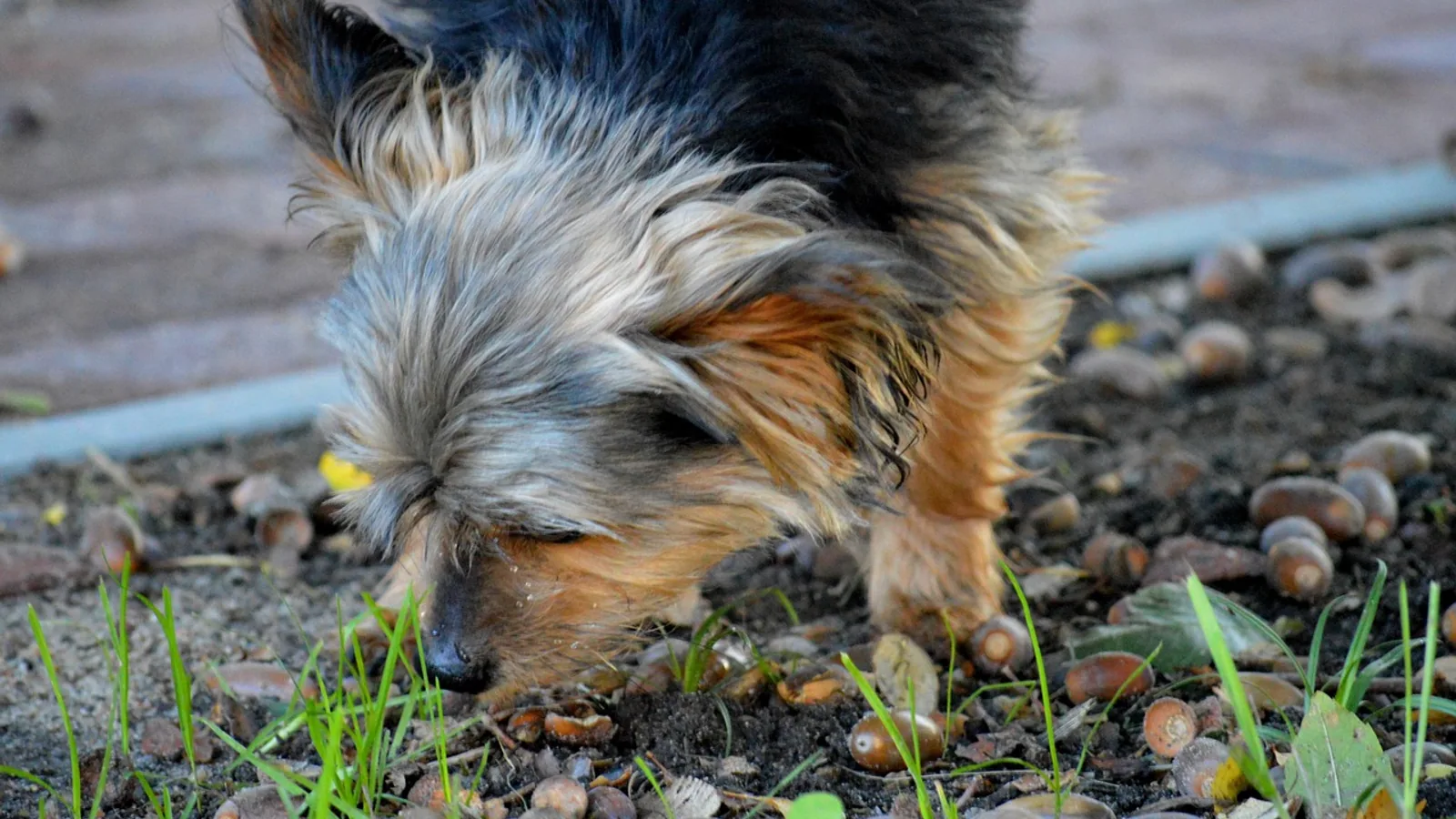
Yes, acorns are poisonous to dogs, but the more common and more immediate danger is physical. An acorn is a hard, smooth, indigestible object roughly the size of a small toy. When a dog swallows one, the realistic risks are choking, stomach irritation, and intestinal obstruction. Chemical poisoning from oak tannins is real but usually requires a dog to eat a meaningful amount of acorn material or oak leaves, and the severe kidney and liver damage that defines oak toxicosis in cattle and horses is far less well documented in dogs.
This article is educational and is not a substitute for veterinary diagnosis or treatment.
Quick Triage: What to Do If Your Dog Ate an Acorn
Use this owner-facing summary to decide how fast you need to act.
- One acorn, small dog, swallowed whole: Call your veterinarian or a pet poison hotline for guidance. Watch for gagging, retching, coughing, or repeated swallowing.
- One or two acorns, large dog, chewed and swallowed: Most dogs pass small amounts without serious illness, but stomach upset is common. Call your vet for advice and monitor for vomiting, diarrhea, and lethargy.
- A large amount of acorns or a pile of oak leaves: This is a genuine poisoning concern. Call your veterinarian or a pet poison hotline immediately. Do not wait for symptoms.
- Any dog showing repeated vomiting, abdominal pain, a hard or bloated belly, drooling, collapse, or unproductive retching: Go to an emergency veterinary hospital now. Unproductive retching can signal a blockage or bloat and is a surgical emergency.
- You are unsure how much was eaten: Treat it as a possible exposure and call for advice. It is safer to make one phone call than to wait.
At a Glance: Acorn and Oak Risk by Scenario
| Scenario | Main risk | Typical urgency | What owners should do |
|---|---|---|---|
| Dog chews one acorn, spits it out | Mouth irritation, mild drooling | Low | Rinse the mouth, offer water, monitor |
| Small dog swallows one whole acorn | Choking, obstruction | Moderate to high | Call your vet or a poison hotline |
| Large dog swallows one or two acorns | Obstruction, stomach upset | Moderate | Call your vet, monitor closely |
| Dog eats a handful of acorns | Tannin toxicity, obstruction | High | Call a vet or poison hotline now |
| Dog eats oak leaves or buds | Tannin toxicity, stomach upset | Moderate to high | Call a vet or poison hotline now |
| Dog eats acorns plus shows vomiting or pain | Obstruction or poisoning | Emergency | Go to an emergency hospital |
| Dog ate acorns several days ago and seems fine | Low residual risk | Low | Mention it at the next vet visit |
What Acorns and Oak Trees Contain
Oak trees belong to the genus Quercus. Every part of most oak species, including the acorns, leaves, buds, bark, and twigs, contains hydrolysable tannins [1]. Tannins are the plant compounds responsible for the astringent, drying sensation of strong tea or unripe fruit. In oak, these tannins are the chemical basis for oak toxicity.
The tannin content is not identical across all oaks. A study that measured total phenolic compounds in acorns from three oak species found that Quercus velutina had the highest level, Quercus alba the lowest, and Quercus rubra fell in between, closer to Q. velutina [2]. That finding matters for pasture safety in livestock. It also tells owners something practical: not every acorn carries the same chemical load, so the species of tree in your yard can shift the risk. A yard dominated by white oak is less chemically dangerous than one full of black oak or red oak.
How Tannins Become Toxic
The toxic story in oak poisoning is a two-step process, and the first step happens in the gut. Rumen microbes and enzymes in cattle degrade oak hydrolysable tannins into smaller, absorbable metabolites [1]. Those low-molecular-weight breakdown products are then absorbed into the bloodstream, where they are thought to bind and damage endothelial cells, the cells lining blood vessels, through mechanisms that are still not fully understood [1].
This microbial step is central to why ruminants are so susceptible. Cattle, sheep, and goats have a large fermentation chamber full of microbes that can unlock the tannins into their more dangerous forms. Dogs are not ruminants. A dog's digestive tract does not perform the same bacterial conversion, which is one reason severe oak poisoning is described far more often in cattle and horses than in dogs.
Pyrogallol and the Kidney
When researchers dosed calves orally with oak leaves, they detected pyrogallol in the serum within hours and in the urine for up to 60 hours [3]. Pyrogallol is a tannin breakdown product and a strong reducing agent. The same study found that calves given commercial tannic acid at an equivalent dose did not develop the same kidney disease, which shows that the specific tannin mixture and its metabolites matter, not just the total tannin amount [3].
The target organ in severe oak poisoning is the kidney. In natural cases of oak toxicity in beef calves, the kidneys were enlarged with perirenal edema, and microscopic examination showed severe necrosis of the renal tubular epithelium along with hemorrhage and protein casts inside the tubules [1]. Electron microscopy showed injury to both proximal and distal convoluted tubules and damage to the endothelial cells of the glomeruli and interstitium [1]. This is acute tubular injury, and it is the reason affected animals can progress to kidney failure.
Are Acorns Poisonous to Dogs? The Honest Answer
The direct answer to "are acorns poisonous to dogs" is yes, but the severity depends on how much is eaten, the dog's size, and whether the acorn is chewed or swallowed whole. There are three distinct problems, and owners often confuse them.
- Mechanical obstruction and choking. This is the most likely serious outcome in dogs.
- Gastrointestinal irritation from tannins. This causes vomiting and diarrhea and is common with moderate ingestion.
- Systemic tannin poisoning with kidney or liver injury. This is the rare, severe end of the spectrum and is much better documented in livestock.
The veterinary literature is candid about this gap. Oak poisoning is described as a known intoxication in grazing animals but only slightly described in the literature overall, and the severe cases are overwhelmingly in ruminants [4]. That does not mean dogs cannot be harmed. It means the dramatic kidney failure cases you read about in cattle are not the typical dog scenario.
The Most Common Practical Risk: Obstruction and Choking
For most dogs, the acorn itself is the problem, not the chemistry inside it.
Why Acorns Obstruct
An acorn has a hard shell and a smooth, rounded shape. It does not soften in stomach acid the way food does. It does not break down in the small intestine. When a dog swallows an acorn whole, that object travels through the esophagus, into the stomach, and then tries to navigate the small intestine, which is a narrow, winding tube. A firm, round object can lodge at any point.
The risk rises with:
- Small dogs. A Chihuahua, Yorkie, or dachshund has a much narrower intestinal lumen than a Labrador. An acorn that passes easily through a large dog can wedge in a small one.
- Dogs that gulp food without chewing. These dogs are more likely to swallow acorns whole.
- Dogs with a history of eating foreign objects. A dog that has swallowed socks, toys, or bones before is at higher risk.
- Puppies. Puppies explore the world with their mouths and are less discriminating about what they swallow.
- Multiple acorns. Several acorns can clump together and create a larger, more dangerous mass.
Choking Versus Obstruction
Choking happens in the throat or upper airway. Signs include gagging, pawing at the mouth, coughing, difficulty breathing, and a blue tint to the gums. This is an immediate emergency.
Obstruction happens lower down, in the stomach or intestine. It can take hours to days to declare itself. Early signs are vague: vomiting, reduced appetite, and lethargy. As the obstruction persists, the dog may vomit repeatedly, refuse all food, develop abdominal pain, and become dehydrated. A complete obstruction can compromise blood flow to the bowel wall and lead to tissue death, which is life threatening.
Bloat and Unproductive Retching
A dog that retches without producing anything, has a distended or hard abdomen, and is restless or pacing may have gastric dilatation and volvulus, a twisted stomach. This is a surgical emergency with a narrow window for survival. An acorn can contribute to this cascade. Any dog showing unproductive retching and a bloated belly should be seen immediately.
Tannins and Stomach Upset
Not every acorn causes a blockage. Many dogs chew acorns, swallow fragments, and end up with nothing worse than an upset stomach. The tannins irritate the lining of the gastrointestinal tract.
Signs of tannin-related stomach upset include:
- Vomiting, sometimes shortly after eating
- Diarrhea, which may be soft or watery
- Drooling and lip smacking
- Reduced appetite
- Mild lethargy
- Gurgling or audible stomach sounds
These signs usually appear within hours of ingestion. In mild cases, they resolve with supportive care and time. The concern is when they persist, worsen, or are accompanied by pain or a distended abdomen, because that pattern points toward obstruction rather than simple irritation.
Oak Leaves Are Also Toxic to Dogs
Owners often focus on acorns and forget the foliage. Oak leaves are toxic to dogs for the same reason acorns are: they contain hydrolysable tannins [1]. Young leaves and buds may be especially palatable, and a study of young Quercus pyrenaica leaves in cattle showed that a large dose of leaves, particularly after a period of feed restriction, triggered a critical drop in rumen fermentation and acute intoxication [5]. The lesson for dog owners is that oak leaves are not a safe alternative snack. A dog that grazes on fallen oak leaves in autumn is also being exposed.
Rare but Serious: Kidney and Liver Injury With Large Amounts
Severe systemic oak poisoning is uncommon in dogs, but it is the reason acorn ingestion deserves respect rather than dismissal.
What Happens in Severe Poisoning
In the well-documented livestock cases, the sequence runs like this: the animal eats a large amount of oak material, tannins are broken down into absorbable metabolites, those metabolites damage blood vessel linings and kidney tubules, and acute kidney failure develops [1]. In the 2022 cattle case series, affected animals showed anorexia, apathy, and polyuria with low urine density. Bloodwork confirmed kidney failure with markedly elevated urea and creatinine. Five of seven animals were euthanized. At necropsy, the team found digestive erosions and ulcerations, edema, and kidney hemorrhages, and histopathology showed renal tubular necrosis [4]. The authors noted there is no specific antidote and that animals are often identified too late, once kidney failure is already established [4].
Why the Liver Enters the Picture
The liver is a secondary concern. A study of Quercus aliena acorn extract in rats found that the extract had antioxidant activity and protected against chemically induced liver injury, reducing liver enzyme elevations and lowering expression of a liver enzyme gene [6]. That study is about protection, not poisoning, so it should not be read as evidence that acorns damage the liver. It does confirm that oak compounds interact with liver biochemistry in a measurable way. In a dog that eats a very large amount of oak material, the liver and kidneys are the organs a veterinarian will monitor.
Why Dogs Are Different From Cattle
The severe kidney failure pattern is documented in cattle, and the mechanism depends on rumen microbes converting tannins into toxic metabolites [1]. Dogs lack that fermentation chamber. This is the single most important reason to keep the dog risk in perspective. A dog that eats one acorn is not a cow that grazed an oak pasture for a week. The realistic dog risk is dominated by obstruction and stomach upset, with systemic poisoning as an uncommon complication of heavy ingestion.
Risk Factors That Raise the Stakes
Certain situations push an acorn exposure from minor to serious.
- Autumn. Acorns drop in fall, and the ground can be covered. The 2022 cattle outbreak occurred in autumn, and the authors specifically recommended prevention in years when acorns are abundant [4].
- Abundant mast years. Some years produce far more acorns than others. A heavy crop means more access for dogs.
- Yard oak trees. A dog with free yard access under a mature oak has repeated exposure.
- Dog parks and walking routes lined with oaks. These are high-traffic exposure zones in fall.
- Small body size. Smaller dogs obstruct more easily and reach toxic thresholds with less material.
- Puppies and young dogs. Curiosity plus a narrower gut equals higher risk.
- Dogs with pica or a history of foreign body ingestion. These dogs are repeat offenders.
- Feed restriction or hunger. In cattle, feed restriction before oak exposure worsened intoxication [5]. A hungry dog may eat more acorns more quickly.
- Competitive eaters in multi-dog homes. One dog may gulp acorns to keep them away from another.
What Veterinarians Do: Examination and Diagnostics
When you bring a dog in after acorn ingestion, the veterinarian's job is to sort out three questions: Is the airway clear? Is there an obstruction? Is there systemic toxicity?
History and Physical Examination
The vet will ask how many acorns were eaten, when, whether they were chewed or swallowed whole, the dog's size, and whether any symptoms have appeared. The physical exam focuses on:
- Airway and breathing
- Gum color and capillary refill
- Abdominal palpation for pain, a foreign object, or a distended stomach
- Hydration status
- Mental attitude and energy level
- Body temperature and heart rate
Diagnostic Testing
Depending on the presentation, the vet may recommend:
- Abdominal radiographs (X-rays). These can show a dense foreign object, a gas pattern consistent with obstruction, or a distended stomach. Acorns are sometimes visible because of their density.
- Abdominal ultrasound. This is often better than X-rays for evaluating the intestinal wall, looking for a focal obstruction, and assessing for free fluid.
- Bloodwork. A complete blood count and chemistry panel assess hydration, electrolytes, kidney values, and liver values. In the cattle cases, elevated urea and creatinine were the key diagnostic findings [4].
- Urinalysis. This checks urine concentration and looks for protein, blood, or glucose, which can signal kidney injury. In the calf study, proteinuria appeared by 48 to 72 hours, hematuria by day 4, and glucosuria by day 5 [3].
- Blood gas or lactate. These help assess perfusion and the severity of illness in a critical patient.
The pattern of serial monitoring matters. In the cattle case series, renal values were reassessed every 24 to 48 hours [4]. A dog with a significant exposure may need repeat bloodwork over the following days, because kidney injury can evolve.
Evidence-Based Management: Dog Acorn Poisoning Treatment
There is no specific antidote for oak poisoning [4]. Treatment is supportive and problem-focused. What your vet does depends entirely on which problem your dog has.
If the Dog Is Choking or the Airway Is Compromised
This is handled first and immediately. The object may need to be removed manually or with instruments. Oxygen and airway support are provided as needed.
If the Acorn Was Just Eaten and Is Still in the Stomach
If ingestion was recent and the acorn is still in the stomach, a veterinarian may induce vomiting in a controlled setting, provided the dog is stable and there is no contraindication. Never induce vomiting at home without veterinary direction. An acorn that is sharp or lodged can cause injury on the way back up, and some dogs should not be made to vomit at all. If the acorn has already passed into the intestine, inducing vomiting will not help.
If There Is an Obstruction
A confirmed or strongly suspected intestinal obstruction is a surgical problem. The veterinarian will stabilize the dog with fluids, correct electrolytes, and manage pain before anesthesia. Surgery removes the obstructive material and any compromised bowel. Some foreign objects can be retrieved endoscopically if they are still in the stomach, which avoids open surgery.
If There Is Tannin-Related Stomach Upset
Mild cases are managed with:
- Gastrointestinal rest. Withholding food for a short period, then reintroducing a bland diet.
- Fluid therapy. Subcutaneous or intravenous fluids correct dehydration.
- Anti-nausea medication. Prescribed by the veterinarian to control vomiting.
- Gastroprotectants. Medications that coat or protect the stomach lining may be used if there is evidence of irritation or ulceration. In the cattle cases, digestive erosions and ulcerations were found at necropsy [4].
- A bland, easily digested diet during recovery.
If There Is Systemic Toxicity or Kidney Injury
This is the intensive-care scenario. Management mirrors the supportive care used in livestock and is aimed at protecting the kidneys and maintaining hydration:
- Intravenous fluids. In the cattle case series, supportive treatment was based on infusions of 0.9% sodium chloride with electrolyte rebalancing [4]. Dogs with kidney injury receive similar fluid therapy, tailored to their electrolyte and acid-base status.
- Electrolyte correction. Potassium, sodium, and other electrolyte abnormalities are common in kidney injury and are corrected carefully.
- Monitoring of kidney and liver values. Serial bloodwork tracks whether the kidneys are recovering or worsening. In the cattle series, renal values were checked every 24 to 48 hours [4].
- Management of urine output. Some poisoned animals produce large volumes of dilute urine, and others stop producing urine. Both patterns require close monitoring and adjustment of fluid rates.
- Supportive care for the gastrointestinal tract. Protecting the eroded or ulcerated gut lining is part of the plan.
Prognosis
Prognosis depends on the problem. A simple acorn ingestion with no obstruction and no systemic toxicity usually carries a good outlook. A surgical obstruction caught early also has a reasonable prognosis. Severe kidney failure from oak poisoning carries a guarded to poor prognosis. In the 2022 cattle series, five of seven animals were euthanized, and the authors emphasized that animals are often identified too late, once renal failure is established [4]. The two surviving animals improved with supportive care and were discharged [4]. Early recognition is the single biggest factor an owner can influence.
Unsafe Home Remedies
Owners often want to act before calling a vet. Some home measures are harmless, and some are dangerous.
Do not induce vomiting at home unless a veterinarian tells you to. This is the most important rule. Emetics given without veterinary guidance can cause aspiration, injury to the esophagus, or complications in a dog that should not vomit.
Do not give human medications. Pain relievers such as ibuprofen, naproxen, and acetaminophen are toxic to dogs. Never give them for acorn-related stomach upset.
Do not give activated charcoal at home. Charcoal is sometimes used in veterinary toxicology, but it is given under supervision, it does not bind hard objects like acorns, and it can cause problems if given incorrectly.
Do not give milk, oil, or bread to "coat" the stomach. These do nothing to help an obstruction and can complicate the picture if the dog needs anesthesia or surgery.
Do not wait it out if there are warning signs. Time matters for obstructions and for kidney injury.
Do give water. A dog that is alert and drinking can have free access to water. Do not force fluids by mouth in a vomiting or obtunded dog.
Prevention: Autumn Walk Safety
Prevention is straightforward and highly effective. The goal is to reduce access during the months when oaks drop their crop.
- Know your route. Identify oak trees on your regular walking path and in your yard. In heavy acorn years, expect more fallen material [4].
- Steer around drop zones. Walk your dog on the opposite side of the street or on a different path during peak drop.
- Use a short leash in acorn areas. A short leash gives you control and time to redirect.
- Teach a reliable "leave it" and "drop it." These cues are the most useful training tools for autumn walks.
- Scan the ground ahead. Acorns cluster under the canopy, so you can often predict where they will be thickest.
- Rake and remove acorns from your yard. Frequent cleanup reduces the standing supply. Dispose of them where the dog cannot reach.
- Supervise outdoor time. A dog left alone in an oak-filled yard has unlimited access.
- Consider a basket muzzle for repeat scavengers. A basket muzzle allows panting and drinking while preventing ingestion. Discuss fit and use with your veterinarian.
- Keep dogs away from oak leaf piles. Oak leaves are toxic to dogs for the same tannin reason, and leaf piles concentrate the material [1].
- Feed before walks. A hungry dog is more likely to scavenge. In cattle, feed restriction worsened oak intoxication [5], so a satisfied dog is a less motivated scavenger.
- Check the mouth after walks. A quick look can catch an acorn before it is swallowed.
- Warn houseguests and dog walkers. Anyone who walks your dog should know the acorn risk.
Emergency Red Flags
Go to an emergency veterinary hospital immediately if your dog shows any of the following after acorn or oak exposure.
- Unproductive retching or dry heaving
- A hard, swollen, or painful abdomen
- Repeated vomiting that does not stop
- Vomiting blood or material that looks like coffee grounds
- Black, tarry stools
- Severe lethargy, weakness, or collapse
- Difficulty breathing, gagging, or pawing at the mouth
- Blue, pale, or white gums
- Drooling with an inability to swallow
- Seizures or disorientation
- Little or no urine production
- Known ingestion of a large amount of acorns or oak leaves
Limitations and When to Contact a Veterinarian
Individual cases need a veterinarian. This article describes general patterns, and no article can examine your dog, know its size and history, or run the tests needed to rule out an obstruction or kidney injury.
Contact a veterinarian or a pet poison hotline right away if:
- Your dog ate more than a small amount of acorns or oak leaves
- Your dog is a puppy, a small breed, or has a history of swallowing foreign objects
- Any vomiting, diarrhea, drooling, or lethargy appears after exposure
- Symptoms persist beyond a few hours or get worse
- You see unproductive retching, abdominal pain, or a distended belly
- Your dog stops eating, stops drinking, or stops producing urine
- You are simply unsure how much was eaten
When in doubt, call. A phone call is cheap and fast. Waiting on a possible obstruction or kidney injury is neither.
Frequently Asked Questions
Are acorns poisonous to dogs?
Yes. Acorns contain hydrolysable tannins, the same class of compounds responsible for oak toxicity in livestock [1]. In dogs, the more common serious risk is physical obstruction from swallowing the hard acorn, while chemical poisoning from tannins typically requires a larger amount of ingested material.
How many acorns can a dog eat safely?
There is no safe number that applies to every dog. Size, whether the acorn is chewed or swallowed whole, and the dog's individual sensitivity all matter. A single whole acorn can obstruct a small dog, while a large dog may pass one without incident. Any ingestion is worth a phone call to your veterinarian for guidance.
What are the first signs of acorn poisoning in dogs?
The earliest signs are usually gastrointestinal: vomiting, diarrhea, drooling, and reduced appetite. These reflect tannin irritation of the gut lining. Signs of obstruction, such as repeated vomiting, abdominal pain, and lethargy, tend to develop over hours to days. Kidney injury from severe poisoning is a later and less common finding in dogs.
Can acorns cause a blockage in dogs?
Yes. Acorns are hard, smooth, and indigestible, which makes them a classic foreign body risk. They can lodge in the esophagus, stomach, or intestine. Small dogs, puppies, and dogs that gulp food are at highest risk. A confirmed obstruction usually requires surgery or endoscopic removal.
Are oak leaves toxic to dogs?
Yes. Oak leaves contain the same hydrolysable tannins found in acorns [1]. Young leaves and buds may be especially palatable, and in cattle, a large dose of young oak leaves after feed restriction triggered acute intoxication [5]. Dogs should not be allowed to graze on fallen oak leaves or leaf piles.
What is the treatment for acorn poisoning in dogs?
There is no specific antidote for oak poisoning [4]. Treatment is supportive and depends on the problem. It may include controlled decontamination if the acorn is still in the stomach, surgery for an obstruction, fluid therapy, anti-nausea medication, gastroprotectants, and, in severe cases, intensive care with serial monitoring of kidney and liver values [4].
Is severe oak poisoning common in dogs?
No. Severe oak poisoning with kidney failure is much better documented in cattle and horses than in dogs [4][1]. The mechanism depends on rumen microbes converting tannins into toxic metabolites, and dogs lack that fermentation chamber [1]. The realistic dog risk is dominated by obstruction and stomach upset.
How can I prevent my dog from eating acorns?
Manage access during autumn. Identify oak trees on your routes, keep your dog on a short leash in acorn areas, teach "leave it" and "drop it," rake and remove acorns from your yard, supervise outdoor time, and keep dogs away from oak leaf piles. In heavy acorn years, be extra vigilant, because exposure rises with the size of the crop [4].
Related Articles
- My Dog Ate a Pen: Is It Toxic or Just a Blockage Risk?
- Dog Ate a Diaper: Blockage Risk and What to Do
- My Dog Ate a Frog: Is It Poisonous?
- Dog Ate a Sponge: Signs of Blockage and What to Do
- Are Tarantulas Poisonous to Dogs? Understanding the Risks
- Dog Ate Ibuprofen or Tylenol: Toxicity Signs and Emergency Treatment
- Salt Toxicity in Dogs and Cats: Sources, Signs, and Treatment
- Lead Poisoning in Dogs and Cats: Sources, Symptoms, Treatment
- Cyanide Poisoning in Dogs: Fruit Pits, Plants, and Real Risk
Sources
- Histopathologic and ultrastructural findings in oak (Quercus spp.) toxicity on 2 beef cattle farms in Colorado.
- Determination of total phenolics in acorns from different species of oak trees in conjunction with acorn poisoning in cattle.
- Comparison of disease in calves dosed orally with oak or commercial tannic acid.
- Oak Acorn Poisoning in Cattle during Autumn 2022: A Case Series and Review of the Current Knowledge.
- Effect of the administration of young leaves of Quercus pyrenaica on rumen fermentation in relation to oak tannin toxicosis in cattle.
- Free radical scavenging and hepatoprotective actions of Quercus aliena acorn extract against CCl4-induced liver.