Why Do Puppies Shake in Their Sleep? Normal vs. Concerning
By Dr. Zubair Khalid, DVM, MS, PhD ·
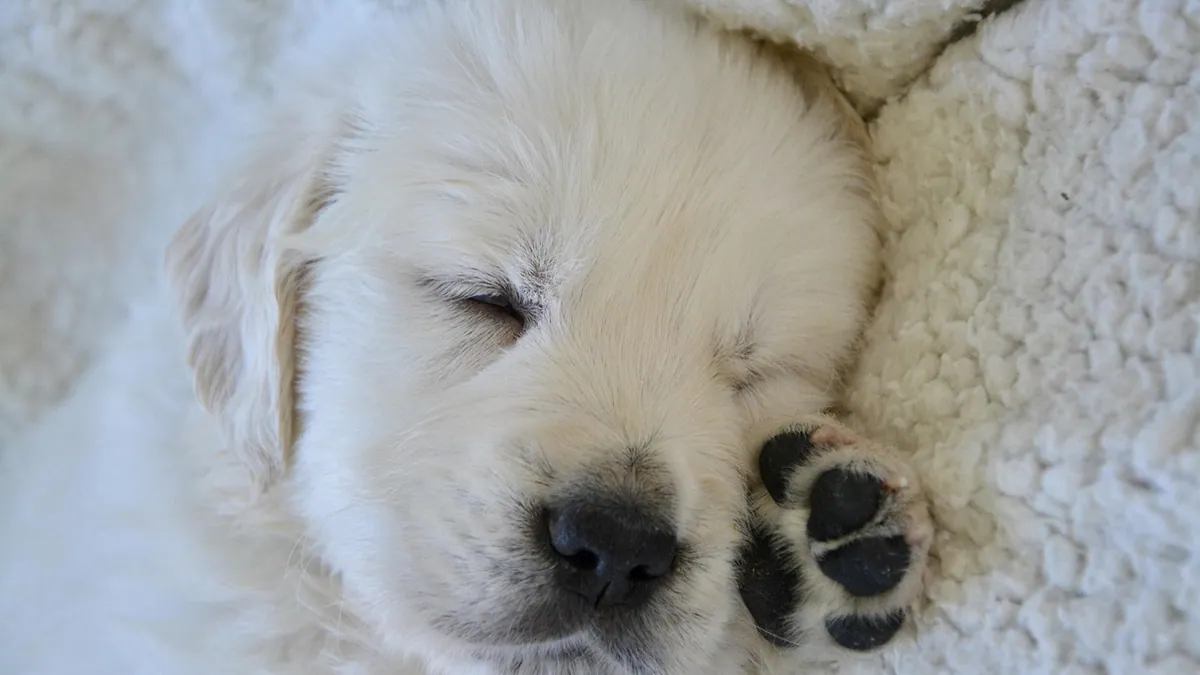
Yes, it is normal for puppies to shake in their sleep most of the time. Puppies spend more time in REM sleep than adult dogs, and their bodies twitch, paddle, and jerk as their brains cycle through that stage. The shaking becomes a concern when it looks different from ordinary dreaming, happens when your puppy is awake, or comes with other symptoms.
This article is educational and is not a substitute for veterinary diagnosis or treatment.
Quick Answer
- Mild twitching, paw paddling, lip smacking, and small body jerks during sleep are common and usually harmless.
- Normal sleep movements stop when you gently wake your puppy, and your puppy acts completely normal afterward.
- Shaking that continues while awake, comes with stiffness, drooling, or loss of consciousness, or lasts more than a couple of minutes needs emergency care.
- A puppy who shakes during sleep and is also weak, wobbly, or hard to rouse when awake may have low blood sugar and needs a vet right away.
- Film the episodes on your phone. Video is one of the most useful things you can bring to a veterinary visit.
What Sleep Shaking Looks Like and What Counts as Normal
A sleeping puppy can twitch an ear, paddle all four legs, chew at nothing, whimper, or give a full-body shudder. The eyes may roll under closed lids. Breathing can speed up, slow down, or become irregular. This is rapid eye movement (REM) sleep, the dreaming stage, and it looks similar in dogs and people.
One study that used electroencephalography (EEG) with video to track a puppy's sleep found that abnormal paddling and chewing movements happened within 20 to 180 seconds of the onset of REM sleep and not during any other stage of sleep or wakefulness [1]. That timing pattern is a useful clue. Movements tied tightly to REM sleep are usually a sleep behavior issue, not a seizure.
Here is how to tell normal sleep twitching from something more serious:
- It stops when you wake your puppy. Call your puppy's name softly. Normal dream twitching ends quickly, and your puppy looks alert and oriented.
- It only happens during sleep. Movements that continue while your puppy is standing, walking, or playing are not simple dream twitching.
- Your puppy is fine between episodes. Normal sleep behavior does not leave behind weakness, confusion, or wobbliness.
- It is brief and small. Quick twitches and paddling are typical. Long, stiff, whole-body episodes are not.
If your puppy shakes during sleep and also shakes while awake, that combination deserves a closer look. Our guide to why is my dog shaking covers the awake causes in more detail.
Why Does My Puppy Shake in His Sleep? The Main Causes
Normal REM sleep behavior
This is the most common reason by far. Puppies have a higher proportion of REM sleep than adult dogs, so you notice it more. The movements are brief, they stay in sleep, and your puppy is normal when awake.
Sleep behavior disorder
Sometimes the normal muscle paralysis that should accompany REM sleep does not hold, and a dog acts out dreams with paddling, chewing, or vocalizing. A case report in a 3-month-old puppy with generalized tetanus documented this pattern, with abnormal movements locked to REM sleep and no epileptiform (seizure-type) brain activity on EEG [1]. The sleep movements in that puppy resolved about 6 weeks after it first showed signs, and the tetanus itself resolved over 8 weeks with treatment [1]. This is a rare situation, but it shows why a vet may want to distinguish a sleep behavior disorder from a seizure.
Seizures
Seizures can happen during sleep or right after waking. They tend to be longer, more symmetric, and more forceful than dream twitching. A puppy may lose consciousness, drool heavily, urinate, or stay confused afterward. An EEG is the tool that separates sleep-related movement disorders from epileptiform activity [1].
Low blood sugar (hypoglycemia)
Small breed puppies, especially toy breeds, can drop their blood sugar between meals. Signs include weakness, wobbliness, trembling that continues when awake, and lethargy. This is a medical emergency in a young puppy.
Pain or discomfort
Shaking can be a pain response. A 2024 study described episodic mandibular tremor in dogs, which shows up as teeth chattering, and noted that this sign can resemble either an idiopathic movement disorder or a manifestation of pain [2]. If your puppy chatters or trembles mainly when chewing, yawning, or being handled around the mouth or neck, pain is a real possibility.
Other causes
Brachycephalic (flat-faced) breeds can have sleep-disordered breathing, with repeated partial or complete airway blockages during sleep that cause intermittent low oxygen levels [3]. Older dogs with cognitive dysfunction often have disrupted sleep-wake patterns, and guardians in one survey reported their dogs were most unsettled between 2:00 and 5:00 a.m. [4]. Puppies are not usually in this group, but the pattern matters if your dog is older. Myoclonus, a sudden muscle jerk, has also been described in geriatric dogs with cognitive dysfunction [5].
| Cause | Typical clues | How urgent |
|---|---|---|
| Normal REM sleep twitching | Brief, only in sleep, stops when woken, puppy normal afterward | Not urgent |
| Sleep behavior disorder | Paddling, chewing, or vocalizing locked to REM sleep, no seizure activity on EEG [1] | Routine visit, video helpful |
| Seizure | Stiffening, paddling, drooling, loss of consciousness, confusion afterward | Emergency if longer than a few minutes or repeated |
| Low blood sugar | Weakness, wobbliness, trembling while awake, lethargy in a small puppy | Emergency now |
| Pain | Trembling or teeth chattering with chewing, yawning, or handling [2] | Same-day visit |
| Sleep-disordered breathing | Snoring, gasping, pauses in breathing, flat-faced breed [3] | Same-day to routine visit |
Red Flags That Make It an Emergency
Call an emergency clinic right away if you see any of these:
- A shaking episode that lasts more than 2 to 3 minutes, or several episodes in a row without full recovery between them.
- Loss of consciousness, heavy drooling, urination, or defecation during the episode.
- Your puppy does not return to normal within a few minutes after the shaking stops.
- Trembling that continues while your puppy is awake, along with weakness, wobbliness, or collapse.
- A small or toy breed puppy who is limp, unresponsive, or too weak to stand.
- Breathing that stops, gasping, or blue-tinged gums during sleep [3].
If your puppy is having a seizure and it will not stop, that is a medical emergency. Do not wait to see if it passes.
Safe Things You Can Do at Home While You Wait
- Record video. Get the whole episode on your phone, including what your puppy looks like right after. This is often more useful to your vet than any description.
- Time it. Note the start and end time of each episode and how long it lasted.
- Do not put your hands near your puppy's mouth during an episode. A puppy mid-seizure can bite without meaning to.
- Keep the area safe. Move hard objects away and pad the space around your puppy. Do not restrain the limbs.
- Note the context. Was your puppy asleep, just waking up, eating, or being handled? Write it down.
- Do not give any medication or sugar source unless your vet tells you to. Your veterinarian calculates any dose from your puppy's weight and health.
- Feed regular meals. Small breed puppies need frequent meals to keep blood sugar steady. Your vet will tell you the right schedule for your puppy.
If the shaking happens mostly when your puppy is lying down and awake, our article on dog head shaking while lying down may help you sort out that pattern.
What Your Veterinarian Will Check and Test
Your vet will start with a full history. Bring your video, your timing notes, and any information about your puppy's breed, age, diet, and recent illnesses.
The physical exam checks neurologic status, gum color, hydration, heart rate, breathing, and whether your puppy shows pain when the mouth, neck, or spine is handled. Your vet may also watch your puppy sleep in the clinic if episodes are frequent.
Common tests include:
- Blood glucose. This is a priority in a small puppy with trembling or weakness.
- Blood work. A chemistry panel and complete blood count look for infection, organ problems, and electrolyte issues.
- EEG. This measures brain electrical activity and can separate sleep-related movement disorders from epileptiform activity [1]. It is not available everywhere and is usually done at a specialty hospital.
- Imaging. MRI or other imaging may be recommended if a structural brain or spinal problem is suspected.
- Sleep study or video monitoring. For suspected sleep-disordered breathing, your vet may recommend monitoring breathing during sleep [3].
If your vet suspects a pain-related movement disorder such as episodic mandibular tremor, the workup may focus on finding the source of discomfort [2].
Prevention and Monitoring
You cannot prevent normal REM twitching, and you do not need to. What you can do is track it well.
- Keep a simple log. Date, time, duration, what your puppy was doing, and what happened after.
- Save videos in one folder on your phone so you can show your vet a clear pattern.
- Keep meals on a regular schedule, especially for toy and small breed puppies.
- Watch for changes over time. More frequent, longer, or more forceful episodes are worth a call.
- If your puppy is a flat-faced breed, watch for snoring, gasping, or pauses in breathing during sleep and mention them at your next visit [3].
- If your dog is older and sleep patterns are shifting, ask your vet about cognitive screening. Sleep-wake disturbance is a common feature of canine cognitive dysfunction, and poorer sleep quality has been linked to greater cognitive severity in guardian surveys [4].
Limitations and When to Contact a Veterinarian
Sleep-related movement in dogs is still an area where veterinary research is limited. Much of what is known comes from small case reports and owner surveys, so not every pattern has a clear explanation. Some movement disorders in dogs are described as idiopathic, meaning no cause is found [2]. Your veterinarian is the only one who can evaluate your individual puppy.
Call an emergency clinic now if: an episode lasts more than a few minutes, your puppy loses consciousness, does not wake up normally, has trouble breathing, or is limp and unresponsive.
Call your vet the same day if: your puppy trembles while awake, seems weak or wobbly, chatters teeth with eating or handling, or has episodes that are getting longer or more frequent.
Schedule a routine visit if: the shaking only happens in sleep, your puppy is completely normal when awake, and you simply want reassurance or a baseline check.
Frequently Asked Questions
Should I wake my puppy during a shaking episode?
Yes, gently call your puppy's name. If the shaking stops quickly and your puppy acts normal, that points toward ordinary REM sleep behavior. If your puppy does not respond, stays stiff, or seems confused afterward, contact your vet.
Can puppies have nightmares?
Puppies do go through REM sleep, which is the stage linked to dreaming in dogs. Whimpering, paddling, and small jerks during that stage are common and usually harmless. There is no reliable way to know what a puppy is experiencing, so focus on whether the behavior stays in sleep and whether your puppy is normal when awake.
Does shaking in sleep mean my puppy is cold?
Not usually. Cold causes shivering while awake, and it stops once your puppy warms up. Sleep twitching follows a different pattern and is tied to the sleep cycle. If your puppy shivers while awake and also seems weak or tired, that is a reason to call your vet.
Can teething cause a puppy to shake at night?
Teething can cause mouth discomfort, and one study found that teeth chattering in dogs can be a manifestation of pain [2]. That said, most sleep shaking in puppies is not related to teething. If your puppy chatters mainly when chewing or when you touch the mouth, ask your vet to check for a dental or jaw problem.
How long do puppy sleep twitches usually last?
Normal dream twitching comes in short bursts, often seconds at a time, and repeats across a sleep cycle. In one documented case, abnormal sleep movements began within 20 to 180 seconds of REM sleep onset [1]. Episodes that run for minutes without stopping, or that repeat back to back, are not typical and should be evaluated.
Related Articles
- Why Is My Dog Shaking?
- Why Does My Dog Keep Shaking Her Head
- Dog Shaking And Shivering While Sleeping
- Dog Head Shaking While Lying Down
- What Does It Mean If My Dog Keeps Shaking Her Head
- Dog Shaking And Restless
- Why Does My Puppy Jerk in Their Sleep? What's Normal
- Why Is My Puppy Jumping in His Sleep? Is It Normal?
- Why Does My Dog Twitch in His Sleep? What's Normal
References
- Electroencephalography of rapid eye movement sleep behavior disorder in a dog with generalized tetanus. Journal of veterinary internal medicine, 2023.
- Episodic mandibular tremor in dogs: an idiopathic movement disorder or a manifestation of pain. Journal of the American Veterinary Medical Association, 2024.
- Association of brachycephaly, sleep-disordered breathing, and inflammatory response in dogs. Journal of veterinary internal medicine, 2026.
- Sleep-wake disturbance in canine cognitive dysfunction: Guardian-reported patterns and a practical screening tool. Veterinary journal (London, England : 1997), 2026.
- Myoclonus in geriatric dogs and its association with canine cognitive dysfunction: an online survey. Frontiers in veterinary science, 2026.