Dog Not Lifting or Wagging Its Tail: What It Means
By Dr. Zubair Khalid, DVM, MS, PhD ·
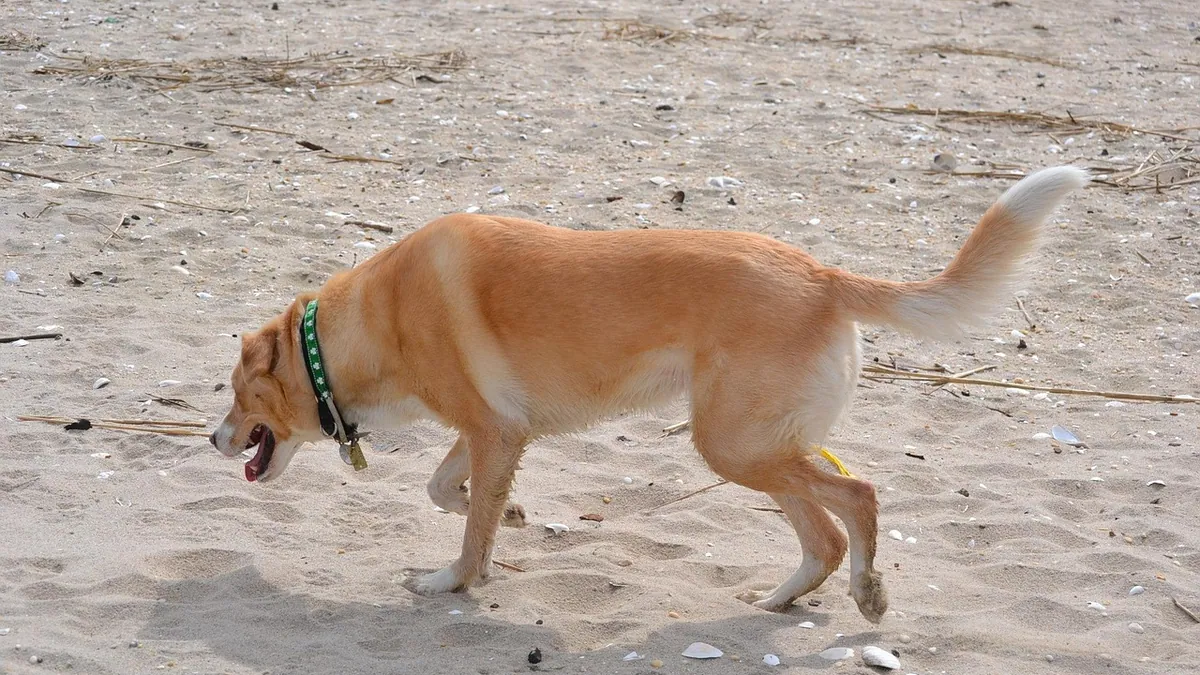
A dog not lifting tail often means the tail muscles or the nerves that control them are painful, inflamed, or injured. The most common cause in young, active dogs is limber tail, a strain of the tail muscles that usually heals with rest [1]. Other causes, including disc problems and nerve compression, need veterinary care. This article is educational and is not a substitute for veterinary diagnosis or treatment.
Quick Answer
- A suddenly limp tail after swimming, hunting, or hard play points to limber tail, which most dogs recover from with rest and anti-inflammatory medication [1].
- A tail that hangs limp along with back pain, trouble walking, or trouble pooping needs a veterinary visit, because nerves near the tail base can be compressed [2][3].
- If your dog cannot urinate or poop, drags a back leg, or cries when the tail area is touched, treat it as an emergency and call a veterinarian now.
- Do not pull, massage, or wiggle the tail to test it. Let your dog rest and keep the tail still.
- Never give human pain relievers. Your veterinarian calculates the right dose from your dog's weight and health.
What a Limp or Still Tail Looks Like
A normal tail moves in a wide range of positions. Your dog lifts it when greeting you, holds it out when running, and tucks it when afraid. The tail base is flexible and the whole tail swings freely.
When something is wrong, the change is often sudden. The tail may hang straight down and stay there. Some dogs hold the first few inches of the tail horizontally and let the rest droop, which is a pattern described in limber tail syndrome [4]. Others cannot lift the tail at all, cannot wag it, or yelp when it moves.
Owners often describe this as their dog "losing their wag" [1]. You might notice it after a bath, a long swim, a day at the lake, or the first hard workout of the season.
Watch for these specific patterns:
- Dog not wagging tail: the tail stays still even when you come home or offer a treat.
- Dog not raising tail: the tail stays low during walks or greetings when it normally lifts.
- Dog not moving tail: the tail looks frozen in one position.
- Dog not lifting tail to poop: your dog squats but the tail stays down, or your dog strains and seems uncomfortable [3].
- Dog not holding tail up: the tail droops for hours or days instead of returning to normal.
A tail that has always hung low is different from a tail that changed today. Breed and mood affect normal tail carriage, so compare your dog to its own usual habits.
If the tail change comes with hiding, pacing, or clingy behavior, that can be a pain signal. Our guide to a dog hiding and acting weird explains what those behavior shifts can mean.
Main Causes of a Dog Not Lifting Its Tail
Limber Tail (Acute Caudal Myopathy)
Limber tail is a strain or overuse injury of the tail muscles. The muscles sit inside a tight layer of tissue called fascia. When they swell, pressure builds in that confined space and can restrict blood flow, similar to compartment syndrome in people [1].
It shows up most in young adult, athletic, large-breed dogs such as Labrador Retrievers and Pointers [1]. Swimming is a common trigger because dogs use the tail as a rudder, and poor conditioning at the start of a training or hunting season raises the risk [1]. A genetic predisposition is suspected in some breeds [1].
The tail is painful but most dogs recover fully with rest and anti-inflammatory medication [1].
Nerve and Spine Problems
The nerves that control the tail run through the lower back and tail base. Pressure on those nerves can make the tail limp and can also affect the back legs, bladder, and bowel.
A case report described a German Shorthaired Pointer with more than six months of slowly worsening weakness in the back legs, a limp tail, and spinal pain. Imaging found disc material compressing the cauda equina, the bundle of nerves at the end of the spinal cord [2].
Another report described a Beagle with severe pain during defecation and tail movement. The cause was a disc extrusion between the first and second tail vertebrae, and surgery resolved the signs completely [3]. That report suggests caudal disc extrusion should be on the list when a dog has pain with pooping and tail movement [3].
Lower back pain can also come from how the bones at the base of the spine formed. A study of Black Norwegian Elkhounds and Brittany dogs found that dogs with certain transitional vertebra types had mild lower back pain more often than dogs without them, and imaging identified a likely cause for that pain [5]. Some of those dogs were younger and lighter than the typical degenerative lumbosacral stenosis patient, and their owners considered them pain-free [5].
Rare conditions can cause similar signs. A French Bulldog was evaluated for chronic lumbar pain and subtle back leg deficits, and imaging found a cyst-like lesion plus signs of a tethered cord [6].
Cause Table
| Cause | Typical clues | How urgent |
|---|---|---|
| Limber tail | Sudden limp tail after swimming, hunting, or hard play. Tail base may be sore. Dog otherwise bright. | See a vet within a day or two. Most recover with rest and medication [1]. |
| Tail injury (pull, bite, fracture) | Visible wound, swelling, crooked tail, pain at one spot. | Same-day visit. Open wounds and suspected fractures need prompt care. |
| Cauda equina or disc compression | Limp tail plus back pain, weak back legs, trouble posturing to poop, pain with tail movement [2][3]. | Urgent. Call your vet today. |
| Transitional vertebra and lower back pain | Low-grade back soreness, sometimes in younger dogs, owners may not notice pain [5]. | Routine visit for evaluation and imaging. |
| Nerve or spinal cord conditions | Slowly progressive signs, sometimes with behavior changes [6]. | Prompt veterinary workup. |
Red Flags That Mean Emergency
Call an emergency clinic right away if you see any of these:
- Your dog cannot urinate or cannot pass stool.
- Your dog drags one or both back legs or cannot stand.
- Your dog cries out, pants, or trembles when the tail or lower back is touched.
- The tail is crooked, bleeding, or obviously broken.
- Your dog has lost bladder or bowel control indoors.
- Your dog's back legs look weak and the problem is getting worse over hours.
Nerve compression in the lower spine can affect more than the tail [2]. Waiting can allow damage to progress. A dog that is painful enough to snap or growl when approached may be showing pain-related aggression, which is a medical sign, not a training problem. Our article on dog behavioral problems covers how pain can change behavior.
What You Can Do at Home While You Wait
Rest is the main home treatment for a suspected muscle strain. Keep your dog calm and skip long walks, fetch, swimming, and rough play.
- Stop all tail-triggering activity. No swimming, no dock jumping, no hard running.
- Use a short leash for potty breaks. Let your dog choose a comfortable posture. Do not pull the tail or lift it to help.
- Check the tail gently with your eyes only. Look for wounds, swelling, or a bend. Do not squeeze or bend it.
- Offer soft bedding. A dog with lower back pain often prefers a flat, padded spot.
- Watch the poop and pee routine. Note whether your dog can posture normally and whether the tail moves at all [3].
- Do not give human medications. Ibuprofen, naproxen, and acetaminophen can harm dogs. Your veterinarian will calculate any pain medication dose from your dog's weight and health.
If your dog stops eating or seems dull, that adds concern. Our guide on a dog not eating helps you judge how quickly to act.
If your dog is limping in a front leg at the same time, that changes the picture. A front leg limp with no crying can still be a pain sign, and our articles on a dog limping front leg not crying and a dog limping front leg with no reason walk through what to watch.
What Your Veterinarian Will Check
Your vet starts with a full history. Expect questions about swimming, exercise, travel, and when the tail change began.
The hands-on exam focuses on the tail base, the lower back, and the back legs. Your vet will watch your dog walk, check tail tone, and test reflexes. They may press gently along the spine to find a painful spot.
Depending on findings, your vet may recommend:
- X-rays of the lower back and tail to look for disc space collapse, bone changes, or a fracture.
- Advanced imaging such as MRI or CT when nerve compression is suspected. In the German Shorthaired Pointer case, MRI showed nerve root enlargement and disc extrusion compressing the cauda equina [2].
- A neurologic exam to grade weakness and check pain sensation.
- Blood work and urine testing before starting medications, especially in older dogs.
Treatment depends on the cause. Limber tail is managed with rest and anti-inflammatory medication [1]. Nerve compression may need pain control, activity restriction, and sometimes surgery. In the Beagle with a tail disc extrusion, surgical decompression resolved all clinical signs [3]. A cat with a similar limber tail pattern improved with prednisolone and was normal within two weeks [4], which shows how much recovery varies by case.
Prevention and Monitoring
You cannot prevent every tail problem, but you can lower the risk of muscle strain.
- Build fitness gradually. Ease into hunting season, dock diving, or long hikes instead of jumping in at full speed [1].
- Warm up before hard activity. A few minutes of walking before intense play helps muscles prepare.
- Limit repeated tail-heavy activity. Long swim sessions and endless fetch can overwork the tail [1].
- Check the tail after outings. A quick look after a lake day catches problems early.
- Keep up routine wellness visits. Your vet can track back and tail function over time, which matters for dogs with lower back pain from vertebral changes [5].
Track how long the tail stays limp. Limber tail usually improves within days to a couple of weeks with treatment [1][4]. If your dog is not improving, or if new signs appear, go back to your veterinarian.
Limitations and When to Contact a Veterinarian
This article cannot tell you what is causing your dog's tail problem. Only a veterinarian who examines your dog can do that.
Call now or go to an emergency clinic if your dog cannot urinate or poop, drags a back leg, cannot stand, cries when touched, or has a bleeding or crooked tail.
Call for a same-day or next-day visit if the tail went limp suddenly, if your dog seems painful, or if the tail has not improved after a day of rest.
Schedule a routine visit if the tail droops on and off, if your dog seems stiff in the back legs, or if you have noticed a slow change over weeks [5][6].
Every case is different, so your dog's individual signs and history need a veterinarian's eyes.
Frequently Asked Questions
How long does limber tail last?
Most dogs with limber tail improve within days and recover fully with rest and anti-inflammatory medication [1]. A similar tail syndrome in a cat resolved within two weeks on prednisolone [4]. If your dog is not better in a few days, call your veterinarian.
Can a dog wag its tail with a tail injury?
Some dogs can still move the tail a little, and others cannot move it at all. The amount of movement does not tell you how serious the problem is. Pain with tail movement, especially during pooping, points to a problem that needs a veterinary exam [3].
Is a limp tail always limber tail?
No. Limber tail is common in young athletic dogs after hard exercise or swimming [1], but a limp tail can also come from nerve compression in the lower spine [2], a tail disc problem [3], or rare spinal conditions [6]. Back leg weakness, bladder changes, or pain with pooping suggest something other than a simple muscle strain.
Should I massage my dog's tail?
No. Massaging or stretching a strained tail can make swelling and pain worse. The tail muscles sit in a tight tissue layer, and extra pressure in that space is part of the problem [1]. Let your dog rest and let your veterinarian decide when gentle movement is safe.
Can a dog's tail problem affect pooping?
Yes. Dogs lift and move the tail when they posture to defecate, so tail and lower spine pain can make pooping uncomfortable. A Beagle with a disc extrusion between tail vertebrae had severe pain with defecation and tail movement, and surgery resolved it [3]. If your dog strains, cries, or avoids pooping, get a veterinary exam.
Related Articles
- Dog Hiding and Acting Weird: What Does It Mean?
- Dog Behavioral Problems Are Not
- Dog Limping Front Leg Not Crying
- Dog Limping Front Leg No Reason
- Dog Not Eating: When to Worry and What to Do
- Dog Won't Quit Shaking Head
- Why Do Dogs Wag Their Tails? What It Really Means
- Dog Not Using Back Leg: Causes of Hind Leg Weakness
- Dog Losing Use of Hind Legs: Causes and Next Steps
References
- Limber tail in dogs (acute caudal myopathy). Cornell University College of Veterinary Medicine.
- Marked Cauda Equina Compression Secondary to Intervertebral Disc Protrusion Resulting in Severe Chronic Neuritis and Neural Fibrosis in a Dog. Case reports in veterinary medicine, 2026.
- Surgical management of Cd1-Cd2 intervertebral disc extrusion in a dog. The Canadian veterinary journal = La revue veterinaire canadienne, 2026.
- Clinical and magnetic resonance imaging findings of presumed limber tail syndrome in a cat. The Canadian veterinary journal = La revue veterinaire canadienne, 2025.
- Transitional lumbosacral vertebrae in black Norwegian elkhound and Brittany dogs: Clinical findings and its association with degenerative lumbosacral stenosis. Acta veterinaria Scandinavica, 2025.
- Case Report: Filum terminale extradural arachnoid diverticulum associated with tethered cord syndrome in a French Bulldog. Frontiers in veterinary science, 2026.