How to Tell If Your Gerbil Is Male or Female
By Dr. Zubair Khalid, DVM, MS, PhD ·
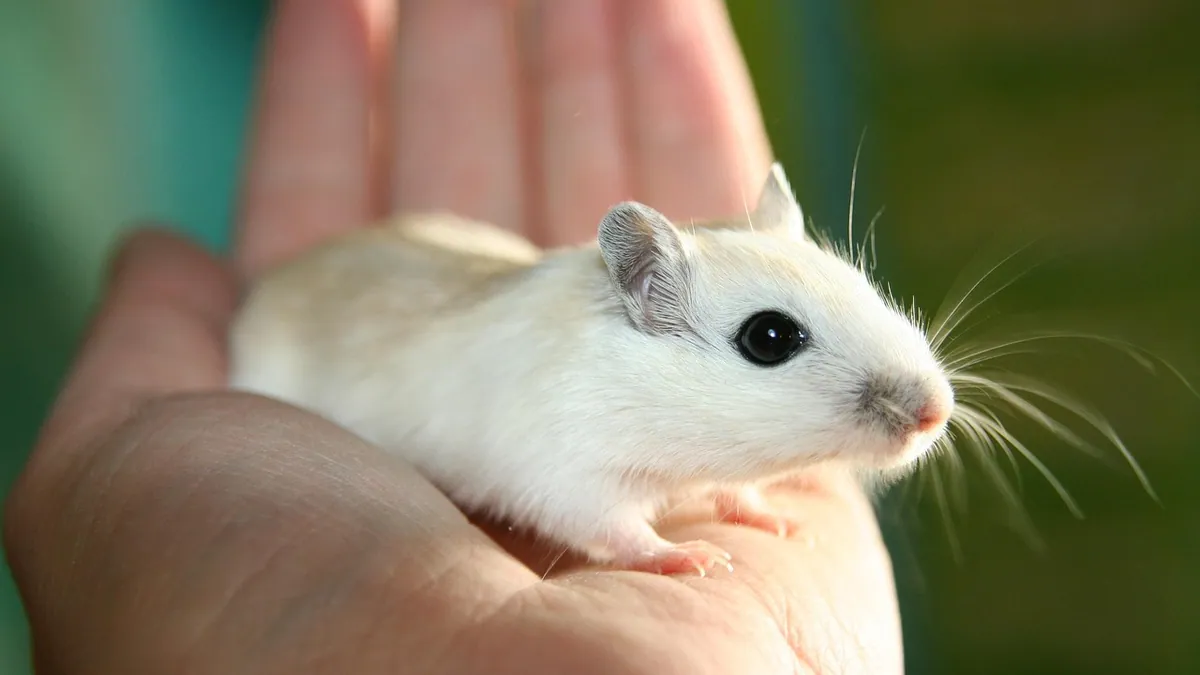
If you are asking how to tell if my gerbil is a boy or girl, the fastest method is to lift the tail and compare two things: the distance between the genital opening and the anus, and whether testicles are visible. Adult males have prominent testicles that you can see under the tail, while the gap between the openings is longer in males than in females [1]. This article is educational and is not a substitute for veterinary diagnosis or treatment.
Quick Answer
- Adult male gerbils (older than 7 weeks) have prominent testicles visible under the tail [1].
- In young gerbils, lift the tail and look at the hairless patch. It sits farther from the tail base in males than in females [1].
- The anogenital distance (space between the genital opening and the anus) is longer in males than in females [2].
- Sexing is much harder before 7 weeks of age, and even experienced owners can be wrong [1].
- The most reliable method for a young gerbil is to compare it side by side with another gerbil of known sex [1].
How to Tell If My Gerbil Is a Boy or Girl: Step by Step
Step 1: Wait for the right age if you can
If your gerbil is under 7 weeks old, sexing is genuinely difficult [1]. You can still try, but treat your answer as a guess until the gerbil matures. If you must know the sex right away, ask a veterinarian or an experienced gerbil breeder to check. If you have a young gerbil and you are not sure, house it alone until you can confirm the sex. Accidental litters are the main reason owners need this skill, and gerbils can mate again almost immediately after the female gives birth [1].
Step 2: Set up a safe handling spot
Work on a table or counter with a towel down. Gerbils are small, fast, and can jump. A fall from a table can cause serious injury. Keep the room quiet and dim the lights a little. Have a second person nearby if possible, one to hold the gerbil and one to look.
Step 3: Pick up the gerbil gently
Cup your hand under the gerbil's body and let it walk onto your palm. Never grab the tail. The tail is covered in fur but it can still be injured or degloved if pulled. If your gerbil is nervous, let it settle for a minute before you start.
Step 4: Lift the tail and look underneath
Hold the gerbil so its belly faces you and its hindquarters are visible. Lift the tail straight up and slightly forward. You will see two openings: the genital opening (closer to the front) and the anus (closer to the tail). In young gerbils, there is a small hairless patch between them [1].
Step 5: Measure the gap
Look at the distance between the two openings. In males, this gap is longer. In females, the openings are closer together, and the genital opening can look like a small slit or a tiny bump. In fetal gerbils, the anogenital distance is significantly longer in males than in females, and this difference persists after birth [2].
Step 6: Look for testicles
In males older than 7 weeks, the testicles are usually obvious. They sit under the tail and make the rear end look rounded and full [1]. Some males tuck their testicles up when they are nervous or cold, so if you do not see them, check again later when the gerbil is relaxed and warm.
Step 7: Check the ventral marking gland
Both male and female gerbils have a ventral marking gland on the abdomen. It looks like an orange-tan hairless oval and can be mistaken for a tumor [3]. In males, this gland enlarges during puberty and produces an oily secretion [3]. A large, oily gland is a clue that you have a male, but it is not proof on its own because females have the gland too [3].
Step 8: Confirm with a second look
Check again in a week. If the gerbil is still young, the differences will become clearer as it grows. If you are still unsure, do not put the gerbil with a suspected opposite-sex cage mate. Wait until you have a confident answer.
Comparison Table: Male vs Female Gerbil
| Feature | Male | Female |
|---|---|---|
| Testicles | Visible under tail after 7 weeks [1] | None |
| Anogenital distance | Longer [2] | Shorter [2] |
| Hairless patch position | Farther from tail base [1] | Closer to tail base [1] |
| Ventral marking gland | Enlarges at puberty, oily [3] | Present but usually smaller [3] |
| Adult size | Slightly larger [3] | Slightly smaller [3] |
| Body weight | 2 to 3 ounces (50 to 90 grams) [3] | 2 to 3 ounces (50 to 90 grams) [3] |
Age Matters: When Sexing Gets Easier
Gerbils under 7 weeks old are hard to sex accurately [1]. Before that age, the differences are subtle, and even the hairless patch method is not always reliable [1]. If you have a young gerbil, the single best thing you can do is compare it with another young gerbil whose sex is known [1]. Put them side by side on a towel and look at the gap between the openings. The difference is often easier to see when you have a reference point.
By 7 weeks, most males start showing testicles [1]. By 3 months, gerbils are usually ready to mate, and the sex differences are obvious [1]. If you adopted a gerbil from a pet store and the staff was not sure of the sex, assume nothing. Keep it separate from any gerbil you have not confirmed as the same sex.
Signs That Something Is Wrong
Sexing itself should not hurt your gerbil. If you see any of these signs while checking or afterward, contact a veterinarian.
- A swollen, red, or discolored area under the tail that is not a testicle
- A lump on the belly that is growing, draining, or changing color (the ventral gland can look like a tumor, so let a vet tell the difference) [3]
- Bleeding from the genital opening or anus
- Straining to urinate or defecate
- A foul smell from the rear end
- Your gerbil seems painful when you lift the tail, or it cries out
- A female that is pregnant or giving birth and seems distressed
Gerbils are prey animals. They hide pain well. If your gerbil is quieter than usual, hunched, or not eating, that is a reason to call your vet.
Common Mistakes When Sexing Gerbils
Mistake 1: Sexing too young
This is the most common error. Before 7 weeks, the differences are small, and even the hairless patch method is not always accurate [1]. If you guess wrong and house a male with a female, you can end up with a litter. Gerbils can mate again almost immediately after the female gives birth, so one mistake can lead to repeated litters [1].
Mistake 2: Confusing the ventral gland with a tumor
Both sexes have a ventral marking gland on the abdomen. It is an orange-tan hairless oval, and it can look alarming [3]. In males, it gets bigger and oilier at puberty [3]. Do not panic and do not try to remove it. Have a vet look at it if you are worried.
Mistake 3: Assuming size tells you the sex
Males are slightly larger than females, but the difference is small and not reliable on its own [3]. A large female can be bigger than a small male. Use the anatomy, not the size.
Mistake 4: Relying on behavior
Male gerbils may rub their abdomen on objects to mark territory, and that can be a clue [3]. But females can also mark, and many males do not do it often. Behavior is not a substitute for looking at the anatomy.
Mistake 5: Checking once and never again
A young gerbil you sexed at 4 weeks may look different at 8 weeks. Check again after 7 weeks and again at 3 months. If you are still unsure, keep the gerbil separate from any potential mate.
Supplies and Setup That Matter for Health
You do not need special equipment to sex a gerbil, but a few items make the job safer and easier.
- A towel or non-slip mat on the table
- A small clear container or a second pair of hands to help hold the gerbil
- A bright but soft light (a desk lamp works, but do not shine it directly in the eyes)
- A treat like a sunflower seed to reward the gerbil afterward
- A scale that measures in grams if you want to track growth
If you are keeping multiple gerbils, a glass aquarium with a secure lid is a common setup. Gerbils are burrowers and need deep bedding. They also need a solid exercise wheel, not a wire one, because wire wheels can catch toes and tails. For a full setup walkthrough, see the Gerbil Care Guide.
If you keep male gerbils together, watch for fighting. Male rodents can be territorial, and the same principles that apply to male pet rat behavior can give you a sense of what to look for, even though rats and gerbils are different species.
Limitations and When to Contact a Veterinarian
Sexing a gerbil is not always straightforward, especially in young animals. Even with careful handling, you can be wrong. If you are not sure, do not guess. A veterinarian can confirm the sex and answer your questions.
Contact a veterinarian the same day if your gerbil has a swollen or discolored rear end, is straining to urinate or defecate, or has a lump that is growing or draining. These can be signs of infection, injury, or other problems that need treatment.
Go to an emergency clinic right away if your gerbil is bleeding heavily, is not breathing normally, is collapsed, or has a prolapsed tissue from the genital or anal opening. Do not wait.
Schedule a routine visit if you want help sexing a young gerbil, if you are planning to breed, or if you have a female that may be pregnant. A veterinarian can also check the ventral gland if you are worried about it [3]. Individual cases need a veterinarian who can examine your pet in person.
Frequently Asked Questions
Can I tell if my gerbil is male or female by looking at its belly?
Not reliably. Both males and females have a ventral marking gland on the abdomen, which looks like an orange-tan hairless oval [3]. In males, the gland enlarges during puberty and produces an oily secretion [3]. A large, oily gland suggests a male, but females have the gland too, so you still need to check the rear end.
At what age can I sex my gerbil accurately?
Sexing is relatively simple after 7 weeks of age [1]. Before 7 weeks, it is much harder, and the methods are not always accurate [1]. If you have a young gerbil, compare it with another young gerbil of known sex, or ask a veterinarian to check.
Do male gerbils have visible testicles?
Yes. Adult male gerbils have prominent testicles that can be seen under their tails [1]. Some males pull them up when they are nervous or cold, so check again when the gerbil is relaxed. If you still do not see them, the gerbil may be too young or may be female.
What is the anogenital distance and why does it matter?
The anogenital distance is the space between the genital opening and the anus. In gerbils, this distance is significantly longer in males than in females, and the difference is present before birth [2]. A longer gap points to a male, and a shorter gap points to a female.
Can I keep a male and female gerbil together if I do not want babies?
No. Gerbils are generally monogamous, and paired gerbils will usually begin to mate at about 3 months of age [1]. Pregnancy lasts about 24 days, and a litter can have 1 to 8 pups [1]. The female can mate again almost immediately after giving birth [1]. If you do not want litters, keep only same-sex pairs or house gerbils separately.
Related Articles
- Gerbil Care Guide
- Can Dogs Be Intersex? Signs, Diagnosis, and Care
- How Do I Know If My Dog's Got Worms
- How Do I Know If My Dog Has Worm
- How To Tell If Dog Has A Worm
References
- Breeding and Reproduction of Gerbils - All Other Pets. Merck Veterinary Manual.
- Developmental changes in paramesonephric and mesonephric ducts and anogenital distance in fetal Mongolian gerbils during sexual differentiation. The Journal of veterinary medical science, 1993.
- Description and Physical Characteristics of Gerbils - All Other Pets. Merck Veterinary Manual.