Appaloosa Breed: Horse Care and Health Guide
By Dr. Zubair Khalid, DVM, MS, PhD ·
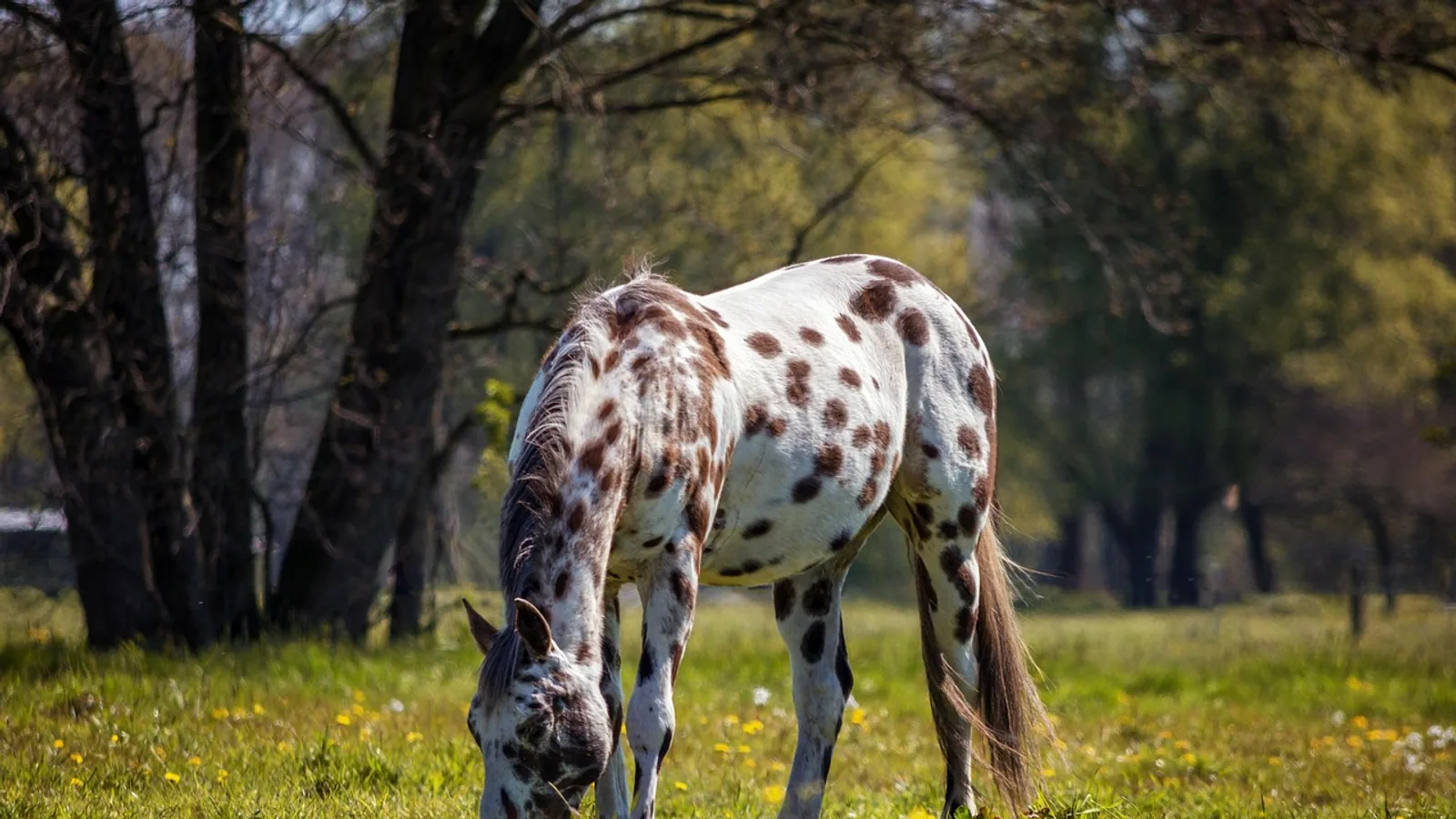
The Appaloosa is a North American horse breed shaped by the Nez Perce people of the Columbia River Plateau and defined by a group of white spotting patterns called the leopard complex. The breed is medium in size, historically a working and traveling horse, and today used for trail riding, ranch work, western performance, and sport. What sets the Appaloosa apart from every other stock-type breed is the genetics behind its coat. The same mutation that paints a horse with a spotted blanket or a leopard coat can also eliminate low-light vision and raise the risk of a painful, blinding eye disease. This guide explains those linked traits in plain terms and lays out a management plan that covers eye screening, sun protection, and routine care.
This article is educational and is not a substitute for veterinary diagnosis or treatment.
At a Glance
| Feature | Detail |
|---|---|
| Origin | Columbia River Plateau, North America, developed by the Nez Perce people [1] |
| Height | Not standardized in the sources used here. Height varies by bloodline and use |
| Weight | Not standardized in the sources used here |
| Coat | Leopard complex spotting: leopard, few-spot, blanket, blanket with spots, varnish roan, snowflake, and related patterns [1] |
| Distinguishing skin/eye signs | Mottled skin, striped hooves, and visible white sclera accompany true Appaloosa patterning |
| Lifespan | Not stated in the sources used here. Appaloosas are affected by age-related eye disease, with uveitis diagnosed at a mean age of about 12 years in one study population [2] |
| Energy and temperament | Historically a working and traveling horse. Individual temperament varies |
| Grooming | Routine care plus sun protection for white or pink skin |
| Trainability | Historically ridden, driven, and used for ranch work. Individual training response varies |
| Good with children or other pets | Not addressed in the sources used here. Evaluate the individual horse |
| Key health risks | Congenital stationary night blindness in LP/LP horses [3][4], equine recurrent uveitis [5][2], sun-exposed unpigmented skin |
Origin, History, and Purpose of the Appaloosa
The Appaloosa as a named breed comes from the Nez Perce, who bred horses with spotted coats on the Columbia River Plateau. The leopard complex spotting patterns that define the breed are old. Genetic testing of archaeological horse bones has traced the LP-associated allele in Europe back to the Late Pleistocene, roughly 17,000 years before present, making it one of the oldest coat traits documented in the horse [6][7]. The insertion responsible for the pattern has been identified in ancient DNA samples, which indicates it has survived in the horse gene pool for at least that long [7].
The trait has not been under steady selection. Leopard complex spotting was present in early domestic horses from Kirklareli-Kanligecit in Turkey dating to around 2700 to 2200 BC, where six of ten individuals were leopard spotted and one adult was homozygous [6]. The pattern then appears to have largely disappeared during the late Bronze Age, which suggests early breeders were selecting against it. It reappeared during the Iron Age, probably reintroduced into the domestic gene pool from wild animals [6]. This pattern of loss and return is consistent with shifting human preference rather than with any change in the biology of the trait. That history matters for owners because it explains why the allele carries a recessive liability that has never been fully bred out.
Leopard complex spotting appears across multiple breeds, not just the Appaloosa. Investigators have documented it in the Welsh Pony, Noriker, Appaloosa, and Pony of the Americas, and CSNB associated with LP has been confirmed in the Miniature Horse and found in Małopolska horses, Felin ponies, and Shetland ponies in Poland [8][9][1]. Horses carrying a leopard complex pattern can produce other patterns when mated to nonpatterned horses, which is a direct consequence of how the gene is inherited [1].
What Makes an Appaloosa: Coat, Skin, and Eye Characteristics


The Leopard Complex Patterns
The classic Appaloosa coat is the result of the leopard complex, abbreviated LP. The trait behaves as a single incompletely dominant allele. Heterozygotes are generally less extensively marked than homozygotes, although the two classes overlap, and the different named patterns reflect varying degrees of expression of the same allele [1]. The recognized patterns include leopard, few-spot leopard, blanket, blanket with spots, varnish roan (also called marble), snowflake, frosted, speckled, and mottled [1].
Beyond the coat, traditional breed identification relies on three physical signs that accompany the pattern: mottled skin, striped hooves, and visible sclera (the white of the eye). These markers are useful because a horse can carry the genetics without showing a dramatic spotted coat, and a horse can show mottling without a classic blanket.
LP Is Incomplete Dominant, and That Matters
Incomplete dominance means the two copies of the gene are not equal in effect. A horse with one copy of LP (written LP/lp) tends to have a more restricted pattern. A horse with two copies (LP/LP) tends to be more extensively white and can be nearly solid white, which is the few-spot presentation. The critical point for owners and breeders is that the homozygous state also carries the eye consequences described below [3][4].
PATN1 and Other Modifiers
LP sets the potential for a pattern. Other genes determine how much white actually appears. The best characterized of these is Pattern-1, or PATN1, a dominant modifier of LP that increases the extent of white patterning. A variant in the RFWD3 gene was identified in strong association with PATN1, and pedigree analysis had already indicated a single dominant gene acting as the major modifier [10].
The practical result is that LP alone does not tell you what a foal will look like. In a study of Noriker horses, 97 percent of genotyped leopard-spotted horses were heterozygous for LP and carried at least one copy of PATN1, yet the remaining variation in pattern was large, indicating additional genetic factors influence how LP is expressed [11]. Age and base coat color also had measurable effects on pattern in that analysis [11]. For Appaloosa breeding, this means two loudly patterned parents can produce a minimally patterned foal, and two quietly patterned parents can produce a spotted one.
The 2020 study of Appaloosa horses in western Canada also found that the few-spot pattern was significantly associated with increased risk for equine recurrent uveitis compared with minimally patterned or true solid horses [2]. Few-spot is the pattern most often seen in LP homozygotes, which ties the uveitis risk back to the genotype rather than to the appearance alone.
Coat Pattern, Genotype, and Health Risk
The table below pairs the common pattern descriptions with the underlying genotype and the associated health risk. Genotype is written as LP/lp for one copy and LP/LP for two copies, with lp/lp meaning no leopard complex allele. This is a guide to the general relationship, not a substitute for DNA testing of an individual horse.
| Pattern | Typical genotype | Pigment in patterned area | Night vision (CSNB) | Uveitis risk |
|---|---|---|---|---|
| True solid, no Appaloosa characteristics | lp/lp | Full pigment | Normal | Baseline |
| Varnish roan, marble, snowflake, speckled, frosted | Often LP/lp | Reduced but present | Normal | Low |
| Blanket, blanket with spots | Commonly LP/lp | Reduced, with spots of pigment | Normal | Moderate |
| Leopard | Commonly LP/lp, sometimes LP/LP | Extensive white with dark spots | Normal if LP/lp | Moderate |
| Few-spot | Often LP/LP | Little to no pigment in the white area | Affected in all LP/LP horses tested | Highest |
| Near-white with mottling | Often LP/LP | Minimal pigment | Affected | Highest |
The night blindness column reflects a consistent finding across studies. All horses in the LP/LP groups were affected by congenital stationary night blindness in both the Appaloosa study and the Miniature Horse study, while no horse in the LP/lp or lp/lp groups was affected [8][4]. Congenital stationary night blindness is inherited as a recessive trait at this locus, which is why only the homozygous animal is night blind [12]. Note that LP/lp horses with heavy leopard patterning are not night blind, and this is a common point of confusion. The risk follows the genotype, not the amount of white.
Understanding Congenital Stationary Night Blindness
What It Is
Congenital stationary night blindness, or CSNB, is a non-progressive defect in low-light vision present from birth. Electroretinography in affected Appaloosas shows a characteristic pattern: the dark-adapted response is a simple negative potential with a non-recordable scotopic b-wave, while a normal c-wave is present [13]. In other words, the retina has no structural abnormality that explains the defect, but the signal from the rods to the bipolar cells does not get through [13]. The condition is stationary, meaning it does not worsen with age, and it does not progress to total blindness.
The Genetics Behind It
CSNB in the Appaloosa is tied directly to the leopard complex. The LP locus maps to a region on equine chromosome 1 containing the gene TRPM1, which encodes a transient receptor potential cation channel [14][3]. TRPM1 is normally expressed in the ON-bipolar cells of the inner nuclear layer of the retina [12].
The causative change is a 1378 base pair insertion in intron 1 of TRPM1. This insertion is a long terminal repeat of an endogenous retrovirus that disrupts TRPM1 transcription by causing premature polyadenylation [7]. The insertion was completely associated with LP in a test of 511 horses and with CSNB in a test of 43 horses [7]. A second variant contributes as well. A single nucleotide polymorphism at ECA1 108,249,293 C>T creates a binding site for the Nova-1 protein, which disrupts normal splicing and produces unstable, non-functional TRPM1 messenger RNA [12].
The consequence is a dramatic drop in TRPM1 expression. In the retina of homozygous Appaloosa horses, TRPM1 expression was measured at 0.05 percent of the level found in non-Appaloosa horses, a change of more than 1800-fold [3]. Expression was also reduced in the skin of LP/LP horses, which helps explain why the same gene affects both coat pigment and retinal signaling [3]. This dual effect is a well-documented example of a pigmentation gene with pleiotropic effects, meaning one gene influences multiple body systems [15].
What It Looks Like in the Barn
Affected horses are night blind, not day blind. In practical terms, an LP/LP Appaloosa may show hesitation about entering a dark barn, reluctance to move in low light, or a startle response at dusk. The condition has been described in the veterinary literature under the older term "nyctalopia" in Appaloosas, with electroretinographic findings matching those in humans with CSNB of the Schubert-Bornschein type [13]. A complete ophthalmic examination with electroretinography confirms the diagnosis, and DNA testing of the TRPM1 insertion identifies carriers and homozygotes [9][16].
Some LP/LP horses also have smaller corneal diameters than LP/lp or lp/lp horses, a finding reported in the Appaloosa study [4]. This is an anatomical observation from an ophthalmic examination, not a disease.
CSNB Outside the Appaloosa
The same TRPM1 insertion has been confirmed in the Miniature Horse [8], and genetic surveys in Poland identified LP-carrying Małopolska horses, Felin ponies, and Shetland ponies homozygous for the insertion, at rates of about 7 percent, 4.8 percent, and 6.25 percent within their LP-carrying populations [9]. A separate form of CSNB, caused by a missense mutation in GRM6 rather than TRPM1, has been reported in the Tennessee Walking Horse and later in several other breeds, so not every night-blind horse has the leopard complex form [17][18]. CSNB has also been documented in a Thoroughbred and a Paso Fino [19]. For an owner, this means a night-blind horse of unknown breeding still warrants a proper diagnostic workup.
Equine Recurrent Uveitis and the Appaloosa
Why the Appaloosa Is Overrepresented
Equine recurrent uveitis is an inflammatory disease of the eye and one of the leading causes of blindness in horses. A large case series found that 28 of 112 horses with uveitis were Appaloosas, compared with only 10 of 260 horses without uveitis, giving an odds ratio of 8.3 [5]. In the same series, 19 of the 28 Appaloosas with uveitis (68 percent) developed blindness, compared with 30 of 84 non-Appaloosas with uveitis (36 percent), an odds ratio of 3.8 [5]. The same study found that leptospiral seroreactivity was strongly associated with uveitis and that seropositive horses with uveitis were at higher risk of losing vision [5].
A later study focused specifically on Appaloosas in western Canada confirmed uveitis in 20 of 145 horses, or 14 percent, with a mean age of 12.3 years at diagnosis [2]. Age was a significant risk factor. The LP/LP genotype was at significantly greater risk than lp/lp with an odds ratio of 19.4 and greater risk than LP/lp with an odds ratio of 6.37, and damage classification was more severe in LP/LP horses than in LP/lp horses [2]. The few-spot pattern was also significantly associated with increased risk compared with minimally patterned or true solid horses [2]. This is the strongest evidence available that the severity of Appaloosa eye disease tracks genotype.
What Owners Notice
Equine recurrent uveitis flares and remits. During a flare, an owner may see squinting, tearing, eyelid swelling, a cloudy or hazy eye, sensitivity to bright light, or a reluctance to have the face handled. Between flares the eye can look nearly normal even while damage accumulates inside. Because of this, uveitis is easy to miss in the early stages and is a strong argument for scheduled veterinary eye examinations rather than waiting for obvious signs.
Screening is worthwhile for Appaloosa horses generally and especially for LP/LP horses. Genetic testing to identify the LP genotype is part of the diagnostic toolkit for ocular disorders in horses, alongside a full ophthalmic examination, because it identifies animals with or at risk for disease and informs breeding decisions [16][2]. Discuss the appropriate screening interval with your veterinarian. A reasonable approach is an annual ophthalmic examination for minimally patterned horses and more frequent examinations for confirmed LP/LP or few-spot horses, with additional visits any time a flare is suspected.
Other Health and Management Considerations
Sun Protection for Unpigmented Skin
Skin without pigment is vulnerable to sunburn, and the white areas of a leopard complex coat are unpigmented by definition. The lection of which body regions lose pigment varies by pattern, but the muzzle, eyelids, and any large white areas are the practical concerns. Provide shade during peak sun hours, and use a veterinarian-approved equine sunscreen on light-skinned areas of the face. A fly mask with a nose extension protects both the eyes and the unpigmented muzzle. These measures also matter for horses with visible sclera, because a larger area of pale tissue around the eye is exposed to ultraviolet light.
Hooves and Skin
Appaloosas are often identified by striped hooves and mottled skin. The mottling and striping are part of the breed's characteristic appearance and are not health problems in themselves. Routine hoof care on the farrier's normal schedule is appropriate for a healthy adult horse.
Travel and Vision
Because LP/LP horses are night blind, plan for transport and turnout around it. Load and unload in daylight when possible. Keep pastures free of hazards that a horse might not see at dusk, such as low posts, wire ends, and open ditches. If you must move a night-blind horse in low light, allow extra time and use a familiar route. A night-blind horse usually adapts well to a consistent environment, and many live normal ridden lives in daylight.
Nutrition and Feeding
Appaloosas are stock-type horses and do not have a breed-specific diet. Match forage quality and concentrate to body condition, workload, and age. The Kentucky Equine Research resource library is a useful reference for evaluating hay and ration balancer choices. Discuss any supplement or feed change with your veterinarian, particularly for horses with metabolic concerns.
Exercise and Training
The breed's historical role as a working and traveling horse means most Appaloosas are suited to regular riding, driving, and ranch work. Build fitness gradually, and account for vision limitations during dawn and dusk sessions. For a night-blind horse, arena work under lights is generally comfortable because the footing is predictable.
Finding a Responsible Breeder or Rescue
The most important question to ask about an Appaloosa is a genetic one. Ask whether the sire and dam have been tested for the TRPM1 insertion and whether the foal's expected LP genotype has been considered. Because LP is incompletely dominant and PATN1 modifies pattern, a breeder who understands the genetics can predict whether a cross is likely to produce an LP/LP foal [10][16]. A homozygous foal will be night blind, and its future risk of uveitis is elevated [4][2].
Other items worth requesting are current ophthalmic examination records for the mare and foal, vaccination and deworming history, and hoof care records. For horses being placed through rescue, ask for any history of eye inflammation, squinting, or cloudy eyes, since these may indicate prior uveitis episodes.
Who Should Not Get an Appaloosa
A buyer should reconsider this breed if the planned use depends on reliable vision in dim light. An LP/LP Appaloosa is night blind [8][4]. A buyer without the time or budget for scheduled eye examinations, and without a plan for handling a flare, should think carefully before choosing a few-spot or heavily homozygous horse. A buyer who wants a horse for dawn and dusk trail riding on unfamiliar terrain should discuss vision testing with a veterinarian before purchase.
Limitations and When to Contact a Veterinarian
No article can assess an individual horse. Contact a veterinarian promptly for any of the following.
- Squinting, tearing, eyelid swelling, or a cloudy eye, in one eye or both
- Sensitivity to light or reluctance to have the face touched
- A sudden change in behavior in low light or difficulty navigating at dusk
- Any change in pupil appearance or a visible abnormality inside the eye
- Suspected sunburn, blistering, or crusting on unpigmented skin
- Reluctance to move, head pressing, or general dullness in a horse with a known eye history
- Any horse with an unknown night-vision status before purchase or training
Equine recurrent uveitis is a medical emergency in the sense that early treatment improves the odds of preserving vision. Do not wait to see whether a squinting eye improves on its own.
Frequently Asked Questions
Are all Appaloosas night blind?
No. Only horses with two copies of the leopard complex allele (LP/LP) are affected by congenital stationary night blindness. Horses with one copy (LP/lp) or no copy (lp/lp) have normal low-light vision [8][4].
Can a horse be an Appaloosa without spots?
Yes. Traditional identification relies on mottled skin, striped hooves, and visible sclera in addition to coat pattern, and pattern expression varies widely even among horses carrying LP and PATN1 [1][11].
What is the difference between LP and PATN1?
LP is the incompletely dominant gene that creates the potential for a spotted coat. PATN1 is a dominant modifier that increases how much white actually appears [1][10].
Do all spotted horses have Appaloosa blood?
No. Leopard complex spotting appears in several breeds, including the Noriker, Miniature Horse, Welsh Pony, Shetland Pony, and Pony of the Americas [8][9][1][11].
Is CSNB the same as blindness?
No. CSNB is a stationary defect in low-light vision present from birth. It does not progress, and affected horses retain daytime vision [13].
How often should an Appaloosa's eyes be examined?
Timing depends on genotype and history. LP/LP and few-spot horses carry the highest risk and benefit from more frequent examinations. Ask your veterinarian to set an interval during a wellness visit.
Does uveitis always cause blindness?
No, but the risk is real and higher in Appaloosas. In one case series, 68 percent of Appaloosas with uveitis developed blindness in one or both eyes [5].
Can a night-blind horse be ridden?
Many can be ridden safely in daylight and in familiar, well-lit surroundings. Discuss the individual horse's vision with your veterinarian before planning any riding program.
Related Articles
- Hairless Cat: Care, Health, and Breed Guide
- Cat Breeds: How to Choose a Cat by Care Needs, Health, and History
- Norwegian Forest Cat: Breed Guide, Health, and Care Tips
- Dog Breeds: Health Guide and Care Tips for Popular Types
- Small Dog Breeds: Health Concerns and Care Tips
- Ragdoll Cat Breed Guide: Personality, Care, and Health Tips
- Shetland Pony Care: Feeding, Hoof, and Health Guide
- Bantam Silkies: Breed Care and Health Guide
Sources
- The inheritance of the leopard complex of spotting patterns in horses.
- Risk factors for equine recurrent uveitis in a population of Appaloosa horses in western Canada.
- Differential gene expression of TRPM1, the potential cause of congenital stationary night blindness and coat spotting patterns (LP) in the Appaloosa horse (Equus caballus).
- Clinical and electroretinographic characteristics of congenital stationary night blindness in the Appaloosa and the association with the leopard complex.
- Association of leptospiral seroreactivity and breed with uveitis and blindness in horses: 372 cases (1986-1993).
- Twenty-five thousand years of fluctuating selection on leopard complex spotting and congenital night blindness in horses.
- Evidence for a retroviral insertion in TRPM1 as the cause of congenital stationary night blindness and leopard complex spotting in the horse.
- Congenital stationary night blindness is associated with the leopard complex in the Miniature Horse.
- Genetic testing as a tool for diagnosis of congenital stationary night blindness (CSNB) in white spotted breeds in Poland.
- Variant in the RFWD3 gene associated with PATN1, a modifier of leopard complex spotting.
- Phenotypic and Genetic Analysis of the Leopard Complex Spotting in Noriker Horses.
- Redundant contribution of a Transient Receptor Potential cation channel Member 1 exon 11 single nucleotide polymorphism to equine congenital stationary night blindness.
- Congenital stationary night blindness: an animal model.
- Fine-mapping and mutation analysis of TRPM1: a candidate gene for leopard complex (LP) spotting and congenital stationary night blindness in horses.
- Pleiotropic effects of pigmentation genes in horses.
- Genetic Testing as a Tool to Identify Horses with or at Risk for Ocular Disorders.
- Additional evidence supports GRM6 p.Thr178Met as a cause of congenital stationary night blindness in three horse breeds.
- Whole-genome sequencing identifies missense mutation in GRM6 as the likely cause of congenital stationary night blindness in a Tennessee Walking Horse.
- Congenital stationary night blindness in a Thoroughbred and a Paso Fino.