Grey and White Cat Breeds: Patterns and Personalities
By Dr. Zubair Khalid, DVM, MS, PhD ·
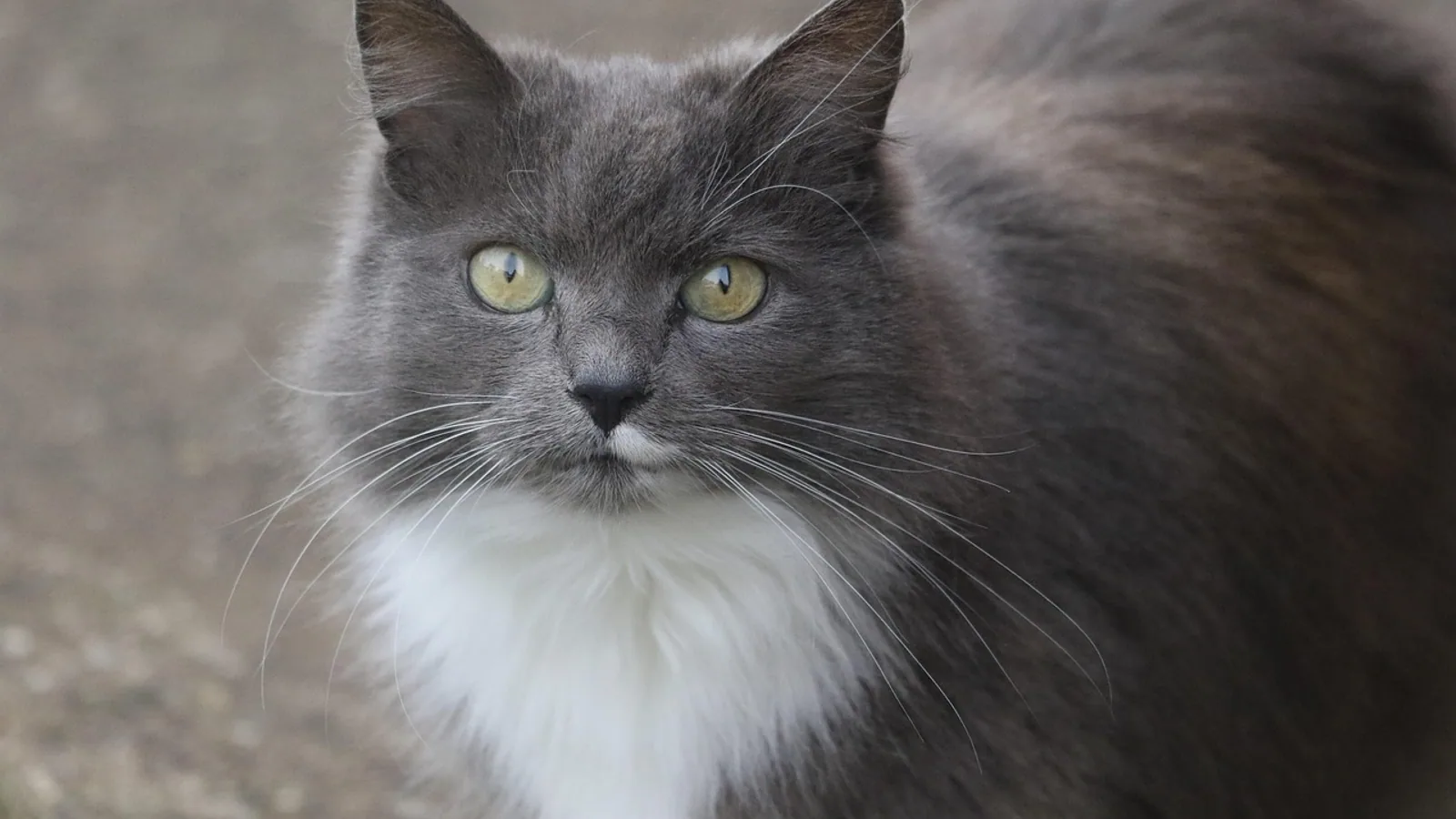
A grey and white cat is not a breed. It is a coat description produced by two independent genetic events: a dilution gene that turns black pigment into grey, and a white spotting gene that lays white patches over that grey base. The result is a spectrum, from a grey cat with a white locket on the chest to a mostly white cat with grey markings on the head and tail. Grey and white coats occur across many recognized breeds and in the general domestic cat population, which is why the same pattern appears on British Shorthairs, Maine Coons, American Shorthairs, Persians, and the ordinary cat at the local shelter.
This article explains the genetics carefully, distinguishes true grey (dilute black) from blue-grey and from silver tabby, covers the breeds where grey and white is a standard color, and reviews what the veterinary literature actually says about the popular idea that coat color predicts personality. The short answer on temperament is that the evidence is weak and inconsistent, and behavior in cats is driven far more by genetics, early experience, and environment than by fur color.
This article is educational and is not a substitute for veterinary diagnosis or treatment.
At a Glance
| Trait | What to expect |
|---|---|
| Coat | Grey (dilute black) base with variable white spotting, from a few white hairs to a mostly white body |
| Eye color | Varies by breed. Copper, gold, green, or blue. Blue eyes are associated with the Dominant White locus and with some white spotting patterns |
| Size | Breed dependent. Domestic cats are typically 8 to 12 lb, with males larger in most breeds |
| Lifespan | Breed dependent. The general domestic cat lifespan is commonly 12 to 18 years, with many individual and breed-level exceptions |
| Energy | Not determined by coat color. Breed and individual variation dominate |
| Grooming | Not determined by coat color. Coat length and density determine grooming needs |
| Trainability | Individual and breed influenced. Coat color is not a predictor |
| Good with children | Individual and breed influenced. Supervision is always required with young children |
| Good with other pets | Individual and breed influenced. Gradual introductions matter more than coat color |
The one coat-associated health fact that owners should know is that white pigmentation, especially when it covers the iris and the inner ear, is linked to deafness in cats, and that white or lightly pigmented skin carries a higher risk of sun-related skin damage [1][2].
What Makes a Cat Grey and White?
Two separate genetic systems combine to produce a grey and white cat. The first controls whether black pigment is full strength or diluted. The second controls how much of the body is covered by white.
The dilute gene (d/d) turns black into grey
Eumelanin is the black or brown pigment that gives a cat its dark color. The dilute locus alters how densely that pigment is packed into the hair shaft. A cat that is homozygous for the dilute allele, written d/d, produces black pigment at reduced density, and the coat looks grey. This grey is the same thing breeders call blue. Blue in a British Shorthair, a Russian Blue, or a grey domestic shorthair is dilute black, not a separate pigment.
The term blue is a breeder and registry convention rather than a distinct color. A "blue and white" cat and a "grey and white" cat are describing the same pigment with different vocabulary. The blue-grey coat seen on grey and white cats, including the classic grey and white tuxedo pattern, is dilute eumelanin, and the intensity can vary slightly with the underlying genotype at the black locus, the brown locus, and modifier genes. Research on dilution across mammals has repeatedly implicated the melanophilin gene, which causes recessive color dilution in species including cats, dogs, mice, and mink [3].
Grey is not silver tabby
A grey tabby and a silver tabby are often confused, and the difference matters for breeding and for understanding the cat in front of you.
A grey tabby is a dilute black cat with tabby markings. The stripes are dark grey on a lighter grey background, and the pigment throughout the coat is eumelanin at reduced density. A silver tabby is a different structure altogether. The silver effect suppresses the warm yellowish tones in the agouti banding of the hair shaft, producing a cool, silvery background with dark markings. Silver is common in Persians, American Shorthairs, British Shorthairs, and related breeds.
The practical distinction: a grey and white cat has dilute eumelanin patches and white patches. A silver tabby has a silver background that may be accompanied by white spotting, but the greyish tone comes from the silver inhibitor gene, not from dilution alone. A review of Siberian cat coat variation notes that registries often differ in how they name silver and golden variants, and that nomenclature across federations is inconsistent [4].
White spotting (S) is variable and polygenic
The white spotting locus is separate from the color loci. A cat can be genetically black or dilute black and still show wide variation in how much white it carries. The amount of white is governed by the spotting gene and by additional factors that are not fully resolved.
The major breakthrough in feline coat genetics was the identification of the KIT gene on feline chromosome B1 as the locus responsible for white and white spotting [1]. A full-length feline endogenous retrovirus insertion at KIT produces white spotting, while a long terminal repeat alone produces Dominant White. This same locus explains the pleiotropic effects of white coats, including incomplete penetrance for deafness and iris hypopigmentation [1]. An earlier linkage study had already narrowed white spotting to the region around KIT on chromosome B1, with PDGFRA as an additional candidate [5].
The traditional model held that one copy of the spotting allele (S/s, also written Ws/w) produced less than 50 percent white, while two copies (S/S) produced more than 50 percent white. A large study of Siberian cat pedigrees tested that model against two databases covering more than 45,000 cats and found significant deviations. Many cats presumed homozygous had less than 50 percent white, and many presumed heterozygous had more than 50 percent white [6]. The conclusion is that the amount of white is not controlled by a simple two-allele switch. Other factors are involved, and the current model should be revised [6].
A recent example of that complexity is the salmiak phenotype reported in Finnish cats. These cats have a distinctive white hair pattern, test negative for all known white variants, and carry a roughly 95 kb deletion downstream of KIT [7]. This confirms that additional white-spotting alleles remain to be discovered.
What this means for a grey and white cat
A grey and white cat is, genetically, something like this:
- At the Black locus (B): a cat carrying at least one B allele produces black eumelanin. A cat carrying b/b produces chocolate or cinnamon, and dilution of those produces lilac or fawn, not grey.
- At the Dilute locus (D): the cat is d/d, so black pigment is reduced to grey.
- At the Spotting locus (S): the cat carries at least one spotting allele, producing white patches on some part of the body.
- At the Dominant White locus (W): if present, the cat is white regardless of every other color gene, because W overrides pigment production entirely. A cat with W is not a grey and white cat. It is a white cat with hidden color underneath.
Genotype to phenotype table
| Locus | Genotype | Phenotype |
|---|---|---|
| Black (B) | B/B or B/b | Black eumelanin base |
| Black (B) | b/b | Chocolate or cinnamon base |
| Dilute (D) | D/D or D/d | Full intensity pigment |
| Dilute (D) | d/d | Diluted pigment. Black becomes grey or blue |
| Agouti (A) | A/* | Tabby pattern expressed |
| Agouti (A) | a/a | Solid color, no tabby pattern |
| Spotting (S) | S/S | Traditionally expected to give over 50 percent white, but real cats vary widely [6] |
| Spotting (S) | S/s | Traditionally expected to give under 50 percent white, but real cats vary widely [6] |
| Spotting (S) | s/s | No white spotting |
| Dominant White (W) | W/* | Fully white coat, may have blue eyes, risk of deafness [1] |
| Dilute plus spotting | d/d plus S/* | Grey and white coat pattern |
Combining d/d with a tabby allele and strong spotting produces what many owners describe as a greyish white cat, where the grey and white blend visually because the pattern density is low and the white area is high.
Which Breeds Commonly Show Grey and White
Grey and white is accepted in many breed standards and appears in the general cat population. Breed standards vary by registry, and the same phenotype may be named differently across federations [4]. The breeds below are commonly associated with grey and white coats. Breed-specific health and temperament statements in this article are limited to what the veterinary literature supports, and individual cats still need individual assessment.
British Shorthair
The British Shorthair is the breed most associated with the blue (grey) coat, and blue and white is a recognized color in most registries. The breed is medium to large, muscular, with a dense short coat. British lines have also been used in the development of the Dominant Blue Eyes trait, where a complex structural variant in PAX3 in British Shorthair and British Longhair cats was identified in all 39 cats with a BDE phenotype in one study and was absent in 47 non-BDE cats [8].
Maine Coon
Maine Coons come in nearly every recognized color, and grey and white is common. The breed is large, long-haired, and slow maturing. Maine Coon lines have been used to establish the Dominant Blue Eyes trait. A PAX3 frameshift variant, PAX3:c.160del, was identified in a specific Maine Coon lineage, and the study noted the need to reassess the prevalence of deafness associated with the trait and revealed the existence of cats that carry the variant but do not show the phenotype [9].
Persian
Persians come in silver and in grey, including smoke and shaded variants. The 2013 study on coat color and hyperthyroidism noted that the pointed coat breeds, Siamese and Himalayan, have a reduced risk of hyperthyroidism compared with domestic shorthairs, but the study did not find a specific mechanism and did not find differences in tyrosine, phenylalanine, iodine, or selenium between light and dark cats [10]. That study did not establish a general protection for grey and white Persians, only that coat color alone did not explain the amino acid and mineral findings.
American Shorthair
The American Shorthair accepts silver tabby, grey tabby, and grey and white patterns. The breed is medium sized, muscular, and known for a broad genetic base.
Siberian
Siberian cats show a wide range of color variation, including white spotting categories. A review of Siberian coat color genetics notes that registries differ in how they define white spotting categories and that some phenotypes are accepted by some federations and not others [4]. An earlier pedigree study on Siberian cats found that the actual amount of white in offspring did not match the expected amount under the simple one-copy versus two-copy model [6].
Russian Blue
The Russian Blue is defined by a solid blue (grey) coat, and white spotting is not part of the breed standard. A grey and white cat that looks like a Russian Blue is usually a domestic shorthair, not a Russian Blue. This is a common point of confusion for owners.
Domestic Shorthair and Domestic Longhair
The majority of grey and white cats are not purebred. The random-bred domestic cat population carries the full range of color and spotting variation. The veterinary literature stresses that random-bred populations can carry defined genetic characteristics and mutations and are as worthy of genetic study as purebreds [11].
The Temperament Question: Does Coat Color Predict Personality?
This is one of the most persistent myths in cat ownership. The idea that grey and white cats are calmer, or that orange cats are friendlier, or that tortoiseshells are difficult, circulates widely. The evidence does not support strong claims.
A systematic review of aggression in domestic cats examined 26 studies and reported that aggression is influenced by a complex interaction between genetic predisposition and environmental factors [12]. Associations have been reported with polymorphisms in genes such as OXTR and AR, chromosomal abnormalities, breed, sex, and coat color, alongside early-life experiences, owner management, and environmental conditions [12]. Coat color is listed among many candidate factors, not as a dominant driver. The findings were synthesized narratively because study designs, behavioral assessment methods, and outcome measures were too heterogeneous to pool [12].
What this means in practice is that a grey and white cat's personality is not determined by its fur. Genetics contribute to temperament through many genes, and the strongest early influence on a cat's behavior is socialization during the sensitive period and the environment it lives in. Breed does influence behavior tendencies in some cases, but grey and white is a color pattern, not a behavioral profile.
The dominance of environment and early experience in the veterinary behavior literature means the single most useful predictor of an adult cat's temperament is how it was handled and socialized as a kitten, not whether it has white patches.
Health Considerations Specific to Grey and White Cats
Coat color itself is not a disease. But some coat color genes have pleiotropic effects, meaning the same gene influences both pigment and other body systems. Owners should understand the two clinically relevant associations.
Deafness and white pigmentation
The KIT locus that drives white and white spotting has incomplete penetrance for deafness and iris hypopigmentation [1]. This means not every white cat is deaf, and not every cat with blue eyes is deaf. But the association is real and genetically linked. A linkage analysis of a pedigree segregating for White identified KIT as the feline W locus, and estimated association P values for deafness in the range of 0.007 to 0.10 [1].
A transcriptome study of cat skin cells found that white coat skin cells may frequently produce a KIT transcript lacking the first exon, called d1KIT. The production of d1KIT showed a substantial negative correlation with SOX10, a gene essential for melanocyte formation and for hearing function [2]. This provides a molecular mechanism linking white pigmentation to deafness risk. The same study raised the possibility that the ratio of tumor-suppressing to tumor-promoting gene expression in orange and white skin cells could be lower than theoretical estimates, and the authors framed this as basic research rather than a clinical risk prediction [2].
Practical implications:
- A white or high-white grey and white cat should have its hearing assessed, especially before being allowed outdoors unsupervised. Deaf cats can be kept safely indoors.
- Blue-eyed white cats have a higher probability of deafness than cats with other eye colors, but the association is not absolute [1].
- Any cat with extensive white on the ears and face has less pigment protection from ultraviolet light.
Sun-related skin damage
White and lightly pigmented skin has less melanin, which is the body's natural ultraviolet shield. The transcriptome work on coat color and squamous cell carcinoma risk found that the ratio of genes suppressing squamous cell carcinoma to genes promoting it might be lower in skin cells with white coats and orange coats in white-spotted cats [2]. The authors presented this as a possible skin coat color dependent risk and a basis for further basic research, not as a measured clinical incidence. Owners of grey and white cats, especially those with white on the ears, nose, and eyelids, should discuss sun exposure and skin monitoring with a veterinarian.
Breed-level conditions that overlap with grey and white breeds
The breed conditions below are not caused by the grey and white coat. They occur in breeds that happen to carry grey and white as a standard color. A grey and white cat from one of these breeds should be screened for the breed's known conditions according to the treating veterinarian's recommendations and the relevant breed health guidelines.
| Breed | Conditions that may be screened or monitored |
|---|---|
| British Shorthair | Hypertrophic cardiomyopathy, polycystic kidney disease, bleeding disorders. Discuss breed-appropriate screening with a veterinarian |
| Maine Coon | Hypertrophic cardiomyopathy, hip dysplasia, spinal muscular atrophy. Discuss screening with a veterinarian |
| Persian | Polycystic kidney disease, brachycephalic airway syndrome, eye conditions. Discuss screening with a veterinarian |
| Siberian | Hypertrophic cardiomyopathy and other breed conditions. Discuss screening with a veterinarian |
| American Shorthair | Hypertrophic cardiomyopathy. Discuss screening with a veterinarian |
The genetic tools available for feline health have expanded substantially. A review of inherited disease investigation in cats noted that over 70 genetic mutations have been defined in the cat, many involving diseases, structural anomalies, and coat color and texture, and that genetic testing and eventually whole-genome sequencing should become routine diagnostic tools in feline healthcare [11]. That framework is the right context for deciding which tests a specific grey and white cat needs.
Hyperthyroidism and coat color, what the evidence shows
A study comparing hyperthyroid cats, Siamese and Himalayan cats, and age-matched controls looked at amino acid, iodine, and selenium status relative to coat color. It found that tyrosine, phenylalanine, iodine, and selenium levels were not significantly different among light or dark cats or cats with or without hyperthyroidism, and that plasma amino acid profiles of hyperthyroid cats and control cats were similar [10]. It did not establish a coat-color protection against hyperthyroidism. Siamese and Himalayan cats have a reduced risk of hyperthyroidism compared with domestic shorthairs, but the mechanism remains unknown and the study did not identify it [10]. Owners should not assume a grey and white coat changes thyroid risk.
Grooming and Coat Care
Grooming needs follow coat length, density, and texture, not color.
- Short-haired grey and white cats (British Shorthair, American Shorthair, domestic shorthair) benefit from weekly brushing, which reduces shedding and hairballs and provides a routine health check of the skin.
- Semi-long and long-haired grey and white cats (Maine Coon, Siberian, Persian) require brushing several times per week, with daily grooming during seasonal shedding. Matting behind the ears, under the front legs, and around the tail base should be addressed early.
- White-coated areas show dirt and tear staining more visibly. Gentle wiping of the face and around the eyes with a soft damp cloth is reasonable for cats that tolerate it.
- Double-coated breeds should not be shaved. The undercoat provides insulation and protection from sunburn. Shaving a double coat can increase sun exposure risk on already light-pigmented skin.
Bathing is rarely necessary for cats unless a veterinarian recommends it for a skin condition. Excessive bathing can strip oils from the coat.
Feeding and Nutrition
There is no evidence that a grey and white cat needs a different diet than any other cat of the same age, weight, and health status. The coat color study on hyperthyroid cats measured amino acid, iodine, and selenium status and found no significant differences between light and dark cats [10]. No coat-color based nutritional recommendation follows from that.
General feeding principles for cats:
- Feed a complete and balanced diet that meets the nutritional requirements established by the Association of American Feed Control Officials (AAFCO) for the cat's life stage.
- Control calorie intake. Obesity is the most common nutritional problem in pet cats and contributes to diabetes, arthritis, and other conditions.
- Provide fresh water at all times. Many cats drink too little, and wet food can help increase water intake.
- Do not give supplements for coat color. No supplement changes a cat's color, and unnecessary supplementation can be harmful.
- Adjust portions as the cat ages, as activity declines, and after any diagnosis that alters nutritional needs.
Specific diets for specific conditions, including kidney disease, urinary disease, and diabetes, should be chosen with a veterinarian.
Lifespan and Senior Care
Lifespan in cats is influenced by breed, body size, genetics, indoor or outdoor lifestyle, preventive care, and nutrition. Coat color does not determine lifespan.
Senior cats, generally those over 10 to 12 years, benefit from more frequent veterinary visits. According to AAHA and AVMA guidance, senior cats should be evaluated at least every six months, with attention to weight, dental health, kidney function, thyroid function, blood pressure, and mobility. Owners of grey and white cats with extensive white on the face should also ask their veterinarian to examine the ears, eyelids, and nose for sun-related changes at these visits.
Signs that warrant prompt evaluation in any older cat:
- Weight loss despite normal or increased appetite
- Increased thirst and urination
- Vomiting or diarrhea lasting more than a day or two
- Reduced activity, hiding, or reluctance to jump
- New lumps, scabs, or non-healing sores, especially on white areas
- Changes in hearing or response to sound
Finding a Responsible Breeder or Adopting
If you want a specific breed
A responsible breeder provides health testing documentation relevant to the breed, allows you to meet the kitten's mother, keeps kittens with the litter until they are at least 12 weeks old, and answers questions about the breed's known health conditions. For breeds with a known cardiac condition such as hypertrophic cardiomyopathy, ask what cardiac screening has been done and whether results are available. The inherited disease review notes that genetic testing should become a routine diagnostic tool, and responsible breeders use available tests where they exist [11].
Grey and white is a color pattern within a breed, not a separate breed. Do not pay a premium for a coat color that is simply one of several accepted patterns in that breed.
If you want a grey and white cat from a shelter
Most grey and white cats are domestic shorthairs or longhairs, and shelters frequently have them. Adoption is the least expensive and often the most straightforward path. Ask the shelter about the cat's history, any known health conditions, and the cat's behavior around people, other cats, and dogs. For a mostly white cat or a cat with blue eyes, ask whether hearing has been assessed and consider having it checked by a veterinarian after adoption.
Who Should Not Get a Grey and White Cat
A grey and white cat is not a good fit for a household that expects a specific personality based on coat color. If you are choosing a cat mainly because you read that grey and white cats are calm, you are choosing on a myth. Behavior in cats is driven by genetics, early socialization, and environment, and coat color is not a reliable predictor [12].
Other situations where a grey and white cat may not be the best fit:
- Households that cannot provide indoor-only housing for a cat with significant white pigmentation and possible hearing impairment
- Owners who cannot commit to regular grooming for long-haired breeds with grey and white coats
- Households unwilling to budget for breed-specific health screening in a purebred cat
- Households that want an outdoor cat in a region with strong ultraviolet exposure and no shade, given the reduced pigment protection on white skin
Limitations and When to Contact a Veterinarian
This article explains coat genetics and general cat care. It cannot assess an individual cat. Every cat is a unique patient with its own history, physical examination findings, and laboratory results.
Contact a veterinarian promptly if your cat shows any of the following:
- Sudden or progressive hearing loss, or signs that a previously responsive cat no longer reacts to sound
- New lumps, scabs, ulcers, or non-healing sores on white or lightly pigmented skin, especially on the ears, eyelids, or nose
- Weight loss, increased thirst or urination, persistent vomiting, or diarrhea
- Difficulty breathing, open-mouth breathing, or a marked reduction in activity
- Pain, limping, or reluctance to jump
- Behavior changes such as new aggression, hiding, or vocalization
- Any concern after a possible toxin exposure, trauma, or ingestion of a foreign object
For emergencies, contact an emergency veterinary hospital. For non-urgent concerns, contact your primary care veterinarian. Routine wellness visits, dental care, parasite prevention, and vaccination should follow the recommendations of your veterinarian and the AAHA and AVMA guidance for your cat's age and lifestyle.
Frequently Asked Questions
What breed is a grey and white cat?
A grey and white cat is usually a domestic shorthair or domestic longhair, not a specific breed. Grey and white is a color pattern that appears in many breeds and in the general cat population. The pattern is produced by the dilute gene acting on black pigment combined with the white spotting gene [5][1].
Is grey the same as blue in cats?
Yes. In cat breeding and registries, blue means dilute black, which is the grey coat color. A blue and white cat and a grey and white cat describe the same pigment. Recessive color dilution across mammals has been associated with the melanophilin gene across multiple species [3].
Is a grey tabby the same as a silver tabby?
No. A grey tabby is a dilute black cat with tabby markings. A silver tabby has a silver inhibitor gene that suppresses warm tones in the coat. The two look similar to some owners but have different genetic origins, and registries sometimes differ in naming [4].
How much white will a grey and white kitten have as an adult?
The amount varies widely and cannot be reliably predicted from the parents' amount of white. A large Siberian cat pedigree study found significant deviations from the expected pattern, with supposed homozygous cats sometimes having less than 50 percent white and supposed heterozygous cats sometimes having more than 50 percent white [6].
Are grey and white cats deaf?
Not necessarily. Deafness risk is associated with the Dominant White locus and with blue eyes, and the genetic linkage is documented with incomplete penetrance [1]. A molecular study found that a KIT transcript variant was negatively correlated with SOX10, a gene essential for hearing function [2]. Any cat with extensive white should have hearing assessed by a veterinarian.
Does coat color determine personality in cats?
No. A systematic review of cat aggression found that behavior is influenced by a complex interaction of genetic and environmental factors, and coat color is only one of many reported associations, alongside breed, sex, early-life experience, and owner management [12]. Coat color alone does not predict temperament.
Do grey and white cats need a special diet?
No. No evidence supports a coat-color specific diet. A study of amino acid, iodine, and selenium status in cats found no significant differences between light and dark coated cats [10]. Feed a complete and balanced diet appropriate for the cat's life stage and health.
Is white spotting in cats a health problem?
White spotting is a normal color pattern, not a disease. The clinical relevance is that white pigmentation is linked with higher deafness risk and reduced melanin protection from ultraviolet light, so skin monitoring is reasonable for white-coated areas [1][2].
Related Articles
- Bombay Cat: The Mini Panther Breed Guide, Personality & Care
- Russian Blue Cat: Complete Breed Guide, Personality & Care Tips
- Bengal Cat: Wild Looks, Domestic Personality - Complete Breed Guide
- Ragdoll Cat Breed Guide: Personality, Care, and Health Tips
- Tabby Cat: Everything You Need to Know About Patterns, Breeds & Temperament
- Competing Risks in Survival Analysis
- Blunt Force Trauma: Injury Patterns and Pathology
- Black and White Cat Coat Genetics Explained
Sources
- Endogenous retrovirus insertion in the KIT oncogene determines white and white spotting in domestic cats.
- Possibilities of skin coat color-dependent risks and risk factors of squamous cell carcinoma and deafness of domestic cats inferred via RNA-seq data.
- Reverse genetic screen for loss-of-function mutations uncovers a frameshifting deletion in the melanophilin gene accountable for a distinctive coat color in Belgian Blue cattle.
- Colour Variants in Siberian Cats: A Comprehensive Review of Phenotype, Genetics, and Breed Registry Standards.
- White spotting in the domestic cat (Felis catus) maps near KIT on feline chromosome B1.
- Genetic Determination of the Amount of White Spotting: A Case Study in Siberian Cats.
- A new Finnish flavor of feline coat coloration, "salmiak," is associated with a 95-kb deletion downstream of the KIT gene.
- Additional PAX3 Variants for Dominant Blue Eyes in Cats.
- Dominant blue eyes in Maine Coon cats: New PAX3 variant and updated phenotypic data.
- Amino acid, iodine, selenium, and coat color status among hyperthyroid, Siamese, and age-matched control cats.
- Investigation of inherited diseases in cats: genetic and genomic strategies over three decades.
- Genetic and Environmental Causes of Aggression in the Domestic Cat.