Black Cat Breeds: 10 Varieties With Black Coats
By Dr. Zubair Khalid, DVM, MS, PhD ·
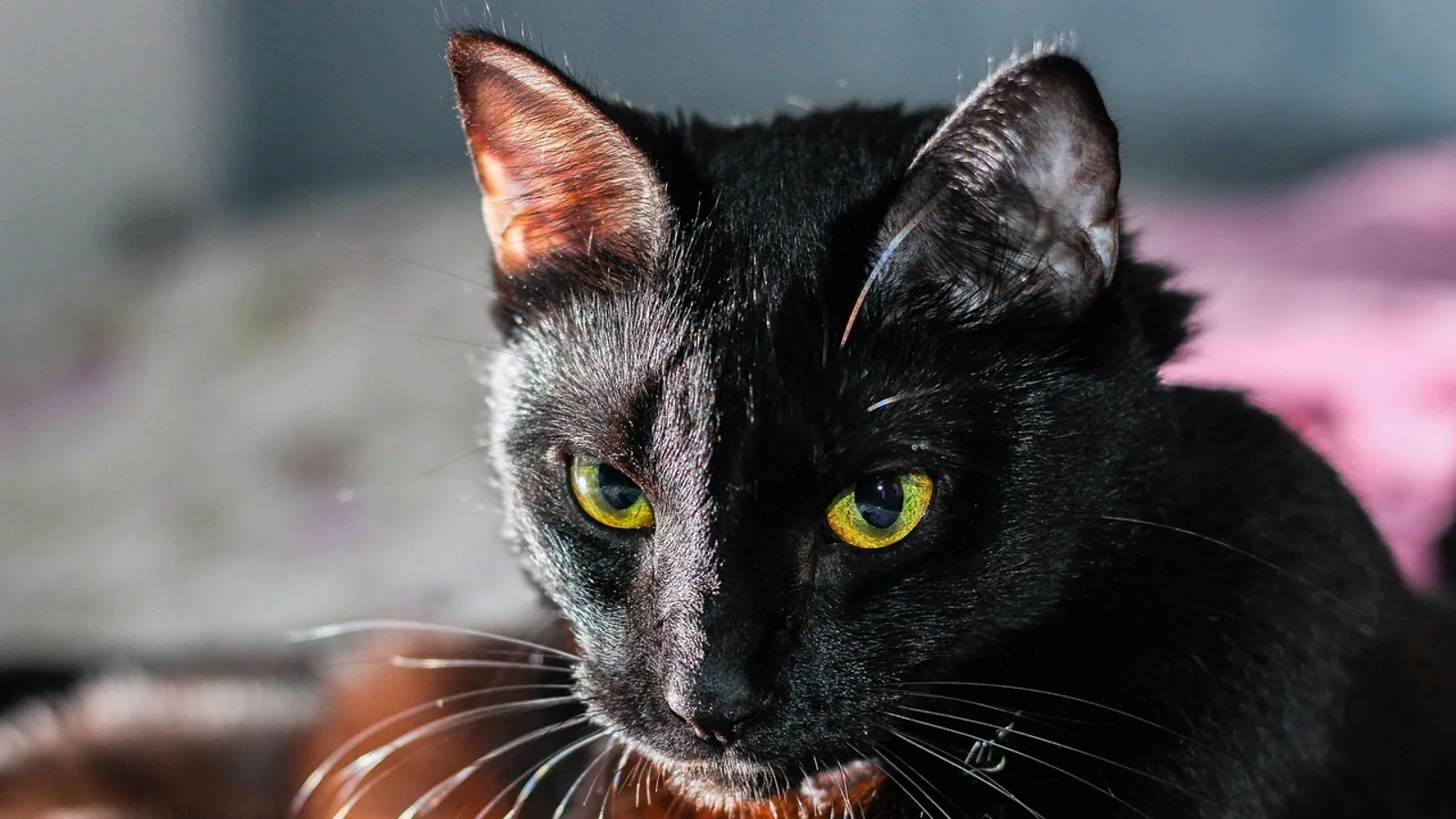
Black is a coat color, not a species and not a breed. That single fact clears up most of the confusion around black cat breeds. A solid black cat can be a pedigreed Bombay, a British Shorthair, a Maine Coon, or a random-bred domestic shorthair with no breed ancestry at all. The color is produced by a small set of well-studied genes, and those same genes can appear in dozens of different body types, coat lengths, and temperaments.
This guide covers the genetics first, because the color is what ties these cats together. It then profiles ten breeds that are commonly seen in solid black, with notes on coat length, eye color, temperament, and the health problems that matter most in each. The ten breeds are the Bombay, Oriental Shorthair, British Shorthair, Persian, Maine Coon, Norwegian Forest Cat, Sphynx, Ragamuffin, American Shorthair, and Chantilly-Tiffany.
This article is educational and is not a substitute for veterinary diagnosis or treatment.
At a Glance
The table below summarizes the ten breeds. Height and weight ranges vary by registry and by sex, and the figures here are typical adult ranges rather than fixed standards. Lifespan figures are general expectations for well-cared-for indoor cats. Energy, grooming, and trainability are rated on a simple low, moderate, or high scale.
| Breed | Coat length | Typical eye color | Weight (lb) | Height (in) | Lifespan (yr) | Energy | Grooming | Trainability | Good with children and other pets |
|---|---|---|---|---|---|---|---|---|---|
| Bombay | Short | Gold to copper | 6 to 11 | 9 to 13 | 12 to 16 | Moderate to high | Low | High | Yes, with gentle handling |
| Oriental Shorthair | Short | Green, sometimes blue or odd-eyed | 5 to 10 | 9 to 12 | 12 to 15 | High | Low | High | Yes |
| British Shorthair | Short | Copper, gold, or blue | 7 to 17 | 12 to 16 | 12 to 16 | Low to moderate | Moderate | Moderate | Yes |
| Persian | Long | Copper or blue | 7 to 12 | 10 to 15 | 12 to 17 | Low | High | Low to moderate | Yes, with calm handling |
| Maine Coon | Long | Green, gold, or copper | 9 to 18 | 10 to 16 | 12 to 15 | Moderate | High | Moderate to high | Yes |
| Norwegian Forest Cat | Long | Green, gold, or copper | 9 to 16 | 9 to 12 | 14 to 16 | Moderate | High | Moderate | Yes |
| Sphynx | Hairless (very short fine down) | Any, often blue or green | 6 to 12 | 8 to 12 | 9 to 15 | High | High (skin care) | High | Yes |
| Ragamuffin | Long | Any | 10 to 20 | 10 to 15 | 12 to 16 | Low to moderate | High | Moderate | Yes |
| American Shorthair | Short | Gold, green, or copper | 7 to 12 | 10 to 14 | 15 to 20 | Moderate | Low | Moderate | Yes |
| Chantilly-Tiffany | Semi-long | Gold or amber | 6 to 12 | 8 to 12 | 12 to 16 | Moderate | Moderate | Moderate | Yes |
What Makes a Cat Black: The Genetics
Solid black in cats is a combination of genes, not a single switch. The two most important are the agouti locus and the brown locus.
The Agouti Locus (A) and Non-Agouti (aa)
The agouti gene controls whether a cat's coat shows banding. A cat with at least one working agouti allele (A) has banded hairs and displays a tabby pattern. A cat that inherits two copies of the non-agouti allele (aa) has no banding, so the coat appears solid. A 2 base pair deletion in the ASIP gene specifies black coloration in domestic cats, and this deletion is the molecular basis of the non-agouti state [1].
This is why a solid black cat is often described genetically as non-agouti. The tabby pattern is still present in the cat's genetic code, but it is hidden. In strong sunlight, many black cats show faint tabby ghost markings, especially on the legs and tail.
The Brown Locus (B)
The brown locus controls whether the base pigment is black or brown. The gene involved is TYRP1, and it has an allelic series written as B > b > b1 [2]. The B allele is normal wild-type black coloration. Cats with the bb or bb1 genotype are chocolate, and cats with b1b1 are cinnamon [2]. A solid black cat must carry at least one B allele. If it carries two brown alleles, the coat shifts to chocolate or cinnamon rather than black.
Dilution and the MLPH Gene
The dilute gene lightens black to gray, which is called blue in cats. Dilute pigmentation is an autosomal recessive trait, and it is caused by a single base pair deletion in exon 2 of the MLPH gene that truncates most of the melanophilin protein [3]. The variant was confirmed in 97 unrelated dilute cats across 26 breeds and in random-bred cats [3]. A black cat that inherits two copies of this deletion becomes blue. A black cat with one or no copies stays black.
The microscopic difference is real. Hair from black cats contains numerous small dark brown to black melanin granules distributed evenly through the hair, while blue cat hair has larger, more irregularly shaped granules that are distributed unevenly [4].
Why Orange and Tortoiseshell Cats Are Not Black
The X-linked orange locus suppresses black-brownish pigment in favor of orange. A 5.1 kilobase deletion within an intron of the X-linked ARHGAP36 gene is closely and exclusively associated with orange coloration, and the deleted region contains a conserved regulatory element whose removal is thought to alter ARHGAP36 expression [5]. Because the gene is on the X chromosome and undergoes X-inactivation, female cats that are heterozygous for orange and non-orange show patches of both colors, which is the tortoiseshell and calico pattern [5][6].
This matters for black cat identification. A tortoiseshell cat carries black pigment, but it is not a solid black cat. A solid black cat has no orange allele expressed in its coat.
White Spotting and the KIT Locus
White spotting can mask a black coat. A cat that is genetically black but carries white spotting alleles may show anything from a small white chest patch to a mostly white body with black patches. The underlying black genotype is unchanged. This is why two black cats bred together can produce kittens with white markings.
The Sex-Linked Black Cat Myth
Older textbooks sometimes claimed that black coat color is sex-linked and allelic with yellow. That claim is wrong. A review of textbook presentations against the research literature found a general failure to identify mutants by contrast with the wild-type standard, which led to the erroneous conclusion that black is sex-linked and allelic with yellow [7]. Black is autosomal. It is not carried on the X chromosome.
Black Is Not a Species
There is no black cat species. Every domestic cat, black or otherwise, is Felis catus. Melanistic coat coloration occurs as a common polymorphism in 11 of 37 wild felid species, and it has at least four independent genetic origins across the cat family [1]. A black domestic cat is the same species as an orange tabby domestic cat. The color difference is a handful of nucleotides.
The 10 Black Cat Breeds
The breeds below are the ones most often cited as black cat breeds. Each is a true breed with a registry standard, a documented history, and a predictable temperament. A random-bred black cat is not a breed, and no registry recognizes "black cat" as one.
1. Bombay
The Bombay was developed in the United States in the 1950s by crossing sable Burmese with black American Shorthairs. The goal was a miniature black panther for the living room, and the breed standard calls for a solid black coat, copper to gold eyes, and a medium muscular body.
Bombays are short-coated, low-shedding cats with a glossy, patent-leather finish. They are outgoing, talkative, and strongly bonded to their people. Many follow their owners from room to room and dislike being left alone for long stretches. They do well with children who handle them gently and with other pets when introduced gradually.
Health priorities in the Bombay reflect its Burmese ancestry. Burmese cats have documented predispositions to certain inherited conditions, and reputable breeders screen breeding cats for those problems. Ask any breeder what health testing they perform on the parents and grandparents.
2. Oriental Shorthair
The Oriental Shorthair is a Siamese-derived breed with a long, tubular body, large ears, and a wedge-shaped head. The breed comes in hundreds of color and pattern combinations, and solid black is one of the most striking. Eye color is usually green, though some cats have blue or odd eyes.
Orientals are among the most active and social of all cat breeds. They talk constantly, learn tricks, and need vertical space and interactive play to stay content. They are a poor fit for households that want a quiet, independent cat.
The breed shares the Siamese gene pool, which carries known inherited risks. A responsible breeder will discuss the health history of the lines and provide documentation for screening tests performed on the parents.
3. British Shorthair
The British Shorthair is one of the oldest recognized cat breeds, descended from cats kept in Britain for rodent control. The breed is compact and muscular with a round head, thick cheeks, and a dense plush coat that stands away from the body. Solid black is an accepted color, and eye color is typically copper, gold, or blue.
British Shorthairs are calm, undemanding, and famously not lap cats. They tolerate handling but rarely seek it out. They get along with children and other pets because they are slow to react and hard to ruffle. Their main health concerns are weight gain from low activity and a handful of inherited conditions that appear in the breed, including heart disease and bleeding disorders. Breeders should screen for these.
4. Persian
The Persian is a longhaired breed with a flat or doll-face profile, depending on the line, and a coat that requires daily grooming. Solid black Persians have copper or blue eyes. The breed has been developed over more than a century and is one of the most recognizable cat breeds in the world.
Persians are quiet, sedentary, and happiest in a calm household. They do not handle stress or change well. Their flat-faced anatomy can affect breathing and tear drainage, and the breed carries known risks for polycystic kidney disease and heart disease. Ask breeders about genetic screening for those conditions.
Grooming is the defining care task. A black Persian coat shows every bit of dander and dust, and mats form quickly if the coat is neglected. Most owners need to brush daily and schedule regular professional grooming.
5. Maine Coon
The Maine Coon is a large, longhaired American breed with a rugged, weather-resistant coat, tufted ears, and a long bushy tail. The breed developed naturally in New England and was recognized as a distinct breed in the late 1800s. Solid black is an accepted color, and eye color is green, gold, or copper.
Maine Coons are friendly, moderately active, and often described as dog-like. They play fetch, follow their owners, and tolerate handling well. They are good with children and other pets.
The breed carries well-documented inherited risks, most notably hypertrophic cardiomyopathy and hip dysplasia. Screening programs exist for both, and a responsible breeder will provide results for breeding cats. The long coat needs brushing several times a week.
6. Norwegian Forest Cat
The Norwegian Forest Cat is a natural breed from Norway with a thick double coat, a triangular head, and a sturdy body built for cold climates. The breed is related to the Maine Coon in function but distinct in type. Solid black is accepted, with green, gold, or copper eyes.
Norwegian Forest Cats are independent but affectionate on their own terms. They climb well and enjoy high perches. They are generally good with children and other pets, though they prefer predictable handling.
The breed has known inherited risks including hypertrophic cardiomyopathy and glycogen storage disease. Breeders should screen for these conditions. The double coat is heavy and needs regular grooming, especially in spring when the undercoat sheds.
7. Sphynx
The Sphynx is a hairless breed that actually carries a very fine down coat. The breed arose from a natural mutation and was developed in Canada in the 1960s. Solid black Sphynx cats exist, but the color appears as pigment in the skin rather than in visible fur. Eye color varies widely.
Sphynx cats are extroverted, high-energy, and intensely social. They seek body heat and often sleep under blankets or against their owners. They are good with children and other pets but need company and interaction.
The breed's health profile includes hypertrophic cardiomyopathy and skin conditions related to oil buildup and temperature sensitivity. Skin care is a weekly task, and ears need regular cleaning. Sphynx cats should not be allowed outdoors unsupervised because they lack insulation.
8. Ragamuffin
The Ragamuffin is a large, longhaired breed developed in the United States from Ragdoll lines. The breed is known for a docile, affectionate temperament and a soft, rabbit-like coat. Solid black is an accepted color, and eye color can be any shade.
Ragamuffins are calm, tolerant, and slow to mature. They are good with children and other pets and often go limp when picked up. They are not highly active and are prone to weight gain if overfed.
The breed carries inherited risks for hypertrophic cardiomyopathy and polycystic kidney disease. Breeders should screen for both. The long coat needs regular brushing.
9. American Shorthair
The American Shorthair is a natural breed descended from cats brought to North America by early settlers. The breed is sturdy, medium-sized, and short-coated, with a broad face and a well-muscled body. Solid black is an accepted color, with gold, green, or copper eyes.
American Shorthairs are easygoing, adaptable, and moderate in every way. They are good with children and other pets, need little grooming, and are content with routine play. The breed is generally healthy, with hypertrophic cardiomyopathy as the main inherited concern. Breeders should screen for it.
The American Shorthair is one of the best choices for a first-time cat owner who wants a low-maintenance black cat.
10. Chantilly-Tiffany
The Chantilly-Tiffany is a semi-longhaired breed developed in North America in the 1960s and 1970s. The breed is known for a soft, silky coat with no undercoat, which reduces matting. The traditional color is solid black or dark chocolate, with gold or amber eyes.
Chantilly-Tiffanys are quiet, affectionate, and moderately social. They bond closely with one or two people and are less outgoing with strangers. They do well with children and other pets in a calm household.
The breed is rare, and its small gene pool means inherited conditions can concentrate. Breeders should provide health screening documentation. The coat needs brushing a few times a week.
Black Kitten Breeds: What to Expect
A black kitten can be born into any of the breeds above, and into random-bred litters. Kitten coat color is usually visible at birth, though some black kittens show faint tabby ghost markings that fade with age. A kitten that is solid black at birth will stay solid black unless it carries white spotting, in which case white patches may grow as the kitten matures.
Kitten temperament is not fixed at birth. Breed tendencies give a general idea, but individual personality depends on genetics, early socialization, and environment. A breeder who raises kittens in a home with handling and household noise produces a more confident adult cat than one who raises them in a cage.
Kittens need a series of veterinary visits for vaccinations, parasite control, and weight monitoring. The AAHA wellness guidelines recommend a schedule of examinations through the first months of life. Your veterinarian will set the exact timing based on your kitten's health and lifestyle.
Temperament and Household Fit
The ten breeds above range from the low-energy Persian to the high-energy Oriental Shorthair. Matching the breed to your household matters more than the coat color.
If you want a cat that talks to you, follows you, and learns tricks, an Oriental Shorthair or Bombay fits. If you want a cat that is calm, quiet, and content to sit nearby without demanding attention, a British Shorthair or Persian fits. If you want a large, dog-like cat that plays fetch, a Maine Coon or Norwegian Forest Cat fits. If you want a hairless cat that sleeps under the covers, a Sphynx fits.
Households with young children should choose a tolerant breed and teach children to handle the cat gently. Households with dogs should choose a confident breed and introduce the animals slowly. Households that are empty during the day should avoid breeds that become distressed when left alone, such as the Bombay and Oriental.
Coat Color and Grooming
Grooming needs track coat length, not coat color. Short-coated black cats like the Bombay, Oriental Shorthair, British Shorthair, and American Shorthair need weekly brushing at most. Longhaired black cats like the Persian, Maine Coon, Norwegian Forest Cat, and Ragamuffin need brushing several times a week or daily.
Black coats show dander, dust, and saliva stains more than lighter coats. This is cosmetic, not medical. A healthy black cat has a glossy coat, and dullness or excessive oiliness is a reason to see a veterinarian.
Sphynx cats need skin care rather than coat care. Oil accumulates on the skin and in the ear canals, and most owners clean both weekly.
Feeding Considerations
Feeding should match the cat's life stage, body condition, and activity level. The AAHA nutritional assessment guidelines recommend that every veterinary visit include a body condition score and a diet review. Black coat color does not change nutritional needs. A black Maine Coon and a black American Shorthair have different calorie requirements because they have different body sizes and activity levels.
Obesity is the most common nutritional problem in cats. Low-energy breeds like the British Shorthair, Persian, and Ragamuffin gain weight easily. High-energy breeds like the Oriental Shorthair and Sphynx burn more calories. Your veterinarian can help you set a target weight and adjust portions.
Inherited and Common Health Problems
The ten breeds in this article carry different inherited risks. The table below lists the main conditions and the screening tests that breeders should perform on breeding cats.
| Breed | Main inherited concerns | Screening to ask about |
|---|---|---|
| Bombay | Conditions linked to Burmese ancestry | Breeder health documentation for parents |
| Oriental Shorthair | Conditions linked to Siamese ancestry | Breeder health documentation for parents |
| British Shorthair | Heart disease, bleeding disorders | Cardiac screening, genetic testing |
| Persian | Polycystic kidney disease, heart disease | Renal ultrasound, cardiac screening |
| Maine Coon | Hypertrophic cardiomyopathy, hip dysplasia | Cardiac ultrasound, hip radiographs |
| Norwegian Forest Cat | Hypertrophic cardiomyopathy, glycogen storage disease | Cardiac ultrasound, genetic testing |
| Sphynx | Hypertrophic cardiomyopathy, skin disease | Cardiac ultrasound, skin examination |
| Ragamuffin | Hypertrophic cardiomyopathy, polycystic kidney disease | Cardiac ultrasound, renal ultrasound |
| American Shorthair | Hypertrophic cardiomyopathy | Cardiac ultrasound |
| Chantilly-Tiffany | Conditions linked to a small gene pool | Breeder health documentation for parents |
Hypertrophic cardiomyopathy is the most common inherited heart disease in cats. It causes thickening of the heart muscle and can lead to heart failure or sudden death. Screening is done by echocardiography, usually performed by a veterinary cardiologist. The Merck Veterinary Manual and the Cornell Feline Health Center both provide owner-facing summaries of the condition and its management.
Polycystic kidney disease causes fluid-filled cysts to form in the kidneys and progressively reduces kidney function. It is most common in Persians and related breeds. Screening is done by ultrasound.
Hip dysplasia causes abnormal development of the hip joint and leads to arthritis. It is most common in large breeds like the Maine Coon. Screening is done by radiography.
Glycogen storage disease is a metabolic condition reported in Norwegian Forest Cats. It affects how the body stores and uses sugar. Screening is done by genetic testing.
Any black cat, pedigreed or not, can develop health problems. Regular veterinary examinations are the most reliable way to catch them early. The AAHA wellness guidelines recommend a physical examination at least once a year for adult cats and more often for seniors.
Lifespan and Senior Care
Lifespan varies by breed and by individual care. The American Shorthair is the longest-lived breed in this group, often reaching the late teens. The Sphynx has the shortest typical lifespan, in part because of its heart disease risk. Most of the other breeds fall in the 12 to 16 year range.
Senior cats need more frequent veterinary visits, typically every six months after age 10. Blood work, blood pressure measurement, and a thorough physical examination help detect kidney disease, thyroid disease, diabetes, and heart disease before they become advanced. The AAHA senior care guidelines recommend a baseline of laboratory testing and an individualized plan for each cat.
Finding a Responsible Breeder or Rescue
Black cats are common in shelters and rescues, and a random-bred black cat can be an excellent companion. If you want a specific breed, buy from a breeder who provides health screening documentation for both parents, raises kittens in the home, and lets you meet the mother. Avoid breeders who cannot answer questions about inherited conditions, who sell kittens before 12 weeks of age, or who will not let you visit.
The AVMA and the CVMA both publish guidance on responsible pet acquisition. The core principles are the same: see the animal's living conditions, ask for health records, and be wary of anyone who pressures you to buy without inspection.
If you are adopting from a shelter, ask about the cat's known history, current vaccinations, and any medical treatment it has received. Shelters routinely screen for parasites and common infections. A black cat adopted from a shelter is not a breed, and it does not need to be one.
Who Should Not Get These Breeds
A high-energy breed like the Oriental Shorthair or Sphynx is a poor fit for a household that wants a quiet, independent cat. A longhaired breed like the Persian or Ragamuffin is a poor fit for someone unwilling to groom daily. A flat-faced Persian is a poor fit for a household that cannot manage potential breathing and eye problems. A Sphynx is a poor fit for a household that keeps the thermostat low or lets cats outdoors unsupervised.
No breed is a good fit for a household that cannot commit to 15 to 20 years of veterinary care, feeding, and daily attention. The coat color is the least important part of that decision.
Limitations and When to Contact a Veterinarian
This article describes breed tendencies and general care. It cannot diagnose or treat an individual cat. Contact a veterinarian if your cat shows any of the following:
- Difficulty breathing, open-mouth breathing, or a resting respiratory rate above 30 breaths per minute
- Sudden weakness, collapse, or hind limb paralysis
- Not eating for more than 24 hours, or vomiting repeatedly
- Weight loss despite a normal appetite
- Increased thirst and urination, which can signal kidney disease or diabetes
- A dull, greasy, or patchy coat, or skin lesions that do not heal
- Lameness, reluctance to jump, or difficulty climbing stairs
- Any new lump, swelling, or change in behavior
A veterinarian who examines your cat in person can interpret these signs in context and recommend testing. Breed tendencies inform the conversation but do not replace an examination.
Frequently Asked Questions
Are black cats a breed?
No. Black is a coat color, not a breed. A black cat can be a pedigreed Bombay, a British Shorthair, or a random-bred domestic shorthair with no breed ancestry.
What is the most common black cat breed?
The Bombay is the breed most closely associated with a solid black coat, since the breed standard requires it. Random-bred domestic shorthairs are far more common than any pedigreed black cat.
How many breeds of black cats are there?
There is no fixed number. Solid black is accepted in many breeds, and this article profiles ten of the most commonly cited: Bombay, Oriental Shorthair, British Shorthair, Persian, Maine Coon, Norwegian Forest Cat, Sphynx, Ragamuffin, American Shorthair, and Chantilly-Tiffany.
What genes make a cat black?
Solid black usually requires two copies of the non-agouti allele (aa) plus at least one copy of the black allele (B) at the brown locus. A 2 base pair deletion in the ASIP gene specifies black coloration in domestic cats.
Can two black cats have a gray kitten?
Yes. If both parents carry the dilute allele, a black kitten can inherit two copies and be born blue (gray). Dilute is an autosomal recessive trait caused by a deletion in the MLPH gene.
Do black cats have health problems because of their color?
No. Coat color does not cause disease. Health risks come from breed, genetics, and environment, not from black pigmentation.
Are black cats harder to photograph or groom?
Black coats show dander and dust more than lighter coats, which is cosmetic. Grooming needs depend on coat length, not color.
Is a black kitten a specific breed?
No. A black kitten can be born into any breed or into a random-bred litter. Coat color alone does not identify a breed.
Related Articles
- Pigeon Breeds: A Guide to Popular Varieties
- Rabbit Grooming: Coat, Nail, and Ear Care for Different Breeds
- Poodle Dog Breed: Varieties, History, Temperament, Health Records, Grooming, and Home Fit
- Goldfish Types and Varieties Guide
- Black Cat
- Quantitative Buffy Coat Analysis for Blood Parasite Detection
- Sympatric Speciation: Definition and Examples
Sources
- Molecular genetics and evolution of melanism in the cat family.
- Chocolate coated cats: TYRP1 mutations for brown color in domestic cats.
- A homozygous single-base deletion in MLPH causes the dilute coat color phenotype in the domestic cat.
- Morphologic basis of inherited coat-color dilutions of cats.
- A deletion at the X-linked ARHGAP36 gene locus is associated with the orange coloration of tortoiseshell and calico cats.
- Localizing the X-linked orange colour phenotype using feline resource families.
- The sex-linked black cat fallacy: a textbook case.