How Do Dogs Communicate With Each Other?
By Dr. Zubair Khalid, DVM, MS, PhD ·
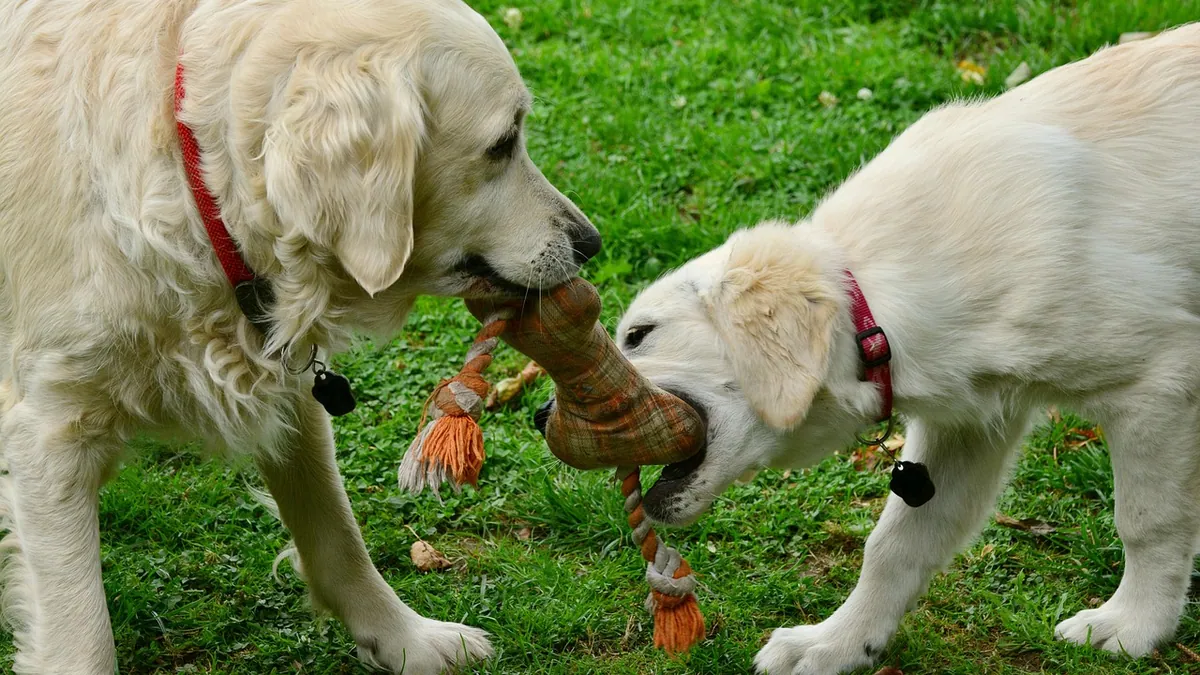
Dogs communicate with each other mainly through body postures, facial expressions, tail and ear positions, raised hackles, vocalizations, and scent [1]. They do not use words, but they read each other's signals with remarkable skill, and most of what looks like "talking" is really a constant exchange of visual and chemical cues. Understanding how dogs communicate with each other helps you tell the difference between healthy play, mild tension, and a situation that needs your help.
This article is educational and is not a substitute for veterinary diagnosis or treatment.
Quick Answer
- Dogs rely most on body language (posture, tail carriage, ear position, facial expression) and scent, with vocalizations adding emphasis [1].
- Play is usually loose and bouncy, with play bows, exaggerated movements, and role reversals that keep things fair.
- Appeasement signals like lip licking, looking away, and a lowered body mean "I am not a threat," not guilt or shame.
- Dogs are a gregarious species with a flexible social structure, and they commonly bond with unrelated dogs they meet as puppies or adults [2].
- A dominance hierarchy does not describe how dogs relate to each other. Access to resources depends on context, motivation, and past learning [2].
How Do Dogs Communicate With Each Other? The Main Channels
Body language and facial expression
Dogs interact with each other and with people through body postures, facial expressions, tail and ear positions, raised hair along the back (hackles), vocalizations, and scents [1]. When two dogs meet, they are reading all of these at once. A stiff, tall stance with a high, fast-wagging tail sends a very different message than a crouched body with a low, slow wag.
Eyes matter a great deal. Dogs, unlike wolves, have eye muscles that let them use their eyes to send social messages, and this ability also triggers oxytocin release in humans [2]. Dogs also gaze at the eye and nose areas of other dogs' faces, and they pay extra attention to emotional expressions, especially angry and happy eyes of their own species [3]. That is why direct, hard eye contact between two unfamiliar dogs is often a warning sign, while soft, blinking, averted eyes signal calm.
Vocalizations
Barks, growls, whines, and yelps all carry meaning, but they rarely stand alone. A growl during tug play with a loose body is very different from a growl with a frozen, forward-leaning posture. Pitch, repetition, and the rest of the body tell you which one you are hearing. If your dog whines often, that sound is usually a request or a sign of distress, and it is worth reading what your dog is trying to tell you.
Scent
Dogs gather a huge amount of information through scent. Urine marking, anal gland secretions, and body odor all carry details about identity, sex, and reproductive status. This is one reason sniffing is not a waste of time on a walk. It is a conversation.
Gaze and showing behavior
Dogs use visual signals to point out the location of things they cannot reach, a behavior called showing. In a study of 101 pet dogs from 43 breeds, gaze alternation between the owner and a reward was a central part of this behavior, and the pattern was not affected by breed or head shape [4]. Life experience, not breeding, seems to shape these visual strategies [4].
Do Dogs Understand Each Other?
Yes, dogs understand each other well, but not perfectly. Domestication and breeding have created wide variation in appearance, temperament, and social signaling, and those variations can make it harder for dogs of very different breeds to read each other [1]. A dog with a tightly curled tail, cropped ears, or a flat face may send signals that other dogs struggle to interpret.
Early and frequent socialization with many different dogs improves a dog's ability to interact with other dogs and people [1]. Puppies who meet a wide range of body types, ages, and temperaments tend to become adults who read other dogs more accurately.
Dogs also read human faces and emotions. In one comparison, dogs mostly gazed at the eye and nose areas of faces, while humans also focused on the mouth, and both species looked longer at emotional faces than neutral ones [3]. Dogs are tuned in to emotion across species, which is part of why they fit into human homes so well.
Why Dogs Communicate This Way
Dogs are highly social animals and are well adapted to living in groups [1]. Their communication system exists to prevent conflict and keep group life smooth. Most signals fall into a few practical categories.
- Greeting and affiliation: loose wiggly bodies, play bows, sniffing, tail wags at mid-height.
- Play: exaggerated movements, bouncy gait, open mouths, frequent pauses, and swapping of roles (the chaser becomes the chased).
- Appeasement: lip licking, yawning, looking away, lowering the head or body, tucking the tail, raising a paw.
- Tension or warning: stiff body, hard stare, closed mouth, tail high and rigid, hackles up, slow deliberate movement.
- Fear: crouching, backing away, tucked tail, ears pinned back, whale eye (whites of the eyes showing).
Domestic dogs form loose associations with unrelated dogs, and it is common for them to bond with other dogs introduced as puppies or as adults in a home [2]. Their social rules are flexible, which is why two dogs can sort out a relationship in minutes while a third pair never quite clicks.
One myth worth retiring: despite its persistence in popular culture, a dominance hierarchy does not describe dogs' relationships with each other or with people. Priority access to valued resources is not fixed or linear. It depends on the context, the dog's motivation, perceived barriers, and previous learning [2]. A dog who guards a bone may happily give up a spot on the couch.
Medical Causes to Rule Out Before Assuming a Behavior Problem
Sudden changes in how a dog interacts with other dogs can have a medical cause. Pain is the most common culprit. A dog with arthritis, dental disease, or an ear infection may growl or snap when another dog bumps into them. Vision or hearing loss can make a dog startle easily and misread approaching dogs. Cognitive dysfunction in older dogs can cause confusion, irritability, or loss of previously reliable social skills.
Hormonal conditions, seizures, and some neurologic diseases can also change social behavior. If your dog's communication style changes abruptly, especially after years of stable behavior, schedule a veterinary visit before assuming it is a training issue. Your veterinarian can examine your dog, run appropriate tests, and calculate any medication dose based on your dog's weight and health.
When Communication Becomes a Problem
Most dog-to-dog signaling is normal and self-resolving. It becomes a problem when:
- Play tips into bullying, with one dog repeatedly pinning, mounting, or chasing while the other tries to disengage.
- One dog cannot read or will not respect appeasement signals, and the other dog escalates.
- Growling, snapping, or biting happens in the home between resident dogs.
- Your dog becomes fearful, avoidant, or reactive on walks.
- Resource guarding over food, toys, or resting spots leads to conflict.
Freezing, stiffening, and a hard stare are the signals that most often come right before a fight. If you see them, interrupt calmly and separate the dogs before anything escalates.
What to Do: Step by Step
1. Learn your dog's baseline
Spend a week watching your dog at home and on walks. Note tail carriage, ear position, mouth shape, and how your dog greets familiar dogs. You cannot spot a change if you do not know the starting point.
2. Socialize thoughtfully at every age
Early and frequent socialization with many different dogs helps a dog interact well with other dogs and people [1]. This does not mean dog parks. It means calm, supervised, one-on-one meetings with dogs you trust, plus gradual exposure to different sizes, coats, and temperaments.
3. Protect play with breaks
Good play includes frequent pauses, loose bodies, and both dogs choosing to re-engage. Call a 5 to 10 second break every minute or two. If one dog does not return to play, the session is over.
4. Manage resources
Feed dogs in separate rooms or crates. Pick up high-value chews when you cannot supervise. Since resource access is context-dependent and not a fixed rank [2], clear management prevents most guarding conflicts.
5. Enrich the environment
Sniffing walks, food puzzles, and training games lower arousal and give dogs appropriate outlets. A tired, mentally satisfied dog reads social situations better.
6. Watch the bond you build
The relationship you have with your dog shapes how your dog reads social cues. In French Bulldogs, factors like dog-owner interaction, emotional closeness, and the dog's age and sex influenced performance on a social cognition task [5]. A close, predictable relationship supports better social skills. The bond runs both ways, and it is worth understanding how deep that canine-human connection can go.
What Not to Do
- Do not punish growling. A growl is information. Suppress it and you may get a bite with no warning.
- Do not use dominance-based training. The dominance hierarchy model does not describe dog social relationships [2]. Alpha rolls, scruff shakes, and "being the boss" increase fear and aggression.
- Do not force interactions. Letting a shy dog "work it out" with a pushy dog teaches the shy dog that other dogs are unsafe.
- Do not assume breed predicts behavior. There is as much behavioral variation between individuals within a breed as between breeds, and breed differences are confined mainly to the traits each breed was developed for [2].
- Do not rely on tail wagging alone. A high, stiff, fast wag is not a friendly signal. Read the whole dog.
When to Involve a Veterinarian or Certified Behavior Professional
Call your veterinarian if your dog's social behavior changes suddenly, if your dog shows pain or discomfort around other dogs, or if you see new fear or aggression in a previously social dog. Your veterinarian can rule out medical causes and, if needed, refer you to a board-certified veterinary behaviorist or a certified applied animal behaviorist.
Seek help promptly if there has been a bite that broke skin, if fights between resident dogs are increasing, or if you feel unsafe managing your dog around other dogs. Behavior problems that involve injury carry real risk and respond best to early professional intervention.
Limitations and When to Contact a Veterinarian
This article covers general principles. Every dog is an individual, and individual cases need a veterinarian who can examine your dog and review the full history.
Contact a veterinarian the same day if your dog:
- Suddenly cannot be handled by another dog in the household without a fight.
- Shows new head pressing, circling, disorientation, or staring into space.
- Has a wound from a dog fight, even a small puncture.
Go to an emergency clinic now if:
- A bite broke skin on your dog or on a person.
- Your dog is collapsing, having a seizure, or cannot stand.
- Your dog has heavy bleeding, a swollen abdomen, or difficulty breathing after an incident.
Schedule a routine visit if:
- Your dog's social behavior has changed gradually over weeks.
- Your older dog seems confused or irritable around other dogs.
- You want help with a training or behavior plan.
Frequently Asked Questions
Do dogs talk to each other?
Dogs do not use language, but they exchange constant signals through posture, facial expression, tail and ear position, vocalizations, and scent [1]. To another dog, a play bow or a lip lick is as clear as a spoken sentence.
Can dogs understand other dogs of different breeds?
Usually yes, but breed variation in appearance and signaling can make it harder [1]. Dogs with very different body types, ear shapes, or tail carriage sometimes misread each other, which is one reason early socialization with many kinds of dogs matters.
Is tail wagging always a friendly sign?
No. Tail wagging signals arousal, not necessarily friendliness. A high, stiff, fast wag with a tense body often means the dog is on alert, while a loose, mid-height wag with a wiggly body usually means the dog is happy.
Why does my dog ignore another dog's warning signals?
Some dogs miss signals because of limited socialization, fear, or high arousal. Others have learned that ignoring warnings works. If your dog repeatedly pushes past another dog's appeasement signals, supervised breaks and professional guidance can help.
Do dogs communicate with each other the same way they communicate with people?
Mostly yes, with one big addition. Dogs use the same body language and vocal signals with people, but they also read human faces and gestures closely, and mutual gaze and petting can synchronize brain activity between a dog and a person [6]. That cross-species skill is part of what makes dogs such good companions.
Related Articles
- Is Your Dog Human? Understanding Canine Behavior and Bonding
- Dog Whining All the Time: What Is Your Dog Trying to Tell You?
- What Is a 'Dog Man'? Understanding the Bond Between Men and Their Dogs
- How Do You Express Anal Glands On A Dog
- Do Dogs Understand Pointing? The Science of Dog Communication
- Dog Ear Language: What Your Dog's Ears Say About Their Mood
- How to Help Your Dog Get Along With Other Dogs
References
- Normal Social Behavior in Dogs - Dog Owners. Merck Veterinary Manual.
- Social Behavior of Dogs - Behavior. Merck Veterinary Manual.
- Species-dependent gazing behavior of emotional facial expressions in dogs (Canis familiaris) and adult humans (Homo sapiens). Journal of comparative psychology (Washington, D.C. : 1983), 2026.
- Showing Behaviour in One Hundred and One Dogs: Gazing, Breed and Cephalic Index. Animals : an open access journal from MDPI, 2026.
- Dog-Owner Relationship and Its Association with Social Cognition in French Bulldogs. Animals : an open access journal from MDPI, 2024.
- Disrupted Human-Dog Interbrain Neural Coupling in Autism-Associated Shank3 Mutant Dogs. Advanced science (Weinheim, Baden-Wurttemberg, Germany), 2024.