How to Help Your Dog Settle and Fall Asleep at Night
By Dr. Zubair Khalid, DVM, MS, PhD ·
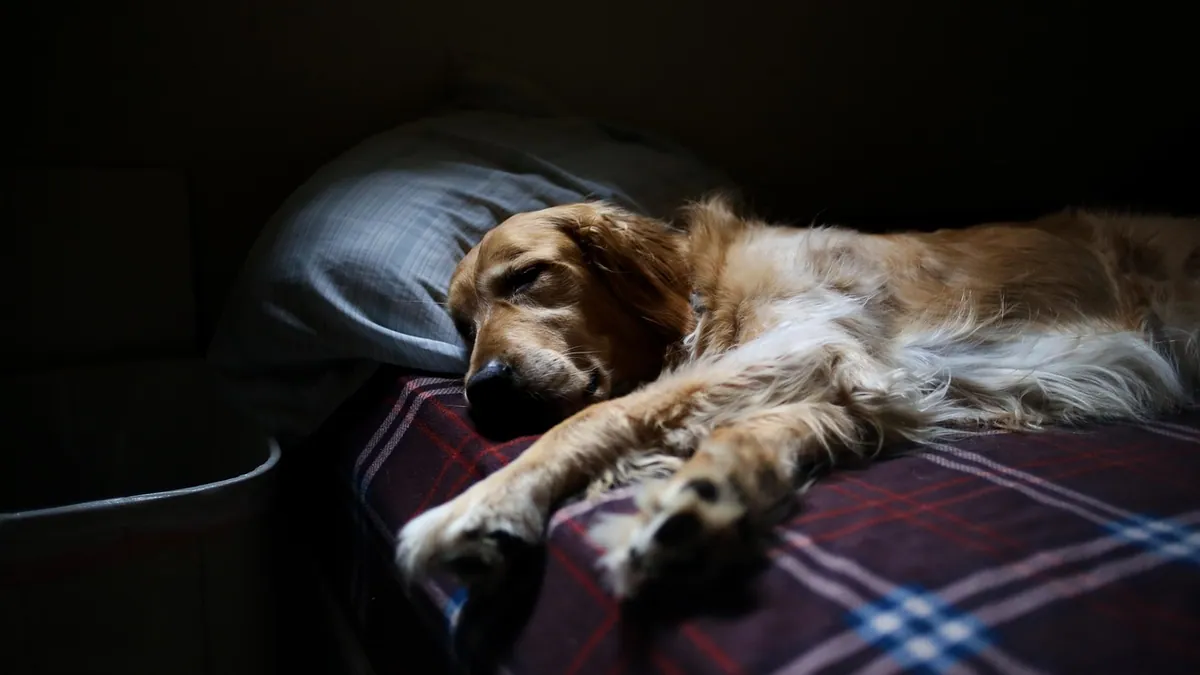
If your dog paces, whines, or stares at you at 2 a.m., you are not alone. Most nighttime restlessness has a fixable cause, and a predictable bedtime routine helps most dogs settle within a week or two. Learning how to get my dog to fall asleep starts with understanding how much sleep dogs actually need and what might be keeping yours awake.
This article is educational and is not a substitute for veterinary diagnosis or treatment.
Quick Answer
- Adult dogs sleep roughly 12 to 14 hours across a full day, and much of that happens at night, so a dog who is awake for hours after bedtime is outside the normal pattern.
- Build a fixed evening sequence (toilet break, quiet play, light snack, dim lights, bed) and repeat it at the same times every night. Predictability is what helps anxious dogs most [1].
- Give your dog a comfortable, dark, draft-free sleeping spot. Dogs in cooler conditions spent more time sleeping when they wore a coat (48.1% versus 40.0% of the overnight period), which shows that simple comfort changes measurable sleep [2].
- Rule out pain, breathing problems, and senior cognitive changes before you assume the problem is behavioral. Sleep disruption is a common feature of canine cognitive dysfunction in dogs 8 years and older [3].
- Never punish nighttime whining or pacing. It adds stress and makes settling harder.
Why Your Dog Won't Settle at Night
Normal reasons dogs wake at night
Dogs are not built to sleep through the night the way people often expect. Their sleep-wake cycle is spread across the day and night, and activity patterns shift with age and temperament [4]. A young dog may simply not be tired yet. A dog who napped all afternoon may be ready to play at 11 p.m.
Normal awakenings are brief. Your dog shifts position, drinks water, circles once, and goes back down. What is not normal is a dog who stays up, paces, pants, or asks to go out repeatedly.
The role of routine and predictability
Dogs relax when they know what comes next. Veterinary behavior guidance is clear that predictability is one of the most effective tools for anxious dogs: if X happens, then Y happens, every time [1]. An unpredictable evening (late walk one night, early bed the next, visitors on a third) keeps your dog's nervous system on alert.
Anxiety and separation-related distress
Anxious dogs often struggle most at night because the house is quiet and they are alone with their arousal. Signs include whining, pacing, panting, and not wanting to settle [1]. If your dog only shows these signs when separated from you, that points toward separation-related anxiety, which is a treatable condition, not a training failure. For a deeper look at this pattern, see Dog Anxiety at Night: Why It Happens and How to Help.
Sleep-disordered breathing
Flat-faced breeds (French bulldogs, pugs, Boston terriers, English bulldogs) can have obstructed airflow during sleep. This causes repeated partial or complete blockages of breathing, which leads to intermittent low oxygen levels during the night [5]. These dogs often snore loudly, wake frequently, and never reach deep sleep. This is a medical problem, not a snoring quirk.
Medical Causes to Rule Out First
Before you change the routine, your veterinarian should check for physical reasons your dog cannot rest.
Pain. Arthritis, dental disease, and back pain all get worse when a dog lies still. A dog who paces at night but seems fine during the day may be hurting.
Cognitive dysfunction in senior dogs. In dogs 8 years and older, poorer sleep quality (trouble falling asleep, trouble staying asleep, more nighttime accidents) is linked to more severe cognitive decline [3]. Over half of affected dogs were reported to be most unsettled between 2:00 and 5:00 a.m. [3]. If your older dog paces, seems disoriented, or stands in corners at night, this is a strong signal to call your vet.
Breathing problems. As above, sleep-disordered breathing causes fragmented sleep and low oxygen [5]. Risk factors include a flat face and being overweight.
Hormonal and metabolic disease. Your veterinarian may recommend bloodwork to check for conditions that cause nighttime restlessness. This is routine and inexpensive relative to months of lost sleep.
Medication side effects. Some drugs cause nighttime arousal. Bring a full list of everything your dog takes to your appointment.
When Nighttime Restlessness Becomes a Problem
Occasional bad nights are normal. It becomes a problem when any of these apply:
- Your dog is awake and unsettled for more than an hour after lights out, most nights.
- You are losing sleep, or your dog is waking other people in the house.
- Your dog is having accidents indoors at night after being house trained.
- Your dog seems confused, disoriented, or gets stuck in corners.
- Your dog pants, gasps, or snores heavily with pauses in breathing.
- Your dog cries out, trembles, or cannot get comfortable in any position.
Any of these deserves a veterinary visit. Nighttime restlessness is one of the earliest signs owners notice when something medical is going on, which makes it useful information instead of an annoyance.
How to Get My Dog to Fall Asleep: Step by Step
Step 1: Set a fixed schedule
Pick a bedtime and a wake time and keep them within 30 minutes every day, weekends included. Feed the last meal at least two to three hours before bed and take your dog out for a final toilet break right before lights out. Consistency is the single most powerful tool you have [1].
Step 2: Build a 20 to 30 minute wind-down routine
Run the same sequence every night, in the same order:
- Final toilet break outside.
- Quiet, low-energy interaction (gentle brushing, a slow sniff walk in the yard, or a chew).
- Dim the lights and lower the volume in the house.
- Settle your dog in their sleeping spot with a calm, brief goodnight.
Skip exciting games, wrestling, and training sessions in the last hour. Arousal takes time to come down.
Step 3: Get the daytime right
A dog who is bored all day will not sleep well at night. Give your dog real physical exercise and mental work during the day. Sniff walks, food puzzles, and short training sessions tire a dog in a way that backyard time does not. If your dog sleeps 10 hours during the day, expect a restless night.
Step 4: Fix the sleep environment
- Temperature and bedding. Dogs sleep more when they are warm enough [2]. Add a coat for cold-natured dogs in winter, or a blanket in the bed.
- Light. Keep the room dim. A night light is fine for a dog who seems disoriented, but bright light suppresses rest.
- Sound. A white noise machine or fan can mask street noise that triggers alert barking.
- Space. Give your dog a defined sleeping area. A crate can help some dogs relax, and it works best when it is trained properly and never used as punishment. See How To Crate Train A Dog For Night and Dog Crate Training For Sleep.
- Bed sharing. If your dog sleeps in your bed and wakes you repeatedly, that arrangement may need to change. Read Dog Sleeping In Bed Behavior Problems before you decide.
Step 5: Teach a settle cue
This is how you get your dog to lay down on command instead of waiting for exhaustion.
- Choose a mat or bed.
- Toss a treat onto the mat and praise calmly when your dog steps on it.
- Repeat, and reward any moment your dog's body relaxes, including a hip drop or a sigh.
- Add the word "settle" just before your dog lies down, then reward.
- Practice in the evening when your dog is already a little tired, then generalize to other times of day.
Keep sessions to two or three minutes. Reward calm, never excitement.
Step 6: Address anxiety directly
If your dog's restlessness is anxiety-driven, routine alone may not be enough. Behavior modification for anxiety takes time and consistency, and it works best with professional guidance [1]. Your veterinarian can also discuss whether medication is appropriate. Doses are always calculated by your veterinarian based on your dog's weight and health.
Step 7: Track it
Keep a simple log for two weeks: bedtime, how long it took to settle, how many times your dog woke, and what happened. This record is genuinely useful at your vet visit and shows whether your changes are working.
What Not to Do
Do not punish nighttime whining, pacing, or accidents. Punishment increases anxiety and teaches your dog to be quiet in ways you cannot monitor. It does not teach sleep.
Do not use a crate as a timeout or a lockup. A crate only helps if your dog sees it as a safe, positive place.
Do not give human sleep aids, melatonin, or any over-the-counter supplement without asking your veterinarian. Doses are not established for dogs here, and some products are toxic.
Do not assume it is "just old age." Sleep-wake disturbance in senior dogs is a recognized clinical sign, not an unavoidable part of aging [3].
Do not expect overnight results. Behavior change takes weeks, not days. Predictability is what does the work [1].
When to Involve a Veterinarian or Behavior Professional
Call your veterinarian if your dog's sleep has changed for more than a week, if your dog is a flat-faced breed with noisy or interrupted breathing [5], if your dog is 8 or older with any confusion or nighttime accidents [3], or if you see signs of pain such as stiffness, reluctance to climb stairs, or crying when touched.
Ask for a referral to a veterinary behaviorist or a certified applied animal behaviorist if your dog's anxiety is severe, if your dog injures themselves or destroys property at night, or if a structured home program has not helped after several weeks [1].
Limitations and When to Contact a Veterinarian
This article covers common patterns only. Your dog's individual situation needs a veterinarian who can examine them, ask questions, and run tests.
Contact your veterinarian the same day if:
- Your dog has not slept well for several nights in a row and is now lethargic or off food.
- Your dog is pacing, panting, and cannot lie down at all.
- Your dog is having nighttime accidents after months or years of being reliable.
- Your dog seems disoriented, stares at walls, or gets stuck in corners.
- Your dog's snoring now includes gasping, choking, or long pauses in breathing.
Go to an emergency clinic now if:
- Your dog is struggling to breathe, has blue or gray gums, or collapses.
- Your dog cries out in severe pain or cannot stand.
- Your dog has a seizure, especially more than one.
- Your dog ate something toxic, including human medication. Call the ASPCA Animal Poison Control Center at (888) 426-4435 or the Pet Poison Helpline at (855) 764-7661 right away.
Schedule a routine visit if:
- Your dog is a senior and sleep has gradually gotten worse.
- Your dog has mild restlessness that has lasted more than two weeks.
- You want to discuss anxiety medication or a behavior referral.
Frequently Asked Questions
Should I let my dog cry it out at night?
No. Crying it out is not an effective approach for most dogs and can worsen anxiety. A better plan is to build a predictable routine, teach a settle cue, and reward calm behavior, then address any medical cause with your vet [1].
Why does my dog pace at night but seem fine during the day?
Pain and cognitive changes often show up at night because your dog is lying still with nothing to distract them. Senior dogs with cognitive dysfunction are commonly most unsettled between 2:00 and 5:00 a.m. [3]. Have your veterinarian examine your dog before assuming it is behavioral.
Can I give my dog melatonin to sleep?
Ask your veterinarian first. Melatonin doses for dogs are not established that applies to every pet, and your vet will calculate any dose from your dog's weight and health. Never give human sleep aids, which can be dangerous for dogs.
Do flat-faced dogs sleep worse than other dogs?
Yes, they often do. Brachycephalic dogs can develop sleep-disordered breathing, with repeated partial or complete airway blockages during sleep that lower blood oxygen and fragment rest [5]. If your flat-faced dog snores heavily or wakes often, ask your vet about screening.
How long does it take for a new bedtime routine to work?
Most dogs show improvement within one to two weeks of a consistent routine, though anxious dogs can take longer. Predictability is the active ingredient, so keep the sequence and timing the same every night [1]. If nothing changes after a few weeks, book a veterinary visit.
Related Articles
- How To Crate Train A Dog For Night
- Dog Anxiety at Night: Why It Happens and How to Help
- Dog Crate Training For Sleep
- Dog Sleeping In Bed Behavior Problems
- How Long Do Dogs Sleep
- How To Get My Dog To Stop Barking
- My Dog Keeps Waking Me Up at Night: Causes and Solutions
- Senior Dog Restless at Night: Why It Happens and How to Help
- What Can I Give My Dog for Sleep? Safe Options
References
- Anxious behavior: How to help your dog cope with unsettling situations. Cornell University College of Veterinary Medicine.
- Accelerometry-Based Assessment of Overnight Coat Use on Dog Sleep and Activity Patterns: Implications for Farm Dog Welfare. Animals : an open access journal from MDPI, 2026.
- Sleep-wake disturbance in canine cognitive dysfunction: Guardian-reported patterns and a practical screening tool. Veterinary journal (London, England : 1997), 2026.
- Beacon-based sleep-wake monitoring in dogs. The Journal of veterinary medical science, 2024.
- Association of brachycephaly, sleep-disordered breathing, and inflammatory response in dogs. Journal of veterinary internal medicine, 2026.