How to Tell If Your Dog and Cat Like Each Other
By Dr. Zubair Khalid, DVM, MS, PhD ·
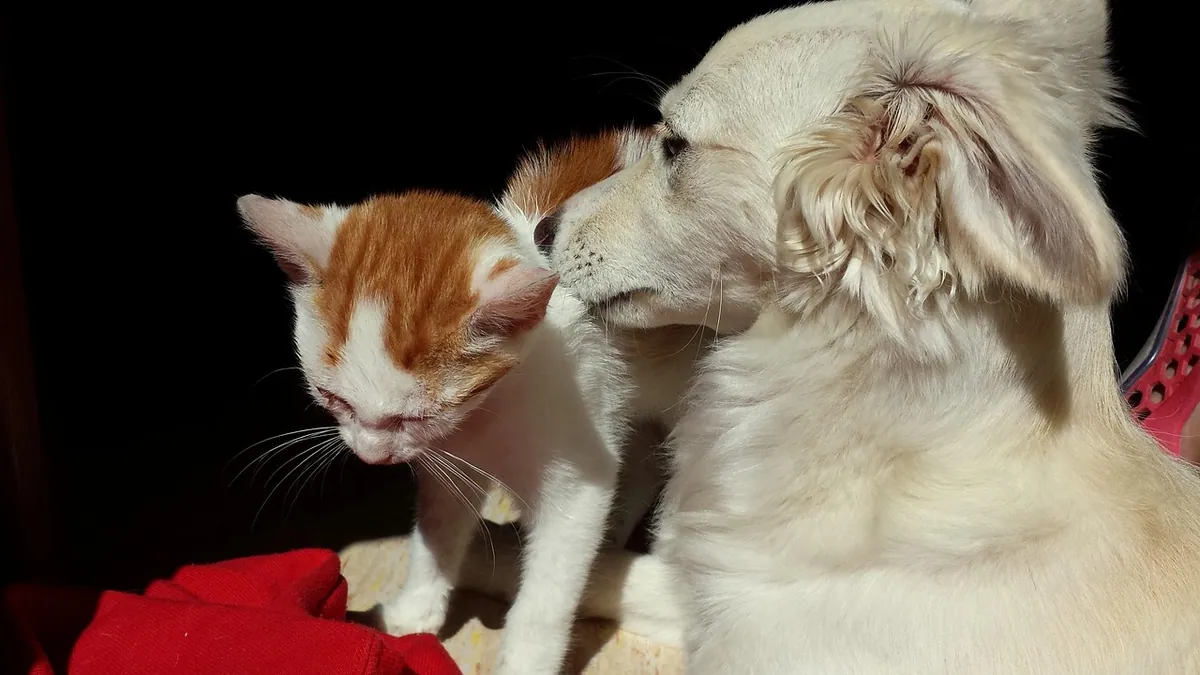
Dogs and cats can share a home peacefully, and some become genuinely fond of each other [1]. The clearest signs of a good relationship are relaxed bodies, voluntary closeness, and play that goes both ways. The clearest warning signs are a stiff, silent stare from the dog and a cat who hides or stops eating. This article is educational and is not a substitute for veterinary diagnosis or treatment.
Quick Answer
- A dog who likes your cat keeps a soft, relaxed body, breaks eye contact easily, and can be called away from the cat without a struggle.
- A cat who likes your dog approaches with a raised tail, rubs against the dog, or chooses to rest in the same room.
- Mutual play looks bouncy and loose, with pauses and role swapping. A dog who freezes, stares, or stalks is not playing [2].
- Separate feeding areas and a cat-only escape route prevent most day-to-day conflict [1].
- Sudden changes in either pet's behavior toward the other deserve a veterinary visit, because pain and illness can change social behavior.
Why Dogs and Cats Act This Way
Dogs and cats speak different languages. A wagging tail, a nose-to-nose greeting, and a paw on the back are friendly in dog body language. To a cat, those same moves can feel rude or threatening. That mismatch explains most of the confusion owners see.
Predatory behavior is normal dog behavior, not a character flaw. Dogs are wired to chase small, fast, fleeing things, and a running cat can trigger that wiring [2]. The ASPCA lists intense staring at other animals, especially with stalking (slow forward movement with the head held low), as a sign of fixation toward small animals [2]. This is the behavior behind the search "how to tell if my dog wants to eat my cat." It does not mean your dog is vicious. It means the dog sees the cat as prey in that moment, and the situation needs management.
Cats have their own conflict signals. In a survey of 2,492 owners of multiple cats, staring was the most common conflict sign, reported at least daily in 44.9% of households, followed by chasing, stalking, fleeing, tail twitching, hissing, and wailing [3]. Cats use the same signals with dogs. A cat who stares, twitches the tail, flattens the ears, or hisses is asking for space.
Affection between cats grows from familiarity. In one study of 28 cats, relatedness and familiarity were linked to how often cats stayed within 1 meter of each other and groomed each other [4]. The same principle applies across species. Time, routine, and safe repeated contact build tolerance, and tolerance can slowly turn into friendship [1].
How to Tell If My Dog Likes My Cat
Watch the dog's whole body, not just the tail. A friendly or neutral dog looks loose. The ears sit in a natural position, the mouth may be open, and the dog shifts weight easily. The dog can look at the cat and then look away. If you call the dog while the cat is nearby, the dog turns and comes.
Signs your dog likes or accepts the cat:
- Soft, brief eye contact with lots of looking away
- Play bows, which are front-end-down invitations to play
- Tail wagging in a wide, loose arc
- Choosing to rest near the cat, even back to back
- Gentle sniffing without following or blocking the cat's path
- Backing off when the cat hisses or swats
Signs your dog is tolerating the cat but not enjoying it:
- Turning the head away or licking the lips when the cat approaches
- Getting up and leaving when the cat comes close
- Yawning, shaking off, or scratching when the cat is nearby
Tolerance is a fine outcome. Many dog-cat pairs never become best friends, and a calm, respectful truce is a success [1].
How to Tell If My Cat Likes My Dog
Cats are subtle. A cat who likes your dog often shows it in small ways. The tail goes up like a question mark when the cat walks toward the dog. The cat rubs its cheek or flank on the dog's leg or shoulder. The cat slow blinks at the dog from across the room. The cat chooses to sleep on the same couch, even at the far end.
Signs your cat likes or accepts the dog:
- Slow blinking or half-closed eyes when looking at the dog
- A raised, relaxed tail during approach
- Rubbing, head bunting, or allogrooming (grooming another animal)
- Kneading or purring while near the dog
- Sleeping in the same room, especially in the open
- Coming out to greet the dog when you all return home
Signs your cat is stressed by the dog:
- Hiding for most of the day
- Staying on high surfaces and never coming down
- Hissing, growling, or swatting when the dog passes
- Tail twitching, flattened ears, or a puffed tail [3]
- Avoiding food or the litter box when the dog is nearby
A cat who never relaxes in the dog's presence is not in a good relationship yet, even if there is no fighting.
Play or Predation? How to Tell the Difference
This is the most important skill you can build. Play and predation can look similar for a few seconds, but they differ in key ways.
| Feature | Play | Predation |
|---|---|---|
| Body | Loose, bouncy, wiggly | Stiff, low, frozen |
| Eyes | Soft, breaks contact | Locked stare, hard eyes [2] |
| Movement | Pauses, role swaps | Silent stalk, then a rush |
| Sounds | Play growls, sneezes | Silence, or a sharp yelp from the cat |
| Recovery | Both pets shake off and reset | Cat flees or freezes, dog does not stop |
A dog who stalks the cat with a low head and a fixed stare is showing predatory behavior, not play [2]. If the cat cannot safely leave the area, stop the interaction right away.
Medical Causes to Rule Out
Behavior changes are often medical. A dog who suddenly snaps at the cat may have pain in the neck, back, or hips. A cat who starts hiding or hissing at a dog she used to ignore may have dental pain, arthritis, or an overactive thyroid. Older pets are especially prone to these shifts.
Rule out these common problems with your veterinarian:
- Pain, including dental disease and arthritis
- Vision or hearing loss, which makes pets startle more easily
- Thyroid disease in cats
- Cognitive changes in senior pets
- Skin problems or parasites that make a pet irritable
A dog with a sudden increase in appetite may also be raiding the cat's bowl. That is a separate problem, and it is worth reading Can Dogs Eat Cat Food and Can You Feed Dogs Cat Food so you know what to watch for.
When the Relationship Becomes a Problem
A relationship is a problem when one pet's quality of life drops. Watch for these patterns:
- The cat hides, stops using the litter box, or eats less
- The dog guards food, toys, or you from the cat [1]
- Chasing happens daily and the cat cannot escape
- Either pet shows fear at the sight of the other
- Any bite, scratch, or near-miss
Food is a common trigger. Dogs can guard food, and a cat who wanders near the bowl can get snapped at [1]. Keep the cat's food somewhere the dog cannot reach, and keep the cat out of the room when you feed the dog [1].
What to Do: Step by Step
Start with separation and scent
For the first few days, keep the new pet completely separate, with a door between them at all times [2]. Let them smell each other through a solid door for a day or two [1]. Bring an item with the other animal's scent to your dog and let the dog sniff it, offering a tasty snack during the sniff so the smell predicts something good [2]. This process takes weeks, sometimes months [1].
If you are at the start of this process, follow a full plan in How to Introduce a New Dog to Your Cat: Step-by-Step Guide and Introducing New Dog Cat.
Build the cat's escape routes
Cats need vertical space and multiple exits. Add cat trees, shelves, and baby gates with a cat-sized gap. The cat should be able to move through every room without passing the dog. This single change prevents most conflict.
Train the dog
Teach and practice sit, look, and touch before the pets share space [2]. Reward the dog for looking at you instead of the cat. Practice these cues daily in short sessions. A dog who can hold a sit and check in with you while the cat walks by is a dog you can trust more.
Feed separately
Feed in separate rooms, at the same time, with the door closed. This removes the biggest source of tension in most homes [1].
Add enrichment for both pets
A tired, mentally satisfied dog is calmer around the cat. Give daily walks, sniffing time, puzzle feeders, and chew toys. Give the cat daily play with a wand toy, scratching posts, and window perches. Boredom fuels chasing.
Supervise and intervene early
Watch for the first stiff stare, not the first lunge. Interrupt with a cheerful "let's go" and call the dog away. Reward the dog for coming. If the dog will not disengage, end the session and separate the pets.
What Not to Do
Do not punish either pet for growling, hissing, or swatting. Those signals are warnings, and punishing them removes the warning without removing the feeling. A pet who stops warning may bite without notice.
Do not hold the cat up to the dog to "make friends." That removes the cat's ability to leave and raises the risk of a scratch or bite.
Do not assume a wagging tail means friendship. A high, stiff, fast wag can signal arousal or tension.
Do not force closeness. Do not put them in a carrier together, and do not lock them in a room to "work it out."
Do not rely on the myth that dogs and cats are natural enemies. With slow introductions, many pairs live together calmly, and some sleep and play together [1].
Do not leave them alone together until you have seen weeks of calm, supervised contact.
When to Call a Veterinarian or Behavior Professional
Contact your veterinarian if either pet shows a sudden behavior change, especially after a fight. Bites and scratches need medical care even when they look small, because cat bites and dog bites can become infected.
The ASPCA strongly recommends consulting a certified dog behavior consultant or veterinary behaviorist if your dog shows intense staring, stalking, or other signs of aggression or fixation toward small animals [2]. Do not wait for a bite. A veterinary behaviorist can assess the dog, rule out medical causes, and build a safe plan.
Limitations and When to Contact a Veterinarian
This article cannot assess your specific pets. Every dog and cat pair is different, and individual cases need a veterinarian who can examine the animals and see the home situation.
Contact your veterinarian the same day if:
- Either pet was bitten or scratched, even if the wound looks minor
- The cat stops eating, drinking, or using the litter box
- The dog shows sudden aggression toward the cat after no prior problems
- Either pet seems painful, lame, or unusually irritable
Go to an emergency clinic now if:
- There is heavy bleeding, a deep puncture, or a visible wound that will not stop oozing
- The cat is limp, breathing hard, or unresponsive
- The dog will not release the cat or has to be physically pulled off
- Either pet collapses, trembles uncontrollably, or seems disoriented
Call your regular veterinarian for a routine visit if:
- The cat has been hiding for more than a day or two
- The dog stares at the cat daily and cannot be redirected
- You see resource guarding around food, toys, or people [1]
- You are unsure whether the behavior you are seeing is play or predation
If you are thinking about adding a pet and want to pick a species that fits your home, see Cat or Dog: Which Pet Is Right for Your Lifestyle?.
Frequently Asked Questions
Can a dog and cat really become friends?
Yes. With slow introductions and respect for the cat's space, some pairs become fond enough to sleep and play together [1]. Friendship is not guaranteed, and a calm, tolerant relationship is still a good outcome.
How long does it take for a dog and cat to get along?
Plan for weeks, and possibly months [1]. Rushing the process is the most common reason introductions fail. Keep the first few days fully separated, with a door between them at all times [2].
Is it normal for my dog to stare at my cat?
Occasional soft glances are normal. Intense staring, especially with stalking and a low head, is a fixation sign that needs attention [2]. Redirect the dog and consult a certified behavior professional if it continues.
Should I let them play wrestle?
Only if both pets stay loose, pause often, and can walk away freely. If the cat hisses, flattens her ears, or tries to flee, stop the interaction. A cat who cannot escape is not playing.
Will my cat ever like my dog?
Some cats do, and many settle into comfortable tolerance. Familiarity builds over time and supports closer, more affiliative behavior [4]. If your cat still hides or avoids the dog after months, get help from your veterinarian or a behavior professional.
Related Articles
- How to Introduce a New Dog to Your Cat: Step-by-Step Guide
- Introducing New Dog Cat
- Can Dogs Eat Cat Food
- Can You Feed Dogs Cat Food
- Cat or Dog: Which Pet Is Right for Your Lifestyle?
- Can Cats Eat Dog Food
- How Do Dogs and Cats View Each Other? A Guide to Peace
- Do Cats and Dogs Get Along? How to Build Peace at Home
- How to Stop Dog and Cat Aggression Toward Each Other
References
- Cats And Dogs As Pets. Pet Poison Helpline.
- Introducing Dogs to Small Pets and Cats. ASPCA Animal Poison Control Center.
- Conflict and affiliative behavior frequency between cats in multi-cat households: a survey-based study. Journal of feline medicine and surgery, 2020.
- Influence of familiarity and relatedness on proximity and allogrooming in domestic cats (Felis catus). American journal of veterinary research, 2003.