Cat Door: Installation and Training Guide
By Dr. Zubair Khalid, DVM, MS, PhD ·
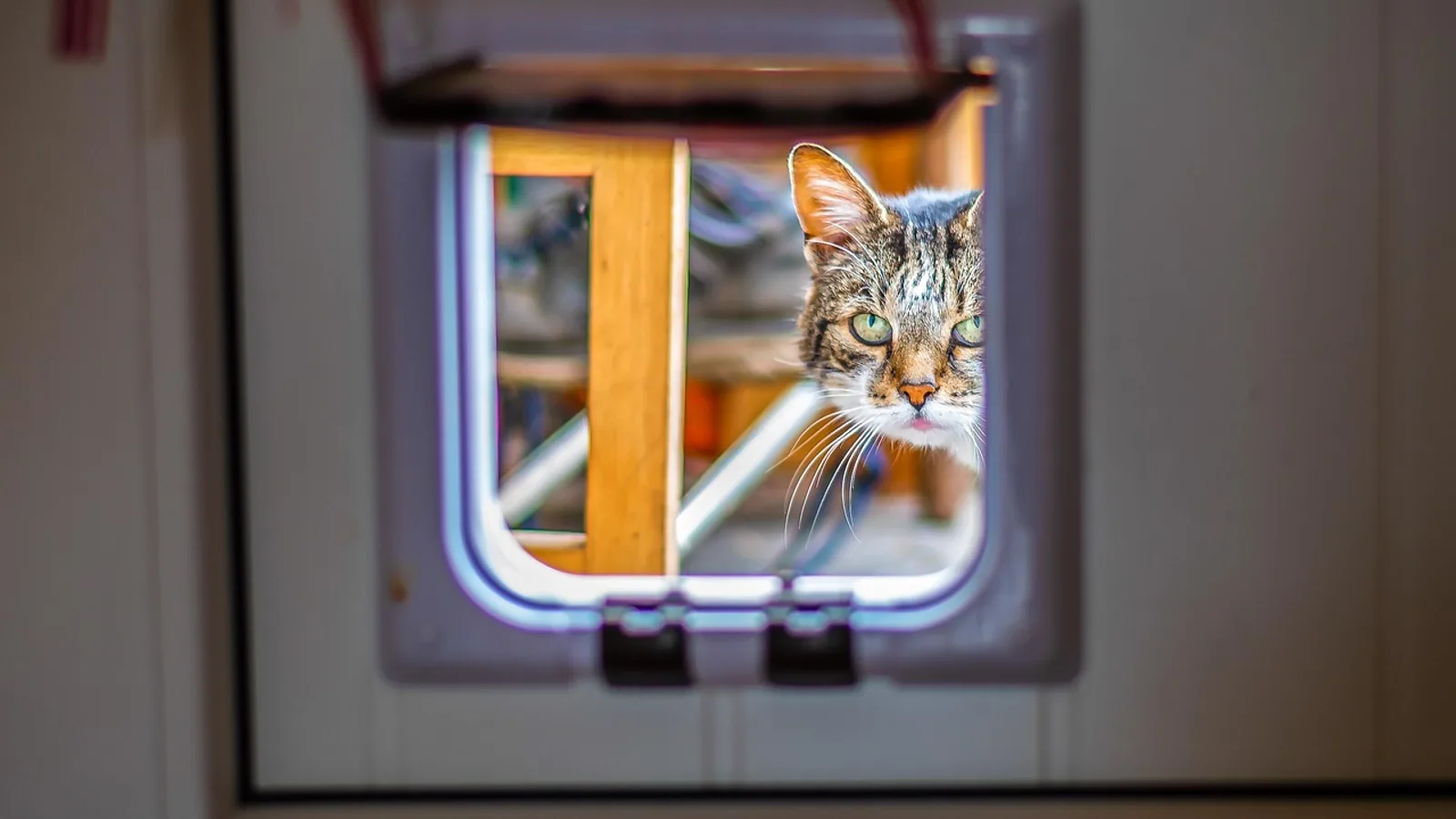
A cat door gives your cat a controlled route between indoors and a safe outdoor area, and the type you choose determines how much control you keep. A manual flap is the simplest and cheapest option, a magnetic door holds the flap shut against wind, and a microchip-reading door unlocks only for the cat wearing the registered chip. That last feature matters because it keeps neighborhood strays, raccoons, and other wildlife out of your home. Installation follows a fixed sequence: measure your cat, pick a location away from wiring and plumbing, cut and seal the opening, and secure the frame. Training works best when you prop the flap open, lure the cat through with treats, keep sessions short, and never push or force the cat through the opening.
This guide covers the four common door types, wall versus door installation, a step-by-step install, a training plan, and the outdoor risks that every owner should weigh before cutting a hole in a wall.
At a Glance
| Step | What to do | Why it matters |
|---|---|---|
| 1 | Measure your cat's shoulder width and belly height | Determines the flap size and cutout height |
| 2 | Choose a location away from utilities, at a quiet spot | Avoids pipes, wiring, and high-traffic stress |
| 3 | Match the door type to your household | Controls strays, wildlife, and weather |
| 4 | Cut the opening and seal all four sides | Prevents drafts, water, and insect entry |
| 5 | Secure the frame and test the flap swing | Stops the door shifting and jamming |
| 6 | Prop the flap open and lure with treats | Builds confidence without forcing |
| 7 | Run short sessions, then close the flap | Teaches the push-through motion gradually |
| 8 | Supervise first outings and check local rules | Manages traffic, predators, and legal limits |
Why Owners Install a Cat Door
Cats are highly motivated to explore, climb, and hunt, and many owners provide some form of outdoor access to satisfy those drives [1]. A national survey of cat owners in Canada and the United States found that 57 percent kept their cats indoors while 43 percent provided some form of outdoor access, and 21 percent of all owners gave their cats uncontrolled outdoor access [2]. A cat door is one way to structure that access so the cat can move in and out on its own schedule rather than waiting for a person to open a door.
The welfare argument cuts both ways. Uncontrolled outdoor access is linked to higher risks of disease and parasites, injury or death from traffic, predation, poisoning, and permanent separation from the owner, and outdoor cats also pose a threat to local wildlife and can become a nuisance to neighbors [1]. A cat door does not remove those risks. It changes how the access is delivered, and the type of door you choose changes how much control you retain.
Environmental enrichment is the alternative that many behavior-focused veterinarians recommend. A study of 3,083 cat owners found that the most common enrichment items were play interaction at 77.4 percent, access to a balcony or window with a protective net at 72.7 percent, places to hide at 54.5 percent, and toys at 46.0 percent [3]. Enrichment also has measurable physiological effects. Shelter cats housed in an enriched environment had roughly half the hair cortisol level of cats in a standard environment, 0.059 ng/mg versus 0.101 ng/mg [4]. If your goal is to reduce boredom and stress, indoor enrichment and a controlled cat door can work together rather than as competing options.
Cat Door Types Compared
Four door types dominate the market, and each solves a different problem. The table below summarizes what each is best for and where it falls short.
| Door type | Best for | Main drawback |
|---|---|---|
| Manual flap | Indoor-only cats, screened porches, budget installs | Any animal can push through, including strays and wildlife |
| Magnetic | Windy locations, keeping the flap sealed | Requires a magnet on the collar, which can snag or be lost |
| Microchip-reading | Multi-cat homes, areas with strays or wildlife | Higher cost and needs a working chip and registration |
| Wall-mounted | Homes without a suitable exterior door | Larger cutout, more structural work, harder to reverse |
Manual Flap Doors
A manual flap is a hinged panel in a frame. The cat pushes it with its nose or paw, and it swings back into place. There is no lock, no collar tag, and no electronics. This is the least expensive and easiest door to install, and it is a reasonable choice for a cat that only uses a screened porch or an enclosed catio.
The drawback is that the flap offers no selectivity. A raccoon, opossum, skunk, or neighborhood cat can push through the same opening. In areas with wildlife, a manual flap can turn your kitchen into a wildlife corridor.
Magnetic Doors
A magnetic door uses a small magnet, usually on the cat's collar, to hold the flap closed until the cat approaches. The magnet releases the latch, and the flap opens. The door stays sealed against wind and reduces the chance that a random animal pushes through.
The tradeoff is the collar hardware. Some cats lose collars, and a collar with a magnet can catch on branches or furniture. Cats that go outdoors with a collar should wear a breakaway design so the collar releases if it snags.
Microchip-Reading Doors
A microchip-reading door contains a scanner that reads the RFID microchip already implanted in your cat. When a registered chip is detected, the latch releases and the flap opens. When any other animal approaches, the door stays locked.
This is the key advantage for most households. A microchip door prevents strays and wildlife from entering your home, which addresses one of the main welfare concerns with uncontrolled outdoor access [1]. It also solves the multi-cat problem. You can program the door to admit one cat and exclude another, which is useful when one cat needs restricted access for medical or behavioral reasons. The door requires a working microchip, and the chip number must be registered with the door. If your cat is not chipped, talk to your veterinarian about implantation before you buy the door.
Microchipping is also a mainstream ownership practice. An international review of online responsible-ownership advice found that more than half of the webpages reviewed recommended registration and microchipping, desexing, and containment [5]. A microchip door aligns with that standard.
Wall-Mounted Versus Door-Mounted
Door-mounted units fit into an existing exterior door, usually a human door or a sliding glass panel. They are the easiest to install and the easiest to remove if you move. The limitation is that you need a suitable door, and you need permission if you rent.
Wall-mounted units fit through an exterior wall. They work when no exterior door is available, and they can be placed at a height that suits your cat. The cutout is larger, the job involves more structural work, and reversing it means patching and finishing the wall. Wall installation also requires more care around insulation and vapor barriers.
Selecting the Right Location
Location decides how well the door works and how much you will regret it later.
Pick an interior wall or door section that is quiet. A door next to a washing machine, a furnace, or a busy hallway gets avoided. Cats prefer routes that feel safe, and a flap in a high-traffic zone creates stress rather than enrichment.
Avoid any location with utilities behind the wall. Electrical wiring, plumbing supply lines, drain pipes, gas lines, and HVAC ducts all run inside walls. Cutting into a live circuit or a water line is dangerous and expensive. If you are unsure what is behind a wall, hire a professional or choose a different location. This guide does not cover electrical work, and any wiring you encounter should be handled by a licensed electrician.
Choose a height that matches your cat. A cat door should sit so the cat can step through without jumping or crouching. Measure the cat's shoulder width and the height from the floor to the underside of the belly, then add clearance for the frame. A door that is too small causes the cat to scrape its shoulders, and a door that is too high forces an awkward jump.
Think about the outdoor side too. The exterior approach should be clear, lit, and free of hazards. Avoid placing the door where a cat steps directly into a driveway, a road, or a dog run.
Step-by-Step Installation
These steps apply to both door-mounted and wall-mounted units. The sequence is the same, but wall installation adds framing and insulation work.
Step 1: Measure Your Cat
Measure shoulder width at the widest point and measure the height from the floor to the belly. Add a margin so the cat passes without contact. Use those numbers to select the flap size, then confirm the cutout dimensions in the manufacturer's instructions. Door sizes vary, so the printed template governs the actual cut.
Step 2: Confirm the Location
Check both sides of the wall or door. Look for outlets, switches, and plumbing fixtures that suggest hidden lines. On an exterior door, confirm that the cutout will not intersect the lock mechanism, hinges, or glass. On a wall, confirm that the exterior surface is accessible and that the cutout will not weaken a load-bearing element.
Step 3: Mark and Cut the Opening
Trace the template onto the surface. Drill a starter hole inside the outline, then cut along the line with the appropriate tool for the material. For a hollow-core door, cut slowly to avoid crushing the inner structure. For a solid wall, cut through the interior surface first, then the exterior surface, and remove insulation from the cavity.
Step 4: Fit the Frame and Seal It
Test-fit the frame before you fasten anything. The frame should sit flush on both sides. Seal the gap between the frame and the cut edge with exterior-grade sealant or expanding foam rated for doors and windows. Seal all four sides. This step weatherproofs the opening and blocks drafts, water, and insects. On a wall installation, restore the vapor barrier and insulation around the frame before closing it up.
Step 5: Secure the Frame
Fasten the frame with the hardware supplied by the manufacturer. Screws should bite into solid material, not just drywall or door skin. If the frame flexes when the cat pushes through, add backing. A loose frame lets the flap misalign, and a misaligned flap either sticks open or fails to latch.
Step 6: Test the Flap
Open and close the flap by hand several times. It should swing freely and return to a closed position under its own weight or spring tension. Check the latch on a magnetic or microchip door by triggering it with the collar magnet or the registered chip. Confirm the locked state holds against a firm push.
Step 7: Finish the Surfaces
Paint or seal any exposed cut edges, especially on exterior doors and walls. Bare wood and exposed composite absorb water and swell. A finished edge keeps the frame stable through weather cycles.
Training Your Cat to Use the Door
Training is the part owners rush, and rushing is why cats refuse the door. The goal is to make the flap a neutral, predictable object, then build the push-through motion in small steps.
Start With the Flap Propped Open
Prop the flap fully open or remove it for the first sessions. The cat now sees an open passage with no moving part. Let the cat investigate on its own. Place a favorite bed or a food bowl on the far side so the route has a reason. Some cats cross within minutes, and some take days. Both are normal.
Lure With Treats and Food
Use high-value treats or a portion of the cat's regular food. Place a treat just inside the opening, then a little farther, then on the far side. Let the cat eat and retreat. Repeat. The cat learns that crossing the threshold predicts something good.
Keep Sessions Short
Run two to five minutes per session, several times a day. Stop while the cat is still succeeding. Long sessions invite frustration, and a frustrated cat avoids the door for weeks.
Lower the Flap Gradually
Once the cat crosses an open passage reliably, lower the flap partway. Hold it or prop it so the cat only needs a light push. Reward every crossing. Then lower it further until the cat pushes through a fully closed flap.
Never Force the Cat Through
Do not push, shove, or trap the cat on the far side of the flap. Forced crossings create fear of the door and can damage the training relationship. If the cat backs away, go back one step and try again later.
Use Shaping Rather Than Flooding
Shaping means rewarding each small approximation of the final behavior. Reward looking at the flap, then touching it with the nose, then pushing it, then stepping through. This is the same principle used in structured animal training systems, where free access to the training device and a gamified learning process are used to enhance welfare rather than create pressure [6]. The cat controls the pace, and the reward follows the behavior.
Expect Individual Variation
Cats differ in boldness, and the choice of enrichment in real households tracks housing features more than personality [3]. A confident cat may use the door on day one. A cautious cat may need two weeks. Match your pace to the cat, not to a schedule.
Decision Flow for Choosing a Door
Use this flow to move from your household situation to a door type and a training plan.
flowchart TD
    A[Do you have a safe outdoor area] --> B{Yes or no}
    B -->|No| C[Use indoor enrichment instead]
    B -->|Yes| D{Are strays or wildlife present}
    D -->|Yes| E[Choose microchip door]
    D -->|No| F{Is wind or weather a problem}
    F -->|Yes| G[Choose magnetic door]
    F -->|No| H[Choose manual flap]
    E --> I[Measure cat and pick location]
    G --> I
    H --> I
    I --> J[Cut seal and secure frame]
    J --> K[Prop flap and lure with treats]
    K --> L[Short sessions and no forcing]
Common Mistakes
Cutting before measuring. A flap that is too small causes shoulder scraping, and a flap that is too high forces a jump. Measure the cat first, then cut.
Ignoring what is inside the wall. Wiring, plumbing, and ducts are invisible until you hit them. Check for fixtures on both sides and choose a different spot if anything is unclear.
Skipping the weather seal. An unsealed frame leaks air and water, and it lets insects into the wall cavity. Seal all four sides with exterior-grade material.
Over-tightening the frame. A frame that pinches the flap causes sticking. Fasten snugly and test the swing.
Forcing the cat. Pushing a cat through a flap teaches the cat to avoid the door. Prop it open and let the cat choose.
Leaving the door open to all animals. A manual flap admits anything that fits. If strays or wildlife are present, a microchip door is the better choice [1].
Skipping the collar check on a magnetic door. A lost magnet means the door stays locked, and a snagged collar is a safety risk. Use a breakaway collar.
Troubleshooting
The cat will not approach the door. Move the flap to a quieter location or add a familiar bed and food bowl nearby. Check for a draft, a noisy appliance, or a scent from another animal.
The cat approaches but will not push the flap. Lower the flap in smaller increments and reward nose contact. Keep sessions short.
The flap sticks open. Check the frame alignment and the latch. Debris in the hinge channel or a warped frame causes most sticking.
The door admits the wrong cat. Reprogram the microchip reader and confirm the registered chip number. If two cats share a chip number, which is rare, contact the chip registry.
The cat uses the door at night. Many cats shift to nocturnal activity. If night access is not safe, lock the door at night and provide indoor enrichment instead.
The cat brings prey inside. This is normal predatory behavior and a sign the cat is hunting outdoors [1]. If you want to reduce wildlife impact, restrict outdoor access and increase indoor play.
Welfare and Safety Considerations
A cat door is a management tool, not a risk-free upgrade. Weigh the benefits against the specific hazards around your home.
Traffic is the leading outdoor hazard for cats with uncontrolled access [1]. If your home sits near a road, a cat door increases exposure. Place the door on the side of the house farthest from traffic, and consider a fully enclosed outdoor run instead.
Predators vary by region. Coyotes, foxes, dogs, and birds of prey all take cats. A cat door that opens to an unfenced yard offers no protection.
Parasites and infectious disease rise with outdoor access [1]. Outdoor cats encounter fleas, ticks, and intestinal parasites, and they can bring those into the home. Talk to your veterinarian about a parasite prevention plan matched to your cat's lifestyle. The Companion Animal Parasite Council publishes region-specific guidance that your veterinarian can apply to your area.
Wildlife impact is real. Cats with outdoor access hunt birds and small mammals, and this is one of the documented welfare concerns with uncontrolled access [1]. A microchip door does not stop your cat from hunting. Only restricting or supervising outdoor time does.
Local laws matter. Some jurisdictions restrict free-roaming cats, require containment, or regulate outdoor access. Requirements vary by state, county, and city, so check your local ordinances before you install a door that allows unsupervised outdoor access. The same international review of responsible-ownership advice found that containment was recommended on 60.3 percent of the webpages reviewed, which reflects how common these rules have become [5].
Cognitive decline changes the picture. Older cats can develop cognitive dysfunction syndrome, which produces disorientation, altered sleep cycles, house-soiling, and learning and memory deficits [7]. A cat with these signs may not navigate a cat door safely or may become distressed by it. Environmental enrichment with easy access to key resources is part of the recommended management for these cats [7]. If your older cat is struggling with a door it once used, that change deserves a veterinary evaluation.
When a Cat Door Is the Wrong Choice
A cat door is a poor fit when the outdoor area is unsafe. If your home is on a busy road, if predators are common, or if local law restricts outdoor cats, keep the cat indoors and build enrichment instead.
It is also a poor fit for a cat with a medical condition that requires monitored food or medication. A door that lets the cat leave at will makes treatment harder to control.
Finally, a cat door is a poor fit if you cannot supervise the first weeks of use. Training and early monitoring are what keep the door safe.
Limitations and When to Contact a Veterinarian
This article is educational and is not a substitute for veterinary diagnosis or treatment. Individual cats vary, and your veterinarian can assess your cat's health, parasite risk, and behavior in the context of your home.
Contact your veterinarian if your cat shows any of the following after a cat door is installed or after increased outdoor access.
- New limping, wounds, or swelling, which can indicate a fight or a traffic injury
- Vomiting, diarrhea, weight loss, or a poor appetite, which can indicate parasites or an infectious disease
- Scratching, hair loss, or skin lesions, which can indicate fleas, mites, or an allergy
- Increased vocalization, disorientation, house-soiling, or altered sleep, which can indicate cognitive dysfunction or another medical problem [7]
- Sudden refusal to use the door after previously using it well, which can indicate pain, fear, or a medical issue
- Any suspected poisoning, which is an emergency
For cats with outdoor access, ask your veterinarian about a parasite prevention plan and about microchipping if your cat is not already chipped.
Frequently Asked Questions
Do microchip cat doors really keep other animals out?
Yes. A microchip door unlocks only for a registered chip, so a stray cat, raccoon, or opossum cannot push through. This is the main advantage over a manual flap.
What size cat door do I need?
Measure your cat's shoulder width and the height from the floor to the belly, then add clearance. Use the manufacturer's template for the final cutout dimensions, because flap sizes vary between models.
Can I install a cat door in a wall instead of a door?
Yes. Wall-mounted doors work when no exterior door is suitable. The cutout is larger, and the job involves more framing, insulation, and sealing work than a door-mounted unit.
How long does it take to train a cat to use a door?
It varies widely. A confident cat may use an open flap the first day, while a cautious cat may need one to two weeks of short sessions. Match the pace to your cat and never force it through.
Should I prop the flap open during training?
Yes. Propping the flap open removes the moving part and lets the cat cross a plain opening. Lower the flap gradually once the cat crosses reliably.
Is a cat door safe for an older cat?
Not always. Cats with cognitive dysfunction can become disoriented and may not navigate a door safely [7]. Ask your veterinarian to evaluate any older cat that shows confusion, house-soiling, or changed sleep patterns.
Does a cat door increase parasite risk?
Outdoor access is linked to higher parasite and disease exposure [1]. Talk to your veterinarian about prevention matched to your cat's lifestyle and your region.
Can I lock a cat door at night?
Yes. Most doors include a locking panel or a manual lock, and microchip doors can be set to lock on a schedule. Locking at night reduces nocturnal outdoor access and wildlife exposure.
Related Articles
- Dog Potty Training Bell For Door
- Heavy-Duty Electronic & Smart Doors for Large Dog Breeds: Insulation, Security, and Door Frame Installation
- Two Door Dog Training Crate Vibrant Life
- Feedlot Fencing Types and Installation Guide
- Cattle Grid Installation: Safety and Maintenance
- Koi Pond Liners: Material Comparison and Installation Guide
- Why Horses Bite: Causes and Training Fixes
- Pit Bull Training: Obedience, Socialization, and Tips
Sources
- Uncontrolled Outdoor Access for Cats: An Assessment of Risks and Benefits.
- Perspectives of Canadian and American Cat Owners on Provision of Uncontrolled Outdoor Access for Owned Domestic Cats.
- Types of Environmental Enrichments Offered for Cats and their Association with Housing Features and Cat Personality.
- The Impact of Environmental Enrichment on the Cortisol Level of Shelter Cats.
- Piloting an International Comparison of Readily Accessible Online English Language Advice Surrounding Responsible Cat Ownership.
- CATOS (Computer Aided Training/Observing System): Automating animal observation and training.
- Cognitive Dysfunction in Cats: Update on Neuropathological and Behavioural Changes Plus Clinical Management.