Are Cats Faster Than Dogs? Speed and Agility Compared
By Dr. Zubair Khalid, DVM, MS, PhD ·
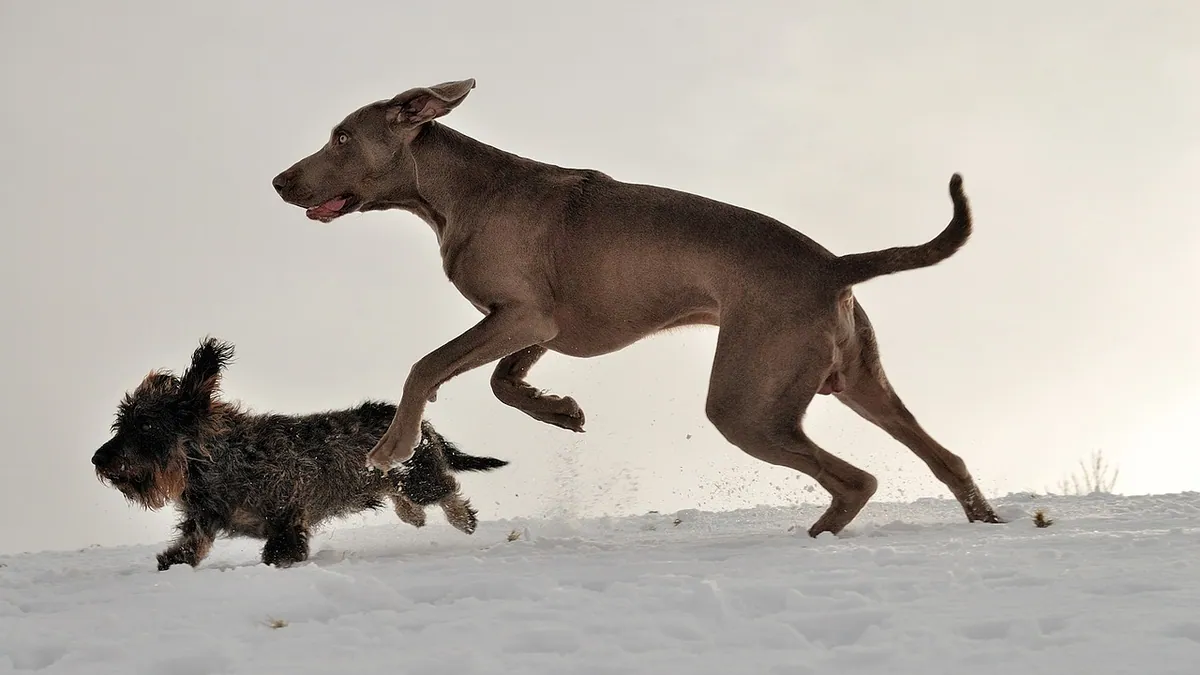
Are cats faster than dogs? For a short burst, yes. A healthy cat can out-sprint most dogs over a few body lengths, but dogs hold up far better over distance. So the honest answer depends on whether you are measuring a 20-yard dash or a three-mile run.
This article is educational and is not a substitute for veterinary diagnosis or treatment.
Quick Answer
- Cats are built for short, explosive sprints and sharp direction changes. Dogs are built for sustained trotting and long-distance travel.
- Over the first few strides, a cat's acceleration usually beats a dog's, especially in smaller dogs.
- In a long chase or a long hike, most dogs will outlast most cats.
- Agility depends on the task. Cats turn and land better. Dogs trained in agility show measurable differences in how they judge their own bodies and obstacles [1].
- Neither speed nor agility should decide how you exercise or house your pets. Safety, breed, age, and health matter more.
Sprint Speed: Where Cats Win
Cats are ambush predators by design. Their hunting style rewards a fast start, a short chase, and a quick stop. That is why a cat can go from a dead sleep to full speed in a fraction of a second.
Their bodies support this. A study of the accessory carpal bone, the small bone at the back of the wrist, found that cats have more compact and slender carpal bones than dogs, which fits their greater mobility and smaller body size [2]. That wrist structure helps a cat grip, pivot, and land cleanly.
Cats also prefer efficient gaits when moving over ground. In adult cats moving at matched speeds, researchers found that overground locomotion used diagonal support patterns that contribute to forward propulsion and locomotor efficiency, while treadmill walking used more stable multi-limb support [3]. In plain terms, a cat moving freely is tuned for efficient, coordinated motion.
So when someone asks are cats quicker than dogs, the answer is usually yes over very short distances. A cat's top sprint speed is roughly in the range of a fast dog, but the cat reaches it faster and holds it for less time.
Endurance and Distance: Where Dogs Win
Dogs were shaped by centuries of working alongside people, and many breeds were selected for stamina. Sled dogs, herding dogs, and hunting dogs can cover miles at a steady pace. Cats cannot match that.
Part of the difference is gait. A study of predatory mammals grouped species by hunting strategy and found that slower, more economical gaits overlap broadly across hunting groups, while social hunters tend to use more upright limb postures [4]. Dogs, especially those bred to work in groups or run long distances, fit that endurance profile.
Acceleration data collected from animal-borne devices over six decades shows that most locomotion research focuses on terrestrial mammals, particularly domesticated species like dogs and cats [5]. That work confirms what owners see: dogs are the distance animals, cats are the burst animals.
If you ask are dogs faster than cats in a marathon, the dog wins almost every time. In a 40-yard dash, the cat wins.
Agility: Turns, Jumps, and Body Awareness
Agility is not the same as speed. It is speed plus balance, timing, and body awareness.
Cats have an edge in raw agility. Their flexible spines, loose shoulder attachments, and light frames let them twist midair and land on narrow surfaces. That is why a cat can clear a counter and land on a two-inch ledge.
Dogs can be highly agile too, but it depends on training and breed. A study of pet dogs and agility-trained dogs tested whether dogs could judge their own body size and the solidity of materials. Dogs could correctly assess their size, and agility dogs showed better shape perception and reached a reward faster in one experiment [1]. That tells us agility training changes how dogs read their environment.
So are cats or dogs faster and more agile? Cats are more agile by default. Dogs can close the gap with training, and some breeds are remarkably quick and coordinated.
If you are choosing a pet and temperament matters more than speed, see Cat or Dog: Which Pet Is Right for Your Lifestyle?.
What This Means for Exercise
Exercising a Dog
Dogs need daily activity, and the amount depends on breed, age, and health. A border collie and a bulldog have very different needs. Most healthy adult dogs do well with a mix of walks, sniff time, and play.
Because dogs are endurance animals, they can handle longer, steadier exercise than cats. Build up distance gradually. Sudden long runs in an unfit dog can cause muscle soreness or injury.
Watch for heavy panting, lagging, limping, or refusal to continue. Stop and rest if you see these.
Exercising a Cat
Cats need activity too, but in short bursts. Two or three play sessions of five to ten minutes with a wand toy or laser pointer (always ending with a tangible catch) mimic natural hunting. This suits their sprint-based physiology.
Do not try to take your cat running. Most cats will not tolerate it, and forced endurance exercise is not appropriate for them.
Multi-Pet Homes
If you have both species, remember that a dog's play style can overwhelm a cat. A dog that chases for fun can trigger a cat's flight response, and the cat will tire quickly. Supervise introductions and give the cat escape routes and high perches. For a structured approach, read Introducing Dogs to Cats: Prey Drive Assessment and Desensitization.
Safety Around Speed
Speed differences matter most in two situations: traffic and predation.
A cat that bolts can reach a road faster than you can react. Keep cats indoors or in secure outdoor enclosures.
A dog with strong prey drive can chase a running cat, squirrel, or rabbit before you can call it back. Use a leash in unfenced areas and work on recall.
If your pets interact, know that a cat's quick sprint can trigger a dog's chase instinct. That is normal behavior, not aggression, but it can be dangerous. Manage the environment so the cat is never cornered.
Training and Enrichment
For Dogs
- Teach a reliable recall with positive reinforcement.
- Try agility, rally, or scent work for body awareness and confidence. Agility training appears to sharpen how dogs perceive obstacles and their own shape [1].
- Use puzzle feeders and sniff walks to burn mental energy.
- Keep sessions short and end on success.
For Cats
- Offer vertical space: cat trees, shelves, window perches.
- Rotate toys to keep play interesting.
- Use food puzzles to encourage movement.
- Provide scratching posts to support normal stretching and claw health.
For Both
- Keep routines predictable.
- Provide separate feeding and resting zones in multi-pet homes.
- Schedule annual veterinary exams so mobility changes get caught early.
What Not to Do
- Do not punish a cat for scratching or climbing. Redirect to appropriate surfaces.
- Do not use shock collars or harsh corrections to stop chasing. These increase fear and can worsen behavior.
- Do not assume a slow pet is lazy. Pain, arthritis, and heart disease all reduce activity.
- Do not compare your cat and dog as if one is "better." They evolved for different jobs.
- Do not rely on internet videos of cats and dogs racing. Those clips are edited and staged.
When Speed or Agility Changes
A sudden drop in speed or willingness to move is a medical sign, not a personality trait.
In dogs, common causes include osteoarthritis, cruciate ligament injury, hip dysplasia, and heart or lung disease. In cats, arthritis is very common and often mistaken for "just getting older." Cats hide pain well.
If your pet slows down, schedule a veterinary visit. Your veterinarian can assess gait, joint health, and heart function, and set a treatment plan for your pet's weight and condition.
Limitations and When to Contact a Veterinarian
No article can tell you whether your specific pet is healthy enough for a given activity. Your veterinarian examines your pet and makes that call.
Contact a veterinarian the same day if you see:
- Sudden reluctance to walk, jump, or climb stairs
- Limping that does not improve after rest
- Collapse, fainting, or extreme weakness
- A cat that stops using the litter box or cries when moving
Go to an emergency clinic now if you see:
- Open-mouth breathing in a cat
- Blue or pale gums
- Inability to stand
- A suspected fracture or a leg held at an odd angle
- Heat exhaustion after exercise (heavy panting, wobbling, vomiting)
Call your regular veterinarian for a routine visit if:
- Your pet is slowing down gradually over weeks
- Your dog tires faster than usual on normal walks
- Your cat hesitates before jumping onto favorite spots
- You want guidance on safe exercise for a senior or overweight pet
If you are unsure whether a behavior is medical or training-related, start with your veterinarian. A certified behavior professional can help once medical causes are ruled out.
Frequently Asked Questions
Can a cat outrun a dog in a straight line?
Over a very short distance, usually yes. Cats accelerate faster and reach top speed quickly. Over longer distances, most dogs will catch up and pass the cat.
Do all dogs run faster than all cats?
No. Size and breed matter a lot. A large athletic dog will beat most cats over distance, but a small or flat-faced dog may not outrun a healthy adult cat even in a short sprint.
Is a cat's speed dangerous for my dog?
Not directly. The risk is behavioral. A running cat can trigger a dog's chase drive, and the dog may knock over furniture or corner the cat. Supervise and separate when needed.
Should I race my cat and dog?
No. Racing encourages chasing and can stress the cat. It also risks injury if either pet slips or collides. Play with each pet separately instead.
Does agility training make dogs faster?
It can improve coordination and body awareness, and agility-trained dogs performed better on some perception tasks in one study [1]. Top speed is largely set by breed and conformation, but skill and confidence improve with practice.
Can I train my cat to be faster or more agile?
You can encourage activity with play, but you cannot change a cat's basic physiology. Cats are already highly agile. Focus on enrichment and healthy weight, which support natural movement.
Why does my older pet seem slower?
Slowing down is often the first sign of joint pain or another medical problem. Book a veterinary exam. Early treatment keeps pets comfortable and active longer.
Do indoor cats get enough exercise?
Many do not. Indoor cats need daily interactive play and climbing opportunities. Without them, obesity and boredom-related problems are common.
Is my dog's speed affected by the weather?
Yes. Heat and humidity reduce a dog's ability to cool down, so exercise tolerance drops. Walk in cooler hours and watch for signs of overheating.
Can speed differences cause injuries between pets?
They can. A cat bolting past a dog may get chased or pinned. A dog chasing a cat may crash into objects. Manage space and supervise interactions, especially during introductions.
For more on how pet behavior and health intersect, see The Nyan Cat Phenomenon: How Internet Memes Affect Pet Behavior and At-Home Pet Blood Glucose Meters: Calibrated Species Coding (Dog vs. Cat), Sample Volumes, and Curves.
Related Articles
- Introducing Dogs to Cats: Prey Drive Assessment and Desensitization
- The Nyan Cat Phenomenon: How Internet Memes Affect Pet Behavior
- Cat or Dog: Which Pet Is Right for Your Lifestyle?
- At-Home Pet Blood Glucose Meters: Calibrated Species Coding (Dog vs. Cat), Sample Volumes, and Curves
- Do Dogs or Cats Have Better Hearing? Ear Anatomy Compared
- Are Dogs or Cats Smarter? What the Science Says
- Do Cats or Dogs Live Longer? Lifespan Compared
References
- Influence of agility training on body-size and object solidity perception in pet dogs. PloS one, 2026.
- Comparative anatomy analysis of the accessory carpal bone across dog and cat breeds. Research in veterinary science, 2025.
- Comparison of forelimb and hindlimb movements during treadmill and overground locomotion at different speeds in intact adult cats. Journal of neurophysiology, 2026.
- Convergent carnivores or divergent dasyurids? Inferring predation and locomotor strategies of extant and extinct carnivorous marsupials from locomotor shape. BMC ecology and evolution, 2026.
- Six decades of animal accelerometry: trends, applications, and future directions. Movement ecology, 2026.