
This article is educational. Stop training and seek veterinary care for collapse, breathing distress, sudden inability to use a limb, severe pain, loss of coordination, or suspected heat illness. Persistent or recurrent lameness, stiffness, reluctance to jump, or a performance change also deserves examination; do not train through pain.
Agility Training for Dogs: Beginner Plan, Equipment, Safety, and Injury Prevention
Quick Answer
Dog agility can be an enriching team sport, but the safest beginning is not a backyard course at full height. Start with a veterinary health check when risk warrants it, reward-based communication, recall, start and release cues, calm waiting, body awareness, confidence on stable low surfaces, and fitness appropriate to the dog. Introduce one skill at a time, keep sessions short, preserve choice, and progress speed, height, repetition, and technical difficulty separately.
A puppy can learn foundations without repetitive jumping, sharp high-speed turns, elevated contact equipment, or full weave-pole demands. An adult beginner also needs gradual conditioning. Enthusiasm is not proof of tissue readiness: many dogs will repeat a physically difficult behavior for a toy despite fatigue or discomfort.
Injury is a real consideration, but published estimates come largely from retrospective owner surveys with different definitions and populations. One early survey of 1,627 agility dogs reported that 33% had experienced an injury; shoulders and backs were commonly reported sites [1]. A Finnish survey limited to competition-level dogs found 119 of 864 dogs had an agility-related injury during one year and estimated 1.44 competition injuries per 1,000 runs [2]. These figures cannot be treated as one universal probability for a beginner. They show why conditioning, equipment, workload, surface, and early recognition of pain matter.
What Dog Agility Involves
In formal agility, a handler directs a dog through a numbered course that may include bar jumps, tunnels, weave poles, a tire or ring jump, and contact obstacles such as an A-frame, dog walk, or seesaw. Rules, obstacle dimensions, jump-height divisions, allowed equipment, and safety specifications differ among organizations and can change. Check the current rulebook for the venue rather than building from a remembered diagram.
At home, “agility” can mean low-impact obstacle games: walking around cones, stepping over poles on the ground, standing on a stable platform, moving through a wide tunnel, circling an object, or following a handling line. Those exercises can develop communication and coordination without reproducing competition loads.
Agility is not just obstacle performance. The dog must travel, wait in stimulating environments, recover between runs, tolerate measurement and examination, disengage from other dogs, and work without coercion. A successful plan trains the whole experience.
Is Agility Right for Every Dog?
No sport suits every individual in every form. Many healthy dogs can enjoy modified agility, but competition-height jumping and high-speed sequences are not prerequisites for enrichment.
Consider:
- age and skeletal maturity;
- body condition and muscle condition;
- conformation and size;
- prior orthopedic, neurologic, cardiac, respiratory, or eye disease;
- medications and heat tolerance;
- confidence on surfaces and around noise;
- arousal, frustration, and recovery;
- the handler’s mobility and timing;
- access to safe equipment and qualified instruction.
Dogs with osteoarthritis, previous cranial cruciate ligament disease, spinal pain, shoulder injury, iliopsoas injury, patellar luxation, hip or elbow dysplasia, or neurologic disease may need rehabilitation-led modification or a different activity. Iliopsoas injuries alone kept a substantial minority of affected survey dogs out of sport for more than six months or led to retirement [5]. Deaf and visually impaired dogs may participate with adapted cues and environments, but safety requires individualized planning.
Brachycephalic dogs can face increased airway and heat risk. Long-backed dogs, giant dogs, very small dogs, and dogs with disproportionate limbs may need modified heights, surfaces, and volume. Breed is not a diagnosis; the individual examination matters.
Overweight dogs should not be “run thin” through jumping. Weight management begins with measured nutrition and low-risk conditioning. Excess mass increases load, while abrupt vigorous exercise raises injury and heat risk.
A Pre-Training Health Check
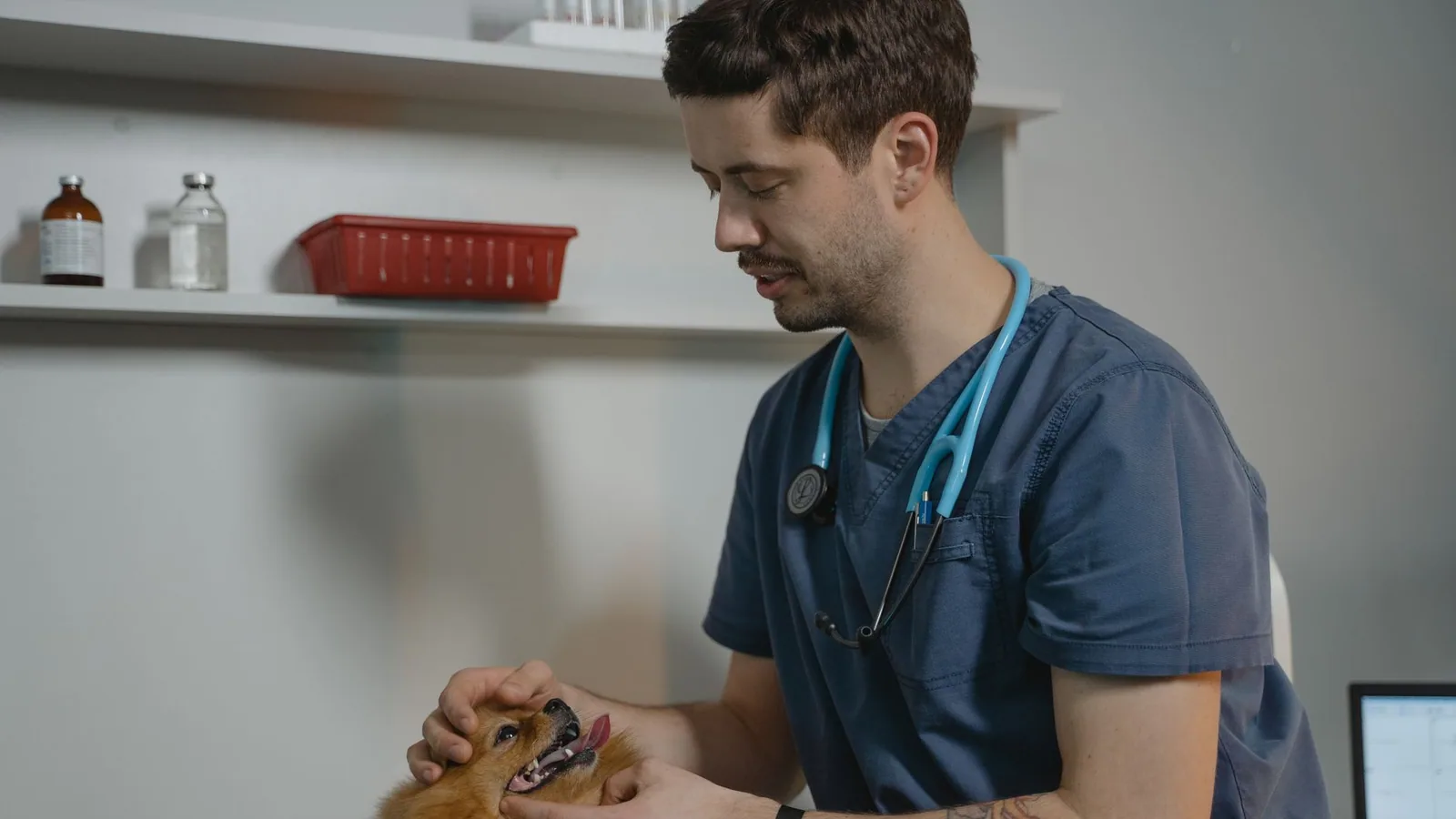
A young healthy pet beginning low-impact foundations may not need sports imaging. A veterinarian should nevertheless know the intended activity, especially before high-speed or competitive work. The examination can assess heart and lungs, body and muscle condition, gait, joint range, feet, nails, spine, neurologic function, and previous injury.
Screening radiographs do not guarantee injury prevention. Imaging is guided by breed risk, signs, prior disease, and competition goals. A normal orthopedic examination today does not make a dog immune to injury, while an incidental imaging finding may not explain function without clinical correlation.
Ask whether conditioning, weight adjustment, medication review, cardiac testing, ophthalmic assessment, or rehabilitation referral is appropriate. Establish a baseline of how the dog rises, walks, trots, sits, turns, jumps into a vehicle, and recovers after normal activity. Subtle change is easier to recognize when normal is documented.
Reward-Based Learning Principles
Agility should be taught with reinforcement, clear criteria, and voluntary engagement. Reward-based methods are effective and avoid adding fear or conflict to a physically demanding task. Aversive collars, leash corrections, yelling, forced contact with equipment, and flooding a frightened dog can damage welfare and create unsafe movement. Injury surveys do not justify coercive handling as a way to make obstacle performance more precise [1].
Define One Criterion
Decide what is being reinforced: looking at the obstacle, approaching, placing one paw, walking across slowly, following the handler’s line, or holding a start. Raising distance, speed, duration, distraction, and precision together makes failure likely.
Use High-Value but Appropriate Rewards
Food allows frequent precise reinforcement. Toys can build speed but may sharply increase arousal and physical intensity. Choose based on the dog, account for calories, and avoid repetitive explosive tugging or chasing when fatigued. The reward should not lure a dog into an unsafe landing.
Protect Choice
A dog that hesitates, leaves, sniffs, scratches, lip-licks, lowers posture, avoids equipment, or repeatedly misses a familiar cue may be confused, worried, tired, or painful. Lower difficulty and assess. Do not physically place a dog onto an obstacle.
Use a Marker and Release Cue
A consistent marker identifies the successful behavior. A release cue ends a station, start-line wait, or rest. Teach both away from equipment first. Releases should not become surprise launches on slippery footing.
For a broader humane foundation, see German Shepherd training; the learning principles apply across breeds even though individual motivation and arousal differ.
Foundation Skills Before Obstacles
Name Response and Orientation
Reinforce turning toward the handler, then moving with the handler on both sides. Agility handling depends on the dog reading motion and reinforcement history, not a shouted stream of words.
Recall
Build a strong recall in fenced areas with gradual distraction. Never test an unproven recall near roads. Reward generously and avoid calling only to end fun. Competition reliability does not equal off-leash safety in uncontrolled spaces.
Start-Line and Stationing
Teach the dog to wait on a mat or platform while the handler moves a small distance, then release. Increase one dimension at a time. If waiting creates frustration, reinforce calm micro-durations rather than repeatedly correcting broken stays.
Hand Target and Directional Movement
A nose target can position the dog without pushing the body. Teach wraps around a cone in both directions at walking speed, then gradually add distance. Avoid drilling tight turns.
Send to a Mat or Low Platform
Use a wide, nonslip platform only a few centimeters high. Reinforce controlled entry, four feet, stillness, and a calm exit. This supports contact behavior and body awareness without height.
Ground Poles
Poles on the ground can teach foot placement. Space them for the individual rather than copying a generic ladder. Begin walking, with few repetitions on nonslip level ground. Raised cavaletti and complex spacing belong in an individualized conditioning plan.
Settle and Recovery
Train resting in a crate or on a mat at a distance from activity. Recovery is a performance skill. A dog that screams, spins, bites the crate, or cannot drink is over threshold, not merely “high drive.” Increase distance and reduce exposure.
A Beginner Progression
Phase 1: Communication and Fitness
Spend several weeks on cues, walking and trotting fitness, body condition, surfaces, stationing, and calmness. The duration depends on the dog, not a calendar promise. Sessions can be two to five minutes with breaks rather than one exhausting block.
Phase 2: One Low-Risk Obstacle at a Time
Introduce wide tunnels held open and straight, cones, ground poles, and stable platforms. Let the dog investigate. Reinforce controlled approaches and exits. Do not collapse a tunnel around a novice or lure a worried dog through a dark curve.
Phase 3: Handling Without Height
Place jump wings or cones with the bar on the ground. Practice lines, front and rear positioning, starts, sends, and recalls. This teaches course communication without repeated takeoff and landing.
Phase 4: Gradual Technical Skills
With a qualified instructor, introduce low bars, safe contact foundations, tunnel curves, and weave training appropriate to maturity and fitness. Change only one load variable at a time. A new surface plus new obstacle plus speed is not a controlled progression.
Phase 5: Short Sequences
Combine two or three familiar skills with generous spacing. Film from the side and behind when safe. Look for consistent striding, confident lines, controlled takeoff and landing, and quick recovery—not just speed.
Phase 6: Course Work and Competition Preparation
Build sequence length, distraction, and venue exposure gradually. Train measurement, leash removal, ring entry, waiting, and exit rewards. Simulate competition sparingly; routine training need not be maximal.
Equipment Safety
Jumps
Use displaceable bars that fall when hit. Fixed broom handles, PVC glued into cups, garden stakes, and furniture can cause injury. Wings and uprights should be stable but not trap a dog. Start with bars on the ground.
Bar height changes biomechanics. A 2025 force-plate and motion-capture study of 17 Border Collies found increasing height from 80% to 120% of withers height increased vertical and decelerative impulses and joint ranges at takeoff [3]. This controlled study demonstrates load changes, but its breed, sample, and single-jump protocol limit generalization.
Another study of nine Border Collies found no significant difference in measured forelimb landing forces between two competition heights when velocity was controlled [4]. These results are not contradictory proof that height either always matters or never matters: they measured different phases, variables, heights, and small samples. Use organization rules, individual assessment, good technique, and conservative practice volume.
Tunnels
Anchor tunnels with equipment designed to prevent movement without creating hard internal pressure points. A rolling tunnel can frighten or injure a dog. Check for tears, exposed wire, heat, water, ice, and sharp edges. Curves increase difficulty and should follow confident straight performance; obstacle contact was a commonly reported injury circumstance in early survey work [1].
Contact Obstacles
A-frames, dog walks, and seesaws require engineered stability, nonslip surfaces, correct dimensions, and supervised instruction. Do not improvise elevated planks on chairs or tables. Falls can be serious. Begin contact behavior on a ground-level board or mat.
Early injury survey data associated A-frames, dog walks, and bar jumps with many obstacle-contact injuries [1]. That retrospective association does not prove every device is inherently unsafe; it supports correct construction, training, and maintenance.
Weave Poles
Weaving requires repeated lateral spinal and limb movement. Do not force a dog through narrowly spaced rigid poles or pull the collar. Use a qualified progression and limit repetitions. An internet survey of 4,197 agility dogs found associations between reported iliopsoas injury and some training or competition variables, including one weave-training method, but retrospective survey associations do not prove the method caused injury [5].
Tire or Ring Jumps
Use a breakaway design meeting current rules. Fixed homemade rings can trap a dog. Teach at low height with a straight approach and clear opening. Never use a child’s rigid hoop held by a person where collision could injure dog or handler.
Pause Tables and Platforms
Surfaces should be nonslip with no protruding fasteners. Choose a low height and adequate area. Reinforce controlled entry and exit rather than launching.
Surface and Environment
Traction, consistency, depth, moisture, temperature, and transition between surfaces matter. A surface can be soft yet unstable, or firm yet slippery. Inspect the complete running line for holes, mats that separate, wet grass, loose gravel, hidden roots, and abrupt edges.
Survey research has linked particular substrates and exposure patterns with reported injuries, but findings vary and are vulnerable to recall, selection, and exposure confounding [2][5][6]. Popular venues may accumulate more injuries simply because dogs spend more runs there. Do not label one material universally safe from a single survey.
Let dogs acclimate to a surface at low speed. Keep nails and paw hair managed for traction. Clean pads, check for cuts, and avoid training on hot material. Indoor mats must lie flat and remain secured.
Weather changes load and physiology. Heat and humidity can make a modest session dangerous. Cold muscles and icy footing change risk. Wind can move jumps; rain can change contact traction. Canceling or reducing a session is a training decision, not a failure.
Warm-Up and Cool-Down
A warm-up should raise tissue temperature and rehearse movements without fatigue. Begin with several minutes of walking, progress to trotting, wide turns, and a few activity-specific low-intensity movements. The exact plan depends on the dog and sport task.
Avoid prolonged static stretching of cold muscles or aggressive limb manipulation. Do not use a cookie stretch to pull a painful dog through range. A rehabilitation professional can teach safe mobility and activation exercises.
Before a run, use a brief targeted re-warm-up if the dog has been crated. Afterward, walk until breathing and arousal settle, offer water, and monitor gait. Cooling down does not remove injury or heat risk; it creates an observation period and gradual transition.
Conditioning for Agility
Agility practice is not a complete conditioning program. Repeating obstacles rehearses skill and load but can overuse the same tissues. Build aerobic capacity, strength, balance, and recovery separately.
Aerobic Base
Progress walking and trotting duration on appropriate surfaces. Increase total time gradually and include easy days. Weekend-only intense exercise is poor preparation.
Strength
Controlled sit-to-stand, backing, low platforms, hill walking, and professionally designed exercises can build strength when performed correctly. Form matters more than repetitions. Dogs with orthopedic disease need tailored choices.
Balance and Proprioception
Stable surfaces come before unstable ones. Inflatable devices are not automatically superior and can cause compensatory movement. Use equipment sized for the dog with professional instruction.
Body Condition
Maintain lean condition. In a survey of digit injuries, long nails and a higher weight-to-height ratio were associated with increased reported odds, while the authors cautioned about recall bias and absent medical-record review [7]. Keep nails functional and weight appropriate, but do not claim these steps prevent every injury.
Rest and Periodization
Tissues adapt during recovery. Alternate demanding and easy days, limit high-impact repetitions, and include breaks from competition. Track training minutes, jump count, surface, intensity, and recovery. High training frequency was associated with injury in the Finnish model, although the study did not establish a causal threshold [2]. Sudden workload spikes are avoidable even though canine-specific thresholds are not fully defined.
Puppies and Adolescent Dogs
Puppies can learn agility-related skills: reinforcement, recall, stationing, tunnel confidence, ground poles, handling lines, calmness around equipment, and transport. Avoid repetitive full-height jumps, narrow high-speed weaving, and elevated obstacles.
There is no universal age at which every dog’s growth plates close. Radiographic research shows breed variation even among similarly sized large dogs [8]. The when dogs stop growing guide explains why height, weight, and skeletal maturity differ.
Do not substitute inactivity for safety. Varied self-paced play and age-appropriate movement support development. The risk comes from fatigue, repetition, forced pace, poor surface, falls, and load that exceeds preparation.
Adolescents can be physically powerful while lacking focus and recovery skills. Lower criteria in exciting environments. A dog that cannot settle may need shorter exposure, more distance, and reinforcement for calm behavior rather than harder exercise.
Recognizing Fatigue and Pain
Dogs may continue for reinforcement despite injury. In the Finnish survey, lameness was the presenting sign in 65% of dogs with an agility-related injury [2]. Watch for:
- knocking bars after normally clearing them;
- refusing an obstacle or taking unusual lines;
- slower weave entries or tunnel exits;
- repeated missed contacts;
- shortened stride, head bob, hip hike, toe scuff, or uneven landing;
- reluctance to sit, down, turn one way, jump into the car, or use stairs;
- stiffness after rest;
- licking a joint or paw;
- reduced speed or unusual frantic speed;
- irritability during harnessing or touch;
- longer recovery or inability to settle.
Stop when performance changes. Do not “try once more” to prove the issue. Film the gait if safe, note when signs occur, and obtain veterinary assessment. Human pain medication can be toxic to dogs; never give ibuprofen, naproxen, acetaminophen, or leftover prescriptions without direction.
In a recent owner survey of 1,714 perceived limb injuries, handlers sought veterinary care for more than 80%, but treatment and return-to-sport practices varied [9]. Return should be criteria-based and coordinated with the treating veterinarian or rehabilitation professional, not based only on a fixed rest period.
Injury Evidence: How to Read the Numbers
Most agility injury studies are surveys. They are valuable for identifying patterns but have limitations:
- enthusiastic handlers may respond differently from others;
- injury definitions range from any problem to time-loss injury;
- diagnosis may be owner reported;
- prior exposure differs between dogs;
- breed participation is uneven;
- recall can be inaccurate;
- associations do not prove causation.
The Finnish 2019 survey found previous agility injury had a strong association with another injury, and high training frequency, starting course-like training later, lumbosacral transitional vertebra diagnosis, and other variables entered its model [2]. Physiotherapy at certain intervals was also associated, likely illustrating possible confounding by indication: dogs at higher risk or with prior problems may receive therapy. It would be wrong to conclude physiotherapy causes injury.
Border Collies are heavily represented and have shown elevated reported injury in multiple surveys [1][7]. A 2024 breed-specific survey found jump height relative to shoulder height and competition exposure among associated variables [10]. This does not mean Border Collies should not participate or that one height change guarantees protection.
Use the evidence to support modifiable basics—lean condition, nail and foot care, graded workload, sound equipment, surface inspection, appropriate technique, recovery, and early evaluation—while acknowledging uncertainty.
Heat Safety
Dogs generate heat during short intense runs and may remain highly aroused afterward. Risk rises with heat, humidity, poor airflow, direct sun, obesity, airway disease, dark enclosed vehicles, and inadequate acclimation.
Provide shade, airflow, water, and long recovery. Do not leave a dog in a parked vehicle. Schedule cooler hours and reduce intensity. Heavy or distressed panting, weakness, bright or pale gums, vomiting, diarrhea, confusion, collapse, or seizures can indicate heat illness.
Move a suspected heat-ill dog to a cooler place, begin active cooling with cool—not ice-cold—water and airflow when safe, and travel for emergency care. Do not wrap the dog in wet towels that trap heat, force water, or wait for a rectal temperature target before calling. Heat injury can affect organs after apparent improvement.
At-Home Agility Setup
A safe starter setup requires little equipment:
- cones or sturdy markers with no sharp edges;
- a wide stable nonslip mat or very low platform;
- lightweight displaceable ground poles;
- a properly anchored wide tunnel designed for dogs;
- fencing or an enclosed room;
- rewards, water, and a rest area.
Do not use chairs supporting fixed poles, ladders, narrow boards elevated on buckets, slippery tarps, children’s rigid tunnels with exposed wire, or unstable seesaws. Remove collars or tags only when facility safety rules and enclosure make snag prevention necessary; otherwise secure identification remains important. Never leave a dog unattended with equipment.
Space obstacles generously. A small yard does not safely support high-speed sequences. Train one station or low-speed handling pattern. Check for toxic plants, tools, holes, chemicals, and hot artificial turf.
A Four-Week Foundation Example
This is a framework, not a deadline. Repeat or step back as needed.
Week 1: Engagement and Surfaces
Practice marker, hand target, mat, release, name response, and walking on both handler sides. Introduce one stable surface at walking speed. End while the dog wants more.
Week 2: Direction and Body Awareness
Add wide cone wraps, backing one or two steps, ground poles, and a straight open tunnel if the dog is confident. Limit repetitions and alternate directions.
Week 3: Handling Lines
Place two pairs of wings or cones with bars on the ground. Practice straight recalls and gentle changes of side. Reinforce start-line calmness separately.
Week 4: Tiny Sequences
Combine a mat, ground-level gate, and straight tunnel in two- or three-skill sequences. Maintain low speed and large spacing. Review video for confidence and even movement.
If the dog shows fear, fatigue, pain, or escalating frustration, the correct progression is easier, not faster.
Choosing a Class or Instructor
Observe before enrolling. A good instructor:
- uses reinforcement and gives dogs choice;
- adjusts height, spacing, and repetitions;
- has safe maintained equipment and suitable flooring;
- separates dogs and manages entrances;
- encourages veterinary evaluation for pain;
- does not promise injury-proof methods;
- plans for puppies, seniors, and reactive dogs;
- keeps emergency contacts and first aid available;
- welcomes breaks and alternative rewards;
- explains current venue rules.
Avoid programs that drag dogs over obstacles, punish refusals, use shock/prong/choke collars, drill to exhaustion, dismiss lameness, or market dominance as sports training. Credentials vary; ask about education in learning theory, sports safety, equipment, first aid, and collaboration with veterinary rehabilitation professionals.
Reactive dogs may need private instruction or substantial distance. Agility is not automatically a cure for reactivity and can increase arousal. Work on the underlying behavior plan.
Competition Without Losing Welfare
Competition adds travel, noise, waiting, unfamiliar surfaces, and handler stress. Enter only when the dog can recover in comparable settings. Competition exposure has appeared among associated variables in breed-specific injury research, but that association does not define a safe number of weekends [10]. Success is not merely qualifying; it includes sound movement, willingness to enter, normal recovery, and the ability to rest.
Walk the venue, inspect footing, and plan warm-up timing. Bring water, shade, appropriate bedding, records, medication, and emergency contacts. Follow anti-doping and medication rules while prioritizing necessary medical care; never withhold treatment just to compete.
Scratch a run if the dog is lame, ill, unusually fatigued, heat-stressed, frightened, or unable to focus safely. Entry fees are sunk costs. A title does not justify compromising welfare.
Track exposures: number of runs, training sessions, jumps, travel days, surface, and recovery. Course-speed analysis of AKC data from 2012 through 2024 found average qualifying speed increased over time [11]. This recent observational performance trend does not prove faster courses cause injury, but it reinforces the need to prepare dogs for current demands rather than historical expectations.
Senior and Returning Dogs
Age alone does not mandate retirement, but recovery, strength, vision, hearing, cognition, and disease change. Lower jump height may be one modification, yet the small landing-force study found no significant forelimb peak-force difference between two heights under controlled velocity [4]. Consider total speed, turns, surface, obstacle choice, volume, and recovery—not height alone.
A veterinarian may recommend preferred-height classes, lower-impact games, tunnels and ground work, or retirement from competition. Preserve the social and cognitive parts the dog enjoys.
After injury, follow a staged return:
- medical diagnosis and pain control;
- daily function without compensatory movement;
- rehabilitation strength and range criteria;
- aerobic conditioning;
- low-speed foundations;
- isolated obstacle skills;
- short sequences;
- competition demands.
Absence of visible limping is not the same as restored capacity. Do not mask pain to train.
Common Mistakes
Building Full-Height Equipment First
This encourages premature repetition and often produces unsafe construction. Invest in instruction and foundations before equipment.
Chasing Speed Before Understanding
Speed magnifies handling error and load. Build clear lines and confidence, then allow speed to emerge.
Repeating the Failed Obstacle
Repeated failure can mean unclear criteria, fear, fatigue, surface trouble, or pain. Stop, inspect, and simplify.
Using Exercise to Fix Arousal
More high-intensity work can produce a fitter dog that remains unable to settle. Train recovery and environmental coping directly.
Weekend Warrior Training
One hard weekend does not replace regular conditioning. Build consistent low-to-moderate work.
Ignoring Nails, Feet, and Weight
Foot care and lean condition are basic components. Survey associations support attention while not proving guaranteed prevention [7].
Treating Survey Associations as Rules
An odds ratio from an owner survey is not proof that a technique caused an injury. Use findings to ask better questions and prioritize modifiable risk, not to shame handlers.
Frequently Asked Questions
How do I start agility training for my dog?
Start with health and fitness appropriate to the dog, then train reward-based recall, stationing, release, handler-side movement, low stable platforms, ground poles, and a straight tunnel. Add height, speed, sequences, and technical obstacles gradually with a qualified instructor.
Can I do dog agility at home?
Yes, but focus on low-impact foundations in a securely fenced, nonslip area. Use displaceable poles, stable low platforms, cones, and a properly anchored tunnel. Avoid improvised elevated planks, fixed jumps, and rigid rings.
At what age can a puppy start agility?
Puppies can learn communication, confidence, ground-level handling, and body awareness. Repetitive jumping, elevated contacts, narrow high-speed weaving, and full-course work should wait for appropriate development, fitness, and veterinary or instructor guidance. There is no universal maturity birthday.
Is agility bad for dogs’ joints?
Agility creates athletic load and injuries occur, but risk varies with dog, exposure, equipment, surface, conditioning, and technique. It is not accurate to call all agility harmful or harmless. Grade the work and stop for pain or performance change.
What equipment does a beginner need?
Very little: rewards, cones, a nonslip mat or low platform, lightweight ground poles, and optionally a safe anchored tunnel. Communication and conditioning matter more than owning a full course.
How often should an agility dog train?
There is no universal schedule. Frequency depends on age, fitness, intensity, other exercise, surface, and recovery. Keep novice sessions short, alternate demanding and easy days, and track total load. High training frequency was associated with injury in one survey but does not define a causal threshold [2].
Should I lower jump height for safety?
Height is one load variable. Biomechanics studies show complex and sometimes measure-specific findings [3][4]. Follow rules and individual veterinary guidance while also managing speed, turns, repetition, surface, conditioning, and recovery.
What should I do if my dog knocks bars?
Stop and assess the pattern. Occasional error can occur, but repeated new knocking may reflect fatigue, unclear handling, unsuitable spacing or height, vision problems, or pain. Lower difficulty and seek veterinary assessment for persistent change.
Can an overweight dog begin agility?
Begin with veterinary-guided weight management and low-impact fitness, not repeated jumping. Low-level training games may provide enrichment while calories and conditioning are addressed.
How can I prevent agility injuries?
No program prevents every injury. Maintain lean condition and feet, use safe equipment and surfaces, warm up, progress workload gradually, include conditioning and rest, recognize subtle change, and obtain prompt veterinary care.
Bottom Line
The best beginner agility plan develops a healthy, confident teammate before a fast obstacle dog. Use reward-based foundations, appropriate conditioning, stable equipment, good footing, short sessions, and gradual progression. Puppies can train ground-level skills without adult loads.
Injury surveys and biomechanics research support caution but not simplistic rules. Published findings differ by population, definition, obstacle, phase of movement, and method [1][2][3][4]. Manage the whole workload—height, speed, turns, repetition, surface, fitness, recovery, and stress—and never train through lameness or fear.
References
- Levy I, Hall C, Trentacosta N, Percival M. A preliminary retrospective survey of injuries occurring in dogs participating in canine agility. Vet Comp Orthop Traumatol. 2009;22(4):321-324. PMID: 19597633.
- Inkilä L, Hyytiäinen HK, Hielm-Björkman A, et al. Part II of Finnish Agility Dog Survey: agility-related injuries and risk factors for injury in competition-level agility dogs. Animals (Basel). 2022;12(3):227. PMID: 35158551.
- Inkilä L, et al. Effect of bar jump height on kinetics and kinematics of take-off in agility dogs. PLoS One. 2025;20(1):e0315907. PMID: 39854409.
- Pogue B, Zink C, Kieves N. Effects of jump height on forelimb landing forces in Border Collies. Front Vet Sci. 2023;9:1028229. PMID: 36644531.
- Fry LM, Kieves NR, Shoben AB, Rychel JK, Pechette Markley A. Internet survey evaluation of iliopsoas injury in dogs participating in agility competitions. Front Vet Sci. 2022;9:930450. PMID: 35873675.
- Jimenez IA, Canapp SO, Percival ML. Internet-based survey evaluating the impact of ground substrate on injury and performance in canine agility athletes. Front Vet Sci. 2022;9:1025331.
- Sellon DC, Martucci K, Wenz JR, et al. A survey of risk factors for digit injuries among dogs training and competing in agility events. J Am Vet Med Assoc. 2018;252(1):75-83. PMID: 29244607.
- Longo F, et al. Limb development in skeletally immature large-sized dogs: a radiographic study. PLoS One. 2021;16. PMID: 34297750.
- Kieves NR, et al. Owner-reported treatments and outcomes of perceived injuries to the thoracic and pelvic limb of agility dogs. J Am Vet Med Assoc. 2024. PMID: 39239389.
- Dinallo G, et al. Risk factors for injury in Border Collies competing in agility competitions. Animals (Basel). 2024;14(14):2081. PMID: 39061542.
- Pechette Markley A, et al. Increasing course speeds in canine agility: a decade of trends from American Kennel Club competition data. Front Vet Sci. 2026. PMID: 42038053.
- Cullen KL, Dickey JP, Bent LR, Thomason JJ, Moëns NMM. Internet-based survey of the nature and perceived causes of injury to dogs participating in agility training and competition events. J Am Vet Med Assoc. 2013;243(7):1010-1018.