Magpie Duckling Care: Brooding and Feeding Guide
By Dr. Zubair Khalid, DVM, MS, PhD ·
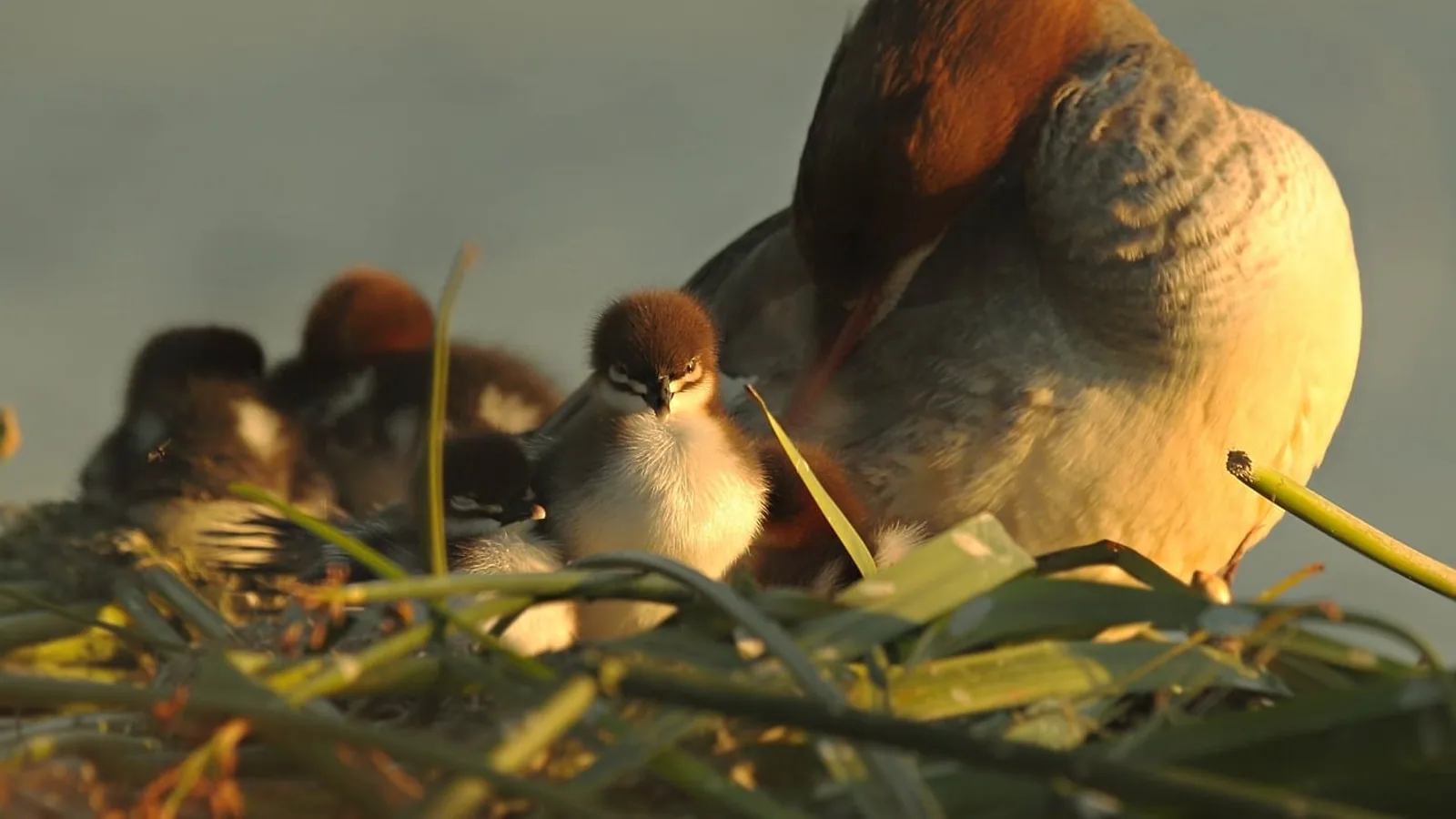
A Magpie duckling needs three things above all else in its first weeks: a warm, dry, draft-free brooder that starts near 32 C (90 F) and drops about 3 C each week, a starter feed with roughly 18 to 22 percent crude protein, and shallow water deep enough to dunk the bill. Ducklings grow fast, and the first three weeks are the steepest part of that curve. Watch the birds, not the thermometer alone. Ducklings that pile into a tight huddle are cold. Ducklings that pant and hold their wings away from the body are too warm. Their behavior is the real thermostat, and adjusting the brooder to match it matters more than hitting an exact number on any given day.
This guide walks through the brooder setup, the week-by-week temperature schedule, starter feed and niacin, water management, growth milestones, and the problems that send owners looking for a veterinarian.
At a Glance: The First Eight Weeks
| Age | Brooder temperature | Feed | Water | Expected weight (approximate) |
|---|---|---|---|---|
| Day 1 to 7 | 32 C (90 F) | Duckling starter, 18 to 22 percent crude protein, free choice | Shallow dish, bill-deep | Hatch weight, roughly 45 to 60 g |
| Week 2 | 29 C (84 F) | Starter, free choice | Shallow dish, bill-deep | Rapid gain, roughly 2 to 3 times hatch weight |
| Week 3 | 26 C (79 F) | Starter, free choice | Deeper dish, bill-deep | Continued rapid gain, body filling out |
| Week 4 | 23 C (73 F) | Starter or grower | Deeper dish | Sex-linked plumage becoming visible |
| Week 5 | 20 C (68 F) | Grower | Open water source with escape ramp | Approaching adult frame |
| Week 6 | 18 C (64 F) or ambient | Grower | Open water source | Near adult body size |
| Week 7 to 8 | Ambient, weather dependent | Grower or maintenance | Open water source | Adult size, feathers complete |
Weights vary with genetics, hatch size, and feed intake. Use the trend, not a single number, to judge whether a duckling is on track.
Why Magpie Ducklings Are Different
Magpie ducks are a light, active breed kept mostly for eggs and as a backyard flock bird. The ducklings share the general waterfowl pattern: they grow quickly in the first three weeks, they imprint on warmth and on the first moving object they see, and they are far more waterproofing-dependent than chicks. A chick can tolerate a slightly damp brooder floor for a day. A duckling that stays wet and chilled can go downhill within hours.
The Magpie's most useful trait for a keeper is sex-linked plumage. Male and female ducklings do not look identical as they feather out, and the color pattern that develops in the first weeks lets an owner sort the flock earlier than with many other breeds. This is a management convenience, not a guarantee. Confirm sex by behavior and, if you need certainty, by a veterinarian or a reputable breeder.
Growth rate in ducks is sensitive to nutrition and to disease. A study of Mule ducklings infected with Eimeria mulardi found that growth rate was reduced at higher infecting doses, with weight loss on day 7 after inoculation and body weight still lower than uninfected controls at the final check on day 28 [1]. The lesson for a Magpie keeper is direct: any intestinal insult during the brooding period costs weight that is hard to recover. Clean bedding, clean water, and prompt attention to diarrhea protect growth.
Brooder Setup: The Foundation
Space and Bedding
Ducklings need floor space that grows with them. Crowding drives huddling, wet bedding, and stress. Start with roughly one square foot per duckling in week one and expand steadily so that by week four each bird has several square feet. Bedding should be absorbent and changed before it mats. Rice hulls, straw, and wood shavings all work. A study of White Pekin ducks raised on rice hull bedding found that deeper bedding (16 cm) produced higher body weight and better feed conversion than shallower bedding over a 42-day grow-out [2]. The practical takeaway is that a thick, dry, absorbent floor supports growth better than a thin, damp one. Do not use newspaper alone. It is slick and contributes to leg splay.
Heat Source
A heat lamp, a brooder plate, or a radiant heater all work if you can adjust the temperature and observe the birds. Suspend the heat source so the temperature at duckling back height matches the schedule below. Provide a warm zone and a cooler zone so ducklings can self-regulate. A brooder with a single uniform temperature forces every bird to accept the same conditions, which is the fastest way to get huddling on one side and panting on the other.
Draft Protection
Ducklings chill quickly. Block drafts at floor level while keeping ventilation at the top of the brooder. Stale, humid air promotes respiratory problems and wet bedding. Good brooding is a balance: warm and dry at the floor, fresh at the ceiling.
Week-by-Week Brooder Temperature Schedule
The schedule below is a starting point. Adjust to behavior.
Week 1: 32 C (90 F)
Hold the brooder at about 32 C (90 F) at duckling back height for the first week. Newly hatched ducklings cannot thermoregulate well. The adrenal gland's weight-specific secretory rate in the duckling increases during the first three weeks and declines afterward, and the body-weight-specific secretory rate declines throughout growth [3]. In plain terms, the young duckling's stress hormone system is still maturing, so it handles cold poorly in week one.
Watch for:
- Huddling in a tight pile under the heat source: too cold, raise the temperature slightly or reduce drafts.
- Panting, wings held out, moving away from the heat: too warm, raise the lamp or lower the setting.
- Even spread, active dabbling, quiet resting: correct.
Week 2: 29 C (84 F)
Drop about 3 C to roughly 29 C (84 F). Ducklings are now eating well and growing fast. Bedding gets wetter faster. Check and top up bedding daily. If the brooder smells of ammonia, ventilation is inadequate.
Week 3: 26 C (79 F)
Drop to about 26 C (79 F). By the end of this week the ducklings should be visibly larger and beginning to feather. This is the peak of the rapid growth phase. Feed intake climbs, water consumption climbs, and the brooder needs more space.
Week 4: 23 C (73 F)
Drop to about 23 C (73 F). Sex-linked plumage is becoming visible in Magpies. Feathers are replacing down on the wings and body. Ducklings can tolerate cooler air if they are dry and out of drafts.
Week 5: 20 C (68 F)
Drop to about 20 C (68 F). Most of the body is feathered. If the outdoor temperature is mild and the ducklings are dry, short supervised outings are reasonable. Bring them in if they huddle or shiver.
Week 6: 18 C (64 F) or Ambient
At about 18 C (64 F), or ambient temperature if the weather is warm, ducklings are largely feathered and can move to a cooler environment. Continue to provide a dry, draft-free sleeping area.
Week 7 and Beyond: Ambient
By week seven or eight, Magpie ducklings are feathered and can be managed like adult birds, with shelter from wind, rain, and extreme cold.
The exact transition depends on feathering, not the calendar. A duckling that is still downy on the belly needs more warmth than one that is fully feathered.
Starter Feed: Protein, Energy, and Form
Crude Protein Target
Duckling starter feed should contain roughly 18 to 22 percent crude protein. This range supports the rapid muscle and feather growth of the first three weeks. Feed is offered free choice, and ducklings should have feed available throughout the day. Ducks eat more when feed is in a shallow, wide dish they can reach without stepping into it.
Protein quality matters as much as the percentage. A starter formulated for waterfowl is preferable to a chick starter because waterfowl have higher niacin requirements and different amino acid needs. If you can only find chick starter, discuss niacin supplementation with your veterinarian or feed supplier.
Feed Form
Crumbles or small pellets are easiest for ducklings to eat. Mash tends to cake and waste. Keep feed fresh and dry. Wet feed spoils quickly and grows mold.
When to Switch to Grower
Move from starter to a grower ration around week four to six, depending on the product. Grower feed has slightly lower protein and supports steady growth rather than the explosive early gain. Do not switch early to save money. The first three weeks are when protein needs are highest.
Feed Additives and What the Evidence Shows
The research on duck growth performance focuses on commercial additives and alternative feed ingredients. A study of Cherry Valley ducks found that supplemental lysophospholipids improved body weight at day 14 and average daily gain during days 1 to 14, and improved feed conversion over the whole period, by improving dry matter and fat utilization [4]. Multi-enzymes improved feed conversion from days 15 to 42 and nitrogen utilization [4]. These are commercial additives, not backyard staples, and they are not necessary for a small Magpie flock on a balanced starter.
A study of Muscovy ducklings fed Silybum marianum (milk thistle) seeds during a four-week brooding period found improved live body weight, body weight gain, and growth rate, and lower feed conversion ratios and mortality at 8 or 12 g per kg of diet compared with controls [5]. This is a research finding in a different breed, not a recommendation to add milk thistle to your Magpie ducklings' feed. Do not add supplements to a balanced starter without veterinary guidance.
Rapeseed meal is a cautionary example. In Cherry Valley ducks, body weight gain and feed intake decreased linearly as dietary double-low rapeseed meal inclusion increased from day 7 to 14, and growth performance decreased linearly as rapeseed meal inclusion increased from 5 to 20 percent in the grower-finisher period [6]. If you mix your own feed, keep alternative protein sources modest and monitor growth.
Niacin: Preventing Leg Weakness
Niacin (vitamin B3) is the nutrient most often missing in duckling diets, and a deficiency shows up as leg weakness, reluctance to walk, and bowing of the legs. Ducklings have higher niacin needs than chicks. A waterfowl starter is formulated with this in mind. If you use a chick starter, supplement niacin.
Signs of a niacin problem:
- Duckling sits more than it walks.
- Legs splay or bow outward.
- The duckling moves by pushing itself along the floor.
- Growth slows because the bird cannot reach feed and water comfortably.
Correct niacin in the diet early. Once leg deformity is advanced, it may not fully reverse. If you see these signs, contact a veterinarian. Do not guess at a dose.
Water: Shallow but Bill-Deep
Waterfowl need water deep enough to dunk the bill. This is not about drinking alone. Ducks use water to clean the nares (nostrils) and eyes, and to keep the bill and mucous membranes moist. A shallow dish that only covers the bill tip is not enough. Provide a container deep enough that the duckling can submerge the bill to the base, but shallow enough that it cannot climb in and drown.
Ducklings are at real risk of drowning in deep water, especially in week one. Use a shallow dish with a lip, or place marbles or clean stones in the bottom of a deeper dish to limit depth. Refresh water frequently. Ducklings foul water within hours by dabbling and defecating.
A lead-contaminated sediment study in mallard ducklings found that contaminated sediment and lead acetate decreased time spent swimming and caused problems with balance and mobility [7]. The relevance to a backyard brooder is that water quality and environmental contamination affect duckling behavior and movement. Keep water clean, keep the brooder free of lead paint, old batteries, and contaminated soil, and observe changes in swimming and walking as early warning signs.
Growth Milestones and What to Expect
The First Three Weeks
This is the period of fastest relative growth. A duckling roughly doubles or triples its hatch weight within the first two weeks and continues climbing steeply through week three. Feed intake rises with body weight. Water intake rises faster than feed intake in warm weather.
Weeks Four to Six
Growth continues but the rate of gain per unit of body weight slows. Feathers replace down. Magpie sex-linked plumage becomes visible. By week six the ducklings are approaching adult frame.
Weeks Seven to Eight
Feathering is complete. Body size is near adult. Growth slows further. At this point the birds can move to adult housing and management.
Using Weight as a Management Tool
Weigh a sample of ducklings weekly on a kitchen scale. Record the weights. A flat or falling weight over a week is a red flag. Causes include cold, crowding, feed access problems, wet bedding, and intestinal disease. A study of Mule ducklings with coccidiosis showed that even after other parameters returned to normal, body weight remained lower than uninfected controls at day 28 [1]. Weight loss during brooding has lasting effects.
The Brooder Decision Path
The flowchart below shows the main decisions in the first weeks of brooding a Magpie duckling.
flowchart TD
    A[Hatch day] --> B[Set brooder to 32 C]
    B --> C[Observe duckling behavior]
    C --> D{Behavior check}
    D -->|Huddling tight| E[Raise temperature or block drafts]
    D -->|Panting wings out| F[Lower temperature or add space]
    D -->|Spread and active| G[Hold temperature]
    E --> H[Recheck in one hour]
    F --> H
    G --> I[Drop about 3 C weekly]
    I --> J{Feathered and dry}
    J -->|No| K[Keep heat and monitor]
    J -->|Yes| L[Move to ambient housing]
    K --> C
Common Mistakes
- Using a single thermometer reading as the only guide. Behavior tells you more.
- Letting bedding stay wet. Wet ducklings chill and grow poorly.
- Providing water too shallow for bill dunking, or too deep for safety.
- Feeding chick starter without addressing niacin.
- Crowding the brooder as the ducklings grow.
- Switching to grower feed too early and cutting protein during peak growth.
- Adding unproven supplements to a balanced starter.
- Ignoring leg weakness until deformity is advanced.
- Mixing ducklings of very different ages in one brooder.
Troubleshooting Common Problems
Ducklings Pile in One Corner
This usually means a draft or a cold spot. Check for air movement at floor level. If the pile is under the heat source, raise the temperature. If the pile is away from the heat source, the brooder may be too warm overall and the ducklings are seeking the coolest spot.
Ducklings Pant and Spread Out
Too warm. Raise the heat source or reduce its output. Provide more space. Panting ducklings drink more and wet the bedding faster.
Wet, Cold Ducklings
Dry them gently, move them to a warm dry brooder, and fix the water source. A shallow water dish with a lip reduces splashing. Do not leave a wet duckling in a cool brooder.
Leg Weakness
Suspect niacin deficiency, injury, or infection. Review the diet and contact a veterinarian. Do not delay.
Diarrhea
Diarrhea in ducklings has many causes, including intestinal parasites and bacterial infections. A study of Mule ducklings with coccidiosis detected blood in feces as early as day 3 after infection with the highest dose, and oocyst excretion began on day 6 [1]. If you see blood, persistent watery droppings, or a duckling that is dull and not eating, contact a veterinarian. Bring a fresh dropping sample if you can.
Slow Growth
Check temperature, space, feed access, water access, and bedding. Weigh a sample weekly. If growth is flat despite good management, a veterinarian should examine the flock.
Welfare and Safety Points
- Keep water and feed clean. Ducklings foul both quickly.
- Provide dry bedding at all times.
- Avoid overcrowding. Space needs grow every week.
- Keep the brooder free of lead sources, including old paint, batteries, and contaminated soil. Lead exposure in ducklings causes balance and mobility problems and reduces normal swimming behavior [7].
- Handle ducklings gently and briefly. They stress easily.
- Provide a warm zone and a cool zone so birds can choose.
- Do not house ducklings with chicks. Their water and warmth needs differ.
- Watch for bullying. Ducklings that are pushed away from feed need more space or a second feeding station.
When a Veterinarian Is Needed
Contact a veterinarian if you see any of the following:
- Bloody or persistently watery diarrhea.
- A duckling that will not stand or walk.
- Leg deformity that is worsening.
- Labored breathing, discharge from the nares or eyes, or a swollen eye.
- A duckling that is cold, wet, and unresponsive.
- Weight loss or no weight gain over a week despite good management.
- Sudden deaths in the brooder.
- Any suspected poisoning or exposure to contaminated soil or water.
A veterinarian can examine the flock, run diagnostics on droppings, and advise on treatment. Do not use medications intended for other species without veterinary direction.
Limitations and When to Contact a Veterinarian
This article is educational and is not a substitute for veterinary diagnosis or treatment. Individual ducklings vary in hatch weight, growth rate, and disease susceptibility, and a veterinarian who examines your flock can give advice specific to your birds. The temperature schedule and feed targets here are starting points that you adjust to the behavior and condition of your own ducklings. If a duckling is not thriving, early veterinary contact is better than waiting.
Frequently Asked Questions
What temperature should a Magpie duckling brooder be in week one?
About 32 C (90 F) at duckling back height. Adjust up or down based on behavior. Huddling means too cold, panting means too warm.
What crude protein should Magpie duckling starter feed contain?
Roughly 18 to 22 percent crude protein. Offer it free choice from day one.
Do Magpie ducklings need niacin supplements?
They need adequate niacin in the diet. A waterfowl starter provides it. If you use chick starter, supplement niacin and watch for leg weakness.
How deep should duckling water be?
Deep enough to dunk the bill to the base, but shallow enough that the duckling cannot climb in and drown. Use a shallow dish with a lip or add clean stones to limit depth.
How fast do Magpie ducklings grow?
Very fast in the first three weeks, roughly doubling or tripling hatch weight by week two and continuing steep gain through week three. Growth slows after week six.
When can Magpie ducklings leave the brooder?
When they are fully feathered and dry, usually around week six to eight, depending on feathering and weather.
Why is my duckling sitting instead of walking?
Leg weakness can come from niacin deficiency, injury, or infection. Review the diet and contact a veterinarian promptly.
Is bloody diarrhea in ducklings an emergency?
Yes. Blood in the droppings can indicate intestinal disease. Contact a veterinarian and bring a fresh sample if possible.
Related Articles
- Duck Brooding Setup: Heat, Space, and Safety for Ducklings
- Turkey Brooding and Early Flock Management
- Poultry Brooding Management for the First Two Weeks
- Purple Finch Care: Identification and Feeding
- Poultry Heat Lamps: Safe Use and Alternatives for Brooding
- Stick Insect Care: Enclosure, Feeding, and Handling
- Feeding Ducklings: Starter Feed and Schedule
- Can Chickens Eat Strawberries? Safe Feeding Guide
Sources
- [[Experimental infection of the mule duck by Eimeria mulardi sp. nov.: effects on body weight and modifications of different hematologic and biochemical parameters].](https://pubmed.ncbi.nlm.nih.gov/8142956/)
- Effect of different bedding depths of rice hulls on growth performance and carcass traits of White Pekin ducks.
- The turnover and distribution of labelled corticosterone during post-natal development of the duckling (Anas platyrhynchos).
- Effects of lysophospholipids and multi-enzymes on growth performance, antioxidant capacity, intestinal health, and cecal microflora of male cherry valley ducks.
- Dietary Supplementation of Silybum marianum Seeds Improved Growth Performance and Upregulated Associated Gene Expression of Muscovy Ducklings (Cairina moschata).
- Effects of dietary rapeseed meal inclusion levels on growth performance, organ weight, and serum biochemical parameters in Cherry Valley ducks.
- Effects of lead-contaminated sediment and nutrition on mallard duckling behavior and growth.