Cinnamon Queen Chicken: Eggs, Temperament, Care
By Dr. Zubair Khalid, DVM, MS, PhD ·
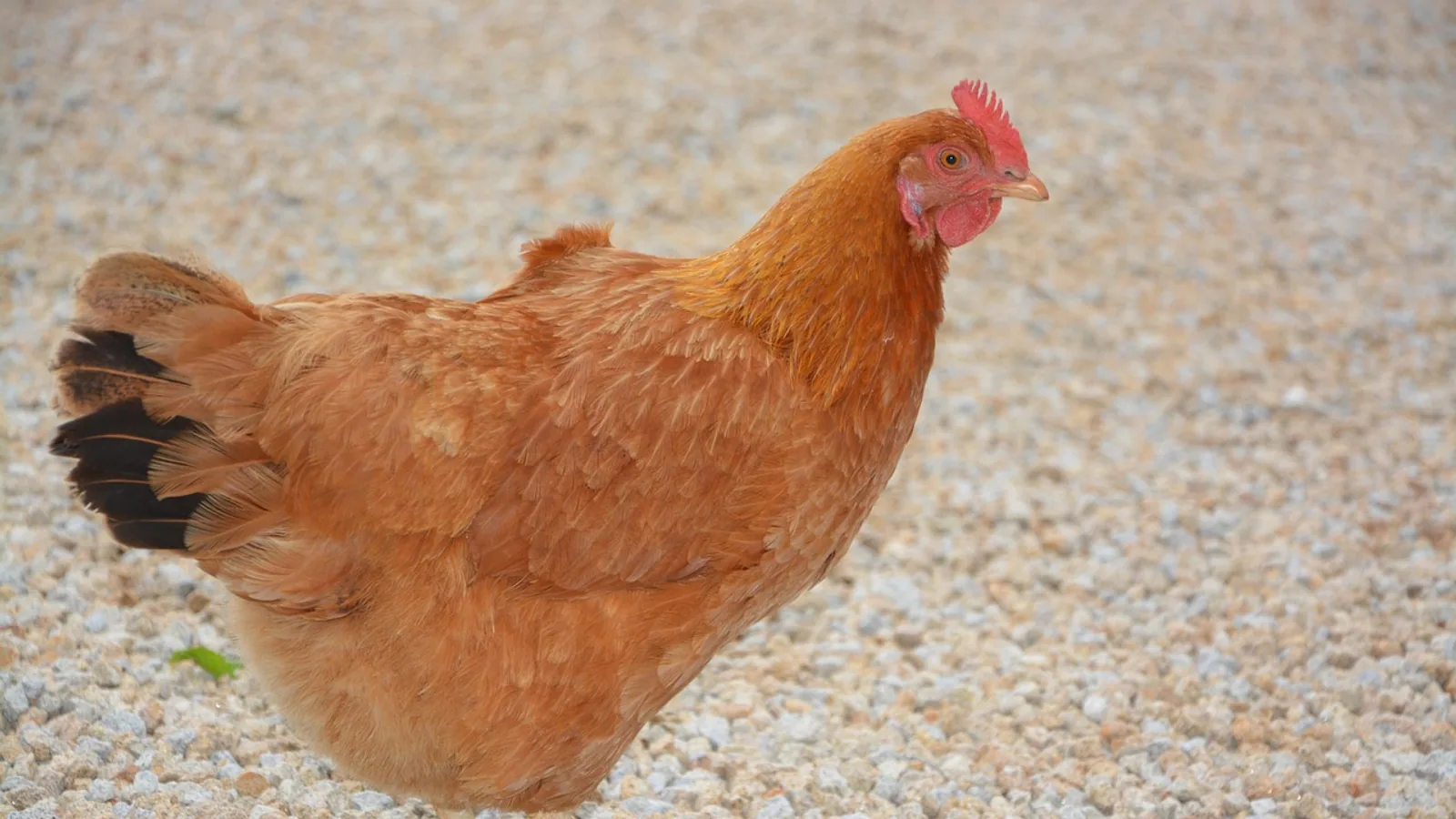
The Cinnamon Queen is a red sex-link hybrid chicken developed for one job above all others: to lay a large number of brown eggs efficiently. It is not a true breed. It is a first-generation cross, and the birds sold under this name are the daughters of a red-feathered rooster line and a silver or white-feathered hen line. Because the cross is deliberate and repeatable, the chicks can be sexed at hatch by color alone, which makes the Cinnamon Queen one of the most practical choices for a backyard flock that needs laying hens rather than roosters.
Owners value the Cinnamon Queen for early maturity, steady production of large brown eggs, and a calm, adaptable disposition that suits small coops and family yards. It tolerates both summer heat and winter cold reasonably well as long as it has shade, airflow, and dry footing. That productivity comes with a tradeoff. A hen that lays nearly every day for years carries a higher lifetime risk of reproductive problems, including egg yolk peritonitis and prolapse. Understanding the hybrid's genetic design, its laying curve, and its reproductive vulnerabilities is the core of good care.
This article is educational and is not a substitute for veterinary diagnosis or treatment.
At a Glance
| Attribute | Typical detail |
|---|---|
| Class | Red sex-link hybrid, not a standardized breed |
| Sex identification | Daughters red at hatch, sons white at hatch |
| Adult weight | Medium to large dual-purpose frame |
| Plumage | Red to reddish-gold hens |
| Egg color | Brown |
| Egg size | Large |
| Annual lay | About 250 to 300 eggs per year |
| Age at first egg | About 18 to 22 weeks |
| Temperament | Calm, docile, adaptable to confinement |
| Cold tolerance | Good with dry, draft-free shelter |
| Heat tolerance | Moderate, requires shade and ventilation |
| Lifespan | Several productive years typical |
| Breeding true | No, offspring of sex-links do not breed true |
| Best suited to | Egg-focused backyard flocks, families, new keepers |
| Not ideal for | Breeders wanting a self-replicating flock |
What the Cinnamon Queen Actually Is
The word "breed" implies a population of birds that mate and produce offspring resembling themselves. The Cinnamon Queen does not meet that standard. It is a hybrid, sometimes called a sex-link, produced by crossing two parent lines each generation. The parent lines are held by hatcheries and breeding companies. A backyard owner who hatches eggs from a Cinnamon Queen flock will not get more Cinnamon Queens.
This distinction shapes everything about how the bird is kept. A Cinnamon Queen is a production animal, closer in concept to a commercial layer cross than to a heritage breed such as the Plymouth Rock or the Rhode Island Red. Heritage breeds have a documented history, a standard of perfection, and the ability to reproduce true to type. The Cinnamon Queen has one documented purpose and a predictable first-generation result.
The name itself is a marketing label. Different hatcheries may use the same or similar names for crosses built from similar parent stock. The two constants are the red hen color and the high laying rate. If a seller describes a "Cinnamon Queen breeder pair," that phrasing is a category error. There is no such thing as a breeding pair of sex-links in the sense of producing identical offspring.
How Sex-Link Genetics Work
Sex-linkage in chickens rests on the Z/W chromosome system. Unlike mammals, in which females are XX and males are XY, birds reverse the pattern. A rooster carries two Z chromosomes (ZZ). A hen carries one Z and one W chromosome (ZW). The W chromosome is small and carries few genes. The Z chromosome carries many, including several that govern feather color and pigmentation [1][2].
This asymmetry is what makes color-based sexing possible. A hen has only one Z chromosome, so whatever color allele sits on that Z is expressed directly. She has no second Z to mask it. A rooster has two Z chromosomes, so he can carry one allele that is hidden behind another.
The red sex-link cross exploits two alleles at the silver locus on the Z chromosome. The silver allele (often written S) is dominant and produces silver or white plumage. The gold or wild-type allele (often written s) is recessive and produces red or gold plumage [2]. When a red male (two gold alleles, ZsZs) is crossed with a silver or white female (one silver allele on her single Z, ZSW), the result is predictable:
- Daughters inherit their father's only Z, which carries gold. They also inherit their mother's W. Their genotype is ZsW, and they show red or gold plumage.
- Sons inherit their father's gold Z and their mother's silver Z. Their genotype is ZsZS. The dominant silver allele masks the gold, so they show silver or white plumage.
That is the entire trick. At hatch, red chicks are pullets and white chicks are cockerels. The parent lines must be maintained in the correct configuration, with red roosters over silver hens, or the system collapses. Reverse the cross and the chicks no longer sort by color.
The silver locus is not the only Z-linked pigmentation gene relevant to chicken color. Sex-linked barring, which produces the white and black barred pattern of the Barred Plymouth Rock, maps to the distal long arm of the Z chromosome and is associated with the CDKN2A/B locus, which encodes the INK4b and ARF transcripts [1][3][4]. A related sex-linked dilution phenotype is allelic at the same locus [3]. Barring is a separate trait from silver, but it demonstrates the same principle: the Z chromosome is rich in pigment genes, which is why poultry breeders have exploited it for sex identification for more than a century.
The silver allele itself is a variant of SLC45A2, a gene involved in melanosome function. The silver mutation specifically inhibits red pheomelanin expression, which is why silver birds lose the red tones that gold birds retain [2]. A separate sex-linked recessive mutation in TYRP1 produces the chocolate plumage dilution, another example of the Z chromosome's role in color [5]. None of these genes are the red sex-link cross itself, but together they explain why color and sex travel together in chickens.
Why Offspring Do Not Breed True
When two Cinnamon Queen hybrids mate, the clean Z/W arithmetic breaks down. A hybrid hen is ZsW and a hybrid rooster is ZsZS. Their chicks can inherit any combination of the two alleles. Some pullets will be red and some will be less clearly red. Some cockerels may show red, some silver, and some intermediate patterns. The reliable color-to-sex link is gone.
Beyond color, the offspring lose the specific combination of production traits that made the parents valuable. The parent lines were selected for egg number, egg size, feed efficiency, and livability. Those traits depend on the specific cross, and they do not recombine predictably in the next generation.
This is why replacement pullets must be purchased from a hatchery or breeder each time a flock is refreshed. You cannot maintain a self-replacing Cinnamon Queen flock. If self-sufficiency matters to you, choose a heritage breed instead and accept a lower laying rate. If maximum egg output matters, plan to buy pullets on a schedule.
Appearance and Identification
A Cinnamon Queen hen is a medium to large bird with red to reddish-gold plumage. The exact shade varies by hatchery and by the parent lines used, ranging from a warm cinnamon-red to a deeper red-brown. The feathers are close and functional rather than ornamental. There is no crest, no muff, no leg feathering, and no unusual structural feature. The bird looks like what it is: a practical layer.
Cockerels hatched from the same cross are silver or white, often with some dark markings as they mature. This makes the sex-link cross easy to verify at a few days old. A seller who claims to have red-sexed pullets but shows you chicks of mixed color is either not selling a sex-link cross or is not selling you what was advertised.
The single comb, wattles, and general body shape are consistent with the layer-type Mediterranean and American ancestry that goes into most sex-link programs. Because the cross draws on multiple parent lines, subtle variation between hatcheries is normal. Do not expect a single uniform appearance across all birds sold as Cinnamon Queens.
Temperament and Behavior
Cinnamon Queens are generally described as calm, docile, and easy to handle. They adapt well to confinement, which makes them suitable for smaller yards where free ranging is not practical. They are not typically aggressive toward keepers or toward each other to the degree seen in some game-derived breeds.
A few behavioral points matter for management:
- They are active foragers when given the opportunity but do not require large pasture.
- They tolerate handling, which simplifies health checks, foot inspection, and catching for treatment.
- Their calm nature makes them a reasonable choice for families with children who want to interact with the birds, with supervision.
- Because they are selected for egg production rather than broodiness, they rarely sit on eggs. This reduces the chance of a hen going broody and stopping lay, but it also means they are not useful as natural incubators.
Temperament varies by individual and by how much human contact the birds receive. Chicks handled regularly from a young age tend to remain approachable as adults. Hens that are only seen at feeding time may stay flighty.
Housing and Coop Needs
A Cinnamon Queen needs the same fundamentals as any backyard chicken, with attention to ventilation because of its high metabolic output. A laying hen eating and producing daily generates substantial body heat and moisture. Poor airflow in a small coop leads to damp litter, ammonia buildup, and respiratory disease.
Key housing principles:
- Provide enough floor space so birds can move, dust bathe, and reach feed and water without crowding. Crowding raises stress and injury risk, particularly around the feed trough.
- Ventilate above the birds' heads, not at their backs. High vents let moist air escape while keeping drafts off the roost.
- Keep the coop dry. Wet bedding is the root of most coop-level health problems.
- Provide one nest box per roughly four to five hens, set in the darkest, most private part of the coop. Hens prefer a quiet, dim nest site and will seek one out even if boxes are provided elsewhere.
- Use a roost wide enough for feet to grip and flat enough that the breastbone rests comfortably. Wide, flat roosts are easier on heavy laying hens than narrow poles.
Heat Tolerance
Laying hens handle heat less well than cold when humidity is high. A Cinnamon Queen in a hot climate needs shade at all times, unrestricted airflow, and cool water. The birds should be able to get off the ground on a shaded roost if the soil is hot. Watch for open-mouth breathing and wing holding away from the body, which indicate heat stress. Provide multiple water stations so a bullied hen is not excluded from drinking.
Cold Tolerance
The breed tolerates cold well if it stays dry and out of wind. Feather cover insulates effectively when it is fluffed and unbroken. The risks in cold weather are dampness, drafts at roost level, and frostbite on combs and wattles in extreme cold. Large single combs are more vulnerable than small ones. Keeping the coop dry and ventilated matters more in winter than adding heat, which can increase humidity and respiratory risk if not managed carefully.
Feeding Considerations
A laying hen has demanding nutritional requirements. She must maintain her own body, produce an egg nearly every day, and do so on a limited feed intake. Diets that are adequate for a non-laying bird or a rooster are not adequate for a high-production hen.
The core feeding rules for a productive layer:
- Feed a complete layer ration formulated for laying hens. It supplies the protein, energy, calcium, phosphorus, and micronutrients needed for sustained production.
- Provide calcium in a form the bird can regulate. Oyster shell offered free choice lets a hen take what she needs for shell formation. Hens can sense their calcium need and adjust intake.
- Do not feed a grower or chick ration to a laying hen. Those diets are not formulated for the mineral demands of lay.
- Keep feed fresh and dry. Moldy feed is a direct health hazard.
- Limit scratch grains and treats. They dilute the nutrient density of the complete ration and can tip a high producer into a deficiency.
Nutrition research in laying hens shows that both dietary energy and amino acid levels affect egg weight and daily egg mass. In a study of Jingfen laying hens during peak production, higher metabolizable energy and higher lysine levels both increased egg weight and daily egg mass, and dietary energy level influenced eggshell proportion [6]. This is a reminder that a hen's output tracks her diet closely. Underfeeding a high-production hybrid costs you eggs and eventually costs the hen her body reserves.
Water is as important as feed. A laying hen drinks a surprising volume, and a hen that cannot drink will stop laying within a day or two. Keep water clean and available at all times, and check that no bird is being kept away from the drinker by flockmates.
Egg Production
The Cinnamon Queen's defining trait is output. A healthy hen of this type typically begins laying between about 18 and 22 weeks of age and produces roughly 250 to 300 large brown eggs in a good year. Peak production occurs in the first laying cycle. Output gradually declines with age and with each molt.
Age at first egg is a meaningful variable. Research in layers shows that extremely early-maturing hens hold an initial production advantage that tends to diminish at later stages, and that the relationship between age at first egg and cumulative production is age-dependent [7]. In practical terms, a pullet that starts a week earlier does not necessarily out-produce one that starts slightly later over a full cycle. The bigger drivers of total output are nutrition, health, and management.
Selection for high egg number is also a genetic story. Modern layers owe much of their performance to decades of selection on production traits, and genomic studies continue to identify regions associated with egg number, egg weight, and clutch characteristics [8][9][10]. Growth differentiation factor 9, a gene involved in follicular development, has variants associated with age at first egg, egg number, and egg weight across breeds [11]. High-production hybrids such as the Cinnamon Queen sit at the far end of this selection curve, which is precisely why they lay so well and why their reproductive systems are under strain.
Brown egg color comes from pigment deposited in the shell as it forms in the shell gland. It is a heritable trait tied to the bird's genetics, not to diet or management. A Cinnamon Queen lays brown eggs because her parent lines were chosen for brown egg color and production, not because of anything the owner does.
Patterns You Will See
- A pullet's first eggs are often small. Size increases over the first weeks of lay.
- Hens lay most consistently during long daylight and cool to moderate temperatures.
- A molt pauses production. Feather renewal takes priority over egg formation.
- Winter production may slow with shortened daylight, even in a well-fed hen.
Production at a Glance
| Feature | Cinnamon Queen |
|---|---|
| Type | Red sex-link hybrid |
| Sex at hatch | Pullets red, cockerels white |
| First egg | About 18 to 22 weeks |
| Annual eggs | About 250 to 300 |
| Egg size | Large |
| Egg color | Brown |
| Broodiness | Rare |
| Feed demand | High, layer ration required |
| Calcium demand | High, free-choice oyster shell helpful |
| Molt | Annual, with production pause |
| Breed true | No |
| Replacement strategy | Buy new pullets |
Reproductive Health Risks in High-Production Hens
A hen that lays 300 eggs a year is doing something physiologically extreme. The oviduct, ovary, liver, and calcium metabolism all run near capacity. High production is not free, and the cost shows up as reproductive disorders.
Egg Yolk Peritonitis
Egg yolk peritonitis occurs when yolk material ends up in the abdominal cavity instead of traveling correctly through the oviduct. The yolk is a rich medium, and it provokes inflammation. Common causes include a malfunctioning oviduct, a follicle that ruptures into the wrong space, or an ascending infection. Affected hens may show a distended, fluid-filled abdomen, a waddling gait, reduced appetite, and a drop or stop in laying. Some become lethargic and develop labored breathing as abdominal pressure rises.
Egg yolk peritonitis is a serious condition. It is one of the leading reasons high-production hens die or are euthanized. There is no simple home treatment. A veterinarian should evaluate any hen with a swollen abdomen, unexplained lethargy, or a sudden cessation of lay.
Prolapse
Prolapse is the protrusion of oviduct or cloacal tissue through the vent. It can happen in a hen straining to pass a large egg, in an overweight hen, or in a hen whose reproductive tract has been stressed. It is more common in heavy-producing hens and in hens that have just come into lay with very large first eggs. A prolapse is a medical emergency. Tissue that stays exposed dries, becomes damaged, and can be pecked by flockmates, which rapidly worsens the situation. Separate the affected hen immediately and contact a veterinarian.
Why High Production Raises the Risk
The pattern is not accidental. The same selection pressure that produces 300 eggs per year also pushes the reproductive system to work continuously. Hens that cycle through lay with little rest accumulate wear on the oviduct and ovary. Because these birds rarely go broody, they do not get the natural production pauses that broody hens experience. The result is a longer cumulative period of reproductive activity across the hen's life.
This is not a reason to avoid the breed. It is a reason to manage it deliberately. Keep hens at a healthy body condition. Feed a proper layer ration. Offer calcium free choice. Watch for early signs of trouble, especially changes in abdominal shape, gait, or appetite. Monitor older hens more closely as they accumulate laying cycles. If you are not dependent on peak production, giving hens periodic rest, for example by allowing a natural molt, can reduce cumulative reproductive strain.
Other problems that appear in aging layers include reproductive tract tumors, internal laying, and chronic egg-related infections. A hen that has stopped laying but remains ill for more than a day or two deserves veterinary evaluation.
General Health Care
Beyond reproductive issues, Cinnamon Queens face the standard set of backyard chicken health concerns. The most common practical problems in small flocks include:
- Respiratory disease from poor ventilation, ammonia, or introduced infection.
- External parasites such as mites and lice, which thrive in crowded or dirty housing.
- Internal parasites, particularly in flocks on pasture.
- Bumblefoot, an infection of the foot pad, often from a sharp object or a heavy landing from a high roost.
- Nutritional deficiencies from unbalanced feeding.
- Injury from flockmates, especially in overcrowded conditions.
Screening and Monitoring
There is no standard screening panel for a backyard hen the way there is for a dog or cat. Monitoring is behavioral and physical. A weekly hands-on check catches most problems early:
- Weigh or body-condition the bird by feeling the breastbone. A sharp keel means the bird is thin. A keel buried in fat means she is overweight.
- Check the vent for cleanliness, discharge, or prolapse.
- Feel the abdomen. It should be soft and neither distended nor tight.
- Inspect the feet and legs for swelling, scabs, or heat.
- Part the feathers at the base of the tail and along the vent to look for mites or lice.
- Check the comb and wattles for color and any lesions.
- Listen to breathing at rest. Any rattle, wheeze, or open-mouth breathing at rest needs attention.
A useful benchmark is that normal hens in good production have a bright, moist comb, an active appetite, and a clean vent. Any move away from that baseline is worth investigating.
Veterinary care for backyard poultry is available but unevenly distributed. Before you acquire birds, identify a veterinarian in your area who sees poultry. Many small-animal clinics do not. Making that contact in advance saves critical time when a hen is sick.
Lifespan and Long-Term Planning
A Cinnamon Queen can live for several years, but her productive and healthy years are not the same as her total lifespan. Peak laying happens in the first cycle. Production declines with each successive year and each molt. Older hens are more likely to develop reproductive disease. Planning for the flock's later stages, including how you will manage hens that are no longer laying heavily, is part of responsible ownership.
There is no single correct approach. Some owners keep retired hens as pets. Some rehome them. Some manage end-of-life with a veterinarian. The decision is personal, but making it before it is urgent is easier on everyone, including the birds.
Finding a Responsible Source
Because the Cinnamon Queen is a first-generation hybrid, the only reliable source is a hatchery or breeder that maintains the parent lines. There is no rescue channel for this bird in the way there is for dogs and cats, though some backyard flocks do end up needing rehoming. If you want Cinnamon Queens specifically, buy from a hatchery that describes the cross honestly and sells sexed pullets.
How to evaluate a source:
- Ask what cross produces the birds. A serious seller can describe the parent lines.
- Confirm that chicks are sexed by color at hatch. That is the defining feature of the cross.
- Ask about vaccination and health history of the parent flock.
- Ask whether the seller keeps the parent lines or buys hatching eggs.
- Look at the birds. Healthy pullets are alert, well-feathered, and active.
- Be cautious of anyone selling "breeding pairs" of a sex-link. That is a warning sign.
If you are open to non-hybrid options, heritage breeds offer the ability to hatch your own replacements. The tradeoff is fewer eggs per year. Make that choice deliberately rather than by accident.
Who Should Not Get a Cinnamon Queen
This bird is a poor fit for some owners:
- Anyone who wants to breed and hatch their own replacement flock. Sex-links do not breed true.
- Owners who cannot commit to a high-nutrition layer diet and free-choice calcium.
- Keepers in very hot, humid climates without a plan for shade and airflow.
- Owners who want a long-lived, low-maintenance pet rather than a production bird.
- Anyone who cannot access poultry veterinary care and is not prepared for the reproductive risks that come with high production.
For everyone else, especially first-time keepers who want reliable brown eggs, the Cinnamon Queen is one of the most practical choices available.
Limitations and When to Contact a Veterinarian
This article covers general care and breed characteristics. It cannot diagnose or treat an individual bird. Chickens hide illness well, and a hen that looks mildly off can deteriorate quickly. Contact a veterinarian promptly if you see any of the following:
- A swollen, distended, or fluid-filled abdomen
- Protruding tissue at the vent, or any tissue visible outside the body
- Sudden stop in laying combined with lethargy or loss of appetite
- Labored breathing, open-mouth breathing at rest, or a rattle in the chest
- A hen that has not eaten for more than a day
- Blood in the droppings, persistent diarrhea, or a dramatic change in droppings
- Inability to stand, a waddling gait, or paralysis
- A wound that is deep, bleeding, or has been pecked by flockmates
- A comb or wattle that turns dark, blue, or pale
- Any hen that is isolated from the flock and unresponsive to normal activity
Prolapse and egg yolk peritonitis are emergencies. Do not wait to see if they resolve on their own.
Frequently Asked Questions
Is the Cinnamon Queen a real chicken breed?
No. The Cinnamon Queen is a red sex-link hybrid, a first-generation cross produced each time from specific parent lines. It is not a standardized breed and does not reproduce true to type.
How many eggs does a Cinnamon Queen lay?
A healthy hen lays roughly 250 to 300 large brown eggs per year, with peak output in her first laying cycle.
When do Cinnamon Queens start laying?
Most begin laying between about 18 and 22 weeks of age.
How do you tell male from female Cinnamon Queen chicks?
By color at hatch. Daughters inherit the red or gold allele from their father and are red. Sons inherit a dominant silver allele from their mother and are silver or white.
Can I hatch my own Cinnamon Queen chicks?
You can hatch the eggs, but the chicks will not breed true. Color no longer reliably predicts sex, and the offspring lose the production traits that make the parents valuable.
Are Cinnamon Queens good in hot weather?
They handle heat moderately well if they have shade, airflow, and unlimited cool water. Watch for open-mouth breathing, which signals heat stress.
Are Cinnamon Queens cold hardy?
Yes, they tolerate cold well when they stay dry and out of drafts. Dampness and roost-level drafts are the real risks, not temperature alone.
Why do high-production hens get reproductive problems?
The same selection that produces nearly daily laying also keeps the reproductive system working continuously. That raises the lifetime risk of egg yolk peritonitis, prolapse, and other reproductive disorders.
Related Articles
- Raising Chickens for Eggs: Breed Selection, Care, and Egg Production
- Can Dogs Have Cinnamon
- Maltese Dog: Complete Guide to Care, Grooming, and Temperament
- Best Pet Rodents for Beginners: Care, Lifespan, and Temperament
- Persian Cat: Complete Care Guide for Grooming, Health, and Temperament
- Why Have My Chickens Stopped Laying Eggs?
- Cuckoo Maran Chicken: Eggs, Temperament, Care
- How Long Do Fresh Eggs Last in the Fridge?
Sources
- Genetic mapping of the sex-linked barring gene in the chicken.
- Mutations in SLC45A2 cause plumage color variation in chicken and Japanese quail.
- The evolution of Sex-linked barring alleles in chickens involves both regulatory and coding changes in CDKN2A.
- Sex-linked barring in chickens is controlled by the CDKN2A /B tumour suppressor locus.
- A missense mutation in TYRP1 causes the chocolate plumage color in chicken and alters melanosome structure.
- Effects of dietary metabolizable energy, crude protein and lysine levels on production performance and egg quality of Jingfen laying hens based on response surface methodology.
- Research note: Genetic background influences the relationship between age at first egg and long-term egg production in layers.
- Multidimensional GWAS analyses on longitudinal phenotypes reveal candidate genes regulating multi-stage egg production traits in Wannan yellow chicken.
- Genetic Architecture of Egg Production Traits in Chickens: A Systematic Review.
- Bayesian fine-mapping pinpoints candidate genes and pleiotropic loci of production traits from a chicken backcrossing scheme.
- Genetic Variation of Chicken Growth Differentiation Factor-9 Gene and Association With Egg Characteristics: A Systematic Review.