Cayuga Ducks: Black Eggs, Green Sheen and Care
By Dr. Zubair Khalid, DVM, MS, PhD ·
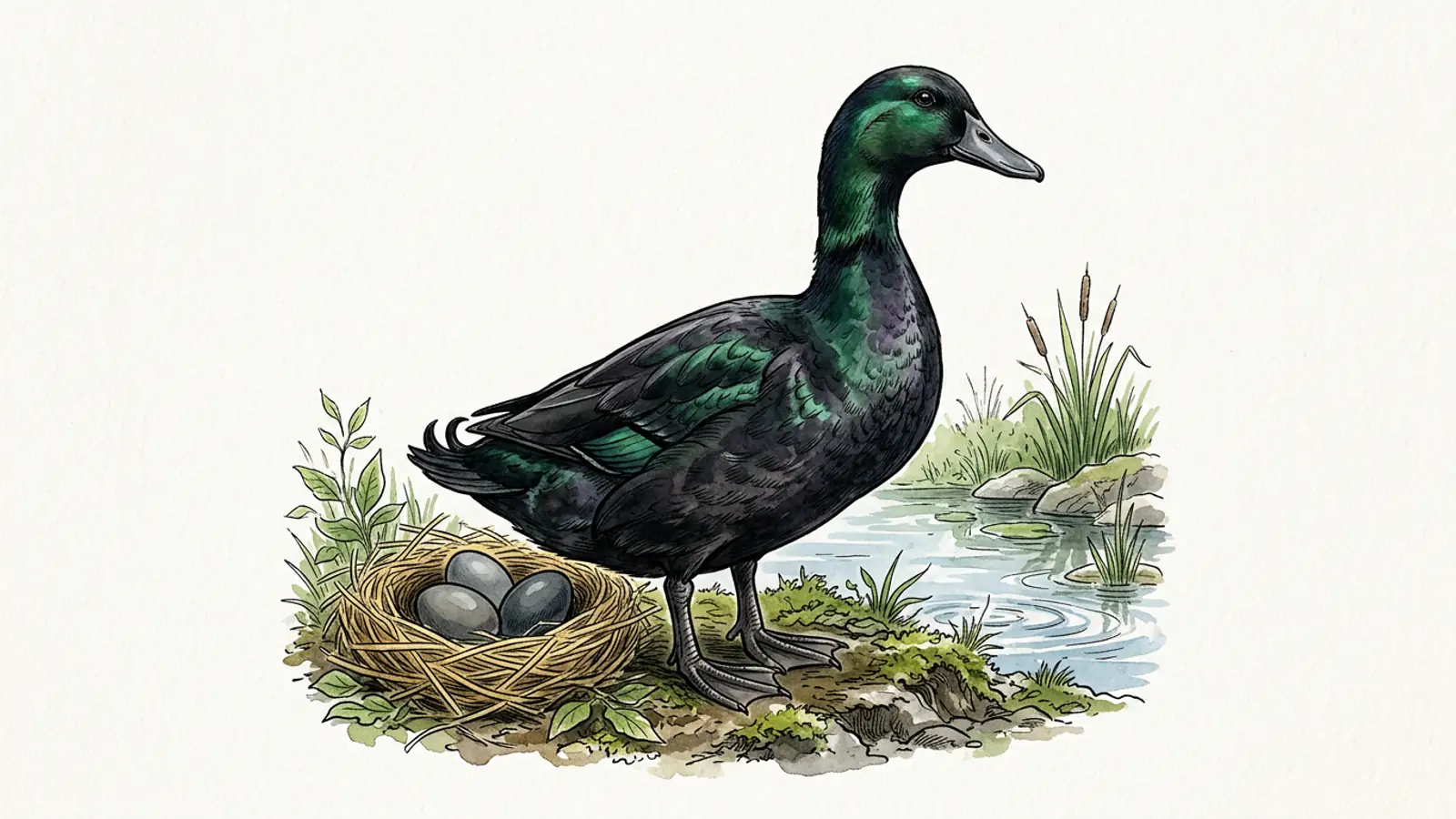
The Cayuga duck is an American breed that originated in the Finger Lakes region of New York in the 1800s, and it remains one of the few duck breeds developed on United States soil [1][2]. It is a medium-weight bird with solid black plumage that carries a beetle-green iridescence in good light, a dark bill, and dark legs [1][3][2]. The breed is best known for two things: its striking appearance and the dark eggs it lays early in the season. Cayuga ducks are docile, relatively quiet compared with some other breeds, and cold hardy, which makes them a practical choice for backyard keepers who want a calm flock that forages well and tolerates northern winters [1][3]. The Livestock Conservancy lists the Cayuga in its Watch category, meaning the breed needs continued attention from keepers to maintain its numbers and genetic diversity [1].
This article covers the history and purpose of the breed, its appearance and temperament, exercise and training needs, grooming, feeding, common health problems and screening, lifespan, how to find a responsible breeder or rescue, and who should not keep this breed. It also explains the egg color question in detail, because the dark shell is the trait most new owners ask about.
This article is educational and is not a substitute for veterinary diagnosis or treatment.
Key Takeaways
- Cayuga ducks are a medium-weight American breed from the Finger Lakes region of New York, developed in the 1800s and listed in The Livestock Conservancy's Watch category.
- Cayuga duck eggs are dark gray to nearly black early in the laying season because a surface pigment coating is applied as the egg passes through the hen's reproductive tract.
- The dark egg color fades gradually across the season, moving from near-black to lighter gray and sometimes to a pale or nearly white egg by season's end.
- Cayuga ducks are docile, relatively quiet, cold hardy, strong foragers, and poor fliers, with drakes weighing 6.5 to 8 lb and ducks 6 to 7.5 lb.
- Cayuga hens lay about 100 to 150 large eggs per year, and older birds normally develop white feathers that are not a sign of illness.
At a Glance
| Attribute | Cayuga duck |
|---|---|
| Origin | New York, Cayuga Lake region, 1800s [1][2] |
| Weight class | Medium; drakes 6.5 to 8 lb, ducks 6 to 7.5 lb [1] |
| Plumage | Black with beetle-green iridescence, white feathers appear with age [1][3][2] |
| Bill and legs | Dark, near black [1][2] |
| Temperament | Docile, relatively quiet compared with some breeds [1][3] |
| Cold hardiness | Good [1][3] |
| Foraging | Strong forager [1][3] |
| Egg color | Dark gray to black early in the season, lightening across the season [1][3] |
| Egg numbers | About 100 to 150 per year [1] |
| Broodiness | Reported to go broody [3] |
| Conservation status | Watch category, The Livestock Conservancy [1] |
| Primary uses | Eggs, meat, ornamental [1][4] |
Cayuga vs Pekin vs Swedish Ducks
| Trait | Cayuga | Pekin | Swedish |
|---|---|---|---|
| Weight class | Medium [1] | Heavy | Medium |
| Plumage | Black with beetle-green sheen [1] | White | Blue-gray with a white bib; black, silver and splashed also occur |
| Egg color | Black early in the season, lightening to gray, greenish or white [1] | White | White or tinted green or blue |
| Eggs per year | About 100 to 150 [1] | Moderate to high | About 100 to 150 |
| Temperament | Docile, calm [1] | Calm, often noisy | Calm |
| Main uses | Meat, eggs, exhibition, pets [1] | Meat | Meat, exhibition, pets |
| Flight | Poor flier [1] | Cannot fly | Poor flier |
| Livestock Conservancy status | Watch [1] | Not listed | Watch |
The Pekin is the heavier, faster-growing white meat duck. The Swedish is the closest match to the Cayuga in size and laying ability, with blue rather than black plumage.
History and Purpose of the Cayuga Duck
The Cayuga duck takes its name from Cayuga Lake in upstate New York, and the breed was developed in that region during the 1800s [1][2]. It is regarded as an American breed rather than an import from Europe or Asia, which sets it apart from most other domestic duck breeds kept in the United States [1][2]. The Livestock Conservancy notes the breed's American origin and its long association with the Finger Lakes area [1].
The breed was kept for both eggs and meat [1][4]. Its dark plumage, medium body size, and ability to forage made it a useful farm bird in a region with cold winters and access to ponds, streams, and pasture. The Cayuga's black feathers were also valued for ornamental purposes, and the beetle-green sheen made the breed distinctive in a mixed flock [1][2].
The breed's history is tied to the broader story of American poultry keeping. As commercial duck production shifted toward faster-growing breeds, the Cayuga became less common on working farms. The Livestock Conservancy now lists the Cayuga in its Watch category, a status that signals the breed is not in immediate crisis but does need continued breeding and keeping to avoid further decline [1]. Keepers who raise Cayugas are, in a practical sense, helping maintain a piece of American poultry history.
Appearance and the Beetle-Green Sheen
The Cayuga's most recognizable feature is its plumage. The feathers are black, and in direct light they show a beetle-green iridescence that shifts with the angle of the sun [1][3][2]. This sheen is not a separate color. It is an optical effect produced by the structure of the feather surface, and it is most visible on the back, neck, and wings of a healthy bird in good feather condition.
The bill and legs are dark, typically near black, which completes the breed's uniform dark look [1][2]. A Cayuga drake and a Cayuga hen look similar in color, though drakes are generally larger and may show slightly different feather texture, including the curled sex feathers typical of drakes. The dark bill and legs are useful for identifying the breed, especially in a mixed flock where several duck breeds are kept together.
One detail that surprises new owners is the appearance of white feathers as the bird ages. Older Cayuga ducks often develop white feathers, particularly around the face, neck, and sometimes the body [1][3][2]. This is a normal age-related change and not a sign of illness or poor health. A young Cayuga in full black plumage will gradually show more white over the years, and some older hens become quite speckled. The white feathers do not change the breed's identity, and they do not affect egg production or temperament.
The breed is classified as medium weight by The Livestock Conservancy [1]. That places it between the heavy breeds, such as the Pekin, and the lighter breeds, such as the Runner. A medium frame is one reason the Cayuga is a practical backyard bird. It is large enough to be a useful meat bird and to withstand cold, but not so heavy that it struggles to move or forage. The Livestock Conservancy notes that Cayugas are not good fliers [1].
Temperament and Behavior
Cayuga ducks are described as docile and relatively quiet compared with some other breeds [1][3]. That combination makes them a good fit for suburban and rural backyards where noise complaints are a concern. They are not silent birds, and a drake or hen will vocalize, but keepers commonly report that the Cayuga is calmer and less loud than breeds such as the Pekin.
The breed is also a strong forager [1][3]. Cayugas will spend much of the day searching for insects, slugs, snails, and plant material if given access to pasture or a yard. Foraging reduces feed costs and gives the birds natural exercise and mental stimulation. A Cayuga flock with access to a pond or a large water tub will also spend time dabbling, preening, and swimming.
Cayugas are generally calm with other ducks and with people who handle them regularly. They are not an aggressive breed, and a Cayuga drake is usually less confrontational than drakes of some heavier breeds. That said, any drake can become territorial during breeding season, and keepers should watch the ratio of drakes to hens. Too many drakes in a small flock can lead to over-mating and injury to hens.
Because the breed is docile, it can be a good choice for families with children who are old enough to handle birds gently. Supervision is still necessary, since ducks can be startled and children can accidentally squeeze or drop a bird. The Cayuga's calm nature makes it easier to train birds to come to a call, to move into a coop at night, and to accept routine handling for health checks.
Exercise and Enrichment Needs
Cayugas need space to move, forage, and bathe. A confined bird that never gets to walk, dabble, or swim can become bored and may develop feather-picking or other problem behaviors. The breed's foraging drive means that a pasture, yard, or large run with some vegetation and insect life is more valuable than a bare, hard-packed pen.
Water is central to duck enrichment. Ducks need water deep enough to dip their heads and bills, because they use water to clean their eyes, nostrils, and feathers [3]. A shallow tub or kiddie pool that allows head dipping is a basic requirement. A deeper pond or pool allows swimming and mating, which is natural behavior for the breed. Water should be changed regularly to keep it clean, since dirty water can spread disease and attract pests.
Exercise also comes from foraging and from the simple act of walking. A Cayuga flock that is allowed to range during the day will cover a surprising amount of ground. If the birds are confined, the run should be large enough that they can walk, flap, and bathe without crowding. Enrichment can include scattered feed, leafy greens, and safe kitchen scraps, which encourage natural foraging behavior.
Grooming and Basic Husbandry
Cayugas are largely self-grooming. They preen, bathe, and oil their feathers using the preen gland, and they do not need bathing by their owners. The main grooming tasks for a keeper are keeping water clean, checking feathers and feet for injury or parasites, and monitoring the bill and legs for signs of frostbite or wounds in cold weather.
Feather condition is a useful health indicator. A Cayuga in good health has glossy black feathers with a visible green sheen. A bird that stops preening, develops a dull coat, or shows bare patches may be ill, stressed, or infested with external parasites. Keepers should handle birds periodically to check the skin under the wings and around the vent.
The white feathers that appear with age are normal and do not need treatment [1][3][2]. Some keepers trim flight feathers to keep birds inside a run, but this should be done carefully and only when necessary. Clipping is not required for the breed's health, and it can reduce a bird's ability to escape predators.
Feeding Considerations
Cayugas do well on a balanced duck diet. Commercial duck feed formulated for the bird's life stage is the simplest way to meet nutritional needs, and it should be the base of the diet. Foraging adds variety and reduces reliance on purchased feed, but it does not replace a complete ration [1][3].
Ducklings have specific nutritional needs, and niacin is the nutrient most often discussed in duckling care. Ducklings need adequate niacin in their feed to support normal leg development. A duckling that develops leg weakness or difficulty walking may be showing signs of a niacin deficiency, and the diet should be reviewed with a veterinarian. Many keepers use duck-specific starter feed, which is formulated with the correct nutrient profile for growing ducks. If a keeper uses chick starter instead, the niacin level may not be adequate for ducks, and supplementation may be needed. Any decision about supplementation should be made with veterinary guidance.
Adult Cayugas should not be fed a diet high in scratch grains or bread. These foods are low in protein and can lead to obesity and poor egg quality. A laying hen needs a ration that supports egg production, and a non-laying bird needs a maintenance ration. Fresh, clean water must be available at all times, both for drinking and for head dipping.
Treats should be limited. Leafy greens, peas, and small amounts of fruit are reasonable occasional additions. Any treat that makes up a large share of the diet will dilute the balanced ration and can cause nutritional problems.
The Cayuga Duck Egg: Color, Numbers, and Broodiness
Why Cayuga Duck Eggs Can Be Black
The Cayuga is famous for cayuga duck black eggs, and the trait is real. Early in the laying season, a Cayuga hen can produce eggs that are dark gray to nearly black [1][3]. The dark color comes from a surface pigment coating applied to the shell as the egg passes through the hen's reproductive tract. The pigment sits on top of the shell rather than being part of the shell structure itself.
Because the pigment is a coating, it fades across the season. A hen that lays a near-black egg in early spring will often lay progressively lighter eggs as the weeks pass, moving from dark gray to lighter gray and sometimes to a pale or nearly white egg by the end of the season [1][3]. The change is gradual and is a normal feature of the breed. It does not mean the hen is sick or that the eggs are inferior.
The dark coating can also be rubbed off or washed off. A Cayuga egg that is scrubbed or handled roughly may lose some of its surface color, revealing a lighter shell underneath. Keepers who want to preserve the dark appearance should handle the eggs gently and avoid aggressive washing.
Are Cayuga Duck Eggs Edible?
Yes. Cayuga duck eggs are edible, and the dark color does not make them unsafe [3]. The pigment is on the outside of the shell and does not affect the inside of the egg. The eggs can be cooked and eaten like any other duck egg. Some keepers find the dark shells visually striking and use them for display or for selling at farmers markets, but the eggs are ordinary duck eggs in every practical sense.
Duck eggs in general are richer than chicken eggs, with a larger yolk and a firmer texture. That difference is a matter of taste and cooking, not a health concern. As with any egg, proper handling and cooking reduce the risk of foodborne illness.
Egg Numbers and Laying Pattern
The Cayuga is a moderate layer rather than a high-production breed [1][3]. The Livestock Conservancy puts typical output at 100 to 150 large eggs per year, well below the output of a specialized layer breed [1]. Actual numbers vary with age, diet, daylight, and management.
Cayuga hens typically begin laying in spring and continue through the warmer months, with production tapering as daylight shortens. Some hens lay through a longer season, and some take a winter break. The breed's egg production is one reason it was kept on farms, along with its meat and its foraging ability [1][4].
Broodiness
Cayugas are reported to go broody, meaning a hen may sit on a clutch of eggs and attempt to hatch them [3]. A broody hen can be useful if a keeper wants natural incubation, and Cayuga hens are often willing mothers. A broody hen can also be a problem if the keeper wants to collect eggs, since a sitting hen stops laying and may become defensive of the nest.
If a keeper wants to break broodiness, the hen should be moved to a cool, well-lit area with no nest and given time to return to normal behavior. If a keeper wants to allow hatching, the hen should be provided with a safe, quiet nest and protection from other birds. Ducklings hatched under a hen should be monitored for warmth and access to water, since a hen can only cover so many chicks.
Cayuga Duckling Care
A cayuga duckling needs warmth, safe water, appropriate feed, and protection from predators. Ducklings are precocial, meaning they hatch with down and can walk and feed soon after hatching, but they cannot regulate their body temperature well in the first weeks of life. A heat source and a draft-free brooder are essential.
Niacin is the nutrient most often associated with duckling leg health. Ducklings need adequate niacin in the diet to support normal growth and leg development. Duck-specific starter feed is formulated for this need. If a keeper uses a feed not designed for ducks, the niacin level may be inadequate, and a veterinarian should be consulted about whether supplementation is needed. Leg weakness, reluctance to walk, or an abnormal stance in a duckling should be evaluated promptly.
Water safety is a major concern for ducklings. A duckling can become chilled and die if it gets soaked and cannot dry off, and a duckling can drown in deep water before it is strong enough to swim well. Young ducklings should have shallow water that allows them to drink and dip their bills without becoming waterlogged. A shallow dish with a lip, or a small container with marbles or pebbles in the bottom, reduces the risk of drowning. Deep water should be introduced gradually as the ducklings grow and gain strength.
Ducklings also need a clean, dry brooder. Wet bedding leads to chilling and to skin problems. The brooder should be cleaned regularly, and the ducklings should have enough space to move away from the heat source if they get too warm. A duckling that is panting and trying to escape the heat is too warm, and a duckling that is huddled directly under the heat source and cheeping loudly may be too cold.
As ducklings grow, they need more space, more water, and gradual introduction to the outdoors. They should not be placed with adult ducks until they are large enough to avoid injury. A drake may mate aggressively with a young duck, and adult hens may peck at newcomers. A gradual introduction with a see-through barrier allows the birds to become familiar before they share space.
Housing, Water, and Predator Protection
Cayugas are cold hardy, which means they tolerate cold weather better than many breeds [1][3]. That does not mean they can live without shelter. A dry, draft-free coop with bedding gives the birds a place to escape wind, rain, and snow. Ventilation is important, since a closed coop with no airflow becomes damp and can lead to respiratory problems. The goal is to block drafts at bird level while allowing moist air to escape.
Water is a daily need, both for drinking and for head dipping [3]. Ducks need to be able to dip their heads and bills into water to keep their eyes and nostrils clean and to preen properly. A water source that is too shallow for head dipping does not meet that need. A tub or trough deep enough for head dipping, with clean water changed regularly, is a basic part of Cayuga housing.
Water also creates mess. Ducks splash, and a water source inside a coop will quickly soak the bedding. Many keepers place water outside the coop or in a designated area with drainage. In freezing weather, water must be kept open and unfrozen, since ducks need to drink and dip even in winter. A heated water bowl or regular replacement of frozen water is necessary in cold climates.
Predator protection is essential for any duck flock. Cayugas are medium-weight birds and cannot reliably escape a determined predator. Common threats include foxes, raccoons, hawks, owls, coyotes, dogs, and cats. A secure coop that is closed at night, with hardware cloth rather than chicken wire on openings, reduces risk. Hardware cloth is stronger and less likely to be torn open by a raccoon. Latches should be secure enough that a raccoon cannot open them, since raccoons are skilled at manipulating simple hooks.
During the day, a fenced run or supervised free range reduces exposure. A covered run protects against hawks and owls. A pond or pool should be placed where the birds can see approaching predators and where the keeper can observe the flock. Ducks that are allowed to range far from the coop are at higher risk, especially at dusk and dawn.
Common Health Problems and Screening
Ducks are susceptible to a range of health problems, and Cayugas are no exception. The breed's cold hardiness does not make it immune to illness, and its dark plumage can hide early signs of injury or disease. Keepers should handle birds regularly and watch for changes in behavior, appetite, and movement.
Common issues in backyard ducks include respiratory disease, intestinal parasites, external parasites such as mites and lice, foot problems including bumblefoot, and reproductive problems in laying hens. Egg binding and prolapse can occur in hens, and a hen that is straining, sitting frequently, or showing a swollen abdomen should be seen by a veterinarian. Drakes can develop penile prolapse, which is a serious condition that needs veterinary attention.
Biosecurity matters for backyard flocks. New birds should be quarantined before introduction to the flock. Shoes and equipment can carry disease between flocks, and visitors who keep poultry should not move freely between coops without changing footwear or using a footbath. Wild waterfowl can carry diseases that affect domestic ducks, so keeping domestic birds away from wild ducks and their droppings reduces risk.
Screening tests and health checks for backyard ducks are not standardized in the way they are for some companion animals. A veterinarian who treats poultry can advise on fecal testing for internal parasites, physical examination for external parasites and foot problems, and vaccination or testing based on local disease risk. Keepers should establish a relationship with a veterinarian before a problem occurs, since not every clinic treats ducks.
The Merck Veterinary Manual and the AVMA provide general resources on poultry health and biosecurity that can inform a keeper's approach. Any specific diagnosis or treatment plan should come from a veterinarian who has examined the bird.
Lifespan and Long-Term Care
Ducks are long-lived birds compared with many backyard species. A well-cared-for Cayuga can live for many years, and the breed's hardiness supports a long life when housing, nutrition, and predator protection are adequate. Lifespan varies with genetics, housing, and care, so keepers should plan for a multi-year commitment rather than a short-term project.
Long-term care includes attention to changing needs as birds age. Older hens may lay fewer eggs, and older birds may develop arthritis or foot problems. The white feathers that appear with age are normal [1][3][2], but a sudden change in feather condition or a new limp should be evaluated. Senior ducks may need easier access to water and feed, and they may benefit from a coop that is close to their daytime area.
A keeper should also plan for the end of a bird's life. Ducks can develop conditions that are painful or untreatable, and humane euthanasia is sometimes the right choice. A veterinarian can help assess quality of life and provide humane options. Planning ahead reduces stress for both the bird and the keeper.
Finding a Responsible Breeder or Rescue
Cayugas are available from breeders, from farms that keep heritage breeds, and occasionally through rescue organizations that place surrendered or abandoned ducks. A responsible breeder will be able to describe the birds' health history, show the parent stock, and answer questions about the breed's traits. The Livestock Conservancy's breed information is a useful starting point for understanding the breed's status and for finding keepers who are working to maintain it [1].
A responsible breeder will not sell a duckling that is too young to be away from heat and care, and will provide guidance on brooding, feeding, and introduction to the flock. A breeder who cannot answer basic questions about niacin, water safety, or predator protection is not a good source for a first-time keeper.
Rescue is a good option for keepers who are willing to take on an adult bird with an unknown history. Rescued ducks may have health problems or behavioral issues, and they may need a slow introduction to a new flock. A veterinarian who treats poultry can help assess a rescued bird before it is introduced to other ducks.
Who Should Not Get a Cayuga Duck
Cayugas are not the right choice for every household. A keeper who wants a high-production layer should look at breeds selected for egg numbers, since the Cayuga is a moderate layer [1][3]. A keeper who wants a very quiet bird should understand that all ducks make noise, even if the Cayuga is relatively quiet compared with some breeds [1][3].
A keeper who cannot provide secure housing, clean water for head dipping, and protection from predators should not keep ducks at all. A keeper who cannot commit to a multi-year lifespan and to veterinary care when needed should reconsider. A household with an aggressive dog or with free-roaming cats that hunt birds may not be a safe environment for a flock.
Cayugas are a good fit for keepers who want a calm, cold-hardy, foraging breed with striking looks and unusual eggs. They are a poor fit for keepers who want maximum egg output or who cannot manage the mess that ducks create around water.
Limitations and When to Contact a Veterinarian
This article is educational and is not a substitute for veterinary diagnosis or treatment. Individual birds need individual assessment, and a veterinarian who examines the bird is the only reliable source of a diagnosis.
Contact a veterinarian promptly if a duck shows labored breathing, a swollen or discolored bill or foot, a sudden drop in appetite or water intake, a limp that does not improve, straining or a swollen abdomen in a hen, a prolapse of any kind, a wound that bleeds or looks infected, or a sudden change in behavior such as isolation or reluctance to stand. Ducklings that are chilled, that cannot walk normally, or that have diarrhea need veterinary attention. A flock with multiple sick birds should be evaluated as a group, since infectious disease can spread quickly.
Frequently Asked Questions
Are Cayuga duck eggs really black?
Early-season Cayuga eggs can be dark gray to nearly black because of a surface pigment coating on the shell [1][3]. The color lightens across the season, and later eggs are often much paler.
Are Cayuga duck eggs safe to eat?
Yes. The dark color is a surface coating on the shell and does not affect the inside of the egg [3]. Cayuga duck eggs can be cooked and eaten like any other duck egg.
How many eggs does a Cayuga duck lay?
The Cayuga is a moderate layer rather than a high-production breed [1][3]. The Livestock Conservancy gives about 100 to 150 eggs per year, and actual numbers vary with age, diet, and daylight.
Do Cayuga ducks go broody?
Yes. Cayugas are reported to go broody, and a sitting hen can hatch and raise ducklings if the keeper allows it [3].
What does a Cayuga duckling need?
A Cayuga duckling needs warmth, a draft-free brooder, feed with adequate niacin for normal leg development, and shallow water that allows drinking and bill dipping without the risk of drowning. Deep water should be introduced gradually as the duckling grows.
Are Cayuga ducks cold hardy?
Yes. The Cayuga is described as cold hardy, which makes it a practical breed for northern climates [1][3]. Cold hardiness does not replace the need for a dry, draft-free coop and unfrozen water.
What is the difference between a Cayuga drake and a Cayuga hen?
Both are black with a beetle-green sheen and dark bills and legs [1][2]. Drakes are generally larger and develop the curled sex feathers typical of drakes, while hens are smaller and lay the breed's dark eggs.
Why does my Cayuga duck have white feathers?
White feathers appear with age in Cayuga ducks and are a normal breed trait [1][3][2]. They do not indicate illness and do not change the bird's breed identity.
Related Articles
- Duck Brooding Setup: Heat, Space, and Safety for Ducklings
- Duck Egg Production and Nest Management
- Duck Farm Lighting: Photoperiod and Intensity for Egg Production
- Duck Egg Laying Nest Design: Privacy and Cleanliness
- Backyard Duck Health: Common Diseases and Preventive Care
- Duck Farming Tips: Maximizing Productivity and Health
- Duck Biosecurity: Quarantine and Sanitation Protocols
- Silver Appleyard Ducks: Breed Profile and Care
Sources
- Cayuga Duck - The Livestock Conservancy (livestockconservancy.org)
- Cayuga duck - Wikipedia (en.wikipedia.org)
- All About Cayuga Ducks - Fresh Eggs Daily® - Lisa Steele (fresheggsdaily.blog)
- Cayuga Duck: An American Breed for Eggs & Meat, Hobby Farms (hobbyfarms.com)
- Influence of age on eggshell quality in ducks: An analysis based on calcium metabolism, gut microbiota, and uterine transcriptome
- Integrated transcriptomic and metabolomic analysis reveals mechanisms of eggshell color variation in Pekin ducks