Can Ducks Fly? Which Domestic Breeds Can and Cannot
By Dr. Zubair Khalid, DVM, MS, PhD ·
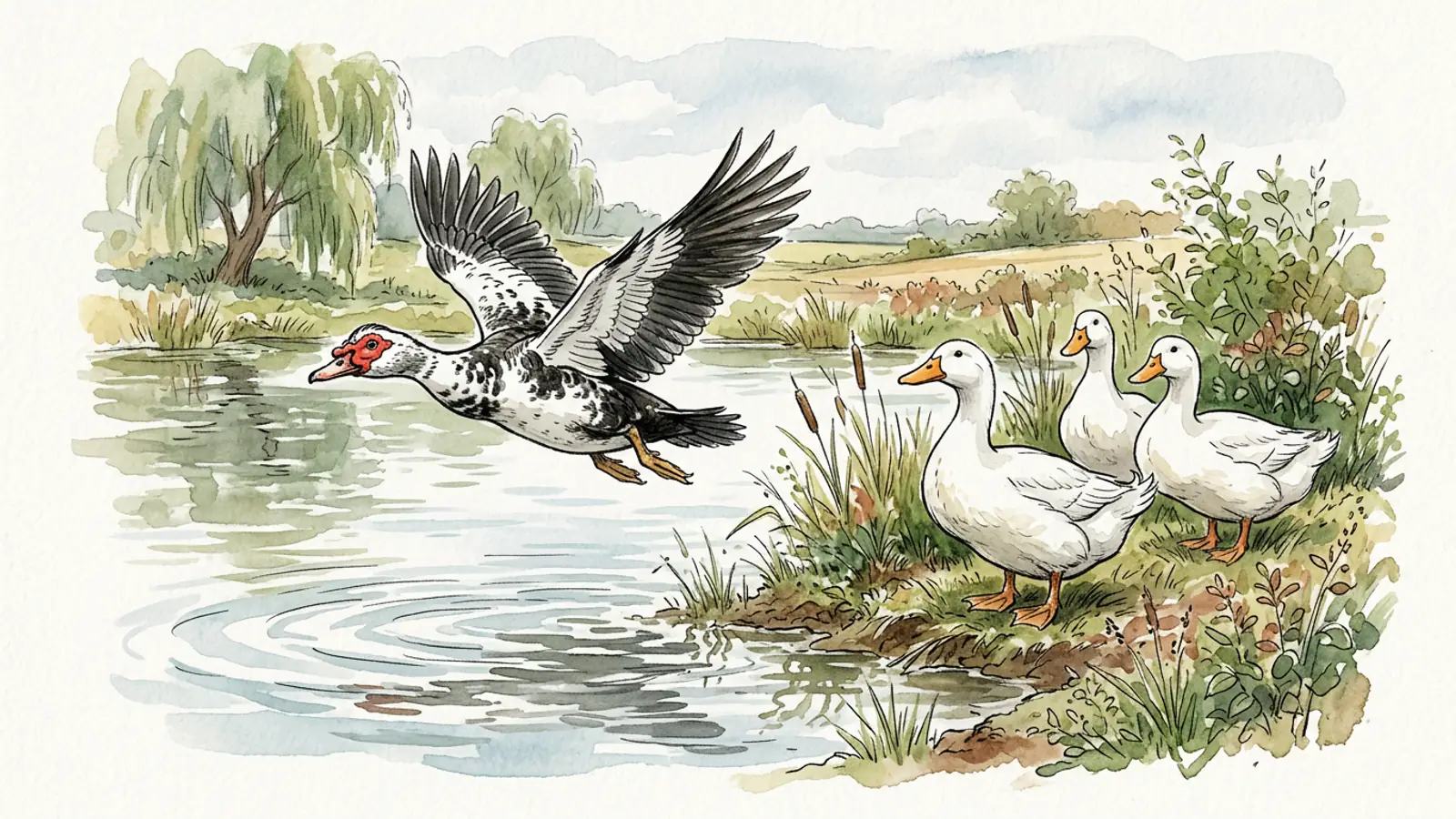
Yes, ducks can fly, but flight ability depends almost entirely on breed and body weight. Wild ducks such as mallards are strong, sustained fliers, while most heavy domestic breeds, including Pekin, Rouen, Aylesbury, Cayuga, Swedish, and Saxony, cannot achieve sustained flight because generations of selective breeding produced heavy bodies with proportionally small wings.
That short answer covers the basics. The longer answer explains why a Call duck can clear a fence while a Pekin cannot get off the ground, why Muscovy ducks behave differently from every other backyard breed, and what owners can do to keep flying breeds safe without harming them.
This article is educational and is not a substitute for veterinary diagnosis or treatment.
Key Takeaways
- Ducks can fly, but flight ability depends almost entirely on breed and body weight, with wild mallards flying strongly while heavy domestic breeds like Pekin, Rouen, and Aylesbury cannot sustain flight.
- Flight comes down to wing loading, the ratio of body weight to wing area, so a Pekin duck weighing several times a wild mallard with proportionally smaller wings cannot generate enough lift to fly.
- Wild mallard ducklings usually make their first flight at around 8 weeks (about 50 to 60 days) of age, and heavier breeds often fledge later or never develop meaningful flight.
- Muscovy ducks are a separate species (Cairina moschata) that retains strong flight ability, and a Muscovy hen can readily fly over a fence or up to a roof, so owners need covered runs or tall fencing.
- Angel wing is a developmental deformity where the last wing joint twists outward, linked to fast growth, high-protein diets, heredity, and in Muscovies goose parvovirus, and it is easiest to correct when caught early by a veterinarian.
The Direct Answer: Can Ducks Fly?
Do ducks fly? Wild ducks do, and they do it well. The mallard, ancestor of most domestic duck breeds, is a migratory bird capable of traveling long distances. Its body is light, its breast muscles are large, and its wings are long relative to its weight. Those three traits together produce efficient, sustained flight.
Domestic ducks are a different story. When humans selected ducks for meat, egg production, or appearance, they also selected for heavier bodies, shorter wings, and calmer temperaments. A heavy body with small wings cannot generate enough lift to overcome gravity for more than a moment. The result is a bird that may flap, hop, or skim a few feet, but cannot truly fly.
So the honest answer to "can domestic ducks fly" is: some can, many cannot, and the difference is largely a matter of breed. A Pekin duck and a Mallard-derived Call duck can live in the same yard and have completely different flight capabilities.
Why Some Ducks Fly and Others Cannot
Body Weight Versus Wing Area
Flight in birds comes down to a ratio called wing loading, which is body weight divided by wing area. A low wing loading means each unit of wing surface has to lift less weight, which makes takeoff and sustained flight easier. A high wing loading means the wings must generate far more lift to get the bird airborne.
Wild mallards have low wing loading. They are lean, their breast muscles (the pectoralis major) are well developed, and their wings are long. Domestic meat breeds have the opposite profile. A Pekin duck can weigh several times what a wild mallard weighs, while its wings are not proportionally larger. That mismatch is why a Pekin duck usually cannot fly.
Selective Breeding and the Loss of Flight
Domestic ducks descend primarily from the mallard (Anas platyrhynchos), with the exception of the Muscovy duck, which is a separate species (Cairina moschata). Over centuries of breeding, keepers favored ducks that stayed close to home, grew quickly, and carried more meat. Birds that flew away were not useful breeding stock. The traits that made a duck a good flier were gradually bred out of the heavy breeds.
This is not a defect. It is the predictable outcome of selection. A duck bred to gain weight rapidly for meat production will not have the light frame and large flight muscles of a migratory bird.
The Muscovy Exception
Muscovy ducks are not mallard descendants. They are a distinct species native to the Americas, and they retain strong flight ability. Muscovies are heavy birds, but their wings are large and powerful relative to their body, and they can fly well, especially females, which are lighter than males. A Muscovy hen can readily fly over a fence or up to a roof. A Muscovy drake is heavier and flies less, but he is still capable of short flights.
This species difference matters for owners. A Muscovy is not just a large domestic duck. It is a different bird with different flight biology, and it needs different containment.
When Do Ducklings Fledge?
Fledging is the point at which a young duck's wing feathers are fully grown and strong enough to support flight. Wild mallard ducklings usually make their first flight at around 8 weeks (about 50 to 60 days) of age, and domestic ducks feather out on a broadly similar schedule, though the exact timing varies with breed, nutrition, and growth rate.
Heavier breeds often fledge later in that window, and some never develop meaningful flight even after fledging because their body weight outpaces their wing development. Lighter breeds and Muscovies tend to fledge earlier and more reliably.
A practical point for owners: a duckling that suddenly starts flapping and hopping at 8 to 10 weeks may be on the verge of its first real flight. If you keep a flying breed, this is the time to check your fencing and run coverage before the bird discovers it can leave.
The First Flight and Molt Cycle
Once a duck fledges, its flight feathers remain until the next molt. During a full molt, the bird sheds and regrows its flight feathers, and for a period it may be temporarily unable to fly. After the molt completes, flight ability returns. This cycle matters for anyone managing flight restriction, because any method that relies on trimming feathers must be repeated after each molt.
Breed-by-Breed Flight Ability
The table below summarizes flight ability for common domestic breeds. It reflects general breed tendencies, not guarantees. Individual birds vary, and a light individual of a heavy breed may surprise you.
| Breed | Species / Origin | Typical Flight Ability | Notes |
|---|---|---|---|
| Mallard | Wild (Anas platyrhynchos) | Strong, sustained flight | Migratory. Ancestor of most domestic breeds. |
| Call duck | Mallard-derived | Can fly, often well | Small and light. Frequently flies over fences. |
| East Indie | Mallard-derived | Can fly | Bantam breed, black with a green sheen. Flight varies by line. |
| Muscovy | Cairina moschata | Flies well, especially females | Different species. Drakes heavier, fly less. |
| Pekin | Mallard-derived | Usually cannot sustain flight | Heavy body, small wings. May flap and hop. |
| Rouen | Mallard-derived | Usually cannot sustain flight | Heavy. Appearance close to mallard but not a flier. |
| Aylesbury | Mallard-derived | Usually cannot sustain flight | Very heavy meat breed. |
| Cayuga | Mallard-derived | Usually cannot sustain flight | Medium weight. May manage short hops. |
| Swedish (Blue and Black) | Mallard-derived | Usually cannot sustain flight | Medium weight. Limited flight. |
| Saxony | Mallard-derived | Usually cannot sustain flight | Heavy. Not a sustained flier. |
| Mandarin | Aix galericulata | Capable of flight | Ornamental. Flight behavior can be limited in aviary settings [1]. |
A note on the Mandarin duck: a study of captive Mandarin ducks at the Toledo Zoo and Aquarium found that flight and flight attempt behaviors were rare in an aviary setting, and that flight status had minimal effect on behavioral and health indicators of welfare [1]. That is a useful reminder that even a capable flier may not fly much when it has no reason to leave.
Can Pekin Ducks Fly?
No, Pekin ducks generally cannot fly. They are one of the heaviest common domestic breeds, and their wings are not large enough to lift their body weight into sustained flight. A Pekin may flap its wings vigorously, run across the yard, and hop a short distance, but it will not clear a fence or leave your property by air.
This is why Pekin ducks are popular with owners who want a duck that stays put without fencing tall enough for a flying bird. The trade-off is that Pekins are also prone to leg and joint problems from carrying so much weight, and they need a diet that keeps them from becoming overweight.
If you are wondering "can pekin ducks fly" because your Pekin just flapped across the yard, that is normal. Flapping and hopping are not flight. Sustained, controlled, level flight is the standard, and Pekins do not meet it.
Can Muscovy Ducks Fly?
Yes, Muscovy ducks can fly, and they often do. Muscovies are a separate species from mallard-derived breeds, and they retain the wing power and body proportions needed for real flight. Females are lighter and fly more readily than males. A Muscovy hen can fly over a standard fence, onto a roof, or into a tree.
This catches many new owners off guard. People assume that because a Muscovy is large, it must be flightless like a Pekin. It is not. If you keep Muscovies, plan for flight. Covered runs, tall fencing, or a management plan for flight restriction are all reasonable options.
Muscovies also have a specific health concern worth knowing. Angel wing syndrome, a developmental wing deformity, has been linked to goose parvovirus infection in Muscovy ducks. A study isolated goose parvovirus strains from affected Muscovy flocks and reproduced both the viral disease and angel wing syndrome experimentally through oral infection [2]. This was the first work to describe a viral cause of angel wing in waterfowl [2]. That finding does not mean every case of angel wing is viral, but it does mean Muscovy owners should take wing deformities seriously and involve a veterinarian.
Angel Wing: A Deformity That Affects Flight
Angel wing is a developmental deformity in which the last joint of the wing twists outward, so the flight feathers point away from the body instead of lying flat. The wing may droop or stick out at an odd angle. Because the feathers are misaligned, the bird cannot fly properly, and in severe cases the wing is permanently deformed.
Causes of Angel Wing
Angel wing has been attributed to dietary, environmental, and hereditary factors. The nutrition angle is well known: fast growth and high-protein or high-energy diets in young waterfowl are associated with the condition, because the wing grows faster than the supporting structures can keep up. A genetic study in Pekin ducks also supports a hereditary component to the condition [3].
In Muscovies, the picture is more complex. The goose parvovirus study described above showed that viral infection can induce angel wing syndrome, at least in part [2]. So angel wing is not a single-cause condition. Genetics, nutrition, growth rate, and in some cases infection can all contribute.
What Owners Should Do
Angel wing is easiest to correct when caught early, while the wing joint is still flexible. If you notice a young duck's wing sticking out or drooping, contact a veterinarian promptly. Do not attempt to splint or tape the wing yourself. Improper wrapping can restrict circulation, cause skin damage, or worsen the deformity.
Prevention focuses on managing growth rate in young waterfowl. Feeding a diet appropriate for the species and age, and avoiding excessive protein or energy in rapidly growing ducklings, reduces the risk. Ask your veterinarian for a feeding plan if you are raising ducklings of a breed known for fast growth.
How to Keep Flying Breeds Safely
If you keep a breed that can fly, you have three main options: containment, feather management, or acceptance of free flight with the risks that come with it. Most owners combine the first two.
Covered Runs and Tall Fencing
A covered run is the most reliable way to keep a flying duck at home. A roof or netting over the top prevents escape by air, and solid walls or fencing prevent escape on foot. For Muscovies and Call ducks, a covered run is often the simplest solution.
Fencing height alone is less reliable because a determined flier can clear a tall fence, and a duck that lands outside the fence may not be able to get back in. A covered run removes the guesswork.
One-Wing Feather Clipping
Feather clipping is a common, non-surgical method of flight restriction. The standard approach is to clip the primary feathers of one wing. Clipping one wing disrupts the symmetry of the wingbeat, so the bird cannot generate balanced lift. Clipping both wings is generally avoided because a bird with both wings clipped can still glide and may injure itself on landing.
Only the primary feathers are clipped, and only the outer portion. The feathers must be clipped correctly, at the right length, without cutting into the blood supply (the quill) of a growing feather. Cutting a blood feather causes pain and bleeding and can lead to infection. If you are not experienced with feather clipping, have a veterinarian or an experienced poultry keeper show you how the first time.
The key limitation of feather clipping is that it is temporary. Clipped feathers are replaced during the next molt, and flight ability returns. You must recheck and reclip after each molt. A bird that was grounded in spring may be fully flighted by fall.
Why Pinioning Is Surgical and Restricted
Pinioning is a permanent surgical procedure in which the tip of the wing, including the joint and some feathers, is removed, usually in very young birds. It permanently prevents flight. Pinioning is more invasive than feather clipping because it removes tissue, not just feathers, and it is irreversible.
Pinioning is restricted or discouraged in many jurisdictions and by many veterinary and welfare bodies, and it is not a routine procedure for backyard ducks. It is generally reserved for specific situations, such as certain zoological collections or regulated settings, and it should only be performed by a veterinarian with appropriate training and legal authorization. For a backyard flock, feather clipping or a covered run is almost always the better choice.
What About the Welfare of Flight-Restricted Birds?
Owners sometimes worry that preventing a duck from flying harms its welfare. The available evidence is reassuring. The Mandarin duck study found no differences in body weight, morbidity, or mortality between flighted and flight-restricted birds, and flight and flight attempt behaviors were rare in that aviary setting [1]. Flight status affected only swimming and vocalization behavior, with flighted birds swimming more and flight-restricted birds vocalizing more [1]. The authors concluded that flight restriction had minimal, if any, effect on behavioral and health indicators of welfare in that species in an aviary setting [1].
That does not mean flight restriction is harmless in every species or every situation. It means that in at least one well-studied captive waterfowl species, the welfare impact was limited. For your own birds, discuss the decision with a veterinarian who knows your species and setup.
Common Myths and Questions About Duck Flight
Myth: All Ducks Fly South for the Winter
Wild migratory ducks do travel seasonally, and the mallard is a classic example. Domestic ducks generally do not migrate. A Pekin or Rouen has neither the flight ability nor the migratory instinct to make a seasonal journey. Even flying domestic breeds such as Call ducks and Muscovies typically stay close to their home territory if they have food, water, and shelter.
Myth: If a Duck Can't Fly, It Can't Get Out of a Fence
Flightless ducks can still escape. They can walk through gaps, push under fencing, or swim out through an unfenced waterway. A duck that cannot fly is not automatically contained. Inspect your perimeter for ground-level gaps as carefully as you inspect the sky.
Myth: Clipping a Duck's Wings Is Cruel
Feather clipping is a painless, temporary, and widely used management method when done correctly on mature feathers. It does not injure the bird, and the feathers regrow at the next molt. It is far less invasive than pinioning. The cruelty concern usually arises when feathers are cut incorrectly, when blood feathers are cut, or when the bird is confined in inadequate conditions. Proper technique and good husbandry address those issues.
Question: Do Ducks Fly at Night?
Some wild ducks move at night, especially during migration. Domestic ducks may be more active at dawn and dusk. If you are trying to contain a flying breed, remember that a dusk or dawn flight attempt is possible.
Question: Can a Duck Fly Right After Laying Eggs?
Laying does not prevent flight. A hen that can fly can still fly during her laying cycle. However, a heavy laying breed that could not fly before laying will not suddenly gain flight ability. Body weight and breed, not reproductive status, determine flight.
Question: Why Does My Duck Flap but Not Take Off?
Flapping without takeoff usually means the bird has the instinct and the wing strength but not the lift. This is common in heavy breeds and in young ducks that have not fully fledged. It can also happen in a bird that has been feather-clipped, because the clipped wing cannot generate balanced lift.
Practical Implications for Backyard Keepers
Choosing a Breed With Flight in Mind
If you want a duck that stays in an open yard without a covered run, choose a heavy breed such as Pekin, Rouen, Aylesbury, Cayuga, Swedish, or Saxony. These breeds generally cannot fly, so a standard fence is usually enough to keep them home.
If you want a flying breed such as a Call duck, an East Indie, or a Muscovy, plan for containment from day one. Do not wait until the bird flies over the fence to build a covered run. It is much easier to prepare before fledging than to retrieve a duck from a neighbor's pond.
Housing and Enclosure Planning
For flying breeds, a covered run is the foundation of safe housing. The cover can be netting, wire, or a solid roof, as long as it prevents escape from above. The sides should be secure enough to prevent ground-level escape as well. Provide shade, clean water for bathing and drinking, and shelter from weather.
For flightless breeds, a secure fence and a predator-proof coop are the priorities. Heavy ducks are vulnerable to ground predators because they cannot fly away, so secure housing matters even more for them than for flying breeds.
Managing Molt and Rechecking Flight Restriction
If you use feather clipping, mark your calendar for the molt. Recheck the wings after the molt completes and reclip if needed. A bird that was safely grounded all summer may be able to fly by autumn. Do not assume a single clipping lasts forever.
Watching for Angel Wing in Growing Ducks
Inspect your ducklings' wings regularly as they grow. Early signs of angel wing include a wing that sticks out from the body, droops, or fails to fold properly. If you see these signs, contact a veterinarian. Early intervention gives the best chance of correction, and the cause may be nutritional, genetic, or infectious depending on the bird and the flock history [2][3].
What Is Still Uncertain
The science of duck flight and flight restriction is not complete. The Mandarin duck study provides useful welfare data, but it studied one species in one aviary setting, and the authors noted that flight and flight attempt behaviors were rare there [1]. We do not have equivalent long-term welfare data for every domestic breed.
Angel wing research is also evolving. The Pekin genome-wide association study identified genetic regions associated with the trait, but the authors described the genetic basis as still poorly understood [3]. The Muscovy parvovirus finding was the first to describe a viral cause of angel wing in waterfowl, and it raises questions about how often infection contributes to the condition in other flocks [2]. More research will clarify how genetics, nutrition, and infection interact.
For owners, the practical takeaway is stable even where the science is incomplete. Know your breed, plan for flight if your breed can fly, manage growth in young birds, and involve a veterinarian when something looks wrong.
Limitations and When to Contact a Veterinarian
This article covers general breed tendencies and management principles. Individual birds vary, and a veterinarian who examines your duck can give advice specific to your situation.
Contact a veterinarian promptly if you observe any of the following:
- A wing that sticks out, droops, or does not fold normally in a growing duck, which may indicate angel wing
- Bleeding from a wing after feather clipping, which suggests a blood feather was cut
- Lameness, difficulty walking, or reluctance to move, which can occur in heavy breeds
- Labored breathing, nasal discharge, or lethargy
- A sudden drop in egg production or appetite
- Any injury after a flight attempt or a fall
- Swelling, redness, or discharge at a wing or leg joint
If you are unsure whether a behavior is normal, a veterinary visit is the safest choice. Do not attempt surgical or invasive procedures on your own. Pinioning and any permanent flight-restriction procedure should only be performed by a qualified veterinarian where legally permitted.
Frequently Asked Questions
Can ducks fly?
Yes, ducks can fly, but ability depends on breed. Wild ducks such as mallards fly well, while most heavy domestic breeds cannot sustain flight.
Do all domestic ducks fly?
No. Heavy breeds such as Pekin, Rouen, Aylesbury, Cayuga, Swedish, and Saxony generally cannot fly. Lighter breeds such as Call ducks, some Mallard-derived lines, and Muscovies can fly.
Can Pekin ducks fly?
No, Pekin ducks generally cannot fly. They are heavy, and their wings cannot generate enough lift for sustained flight. They may flap and hop but will not clear a fence.
Can Muscovy ducks fly?
Yes, Muscovy ducks can fly, and females fly more readily than males. Muscovies are a separate species from mallard-derived breeds and retain strong flight ability.
At what age do ducklings start flying?
Wild mallard ducklings usually fly at around 8 weeks of age, and domestic ducklings feather out on a similar schedule depending on breed, nutrition, and growth rate. Heavier breeds may never fly well.
How do you stop a duck from flying away?
A covered run is the most reliable method. One-wing clipping of the primary feathers is a temporary option that must be repeated after each molt. Pinioning is a permanent surgical procedure that is restricted or discouraged in many places.
Is clipping a duck's wing painful?
No, clipping mature primary feathers is painless when done correctly. Cutting a growing blood feather causes pain and bleeding, so clipping should be done carefully or by an experienced person.
What is angel wing in ducks?
Angel wing is a developmental deformity where the last wing joint twists outward and the flight feathers point away from the body. Causes include nutrition, genetics, and in Muscovies, goose parvovirus infection.
Related Articles
- Backyard Duck Health: Common Diseases and Preventive Care
- Duck Farming Tips: Maximizing Productivity and Health
- Duck Biosecurity: Quarantine and Sanitation Protocols
- Duck Egg Production and Nest Management
- Silver Appleyard Ducks: Breed Profile and Care
- How Long Do Ducks Live? Domestic and Wild Lifespans
- Duck Fencing Options: Electric, Netting, and Permanent
- Cayuga Ducks: Black Eggs, Green Sheen and Care
- Raising Backyard Ducks: A Beginner's Guide
Sources
- The Impact of Flight Restriction on Behavior, Body Weight, and Health Outcomes in Mandarin Ducks (Aix galericulata).
- Involvement of Goose Parvovirus in Induction of Angel Wing Syndrome in Muscovy Ducks.
- Genome-wide association study identified the candidate genes associated with angel wing trait in Pekin duck.
- Mallard: Life History and Identification (All About Birds, Cornell Lab of Ornithology)
- Muscovy Duck: Life History and Identification (All About Birds, Cornell Lab of Ornithology)