Ember Tetra Care: Tank Setup and Water Parameters
By Dr. Zubair Khalid, DVM, MS, PhD ·
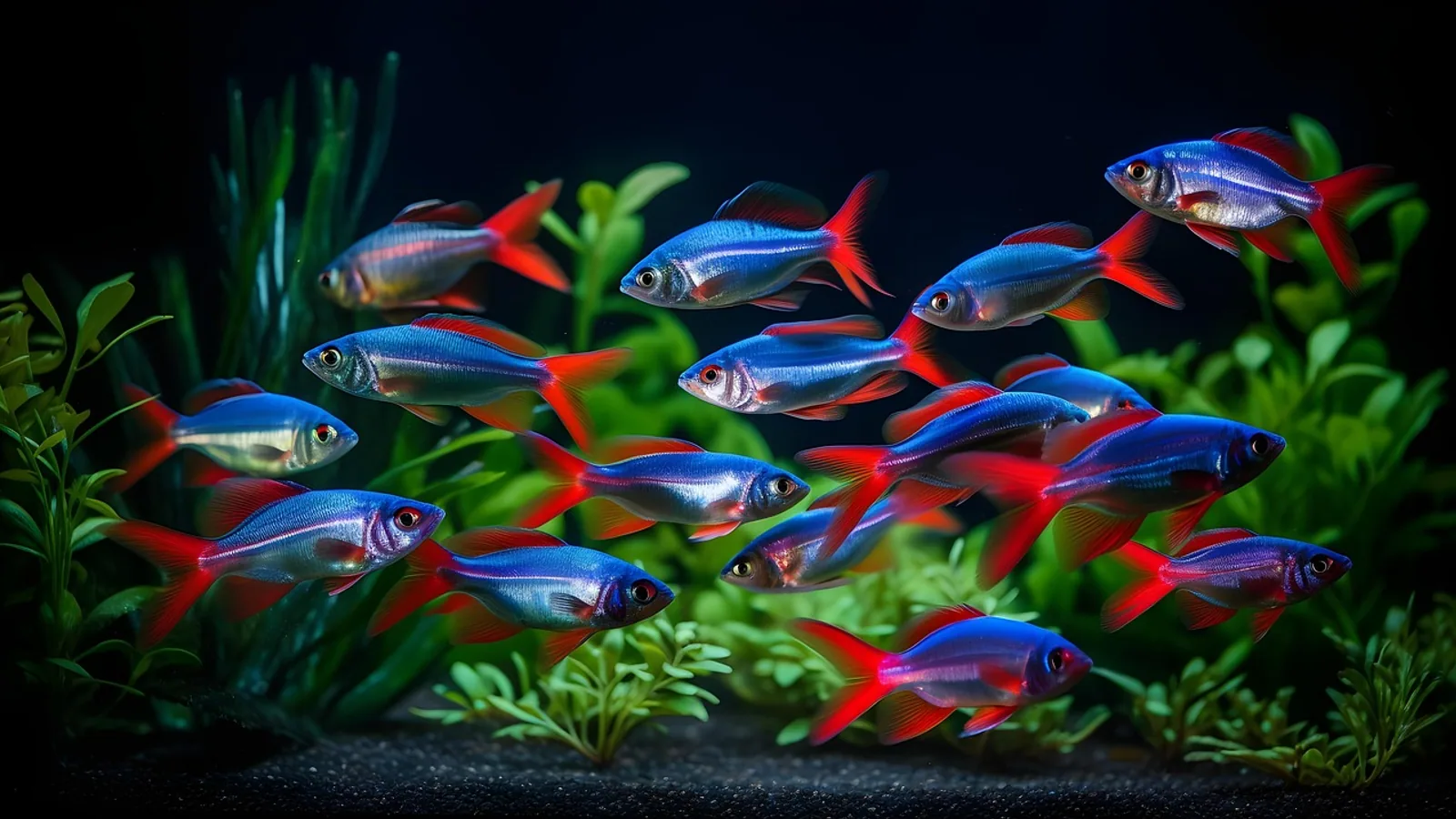
The ember tetra (Hyphessobrycon amandae) is a small, peaceful schooling characin that needs a tank of at least 10 to 15 gallons for a group of 6 to 10 fish, stable soft and slightly acidic water (pH 5.5 to 7.0, 2 to 10 dGH), a temperature between 24 and 28°C (75 and 82°F), and consistently low nitrate. Keep them in a school, feed them as the micropredators they are with small live or frozen foods plus a fine micro pellet, and give them a heavily planted tank with gentle flow. They are not a "set and forget" fish. Their small body size makes them sensitive to sudden shifts in water chemistry, so the aquarist who succeeds with ember tetras is the one who prioritizes biological filtration stability over decoration.
This guide covers the ember tetra tank size, the exact water parameters to target, how to build and cycle the aquarium, what to feed, which tankmates work, how to troubleshoot common problems, and when a fish needs a veterinarian.
This article is educational and is not a substitute for veterinary diagnosis or treatment.
At a Glance: Ember Tetra Quick Reference
| Parameter | Target Range |
|---|---|
| Minimum tank size | 10 to 15 gallons for a school of 6 to 10 |
| Temperature | 24 to 28°C (75 to 82°F) |
| pH | 5.5 to 7.0 |
| General hardness (dGH) | 2 to 10 dGH (soft) |
| Ammonia | 0 ppm |
| Nitrite | 0 ppm |
| Nitrate | As low as practical, kept low with water changes |
| Group size | 6 minimum, 10 or more preferred |
| Diet | Micropredator: small live and frozen foods plus micro pellets |
| Temperament | Peaceful schooling fish, stressed if kept singly |
| Flow | Gentle to moderate |
| Lighting | Moderate, plant-friendly |
What Is an Ember Tetra?

.jpg)
The ember tetra is a diminutive characin from the family Acestrorhamphidae, the same broad group that contains many of the small South American tetras familiar to aquarists. It is often called the amandae tetra after its specific epithet, and hobbyists frequently refer to groups of them simply as ember tetras. The common name comes from the fish's warm orange to red body color, which intensifies when the fish is comfortable, well fed, and kept in a group.
The genus Hyphessobrycon is large and taxonomically active. New species are still being described from Brazilian drainages, and existing species are periodically redescribed as more material becomes available. A 2016 study described a new Hyphessobrycon species from the upper Rio Juruena basin in central Brazil and redescribed H. cyanotaenia, a species originally known only from aquarium-trade specimens without a precise locality [1]. That pattern matters to hobbyists because it shows how much of what reaches the trade is documented through aquarium populations rather than wild surveys.
A separate taxonomic study examined Hyphessobrycon scholzei, the black line tetra, and concluded that H. fernandezi is a junior synonym of it. The authors also assembled circumstantial evidence that the purported type locality of H. scholzei is incorrect and that the original aquarium stock was likely collected alongside the first Moenkhausia pittieri specimens introduced to the hobby. The paper discusses the species' conservation status and its apparent disappearance from the aquarium hobby [2]. This is a useful cautionary example. Aquarium populations can persist for decades while wild provenance remains uncertain, and a species can fade from the trade even after being common.
For ember tetra keepers, the practical takeaway is simple. Buy from a source that maintains healthy, well-fed stock, quarantine new arrivals, and do not assume that a fish's availability tells you anything reliable about its wild origin or its tolerance for poor water.
Why Water Stability Matters More Than Any Single Number
The most common mistake with ember tetras is treating them as a beginner fish that tolerates anything. They are hardy in the sense that captive-bred specimens adapt to a range of conditions, but they are small-bodied fish with a high surface-area-to-volume ratio. A small fish in a small volume of water experiences any chemistry change faster than a large fish in a large volume. A pH swing that a large cichlid shrugs off can stress a school of ember tetras within hours.
Water quality in a freshwater aquarium is driven by the nitrogen cycle. Fish excrete ammonia, beneficial bacteria convert ammonia to nitrite and then to nitrate, and nitrate accumulates until it is removed by water changes or taken up by plants. A study on photosynthetic bacteria as a wastewater treatment in freshwater aquarium setups found that ammonia and nitrite in treated systems gradually decreased over 30 days, with zero ammonia and nitrate measured from day 21 through day 30 in the wastewater experiment [3]. That study used a different tetra species, Hyphessobrycon herbertaxelrodi, but it demonstrates the core principle that matters here: biological and microbial processing, not chemical additives, is what keeps nitrogen compounds under control in a planted or well-filtered tank.
The practical implication for ember tetra care is that you should build a mature biofilter before adding the fish, keep the filter media undisturbed, and change water on a schedule. Chasing a perfect pH number with chemicals creates swings. Providing stable, soft, slightly acidic water with low nitrate creates the conditions the fish actually need.
Ember Tetra Tank Size: Minimum and Ideal
A 10-gallon tank is the practical minimum for a school of 6 ember tetras. A 15-gallon tank is better for a group of 8 to 10, and a 20-gallon long is better still if you want a planted community with bottom-dwelling tankmates.
Tank size is not only about swimming room. It is about dilution. The larger the water volume, the slower ammonia, nitrite, and nitrate rise between water changes, and the slower temperature and pH drift when something goes wrong. A 10-gallon tank with 6 ember tetras and a sponge filter is a workable setup. The same tank with 15 fish, a heavy feeding schedule, and no plants is a water-quality problem waiting to happen.
The shape of the tank matters as much as the volume. Ember tetras are midwater schoolers. They use horizontal space more than vertical space. A long, shallow tank gives a school more usable swimming length than a tall, narrow tank of the same volume. A 20-gallon long is a better ember tetra tank than a 20-gallon tall.
How Many Ember Tetras Should You Keep?
Six is the absolute minimum. Ten is better. Fifteen to twenty in a 20-gallon long is comfortable. Schooling fish show more natural behavior and less stress-related hiding when the group is larger, and aggression or fin-nipping within the school is diluted across more individuals. A single ember tetra kept alone is a stressed fish. It may survive, but it will not show the color, activity, or schooling behavior that makes the species worth keeping.
Setting Up the Tank: Step by Step
Step 1: Choose the Tank and Position It
Select a tank of at least 10 gallons, ideally 15 to 20 gallons for a group of 8 to 10. Place it on a level stand away from direct sunlight, heating vents, and exterior doors that cause temperature swings. Direct sun drives algae and temperature instability.
Step 2: Add Substrate and Hardscape
A dark, fine substrate brings out the orange and red coloration of ember tetras. Dark substrate also makes the fish feel more secure. Add driftwood, which releases tannins that gently lower pH and soften water, and rocks that do not raise hardness. Avoid limestone, crushed coral, and other carbonate-rich materials in an ember tetra tank because they push pH and hardness upward.
Step 3: Plant Heavily
Live plants are the single best addition to an ember tetra tank. They consume nitrate, provide cover, and create the dappled light and structure that small tetras prefer. Good choices include floating plants, stem plants, and mosses. Floating plants are especially useful because they shade the tank, reduce algae, and give the fish a sense of overhead cover. A study on aquarium wastewater treatment used hornwort and salvinia as plant treatments alongside photosynthetic bacteria, which reflects the accepted role of plants in nutrient management in freshwater systems [3].
Step 4: Install Filtration and Gentle Flow
Use a filter that provides biological filtration without blasting the tank. A sponge filter driven by an air pump, or a small canister or hang-on-back filter with the flow diffused, works well. Ember tetras come from slow-moving waters and do not appreciate strong current. Aim for gentle circulation that moves water through the filter media without creating a whirlpool.
Step 5: Add a Heater and Thermometer
Set the heater to 24 to 28°C (75 to 82°F). A reliable thermometer is not optional. Temperature is a primary factor affecting a fish's ability to thrive, and tetras shift their thermal tolerance range based on recent acclimation history. Research on two South American tetras, the neon tetra (Paracheirodon innesi) and the black neon tetra (Hyphessobrycon herbertaxelrodi), found that critical thermal maxima increased with acclimation temperature, and the black neon tetra consistently demonstrated higher critical thermal maxima than the neon tetra by 1.0 to 1.4°C [4]. That study did not examine ember tetras, but it establishes that small tetras have measurable thermal limits and that acclimation history shapes them. Keep the temperature stable and within the species range rather than pushing the upper end.
Step 6: Cycle the Tank Before Adding Fish
Run the tank with the filter, heater, and a source of ammonia for several weeks until ammonia and nitrite read zero and nitrate begins to accumulate. This is the nitrogen cycle. Do not add ember tetras to an uncycled tank. A new tank with no established biofilter will expose the fish to ammonia and nitrite spikes, which cause gill damage, stress, and death.
Step 7: Quarantine New Fish
Set up a separate quarantine tank for new arrivals. Observe them for at least two to four weeks before adding them to the main display. Quarantine protects your existing fish from parasites and pathogens and gives you time to treat a new fish if needed. Wild and farmed ornamental fish can carry parasites. A study of Hyphessobrycon takasei and H. amapaensis from two basins in Amapá state, Brazil, found that 95.2 percent of H. takasei were parasitized by one or more species, including monogeneans, digenean metacercariae, and nematode larvae, while 28.1 percent of H. amapaensis carried Camallanus larvae [5]. Those are different species from the ember tetra, but the finding reinforces a general principle: ornamental characins can harbor internal and external parasites, and quarantine is the hobbyist's first line of defense.
Step 8: Acclimate and Introduce the School
Float the bag to equalize temperature, then drip-acclimate or gradually exchange tank water into the bag over 30 to 45 minutes. Add the whole group at once so the school forms immediately. Net the fish rather than pouring bag water into the tank, and never add store water to your display.
Ember Tetra Water Parameters in Detail
Temperature: 24 to 28°C (75 to 82°F)
Keep the temperature in this range and keep it stable. A heater with a reliable thermostat and a separate thermometer let you verify that the set point matches reality. Avoid the upper end of the range unless you have a specific reason to use it, because warmer water holds less dissolved oxygen and accelerates metabolism. The thermal tolerance research on related tetras shows that acclimation to warmer water raises the upper thermal limit but also carries metabolic costs [4]. For long-term health, aim for the middle of the range, around 25 to 26°C (77 to 79°F).
pH: 5.5 to 7.0
Ember tetras do best in slightly acidic water. A pH between 5.5 and 7.0 is the target. Do not chase a specific number. Stability matters more than precision. If your tap water comes out at pH 7.4 and you use driftwood and a planted substrate, the tank may settle at 6.8 to 7.0, which is acceptable. If you try to force pH down with chemicals, you risk a swing that harms the fish more than the slightly high reading would.
Test pH at the same time of day on a consistent schedule. pH naturally fluctuates over 24 hours in a planted tank because photosynthesis and respiration change dissolved carbon dioxide levels. A reading that moves by 0.2 to 0.4 over the day is normal. A reading that swings by a full point is a problem.
General Hardness: 2 to 10 dGH (Soft Water)
Ember tetras are soft-water fish. Target 2 to 10 dGH. If your tap water is hard, mix it with reverse-osmosis water to bring hardness down, or use rainwater if you can collect it cleanly. Hard water does not immediately kill ember tetras, but it is outside their preferred range and can contribute to chronic stress. Avoid carbonate-rich decor and substrates that raise hardness.
Ammonia and Nitrite: 0 ppm
Ammonia and nitrite are toxic to fish at any measurable level. A cycled tank with adequate filtration should read zero for both. If either is detectable, perform a water change, reduce feeding, and check that the filter is running and not clogged. Do not add more fish until both read zero.
Nitrate: Keep It Low
Nitrate is the end product of the nitrogen cycle and is far less acutely toxic than ammonia or nitrite, but it accumulates and chronic exposure stresses fish. Keep nitrate as low as practical. Heavy planting, regular partial water changes, and not overfeeding are the three tools that keep nitrate down. The photosynthetic bacteria study showed that biological treatment can drive ammonia and nitrate to zero over time in a closed system [3]. In a home aquarium, you achieve the same effect through plants, water changes, and a mature biofilter.
Dissolved Oxygen and Flow
Warm water holds less oxygen than cool water. Gentle surface agitation from a filter outlet or a small air stone improves gas exchange. Ember tetras do not need high flow, but they do need oxygenated water. Avoid a completely still surface in a warm tank.
Filtration and the Nitrogen Cycle
Filtration in an ember tetra tank has three jobs: mechanical removal of particles, biological conversion of ammonia and nitrite, and chemical or plant-based removal of nitrate and dissolved organics. The biological job is the most important.
Beneficial bacteria colonize filter media, substrate, and surfaces throughout the tank. They convert ammonia to nitrite and nitrite to nitrate. These bacteria are slow to establish, which is why a new tank must be cycled before fish are added, and they are sensitive to chlorinated water, sudden temperature changes, and filter media replacement. When you clean a filter, rinse the media in tank water, not tap water, to preserve the bacteria.
A sponge filter is an excellent choice for an ember tetra tank because it provides large biological surface area, gentle flow, and no risk of sucking up small fish. A small canister or hang-on-back filter also works if the flow is diffused. Whatever you choose, do not turn the filter off for extended periods. The bacteria need continuous oxygenated flow.
Diet and Feeding: Ember Tetras Are Micropredators
Ember tetras are micropredators. In the wild they feed on small aquatic invertebrates, insect larvae, and zooplankton. In the aquarium, they need a diet that reflects that. The best approach is a combination of small live or frozen foods and a high-quality micro pellet.
Live and frozen options include baby brine shrimp, daphnia, microworms, and small bloodworms. These foods trigger natural hunting behavior and provide nutrition that dry foods may not fully replicate. Micro pellets formulated for small tetras serve as a convenient staple. Feed small amounts two to three times daily, and only as much as the school consumes in a few minutes. Overfeeding is the most common cause of rising nitrate and cloudy water.
A useful reference point for how small these fish are at different life stages comes from a study of Hyphessobrycon eques, a related characin. Fertilized eggs averaged 0.92 mm in diameter, larvae hatched at about 2.90 mm total length, complete yolk sac resorption and mouth opening occurred on the third day post hatching, and at 45 days post hatching the juveniles reached 12.5 mm total length [6]. Ember tetras are similarly small, which is why their food must be correspondingly small. A pellet sized for a medium cichlid is useless to them. Choose foods in the 0.5 to 1 mm range.
Feeding Schedule and Vacation Care
Feed two to three small meals per day. If you go away for a few days, a healthy adult ember tetra can fast without harm. For longer absences, use an automatic feeder or have someone feed a pre-measured portion. Do not let a well-meaning caretaker overfeed.
Tankmate Compatibility
Ember tetras are peaceful schooling fish that do best with other small, non-aggressive species. They should not be kept with large or boisterous fish that will outcompete them for food or chase them. The table below lists compatible and incompatible tankmates.
| Tankmate | Compatibility | Notes |
|---|---|---|
| Other small rasboras (e.g., chili, kubotai) | Excellent | Similar size, similar water parameters, peaceful |
| Corydoras catfish | Excellent | Bottom dwellers, no competition for midwater space |
| Small gouramis (e.g., sparkling, licorice) | Good | Peaceful, occupy different zones, avoid large or aggressive gouramis |
| Otocinclus catfish | Excellent | Algae grazers, peaceful, soft-water tolerant |
| Small loaches (e.g., kuhli) | Good | Bottom dwellers, peaceful, provide hiding spots |
| Neon and cardinal tetras | Good | Similar size and temperament, similar parameters |
| Cherry barbs | Good | Peaceful, but slightly larger, monitor feeding |
| Betta fish | Variable | Some bettas ignore them, others chase them. Monitor closely |
| Angelfish | Poor | Large enough to eat ember tetras, may bully them |
| Large cichlids | Poor | Predatory or aggressive, will stress or eat ember tetras |
| Goldfish | Poor | Different temperature and water chemistry needs |
| Large barbs (e.g., tiger barb) | Poor | Fin-nipping and boisterous, will stress the school |
The general rule is to match tankmates by size, temperament, and water parameters. A tankmate that needs hard, alkaline water should not share a tank with ember tetras. A tankmate that grows to four inches or more may view an ember tetra as food.
Behavior and Social Needs
Ember tetras are schooling fish. In a group, they swim together, display more color, and show less hiding behavior. Kept singly or in pairs, they become withdrawn, pale, and prone to stress-related illness. The minimum school size is six, and ten or more is better.
Schooling behavior is also a welfare indicator. A school that stays tight, swims actively in the midwater, and feeds eagerly is a school that feels secure. A school that hides behind plants, presses into corners, or refuses food is telling you something is wrong with the water, the temperature, or the tankmates.
Common Mistakes in Ember Tetra Care
Adding Fish to an Uncycled Tank
This is the most common and most lethal mistake. Ammonia and nitrite from fish waste spike in an uncycled tank and damage gills. Cycle the tank first.
Keeping a Single Ember Tetra
Ember tetras are schooling fish. A lone ember tetra is a stressed fish. Keep at least six.
Using Hard, Alkaline Water
Ember tetras need soft, slightly acidic water. Hard water and carbonate decor push parameters in the wrong direction.
Overfeeding
Overfeeding raises nitrate, clouds water, and stresses the biofilter. Feed small amounts and remove uneaten food.
Strong Current
Ember tetras come from slow waters. A filter that blasts the tank exhausts them. Diffuse the flow.
Skipping Quarantine
New fish can carry parasites and pathogens. Quarantine protects your existing school.
Chasing pH With Chemicals
Chemical pH adjusters cause swings. Stable water at a slightly high pH is better than unstable water at a perfect pH.
Troubleshooting Common Problems
Fish Hiding Constantly
Check the school size, the temperature, and the tankmates. A small school, a temperature outside the range, or a bullying tankmate will cause hiding. Increase the group, verify the heater, and remove aggressive fish.
Loss of Color
Stress, poor diet, and suboptimal water cause color loss. Verify water parameters, increase feeding of live or frozen foods, and confirm the school size is adequate.
Gasping at the Surface
Gasping indicates low dissolved oxygen or high ammonia or nitrite. Test the water, increase surface agitation, and perform a water change.
Cloudy Water
Cloudy water in a new tank is often a bacterial bloom during cycling. Cloudy water in an established tank usually means overfeeding or a filter problem. Reduce feeding, check the filter, and perform a water change.
Fin Damage or Nipped Fins
Fin damage usually points to an aggressive tankmate or poor water quality. Identify and remove the aggressor, and verify ammonia and nitrite are zero.
Sudden Deaths
Sudden deaths in a school usually indicate a water quality crash, a temperature spike, or an introduced pathogen. Test ammonia, nitrite, pH, and temperature immediately. Quarantine remaining fish if a pathogen is suspected.
Health, Welfare, and Disease Prevention
The best disease prevention is good husbandry. Stable water parameters, a mature biofilter, a proper school, a correct diet, and quarantine of new arrivals prevent most problems.
Ornamental fish can carry viral and parasitic pathogens. A Malaysian study screened several oviparous ornamental fish species, including Hyphessobrycon anisitsi, for megalocytivirus and found infectious spleen and kidney necrosis virus in some samples, with positive fish showing few or no clinical signs [7]. The ember tetra was not part of that survey, but the finding is relevant to any aquarist buying farmed or wild-caught characins. Subclinical carriers can introduce disease to a display tank. Quarantine and observation are the practical response.
Parasites are also a real risk. The survey of H. takasei and H. amapaensis found high rates of parasitism in one species and moderate rates in the other, including nematodes and digenean metacercariae [5]. Again, the ember tetra is a different species, but the principle holds. Wild or farmed characins can carry internal parasites, and a fish that looks healthy can still be infected.
If you see white spots, clamped fins, rapid breathing, bloating, wasting, or unusual behavior that does not resolve with a water change, consult an aquatic veterinarian. Do not guess at medications or doses. Many aquarium remedies are unregulated, and incorrect dosing harms fish and disrupts the biofilter.
Acclimation and Introduction: A Closer Look
Acclimation is the process of moving a fish from store water to tank water without shocking it. Temperature, pH, and hardness differences between the bag and the tank can cause osmotic stress.
The safest method is drip acclimation. Float the sealed bag in the tank for 15 to 20 minutes to equalize temperature. Then open the bag and slowly add tank water to it over 30 to 45 minutes, removing some bag water periodically so the volume does not overflow. When the water in the bag is mostly tank water, net the fish and release them into the tank. Discard the bag water. Do not pour it into the display.
For ember tetras, introduce the whole school at once. A school that forms immediately settles faster than fish added one at a time.
Maintenance Schedule
A consistent maintenance routine keeps water stable.
Daily: Observe the fish for behavior changes, check temperature, and feed small portions two to three times.
Weekly: Perform a 20 to 30 percent water change with temperature-matched, dechlorinated water. Test ammonia, nitrite, nitrate, pH, and hardness. Clean the glass and remove dead plant material.
Monthly: Rinse filter media in tank water. Check the heater and thermometer for accuracy. Inspect plants and remove excess growth.
As needed: Quarantine new fish, treat sick fish in a hospital tank, and replace worn equipment.
Choosing Equipment: Selection Criteria
Tank: 10 gallons minimum, 15 to 20 gallons preferred. Long and shallow beats tall and narrow.
Filter: Sponge filter or a small canister or hang-on-back with diffused flow. Prioritize biological surface area.
Heater: Adjustable, sized for the tank volume, with a reliable thermostat. Verify with a separate thermometer.
Thermometer: A simple glass or digital thermometer. Check it against a second thermometer occasionally.
Lighting: Moderate, plant-friendly. A full-spectrum LED on a timer for 6 to 8 hours per day reduces algae.
Substrate: Dark, fine gravel or sand. Avoid carbonate-rich substrates.
Decor: Driftwood, inert rocks, and live plants. Provide cover and structure.
Test kits: Liquid test kits for ammonia, nitrite, nitrate, pH, and hardness. Test strips are less accurate.
Frequently Asked Questions
What is the minimum tank size for ember tetras?
A 10-gallon tank is the minimum for a school of 6 ember tetras. A 15 to 20-gallon tank is better for a group of 8 to 10 and provides more water volume for stability.
What water parameters do ember tetras need?
Target pH 5.5 to 7.0, temperature 24 to 28°C (75 to 82°F), general hardness 2 to 10 dGH, and zero ammonia and nitrite. Keep nitrate as low as practical.
Can ember tetras live alone?
No. Ember tetras are schooling fish and become stressed when kept singly. Keep at least six, and ten or more is better.
What do ember tetras eat?
Ember tetras are micropredators. Feed small live or frozen foods such as baby brine shrimp and daphnia, plus a high-quality micro pellet. Feed small amounts two to three times daily.
Are ember tetras good for beginners?
They can suit a beginner who is willing to cycle the tank, maintain stable water parameters, and keep a proper school. Their small size makes them sensitive to water quality swings, so stable water matters more than experience level.
What fish can live with ember tetras?
Small rasboras, corydoras catfish, small gouramis, otocinclus, kuhli loaches, and other small peaceful tetras are good tankmates. Avoid large, aggressive, or fin-nipping fish.
Why are my ember tetras hiding?
Hiding usually means stress from a small school, wrong temperature, poor water quality, or aggressive tankmates. Increase the group size, verify parameters, and remove bullies.
Do ember tetras need a heater?
Yes, in most home aquariums. They need stable water between 24 and 28°C (75 and 82°F), which usually requires a heater with a reliable thermostat.
Limitations and When to Contact a Veterinarian
This article covers general husbandry for ember tetras. Individual fish can have conditions that require hands-on evaluation, and no article can replace a physical examination of your fish and your tank water.
Contact an aquatic veterinarian or a fish health professional if you observe any of the following:
- Fish that stop eating for more than a few days despite correct water parameters
- Visible lesions, white spots, fuzzy growths, or open wounds
- Rapid breathing, gasping, or listing at the surface that does not improve with a water change
- Abdominal swelling, wasting, or curved spine
- Multiple deaths in the school within a short period
- Persistent ammonia or nitrite readings despite water changes and reduced feeding
- Any suspicion of an infectious disease in a tank with other fish
Early intervention is easier than treating an advanced problem. When in doubt, isolate affected fish in a hospital tank, maintain stable water, and seek professional advice before adding any medication.
Related Articles
- Axolotl Tank Setup and Water Parameters
- Tetra Fish Care: Species Guide, Tank Setup, and Feeding
- Goldfish Tank Setup: Essential Equipment and Water Parameters for Healthy Goldfish
- Discus Fish Care: Tank Setup, Water, Diet, and Health
- Coral Reef Abiotic Factors: Water Chemistry and Environmental Parameters for Reef Tanks
- Neon Tetra Care Guide
- Water Conditioner for Fish Tank: How and When to Use
- Guinea Hen Coop: Design, Size, and Setup Guide
Sources
- A New Species of Hyphessobrycon (Characiformes: Characidae) from the Upper Rio Juruena Basin, Central Brazil, with a Redescription of H. cyanotaenia
- A tale of false origins: Hyphessobrycon scholzei Ahl, 1937 and its junior synonym, Hyphessobrycon fernandezi Fernández-Yépez, 1972 (Teleostei: Characifomes: Acestrorhamphidae).
- Photosynthetic Bacteria as an Alternative Wastewater Treatment in Freshwater Aquarium Fish Set Up
- Temperature tolerance and oxygen consumption of two South American tetras, Paracheirodon innessi and Hyphessobrycon herbertaxelrodi.
- Parasitic fauna of Hyphessobrycon takasei and Hyphessobrycon amapaensis (Osteichthyes: Characidae), ornamental fish of two basins from Amapá state, Brazil
- Spawning Behavior, Egg Development, Larvae and Juvenile Morphology of Hyphessobrycon eques (Pisces: Characidae) Characidae Fishes
- MOLECULAR DETECTION OF MEGALOCYTIVIRUS GENOTYPE: INFECTIOUS SPLEEN AND KIDNEY NECROSIS VIRUS IN MALAYSIAN OVIPAROUS AQUARIUM FISH