Axolotl Tank Setup and Water Parameters
By Dr. Zubair Khalid, DVM, MS, PhD ·
Key Takeaways
- Temperature is paramount: Axolotls require a stable, cool water temperature between 16-18 °C (60-64 °F). Temperatures exceeding 22 °C (72 °F) induce thermal stress, compromise immunity, and increase metabolic demand, leading to anorexia and increased susceptibility to fungal infections.
- Nitrogen cycle and water quality are critical: A fully established biological filter is essential to convert toxic ammonia and nitrite to less harmful nitrate. Target parameters include 0 mg/L ammonia and nitrite, and < 20 mg/L nitrate, with a stable pH between 6.5-8.0.
- Substrate selection prevents impaction: Fine gravel (1-5 mm) is a significant risk factor for fatal gastrointestinal obstruction due to axolotls' suction feeding. Safe alternatives include bare-bottom tanks, fine silica sand (0.2-1 mm) for adults, or large, smooth river stones (>5 cm).
- Filtration must be gentle: Axolotls possess sensitive gills and lateral line systems, making strong water currents stressful. Sponge filters are ideal, providing biological filtration with minimal flow. Canister filters require a diffused output, and hang-on-back filters necessitate a pre-filter sponge.
- Tank size and enrichment are vital for well-being: A minimum of 75 liters (20 US gallons) is recommended for a single adult axolotl, with 110 liters (30 US gallons) preferred, and additional volume for each subsequent animal. Multiple hiding places are crucial for reducing stress.
Axolotls (Ambystoma mexicanum) are fully aquatic neotenic salamanders that require carefully managed captive environments to thrive. Unlike many amphibians that metamorphose onto land, axolotls retain their gills and remain underwater for life, making water quality and tank setup the single most critical determinant of health. A poorly maintained tank can lead to stress, immunosuppression, bacterial or fungal disease, and death within a short period. This article provides a publication-grade, veterinary-centered guide to establishing and maintaining an optimal axolotl habitat, covering tank size, water parameter management, biological cycling, substrate selection, filtration, and enrichment. Recommendations are drawn from published scientific literature on water quality and aquatic biology, as well as clinical guidelines from international veterinary and exotic animal organizations.
Quick Q&A
Question: What water temperature do axolotls need, and why is it so important?
Answer: Axolotls require a cool water temperature between 60 and 64 °F (16 to 18 °C). Temperatures above 72 °F (22 °C) cause thermal stress, suppressed immunity, and increased metabolic demand, which can lead to anorexia, fungal infection, and death. Sub-optimal temperature is the most common husbandry error in axolotl keeping.
Tank Size Requirements
Axolotls are relatively large amphibians, reaching 23 to 30 cm (9 to 12 inches) in body length. They produce a significant bioload and require ample horizontal swimming space. The minimum recommended tank size for a single adult axolotl is 75 liters (20 US gallons), with 110 liters (30 US gallons) preferred. For each additional axolotl, add 40 liters (10 US gallons). Jurisdictional guidelines from the AVMA’s Exotic Animal Section and the European College of Zoological Medicine (ECZM) emphasize that undersized tanks lead to poor water quality, stunted growth, and aggressive interactions. A longer tank (90-120 cm) is superior to a taller one, as axolotls are benthic and rarely use vertical space.
Water Parameters and the Nitrogen Cycle
Axolotls are extremely sensitive to nitrogenous waste. Uncycled tanks containing high ammonia or nitrite cause gill damage, neurologic signs, and mortality. The biological filter must be fully established before introducing the animal.
The Nitrogen Cycle in Axolotl Tanks
The cycling process involves two primary bacterial guilds. Ammonia-oxidizing bacteria (AOB) convert ammonia (NH₃) to nitrite (NO₂⁻), and nitrite-oxidizing bacteria (NOB) convert nitrite to nitrate (NO₃⁻). This process can take 4 to 8 weeks. Recent research on nitrifier recovery kinetics in acidic systems demonstrates that AOB and NOB have differential sensitivities to environmental shocks; in axolotl tanks, maintaining pH within the neutral range (7.0-7.5) optimizes the growth of both groups. However, under suboptimal pH (below 6.5), nitrification slows significantly. Clinicians recommend using a commercial liquid test kit weekly during cycling.
Target Water Parameters
| Parameter | Ideal Range | Critical Threshold |
|---|---|---|
| Temperature | 16-18 °C (60-64 °F) | Above 22 °C (72 °F) |
| pH | 6.5-8.0 (stable) | Below 6.0 or above 8.5 |
| Ammonia (NH₃) | 0 mg/L | Above 0.25 mg/L |
| Nitrite (NO₂⁻) | 0 mg/L | Above 0.5 mg/L |
| Nitrate (NO₃⁻) | < 20 mg/L | > 40 mg/L |
| General Hardness (GH) | 7-12 dGH | , |
| Carbonate Hardness (KH) | 3-8 dKH | , |
These figures align with water quality indices used in aquatic ecosystem monitoring. Axolotls tolerate moderately hard water; very soft water can cause osmoregulatory stress. Adding dechlorinated tap water that contains dissolved minerals is usually preferable to using reverse osmosis water alone.
Water Change Protocol
Partial water changes of 25-50% should be performed weekly. Gravel vacuum the substrate if sand is used. Always treat tap water with a dechlorinator that neutralizes chlorine, chloramine, and heavy metals. In regions where chloramine is used (common in North America and parts of Europe), a product that binds ammonia released from chloramine is required.
Cooling and Temperature Control
Axolotls are cold-adapted amphibians. Their natural habitat, the Xochimilco lake system in Mexico, maintains year-round temperatures of 14-20 °C. In captivity, high ambient heat is the leading cause of morbidity.
Thermal Tolerance
Embryonic and larval axolotls have a similar thermal window to many temperate fish species. Studies on fish early embryogenesis indicate that optimal survival occurs within a narrow range; for axolotls, survival drops sharply above 22 °C. At 25 °C, metabolic oxygen demand doubles while dissolved oxygen decreases, leading to hypoxia and oxidative stress.
Cooling Methods
- Fans: Clip-on fans directed at the water surface increase evaporative cooling. Effect: 1-3 °C drop depending on humidity.
- Chillers: In-line aquarium chiller units are the gold standard for tanks in warm climates or rooms without air conditioning. They maintain a set temperature within ±0.5 °C.
- Frozen water bottles: A temporary emergency measure. Place sealed bottles of frozen dechlorinated water in the tank (monitor to avoid sudden swings).
- Room cooling: Air conditioning or cool basement locations are simplest for small setups.
A combination of a chiller and a thermometer with a digital alarm is recommended. Axolotl owners in Australia and the southern United States often require active cooling year-round.
Substrate Selection: Why No Fine Gravel
One of the most critical safety decisions is substrate choice. Axolotls are ambush predators that feed by suction; they routinely ingest small particles along with food. Fine gravel (size 1-5 mm) is a primary cause of gastrointestinal foreign body obstruction, which can be fatal.
Safe Substrate Options
- Bare bottom glass: Easiest to clean and safest for juveniles. Can be criticized as lacking enrichment, but is the veterinary gold standard for quarantine tanks and young axolotls.
- Fine silica sand (0.2-1 mm particle size): Considered safe for adults because particles are small enough to pass through the digestive tract without causing impaction. However, sand must be thoroughly rinsed before use.
- Large river stones (diameter > 5 cm): Cannot be swallowed. Ensure stones are smooth and free of sharp edges.
- Slate or tile: Flat pieces can be placed on the bottom to create a natural look while eliminating ingestion risk.
The American Association of Zoo Veterinarians (AAZV) and CVMA exotic animal guidelines explicitly warn against using gravel or crushed coral in axolotl tanks.
Filtration and Water Flow
Axolotls have delicate, highly vascularized gills and a lateral line system that is sensitive to strong water currents. High flow stresses axolotls and can cause gill curling (a chronic stress response). The ideal filter provides thorough biological, mechanical, and chemical filtration while producing minimal current.
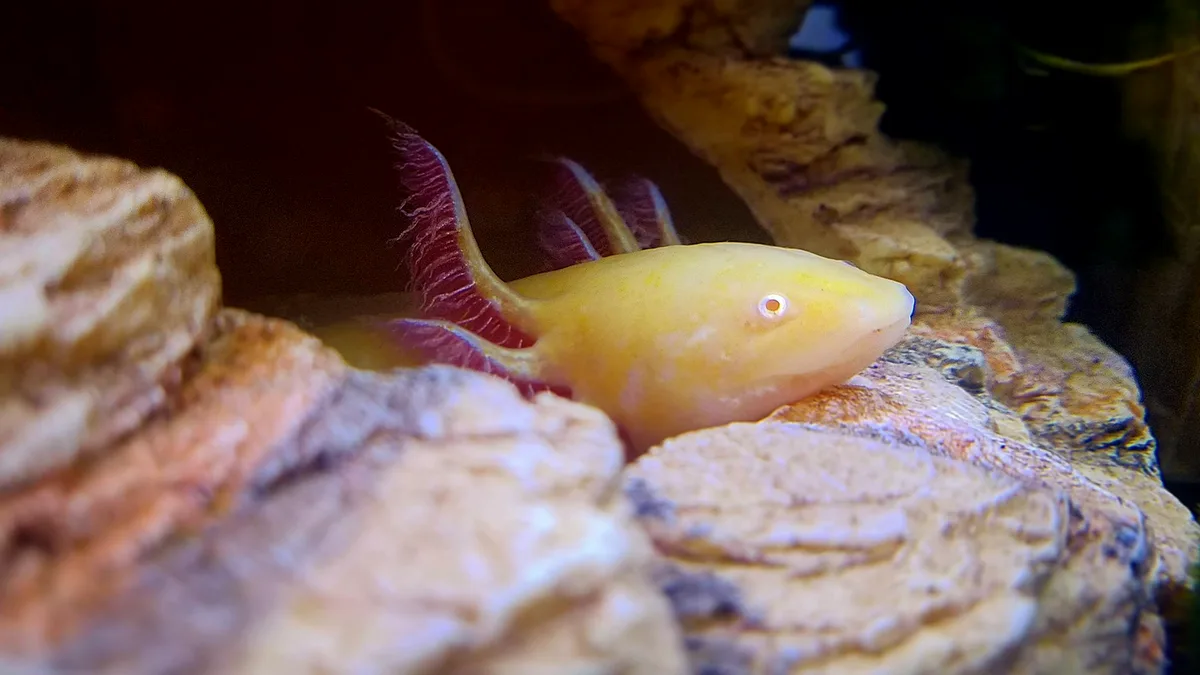 Amphibian skin is permeable, so water chemistry acts directly on the animal. Photo: Split Gill Studio via Pexels.
Filter Types
- Sponge filter: The safest choice for axolotls. Large-pore sponges provide a high surface area for nitrifying bacteria and create only a gentle water movement. Must be sized to the tank volume.
- Canister filter with spray bar: Acceptable if the return flow is aimed at the tank wall or surface to diffuse current. Avoid internal power filters with direct outlet flow.
- Hang-on-back (HOB) filter: Use only with a pre-filter sponge to reduce intake velocity and prevent gill or limb damage.
Biofouling and clogging of filter media can lead to ammonia spikes. A study on membrane biofouling highlights that polymer materials with low biofouling potential (e.g., polyvinyl alcohol) can reduce maintenance; in aquaria, regular cleaning of sponge filters in tank water (not tap water) preserves beneficial bacteria. According to the AVMA, filters should be checked weekly and cleaned when flow reduces to 50% of the original output.
Hides and Enrichment
Axolotls are nocturnal and benefit from multiple hiding places to reduce stress and provide security. Offering adequate shelter is considered best practice by the Federation of European Veterinarians (FVE) for amphibian welfare.
Acceptable Hide Materials
- PVC pipe (4-6 cm diameter, cut lengthwise)
- Ceramic flower pots (cleaned, no sharp edges, with a hole cut for entry)
- Commercially available reptile caves (smooth interior)
- Large pieces of driftwood (avoid sharp points; soak to leach tannins)
Provide at least one hide per axolotl, plus an extra. LED lighting should be dim (lower than 50 lux) or used only for short observation periods; axolotls have no eyelids and bright light causes persistent stress.
Special Considerations for UK, European, and Australian Keepers
Local regulations and water quality differ across regions. In Europe, tap water tends to be harder (higher GH), requiring less supplementation. In Australia, many native amphibian species are protected, but axolotls are legal as exotic pets in most states; keepers must ensure water temperatures do not exceed 24 °C even with the use of evaporative coolers. The AVA (Australian Veterinary Association) suggests that axolotls be housed indoors with climate control.
Water parameter testing should account for local variations. For example, in some areas of Canada and the northern US, well water may contain high iron or sulfur, which can be toxic. A water quality report from the local utility is recommended.
Conclusion
Successful axolotl husbandry hinges on rigorous water parameter management, appropriate tank size, and a well-cycled environment. Key points include maintaining a stable temperature between 16-18 °C, using a sponge or low-flow canister filter, avoiding fine gravel, and providing multiple hides. Regular water testing and partial changes are non-negotiable. Consultation with a veterinarian experienced in exotic aquatic species is advised at the first sign of illness. Through evidence-based tank setup, keepers can provide a healthy, enriching home for these remarkable amphibians.
Related Clinical & Scientific Guides
References
Guo S, Gao L, Chen H, et al. Digitally-driven optimization of intraoral water jet parameters for plaque removal. BMC Oral Health. 2026. PubMed ID: 42351150.
Omarov A, Mustafayev Z, Skorintseva I, et al. A multi-criteria framework for assessing the natural resource potential of agricultural landscapes using Harrington's generalized desirability function. Environ Monit Assess. 2026. PubMed ID: 42350838.
Mahariq I, Helal MM, Shaheen M, et al. Computational analysis of thermally reactive MHD thixotropic hybrid nanofluid flow. Discov Nano. 2026. PubMed ID: 42350748.
Abdellatief M, Saqr AM. Machine learning prediction of compressive strength in 3D printed fiber reinforced concrete. Sci Rep. 2026. PubMed ID: 42350568.
Haddad DH, Salem KG, Abdel-Fattah MI, et al. Comparative scenario analysis for improved oil recovery in a heterogeneous carbonate reservoir. Sci Rep. 2026. PubMed ID: 42350471.
Xie C, Li Z, Tong C, et al. Exploiting differential recovery kinetics of nitrifiers after extreme free nitrous acid shocks enable rapid nitritation start-up in acidic granular sludge systems. Bioresour Technol. 2026. PubMed ID: 42349565.
Fischbach V, Dahlke FT, Kotterba P, et al. Thermal tolerance of herring (Clupea harengus) early embryogenesis in relation to temporal temperature dynamics in the Baltic Sea. J Therm Biol. 2026. PubMed ID: 42349028.
Möginger B, Retterath L, Meurer M, et al. Diffusion of water and sweat-like aqueous solutions into silicone-based pressure-sensitive adhesives. Sci Rep. 2026. PubMed ID: 42350510.
Feng J, Wu W, Su M. Study on a novel vacuum sublimation-rehydration thawing method for large yellow croaker. Cryobiology. 2026. PubMed ID: 42349219.
McMurray C, Finch AC, Jones K, et al. Evaluation of stream visual assessment protocol with measured water quality parameters in urban streams. PLoS One. 2026. PubMed ID: 42348640.
Li T, Wu Y, Jiang F, et al. Enhancing the quantum yield of lanthanide clusters via single-site ligand modulation. Nanoscale. 2026. PubMed ID: 42348204.
Ullah I, Khan WA, Abd-Elmonem A, et al. Magnetohydrodynamic bioconvective transport of Carreau hybrid nanofluid over nonlinear stretching surface. Discov Nano. 2026. PubMed ID: 42348109.
Dias LC, Teixeira LCGM, Fernandes LL, et al. Overview of Systematic Monitoring Networks for Surface Water Quality in the Amazon River Basin. Environ Manage. 2026. PubMed ID: 42348016.
Katip A, Demiralp E. Assessing the Water Quality of a Stream and Its Relationship with Climate Change Using Water Quality Index and Multivariate Statistical Methods. Toxics. 2026. PubMed ID: 42347418.
Fang Y, Li L, Li H, et al. Effects of Early Life Exposure to the Insecticide Cyfluthrin on Cognitive Dysfunction in Offspring of Rats. Toxics. 2026. PubMed ID: 42347398.
Lan X, Sheraz R, Waqar-Un-Nisa, et al. Bioaugmented Phytoremediation of Heavy Metals in Petrochemical Wastewater Using Eichhornia crassipes. Toxics. 2026. PubMed ID: 42347391.
Nguyen HL, Nguyen HMX, Nguyen TBN. Data-Driven Engineering of Antimicrobial Nanomaterials for Food Safety and Biomedical Systems. Nanomaterials (Basel). 2026. PubMed ID: 42347328.
Na-Ek P, Narkkul U, Phasuk N, et al. Seroprevalence and Associated Factors of Anti-Strongyloides spp. IgG Among Primary School Children in Southern Thailand. Pathogens. 2026. PubMed ID: 42347178.
Ahmad U, Van der Bruggen B, Yang X. A Green Approach Towards Desalination: Sustainable Poly(lactic acid) Membranes for Pervaporation Desalination. Membranes (Basel). 2026. PubMed ID: 42346961.
Hampel S, Lutz C, Falkenberg G, et al. Understanding Vanadium Ion Diffusion in Nafion Using an Atomistic Study and Microscopic Concentration Profiles. Membranes (Basel). 2026. PubMed ID: 42346951.
Tsioptsias C, Manolis C, Kokkinos E, et al. Polymer Screening for Proper Selection of Membrane Manufacturing Material with Decreased Biofouling Capacity. Membranes (Basel). 2026. PubMed ID: 42346944.
Emin A, Liu J, Sun X, et al. Recent Progress in Anion Exchange Membrane Water Electrolysis: From Membrane Materials to System Components. Membranes (Basel). 2026. PubMed ID: 42346941.
Zubair MM, Zaidi SJ. Simulation of GO-PAMAM-Modified Polysulfone Substrate-Based Thin-Film Composite Reverse-Osmosis Membranes for Desalination. Membranes (Basel). 2026. PubMed ID: 42346940.
Bayrak B, Cashman A, McGowan P, et al. 3D Printing with Marine Gelatin: A Cross-Sector Review of Biomedical, Food, and Health Uses. Mar Drugs. 2026. PubMed ID: 42346802.
Faraco G, Mendes NF, Schmitt LO, et al. Chronic Caffeine Consumption Prevents Body Weight Gain and Glucose Intolerance in High-Fat Diet-Induced Obesity Mice Model. Metabolites. 2026. PubMed ID: 42346361.
Varnalidis I, Ioannidis O, Papadopoulou A, et al. Combined Synbiotics and Omega-3 Polyunsaturated Fatty Acids Enhance Clinical and Histological Recovery in DSS-Induced Ulcerative Colitis. Diseases. 2026. PubMed ID: 42346285.
Wu T, Li Q, Wang H, et al. Spatial Heterogeneity of Phytoplankton Taxa and Functional Groups Under Multidimensional Environmental Factors in Karst Urban Rivers. Biology (Basel). 2026. PubMed ID: 42345837.
Atem EE, Kindong R, Ayuk CE, et al. Data-Limited Stock Status Assessment of Bonga Shad and Lesser African Threadfin in the Central Gulf of Guinea. Biology (Basel). 2026. PubMed ID: 42345834.
Li J, Zheng S, Chen Y, et al. Adaptive Multi-Scale Fusion Enhanced RT-DETR for Efficient Cyanobacteria Detection in Microscopic Images. Biology (Basel). 2026. PubMed ID: 42345826.
Koçak S, Ünlü G, Kalkan KT, et al. Biochemical, Immunohistochemical and Behavioral Effects of Spexin in a Methimazole-Induced Hypothyroidism Rat Model. Biology (Basel). 2026. PubMed ID: 42345788.
Chakarova M, Miladinova-Georgieva K, Geneva M, et al. Effect of Methyl Jasmonate on the Growth, Antioxidant Potential, and Phenolic Compound Synthesis of Arnica montana L. In Vitro Shoots. Biology (Basel). 2026. PubMed ID: 42345765.
Cheng J, Liu C, Cai Y, et al. Size-Fractionated Net Primary Production Distribution and Its Environmental Control in the East China Sea During Winter. Biology (Basel). 2026. PubMed ID: 42345761.
Shu Y, Li P, Wang Y, et al. Design of Knitted Fabrics with Biomimetic Bird Feather Hierarchical Structures for Thermal and Moisture Adaptation. Biomimetics (Basel). 2026. PubMed ID: 42345653.
Fadgen AM, Pizzi NA, Wigent RJ, et al. Structural definition of water activity reveals near-ideal thermodynamic behavior in electrolyte solutions. J Chem Phys. 2026. PubMed ID: 42345458.
Tsegaye AA, Suptela AJ, Keanini RG, et al. Integrated optical and thermal modeling for the development of a scalable multi-sample light-assisted drying platform for biologic stabilization. Front Bioeng Biotechnol. 2026. PubMed ID: 42344848.
Mokhnachova N, Skrepets K, Zhukorskyi O, et al. Microsatellite-based assessment of genetic diversity and inbreeding in the Ukrainian water buffalo population. Vet World. 2026. PubMed ID: 42344340.
Sun W, Liu Y, Xu C, et al. Effect on Cognitive Behavioral Therapy Combined With Transcranial Direct Current Stimulation on Anxiety and Depression in Stroke Patients With Dysphagia. Actas Esp Psiquiatr. 2026. PubMed ID: 42343727.
Yücel HŞ. Machine learning-assisted non-destructive prediction of root architecture in early-stage tomato rootstocks. BMC Plant Biol. 2026. PubMed ID: 42343226.
Bassila C, Bassila JC, Slim M. Efficacy and safety of hydrolyzed collagen supplementation on skin health outcomes: a systematic literature review of randomized controlled trials. Eur J Clin Nutr. 2026. PubMed ID: 42342959.
Haoze L, Tuo D, Peiheng Y, et al. Mechanisms of proppant transport diversion and confluence in fracture networks of unconventional reservoir. Sci Rep. 2026. PubMed ID: 42342840.