Can Fish See Water? How Fish Vision Actually Works
By Dr. Zubair Khalid, DVM, MS, PhD ·
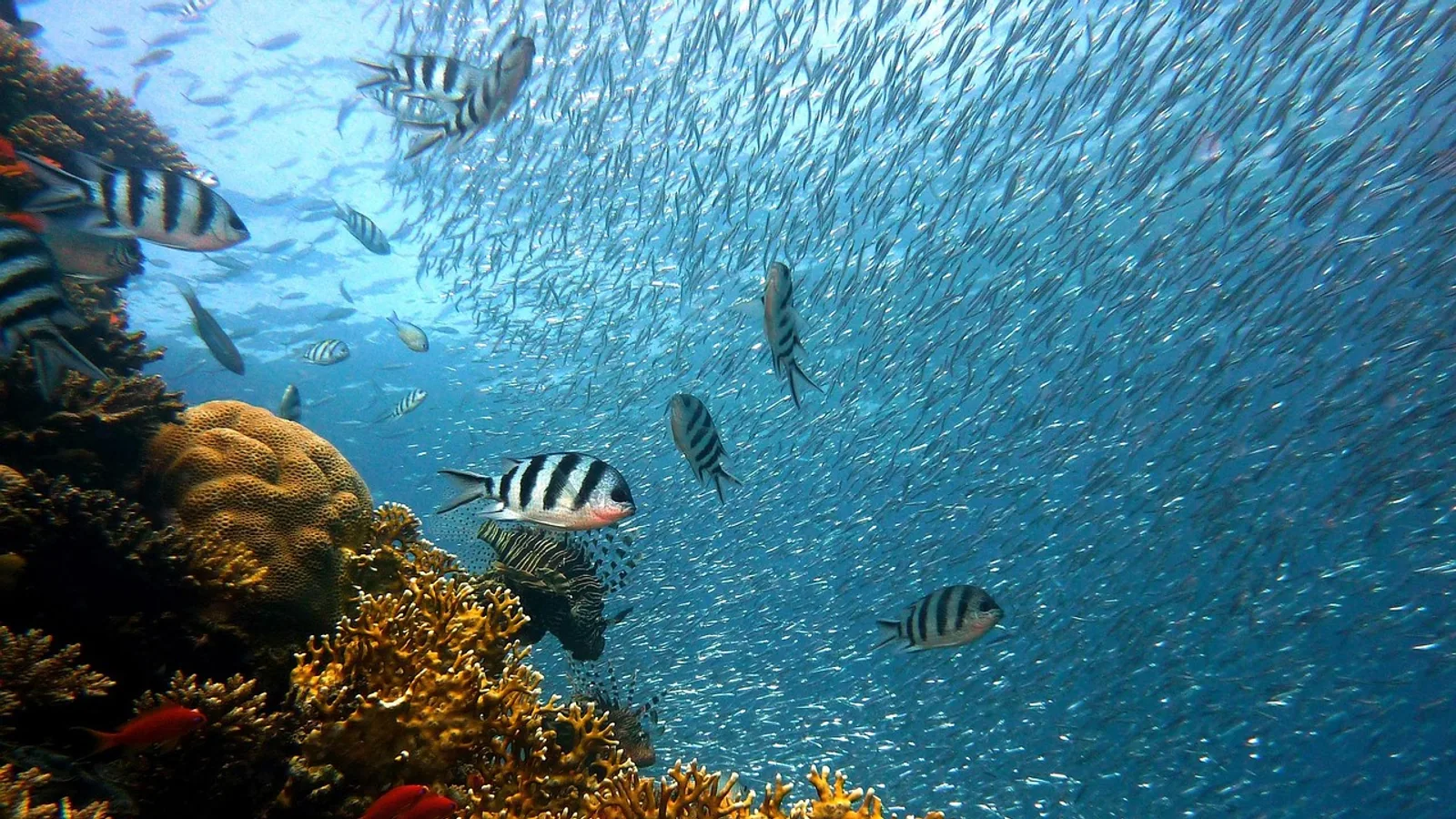
No, fish do not see water. Water is the medium they live in, just as air is the medium we live in, and neither humans nor fish perceive their own medium as a visible object. A fish sees the objects, predators, prey, and tankmates inside the water, and it sees the boundary between water and air when it looks up, but it does not see water itself as a colored or textured substance.
That short answer hides a remarkable set of adaptations. Fish eyes are built differently from ours, they detect colors we cannot, many species navigate in near-total darkness, and an entire second sensory system runs along their bodies to detect water movement. Understanding how fish vision actually works changes how you light your aquarium, how you approach the glass, and how you interpret your fish's behavior.
This article is educational and is not a substitute for veterinary diagnosis or treatment.
The Direct Answer: Why Fish Do Not See Water
Vision works when light travels from an object into an eye. For an object to be visible, it must differ in brightness, color, or contrast from its surroundings. Water surrounds a fish completely and is optically uniform in every direction. There is no edge, no boundary, and no contrast to detect, so there is nothing for the visual system to lock onto.
Humans have the same experience with air. You can see dust motes, fog, smoke, and heat shimmer, but you cannot see clean air itself. Air becomes visible only when particles or temperature gradients scatter light. Water behaves the same way. Clear water is invisible to the fish inside it. Turbid water, silt, algae blooms, and suspended particles become visible because they scatter light and create contrast.
There is one important exception. When a fish looks upward, it can see the water surface as a reflective boundary, often called Snell's window. This is the circular patch of sky and shoreline visible from below, surrounded by a mirror-like reflection of the underwater world. That surface is visible because it separates two media with different optical densities. The water itself, in every other direction, is not.
How Light Behaves Underwater
Refraction and the Spherical Lens
Light bends when it passes from water into a fish's eye. This is called refraction, and it creates a fundamental problem for any animal living in water. The human eye relies mainly on the curved front surface of the cornea to bend light into focus. Because the cornea has roughly the same refractive index as water, that trick does not work underwater. A fish cornea is nearly flat and contributes almost nothing to focusing.
Fish solved this by evolving a lens that does the entire job. A fish lens is dense, spherical, and sits close to the cornea. It has a very high refractive index, which lets it bend light sharply enough to form an image on the retina. The trade-off is that a spherical lens cannot change shape the way a human lens does. Most fish focus by moving the lens backward and forward inside the eye, using a small muscle, rather than by squeezing it flatter or rounder.
This design produces a wide field of view, often close to 180 degrees in each eye, with a narrow blind spot directly behind the head. It also means fish are typically nearsighted compared with humans, which suits a life spent navigating around rocks, plants, and other fish at close range. A review of short-range navigation in teleost fish describes how eye and retinal anatomy, combined with cognitive processing, lets fish perform motion perception, object recognition, and recognition across changes in viewpoint or lighting [1].
The Shape of a Fish Eye
Fish eyes are usually large relative to body size, and they bulge slightly from the head rather than sitting in deep sockets. There is no eyelid in most species. Instead, the eye is bathed directly by tank water, which keeps the cornea clean and oxygenated. Some species have a fatty or transparent covering, but the basic plan is the same.
Behind the lens, the retina contains photoreceptor cells. These come in two main types. Rods work in dim light and do not distinguish color. Cones work in brighter light and provide color vision. The ratio of rods to cones varies enormously between species and reflects the light environment each fish evolved in. A nocturnal catfish has a rod-dominated retina. A shallow-water reef fish may have a cone-rich retina tuned to a broad spectrum.
Can Fish See Color?
The Opsin Toolkit
Color vision depends on photopigments built from a protein called opsin plus a light-sensitive chromophore. Each opsin is tuned to absorb best at a particular wavelength. The more spectrally distinct opsins an animal expresses, the more colors it can discriminate.
Teleost fish, the group that includes almost all aquarium species, have more copies of visual opsin genes than amphibians, reptiles, birds, or mammals [2]. These extra copies arose through gene duplication, and many of them subsequently diversified at key spectral-tuning sites. The result is visual pigments sensitive across the ultraviolet to red spectrum. Species-specific opsin repertoires correlate strongly with underwater light habitat, ecology, and color-based sexual selection [2].
This is why a goldfish can distinguish red, green, blue, and ultraviolet, while a human sees only red, green, and blue. Zebrafish are a well-studied example, with cone photoreceptors sensitive to red, green, blue, and ultraviolet light [3]. The retinal circuitry behind this is complex. Horizontal cells in the fish retina establish diverse spectral responses, and cone-selective connections to bipolar cells set up color-opponent channels that travel to the brain [4].
Ultraviolet Vision
Many fish see ultraviolet light, which humans cannot. UV is abundant in shallow, clear water and fades quickly with depth or turbidity. Species that live near the surface and use UV for foraging or mate choice often retain UV-sensitive cones. Species in deeper or murkier water tend to lose them.
UV vision matters for aquarists because standard aquarium lighting and glass can filter UV. A fish that evolved to see UV patterns on conspecifics may perceive a different world under your light fixture than it would in nature. This is one reason that matching light spectrum to a species' natural habitat is more than an aesthetic choice.
Color Vision Varies by Species and Habitat
Not every fish sees the same colors. A meta-analysis of 573 effect sizes from 36 studies found that plasticity in opsin gene expression is widespread across teleost fish and generally strong [5]. Internal stimuli such as hormonal changes produced larger and more consistent shifts than external light conditions, particularly in the red-sensitive lws gene and the UV-sensitive sws1 gene. The capacity to modulate the visual system appears broadly distributed across teleost lineages rather than restricted to a few specialists [5].
Habitat shapes color vision over evolutionary time as well. Midas cichlids in Nicaragua offer a striking example. Populations adapted to short-wavelength light in clear lakes have lower thyroid hormone levels than populations in turbid lakes enriched in long-wavelength light. When researchers manipulated thyroid hormone in young cichlids, exogenous hormone shifted sensitivity toward longer wavelengths by changing opsin expression and chromophore usage together, while hormone inhibition shifted sensitivity toward shorter wavelengths [6]. The same endocrine signal regulates differential expression within tandem opsin arrays in zebrafish, and individual cones can switch which gene they express [7]. This means a fish's color vision is not entirely fixed at birth. It can be tuned by hormonal signals during development.
Can Fish See in the Dark?
Rods, Taps, and Low-Light Specialists
Many aquarium fish are crepuscular or nocturnal. They feed at dawn, dusk, or after lights out. Their retinas are packed with rods, which capture dim light far more efficiently than cones. Some species add a reflective layer called the tapetum lucidum behind the retina, which bounces light back through the photoreceptors for a second chance at absorption. This is why some fish eyes glow when a flashlight hits them at night.
Rods cannot distinguish color, so a fish hunting in near-darkness sees a monochrome world of shapes and motion. That is usually enough. A moving insect or a struggling prey item creates contrast that a rod-rich retina detects easily.
Absolute Darkness and the Limits of Vision
No eye can see in the total absence of light. In a completely dark tank, a fish relies on other senses. The lateral line detects water movement, and the olfactory system detects dissolved chemicals. This is why fish can still find food and avoid obstacles in a blacked-out aquarium, though they move more cautiously.
Blind cavefish offer an extreme example. Mexican blind cavefish have lost functional eyes and rely on the lateral line to navigate. When researchers ablated the lateral line, the fish increased their swimming speed, presumably to improve flow sensing, and touched obstacles more often. They also leaned more on fin and snout mechanoreception. The study concluded that blind cavefish have compensatory sensory mechanisms that let them navigate novel environments when their major sensory system is not working [8].
What "Can Fish See in the Dark" Really Means for Aquarists
A fish can see in dim light far better than you can. It cannot see in zero light. This has practical consequences. Leaving a tank light on all night does not help a nocturnal fish. It disrupts the day-night cycle and can increase stress. A dim blue or red moon light is a common compromise, but even that should be off for part of the night. Total darkness is normal and necessary.
The Lateral Line: A Second Way to Sense the World
What the Lateral Line Detects
The lateral line is a mechanosensory system found in all fishes. It detects water movement and pressure fields, and it mediates behaviors that are essential for survival in water [9]. The functional units are neuromasts, small sensory organs containing hair cells. Superficial neuromasts sit on the skin surface. Canal neuromasts sit inside fluid-filled canals beneath the skin, where they are protected from constant background flow and better tuned to rapid pressure changes.
The cupula, a gelatinous cap covering each neuromast, bends when water flows past it. Computational modeling shows that cupula sensitivity varies with its shape, size, height, material properties, and the direction of flow relative to its major axis [9]. This diversity of form lets different species tune their lateral line to different flow regimes.
How Fast the Lateral Line Responds
The lateral line is faster than vision. A study of rummy-nose tetra schools found that fish able to sense the flow of their neighbors responded to accelerations with a latency one-third shorter than fish with a compromised lateral line. Flow-sensing schools also showed higher mutual information and a more efficient communication network [10]. No difference appeared during deceleration, which suggests the lateral line is especially important when fish must react quickly to a neighbor speeding up.
This speed advantage matters in a home aquarium. When one fish darts, others may react before they have visually processed the movement. The lateral line gives them a head start.
The Lateral Line and Aquarium Stressors
The lateral line is vulnerable. High stocking densities in aquaculture upregulated genes related to glucocorticoid secretion, hypoxia, and oxidative stress in the lateral line skin of grass carp and turbot, and altered circadian rhythm-related gene expression in leopard coral grouper [11]. This is a reminder that crowding affects sensory systems, not just growth and behavior.
Environmental toxins also damage the lateral line. Minnows exposed to sublethal diesel concentrations for 24 hours had significantly decreased lateral line neuromast counts and severe eye pathology, and diesel-exposed prey made up 77 percent of predated fish across all predation events [12]. The authors attributed reduced predator avoidance to sensory impairment. For aquarists, this reinforces the importance of water quality and prompt removal of contaminants.
One encouraging finding is that lateral line hair cells regenerate. In zebrafish, ybx1 acts upstream of atoh1a to promote rapid hair cell regeneration in neuromasts, and mutant larvae initiate regeneration about 20 percent slower than normal siblings [13]. This regenerative capacity is why the lateral line is a useful model for hearing research and why some damage may be reversible if the insult is removed.
Do Fish Recognize Their Owners?
The Archerfish Face Study
Archerfish are famous for spitting jets of water at insects above the surface. They can also be trained to discriminate between human faces. In controlled studies, archerfish learned to pick out one face from a set of others, even when the faces were converted to grayscale and the internal features were standardized. They could do this reliably, which suggests they form complex visual categories rather than memorizing simple cues.
This does not mean your betta knows your name. It means fish are capable of sophisticated visual discrimination, including the kind of pattern recognition that lets them tell one person from another. In a home aquarium, a fish that swims to the front when you approach may be responding to your silhouette, your movement pattern, or the association between you and food. The distinction between recognition and association is hard to prove outside a controlled experiment.
What Fish Likely Notice About You
Fish are sensitive to motion, contrast, and size. A person walking past a tank creates a large moving stimulus. A hand reaching over the tank may signal feeding. Over time, fish can learn that certain visual cues predict food or safety. This is operant and classical conditioning, not affection in the human sense. It is still a real form of learning, and it is one reason fish can become tame enough to hand-feed.
Visual exposure to conspecifics also matters. A study of zebrafish found that observers of conspecifics having seizures did not show the canonical stress response or cortisol increase seen in other stress contagion paradigms, but both demonstrators and observers spent less time in the portion of their tanks adjacent to the social partner [14]. The authors concluded that visual exposure to a pronounced non-ethological motor disturbance altered social positioning without transferring stress. In plain terms, fish notice what other fish are doing, and it changes where they choose to be, even when it does not raise their stress hormones.
Can Fish See Glass? Glass Surfing and Reflections
Why Fish Sometimes Swim Against the Glass
Glass is transparent to visible light, so a fish looking straight through it sees the room beyond. But glass also reflects. At certain angles and light levels, the inside of the tank acts like a mirror. A fish may see its own reflection and treat it as a rival. This is common in bettas, cichlids, and other territorial species. The fish flares, charges, and repeatedly returns to the same spot. This is glass surfing driven by reflection, not by the glass itself.
Glass surfing can also be a sign of stress, boredom, or poor water quality. A fish that paces the front pane for hours may be reacting to a reflection, a too-small tank, or an uncomfortable parameter. The behavior alone does not tell you which. Context matters.
Reducing Reflection and Glass Surfing
You can reduce reflection by lowering the difference in light between the tank and the room. A bright room light behind the tank makes the glass more transparent and less mirror-like. Blacking out the back and sides of the tank also reduces confusing reflections. Adding plants, driftwood, or other visual barriers breaks up the open space that encourages pacing.
For territorial species, a background that reduces the fish's ability to see its own reflection is often enough to stop the behavior. If the fish continues to surf despite these changes, check water quality, temperature, and tank size. Persistent glass surfing is a welfare signal.
Can Fish See the Glass Itself?
A clean glass pane is nearly invisible to a fish looking through it. A dirty pane, a pane with algae, or a pane with water spots becomes visible because it scatters light. From the fish's side, the glass is usually not perceived as an object. The fish perceives the room beyond, the reflection in front of it, or both.
Lighting Implications for Aquarium Welfare
The Day-Night Cycle
Fish have circadian rhythms. The lateral line study on leopard coral grouper found that high stocking density altered circadian rhythm-related gene expression in the lateral line skin [11]. This is a reminder that light cycles affect physiology at the gene level, not just behavior.
A consistent day-night cycle supports normal feeding, resting, and social behavior. Most tropical aquarium fish do well with 8 to 12 hours of light and 12 to 16 hours of darkness. The exact schedule depends on the species and its natural habitat. Nocturnal species need a true dark period. Diurnal species need a predictable light period.
Why Sudden Lights Are Stressful
Turning on a bright overhead light in a dark room is startling to a fish. The pupil cannot adjust instantly, and the sudden change in illumination can trigger a startle response. A fish that bolts, hides, or jumps when the light snaps on is showing you that the transition was too abrupt.
A gradual ramp-up, either from a dimmable fixture or from ambient room light before the tank light, softens the transition. The same applies at night. Turning the tank light off while the room remains lit is gentler than plunging the tank into darkness.
Matching Spectrum to Species
Because fish color vision varies by species and habitat, a single "best" spectrum does not exist. A shallow-water species with UV and blue sensitivity may benefit from a fuller-spectrum light. A deep-water or turbid-water species may be adapted to narrower, longer-wavelength light. The meta-analysis on opsin plasticity found that external light conditions can shift opsin expression, though internal hormonal signals produced larger and more consistent effects [5]. This means lighting can influence the visual system over time, but it is not the only factor.
For most hobbyists, the practical goal is a stable, appropriately timed light cycle with a spectrum that supports plant growth if plants are present and does not wash out natural coloration. Extreme spectrums, such as very blue or very red lighting, are best reserved for specific setups and specific species.
Light Pollution and Algae
Leaving a tank light on continuously promotes algae growth and disrupts fish rest. It also wastes energy. A timer is one of the simplest welfare improvements you can make. It removes the human variable and gives the fish a predictable cycle.
A Table of Key Facts
| Question | Short Answer | Key Mechanism |
|---|---|---|
| Do fish see water? | No | Water is optically uniform and has no contrast edge |
| Can fish see color? | Yes, often more colors than humans | Multiple opsin genes, including UV-sensitive sws1 [2] |
| Can fish see in the dark? | Better than humans, but not in zero light | Rod-rich retinas, sometimes a tapetum lucidum |
| Can fish see glass? | They see through it or see reflections in it | Glass is transparent but reflective at some angles |
| Do fish recognize owners? | They can learn visual cues and discriminate faces | Archerfish face discrimination studies |
| What is the lateral line? | A flow-sensing system along the body | Neuromasts with hair cells and cupulae [9] |
| How fast is the lateral line? | Faster than vision for accelerations | One-third shorter response latency in schools [10] |
| Does lighting matter? | Yes, for rhythm and welfare | Circadian gene expression in lateral line skin [11] |
Practical Takeaways for Aquarium Keepers
Observe Before You Change
Before adjusting lighting, adding tankmates, or moving a fish, watch its behavior for several days. Note when it is active, when it rests, where it spends time, and whether it reacts to the glass. A written log helps you spot patterns that are invisible in the moment.
Fix the Environment Before Assuming Illness
Many visual and behavioral problems trace back to the environment. Reflections cause glass surfing. Constant light causes restlessness. Crowding stresses the lateral line. Contaminants damage the eyes and neuromasts. Before assuming a fish is sick, check water quality, temperature, lighting schedule, tank size, and tankmate compatibility.
Support the Senses You Cannot See
You cannot see the lateral line working, but you can protect it. Avoid overcrowding. Keep water clean. Remove contaminants promptly. Maintain a stable day-night cycle. These steps support both vision and mechanosensation, and they reduce the chronic stress that makes fish vulnerable to disease.
Use Light as a Welfare Tool
A timer, a dimmable fixture, and a gradual on-off transition are simple tools that improve fish welfare. They cost little and remove a common source of startle. If you keep nocturnal species, make sure they get a true dark period. If you keep diurnal species, give them a predictable light period.
Respect Species Differences
A betta, a goldfish, a cichlid, and a catfish do not see the same world. Their opsin repertoires, rod-cone ratios, and lateral line morphologies differ. Care that suits one species may not suit another. When you set up a tank, research the visual ecology of the species you keep, not just its temperature and pH preferences.
What Is Still Uncertain
Fish vision research is active, and several questions remain open. The precise way fish integrate visual and lateral line information in real time is not fully mapped. The role of thyroid hormone in tuning adult color vision, beyond development, is still being explored [7][5]. The extent to which individual fish recognize specific humans outside controlled experiments is difficult to establish. The long-term effects of aquarium lighting spectra on opsin expression in home tanks have not been studied in detail.
What is clear is that fish perceive their environment through a rich combination of vision and mechanosensation. They see color, motion, and contrast. They feel water movement with a dedicated sensory system. They do not see the water they swim in, any more than we see the air we breathe.
Limitations and When to Contact a Veterinarian
This article describes general principles of fish vision and sensory biology. It cannot diagnose a specific fish or predict how an individual will behave. If your fish shows any of the following signs, contact an aquatic veterinarian or a veterinarian experienced with fish:
- Persistent glass surfing that does not improve after reducing reflections and checking water quality
- Cloudy, bulging, or asymmetrical eyes
- Sudden loss of color, appetite, or normal swimming behavior
- Erratic swimming, spinning, or inability to maintain position in the water
- Visible lesions, frayed fins, or patches on the skin
- Gasping at the surface or hanging near the filter outflow
- Any behavior change that lasts more than a few days
The World Aquatic Veterinary Medical Association (WAVMA) and the Merck Veterinary Manual both provide resources on fish health for owners and veterinarians. A veterinarian can assess water quality, examine the fish, and determine whether the problem is environmental, infectious, or both.
Frequently Asked Questions
Do fish see water?
No, fish do not see water. Water surrounds them completely and is optically uniform, so there is no contrast edge for the visual system to detect. They see objects and other fish within the water, and they can see the water surface from below, but the water itself is invisible to them.
Can fish see water the way humans see air?
Fish relate to water much as humans relate to air. We do not see clean air because it has no contrast, and fish do not see clean water for the same reason. Both media become visible only when particles, bubbles, or temperature gradients scatter light.
Does fish see water as blue?
Fish do not see water as a colored substance. Water can appear blue or green to a human looking into a large body of water because of light absorption and scattering over distance, but a fish inside the water does not perceive a blue field surrounding it. It perceives the objects and light sources in its environment.
Can fish see in the dark?
Fish can see in dim light far better than humans because many species have rod-rich retinas and some have a reflective tapetum lucidum. They cannot see in total darkness. In a completely dark tank, they rely on the lateral line and smell to navigate.
Can fish see color?
Yes, most fish see color, and many see more colors than humans. Teleost fish have more visual opsin genes than mammals, and species-specific repertoires are tuned to their light habitat [2]. Zebrafish, for example, have cones sensitive to red, green, blue, and ultraviolet light [3].
Can fish see glass?
Fish can see through glass, and they can see reflections in it. A clean pane is nearly invisible from the fish's side, but at certain angles the glass acts like a mirror. This is why some fish flare at their own reflection or swim repeatedly against the front pane.
Do fish recognize their owners?
Fish can learn to associate specific visual cues with food or safety, and archerfish can discriminate between human faces in controlled studies. Whether a fish recognizes its owner as an individual outside a training context is harder to prove. The behavior you see is likely a mix of visual discrimination and learned association.
Is it bad to leave aquarium lights on all night?
Yes, leaving lights on all night disrupts the fish's day-night cycle and can increase stress. High stocking density has been shown to alter circadian rhythm-related gene expression in the lateral line skin of some species [11]. A consistent light and dark schedule supports normal behavior and physiology.
Related Articles
- Aquarium Fish Water Quality Testing and Interpretation
- Dechlorinating Water for Your Fish Tank: Methods and Best Practices
- Discus Fish Care: Tank Setup, Water, Diet, and Health
- Choosing the Right Water for Your Fish Tank: Tap, Spring, or Distilled?
- Water quality parameters amphibian fish clinical assessment
- Platy Fish Emergency Weather Prep: Temperature, Oxygen & Water Stability Guide
- Do Fish Drink Water? Freshwater vs Saltwater Fish Explained
- Saltwater Aquarium Water Changes: How Much, How Often, How To
- Fish Tank Leak: Emergency Steps, Finding It, and Resealing
Sources
- The visual challenges of short-range navigation in teleost fish.
- The Visual Opsin Gene Repertoires of Teleost Fishes: Evolution, Ecology, and Function.
- miRNA 183 Knockout Alters Cone Subtype Distribution, Transcriptional Activity and ERG Signals in the Tetrachromatic Zebrafish Visual System.
- The Retinal Basis of Vertebrate Color Vision.
- Phenotypic plasticity in visual opsin gene expression: a meta-analysis in teleost fish.
- Thyroid hormone tinkering elicits integrated phenotypic changes potentially explaining rapid adaptation of color vision in cichlid fish.
- Endocrine regulation of multichromatic color vision.
- Compensatory sensory mechanisms in naïve blind cavefish navigating novel environments after lateral line ablation.
- Functional significance of morphological variation in the mechanosensory lateral line system of fishes and its biomimetic potential.
- The Lateral Line Facilitates Rapid Responses in Accelerating Fish Schools.
- Effects of High-Density Aquaculture on Grass Carp, Leopard Coral Grouper, and Turbot: Growth Performance and Transcriptome Analysis of Lateral Line.
- Reduced predator avoidance follows ocular and lateral line pathology in minnow species after diesel exposure.
- ybx1 acts upstream of atoh1a to promote the rapid regeneration of hair cells in zebrafish lateral-line neuromasts.
- Cue-dependent limits of stress contagion in zebrafish: visual exposure to seizure-like behavior alters social positioning without stress transfer.