The Bioinformatics Application Note
By Dr. Zubair Khalid, DVM, MS, PhD ·

A bioinformatics application note is a short peer-reviewed paper, usually two to four published pages, that describes a piece of new software, a database, or a web tool for biological data analysis rather than a complete biological study. Its job is to tell the community what the tool does, what data it accepts, how it was validated, and where to get it, so that other researchers can install it and reproduce the authors' results on their own data.
These notes matter because nearly every modern biology project lives or dies by its software. Next-generation sequencing and other high-throughput technologies generate datasets that no researcher can analyze by hand, so the field depends on a steady stream of new algorithms, pipelines, and interfaces, each of which needs a compact, citable announcement [1]. If you learn bioinformatics, you will read dozens of application notes before you ever write one, and knowing how to judge them quickly is a practical skill that no bioinformatics course should skip.
What Does Bioinformatics Application Note Mean?
The phrase has a precise meaning in scientific publishing. Leading bioinformatics journals, most prominently the Oxford journal Bioinformatics, maintain a dedicated submission category and printed section header called "Application Note," and papers published there carry that label at the top of the page [2][3][4][5]. A paper that begins with the header "Bioinformatics Applications Note" is signaling that the contribution is the software itself, not a new biological discovery.
That distinction shapes everything about the document. A full research article argues for a biological conclusion, such as a new disease-associated gene or a revised pathway. An application note argues for a computational contribution, such as a faster algorithm, a friendlier interface, or a new way to package an existing statistical method. The biology appears only as a demonstration that the tool works on real data.
Readers searching for a "bioinformatics application note explained" usually want two things at once: the definition of the article type, and a way to make sense of the dense technical content inside one. This article covers both. First we look at the format, then we walk through real published examples, then we cover how to interpret and evaluate a note before you trust its software with your own data.
Where the Format Came From and Why It Exists
Through the 1990s, bioinformatics software was described inside full-length methods papers or released informally by email. As sequencing output grew, that arrangement broke down. A tool that solved one narrow but important task, such as converting between sequence formats or visualizing SNP-gene associations, did not contain enough biological content to fill a traditional article, yet the community needed a citable record of it.
Journals solved this with a compressed article type. The Bioinformatics journal formalized the Applications Note section, and the same header appears across decades of the literature, from early integrated software packages in 2004 [4] to web tools for RNA sequence processing [3] and, much later, interactive analysis platforms [6]. The persistent header in the published PDFs is the reason the phrase "Bioinformatics Applications Note" appears verbatim in so many database records [5].
The format spread beyond a single journal. Journals in adjacent fields adopted short software-paper categories, and preprint servers now carry software announcements as well, which matters because peer review of a preprinted tool can trail the tool's actual use by months. The core idea stayed constant across all of these venues: describe the tool, prove it runs, give the reader a way to obtain it.
The Anatomy of an Application Note
Most application notes, whatever the journal, follow the same four-part skeleton. Learning the skeleton is the fastest way to read them quickly.
1. Motivation
One or two sentences state the problem. Good motivation paragraphs name the gap honestly. For example, the authors of two Bioconductor packages for tensor decomposition-based unsupervised feature extraction stated that the method had proven effective for biomarker identification, disease gene discovery, and drug repositioning, but had failed to gain widespread acceptance because non-experts lacked user-friendly tools. That single framing sentence tells you exactly what contribution to expect. Similarly, the VAREANT authors framed their tool around the gap between the volume of genomic variant data being produced and the scarcity of accessible tools to prepare that data for analysis [7].
2. Implementation
This section names the language, the dependencies, the architecture, and any server infrastructure. A web-based tool for processing RNA sequences, for instance, would describe its web front end and the processing steps it performs behind the interface [3]. A database-backed desktop tool would describe its data schema and graphical framework, as the Genevar authors did for their Java application built to explore SNP-gene associations in eQTL studies [2]. An integrated suite like BIAS, published in the databases and ontologies category in 2004, described how multiple analysis functions were bundled behind one interface [4].
Implementation details are not trivia. They tell you whether the tool will run on your hardware, whether you can modify it, and whether its dependencies conflict with the rest of your environment.
3. Results or Use Cases
Application notes demonstrate the tool on real or benchmark data rather than testing a biological hypothesis. The DECOMICS authors, for example, described a Shiny web application for unsupervised cell-type deconvolution of bulk transcriptomic and methylomic data, and listed its three capabilities: a selection of existing deconvolution algorithms, an enrichment analysis module for biological interpretation of the deconvolved components, and visualization tools, with results downloadable in CSV format [6]. The claim being tested is operational, meaning that the workflow runs end to end and produces interpretable output, not that a biological hypothesis is true.
Some notes include quantitative comparisons with existing tools. The TDbasedUFE authors reported that their packages outperformed two state-of-the-art methods, DESeq2 and DIABLO, on the tasks they tested [8]. When a note includes head-to-head numbers, read the benchmark design carefully, because authors choose the comparison datasets themselves.
4. Availability and Implementation
Every credible application note ends with a statement of where the software lives. This might be a Bioconductor package URL, as with TDbasedUFE and TDbasedUFEadv, which were released as freely available R/Bioconductor packages with stable package pages [8]. It might be a source repository and Docker image, as with DECOMICS, which could be run from a local R session, from a provided virtual machine, or through a national life-science cloud service [6]. Availability is the single most load-bearing sentence in the note. A tool without a working download link, an archived release, and version documentation is a description of software rather than software.
A Summary Table of the Article Types
Students often confuse the application note with neighboring article types. The table below separates them.
| Feature | Application note | Full research article | Review article | Research note or letter |
|---|---|---|---|---|
| Primary contribution | Software, database, or web tool [2][4][6] | New biological finding or method | Synthesis of published work | Small but citable observation |
| Typical length | 2 to 4 published pages | 8 to 15 pages | 10 to 30 pages | 1 to 3 pages |
| Peer review focus | Does the tool work, install, and fill a need [9] | Is the finding sound and novel | Is the synthesis accurate | Is the observation correct |
| Data presented | Demonstration datasets, benchmarks [8] | Full experimental results | Figures summarized from literature | Preliminary or negative results |
| Reproducibility burden | Source code, version, install path [8][6] | Methods, code, raw data | Low | Methods and data |
| Typical failure mode | Tool becomes unmaintained after publication [9] | Overstated conclusions | Stale references | Thin novelty |
| Example | DECOMICS deconvolution app [6] | A GWAS discovery paper | A narrative review of sequencing methods [1] | Database choice altering microbiota results [10] |
One adjacent label deserves mention because it is easy to conflate. A "research note" is a different format from an application note. A research note reports a compact scientific observation, such as the finding that the choice of taxonomic database changes the results and interpretation of chicken cecal microbiota analysis [10]. It contains no software contribution at all. If you cite a research note as if it were an application note in a manuscript or a bioinformatics course assignment, a reviewer will notice.
Worked Examples From the Published Literature
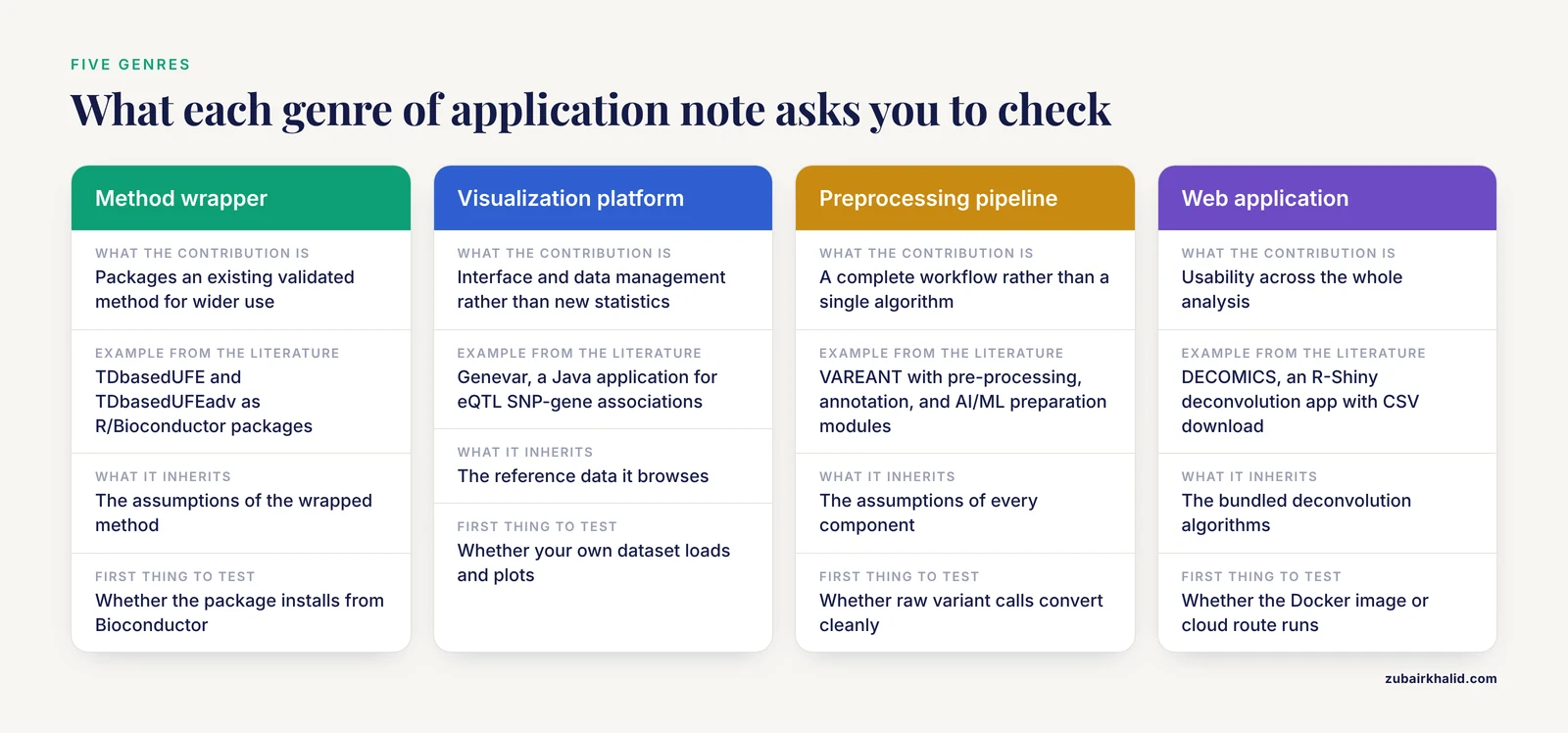
Abstract advice sticks better with concrete cases. Here are five published application notes that show the range of the format.
Comparing SNP effects across GWAS datasets
One note described using Fisher's method, applied to linkage-disequilibrium-clumped output from PLINK, to compare SNP effects across genome-wide association study datasets [11]. PLINK is the standard command-line toolkit for GWAS data, and its clumping procedure groups correlated SNPs so that independent signals can be compared. The note's contribution was a statistical workflow, meaning a recipe built from existing components, packaged and documented so that other GWAS analysts could apply it to their own datasets. Many application notes are exactly this kind of contribution, a smart assembly of standard tools rather than a novel algorithm, and the format exists partly so that such workflows get proper credit.
Visualizing eQTL associations
Genevar was described as a database and Java application for the analysis and visualization of SNP-gene associations in eQTL studies [2]. An eQTL, short for expression quantitative trait locus, is a genetic variant associated with the expression level of a gene, and eQTL datasets produce thousands of variant-gene pairs that researchers need to browse, filter, and plot. Genevar's contribution was interface and data management rather than statistics, which illustrates a second common application-note genre: the tool that makes an existing data type explorable.
Lowering the barrier to an existing method
The TDbasedUFE and TDbasedUFEadv packages wrapped tensor decomposition-based unsupervised feature extraction, a technique already validated across biomarker discovery, disease gene identification, and drug repositioning, into Bioconductor packages so that researchers unfamiliar with tensor decomposition could use it [8]. The note explicitly framed accessibility as the motivation, and the packages support identifying differentially expressed genes and performing multiomics analysis. This genre, method-wrapper notes, is extremely common and often produces the highest-impact tools because it moves a good algorithm from specialists to the wider community.
Preparing variant data for downstream analysis
VAREANT, released as a preprint in 2024, tackles the unglamorous but essential work of turning raw variant call data into an analysis-ready format [7]. It ships as three standalone modules: pre-processing for fine-grained filtering of complex variant datasets, variant annotation that adds metadata from public annotation databases, and AI/ML data preparation that builds datasets suitable for immediate machine learning analysis. The authors framed the problem around data volume, computational and storage costs, and the difficulty of identifying relevant information. This note is a good example of the pipeline genre, where the contribution is a complete workflow rather than a single algorithm.
Making deconvolution accessible through a web interface
DECOMICS is an R-Shiny web application for unsupervised cell-type deconvolution of bulk omic data [6]. Bulk tissue samples mix signals from multiple cell types, and deconvolution algorithms estimate the composition from the mixed profile. Because applying those algorithms and interpreting the output is difficult without bioinformatics training, DECOMICS bundles several existing algorithms, adds an enrichment analysis module for biological interpretation, provides visualization, supports in-app preprocessing such as normalization, transformation, and feature selection, and lets users download results as CSV. It can be launched from a local R session using the package from the authors' repository, installed via a Docker image, or run through a national life-science cloud platform [6]. This is the full-service genre, where usability across the entire analysis is the contribution.
These five examples span statistical workflows, visualization platforms, method wrappers, preprocessing pipelines, and web applications. Every one of them would have struggled to fit a traditional research article, and every one of them earned its authors a citable, dated, peer-reviewed record through the application note format.
How Application Notes Are Reviewed and What Reviewers Check
Peer review of an application note differs from review of a research article. Reviewers generally assess four things, and understanding them helps you predict where weak notes fail.
First, reviewers check novelty and necessity. The field has a documented overproduction problem. As one analysis of the software ecosystem put it, many computational tools exist with numerous alternatives for the same task, workflow management systems are duplicated across groups, software quality is often of low concern, and small proof-of-principle datasets are used to support rapid publication [9]. A reviewer's first question is therefore whether the field needs another tool for this task, or whether the note merely repackages existing work.
Second, reviewers evaluate validation. Because notes usually demonstrate the tool on one or a few datasets, the depth of validation is the weakest link, and the community literature is explicit that small proof-of-principle datasets and low software quality are chronic issues [9]. Strong notes anticipate this with benchmarks against established alternatives, as the TDbasedUFE authors did against DESeq2 and DIABLO [8], or with performance and scalability analysis, as the Hadoop-in-structural-bioinformatics review did when it examined ligand-protein docking and structural alignment implementations and found that direct performance comparisons were rarely available and that MPI implementations sometimes scaled better than Hadoop [12].
Third, reviewers verify availability. The expectation is a permanent, versioned location, ideally with containerization or package-manager installation so that dependencies resolve cleanly. Containers and virtual machines ease installation, but as the software-quality critique observed, they do not solve the underlying quality and duplication problems [9].
Fourth, reviewers increasingly consider how interpretation risk is handled. This concern has sharpened with the arrival of large language models in bioinformatics workflows. A recent framework for responsible LLM use in microbial genomics catalogued the risks that also apply to any computational output consumed without verification: hallucinated biological claims, inaccurate citations, irreproducible code, unsupported genotype-to-phenotype inference, and inappropriate clinical framing, and proposed classifying outputs by reliability before scientific or clinical use [13]. Application notes that guide users toward correct interpretation, or that state clearly what their output does and does not mean, age far better than those that leave interpretation entirely to the user.
Bioinformatics Application Note Interpretation: A Practical Reading Method
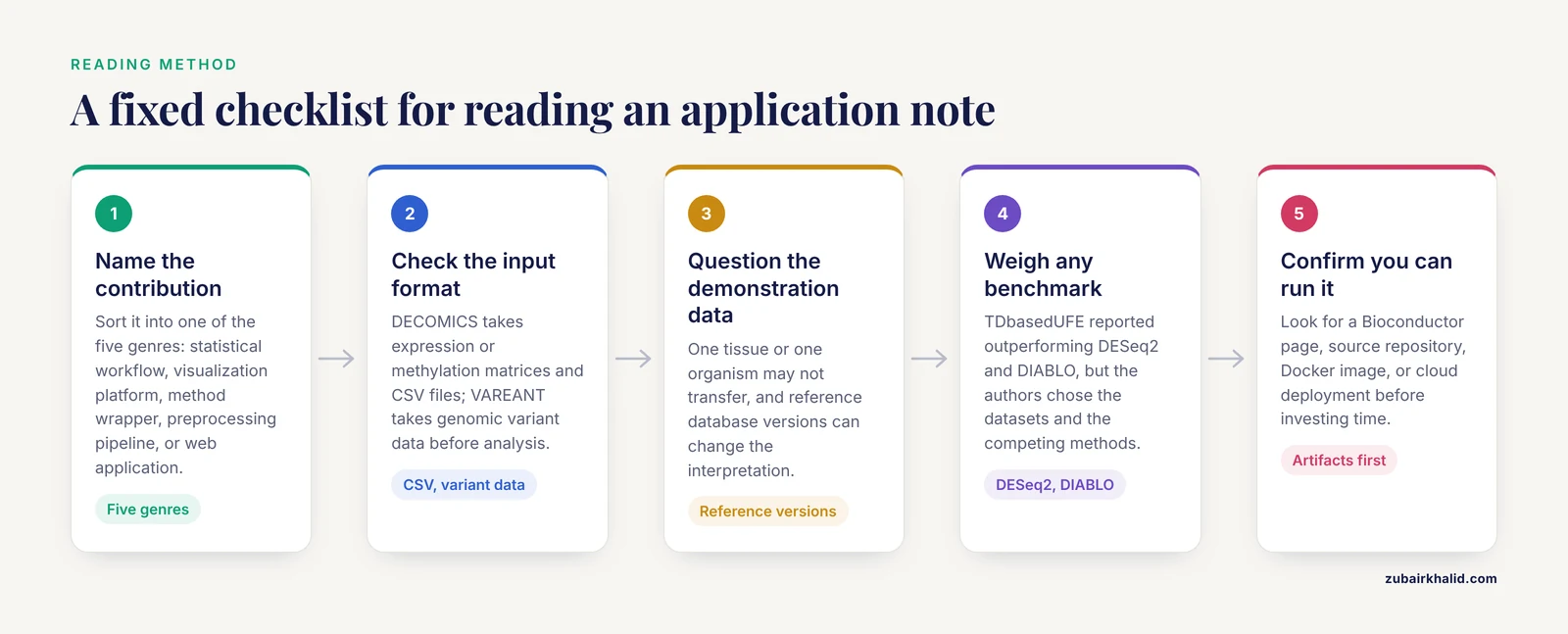
Interpreting an application note is a skill you can practice on a fixed checklist. When you open one, work through the following questions in order.
What exactly is the contribution? Sort it into one of the five genres from the examples above. A statistical workflow, a visualization platform, a method wrapper, a preprocessing pipeline, or a web application each carries different risks. A wrapper inherits the assumptions of the wrapped method. A pipeline inherits the assumptions of every component.
What input does the tool expect? Notes usually specify data formats, and the specifics matter enormously in practice. DECOMICS accepts gene expression or methylation-level matrices, offers in-app normalization and feature selection, and works with CSV files [6]. VAREANT works on genomic variant data and targets the preprocessing stage before analysis [7]. If the note is vague about input format, that vagueness is a warning sign you will discover the hard way at install time.
What was the demonstration dataset? A tool validated on one tissue or one organism may not transfer. The microbiota literature offers a sharp illustration of how dataset-specific the downstream interpretation is: when the same 16S dataset processed through QIIME 2 was assigned taxonomy with Greengenes, RDP, and SILVA, the results differed, with SILVA classifying members of the family Lachnospiraceae into separate genera while Greengenes, which had not been updated since 2013, and RDP left them in one unclassified group, and LEfSe analyses showed that SILVA produced more differentially abundant genera [10]. The software was the same. The database choice changed the interpretation. When you read an application note, ask which reference databases, annotation releases, and versions underlie its results, because the same fragility applies.
Is there a quantitative comparison, and is it fair? Some notes benchmark. TDbasedUFE reported outperforming DESeq2 and DIABLO [8]. Treat such comparisons as encouraging rather than definitive, since the authors selected the datasets and the competing methods.
Can you actually obtain and run it? Check the availability statement before investing time. Bioconductor package pages, source repositories, Docker images, and cloud deployments all signal different levels of maintenance commitment [8][6]. A note whose availability statement points only to an email address has effectively already failed this test.
What does the output mean? The best notes explain interpretation. DECOMICS pairs its deconvolution with an enrichment module specifically to aid biological interpretation of the components [6]. Tools that omit interpretive guidance push the hardest part of the analysis back onto the user, which is where unsupported inference creeps in [13].
This checklist is the core of what "bioinformatics application note interpretation" means in practice. It converts a two-page technical paper into a decision about whether the tool deserves a place in your workflow.
Where Application Notes Fit in Learning Bioinformatics
If your goal is to learn bioinformatics, application notes are the literature genre you will consume most often, and they reward a different reading style than textbook chapters. A bioinformatics course typically teaches stable fundamentals, alignment theory, statistical testing, standard file formats like FASTQ and VCF, and the command line. Application notes sit at the moving frontier past the textbook, announcing the newest tools for variant annotation [7], deconvolution [6], feature extraction [8], and sequence processing [3].
A practical training strategy is to read one note per week alongside a hands-on task. Pick a note, download the tool, run it on a public dataset, and compare your output to the figures in the paper. This exercise teaches three lessons at once: how the format compresses information, where the unstated assumptions hide, and how much of real analysis depends on parameters and reference data that the note mentions only in passing. Students who do this regularly develop the judgment to distinguish a well-supported note from a thin one long before peer review would.
The breadth of the field also becomes visible through this literature. The same note format announces tools for GWAS analysis [11], eQTL visualization [2], RNA processing [3], tensor decomposition [8], variant preparation [7], and deconvolution [6], and the surrounding literature shows the same computational methods reaching into ischemic stroke research from prevention through prognosis [14], agriculture and animal sciences through next-generation sequencing analysis [15], microarray-based analysis for environmental bioremediation applications [16], and data mining approaches to biological interpretation generally [17]. No course syllabus covers all of it. The application note is how working scientists keep up.
How Application Notes Are Tested and Validated in Practice
Beyond journal peer review, an application note faces a second, harsher trial, which is adoption. The community tests a tool implicitly through use, and several failure modes show up repeatedly in that trial.
Installation failure is the most common. Dependencies drift, operating systems change, and a tool that ran at publication stops building two years later. This is why container images and virtual machines have become frequent companion artifacts, as with DECOMICS, which shipped a Docker image and a virtual machine alongside its R package [6]. The software-quality critique in the literature is blunt that these packaging solutions ease installation but do not fix quality [9], so treat a working container as necessary rather than sufficient.
Performance claims face their own trial. A review of Hadoop deployments in structural bioinformatics found that most implementations simply called existing executables from MapReduce rather than rewriting algorithms, that scalability behavior varied compared to other batch schedulers, and that direct comparisons on the same platform were generally unavailable [12]. The lesson generalizes, meaning that throughput and scalability claims in notes should be tested on your own data volume before you build a pipeline around them.
Interpretation claims face the least formal testing and deserve the most reader skepticism. The food-industry whole-genome sequencing literature documents how difficult robust interpretation is even in a high-stakes setting: despite standardization of wet-lab and sequencing protocols guided by regulatory authorities and international efforts, data analysis and results interpretation guidelines remained fragmented across institutions, with little consensus on a standard way to process the data and interpret the results [18]. If interpretation lags this badly in an industrial setting with regulatory pressure, an application note's interpretive guidance, offered in a few sentences, should be read as a starting point rather than a protocol.
Finally, the field's collective response to these trials has been a call for community-wide collaboration to ensure software quality, increase code reuse, force proper software review, increase testing, and make interoperability seamless, precisely because individual notes cannot carry that burden alone [9]. When you evaluate a note, you are effectively voting in that system, and tools that provide versioned releases, tests, and documentation are the ones that deserve your citation.
The Relationship to Reproducibility and Trust
Reproducibility is where the application note format shows its age. The original compact format assumed readers would contact authors for code. Modern expectations are heavier, and the literature documents the gap. Virtually all biomedical applications now involve computational data analysis, the number of alternative tools keeps growing, and quality assurance lags [9]. At the same time, new classes of tooling, including LLM-assisted coding and workflow troubleshooting, introduce risks such as irreproducible code and hallucinated citations that require evidence verification and expert validation before use [13].
For the reader, the practical rule is simple. A note earns trust through its artifacts, not its prose. The artifacts are the source repository, the version number, the container or package manager entry, the test data, and the parameter settings used to produce every figure. TDbasedUFE earned immediate trust by publishing through Bioconductor, which enforces package standards and provides stable versioned URLs [8]. DECOMICS earned trust by offering four independent ways to run it, including a cloud deployment. Notes that offer none of these artifacts are asking for faith, and faith is not a reproducibility strategy.
Common Mistakes and Limitations
Students and even experienced analysts make predictable errors with application notes. The following are the ones worth unlearning.
- Citing the note as evidence for a biological claim. An application note demonstrates that a tool runs, not that a biological hypothesis holds. The TDbasedUFE note shows the packages work and compare well on selected benchmarks [8], but any biological conclusion drawn from a TD-based analysis needs its own full study.
- Assuming the demonstration dataset is representative. Notes validate on one or a few datasets, and the literature explicitly identifies small proof-of-principle datasets as a chronic weakness of published software [9]. Test on your own data before committing.
- Ignoring reference database versions. The same microbiota dataset produced materially different taxonomic assignments and differential-abundance findings under Greengenes, RDP, and SILVA, partly because one database had not been updated since 2013 [10]. Any tool that assigns taxonomy, annotates variants, or maps identifiers inherits a reference version, and that version belongs in your methods section.
- Confusing an application note with a research note. They are different article types. A research note reports a compact scientific finding, such as the database-comparison result above [10], while an application note reports software.
- Over-reading benchmark wins. A single reported comparison against two methods, as in the TDbasedUFE note [8], is a signal, not a verdict. Benchmark design, dataset choice, and parameter tuning all sit under the authors' control.
- Building on unmaintained software without an exit plan. Tools published as preprints, such as VAREANT [7], may still be evolving. Pin versions, containerize your workflow, and record the exact release you used so results remain reproducible when the tool changes.
- Trusting generated code or interpretations without verification. The microbial genomics framework for LLM use documents hallucinated biological claims, irreproducible code, and unsupported genotype-to-phenotype inference as concrete, observed failure modes, and recommends explicit verification before scientific or clinical use [13]. Apply the same standard to any tool output you did not independently sanity-check.
- Assuming peer review guarantees the tool still works. Review happens once, at a moment in time. The Hadoop review noted that interface and configuration difficulty was a significant barrier even for well-reviewed systems [12], and barriers only shift over time.
A final limitation concerns scope. Application notes compress their methods into a few hundred words, so subtle choices about filtering, normalization, and parameters are often under-documented. When a note's description is insufficient for exact reproduction, contact the authors or consult their repository documentation rather than guessing. Individual scientific results, like individual clinical cases, always need appropriate expert judgment before they inform decisions.
Quick Review
- A bioinformatics application note is a short peer-reviewed paper whose contribution is software, a database, or a web tool rather than a biological finding [2][4][6].
- The format exists to give computational contributions a citable, dated record, and the "Applications Note" section header in journals marks it explicitly [5].
- The standard structure is motivation, implementation, demonstration results, and an availability statement [7].
- Common genres include statistical workflows assembled from standard tools [11], visualization and database platforms [2], method wrappers that lower adoption barriers [8], preprocessing pipelines [7], and full-service web applications [6].
- Peer review of notes checks novelty, validation depth, availability, and interpretive guidance, and the field's own literature identifies small validation datasets and uneven software quality as chronic weaknesses [9].
- Reference data choices change results, as shown when Greengenes, RDP, and SILVA produced different taxonomic assignments and differential-abundance findings on the same dataset [10].
- Trust a note through its artifacts, including versioned releases, containers, and documented parameters, not through its prose [9].
Frequently Asked Questions
What does bioinformatics application note mean?
It is a compact, peer-reviewed journal article, typically two to four pages, whose primary contribution is a piece of software, a database, or a web tool for biological data analysis. Journals publish these under a dedicated "Application Note" or "Applications Note" section header, which is where the name comes from [2][5].
How is an application note different from a full research paper?
A research paper argues for a biological or methodological finding, while an application note argues that a tool works and fills a need. The note presents the implementation, a demonstration on real data, and a download location, and it does not carry the weight of a complete biological study.
How should I interpret the results section of an application note?
Read it as an operational demonstration, meaning proof that the tool runs end to end and produces interpretable output, rather than as hypothesis testing. Check which demonstration datasets were used, whether any head-to-head benchmark against established methods was included, and what reference databases or versions underlie the results.
Are application notes peer reviewed?
Yes, in the journals that publish them under the Applications Note header. Review focuses on novelty, whether the tool functions and installs, validation depth, and availability, though the compressed format means validation is usually narrower than in a full methods paper, a weakness the field's own software-quality literature acknowledges [9].
Why do so many bioinformatics tools have application notes instead of full papers?
Because software contributions often lack the biological narrative a full paper requires, yet the community needs citable, dated records to build on. The compact format lets a workflow assembled from standard tools [11], a visualization platform [2], or a method wrapper [8] receive proper scholarly credit without padding.
Can I use an application note's tool for my own research data?
Yes, that is the purpose of the format, but treat the note as a starting point. Confirm you can obtain the exact version, test the tool on a small subset of your data first, record all parameters and reference database versions, and verify that the tool's interpretive assumptions match your experimental design before scaling up.
Sources
- Bioinformatics Methods and Biological Interpretation for Next-Generation Sequencing Data
- Bioinformatics Applications Note Genetics and Population Analysis Genevar: a Database and Java Application for the Analysis and Visualization of Snp-gene Associations in Eqtl Studies
- Bioinformatics Applications Note Databases and Ontologies Waprna: a Web-based Application for the Processing of Rna Sequences
- BIOINFORMATICS APPLICATIONS NOTE Databases and ontologies BIAS: Bioinformatics Integrated Application Software
- BIOINFORMATICS APPLICATIONS NOTE
- DECOMICS, a shiny application for unsupervised cell type deconvolution and biological interpretation of bulk omic data
- VAREANT: a bioinformatics application for gene variant reduction and annotation
- Application note: TDbasedUFE and TDbasedUFEadv: bioconductor packages to perform tensor decomposition based unsupervised feature extraction
- Community-wide collaboration is a must to reinstall trust in bioinformatics solutions and biomedical interpretation
- Research Note: Choice of microbiota database affects data analysis and interpretation in chicken cecal microbiota
- Bioinformatics Application Note Using Fisher’s method with PLINK ‘LD clumped’ output to compare SNP effects across Genome-wide Association Study (GWAS) datasets
- The application of Hadoop in Structural Bioinformatics
- Responsible Use of Large Language Models in Microbial Genomics and Bioinformatics: A Life-Science Framework for Reliability, Reproducibility, and Risk-Aware Interpretation
- Application and prospect of bioinformatics in the prevention and treatment of ischemic stroke: A comprehensive narrative review
- Application and Potential Use of Advanced Bioinformatics Techniques in Agriculture and Animal Sciences
- Advancement in bioinformatics and microarray-based technologies for genome sequence analysis and its application in bioremediation of soil and water pollutants
- APPLICATION OF DATA MINING AND INTERPRETATION IN BIOINFORMATICS
- Whole Genome Sequencing Applied to Pathogen Source Tracking in Food Industry: Key Considerations for Robust Bioinformatics Data Analysis and Reliable Results Interpretation