The Best Bioinformatics MOOCs for Beginners
By Dr. Zubair Khalid, DVM, MS, PhD ·

The difference between the best beginner bioinformatics MOOCs comes down to what they make you do. UC San Diego has you write the algorithms yourself, Johns Hopkins has you run the standard tools on real sequencing data, and HarvardX drills the statistics that keep both approaches honest.
The rule of thumb for choosing: match the course to the first job you need it to do. If you want to understand how the methods work under the hood, start with UC San Diego. If you want to analyze your own sequencing data within a couple of months, start with Johns Hopkins. If you already write code and want the mathematics done properly, add HarvardX. If English-only lectures are a barrier, the bilingual course from Peking University removes that obstacle.
A MOOC (massive open online course) is a university-style course delivered over the internet to an unlimited audience, usually with video lectures, auto-graded exercises, discussion forums, and an optional paid certificate. Bioinformatics blends biology, statistics, computer science, and information technology to process and analyze genomic data, the DNA and RNA sequences that encode how living systems work [1]. Combining the two gives you a structured on-ramp into a field that many universities still struggle to teach at scale.
This guide ranks the best bioinformatics MOOC options for beginners in a side-by-side table, profiles each course on its own terms, weighs the pros and cons on criteria that actually decide a choice, walks through realistic learner scenarios, and closes with the mistakes that waste the most time.
Why Learn Bioinformatics Through a MOOC
Demand explains the timing. The need for trained bioinformaticians keeps growing and the job market outlook is positive, yet most undergraduate institutions struggle to weave bioinformatics into life science curricula because of technical hurdles and limited faculty expertise [1]. Learners who want to learn bioinformatics therefore increasingly self-serve, and a well-chosen MOOC is the most structured way to do it.
Breadth explains the payoff. Environmental biotechnology shows how far these skills now reach, with researchers integrating genomics, computational tools, and artificial intelligence to analyze metagenomes and environmental DNA, map pollutant-degradation pathways, monitor ecosystems, and model microbial behavior in contaminated environments [2]. Machine learning and collaborative frameworks are named as priority directions in that field, and the same core techniques power infectious disease research, agriculture, food science, and drug development. A beginner who masters sequence analysis, basic statistics, and scripting can contribute in any of them.
Honesty explains the limits. A MOOC gives you a schedule, graded problem sets, and a credential, which is exactly what unstructured self-study lacks. It cannot give you your laboratory's bespoke pipeline, your organism's quirks, or the texture of messy real data. Plan from the start to add a practice layer on top of whichever bioinformatics course you pick, because the combination outperforms either part alone.
The Best Bioinformatics MOOC Options at a Glance
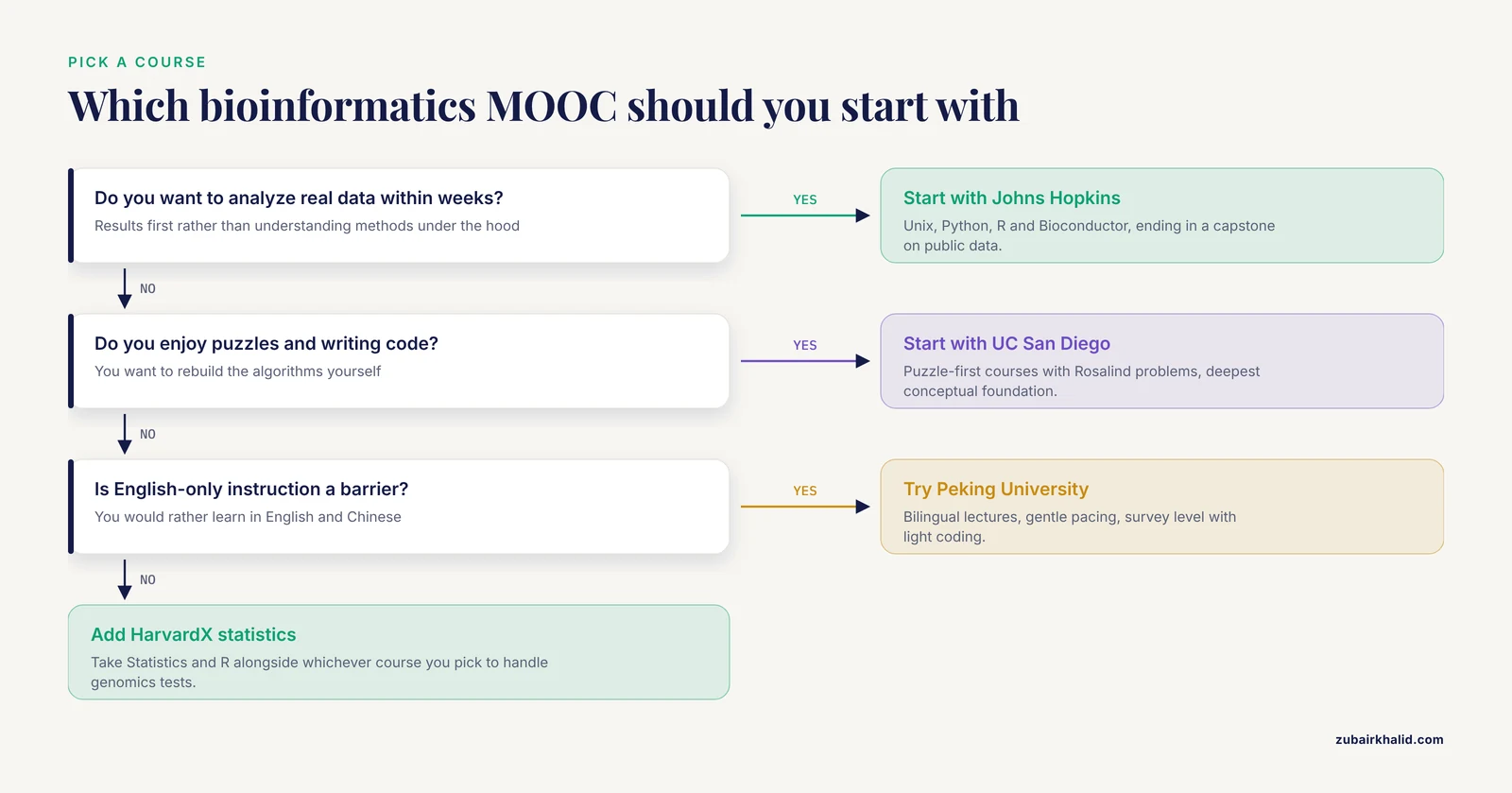
The table below compresses the whole decision. Each row is explained in full in the course profiles that follow.
| Option | Platform | Best for | Prerequisites | Format | Standout strength | Biggest trade-off |
|---|---|---|---|---|---|---|
| UC San Diego Bioinformatics Specialization | Coursera | Understanding how methods work | No formal prerequisites, patience for coding | Multi-course sequence, puzzle-driven programming | Deep algorithmic foundation with free practice problems | Slowest route to analyzing your own data |
| Johns Hopkins Genomic Data Science Specialization | Coursera | Running real analyses with standard tools | None for the opening course | Multi-course sequence plus capstone | Teaches the Unix, Python, and R tool chain employers expect | Breadth over depth, some content ages with software |
| Bioinformatics: Introduction and Methods (Peking University) | Major MOOC platforms, availability varies | A gentle, bilingual first course | None | Lecture-based single course | Instruction in English and Chinese | Older material, lighter on coding practice |
| Data Analysis for Life Sciences (HarvardX) | edX | Statistics done right | Comfort with math helps | Course series taught in R | Rigorous statistical grounding on real datasets | Steep slope for true novices |
| BV-BRC and free practice platforms | Web browser | Practicing on real data at zero cost | None | Guided web workflows | Nothing to install, genuine research data | No structured curriculum or credential |
Three fast readings of the table:
- If you learn best by building things, start with the UC San Diego row.
- If you learn best by producing real results with existing tools, start with the Johns Hopkins row.
- If language access or a statistics foundation decides for you, start with the Peking University or HarvardX row, and use the free practice layer no matter which course you choose.
Course Profiles: What Each Option Actually Teaches
UC San Diego Bioinformatics Specialization (Coursera)
What it is. A multi-course specialization built by Phillip Compeau and Pavel Pevzner around their textbook Bioinformatics Algorithms: An Active Learning Approach. The design principle is puzzle-first learning. Every concept arrives as a problem you want to solve, and you solve it by writing code rather than by watching someone else solve it.
What you actually do. The opening course, Finding Hidden Messages in DNA, asks you to locate the origin of replication in a bacterial genome by hunting for recurring short words called k-mers, which are DNA strings of a fixed length k. You implement the counting and matching algorithms yourself in a programming language, most learners choose Python, and submit them through Rosalind, a free auto-graded problem site the course uses for its coding challenges. Later courses build from there into genome assembly, which stitches millions of short sequencing reads into a complete genome sequence, comparison of genes and proteins through alignment, meaning arranging sequences side by side to score their similarity, and molecular evolution.
Strengths.
- The deepest conceptual foundation of any beginner option, because you rebuild the methods from first principles.
- Excellent free companion materials, including the Rosalind problem archive.
- Free to audit, with the paid certificate optional.
- Teaches algorithmic thinking that transfers to every later tool you will meet.
Trade-offs.
- The heaviest programming workload of the beginner options.
- Biology-first learners can feel buried in string manipulation before the biological payoff arrives.
- You will not operate a modern analysis pipeline until late in the sequence.
Best fit. Learners who enjoy puzzles, students considering graduate work in computational biology, and programmers moving into biology who want the domain knowledge installed properly.
Johns Hopkins Genomic Data Science Specialization (Coursera)
What it is. A Coursera specialization from Johns Hopkins that teaches the standard genomics tool chain. It opens with genomic technologies, meaning what sequencers produce and why, then moves through the Unix command line, which means typing commands in a text terminal instead of clicking icons, Python, R with Bioconductor, a widely used collection of R packages for genomic analysis, and statistics for genomic data, closing with a capstone, a final project course built on public data.
What you actually do. You set up a working analysis environment, move through a file system, run quality checks on sequencing reads, align those reads to a reference genome, and carry a dataset through the standard steps that turn raw output into a results table. A pipeline is a chained series of analysis steps, and this specialization teaches you to build and run one rather than to admire one in a lecture.
Strengths.
- The closest match to day-one tasks in a genomics job or core facility.
- Modular design, so you can take a single course such as the command line module without committing to the whole sequence.
- The capstone produces a portfolio artifact you can show an employer or thesis advisor.
Trade-offs.
- Breadth over depth, since each method gets a working treatment rather than a derivation.
- Some content ages as software versions move, so expect to cross-check commands against current documentation.
- Environment setup defeats more novices than any lecture ever will, so budget time for installation friction.
Best fit. Research assistants, laboratory technicians, medical and biology students, and career changers who want usable analysis skills quickly.
Bioinformatics: Introduction and Methods (Peking University)
What it is. A bilingual MOOC developed by a Peking University-led team and described in the journal PLoS Computational Biology as a new example of global bioinformatics education [3]. Lectures and materials run in both English and Chinese, which remains rare among university bioinformatics courses and matters enormously for learners who think in a language other than English.
What you actually do. You work through structured lectures that introduce the field and its core methods, reinforced by quizzes and conceptual exercises. The emphasis sits at survey altitude, a map of the territory rather than a deep dive into any single valley.
Strengths.
- The lowest language barrier of any option covered here.
- Gentle pacing suited to a true first course.
- University pedigree and a peer-reviewed design rationale behind it.
- Free to access where offered.
Trade-offs.
- The course dates to the mid-2010s, so tool-specific content lags current practice.
- Coding practice is light compared with the UC San Diego and Johns Hopkins tracks.
- Availability rotates across MOOC platforms over time, so confirm the current listing before you plan a semester around it.
Best fit. Chinese-speaking beginners, learners who want a conceptual map before committing to a coding-heavy sequence, and instructors looking for a model of bilingual course design.
Data Analysis for Life Sciences (HarvardX on edX)
What it is. A series of edX courses from Harvard biostatisticians, commonly known by the PH525 course codes, that begins with Statistics and R and climbs through statistical inference to genomics case studies. R is a programming language built for statistics and graphics, and it remains the dominant environment for analyzing genomic data tables.
What you actually do. You analyze real datasets in R from the first week. You estimate quantities, test hypotheses, and learn the corrections that high-dimensional biology demands. When a single experiment tests thousands of genes at once, ordinary significance thresholds collapse under the sheer number of tests, so the series teaches false discovery rate control, which bounds the expected fraction of declared discoveries that are actually false.
Strengths.
- The most rigorous statistics foundation of the beginner options.
- Real data throughout, so every concept lands on an actual dataset.
- Skills that transfer to any quantitative domain, not only genomics.
Trade-offs.
- The steepest mathematical ramp for someone with no recent algebra or probability.
- Lighter on sequencing pipelines and laboratory context than the Johns Hopkins track.
- Assumes you want to understand the why at a mathematical level, which some beginners do not yet want.
Best fit. Quantitatively inclined learners, students who already hold some coding or mathematics background, and anyone whose future work will center on interpreting results rather than only producing them.
The Free Practice Layer: BV-BRC, Galaxy, and Rosalind
None of the following are MOOCs, and that is the point. They form the practice layer that converts course knowledge into durable skill, and every one of them is free.
BV-BRC, the Bacterial and Viral Bioinformatics Resource Center, is one of three Bioinformatics Resource Centers funded by NIAID, the National Institute of Allergy and Infectious Diseases. Its browser-based services run complete analyses with no local installation. Educators have built an undergraduate exercise around two of its end-to-end services, Taxonomic Classification and Metagenomic Read Mapping, guiding students through a three-part exploration of antimicrobial resistance genes in six publicly available metagenomic samples collected from wild and domestic animals [1]. Metagenomics means sequencing the collective DNA of an environmental or clinical sample, such as a gut swab, to identify the organisms and genes present without culturing anything in advance.
Galaxy provides a point-and-click interface for building analysis workflows on public servers, which makes it the gentlest place to run a real pipeline before you can type a Unix command. Rosalind turns bioinformatics algorithms into graded puzzles and pairs naturally with the UC San Diego track. Public training portals, including EMBL-EBI's online training collection, add short focused modules on individual databases and tools.
Use this layer alongside any MOOC. Thirty minutes of clicking through a genuine workflow after a lecture beats three hours of passive rewatching.
Pros and Cons of the Best Bioinformatics MOOC Options
Brochures list features. Decisions turn on the criteria below, compared side by side.
| Criterion | UC San Diego | Johns Hopkins | Peking University | HarvardX |
|---|---|---|---|---|
| Programming load | High, you write the algorithms | Moderate, you apply the tools | Low | Moderate, R only |
| Mathematics load | Moderate | Moderate | Light | High |
| Hands-on with real data | Arrives in later courses | Early and constant | Limited | Case-study based |
| Speed to first useful analysis | Months | Weeks | Weeks, conceptual only | Weeks for plots, months for fluency |
| Depth of understanding | Deepest on methods | Broadest on workflows | Survey level | Deepest on statistics |
| Language options | English | English | English and Chinese | English |
| Tangible output | Solved problem sets | Capstone project | Course concepts | Reusable analyses |
Depth versus breadth. UC San Diego goes deepest on how methods work, Johns Hopkins goes broadest on what working analysts actually do, HarvardX goes deepest on the statistics underneath, and the Peking University course stays deliberately at survey altitude. Depth compounds. A learner who understands why a genome assembler behaves badly with certain reads can debug it, while a learner who only clicked through one must wait for help.
Theory versus tools. Neither pole wins outright. Theory without tools leaves you unable to produce a result by Friday, and tools without theory leave you unable to tell a real result from an artifact. The honest answer is sequencing: tools first for momentum, theory immediately after so the tools stop being magic.
Credentials and portfolios. Certificates from Coursera and edX signal persistence, and a specialization capstone gives you something concrete to show. Hiring managers and thesis advisors still weight a small portfolio of real analyses more heavily than a wall of certificates. Treat the certificate as scaffolding, never as the building.
Cost model. All four MOOC options can be audited free, with paid certificates optional, and the practice layer costs nothing at all. Platform pricing and catalog listings change often enough that you should verify current details on the platform before enrolling rather than trusting any fixed figure quoted anywhere, including figures you may have read in older guides.
Worked Scenarios: Which Course Fits Which Beginner
A biology undergraduate who wants to help in a sequencing lab
You have joined a laboratory that sequences bacterial isolates, you have never programmed, and you want to earn analysis tasks within a semester. Start with the Johns Hopkins opening course on genomic technologies and the site's beginner Python track on Rosalind in parallel. Spend months two and three on the command line and Python courses, practicing weekly in Galaxy or BV-BRC on public microbial data so the commands attach to real files. In months four and five, take the R and Bioconductor course and ask your mentor for one published bacterial genome analysis to reproduce. You finish the semester having rerun a real analysis end to end, which is precisely the contribution laboratories need.
A computer science graduate moving into genomics
You already write code comfortably, so the programming ramp that slows other beginners means little to you. Start the UC San Diego specialization to install domain intuition, because knowing how assemblers and aligners work under the hood is what separates a genomics engineer from a script runner. Take HarvardX Statistics and R alongside it, since statistics is the gap in most self-taught programmer profiles. Close with the Johns Hopkins Bioconductor and statistics courses to learn the tools the field actually runs on, then build a personal project, for example assembling a public bacterial genome and comparing it against a reference.
A wet-lab researcher who needs to analyze RNA-seq data now
RNA-seq measures gene activity by sequencing transcript fragments and counting them across experimental conditions, and your samples are already sequenced with a deadline attached. Run your data through Galaxy on a public server in week one to get a first results table, because momentum matters when a project is live. Over the following quarter, take the Johns Hopkins command line and statistics courses so you can move off the graphical interface and understand what the counts mean. Add the HarvardX genomics case studies before you interpret anything for a manuscript, since differential expression claims stand or fall on the statistical handling of counts and batch effects.
A curious beginner who wants a low-commitment taste
You are not sure bioinformatics is for you and you refuse to sink a semester into finding out. Audit a single course. Finding Hidden Messages in DNA is the best single taste of the field's flavor, because it delivers a genuine research result through pure problem solving in a few weeks of part-time effort. If English-only instruction is the friction point, take the Peking University bilingual course instead and decide your direction afterward.
The Best of the Best Bioinformatics MOOC, If You Pick Only One
Lists rarely commit, so here is the commitment. For the largest group of beginners, people with a life-science background who want to analyze real data, the Johns Hopkins Genomic Data Science specialization is the single best bioinformatics MOOC. It teaches the exact Unix, Python, and R tool chain that real analyses run on, it starts from zero prerequisites, and it ends with a capstone you can show another human being. There is no single best bioinformatics MOOC for every person on earth, but this one serves the widest slice of beginners well. If you are concept-first rather than results-first, swap in UC San Diego as your number one and keep Johns Hopkins as the follow-up.
After the MOOC: Turning Lessons Into Real Analyses
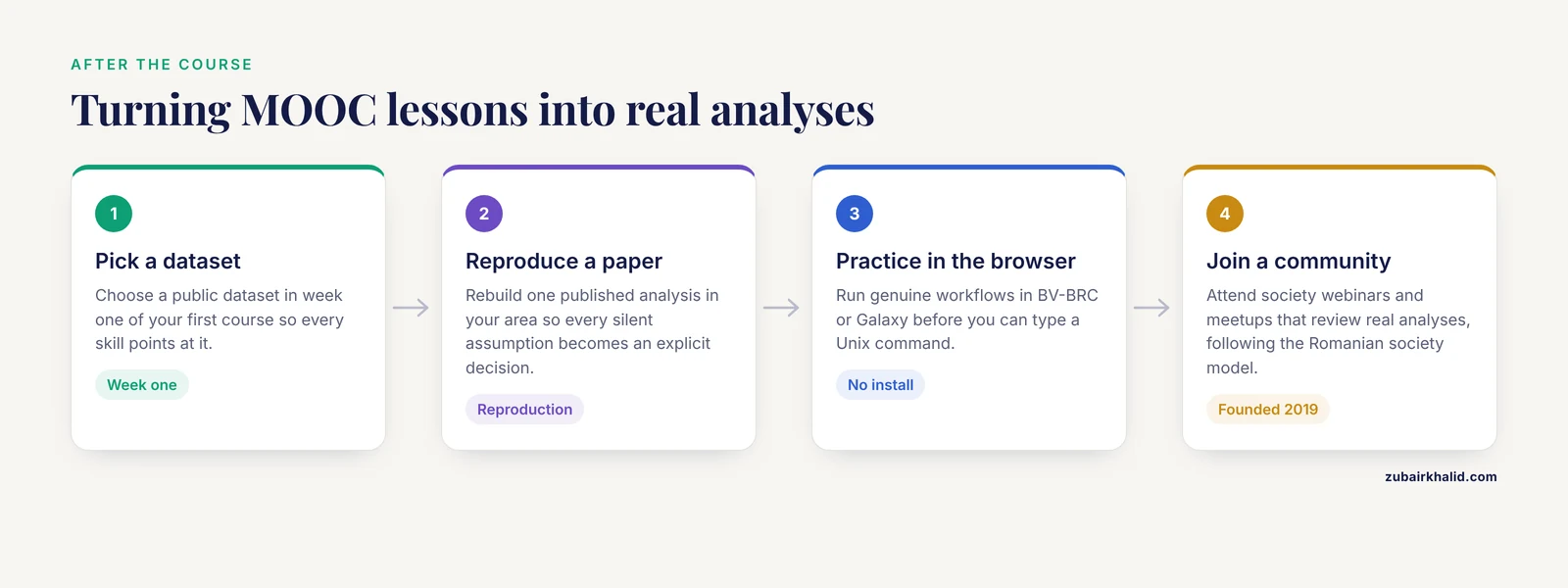
Practice on public data. Browser-based resource centers of the kind described above let you reproduce published workflows on real samples without installing anything, and public archives hold raw data for thousands of studies. Pick one published analysis in your area of interest and rebuild it. Reproduction teaches more per hour than any additional lecture, because every silent assumption in the paper becomes an explicit decision on your desk.
Join a community. Learning sticks better in company, and the infrastructure exists if you look for it. National bioinformatics societies show the model at scale, for example the Romanian Society of Bioinformatics, founded in 2019, which grew from scattered professionals into an organized community running national training, engaging the public, and connecting members to European research infrastructure through the development of the Romanian Bioinformatics Cluster as a national node of ELIXIR, the European infrastructure that organizes life-science data, tools, and training across member countries [4]. Borrow the playbook wherever you live: attend society webinars, work through open training materials, and find a local or online meetup that reviews real analyses.
Grow into applied methods. Once preprocessing and statistics feel routine, supervised machine learning, meaning algorithms that learn patterns from labeled data rather than following hand-written rules, becomes a natural next step rather than a leap. One published food-microbiology study illustrates the shape of that work. Researchers classified 872 fungal community samples from table olives, described with metataxonomic data, which means targeted sequencing of a marker gene to profile a microbial community, by processing type, country of origin, and olive cultivar. They compared three tree-based models, and random forest, an ensemble of decision trees whose individual votes are averaged, performed best with overall accuracy above 75% and 89% for classifying country of origin [5]. Notice what made that analysis credible: careful dataset assembly, sensible validation, and interpretable models. Those are exactly the habits a good MOOC sequence builds before anyone mentions an algorithm with a fashionable name.
Common Mistakes and Limitations
- Watching without typing. Bioinformatics is a performance skill, like surgery or piano. Adopt a hard ratio: for every hour of video, spend an hour reproducing the steps and another hour changing something, a different parameter, a different dataset, a deliberate breakage you then repair.
- Starting with machine learning. Applied papers that pair omics data with classifiers look seductively simple, but those analyses sit on top of quality control, which flags failing reads and contaminated samples, plus normalization and honest validation. Beginners who start with the model produce results they cannot debug and nobody can trust.
- Skipping the command line. Nearly every published workflow assumes a terminal. Learners who stay graphical hit a wall the first time a tutorial says
fastqc sample.fastq. Push through the terminal discomfort in your first months, not your last. - Ignoring statistics. Genomics generates thousands of simultaneous tests, systematic batch effects, and deceptive correlations. Without the statistical layer, you will manufacture convincing-looking noise at industrial scale. HarvardX exists precisely for this gap.
- Treating the certificate as the goal. Audit first and pay only when a certificate serves a concrete purpose, such as a CV line, an employer reimbursement, or the deadline pressure you personally need. Money spent on a certificate you never needed is the cheapest lesson in the field.
- Using stale material uncritically. Software versions move, interfaces shift, and a course recorded years ago can teach commands that now fail politely or catastrophically. Check when a course was last updated and cross-check commands against current official documentation.
- Learning without a project. Coursework without a target dataset evaporates within weeks. Choose a public dataset in week one of your first course and let every new skill point at it.
- Expecting a MOOC to carry you to a job alone. Employers hire evidence, and evidence means a portfolio, a community that can vouch for you, and the ability to talk through an analysis you actually performed. Pair the coursework with all three.
A final word on limits. MOOCs teach generic pipelines, and your organism, data type, or scientific question may demand specialized workflows that no beginner course covers. Catalogs, prices, and platform availability change without notice, so verify current listings before enrolling. Individual backgrounds and goals differ enough that the right sequence for you may not match any scenario above, and a mentor, advisor, or local bioinformatics community is the best source of personalized guidance.
Frequently Asked Questions
What is the best bioinformatics MOOC for a complete beginner?
For most complete beginners, the best starting point is the Johns Hopkins Genomic Data Science specialization if you want to analyze real data soon, or the UC San Diego Bioinformatics specialization if you want to understand how the methods work. Audit the first course of either track for free before paying for a certificate, and let the first few weeks of actual coursework settle the question better than any ranking can.
Can I learn bioinformatics for free?
Yes. Every option in this guide can be audited without payment or accessed through free public platforms, and certificates are optional extras rather than requirements. The free practice layer, including browser-based resource centers, workflow platforms, and problem archives, costs nothing and delivers the hands-on time that makes the paid courses worthwhile.
Do I need programming experience before starting a bioinformatics course?
No. The strongest beginner options assume no prior programming and teach Python, R, or both along the way. Comfort with basic computer file handling makes the first weeks smoother, but typing your first loop is part of the curriculum, not a prerequisite for it.
How long does it take to learn bioinformatics through a MOOC?
Plan on a few months of steady part-time study to reach basic competence, usually one course at a time at a few hours per week. Expect closer to a year of consistent practice, including real dataset projects, before you become genuinely productive on your own analyses.
Are bioinformatics MOOC certificates worth paying for?
They are worth paying for when you need external structure, a visible credential for a CV, or the deadline pressure to finish. They are worth skipping when you are self-disciplined, because employers and admissions committees weigh a portfolio of real analyses far more than any certificate.
Should I learn Python or R for bioinformatics?
Learn whichever language your first course teaches, then add the other later. Python dominates scripting and workflow automation, while R dominates statistics and graphics through the Bioconductor collection, and working analysts eventually use both.
Sources
- Exploring antimicrobial resistance in wild and domestic animal populations: combining publicly available data with BV-BRC resources to introduce bioinformatics in an undergraduate classroom.
- Integrative Bioinformatics Approaches in Environmental Biotechnology: A Review.
- "Bioinformatics: introduction and methods," a bilingual Massive Open Online Course (MOOC) as a new example for global bioinformatics education.
- From the establishment of a national bioinformatics society to the development of a national bioinformatics infrastructure.
- Unraveling fungal community biodiversity in table olives through tree-based machine learning classification.