Reproducible Environments in Practice
By Dr. Zubair Khalid, DVM, MS, PhD ·

A reproducible environment is the complete, self-contained setup of data, code, software versions, hardware settings, and documentation that lets another scientist rerun an analysis and obtain the same result. In practice, reproducibility fails most often at the environment level rather than at the level of ideas, and a reproducible environment case study is a documented teardown of one published workflow that shows exactly where the setup breaks and why.
This article uses real published case studies, anchored by a 2026 assessment of a graph neural network study in cell dynamics, to show what reproducible environments look like when they succeed and when they fail. By the end, you should be able to read a methods section with a trained eye, build your own reproducibility checklist, and avoid the configuration traps that cost working scientists weeks of lost time.
What Does a Reproducible Environment Case Study Mean?
A case study in this context means a detailed examination of one specific research workflow, treated as a specimen. Rather than surveying hundreds of papers, the authors pick a single published analysis and attempt to rebuild it from scratch, usually following only what the original authors reported. The written record of that rebuild attempt, including every obstacle, workaround, and failure point, is the case study.
The phrase has two parts worth defining separately:
- Reproducible environment. The computational or physical setting in which an analysis runs. In computational biology, this includes the operating system, software package versions, library dependencies, random seeds, input data, and parameter files. In wet-lab science, it includes instrument settings, reagent lots, environmental conditions such as temperature and atmosphere, and calibration records.
- Case study interpretation. The analytical step where the evaluators translate their rebuilding experience into generalizable lessons. They ask which failures were avoidable, which were typical for the field at the time, and which reporting standards would have prevented them.
The value of this approach is honesty. A checklist on paper can look complete while the underlying workflow remains impossible to rerun. A case study forces the gap between reporting and reality into the open, and that gap is where most of the actionable knowledge lives.
The Anchor Case Study: A Graph Neural Network for Cell Dynamics
The clearest worked example comes from a collaboration organized through the Global BioImage Analysts' Society (GloBIAS), in which analysts evaluated the reproducibility of a published study that used a Graph Neural Network (GNN) to model cell dynamics. A GNN is a machine learning architecture that represents objects, in this case cells, as nodes in a graph and learns from the connections between them, making it well suited to tracking how cells move, divide, and interact over time.
The evaluators used structured, community-developed checklists from the QUAREP-LiMi initiative (Quality Assessment and Reproducibility for Instruments and Images in Light Microscopy), a working group dedicated to improving quality control and reporting in light microscopy. Because those checklists were published after the 2022 target paper, the assessment was necessarily retrospective. The evaluators were judging a study against standards that did not formally exist when it was published, and they were explicit about that limitation [1].
What the Teardown Found
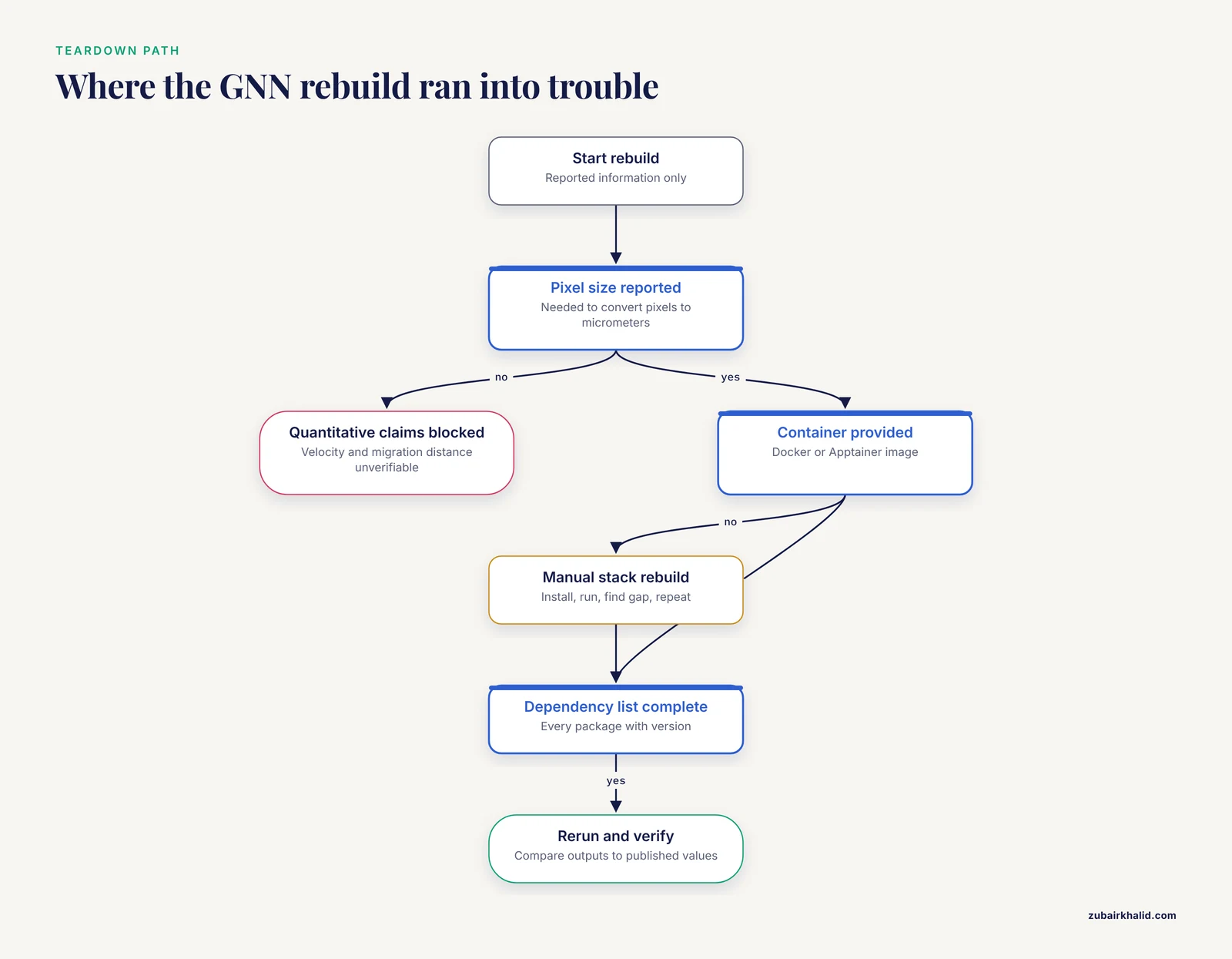
The assessment revealed a persistent gap between recent reporting standards and practical execution. Three specific deficiencies drove most of the difficulty:
- Missing image metadata. The published work did not explicitly report pixel size or timestamps for the microscopy images. Without pixel size, a downstream analyst cannot convert measurements from pixels to micrometers, which means quantitative claims about cell velocity, migration distance, or growth rates cannot be verified. Without timestamps, the temporal dynamics that a cell-tracking model depends on cannot be reconstructed faithfully.
- No software container. A container is a portable package that bundles an application with its entire software environment, including the exact versions of every library it needs. Tools such as Docker and Apptainer (formerly Singularity) are the standard vehicles for this. The target paper contained no container, which was typical practice at the time of publication, so the evaluators had to reconstruct the software stack manually.
- An incomplete dependency list. Even the list of required software packages was incomplete, which meant manual environment configuration involved repeated cycles of installing a package, running the code, discovering a missing dependency, and installing again. Each cycle raises the barrier to entry and increases the chance that the rebuilt environment drifts from the original one in subtle ways.
The evaluators concluded that their experience highlighted the contrast between the reproducibility expectations in force at the time of publication and the newer standards achievable with minimal compliance. Their actionable recommendations were robust environment containerization and standardized data deposition, so that complex computational workflows can be rerun without archaeology [1].
Case Studies Compared: What Each One Teaches
The GNN teardown is one entry in a broader pattern. Across chemistry, microbiology, bioinformatics, and toxicology, published case studies converge on the same lesson: reproducibility is a property of controlled, documented conditions, not of good intentions. The table below summarizes several well-documented examples.
| Case study | Field | Core reproducibility challenge | Solution demonstrated |
|---|---|---|---|
| GNN cell dynamics assessment [1] | Bioimage analysis | Missing metadata, no container, incomplete dependencies | Containerization and standardized data deposition |
| Cd₂(TTFTB) conductivity benchmarking [2] | Materials chemistry | Measurement results shift with temperature, atmosphere, and illumination | Strictly controlled conditions plus full device characterization |
| PDA Technical Report No. 33 validation [3] | Pharmaceutical microbiology | New rapid methods need statistically defensible equivalence testing | Standardized statistical protocols for accuracy, precision, ruggedness, and equivalence |
| SARS-CoV-2 sgRNA tool benchmarking [4] | Bioinformatics | Tool performance varies with read length, aligner, and mutation profile | Systematic benchmarking on 25 synthetic datasets plus real wastewater data |
| AI pipeline for molecular initiating events [5] | Computational toxicology | Ad hoc model training resists reruns | Automated, end-to-end pipeline from raw data to deployable model |
| Reference gene validation for RT-qPCR [6] | Ecotoxicology | Normalization gene choice is often unvalidated | Systematic validation with tools such as geNorm and NormFinder |
The Four Layers of a Reproducible Environment
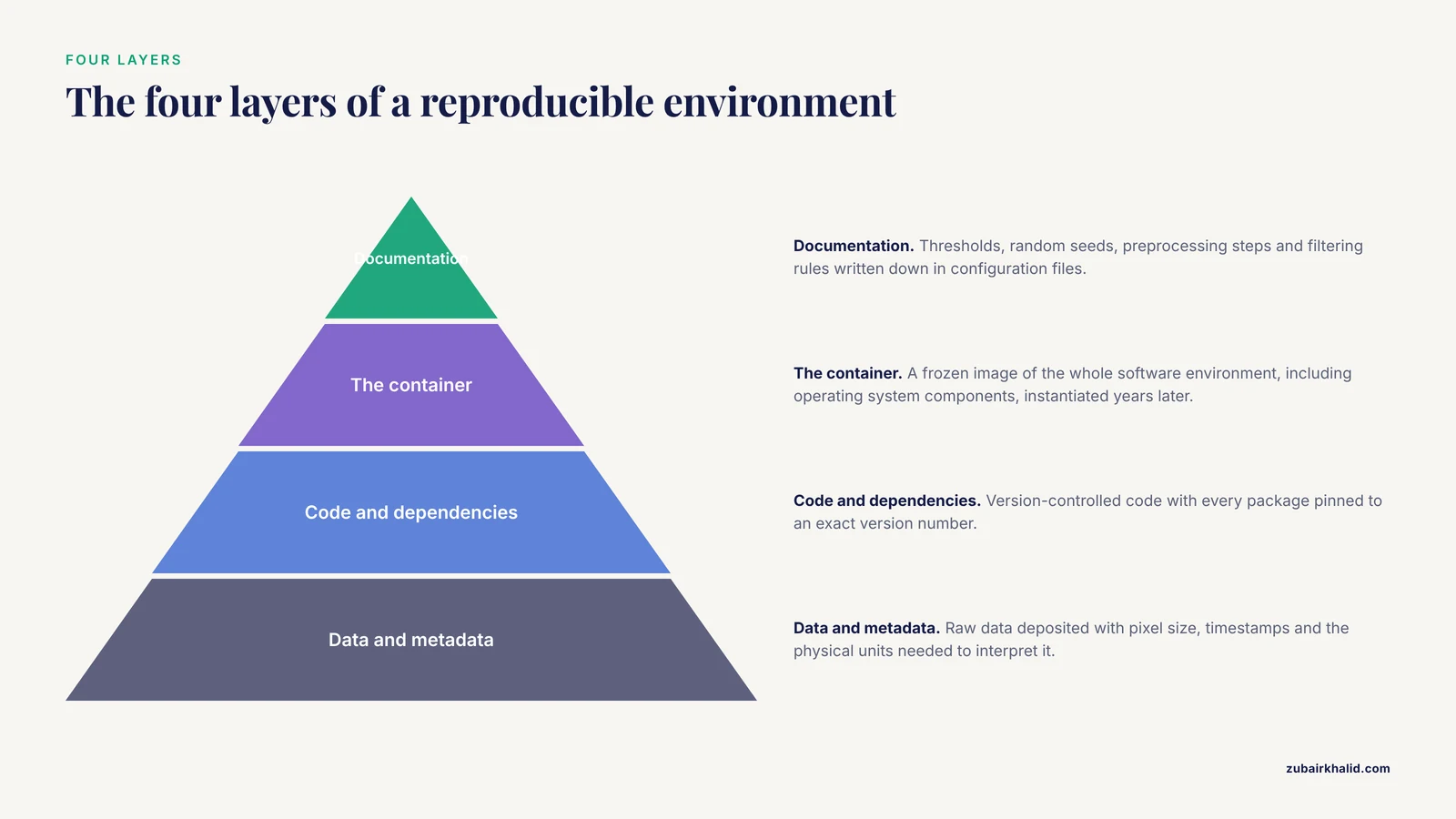
Every computational workflow, whether it processes microscopy images, sequencing reads, or simulation outputs, sits on four layers. A case study teardown usually finds the failure in one specific layer, so it helps to keep them separate in your mind.
Layer 1: Data and Metadata
The raw data must be available, and it must carry the metadata needed to interpret it. In microscopy, that means pixel size and acquisition timestamps. In sequencing, it means read length, library preparation method, and instrument run information. The GNN case study showed that even a fully available dataset cannot support quantitative interpretation when its metadata are absent, because numbers like cell displacement have no physical meaning without a length scale [1].
Layer 2: Code and Dependencies
The analysis code should be deposited in a version-controlled repository, and its dependencies should be exhaustively listed with version numbers. The distinction between "we used Python with standard scientific libraries" and a pinned dependency file listing, for example, the exact version of every package, is the difference between a rerun that works and one that fails silently or produces different numbers.
Layer 3: The Container
A container image freezes the entire software environment, including the operating system components, at a specific point in time. Anyone can then instantiate that frozen environment on their own machine years later. The absence of a container in the target paper was described as typical for its publication date, which is a useful calibration point: standards change quickly, and what passed review in 2022 falls short of current expectations [1].
Layer 4: Documentation and Parameters
Every threshold, random seed, preprocessing step, and filtering rule must be written down. A machine learning workflow with an unstated random seed may produce different results on every run, which makes verification impossible even when every package version matches. Parameter files saved alongside code, rather than values typed interactively during analysis, close this gap.
Building a Reproducibility Checklist
The QUAREP-LiMi checklists used in the GNN assessment demonstrate the format that works: a fixed list of items, each answerable with a yes, a no, or a specific value. You can build a personal version for your own field. A practical checklist for a computational life science project contains at minimum the following items:
- Raw data deposited in a public repository with a persistent identifier.
- All metadata recorded, including the physical units needed for quantitative interpretation.
- Code deposited in a version-controlled repository.
- A dependency file pinning every software package version.
- A container image built and deposited.
- All parameters, thresholds, and random seeds recorded in configuration files.
- A written run procedure, from download to final figure, tested on a clean machine.
- Expected output values recorded so a rerun can be verified, not just executed.
The final item deserves emphasis. Executing without errors is not the same as reproducing the result. A verification step that compares key output numbers against the published values turns a rerun into a genuine reproduction test.
Reproducible Environments in Practice Across the Life Sciences
The same principles appear in fields far from bioimage analysis, and the cross-disciplinary evidence strengthens the case that environmental control, not brilliance, drives reproducible results.
When Physical Conditions Change the Answer
In materials chemistry, a benchmarking study of the conductive metal-organic framework Cd₂(TTFTB) showed that electrical measurements vary systematically with temperature, chemical atmosphere, and illumination conditions, and that consistent results emerge only when these factors are strictly controlled and the morphology and anisotropy of the single-crystal devices are taken into account. Depending on the technique, the device construction, or the environment, reported values could differ by orders of magnitude [2]. This is the physical-world analog of a missing dependency list: an unstated environmental variable that silently changes the result.
When the Environment Is a Regulatory Requirement
In pharmaceutical quality control, the Parenteral Drug Association's Technical Report No. 33 provides standardized statistical recommendations for validating rapid microbiological methods. A published case study applied those methods to a rapid water bioburden testing system, analyzing accuracy, precision, ruggedness, and equivalence data, and showed that the recommended statistical methods could all be applied successfully and gave the same equivalence interpretation as the standard method. The same study noted caution when applying statistical tests to low average colony-forming unit values, where occasional outlying results appeared [3]. The lesson is that a validated, standardized environment for evaluation is itself a reproducibility tool: two laboratories following the same protocol can compare results meaningfully.
When the Environment Is a Chip
Organ-on-a-chip platforms illustrate that reproducibility problems are not confined to software. A modular liver-on-a-chip platform designed for toxicology testing addressed the classic weaknesses of such systems, namely uncontrolled flow dynamics and poor replicability, with a tubing-free design, a clamping cartridge, and software-controlled recirculation supporting 12 parallel channels with reproducible recirculating concentrations. When tested with the hepatotoxic chemical triphenyl phosphate, the platform showed enhanced hepatic function markers compared with static culture and dose-dependent changes in urea, lactate dehydrogenase, and aspartate aminotransferase levels [7]. The engineering choices that made concentrations reproducible are what made the biological conclusions defensible.
When the Environment Is a Statistical Choice
Normalization decisions in molecular biology create their own environment. A systematic review of RT-qPCR studies in marine bivalve ecotoxicology examined 52 papers and found that normalization was largely performed with single reference genes, while fewer than 40 percent of studies experimentally validated the expression stability of the genes they used. The accompanying case study, using copper-treated hemocytes from the clam Ruditapes philippinarum, walked through the established validation algorithms geNorm, NormFinder, and BestKeeper, along with the online tool RefFinder [6]. An unvalidated reference gene is functionally an uncontrolled variable: if its expression shifts with treatment, every downstream fold-change estimate shifts with it.
Similarly, in network biology, a case study on MYC translocation status in 214 lymphoma patients identified concrete steps for trustworthy validation of reconstructed gene interaction networks, including analyzing a medium-sized network as a subnet of a larger environment to avoid confounding, using external data to demonstrate the stability and reproducibility of the derived structures, and systematic literature review of the relevant biology [8]. External validation data serve as an independent check that a result is not an artifact of one particular dataset environment.
When the Environment Is the Benchmark Itself
In bioinformatics, tool choice within a workflow is an environmental variable. A benchmarking case study on SARS-CoV-2 subgenomic RNA detection generated 25 synthetic Illumina datasets simulating both shotgun and amplicon sequencing strategies, plus a real wastewater dataset, and found substantial performance variability across tools. Tools built to identify subgenomic RNAs struggled with shotgun data and were sensitive to mutations depending on the chosen aligner, while amplicon sequencing improved sensitivity, with aligner choice and primer design still significantly affecting outcomes [4]. A workflow that is perfectly reproducible but built on a suboptimal tool will faithfully produce the wrong answer every time, which is why benchmarking belongs inside the reproducibility conversation.
When the Pipeline Itself Is the Deliverable
An emerging pattern in computational toxicology is to make the pipeline, rather than a single trained model, the reproducible artifact. One framework converts raw ChEMBL bioactivity data into optimized deep learning models for predicting molecular initiating events, the first step in an Adverse Outcome Pathway. The pipeline integrates data curation, molecular graph generation, and model training and tuning, so that users can construct target-specific prediction models in a seamless and reproducible way from initial data to deployable AI. In a neural tube defect case study, fine-tuned models built on the Knowledge-Guided Pre-training of Graph Transformer framework outperformed traditional support vector machine models with a radial basis function kernel [5]. Because the full pipeline is automated, a new target can be modeled with the same controlled environment, which is reproducibility converted directly into throughput.
Physical simulation tools follow the same logic. SolvateIt, a tool for constructing explicit solvation shells around molecules, derives the number and arrangement of solvent molecules from the percentage of solvent-accessible surface rather than from user choice, a design decision made explicitly to ensure reproducibility. Validation on phloroglucinol in ethanol showed that the fully solvated first shell predicted a dipole moment within 0.7 percent of the experimental value [9]. Removing user discretion from a construction step is a form of environmental control.
Even ecological risk assessment has entered this territory. An integrative framework for soil contamination in southern Italy introduced the Standardized Ecological Risk index (SPERI), which preserves the ranking of conventional contamination indices while stabilizing variance and reducing outlier leverage, with strong agreement to an established index (R² = 0.896) and improved between-site comparability [10]. Stable, well-defined metrics are the statistical layer of a reproducible environment.
Finally, some case studies demonstrate what a controlled environment makes possible rather than what its absence costs. A setup for real-time gamma irradiation of optical fiber sensors was engineered specifically for a homogeneous radiation field and high reproducibility of experiments, allowing the same type of grating to be compared across different irradiation sources with confidence [11]. Control first, comparison second.
Reproducible Environment Case Study Interpretation: Reading the Gap
When you encounter a case study of this kind, the interpretive work happens in three questions.
First, what standards applied at the time? The GNN assessment was careful to note that its checklists postdate the target paper, so the deficiencies it found reflect the norms of 2022 as much as the choices of the authors [1]. This matters because retrospective judging with modern standards can mislead. A paper without a container in 2019 is a normal paper. A paper without a container in 2026 is a warning sign.
Second, is the failure in reporting or in execution? These are different defects. A study can report everything correctly and still fail reproduction because an undocumented dependency breaks on modern operating systems. A study can also be perfectly rerunnable while reporting almost nothing, because a helpful author e-mailed you the environment. Case studies that distinguish these failure modes are more useful than ones that simply tally missing items.
Third, what would minimal compliance have cost? The GNN evaluators framed their recommendations around minimal compliance, meaning the smallest set of practices, containerization and data deposition, that converts an unrerunnable workflow into a functional one [1]. When reading any gap analysis, estimate the effort the original authors would have needed. If two hours of container building would have saved weeks of community reconstruction, the cost-benefit argument writes itself.
Common Mistakes and Limitations
These are the errors that appear most often in real workflows, drawn from the failure patterns documented in the case study literature.
- Treating a dependency list as optional polish. In the GNN case study, the incomplete dependency list was a direct cause of complex manual environment configuration, which raised the barrier to entry for anyone attempting reproduction [1]. Generate the dependency file automatically from your working environment rather than writing it from memory.
- Depositing data without the metadata that gives it meaning. Pixel size and timestamps are not luxuries in quantitative microscopy. Without them, absolute measurements cannot be interpreted, as the cell dynamics teardown demonstrated [1].
- Equating a successful code execution with a reproduced result. Code can run cleanly and still produce different numbers if a package version differs or a random seed is unset. Verification requires comparing outputs against recorded expected values.
- Confusing reproducibility with replicability. Reproducibility means the same team or another team can rerun the same analysis on the same data and get the same result. Replicability means a new study, with new data, reaches the same conclusion. A workflow can be perfectly reproducible and still not replicate if the underlying finding is fragile, and benchmarking studies such as the SARS-CoV-2 tool evaluation show how method choices shape what any single analysis can see [4].
- Assuming standards are static. The practices that satisfied reviewers a few years ago may already fall short of current community checklists. Budget time each year to re-check your templates against the latest versions from relevant community groups.
- Over-normalizing in molecular assays. Using a single, unvalidated reference gene in RT-qPCR remains common despite well-established validation tools, and it introduces a silent source of variance into every comparison [6].
- One individual study cannot capture every situation. Case studies are single specimens by design. They identify failure modes that recur across fields, but your own project may have domain-specific weak points that only a mentor or institutional data steward can help you spot. For guidance specific to your situation, consult your institution's research data management support.
What Is Still Uncertain
Open questions remain about how reproducibility practices spread and how they should be enforced. The retrospective character of the GNN assessment illustrates a structural tension: community checklists arrive after the studies they would have improved, so each generation of papers is judged by the next generation's standards [1]. How quickly fields converge on containerization and standardized deposition, and whether journals make these practices mandatory rather than encouraged, are live questions. There is also genuine uncertainty about the right depth of environmental freezing. Fully pinned containers maximize rerunnability but can embed obsolete, insecure software. Balancing reproducibility against maintainability is an active discussion in software engineering for science, and no consensus answer applies to every field.
A Practical Roadmap for Students and Early-Career Researchers
- Start every project with a repository containing a README, a dependency file, and a folder structure, before you analyze anything.
- Record metadata at acquisition time, when it is free, rather than during analysis, when it is lost.
- Build a container image the week your analysis first runs successfully, not the week before submission.
- Write your own ten-item reproducibility checklist adapted from community resources such as the QUAREP-LiMi checklists, and apply it to every project.
- Practice teardown thinking. Pick one published workflow in your subfield and attempt to rerun it, documenting every obstacle. Even a partial attempt teaches more about environment fragility than any lecture.
- Verify, do not just execute. Record the key output numbers of your final analysis and confirm a clean-machine rerun reproduces them.
Frequently Asked Questions
What does a reproducible environment case study mean?
It is a detailed, published teardown of one specific research workflow in which evaluators attempt to rebuild and rerun the analysis from the reported information alone, then document every obstacle they encounter. The written record of that attempt, together with the lessons drawn from it, is the case study.
What is reproducible research in simple terms?
Reproducible research is research whose data, code, and conditions are complete and accessible enough that another person can rerun the analysis and get the same result. It is about the mechanics of rerunning, which is distinct from whether the underlying finding holds up in a brand-new experiment.
Why do software containers matter so much for reproducibility?
A container bundles an application with the exact versions of every software library it needs, frozen at a moment in time. Without one, a rerunner must reconstruct the software stack manually, and small version differences can change results or break the code entirely, which is precisely the failure mode documented in the cell dynamics case study [1].
What belongs on a reproducibility checklist?
Core items are raw data availability, complete metadata with physical units, version-controlled code, a pinned dependency file, a container image, recorded parameters and random seeds, a tested run procedure, and expected output values that let a rerun be verified rather than merely executed.
Can a study be reproducible and still reach a wrong conclusion?
Yes. Reproducibility guarantees that the same analysis on the same data yields the same output. It says nothing about whether the analysis design, the tool choice, or the data themselves support the conclusion. Benchmarking studies show that a fully rerun workflow built on a suboptimal tool will reliably produce misleading results [4].
What is the difference between reproducibility and replicability?
Reproducibility means rerunning the same analysis on the same data and obtaining the same result. Replicability means conducting a new, independent study that reaches the same conclusion. A workflow can excel at the first and fail the second, and both matter for trust in a finding.
How can a student make their own analysis reproducible without much extra effort?
Use version control from day one, generate your dependency file automatically, save parameters in configuration files rather than typing them interactively, and write the run procedure down as you go. These habits add minutes per day during the project and save days during revision or handoff.
How should I interpret a case study that reports a reproducibility gap?
Ask which standards applied when the original study was published, whether the failure was in reporting or in execution, and what minimal compliance would have cost. That framing separates fair criticism of authors from fair criticism of outdated field norms, and it points directly at the practices worth adopting in your own work.
Sources
- The reproducibility gap in graph neural network workflows for cell dynamics: A checklist-driven case study.
- Measuring and Reporting Electrical Conductivity in Metal-Organic Frameworks: Cd(2)(TTFTB) as a Case Study.
- Evaluation of PDA Technical Report No 33. Statistical Testing Recommendations for a Rapid Microbiological Method Case Study.
- How benchmarking of bioinformatics tools is essential for informed workflow selection: a case study on SARS-CoV-2 subgenomic RNA detection.
- A pipeline for developing AI-driven models to predict molecular initiating events: a case study on neural tube defects.
- Validation of reference genes for RT-qPCR in marine bivalve ecotoxicology: Systematic review and case study using copper treated primary Ruditapes philippinarum hemocytes.
- Modular Liver-on-a-Chip Platform for Accelerating Toxicological Applications: A Case Study of Triphenyl Phosphate Hepatotoxicity.
- Biological feature validation of estimated gene interaction networks from microarray data: a case study on MYC in lymphomas.
- SolvateIt: A Tool for Solvating Molecules. A Case Study of Phloroglucinol in Solution.
- A statistical approach to model soil microbiota versus heavy metals: a case study on soil samples from Foggia, Southern Italy.
- A New Setup for Real-Time Investigations of Optical Fiber Sensors Subjected to Gamma-Rays: Case Study on Long Period Gratings.