Preprints vs Peer-Reviewed Papers: What's the Difference
By Dr. Zubair Khalid, DVM, MS, PhD ·

A preprint is a complete draft of a scientific paper posted online before any journal has reviewed it. A peer-reviewed paper is a version that independent experts have examined and that a journal has accepted, usually after revisions. The rule of thumb is simple: use a preprint when you need the newest data fast and are willing to check it yourself, and use a peer-reviewed paper when you need a version that has passed a formal quality check.
Both are real research. Neither is automatically wrong or automatically right. The difference between preprint and peer reviewed paper versions is mostly about quality control, timing, and how much trust you can place in the details without doing your own checking. This guide explains each format on its own terms, compares them side by side, shows what the research says about how much papers actually change between the two versions, and gives practical rules for reading and citing both.
What a Preprint Is
A preprint is the full manuscript an author uploads to a public server, typically before submission to a journal or while that submission is still under review. In the life sciences, the major servers are bioRxiv and medRxiv. Other fields have their own, such as arXiv for physics and computing and EarthArXiv for earth sciences. Papers on some servers carry an explicit notice of their status. EarthArXiv preprints, for example, display the label "This paper is a non-peer reviewed preprint submitted to EarthArXiv" on the title page [1][2].
Several features define the format:
- Speed. Posting takes days. The manuscript appears online with a date, a version number, and a digital object identifier (DOI), which is a permanent web address for the document. No editor or reviewer stands between the authors and publication.
- Versioning. Authors can post revised versions. Each version keeps its own DOI, so a reader can see exactly what changed. This is different from a journal article, which is usually a single fixed version of record.
- Open commentary. Readers can often leave public comments, and authors can respond and upload corrections without waiting for a journal cycle.
- No quality gate. Most preprint servers run a basic screening for scope and obvious problems, but this is not scientific peer review. Nobody has verified the methods, statistics, or conclusions before posting.
Preprints became mainstream in physics decades ago and spread to biology in the 2010s. Their use grew sharply during the COVID-19 pandemic, when researchers needed immediate access to findings about treatments, vaccines, and viral epidemiology. Europe PMC, an open database of life science literature maintained at EMBL's European Bioinformatics Institute, began indexing preprint records in July 2018 and later added full-text collections for COVID-19 preprints and for work funded by its funder consortium, making preprints searchable alongside traditional journal articles [3].
The tradeoff is baked into the format. You get the data months earlier, and you accept responsibility for judging whether the work holds up.
What a Peer-Reviewed Paper Is
A peer-reviewed paper is a manuscript that has passed through journal-run evaluation. The process works like this:
- The authors submit the manuscript to a journal.
- An academic editor checks that the paper fits the journal's scope and meets basic standards.
- The editor sends the manuscript to two or more independent experts in the same field. These reviewers, who usually work anonymously and without payment, read the paper critically. They assess whether the question is novel, whether the methods can answer the question, whether the statistics support the claims, and whether the conclusions match the data.
- Reviewers return written critiques. Common outcomes are acceptance, minor revision, major revision (the authors must fix substantial problems and resubmit, often triggering a second round of review), or rejection.
- Once the editor is satisfied, the journal publishes the paper as the version of record, with copyediting, typesetting, and indexing.
Peer review is the established quality-control process of science, but it is not a guarantee of correctness. Reviewers cannot rerun experiments, they sometimes miss errors, and the system itself is under strain from rising submission volumes. Recent work on automating parts of review has found serious problems, including large language models producing reviews that agree with each other too much and scores that can be inflated simply by rewriting a paper's prose without changing its science. The practical takeaway is that peer review raises the probability that a paper is sound. It does not make any single paper infallible.
A second key concept is the version of record. When a journal publishes a paper, that specific typeset version becomes the canonical, citable document. Corrections are handled through formal errata or retraction notices tied to that version. Preprints have no equivalent mechanism, which is one reason the two formats behave differently in the literature.
Side-by-Side Comparison
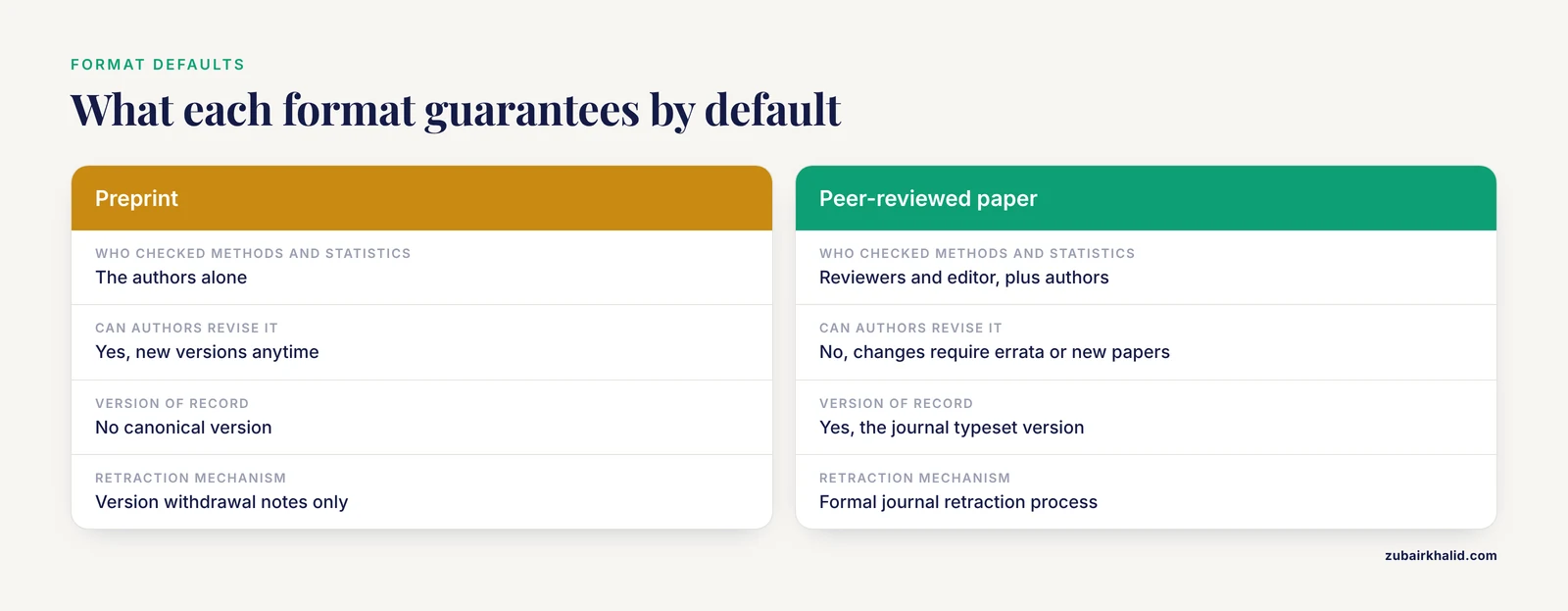
| Feature | Preprint | Peer-Reviewed Paper |
|---|---|---|
| Review status | None, or basic server screening only | Formal review by independent experts |
| Time from writing to public availability | Days | Months, often 6 to 12 or more |
| Cost to read | Free on the preprint server | Varies, often paywalled unless open access |
| Can authors revise it? | Yes, new versions anytime | No, changes require errata or new papers |
| Version of record | No canonical version | Yes, the journal typeset version |
| Who checked the statistics and methods? | The authors alone | Reviewers and editor, plus authors |
| Citation weight | Lower, use with caution | Standard for most purposes |
| Retraction mechanism | Version withdrawal notes only | Formal journal retraction process |
Read this table as a description of defaults, not promises. A careful preprint from a rigorous lab can be more trustworthy than a sloppy paper in a low-quality journal. The point is what the format itself guarantees, and peer review guarantees more checking.
What Actually Changes Between a Preprint and Its Published Version
The most useful evidence on preprints vs. peer-reviewed papers comes from studies that find pairs of documents, the same study posted as a preprint and later published in a journal, and compare them item by item.
Most main conclusions survive. A cross-sectional study of 547 clinical studies posted on medRxiv and later published in journals found high concordance between the two versions: 86.4% of pairs matched on sample size, 97.6% on primary end points, 81.1% on results for primary end points, and 96.2% on the study's interpretation [4]. A separate systematic review of 152 randomized controlled trials (RCTs) of COVID-19 treatments posted as preprints in 2021 found that 78% were later published in journals, and although 55% of pairs differed somewhere in outcomes, analyses, results, or conclusions, the main conclusion stayed consistent in all but 2 of the 119 published studies [5].
Secondary details change more often than headline results. In a comparison of 21 COVID-19 treatment studies that had appeared both as preprints and as peer-reviewed papers in intensive care journals, only one article (4.8%) changed its primary outcome between versions. But one third (33.3%) changed the effect measure reported for the primary outcome, 23.8% changed the statistical significance of at least one secondary outcome, and 19.0% changed the stated conclusion of the study [6]. This pattern matters if you are reading a preprint closely. The central result is usually stable. The finer details around it are where revisions concentrate.
Effect estimates are usually consistent in trials. Among 109 COVID-19 randomized trials posted first as preprints and later published as journal articles, researchers compared the effect estimates, the numbers quantifying how much a treatment changed an outcome, between the two versions and found overall consistency, with a median of 121 days between preprint posting and journal publication [7].
Reporting quality improves modestly. A comparison of bioRxiv preprints with their published versions found that peer-reviewed articles scored better on completeness of reporting, but the difference was small, around 5% of checklist items in both independent and paired samples. The larger differences were in subjective clarity, with published versions having clearer titles, abstracts, and easier-to-locate information [8]. A meta-research study of artificial intelligence papers in medical imaging measured adherence to a 42-item reporting checklist and found median adherence of 57% for peer-reviewed manuscripts versus 40% for preprints [9].
Preprints still compare well as a body of literature. A synthesis of 106 COVID-19 studies estimating key epidemiological parameters, such as the basic reproduction number and case fatality rate, found that the distributions of estimates from preprints and peer-reviewed papers were close, with preprints offering better timeliness [10].
Peer review takes time, and not every preprint converts. A scoping review of 40 studies comparing preprints with their published versions in the health sciences reported that a median of 42% of preprints were eventually published (interquartile range 22% to 67%), and the median lag between preprint posting and journal publication stretched to 11.5 months in the comparison windows studied [11].
Taken together, this evidence supports a nuanced position. Peer review measurably improves clarity, completeness, and some quantitative details, but it rarely overturns a study's main conclusion.
When to Use a Preprint
Choose a preprint in these situations:
- The result is time-sensitive. During an outbreak, a new method release, or a fast-moving debate, the preprint may be the only version available for months. COVID-19 epidemiology estimates from preprints matched published values closely while arriving earlier [10].
- You need methods or data before they appear in print. Labs often post preprints to establish priority, share protocols, or let collaborators start building on the work.
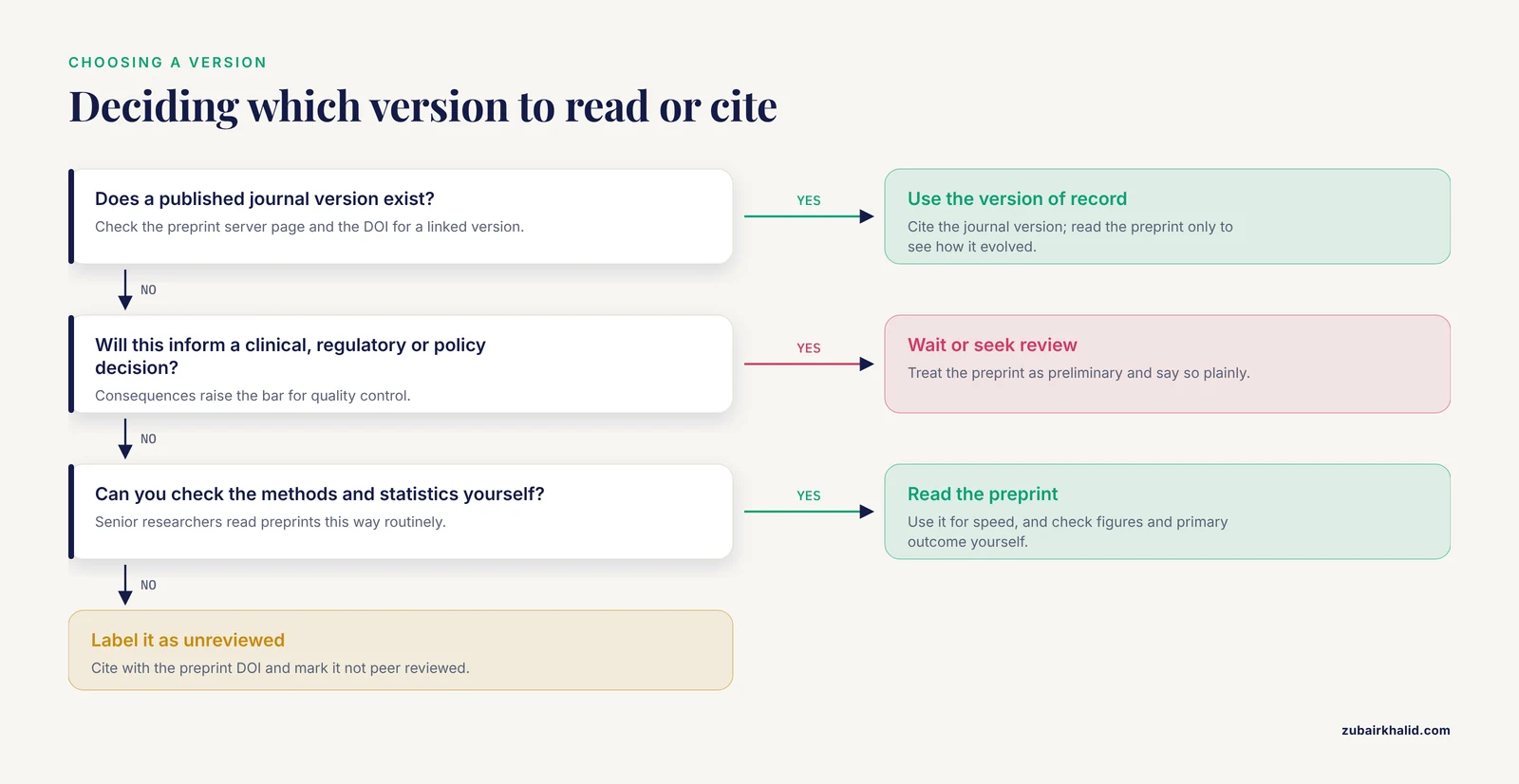
- You are technically qualified to evaluate the work. If you can check the methods, statistics, and figures yourself, the missing review matters less. Senior researchers read preprints this way routinely.
- You are following a specific lab or project. Preprints let you track work in progress and see how manuscripts evolve through versions.
Be more cautious when the preprint touches decisions with consequences, such as clinical practice, policy, or high-stakes research directions. In one survey of preprint behavior, researchers worried specifically that nonscientists would treat unreviewed findings as fully vetted [12].
When to Use the Peer-Reviewed Paper
Choose the journal version in these situations:
- You are writing a thesis, manuscript, or review. Standard citation practice favors the version of record when it exists.
- You are supporting a clinical, regulatory, or policy decision. Formal quality control matters most when decisions carry real consequences.
- You are a student still learning how to read research paper structure and judge evidence. Peer-reviewed papers give you the additional signal that experts found the work acceptable, which helps while your own judgment is developing.
- The published and preprint versions might differ. Because roughly half of preprints in the health sciences convert to journal articles [11], checking for a published version is often worthwhile, especially if months have passed.
Worked Scenarios
Scenario 1: A graduate student writing a literature review. You find a 2021 manuscript on atmospheric transport modeling posted to EarthArXiv carrying a non-peer-reviewed notice [1]. For your thesis chapter, cite it as a preprint with its preprint DOI, and search for a journal version. If none exists, describing the work with an explicit "preprint" label is honest and acceptable in most fields. If a published version exists, switch to it.
Scenario 2: A journalist covering a new treatment. A striking result appears on medRxiv with no journal publication. The evidence reviewed above says most clinical study conclusions survive review intact [4][5], but reporting quality measurably improves in published versions [9][8], and some conclusions do change [6]. A careful report would describe the finding as preliminary and unreviewed, and would quote the authors' own stated limitations.
Scenario 3: A researcher checking whether a treatment works. You find a preprint and a published paper describing the same randomized trial. The published version is the one to anchor on, because comparisons of trial pairs show that details like effect measures and secondary outcome significance change between versions even when primary outcomes stay stable [6][7]. Read both only if you want to see how the interpretation evolved.
Scenario 4: A reader who cannot tell which version they are looking at. This happens more than it should. Research on nonscientists found that without any explanation, people rated findings in preprints as equally credible as findings in peer-reviewed articles, and that a short explanation of what peer review is allowed them to adjust their credibility judgments appropriately [12]. If you are not sure which version you are reading, look for the journal name, volume, and DOI on the first page. A preprint typically shows a server name (bioRxiv, medRxiv, EarthArXiv), a version number, and a statement that the manuscript is not peer reviewed.
How to Read Scientific Papers From Either Format
Knowing the difference between formats is the first half of the skill. The second half is evaluating the document in front of you. Whether you read a preprint or a journal article, the same core questions apply, and asking them in order is the most reliable way to read research paper content efficiently.
- Read the abstract, then the figures, then the discussion. Most readers learn more from a paper's figures than from its prose. Ask whether each figure actually shows what the caption claims.
- Identify the primary outcome before reading the results. The primary outcome is the measurement the study was designed to assess. Knowing it in advance protects you from being impressed by a secondary result that looks dramatic but was one of many tests.
- Check the sample size and what it is measured in. Is it patients, cells, animals, or sequencing runs? A result from three biological replicates carries different weight than one from 300 patients.
- Look for uncertainty. Every quantitative result should carry a measure of spread, such as a confidence interval or standard error. Reporting transparency varies across fields, and evaluation studies in ecosystem science found that many papers report only a minority of the uncertainty sources relevant to their measurements [13].
- Distinguish results from interpretation. The results section states what was measured. The discussion states what the authors think it means. These are different claims with different failure modes.
- Check the reporting checklist items that matter for the study type. Randomized trials should describe randomization and blinding. Diagnostic studies should report sensitivity and specificity with confidence intervals. The gap found between preprint and published versions on structured reporting checklists [9] tells you that a preprint may simply be missing information the final version would include.
For preprints specifically, add one more step: search the preprint server page for linked published versions and for public comments. Platforms that index preprints, including Europe PMC, link comments and later versions, which surfaces criticism the authors may have already addressed [3].
Common Mistakes and Limitations
Mistake 1: Treating "preprint" and "wrong" as synonyms, or "peer reviewed" and "true" as synonyms. The evidence does not support either. Main conclusions usually survive review [4][5], and peer review itself is imperfect and under pressure, with journals relying on volunteer reviewers and emerging questions about automation [14].
Mistake 2: Citing a preprint when a published version exists. Once a paper is published, the journal version is the version of record. Citing the preprint when both exist creates ambiguity about which document you mean.
Mistake 3: Assuming secondary details in a preprint are final. Comparisons of preprint and published versions show that effect measures, secondary outcomes, and stated conclusions change at meaningful rates even when primary outcomes do not [6]. If your analysis depends on a specific number from a preprint, verify it against the published version or contact the authors.
Mistake 4: Confusing server screening with peer review. bioRxiv, medRxiv, and similar platforms check that submissions fit the server's scope and are not obviously problematic. This is not peer review. Check the wording on any document you download.
Mistake 5: Assuming non-publication means the work was wrong. A median of 42% of health-science preprints convert to journal publications, with wide variation across studies [11]. Many preprints remain unposted-to-journal simply because the authors moved on, the work is still under review, or the result was too preliminary for a journal.
Mistake 6: Reading only the abstract and conclusion. Reporting studies show that clarity of titles and abstracts improves with peer review precisely because early versions are often imprecise [8]. Reading a preprint's abstract as if it were a vetted summary overstates what that abstract represents.
Limitations of the evidence itself. Most comparison studies come from the COVID-19 era, which was an unusually intense period for preprint use. Findings about concordance between versions may not generalize evenly to all fields or all time periods. And peer review, while it improves reporting on average, does not guarantee that any individual published paper is correct.
One final note on scope. This article is about evaluating scientific documents. Individual research or health decisions need qualified professional advice specific to the case, not a general guide to literature formats.
Frequently Asked Questions
Is a preprint peer reviewed?
No. A preprint is posted on a public server before any journal review. Servers perform basic screening for scope and suitability, but independent expert evaluation happens only later, if the work is submitted to and accepted by a journal.
Can I cite a preprint?
Yes. Preprints have DOIs and are formally citable. In a thesis, review, or manuscript, cite the preprint with its preprint DOI and mark it as not peer reviewed, then switch the citation to the journal version once one appears.
Which comes first, the preprint or the journal article?
The preprint comes first. Authors post the draft before or during journal submission, and the peer-reviewed version appears months later. In one analysis of randomized trials, the median gap between preprint posting and journal publication was 121 days [7].
Do preprints eventually get published in journals?
Many do, but far from all. Across 33 studies of health-science preprints, the median share eventually published in a journal was 42%, with individual studies ranging widely from 22% to 67% [11].
Are preprints reliable?
Often, but not guaranteed. Comparisons of matched pairs show that most primary outcomes and main conclusions are consistent between preprints and published versions, while secondary outcomes, effect measures, and reporting completeness change at meaningful rates [6][4][8]. Read preprints with extra scrutiny, especially for details rather than headline findings.
How can I tell whether a paper I found is a preprint?
Look at the first page. A preprint shows a server name such as bioRxiv, medRxiv, or EarthArXiv, a version number and date, and usually a statement that the manuscript is not peer reviewed. A journal article shows a journal name, volume, issue, page numbers or article number, and often a received-to-accepted date pair. Searching the DOI will also resolve the question.
Sources
- This paper is a non-peer reviewed preprint submitted to EarthArXiv! Massive-Parallel Trajectory Calculations version 2.2 (MPTRAC-2.2): Lagrangian transport simulations on Graphics Processing Units (GPUs)
- This paper is a non-peer reviewed preprint submitted to EarthArXiv Chevrons: origin and relevance for the reconstruction of past wind regimes
- Enabling preprint discovery, evaluation, and analysis with Europe PMC
- Comparison of Clinical Study Results Reported in medRxiv Preprints vs Peer-reviewed Journal Articles
- Comparison of Preprint Postings of Randomized Clinical Trials on COVID-19 and Corresponding Published Journal Articles
- Comparison of COVID-19 Preprint and Peer-Reviewed Versions of Studies on Therapies for Critically Ill Patients
- Comparison of effect estimates between preprints and peer-reviewed journal articles of COVID-19 trials
- Comparing quality of reporting between preprints and peer-reviewed articles in the biomedical literature
- Checklist for Artificial Intelligence in Medical Imaging Reporting Adherence in Peer-Reviewed and Preprint Manuscripts With the Highest Altmetric Attention Scores: A Meta-Research Study
- The collective wisdom in the COVID-19 research: comparison and synthesis of epidemiological parameter estimates in preprints and peer-reviewed articles
- Comparison of preprints and their corresponding peer-reviewed publications in the health field: a scoping review
- Caution, Preprint! Brief Explanations Allow Nonscientists to Differentiate Between Preprints and Peer-Reviewed Journal Articles
- The current state of uncertainty reporting in ecosystem studies: a systematic evaluation of peer-reviewed literature
- Is Your Paper Being Reviewed by an LLM? Benchmarking AI Text Detection in Peer Review