Terrapene carolina carolina: Eastern Box Turtle
By Dr. Zubair Khalid, DVM, MS, PhD ·
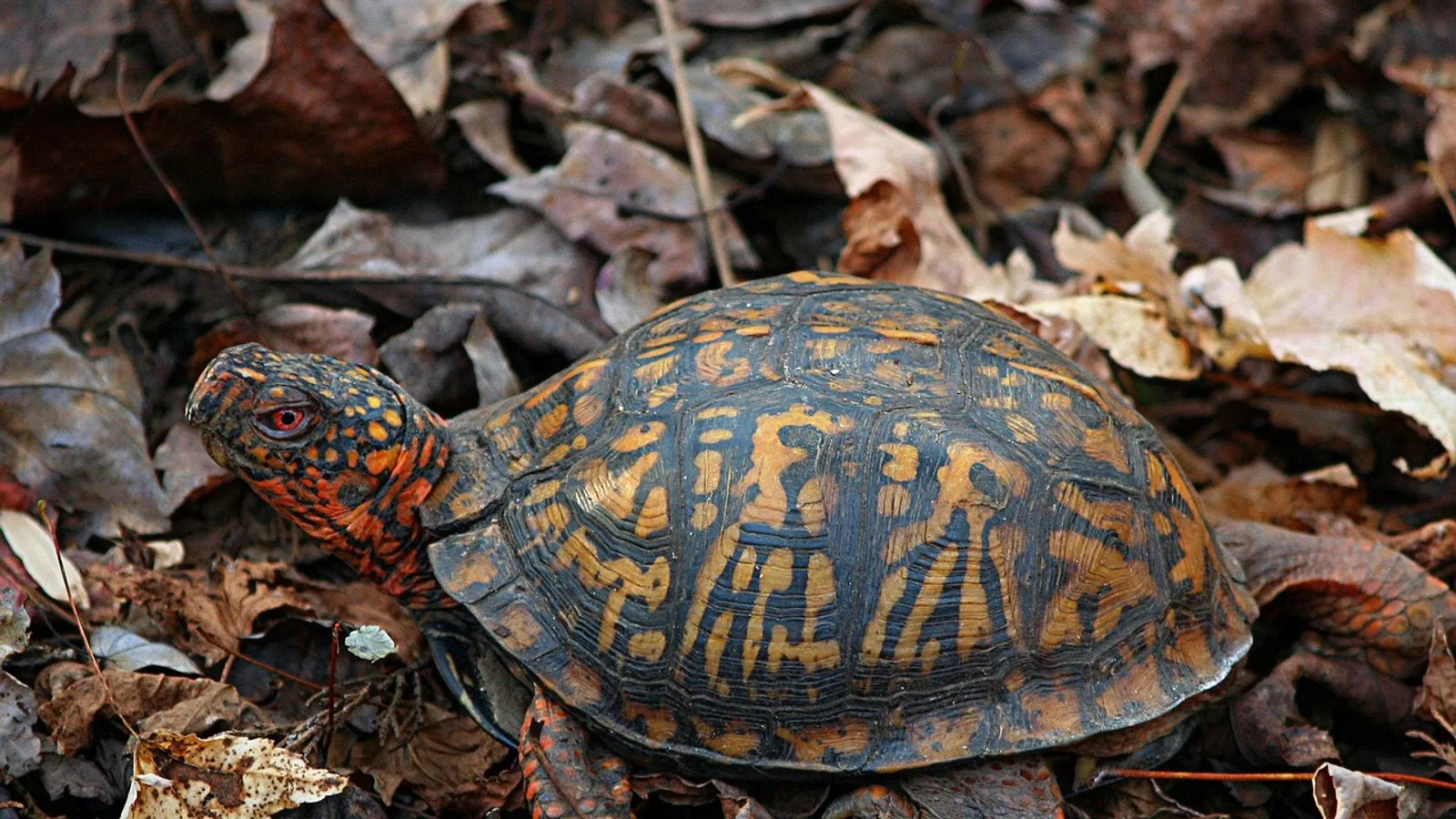
Terrapene carolina carolina is the nominate subspecies of the eastern box turtle, a terrestrial chelonian native to the eastern United States that carries a domed carapace and a hinged plastron capable of closing the shell completely. It is a long-lived omnivore with slow reproduction, and the International Union for Conservation of Nature (IUCN) lists the species Terrapene carolina as vulnerable.
That combination of traits, a familiar backyard animal that is quietly disappearing, makes this subspecies a useful case study in how wildlife decline happens. Box turtles are not hunted to extinction or wiped out by a single catastrophe. They are lost to roads, subdivisions, collection, and disease, one slow generation at a time. Understanding the biology of Terrapene carolina carolina is the first step toward recognizing why a turtle you saw as a child may be the same individual still crossing the same field today, and why its replacement may never arrive.
What Is Terrapene carolina carolina?
The eastern box turtle is a member of the family Emydidae, the pond and box turtles, and the genus Terrapene. The genus name refers to the box-like shell, and the species name carolina refers to the Carolinas, where early naturalists encountered the animal. The trinomial Terrapene carolina carolina identifies the nominate subspecies, the first-described form, which occupies most of the species range in the eastern United States.
Despite belonging to a family dominated by aquatic turtles, the eastern box turtle is fully terrestrial as an adult. It has a heavy, high-domed shell rather than the flattened, streamlined shell of a swimming turtle, and its feet are stout with short toes rather than webbed paddles. It walks, it does not swim, and it spends its life on the forest floor, in meadows, and along the edges where woods meet open ground.
The Nominate Subspecies
A subspecies is a geographically distinct population that differs consistently from other populations of the same species. Terrapene carolina has several recognized subspecies across the eastern and central United States and Mexico. The nominate subspecies, T. c. carolina, is the one most people mean when they say "eastern box turtle." It is distinguished from its relatives partly by geography and partly by shell and skin markings, though the boundaries between subspecies blur where ranges meet.
Identification: How to Recognize an Eastern Box Turtle
Field identification of Terrapene carolina carolina rests on three features that are easy to check and hard to confuse with anything else in its range.
The Domed Carapace and Its Markings
The carapace, the top shell, is high-domed and roughly oval. Each scute, the individual plate of the shell, typically carries a pattern of yellow to orange blotches, streaks, or radiating lines set against a dark brown or black background. The pattern is variable. Some individuals are boldly marked, others are nearly uniform dark. This variability is real and measurable. Researchers have developed algorithms to capture 19 different pattern measurements from digital photographs of eastern box turtles, using the species as a model because its bright pattern against a dark background is easy to identify and its rigid shell removes the distortion problems that complicate photography of soft-bodied animals [1]. That work also measured symmetry of the pattern across scutes, a trait relevant to developmental and evolutionary studies [1].
The practical takeaway for identification is that the pattern is diagnostic in combination with other features, not by itself. A dark, nearly unmarked box turtle is still an eastern box turtle if it has the right shell shape, hinge, and toes.
The Hinged Plastron
The plastron, the bottom shell, is the feature that gives box turtles their name. In Terrapene carolina, the plastron has a transverse hinge that allows the front and rear sections to fold upward. When threatened, the turtle pulls its head, limbs, and tail inside and closes the hinge, sealing the shell like a box. This is a genuine mechanical defense, not a partial retraction. A closed box turtle presents a nearly continuous hard surface to a predator.
The hinge is worth understanding because it is the single most reliable way to separate a box turtle from any other turtle in its range. No other common eastern turtle closes its shell this way.
Four Toes on the Hind Feet
Count the toes on the hind foot. An eastern box turtle has four. This distinguishes it from the ornate box turtle and from several aquatic species that have five. Combined with the domed shell and the hinge, the four-toe count is a quick field check.
Confusing Species and Subspecies
The eastern box turtle is most often confused with the ornate box turtle (Terrapene ornata), a western relative, and with the three-toed box turtle (Terrapene carolina triunguis), a subspecies of the same species. The table below summarizes the main differences.
| Form | Typical range | Hind toes | Key markings |
|---|---|---|---|
| Eastern box turtle (T. c. carolina) | Eastern United States, from New England south to Georgia and west to the Mississippi region | Four | Yellow to orange blotches or lines on a dark carapace, often bold on the head and forelimbs |
| Three-toed box turtle (T. c. triunguis) | South-central United States | Three | Usually plainer, olive to brown shell with less yellow |
| Ornate box turtle (T. ornata) | Central and western Great Plains | Four | Radiating yellow lines on a dark shell, often with a distinct pattern |
Where subspecies ranges overlap, intergrades occur, and identification can be genuinely difficult. This is one reason biologists rely on genetics and geographic origin, not pattern alone, when subspecies assignment matters.
Habitat and Range
The eastern box turtle occupies the eastern United States, from southern Maine and New York south through the Carolinas and Georgia, and west into the Mississippi Valley region. Within that range it uses a wide variety of terrestrial habitats: deciduous and mixed forests, woodland edges, meadows, pastures, and, increasingly, suburban yards and gardens. It prefers areas with some canopy cover, leaf litter, and damp soil where it can burrow to escape heat and cold.
The species is not a habitat specialist in the narrow sense, which is part of why it persists in fragmented landscapes longer than many sensitive species. But that flexibility has limits. A box turtle needs connected habitat to move, find mates, and locate the seasonal resources it depends on. Roads, fences, and development cut those connections.
Home Range and Movement
Eastern box turtles are not wide-ranging animals. Individuals typically stay within a relatively small home range and may return to the same overwintering site year after year. This site fidelity is one of the traits that makes them vulnerable. A turtle that has lived in the same patch of woods for decades will keep trying to cross the road that now bisects it.
Seasonal Activity and Brumation
Box turtles are ectotherms, meaning they regulate body temperature through behavior rather than internal heat production. They are active in warm months and retreat underground to brumate, a state of dormancy similar to hibernation, when temperatures drop. During brumation they may remain buried for months. This matters for two reasons. First, it makes them hard to survey, since a buried turtle is invisible. Second, it complicates the study of survival, because a turtle that dies underground can be missed entirely. Researchers estimating survival in wild eastern box turtles have noted that deceased turtles can be quickly scavenged and that turtles can die underground during brumation, both of which bias naive estimates [2].
Diet and Feeding Biology
The eastern box turtle is omnivorous, meaning it eats both plant and animal material. Its diet includes invertebrates such as insects, worms, slugs, and snails, along with fungi, fruits, and carrion. This broad diet is one reason the species can persist in disturbed habitats, but it also brings turtles into contact with hazards, including contaminated prey, vehicle traffic on roads where they forage, and toxins.
Box turtles are slow-moving foragers that use smell and vision to locate food. They are known to eat mushrooms, including some species toxic to humans, and they appear to have some tolerance for compounds that would harm other animals. They also consume fallen fruit and berries seasonally, which makes them occasional seed dispersers.
Why Diet Matters for Conservation
An omnivore that eats carrion and fungi sits at a particular point in the food web. It scavenges, it disperses seeds, and it moves nutrients around the forest floor. Removing box turtles from a habitat changes those small-scale processes. The ecological role is modest compared with that of a large predator, but it is real, and it is one more reason the species is worth tracking.
Reproduction and Life History
Eastern box turtles are long-lived and slow to reproduce. Females typically reach sexual maturity only after several years, and they lay relatively small clutches, often just a few eggs, and not necessarily every year. The eggs are buried in soil and left to incubate. Hatchlings are small, cryptic, and vulnerable to a long list of predators.
This life history strategy, long life plus low reproductive output, is common among turtles and has a specific consequence. A population can tolerate high adult survival and still persist, but it cannot easily absorb extra adult mortality. When adults are killed faster than they can be replaced, the population declines even if reproduction continues normally. Road mortality and collection both remove adults, which is exactly the wrong part of the life cycle to lose.
Disease in Wild and Managed Populations
Infectious disease adds another pressure. A survey of eastern box turtles presented to a wildlife rehabilitation center in Virginia found box turtle adenovirus (BTAdV) in 55.7 percent of 106 turtles tested, though most positive animals carried fewer than 100 viral copies per nanogram of DNA and the study did not find a statistically significant association between adenovirus status and cause of admission, age, sex, or outcome [3]. The probability of detection was 1.5 times higher in rehabilitation turtles than in wild turtles, which suggests that captivity and stress may influence viral shedding or exposure [3].
Other pathogens are also documented in the species. Terrapene herpesvirus 2 has been associated with fibropapillomas, and a quantitative PCR assay has been developed and validated to detect it, with high specificity and efficiency [4]. A large mortality event among 96 eastern box turtles confiscated from the illegal wildlife trade found that 94 percent of a tested subset were positive for frog virus 3, 100 percent for Mycoplasmopsis sp., 80 percent for Terrapene herpesvirus 1, and 60 percent for Terrapene adenovirus, with at least two pathogens co-detected in each turtle and 40 of the original 96 animals dying [5]. That event illustrates how disease and trade interact.
Ranavirus is a particular concern. It has caused fatal infections in captive eastern box turtles, with clinical signs including nasal and oral discharge and palpebral edema, and it has been confirmed by PCR and partial genome sequencing [6]. A separate study found ranavirus-positive hatchling eastern box turtles, suggesting vertical transmission from mother to offspring, though none of the positive hatchlings showed clinical signs during eight months of captive rearing [7]. That finding matters because it means the virus can move between generations even when adults appear healthy.
Immune Function and Why It Varies
Box turtle immune defenses are not identical across species. Eastern box turtles rely on the lectin pathway of complement activation, while ornate box turtles use the alternative pathway, a difference identified through hemolysis assays and protein analysis [8]. Eastern box turtle plasma also shows antibacterial activity against a range of bacteria, including Salmonella typhimurium, Escherichia coli, and Staphylococcus aureus, with activity abolished by heat, protease, and EDTA treatment, which points to complement as the effector [9]. This kind of comparative immunology helps explain why closely related species can differ in disease susceptibility.
Conservation Status and Threats
The IUCN lists Terrapene carolina as vulnerable. Within the United States, the eastern box turtle is protected in many states, and it is illegal to collect wild individuals in numerous jurisdictions. The species is declining range-wide due to anthropogenic factors, a conclusion stated directly in the wildlife trade literature [5].
Three threats dominate.
Habitat Loss and Fragmentation
Development, agriculture, and road construction remove and divide habitat. Because box turtles have small home ranges and strong site fidelity, a single road through a woodlot can isolate a population. Fragmentation also reduces gene flow between populations, which over time reduces genetic diversity and adaptive capacity.
Road Mortality
Vehicle collisions are a leading cause of adult mortality. A 22-year review of 2,356 wild eastern box turtles admitted to a North Carolina wildlife clinic found that the most common presenting complaint was vehicular trauma, accounting for 1,195 cases, and that over 70 percent of the caseload was associated with anthropogenic impacts [10]. The same study documented shifts in the timing of admissions and annual peak temperatures over the study period, linking turtle admissions to climate patterns [10]. Road mortality is not incidental. It is a primary driver of decline.
Collection and the Illegal Wildlife Trade
Collection for pets and for international trade removes animals from wild populations. The confiscation event described earlier, in which 96 eastern box turtles were seized en route to Asia, shows the scale of the trade and its consequences [5]. Turtles in trade are stressed, housed in high-density conditions, and exposed to pathogens, and the mortality that follows seizure can be severe [5]. Even legal collection, where it occurs, removes long-lived adults that populations cannot quickly replace.
Disease as a Compounding Threat
Disease does not act alone. A turtle stressed by habitat loss, crowding, or transport is more likely to shed and transmit pathogens. The interaction between trade, stress, and infectious disease is one of the clearest examples of how conservation threats compound.
How Scientists Study Eastern Box Turtles
Because box turtles are cryptic and long-lived, studying them requires patience and specific methods.
Mark-recapture is the standard approach. Researchers capture turtles, mark them individually, and record recaptures over years. A study using mark-recapture data from 778 individuals across five populations over seven years estimated apparent survival ranging from 71 to 88 percent, with similar rates between sexes [2]. That study also found that turtles detected with a pathogen were two to six times more likely to survive than those without detected pathogens, a counterintuitive result that likely reflects sampling bias rather than a protective effect of infection [2]. The lesson is that apparent survival estimates can be shaped by how and when animals are detected.
Health assessment relies on blood work. Eastern box turtle blood analytes differ by venipuncture site and by whether the turtle was head-started or free-ranging, with jugular samples showing higher total solids and different leukocyte profiles than subcarapacial samples, and the jugular vein identified as the more suitable site [11]. Anticoagulant choice also matters. Lithium heparin and EDTA produce different hematologic values in this species, with EDTA causing hemolysis and lower packed cell volume, white blood cell counts, and lymphocyte counts [12]. These methodological details are not trivia. They determine whether a blood result is interpretable.
Biochemistry has limits in this species. A point-of-care uric acid meter did not agree well with a benchtop chemistry analyzer in free-living eastern box turtles, and the differences fell outside clinically acceptable limits, meaning the meter should not be used in this species [13]. Sample dilution for chemistry panels is also not recommended for most analytes because values fall outside the analyzer's detection limits, though glucose and ionized calcium may retain some clinical utility when interpreted cautiously [14].
Pharmacology studies inform treatment. Enrofloxacin pharmacokinetics in eastern box turtles show an elimination half-life of about 63 hours, longer than earlier reports, with concentrations above a minimum inhibitory concentration of 0.5 micrograms per milliliter for over 200 hours after a single subcutaneous dose of 10 milligrams per kilogram [15]. Anesthesia research has also evaluated brachial plexus blockade with lidocaine, finding that motor and sensory blockade was achieved at higher dose rates but that the technique was unreliable in the study group [16], and cadaver work has mapped the brachial plexus anatomy to guide injection technique [17].
Common Mistakes and Limitations
Several errors are common when people think about eastern box turtles.
Treating them as aquatic. The eastern box turtle is terrestrial. It does not live in ponds and does not need to swim. A box turtle found in water is usually there temporarily, not resident.
Assuming the shell pattern alone identifies the subspecies. Pattern varies widely, and intergrades occur. Shell shape, hinge, toe count, and geography all contribute.
Believing that releasing a captive turtle is harmless. Moving a box turtle from one place to another can introduce disease, disrupt local genetics, and leave the animal in unfamiliar habitat where it may not survive. Releasing captive turtles is regulated in many states for these reasons.
Assuming a turtle seen in the same spot for years is fine. Site fidelity means the same individual may be recrossing a dangerous road repeatedly. Long residence is not evidence of safety.
Assuming that a positive pathogen test means disease. Many box turtles carry pathogens without signs of illness, and detection rates vary with sampling method, season, and stress [3][2].
Finally, individual animals vary. A single turtle's health, prognosis, or appropriate management depends on its specific history and condition, and those judgments belong with a veterinarian who can examine the animal.
Quick Review
- Terrapene carolina carolina is the nominate subspecies of the eastern box turtle, native to the eastern United States and fully terrestrial as an adult.
- Identification rests on a domed carapace with variable yellow-to-orange markings, a hinged plastron that closes the shell, and four toes on the hind feet.
- The species is omnivorous, eating invertebrates, fungi, fruits, and carrion.
- It is long-lived with slow reproduction, which makes adult mortality hard to absorb.
- The IUCN lists Terrapene carolina as vulnerable, with habitat loss, road mortality, and collection as major threats.
- Disease, including ranavirus, adenovirus, herpesvirus, and Mycoplasmopsis, is a compounding pressure, especially in trade and rehabilitation settings.
- Studying box turtles requires mark-recapture, careful blood collection, and awareness of sampling bias.
Frequently Asked Questions
Is the eastern box turtle aquatic or terrestrial?
It is terrestrial. Adults live on land in forests, meadows, and yards, and they have a heavy domed shell and stout feet rather than webbed paddles.
How do you identify an eastern box turtle?
Look for a high-domed carapace with yellow to orange markings on a dark background, a hinged plastron that lets the shell close completely, and four toes on each hind foot.
What does an eastern box turtle eat?
It is an omnivore. Its diet includes invertebrates such as insects and worms, fungi, fruits, and carrion.
Why is the eastern box turtle declining?
Habitat loss and fragmentation, road mortality, and collection for the wildlife trade are the major threats. Disease adds further pressure, particularly in crowded or traded populations.
How long do eastern box turtles live?
They are long-lived animals with slow reproduction, reaching maturity after several years and producing small clutches. Their life history depends on high adult survival.
Can you keep a wild eastern box turtle as a pet?
Collection removes long-lived adults from wild populations and is restricted or illegal in many states. Wild turtles also carry pathogens, and moving them can spread disease and disrupt local genetics.
Related Articles
- Box Turtle Care Guide
- Carolina Dog Behavior Problems
- Deer Farming in North Carolina: Legal and Practical Considerations
- Musk Turtle Care Guide
- How Turtles Navigate From Hatchlings To Adults
- Dog Box In Train
- What Do Turtles Eat? Diet Guide by Species
- Yellow Belly Turtle Care: Habitat and Diet
Sources
- New approaches for capturing and estimating variation in complex animal color patterns from digital photographs: application to the Eastern Box Turtle (Terrapene carolina).
- Estimating Survival of Eastern Box Turtles (Terrapene carolina carolina) with Mycoplasmopsis sp., Adenovirus, and Herpesvirus Detection in Illinois, USA.
- PREVALENCE OF BOX TURTLE ADENOVIRUS IN EASTERN BOX TURTLES (TERRAPENE CAROLINA CAROLINA) PRESENTED TO A WILDLIFE REHABILITATION CENTER IN VIRGINIA, USA.
- Development and validation of a quantitative PCR assay for detection of Terrapene herpesvirus 2 in eastern box turtles (Terrapene carolina carolina).
- LARGE-SCALE DISEASE-ASSOCIATED MORTALITY EVENT OF EASTERN BOX TURTLES (TERRAPENE CAROLINA CAROLINA) CONFISCATED DUE TO THE ILLEGAL WILDLIFE TRADE.
- Case report: ranavirus infections in captive eastern box turtles (Terrapene carolina carolina) in Japan.
- Ranavirus-Positive Hatchling Eastern Box Turtles (Terrapene carolina carolina) Suggest Vertical Transmission without Observed Disease.
- Plasma complement activation mechanisms differ in ornate (Terrapene ornata ornata) and eastern box turtles (Terrapene carolina carolina).
- Plasma antibacterial activities in ornate (Terrapene ornata) and eastern box turtles (Terrapene carolina).
- TEMPORAL PATTERNS IN ADMISSION OF EASTERN BOX TURTLES (TERRAPENE CAROLINA CAROLINA) AT A NORTH CAROLINA WILDLIFE CLINIC AS A REFLECTION OF CLIMATE.
- Venipuncture site and population affect blood analytes in head-started and free-ranging eastern box turtles (Terrapene carolina).
- COMPARING THE EFFECTS OF LITHIUM HEPARIN AND DIPOTASSIUM ETHYLENEDIAMINETETRAACETIC ACID ON HEMATOLOGIC VALUES IN EASTERN BOX TURTLES (TERRAPENE CAROLINA CAROLINA).
- LACK OF AGREEMENT BETWEEN A POINT-OF-CARE BLOOD URIC ACID METER AND A BENCHTOP CHEMISTRY ANALYZER IN EASTERN BOX TURTLES (TERRAPENE CAROLINA CAROLINA).
- Comparison of Dilution on Eastern Box Turtle (Terrapene carolina carolina) and Marine Toad (Rhinella marinus) Blood Parameters as Measured on a Portable Chemistry Analyzer.
- Population pharmacokinetics of enrofloxacin and its metabolite ciprofloxacin in clinically diseased or injured Eastern box turtles (Terrapene carolina carolina), yellow-bellied sliders (Trachemys scripta scripta), and river cooters (Pseudemys concinna).
- Evaluation of lidocaine for brachial plexus blockade in eastern box turtles (Terrapene carolina carolina).
- Feasibility of a blind perineural injection technique for brachial plexus blockade in eastern box turtles (Terrapene carolina carolina): a cadaver study.