States of Matter: Solid, Liquid, Gas, Plasma
By Dr. Zubair Khalid, DVM, MS, PhD ·

Matter exists in four classical states: solid, liquid, gas, and plasma, each defined by how its particles are arranged and how much energy they carry. These states, and the transitions between them, explain everything from the ice in a drink to the plasma that makes up stars.
Understanding states of matter is foundational for chemistry, physics, biology, and medicine. When a drug is delivered as a liquid that turns to gas inside the body, or when a plasma-treated solution kills cancer cells, the behavior of matter in different states is doing the work [1][2]. Students who master this concept can understand why materials behave differently, how energy flows through systems, and how new technologies use phase changes to solve real problems.
What Are the States of Matter?
A state of matter is a distinct form that matter can take based on the arrangement and energy of its particles. In a solid, particles are locked in place. In a liquid, they slide past one another. In a gas, they move freely and fill any container. In plasma, atoms are stripped of electrons, creating a mixture of charged particles.
The four states differ in three measurable properties: shape, volume, and particle energy. Solids have fixed shape and fixed volume. Liquids have fixed volume but take the shape of their container. Gases have neither fixed shape nor fixed volume. Plasma, like gas, has no fixed shape or volume, but it conducts electricity and responds to magnetic fields because its particles are charged [3].
The kinetic theory of matter explains these differences. All particles are in constant motion, and the amount of motion depends on temperature. In a solid, particles vibrate around fixed positions. As energy is added, vibrations become stronger until particles break free and slide past each other, forming a liquid. With even more energy, particles escape the liquid surface and move freely as a gas. If enough energy is added to a gas, electrons are torn from atoms, creating plasma.
| State | Particle arrangement | Shape | Volume | Examples |
|---|---|---|---|---|
| Solid | Tightly packed, vibrating in place | Fixed | Fixed | Ice, metal, bone, nylon |
| Liquid | Close together, sliding past each other | Container-shaped | Fixed | Water, blood, oil |
| Gas | Far apart, moving rapidly | Container-shaped | Fills container | Oxygen, carbon dioxide, steam |
| Plasma | Ionized atoms, free electrons and ions | Container-shaped | Fills container | Lightning, stars, neon signs |
Solids: Fixed Shape and Volume
In a solid, particles are packed closely together and can only vibrate around fixed positions. This gives solids their defining properties: a definite shape and a definite volume. The strength of the bonds between particles determines whether a solid is hard like diamond or soft like wax.
Solids can be crystalline or amorphous. In a crystalline solid, particles form a repeating, ordered lattice. The charge density wave state in monolayer tantalum disulfide is one example of how the electronic structure of a crystalline solid can be tuned, with strain shifting the material between insulating and metallic behavior [4]. In an amorphous solid, particles are arranged randomly, like the molecules in glass or plastic.
Recent research has blurred the line between solid and liquid at the atomic level. Inelastic neutron scattering on silver chromium diselenide crystals revealed liquid-like, glassy-like, and crystal-like vibrations coexisting in a single crystalline solid [5]. This finding challenges the idea that a material must belong to exactly one state of matter at a time.
Solid materials are also central to energy storage. Hydrogen, which is normally stored as a compressed gas or a cryogenic liquid, can be stored in solid form inside layered molybdenum trioxide thin films. Hydrogen plasma inserts hydrogen atoms into the material at room temperature, and the process is reversible, making solid-state hydrogen storage a promising clean energy technology [6].
The mechanical properties of solids matter in medicine and industry. Plasma-polymerized nanoparticles of nylon 6,6 form a rubber-like network that can reflect from surfaces upon high-speed impact [7]. Understanding the solid-state structure of these nanoparticles, including their insoluble network skeleton and soluble components, is essential for designing materials with specific properties [7].
Liquids: Fixed Volume, Changing Shape
In a liquid, particles are still close together, but they have enough energy to slide past one another. This is why a liquid has a fixed volume but takes the shape of its container. The intermolecular forces in a liquid are strong enough to keep particles together but weak enough to let them move.
Liquid water is the most familiar example, but liquids in biology include blood, plasma, and the cytoplasm inside cells. In the laboratory, liquid samples are studied with techniques such as liquid-state nuclear magnetic resonance (NMR) spectroscopy, which reveals the structure of molecules dissolved in solution [7]. Terahertz time-domain spectroscopy can probe the dynamics of liquid materials in the 0.1 to 10 terahertz frequency range, a part of the spectrum that was previously difficult to access [8].
Liquids also play a key role in phase transitions. In Langmuir monolayers, which are single layers of molecules on a water surface, a first-order gas-liquid phase transition can couple with a second-order orientational transition, meaning the change in density and the change in molecular alignment happen together [9]. This kind of coupled transition is important for understanding how biological membranes organize.
Liquids are essential in analytical chemistry. Sample preparation for high-performance liquid chromatography often involves liquid-liquid partitioning, where a compound moves between two immiscible liquids, and solid-phase extraction, where a compound binds to a solid column and is then eluted [10]. These techniques rely on the different affinities of molecules for different states of matter.
Gases: Expanding to Fill Space
In a gas, particles are far apart and move rapidly in random directions. A gas has no fixed shape and no fixed volume; it expands to fill any container. The kinetic energy of gas particles is much higher than in solids or liquids, which is why gases are less dense and more compressible.
Gases are everywhere in biology and medicine. Oxygen and carbon dioxide move between the lungs and the blood by diffusion through gas-liquid interfaces. Anesthetic gases are delivered as vapors that the patient inhales. Hydrogen gas is an energy carrier, but storing it as a gas requires high pressure, and storing it as a liquid requires cryogenic temperatures, which is why solid-state storage is an active area of research [6].
Gases can also be detected and studied with terahertz spectroscopy, which works in solid, gaseous, and liquid media [8]. The ability to measure both the amplitude and phase of terahertz waves in all three states makes this technique valuable for materials science.
The gas state is also important in industrial processes. Plasma gasification of refuse-derived fuel produces syngas, a mixture of carbon monoxide and hydrogen, at temperatures between 1400 and 1600 K [11]. The syngas can be used for energy production or as a chemical feedstock, demonstrating how the gas state enables waste-to-energy conversion [11].
Plasma: The Fourth State of Matter
Plasma is an ionized gas, meaning that atoms have lost some or all of their electrons, leaving a mixture of positively charged ions and free electrons. Because it contains charged particles, plasma conducts electricity and responds to electromagnetic fields. It is often called the fourth state of matter, alongside solid, liquid, and gas [3].
Plasma is the most common state of matter in the universe. Stars, including the Sun, are plasma. Lightning, auroras, and neon signs are familiar earthly examples. In each case, enough energy has been added to a gas to strip electrons from their atoms.
Plasma can also exist in complex forms. In dusty plasma, solid particles are suspended in an ionized gas, and the particles can organize into liquid-like or solid-like structures. Researchers have studied dusty plasma at superfluid helium temperatures, observing the formation of liquid-like structures and solid helical filaments [12]. In a two-dimensional dusty plasma, laser-induced melting occurs in two stages: first from solid to an intermediate hexatic phase, then from hexatic to liquid [13]. These experiments provide a window into how melting works at the particle level.
Plasma is also a tool for chemistry and medicine. Atmospheric pressure micro-plasma can be used to synthesize gold nanoparticle composites in liquid, a process that involves gas, plasma, liquid, and solid phases all at once [14]. Nonthermal plasma in contact with liquids generates reactive species that can drive reduction-oxidation reactions at the plasma-liquid interface, with the reduction potential controlled by plasma parameters such as electron density and temperature [15].
Microwave discharges in liquid hydrocarbons are another area of plasma research. These discharges generate plasma directly inside liquid alkanes and aromatic hydrocarbons, producing gas products and solid carbonaceous materials [16]. The physical and chemical characteristics of these discharges depend on the type of hydrocarbon and the plasma parameters [16].
In medicine, the word "plasma" causes confusion because it has two meanings. In biology, plasma is the liquid component of blood. In physics, plasma is ionized gas [3]. The two are unrelated, but both are important in healthcare. Cold atmospheric plasma, a subtype of physical plasma that stays below 104°F (40°C) at the application point, can be applied to living tissue for therapeutic purposes, including reducing bacterial loads and potentially eradicating biofilms [3].
How Matter Changes State

Matter changes state when energy is added or removed. The six common phase transitions are:
- Melting: solid to liquid (energy added)
- Freezing: liquid to solid (energy removed)
- Evaporation: liquid to gas (energy added)
- Condensation: gas to liquid (energy removed)
- Sublimation: solid to gas (energy added)
- Deposition: gas to solid (energy removed)
These transitions are not always simple. In a first-order gas-liquid phase transition, like the one studied in Langmuir monolayers, the density of the material changes abruptly while temperature and pressure stay constant [9]. The coupling between a gas-liquid transition and an orientational transition shows that multiple ordering processes can happen at the same time.
Phase transitions can also be driven by extreme conditions. Intense heavy-ion beams can deposit enough energy into solid lead to induce phase transitions on a timescale of tens of nanoseconds, creating high-energy-density states of matter [17]. This kind of research is relevant for understanding planetary interiors and inertial fusion.
In biology, phase transitions are used deliberately. Ultrasound-induced liquid-gas phase transition in liposomes can transform nanodroplets into microbubbles inside tumor blood vessels, which helps the liposomes shed their protein corona and regain their targeting ability [1]. This is a practical example of how controlling the transition between liquid and gas can improve cancer therapy.
Plasma can also drive phase transitions. In plasma-enabled polymerization, a dielectric barrier discharge converts a liquid precursor, m-cresol, into a solid film through on-surface polymerization [18]. The process consumes only 1.5 watt-hours of electricity per square centimeter of film, much less than chemical vapor deposition [18].
Observing and Testing States of Matter
Scientists use a variety of tools to study states of matter. Solid-state and liquid-state NMR spectroscopy can analyze the structure of materials in different phases, distinguishing between insoluble network skeletons and soluble components in plasma-polymerized nanoparticles [7]. Terahertz time-domain spectroscopy can measure both the amplitude and phase of terahertz waves in solid, gaseous, and liquid media, allowing researchers to investigate the dynamic properties of dielectric materials [8].
For plasma, diagnostics include laser Thomson scattering, which measures electron density and electron temperature in a plasma jet [15]. In dusty plasma experiments, the coupling parameter, which describes how strongly particles interact, can be calculated from the standard deviation of particle positions and the local particle number density [19]. A coupling parameter around 100 indicates a solid-like structure, while lower values indicate a liquid-like structure [19].
Chromatography is another tool that separates materials based on their behavior in different states. Liquid-liquid partitioning and solid-phase extraction are standard techniques for preparing samples for high-performance liquid chromatography, for example in measuring drug concentrations in animal plasma [10].
Why States of Matter Matter in Biology and Medicine
The states of matter are not just a physics concept; they are directly relevant to health and disease.
Plasma medicine is a growing field that combines plasma physics, life sciences, and clinical medicine [3]. Cold atmospheric plasma can be applied to living tissue, and plasma-treated liquids, such as plasma-treated Ringer's lactate and phosphate-buffered saline, have shown selective toxicity toward cancer cells [2]. These treated liquids induce immunogenic cell death in lung carcinoma cells, marked by the enhanced expression of damage-associated molecular patterns, and reduce the expression of the immunosuppressive protein CD47 [2]. This makes plasma-treated liquids a promising approach for cancer immunotherapy.
Phase transitions are also used in drug delivery. Liposomes decorated with targeting peptides lose their targeting ability in the bloodstream because plasma proteins bind to their surface, forming a protein corona [1]. When ultrasound is applied at the tumor site, the liposomes undergo a liquid-gas phase transition, transforming from nanodroplets into microbubbles. This sheds the protein corona and restores the targeting ability of the liposomes, allowing them to accumulate in the tumor [1].
Plasma is also used in materials for medical devices. Plasma-enabled polymerization can create antimicrobial adhesive films that bond materials together while killing bacteria [18]. Plasma copolymerized coatings can provide both antibacterial and antifouling properties to commercial fabrics, which is valuable for the healthcare industry [20].
Outside of medicine, plasma gasification can convert waste materials into syngas, a mixture of carbon monoxide and hydrogen that can be used for energy or chemical production [11]. The process operates at temperatures from 1400 to 1600 K and produces a medium-calorific-value syngas with low levels of tar [11].
Common Mistakes and Limitations
Mistake 1: Confusing blood plasma with physical plasma. In medicine, plasma is the liquid component of blood. In physics, plasma is an ionized gas. The two share a name but have nothing else in common.
Mistake 2: Believing glass is a liquid. Glass is an amorphous solid. Its atoms are arranged randomly, but they do not flow. The idea that glass flows slowly in old windows is a myth.
Mistake 3: Assuming every material fits neatly into one state. Recent research shows that a single crystalline solid can exhibit liquid-like, glassy-like, and crystal-like vibrations at the same time [5]. The boundaries between states are more fluid than textbooks suggest.
Mistake 4: Thinking phase transitions are always simple. A first-order phase transition involves an abrupt change in density, but it can be coupled to other transitions, such as orientational ordering [9]. In two-dimensional systems, melting can occur in two stages, with an intermediate hexatic phase between solid and liquid [13].
Mistake 5: Overlooking the role of energy. Phase transitions require energy input or release. The energy involved is not always obvious, but it is always there, whether it is the latent heat of melting ice or the energy deposited by an ion beam in a solid [17].
Limitation: Plasma is hard to contain. Because plasma consists of charged particles, it responds to electric and magnetic fields, which makes it difficult to confine in a laboratory. This is why plasma research often requires specialized equipment.
Limitation: States of matter are context-dependent. The same material can exist in different states under different conditions of temperature and pressure. Water is a solid below 32°F (0°C), a liquid at room temperature, and a gas above 212°F (100°C) at sea level. The exact transition temperatures depend on pressure.
Limitation: Individual cases need a clinician. In medicine, the effects of plasma-treated liquids and cold atmospheric plasma vary by patient, tumor type, and treatment protocol. A veterinarian or physician should always guide clinical decisions.
Quick Review
- Matter has four classical states: solid, liquid, gas, and plasma, defined by particle arrangement and energy.
- Solids have fixed shape and volume. Liquids have fixed volume but variable shape. Gases have neither. Plasma is an ionized gas with charged particles.
- Phase transitions include melting, freezing, evaporation, condensation, sublimation, and deposition, each requiring or releasing energy.
- Plasma is the most common state of matter in the universe, found in stars, lightning, and neon signs [3].
- Plasma is used in medicine for sterilization, cancer therapy, and drug delivery, and in industry for waste gasification [2][3][11].
- The boundaries between states can blur: crystalline solids can show liquid-like behavior, and melting can occur in stages [5].
- For students, a states of matter worksheet or quiz is a good way to test understanding of the four states and their transitions.
How to Predict the State of Matter: Phase Diagrams and Intermolecular Forces
Temperature and pressure together determine the state of a pure substance. A phase diagram is a graph with temperature on the horizontal axis and pressure on the vertical axis. Lines on the diagram show the conditions where two phases coexist in equilibrium. The three lines meet at the triple point, where solid, liquid, and gas all exist together. The liquid-gas line ends at the critical point, beyond which the liquid and gas phases become indistinguishable.
Intermolecular forces explain why different substances have different phase diagrams. Stronger forces, such as hydrogen bonding, hold particles together more tightly, so the substance needs higher temperatures or lower pressures to melt or boil. Weaker forces, such as London dispersion, allow phase transitions to occur at much lower temperatures.
Worked Example: Water and Carbon Dioxide
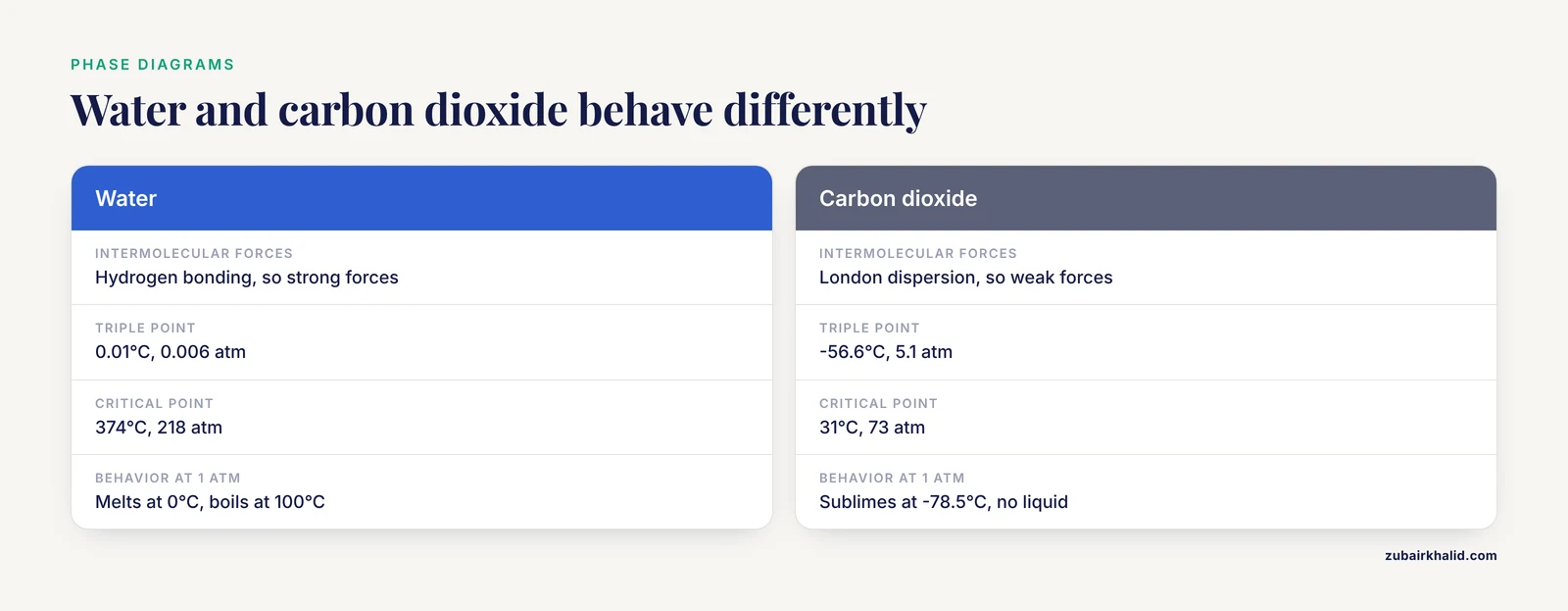
Water molecules form hydrogen bonds, giving water strong intermolecular forces. Carbon dioxide is a nonpolar molecule with only weak London dispersion forces. These differences are visible in their phase diagrams.
| Substance | Intermolecular forces | Triple point | Critical point | Behavior at 1 atm |
|---|---|---|---|---|
| Water | Hydrogen bonding | 0.01°C, 0.006 atm | 374°C, 218 atm | Melts at 0°C, boils at 100°C |
| Carbon dioxide | London dispersion | -56.6°C, 5.1 atm | 31°C, 73 atm | Sublimes at -78.5°C, no liquid |
At ordinary atmospheric pressure, carbon dioxide cannot exist as a liquid. It goes directly from solid to gas, which is why dry ice sublimes. Liquid carbon dioxide only forms at pressures above its triple point of 5.1 atm. Water, by contrast, has a liquid phase at 1 atm because its triple point is far below atmospheric pressure.
Common Mistake: Ignoring Pressure
A frequent error is predicting boiling or freezing behavior from temperature alone. Pressure shifts these transitions. At high altitude, lower atmospheric pressure lowers the boiling point of water, so water boils at a lower temperature and food cooks more slowly. In a pressure cooker, higher pressure raises the boiling point, allowing food to cook faster. The freezing point of water also shifts with pressure, decreasing slightly under high pressure, which is why ice melts beneath a skate blade.
For carbon dioxide, ignoring pressure leads to the false expectation of liquid CO2 at room temperature. At 20°C, CO2 is a gas at 1 atm and only becomes a liquid when compressed above about 57 atm. Reading a phase diagram correctly means always checking both temperature and pressure before predicting the state of matter.
Phase Change Calculations: Latent Heat and Energy Budgets
Heating a substance does not always raise its temperature. During a phase change, added energy breaks or forms intermolecular bonds while temperature stays constant. That energy is called latent heat. Two equations are needed for energy budgets: q = mcΔT for temperature changes, and q = mL for phase changes, where L is the latent heat of fusion or vaporization.
Worked Example: Melting Ice
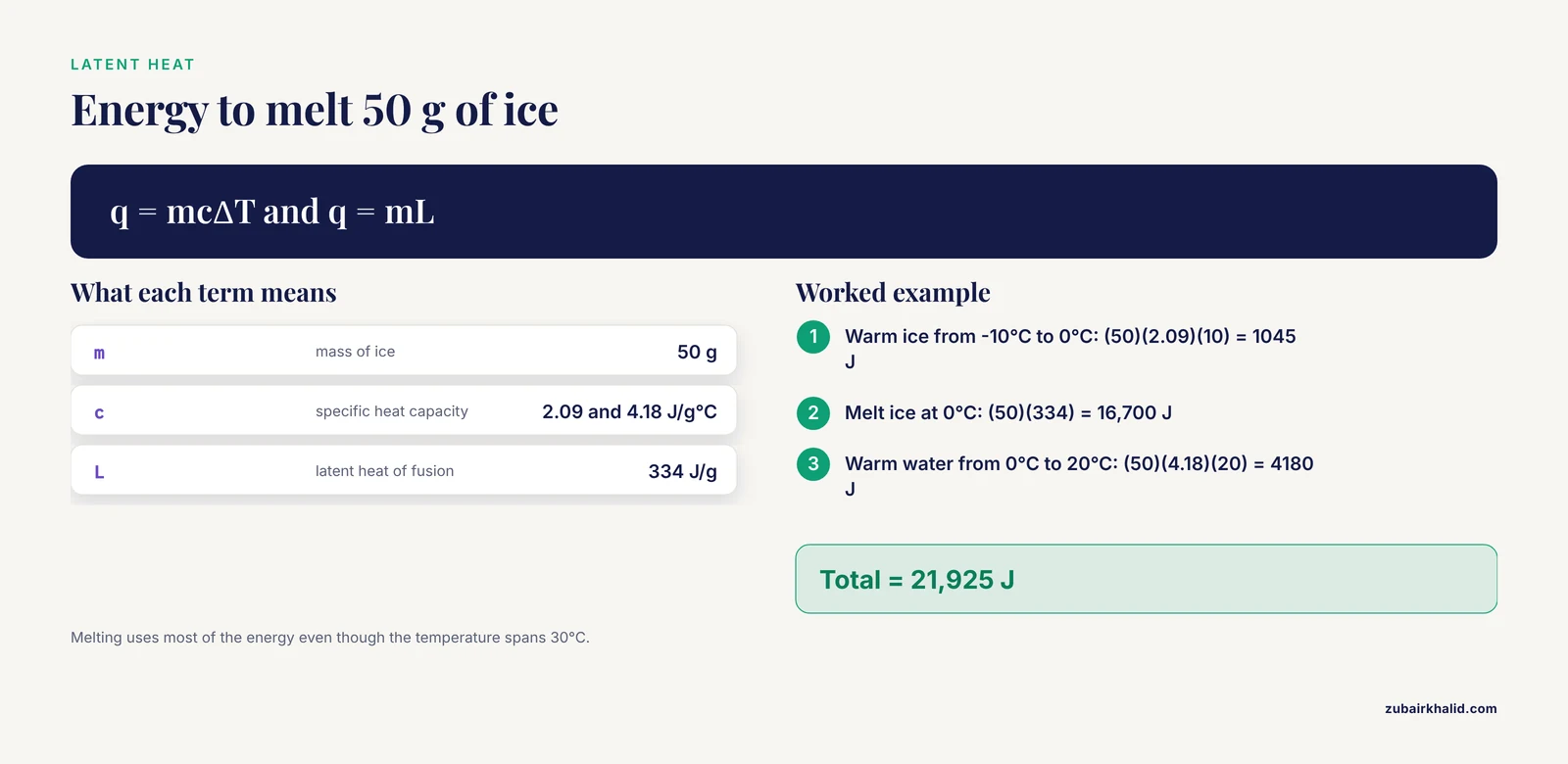
How much energy is needed to convert 50 g of ice at -10°C into liquid water at 20°C? Three steps are required.
- Warm ice from -10°C to 0°C: q = (50 g)(2.09 J/g°C)(10°C) = 1045 J
- Melt ice at 0°C: q = (50 g)(334 J/g) = 16,700 J
- Warm water from 0°C to 20°C: q = (50 g)(4.18 J/g°C)(20°C) = 4180 J
Total = 21,925 J. Melting dominates the budget even though the temperature change covers 30°C.
Worked Example: Boiling Water
To turn 100 g of water at 100°C into steam at 100°C: q = (100 g)(2260 J/g) = 226,000 J. For comparison, heating the same water from 20°C to 100°C requires only (100 g)(4.18 J/g°C)(80°C) = 33,440 J. Vaporization requires about seven times more energy than heating the liquid through 80°C.
The Common Mistake
During a phase change, ΔT = 0, so q = mcΔT gives zero. That is incorrect. The right equation is q = mL. Using specific heat during melting or boiling ignores the energy required to change the arrangement of particles, not their average kinetic energy.
Calorimetry in the Lab
In a calorimetry experiment, ice at 0°C is added to warm water. The heat lost by the warm water equals the heat gained by the ice, which includes the latent heat of fusion plus the specific heat warming of the melted ice. For example, adding 30 g of ice at 0°C to 200 g of water at 40°C gives:
10020 J + (30 g)(4.18 J/g°C)(Tf) = (200 g)(4.18 J/g°C)(40°C - Tf)
Solving gives Tf = 24.4°C. Without the 10,020 J of latent heat, the final temperature would be far too high. Calorimetry measurements of this kind let researchers measure latent heats directly from observed temperature changes.
Supercritical Fluids and Other Exotic States
The four classical states are a useful starting point, but they are not the whole story. Additional phases emerge under special conditions of temperature, pressure, or quantum behavior.
Supercritical Fluids
When a substance is heated and compressed beyond its critical point, the boundary between liquid and gas disappears. The resulting supercritical fluid has liquid-like density and gas-like diffusivity, so it penetrates materials and dissolves compounds efficiently. Supercritical carbon dioxide decaffeinates coffee beans without organic solvents, and supercritical fluid chromatography separates heat-sensitive molecules in pharmaceutical analysis.
Liquid Crystals
Liquid crystals have order intermediate between solid and liquid. Their molecules keep orientational alignment, like a solid, while still flowing, like a liquid. This dual character makes liquid crystal displays possible: an electric field reorients the molecules, changing how they transmit light.
Bose-Einstein Condensates
At temperatures within billionths of a degree of absolute zero, bosons such as rubidium-87 collapse into the same quantum ground state. The result is a Bose-Einstein condensate, a single macroscopic quantum object that behaves as one coherent wave. First produced in 1995, BECs are used to study quantum phenomena and to build atom interferometers.
Quark-Gluon Plasma
At temperatures above about two trillion kelvin, protons and neutrons dissolve into their constituent quarks and gluons. This quark-gluon plasma filled the early universe and is recreated in heavy-ion colliders, where it behaves as a nearly perfect fluid.
These are not exceptions to the rules of matter; they are additional phases with their own transitions. The four classical states remain the right framework for everyday conditions, but the full phase diagram of matter is far richer.
Related Guides
- Settling Basins and Solids Removal in Aquaculture Systems: Explains settling basins for removing suspended solid particles
- Manure Storage Options for Small Farms: Solid vs Liquid Systems: Explains solid vs liquid manure storage, a practical application of states
- Octapharma Careers: Inside Plasma-Derived Therapies and What They Look For: Details careers in plasma-derived therapies, linking biology and physics plasma
- Pillow Foot in Cats: Plasma Cell Pododermatitis: Covers a feline disease caused by plasma cells, another meaning of plasma
- Calf Barn Flooring Options: Slatted, Solid, and Rubber Surfaces: Describes calf barn flooring with solid options, showing solid state usage
- Rabbit Cage Flooring Options: Wire, Plastic, and Solid Surfaces: Rabbit cage flooring including solid surfaces, relates to solid state
- Pig Barn Flooring Options: Slatted, Solid, and Bedded Systems: Pig barn flooring with solid systems, another solid-state example
- Beef Cattle Barn Flooring Options: Slatted vs Solid Concrete: Beef cattle barn flooring comparing solid concrete, solid material application
Frequently Asked Questions
What are the four states of matter?
The four classical states of matter are solid, liquid, gas, and plasma. Solids have fixed shape and volume, liquids have fixed volume but variable shape, gases expand to fill any container, and plasma is an ionized gas containing free electrons and ions [3].
How do I explain states of matter to a child?
Use everyday examples. Ice is a solid because it keeps its shape. Water is a liquid because it takes the shape of its cup. Steam is a gas because it spreads through the air. Lightning and the Sun are plasma, which is like a gas that conducts electricity.
What are some examples of states of matter?
Solids include ice, metal, and bone. Liquids include water, blood, and oil. Gases include oxygen, carbon dioxide, and steam. Plasma includes lightning, stars, and neon signs.
How does matter change from one state to another?
Matter changes state when energy is added or removed. Melting turns solid to liquid, freezing turns liquid to solid, evaporation turns liquid to gas, condensation turns gas to liquid, sublimation turns solid to gas, and deposition turns gas to solid. These transitions are driven by changes in temperature and pressure.
Is plasma a gas?
Plasma is often described as an ionized gas, but it is distinct from an ordinary gas because its atoms have been stripped of electrons, leaving a mixture of positively charged ions and free electrons [3]. This gives plasma unique properties, such as electrical conductivity and responsiveness to magnetic fields.
What is the difference between blood plasma and physical plasma?
Blood plasma is the liquid component of blood that carries cells and proteins. Physical plasma is an ionized gas, the fourth state of matter [3]. The two are unrelated except for their name.
Sources
- Unraveling the Plasma Protein Corona by Ultrasonic Cavitation Augments Active-Transporting of Liposome in Solid Tumor.
- Argon gas plasma-treated physiological solutions stimulate immunogenic cell death and eradicates immunosuppressive CD47 protein in lung carcinoma.
- Modern Plasma Medicine and Orthopaedic Surgery: A Brief History and Outlook.
- Strain-driven stability modulation and Mott transitions in the charge density wave phase of monolayer 1T-TaS(2).
- Coexisting Liquid-, Glassy-, and Crystal-like Phonons in a Crystalline Solid.
- Solid-State Hydrogen Storage in Atomic Layer Deposited α-MoO(3) Thin Films.
- Insoluble Network Skeleton and Soluble Components of Nylon 6,6-Sputtered Nanoparticles: Insights from Liquid-State and Solid-State NMR Analysis.
- Coherent detection of pulsed terahertz waves in solid, gaseous, and liquid media.
- Coupling between a first-order gas-liquid phase transition and a second-order orientational transition in Langmuir monolayers.
- A robotic sample preparation scheme for the high performance liquid chromatographic determination of ivermectin in animal plasma.
- Plasma gasification of refuse derived fuel in a single-stage system using different gasifying agents.
- Formation of solid helical filaments at temperatures of superfluid helium as self-organization phenomena in ultracold dusty plasma.
- Laser-induced melting of two-dimensional dusty plasma system in RF discharge.
- AuNP/Chitosan Nanocomposites Synthesized through Plasma Induced Liquid Chemistry and Their Applications in Photothermal Induced Bacteria Eradication.
- Plasma parameters and the reduction potential at a plasma-liquid interface.
- Microwave Discharges in Liquid Hydrocarbons: Physical and Chemical Characterization.
- Studies of equation of state properties of high-energy-density matter generated by intense ion beams at the facility for antiprotons and ion research.
- Antimicrobial adhesive films by plasma-enabled polymerisation of m-cresol.
- Dust coupling parameter of radio-frequency-discharge complex plasma under microgravity conditions.
- Plasma copolymerized oxazoline and fluoro monomer based amphiphilic coatings for antibacterial and antifouling applications.