Moles: Anatomy, Diet, and Tunnel-Building Behavior
By Dr. Zubair Khalid, DVM, MS, PhD ·
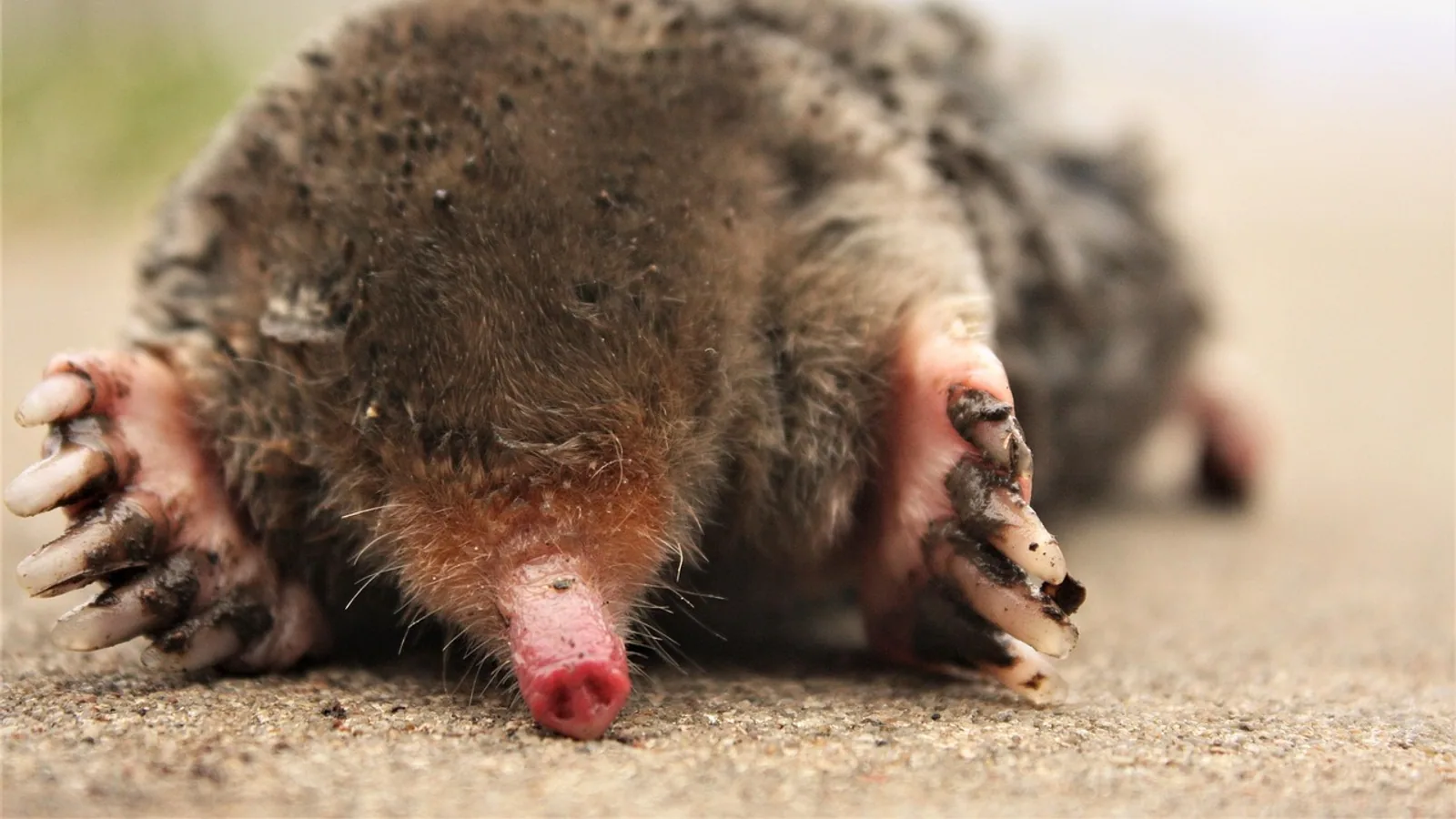
A mole is a small fossorial mammal in the family Talpidae, not a rodent, that lives almost entirely underground and digs with massively modified forelimbs. True moles eat earthworms, insects, and larvae, often consuming close to their own body weight each day, and they build two distinct kinds of tunnels: shallow feeding runs just under the surface and deeper permanent burrows that stay dry and stable.
This guide covers the anatomy that makes digging possible, the diet that keeps a mole's metabolism running, and how tunnel systems are organized. It also clears up the most common mix-ups, because moles are routinely confused with voles, gophers, shrews, and mole-rats, and each of those is a different animal with different biology.
What Is a True Mole?
True moles belong to the family Talpidae, within the order Eulipotyphla. That order also contains shrews and hedgehogs, which makes moles close relatives of shrews rather than of mice, rats, or voles. This distinction matters because people often assume any small burrowing mammal is a rodent. Moles are not rodents. They are insectivores in the broad, traditional sense: small mammals that feed mainly on invertebrates.
The Talpidae includes fully fossorial species such as the eastern mole (Scalopus aquaticus) and the Iberian mole (Talpa occidentalis), plus semi-fossorial and semi-aquatic relatives. Fossil and phylogenetic work continues to refine how these groups relate to one another. A recently described Pliocene mole from northeastern Spain, Vulcanoscaptor ninoti, was placed in the tribe Scalopini, whose closest living relatives are North American, and its postcranial skeleton shows a highly fossorial lifestyle supported by a complex forelimb structure [1].
The word fossorial means adapted for digging and living underground. Moles are among the most specialized fossorial mammals alive, and almost every striking feature of their anatomy traces back to that single fact.
Mole Anatomy: A Body Built for Digging
The Forelimb: Broad, Rotated, and Powerful
The mole forelimb is the defining structure of the animal. In talpid moles the humerus is unusually short and rotated dorsoventrally, with broadened proximal and distal ends where large muscles attach. The radius and ulna are exceptionally robust and short, and the ulna has an expanded olecranon process, the bony lever at the elbow that gives the triceps muscle mechanical advantage [2].
These skeletal changes are matched by developmental changes. Studies of Hox gene expression in the Iberian mole show that HoxA9 expression is spatially expanded in the developing stylopodial area of the forelimb compared with the less specialized mouse forelimb and with the mole's own hind limb [2]. In plain terms, the genetic program that patterns the upper forelimb is stretched out during development, which helps produce the short, wide, muscle-anchored humerus that digging demands.
Moles dig by humeral rotation, a strategy that is distinctive among burrowing mammals [3]. Rather than scooping forward like a shovel pushed straight ahead, the mole rotates the humerus so the broad forepaw sweeps laterally through soil, then retracts. Comparative analysis of bone microstructure in three mole species (Mogera imaizumii, Mogera wogura, and Urotrichus talpoides) found that vascular canals in the humerus are aligned predominantly circumferential along the bone wall, an arrangement consistent with resistance to the torsional load that humeral rotation generates [3]. The bone itself is organized around the twisting forces of digging.
The Hand: Pollex, Prepollex, and Claws
The mole's forepaw is broad and shovel-like, and it carries a set of structures that increase its effective surface area. The pollex, or thumb, is present, and alongside it sits a sesamoid bone often called the prepollex. A sesamoid is a small bone embedded in a tendon or joint capsule, and the prepollex acts as an extra strut that widens the palm. The result is a hand that functions less like a grasping tool and more like a paddle with a rigid leading edge.
Prominent claws complete the digging apparatus. In scratch-digging mole-rats, researchers have documented prominent claws together with a prominent bony structure underlying the thenar pad and a cartilaginous protrusion beneath the hypothenar pad on the palmar surface of the manus [4]. The same general principle applies to true moles: the palm is reinforced where it contacts and compresses soil, and the claws break up compacted ground ahead of the sweep.
Pectoral Muscles and the Shoulder Girdle
Powerful pectoral muscles drive the digging stroke. Across scratch-digging subterranean mammals, the shoulder, elbow, and wrist work in synergy to generate large out-forces, and the scapula and proximal ulna act as pivots that maximize and accommodate specialized muscles for shoulder stabilization, powerful shoulder flexion, elbow extension, and flexion of the manus and digits [5]. Species that dig with their forelimbs show more robust neck, shoulder, and forearm musculature than species that dig with their teeth, and some of their muscles are fused or have wider attachment areas on bone [5].
Muscle fiber type follows the same logic. In the scratch-digging Cape dune mole-rat, muscles involved in the power stroke of digging show a higher percentage of glycolytic fibers, which support fast, powerful motion, while a head and neck flexor in the tooth-digging naked mole-rat has more oxidative fibers [6]. Glycolytic fibers burn fuel quickly for short bursts. Oxidative fibers resist fatigue over longer periods. A mole's digging stroke is a burst activity, and its muscle chemistry reflects that.
Head, Snout, and Sensory Specializations
Moles have poor vision. Their eyes are tiny, sometimes covered by skin, and the visual system is reduced. What replaces vision is touch. The mole's snout is covered with Eimer's organs, which are specialized sensory structures packed with nerve endings that detect fine texture and vibration. Recordings from the somatosensory cortex of the eastern mole revealed a face representation containing barrel-like cytochrome oxidase dark ovals corresponding to the vibrissae on the snout, plus a representation of the palm and digits of the forepaw [7]. The brain devotes a large share of its sensory map to the snout and the digging hand, the two surfaces that read the underground world.
The corticospinal projections from the forelimb representation and motor cortex are dense, which fits a sensorimotor system tuned for continuous feedback during digging [7]. A mole is effectively feeling its way through soil with a hand that is also a sensory organ.
Summary Table: Mole Body Parts and Their Functions
| Body part | Adaptation | Function |
|---|---|---|
| Humerus | Short, dorsoventrally rotated, broad at both ends | Anchors large muscles and rotates during the digging stroke [2] |
| Radius and ulna | Exceptionally robust and short, expanded olecranon | Transmits force from the elbow to the hand [2] |
| Forepaw (manus) | Broad and shovel-like, with pollex and sesamoid prepollex | Widens the digging surface and compresses soil |
| Claws | Prominent and curved | Break up compacted soil ahead of the sweep [4] |
| Pectoral and shoulder muscles | Large mass, wide attachment areas, some fused | Generate the power stroke and stabilize the shoulder [5] |
| Muscle fibers | High glycolytic fiber share in power-stroke muscles | Deliver fast, powerful bursts rather than endurance [6] |
| Eyes | Tiny and reduced | Minimal role in navigation |
| Snout with Eimer's organs | Dense sensory nerve endings | Detect texture, vibration, and prey movement [7] |
| Somatosensory cortex | Large forepaw and snout representations | Processes touch feedback during digging [7] |
Diet: What Moles Actually Eat
Moles are insectivores and carnivores in practice. Their diet is dominated by earthworms, insect larvae, and adult insects, and they also take other soft-bodied invertebrates they encounter in soil. They do not eat roots, bulbs, or seeds in any meaningful way, which is one of the most persistent misunderstandings about them. A mole in a lawn is not eating the grass. It is hunting the invertebrates living under it.
The metabolic cost of digging is high, and moles eat accordingly. A working figure often cited for moles is consumption approaching their own body weight in food each day. That number reflects the energy required to move through soil, maintain a high metabolic rate, and fuel constant tunnel patrol. A mole that cannot find food quickly will move on to another part of its tunnel system or dig new runs.
Prey detection relies on touch and vibration rather than sight. Earthworms moving in a tunnel wall generate vibrations that a mole can sense through its snout and forepaws. This is why moles often appear to find worms with startling accuracy in complete darkness.
Moles cache food as well. Earthworms are sometimes stored in dedicated chambers within the burrow system, alive but immobilized, which gives the mole a reserve when foraging is poor. This behavior is consistent with the broader pattern seen in subterranean mammals, where burrow architecture influences food availability, temperature, humidity, gas concentrations, and protection from flooding and predation [8].
Tunnel-Building Behavior
Two Kinds of Tunnels
Mole tunnel systems are not uniform. They typically include two functional categories.
Shallow feeding runs lie just below the surface, often only a few centimeters down. These are the tunnels that produce the raised ridges people see crossing a lawn. A mole pushes through the soil along these runs while hunting invertebrates, and it may abandon a run once the local prey is depleted.
Deep permanent burrows sit well below the surface, sometimes more than a meter down. These are the structural core of the territory. They stay drier, hold temperature more steadily, and are less likely to collapse. A deep burrow system includes a nesting chamber, and often a food storage chamber and a latrine area.
Molehills are the visible byproduct of deep digging. When a mole excavates a deep tunnel, it must move the excavated soil somewhere, and it pushes it up through a vertical shaft to the surface. The result is the characteristic conical mound of loose soil. A molehill is therefore a sign of deep construction, not of a shallow feeding run.
Why Tunnel Architecture Matters
Burrow structure is not incidental. For most moles and mole-rats, the burrow environment shapes anatomy, physiology, behavior, and distribution, because temperature, humidity, gas concentrations, living space, food availability, mating access, and flood and predator protection are all influenced by how tunnels are built [8].
Excavating and mapping these systems is difficult. Burrow excavations can extend for hundreds of meters and reach depths beyond a meter, removing the occupant before excavation is often impractical, and different subterranean mammals are limited to particular continents, which makes a global comparative picture hard to assemble [8]. That is why detailed tunnel maps exist for only a minority of species.
Digging Mechanics
A mole excavates by driving the forepaws into soil, rotating the humerus to sweep the paw laterally, and pushing loosened soil back and up behind itself. The broad palm and prepollex act as a rigid plate. The claws loosen compacted material. Powerful shoulder and pectoral muscles supply the force, and glycolytic muscle fibers supply the speed [5][6].
Bone responds to these loads over an animal's lifetime. The circumferential alignment of vascular canals in the mole humerus is a structural signature of repeated torsion [3]. This is a good example of how behavior and anatomy reinforce each other in a highly specialized species.
Moles vs. Voles, Gophers, Shrews, and Mole-Rats
These animals get confused constantly, and the differences matter for anyone trying to identify what is in their yard.
Voles are small rodents, related to mice, that live above ground or in shallow surface runways. They eat plant material, including roots, bark, and stems. A vole problem in a garden is a rodent problem, not a mole problem.
Gophers (pocket gophers) are also rodents. They dig with their teeth and forelimbs, produce fan-shaped mounds, and feed on plant roots and tubers. Gopher mounds are typically crescent or fan shaped, while mole mounds are conical.
Shrews are close relatives of moles within Eulipotyphla, but they are not fossorial in the same way. They are small, active predators that often live at the surface or in leaf litter. Some shrews are venomous, and their teeth are often stained dark.
Mole-rats are rodents, not talpids, despite the name. African mole-rats in the family Bathyergidae dig either by scratching with their forelimbs or by chiseling with their incisors, and they include the naked mole-rat, which is eusocial and nearly poikilothermic [9]. A study of four solitary African mole-rat species found that scratch-diggers have more robust neck, shoulder, and forearm muscles than tooth-diggers, and that tooth-diggers may lack certain muscles entirely [5]. The name similarity is coincidental. Mole-rats are rodents. Moles are not.
The single most reliable way to tell a mole from a rodent is the forelimb. A mole's forepaws are broad, turned outward, and positioned close to the head, and the animal has no visible external ear and only tiny eyes. A vole or gopher has a more conventional rodent body plan.
What Moles Do in a Landscape
Moles are territorial. A single mole typically occupies its own tunnel system and defends it against intruders. Encounters between neighbors are infrequent but can be serious, and research on blind mole-rats shows that encounters produce measurable physiological stress responses, including changes in blood glucose and neutrophil-to-lymphocyte ratios [10]. Even in species that are not closely related to true moles, the pattern is instructive: a solitary subterranean mammal invests heavily in avoiding contact with its neighbors.
Moles also navigate without sight. Studies of blind mole-rats show they can learn a winding path through a maze faster than surface-dwelling rats and voles, and they retain that memory far longer, still showing roughly 45 percent of their optimal performance after four months compared with about 20 percent for voles [11]. The same study found that blind mole-rats use the earth's magnetic field for orientation, shifting the location of their nests and food stores when the magnetic field was experimentally reversed [12]. True moles rely more heavily on touch and vibration, but the broader lesson holds: subterranean mammals compensate for lost vision with other senses.
Common Mistakes and Limitations
Assuming a mole is a rodent. Moles are talpids in the order Eulipotyphla. Voles, gophers, and mole-rats are rodents. This is the most common identification error and it leads people to the wrong conclusions about diet and behavior.
Blaming moles for eaten plants. Moles eat invertebrates. If bulbs, roots, or garden plants are being eaten, the culprit is almost certainly a vole or a gopher, which may be using mole tunnels as travel routes.
Treating every mound the same. Conical mounds indicate deep mole digging. Fan-shaped or crescent mounds point to gophers. Shallow surface ridges with no mound point to feeding runs.
Expecting a single control method to solve everything. Because moles, voles, and gophers differ in diet and digging strategy, the approach that works for one will not necessarily work for another. Identification comes first.
Overestimating how much is known. Detailed burrow maps exist for only a small fraction of subterranean mammal species, and excavation is laborious and often incomplete [8]. Claims about the exact layout of a mole's tunnel system in a given yard should be treated as approximate.
Assuming a mole is blind and helpless. Moles have poor vision but excellent touch sensitivity, and their sensory cortex devotes large areas to the snout and forepaw [7]. They are highly effective at finding prey in total darkness.
For any specific situation involving an animal on your property, or a mole that has been handled or injured, consult a licensed veterinarian or your state wildlife agency. Individual cases vary, and general information cannot substitute for direct assessment.
Frequently Asked Questions
Are moles rodents?
No. Moles belong to the family Talpidae in the order Eulipotyphla, which makes them relatives of shrews and hedgehogs. Rodents include mice, rats, voles, gophers, and mole-rats.
What do moles eat?
Moles eat mainly earthworms, insect larvae, and adult insects, along with other soft-bodied invertebrates. They do not eat roots, bulbs, or seeds.
How much does a mole eat per day?
Moles have high metabolic demands from constant digging and are commonly described as eating close to their own body weight in food each day.
Why do moles make hills?
Molehills are the soil a mole pushes to the surface while excavating deep permanent burrows. Shallow feeding runs usually produce raised ridges instead of mounds.
Do moles have eyes?
Yes, but the eyes are tiny and the visual system is reduced. Moles rely on touch, vibration, and specialized sensory structures called Eimer's organs on the snout.
What is a prepollex?
A prepollex is a sesamoid bone near the thumb that widens the mole's forepaw and helps it function as a rigid digging plate.
How can I tell a mole from a vole?
Look at the forelimbs and the body plan. Moles have broad, outward-turned forepaws, no visible external ears, and tiny eyes. Voles look like typical small rodents and feed on plants.
Do moles live alone?
Most true moles are solitary and territorial, maintaining their own tunnel systems. Some other subterranean mammals, such as naked mole-rats, are highly social, but those are rodents, not moles.
Related Articles
- Animal Welfare Audits: Building a Useful Farm Program
- Building a Career in Animal Science Education
- Parrot Nutrition: Building a Balanced Diet for Pet Parrots
- Frog vs. Toad: A Veterinary Comparison of Anatomy, Behavior, and Care
- Broiler House Tunnel Ventilation Design and Operation
- Animal Behavior Certification
- Fisher Animal: Facts, Habitat, and Behavior
- Genets: Animal Facts, Habitat, and Behavior
- Lemmings: Biology, Behavior, and Population Cycles
Sources
- An unexpected Scalopini mole (Talpidae, Mammalia) from the Pliocene of Europe sheds light on the phylogeny of talpids.
- Hox gene expression in the specialized limbs of the Iberian mole (Talpa occidentalis).
- Bone microstructure as an indicator of digging ability in moles (Talpidae, Eulipotyphla).
- Comparative forelimb morphology of scratch-digging and chisel-tooth digging African mole-rat species.
- Functional and morphological divergence in the forelimb musculoskeletal system of scratch-digging subterranean mammals (Rodentia: Bathyergidae).
- Muscle architecture and muscle fibre type composition in the forelimb of two African mole-rat species, Bathyergus suillus and Heterocephalus glaber.
- Organization of somatosensory cortex and distribution of corticospinal neurons in the eastern mole (Scalopus aquaticus).
- Adaptiveness of tunnel system features in subterranean mammal burrows.
- Measurements of behavior in the naked mole-rat after intraperitoneal implantation of a radio-telemetry system.
- Social stress in neighboring and encountering blind mole-rats (Spalax ehrenbergi).
- Spatial learning and memory in the blind mole-rat in comparison with the laboratory rat and Levant vole.
- Magnetic compass orientation in the blind mole rat Spalax ehrenbergi.