Isotopes: Definition, Examples and Uses
By Dr. Zubair Khalid, DVM, MS, PhD ·
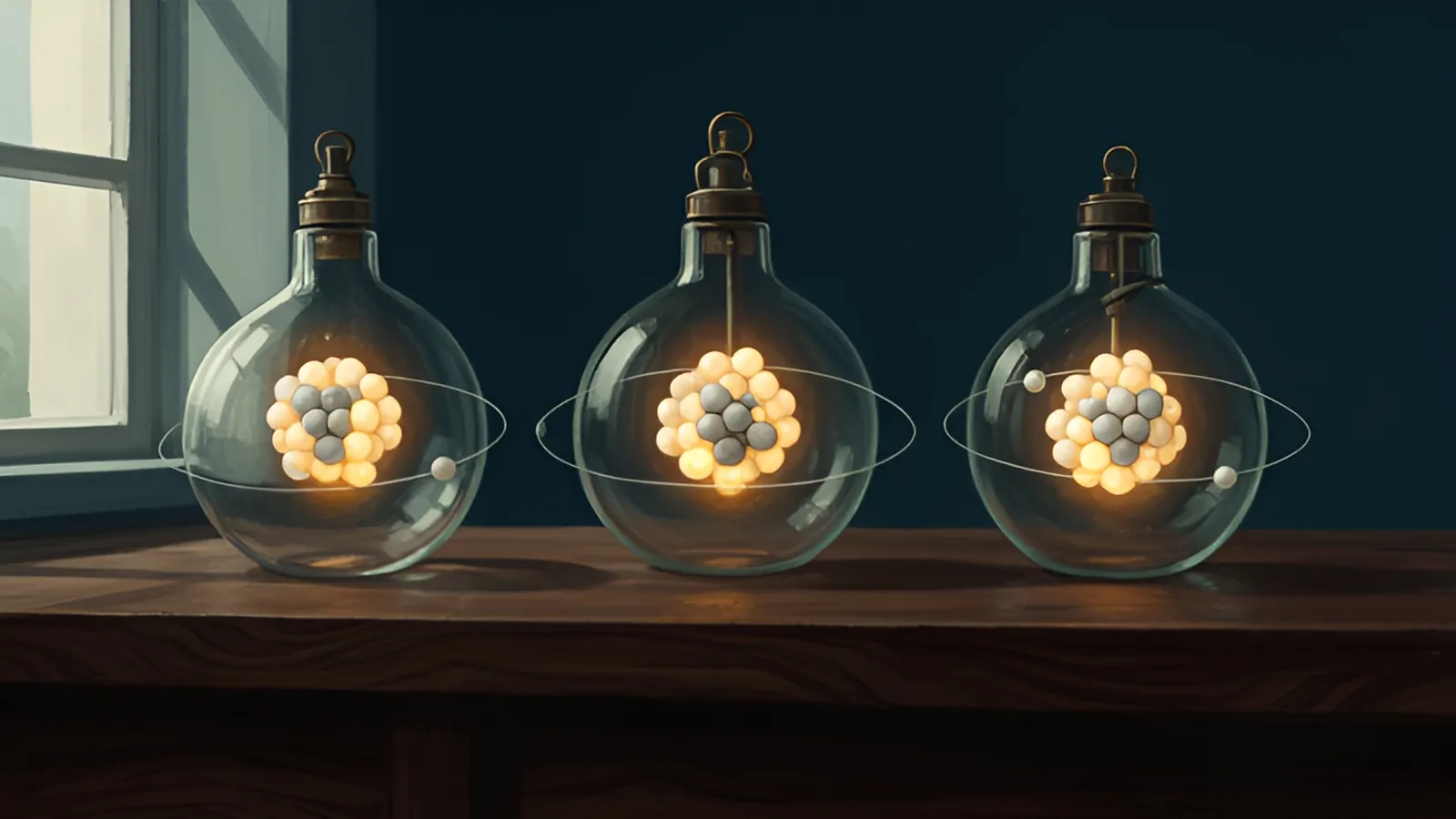
Isotopes are atoms of the same chemical element that have the same number of protons but different numbers of neutrons in their nuclei (Isotope; DOE Explains...Isotopes). The proton count, called the atomic number, fixes which element an atom is, so every isotope of an element holds the same position on the periodic table and behaves almost identically in chemical reactions (Isotope; Isotope Basics).
The neutron count changes the mass. Carbon-12, carbon-13, and carbon-14 each have 6 protons, with 6, 7, and 8 neutrons respectively, giving mass numbers of 12, 13, and 14 (Isotope). Isotopes are written with the element name or symbol followed by a hyphen and the mass number, such as carbon-14 or C-14 (Isotope Basics). Some isotopes are stable and others are radioactive: carbon-12 and carbon-13 do not decay, while carbon-14 is unstable (Education). The word itself comes from the Greek isos (equal) and topos (place), coined by Margaret Todd in a 1913 suggestion to Frederick Soddy.
Key Points
- Isotopes of one element share the same atomic number (Z) but differ in mass number (A) because their neutron numbers differ (Isotope Basics).
- Every carbon atom has 6 protons; carbon-12, carbon-13, and carbon-14 carry 6, 7, and 8 neutrons (Isotope).
- Hydrogen has three naturally occurring isotopes: hydrogen-1 (protium, 99.98% of hydrogen atoms, no neutrons), hydrogen-2, and hydrogen-3. Hydrogen-4 through hydrogen-7 are manmade and highly unstable.
- Strontium always has 38 protons, and 82.58% of strontium atoms have 50 neutrons, while others range from 44 to 52 neutrons.
- Isotopes can be written in AZE notation, with the mass number as a superscript and the atomic number as a subscript; a letter "m" after the mass number, as in technetium-99m, marks a metastable state.
- Isotopic labels in atmospheric CO2 samples let NOAA scientists determine what percentage of that carbon came from fossil fuels, the terrestrial biosphere, or the ocean (Education).
At a Glance
| Feature | What it means | Example |
|---|---|---|
| Definition | Atoms of one element with the same proton count and different neutron counts (Isotope) | Carbon-12 and carbon-14 |
| Atomic number (Z) | The proton count, which fixes the identity of the element (Isotope Basics) | Every carbon atom has Z = 6 |
| Mass number (A) | Protons plus neutrons | Carbon-14: 6 protons + 8 neutrons = 14 |
| Stability | Stable isotopes hold their form; radioactive isotopes decay over time (DOE Explains...Isotopes) | Carbon-12 is stable, carbon-14 is radioactive |
| Notation | Mass number as a superscript, or element name plus mass number | $^{14}\text{C}$ or carbon-14 |
| Behavior | Chemical behavior stays close across isotopes; mass and nuclear behavior differ | Deuterium forms heavy water, D$_2$O |
Isotopes of one element share nearly identical chemistry because they share the same electron arrangement, and they differ in mass and nuclear behavior because they carry different numbers of neutrons (Isotope). The sections below cover the nuclear structure behind that split and the notation used to write it.
What Is an Isotope?
An isotope is a version of a chemical element defined by its neutron count. All isotopes of an element have the same number of protons and a different number of neutrons in the nucleus (Isotope). That single difference in the nucleus separates one isotope from another, and it leaves the electron arrangement, and therefore the chemistry, almost untouched.
The Proton Count Sets the Element
The number of protons in a nucleus is the atomic number, and each atomic number identifies one specific element (Isotope). Carbon has six protons. An atom with five protons is boron, and an atom with seven protons is nitrogen (Education). Because the proton count is fixed for an element, the neutron count is the main variable that distinguishes isotopes of that element.
The Meaning of the Word
Isotope comes from the Greek roots isos, meaning "equal," and topos, meaning "place" (Isotope). Different isotopes of an element sit in the same place on the periodic table because that position is set by the atomic number. Margaret Todd suggested the term in 1913 to the British chemist Frederick Soddy, who popularized it.
What Stays the Same and What Changes
Isotopes of a given element have virtually the same chemical properties (Isotope). They differ in atomic mass and in physical properties. The neutron number has a strong effect on nuclear properties and a negligible effect on chemical properties for most elements. Hydrogen is the notable exception, where the isotope effect is large enough to affect biology.
Isotopes in Nature
Most elements occur naturally as a mixture of isotopes (Isotope Basics). Strontium shows the range. About 82.58 percent of strontium atoms have 50 neutrons, and other strontium atoms carry anywhere from 44 to 52 neutrons, yet all of them remain strontium because every one has 38 protons. Hydrogen has three naturally occurring isotopes, hydrogen-1, hydrogen-2 and hydrogen-3, plus four manmade isotopes that are highly unstable.
Isotope or Nuclide?
A nuclide is a nuclear species with a specific number of protons and neutrons, such as carbon-13 with 6 protons and 7 neutrons (Isotope). The two terms overlap in practice. The nuclide concept stresses nuclear properties, and the isotope concept stresses chemical properties.
Worked Example: Carbon
Carbon has three well-known isotopes, carbon-12, carbon-13 and carbon-14, with mass numbers 12, 13 and 14 (Isotope). The atomic number of carbon is 6, so the neutron numbers are 6, 7 and 8 respectively. All three behave as carbon in chemical reactions, and only carbon-14 is radioactive.
Inside the Atom: Protons, Neutrons and Electrons
| Particle | Charge | Location | Main role |
|---|---|---|---|
| Proton | Positive | Nucleus | Sets the atomic number and the element (Isotope Basics) |
| Neutron | Neutral | Nucleus | Adds mass and helps bind the nucleus (DOE Explains...Isotopes) |
| Electron | Negative | Shells around the nucleus | Determines chemical properties |
The Nucleus
Protons and neutrons pack into the dense central nucleus of the atom (DOE Explains...Isotopes). The nucleus is about 100,000 times smaller than the electron cloud that surrounds it, and it holds nearly all of the atom's mass (Isotope Basics).
The Electron Cloud
Electrons occupy shells around the nucleus (DOE Explains...Isotopes). In a neutral atom, the number of electrons equals the number of protons (Isotope Basics). Electrons determine the chemical properties of the element and allow bonds to form, as in strontium chloride, SrCl$_2$. An atom can gain or lose electrons, which changes its charge and creates an ion, and the element stays the same (Education).
Atomic Number
The number of protons is the atomic number, written Z (Isotope Basics). A strontium nucleus always has 38 protons, and a rubidium nucleus always has 37. The proton count is fixed for a given element, while the neutron count can vary widely (Isotope).
Neutrons, Mass and Binding
Neutrons carry no charge and add mass (Education). They also help bind the nucleus together (DOE Explains...Isotopes). The mass number, A, is the total count of protons and neutrons in the nucleus (Isotope Basics). Isotopes of one element share the same Z and differ in A.
Worked Example: Carbon-14
Carbon-14 has an atomic number of 6 and a mass number of 14. The neutron count follows from subtraction:
$$\text{neutrons} = A - Z = 14 - 6 = 8$$
So the nucleus holds 6 protons and 8 neutrons, and the neutral atom carries 6 electrons in its shells (Isotope; Isotope Basics).
When the Balance Fails
A nucleus needs a workable ratio of neutrons to protons. An unbalanced neutron-to-proton ratio can make the nucleus unstable and trigger decay (DOE Explains...Isotopes). That instability sits in the nucleus, while the electron arrangement that drives ordinary chemistry stays largely the same (Isotope).
Isotope Notation and Naming
AZE Notation
Standard notation places the mass number as a superscript to the left of the chemical symbol and the atomic number as a subscript (Isotope Basics). For carbon-14, the full form is:
$$^{14}_{6}\text{C}$$
Because the chemical symbol already fixes the atomic number, the subscript is often dropped, giving $^{14}\text{C}$, which is read as "carbon fourteen" (Isotope Basics).
Hyphen Notation
The most common form in everyday writing is the element name or symbol, a hyphen, and the mass number, as in carbon-14 or C-14 (Isotope Basics). Textbooks and news reports use this style (Isotope). The mass number always follows the hyphen, so carbon-14 and 14C mean the same thing.
Metastable States
A letter m placed immediately after the mass number marks a metastable state, as in technetium-99m (Isotope Basics). The m signals an excited nuclear state that releases energy later, which matters in medical imaging.
Special Names for Hydrogen
Hydrogen isotopes carry their own names. Hydrogen-1 is protium, the most abundant hydrogen isotope, with no neutrons, and it accounts for 99.98 percent of hydrogen atoms (Isotope Basics). Hydrogen-2 is deuterium, with one neutron, and hydrogen-3 is tritium, with two neutrons.
Notation at a Glance
| Style | Written form | Example | Typical setting |
|---|---|---|---|
| AZE, full | Superscript A, subscript Z, symbol | $^{14}_{6}\text{C}$ | Nuclear science texts (Isotope Basics) |
| AZE, short | Superscript A, symbol | $^{14}\text{C}$ | Journals and data tables |
| Hyphen | Element name or symbol, hyphen, mass number | carbon-14, C-14 | Textbooks and news reports (Isotope; Isotope Basics) |
| Metastable | Mass number plus m | technetium-99m | Nuclear medicine |
Worked Example: Writing Chlorine-37
Chlorine has an atomic number of 17, so every chlorine atom has 17 protons. Chlorine-37 has a mass number of 37, which gives 37 - 17 = 20 neutrons. In full AZE notation it is written $^{37}_{17}\text{Cl}$, and in hyphen notation it is chlorine-37 or Cl-37 (Isotope Basics).
Stable and Radioactive Isotopes
Every element has a family of isotopes, and that family usually splits into two groups. Stable isotopes keep the same nucleus over time (DOE Explains...Isotopes). Radioactive isotopes release particles or energy until they reach a more stable arrangement. The dividing line is the balance of protons and neutrons in the nucleus, not the number of electrons orbiting it.

What Holds a Nucleus Together
A nucleus packs positively charged protons into a volume far smaller than the atom around it. Protons repel one another, and the strong nuclear force has to overcome that repulsion. Neutrons contribute attraction without adding charge, so they act as nuclear glue. When the ratio of neutrons to protons sits in a range the strong force can manage, the nucleus holds together indefinitely, and the isotope is stable (DOE Explains...Isotopes). When the ratio drifts outside that range, the nucleus carries excess energy or an unfavorable balance and rearranges itself.
How Radioactive Isotopes Decay
Radioactive isotopes release particles or energy until stable (DOE Explains...Isotopes). The pathway taken is the decay mode, and the decay mode depends on the balance inside the nucleus.
| Decay mode | What leaves the nucleus | Typical imbalance |
|---|---|---|
| Alpha decay | Two protons and two neutrons, as a helium nucleus | Heavy nuclei with too many protons |
| Beta-minus decay | An electron and an antineutrino; a neutron becomes a proton | Too many neutrons |
| Beta-plus decay | A positron and a neutrino; a proton becomes a neutron | Too many protons |
| Electron capture | An inner-shell electron; a proton becomes a neutron | Too many protons |
| Gamma emission | A high-energy photon only | Nucleus left in an excited state |
Decay often proceeds in steps. A parent isotope transforms into a daughter that may itself be radioactive, and the chain continues until a stable nuclide appears.
Half-Life: The Clock Inside the Nucleus
Half-life describes how quickly a radioisotope decays (Isotope Basics). It is the time needed for half the atoms in a sample to transform. Decay is random for any single nucleus, but large samples follow a smooth curve. After one half-life, half the original atoms remain. After two, one quarter. After three, one eighth.
The fraction remaining after time $t$ is $(1/2)^{t/t_{1/2}}$, where $t_{1/2}$ is the half-life.
Worked example: a sample holds 1,000 radioactive atoms with a half-life of 8 days. After 8 days, about 500 remain; after 16 days, about 250; after 24 days, about 125. The count approaches zero without reaching it in a finite number of steps.
Some half-lives last seconds, others billions of years (Isotope Basics). That spread explains why radioisotopes serve such different jobs. A short half-life suits a medical tracer that must clear from the body quickly. A long half-life suits geological dating, where the clock has to run for millions of years.
Stability and Hazard Are Separate Questions
A stable isotope can still be chemically toxic, and a long-lived radioisotope that emits low-energy radiation can be handled with modest precautions. Risk depends on the radiation type and energy, the chemical form of the material, and the route by which it enters the body.
Examples of Isotopes
Hydrogen: One Proton, Three Common Masses
Hydrogen-1, hydrogen-2 and hydrogen-3 differ by neutrons (Isotope). All three have a single proton, so all three are hydrogen. Hydrogen-1, also called protium, has no neutrons and accounts for 99.98 percent of hydrogen atoms (Isotope Basics). Hydrogen-2, or deuterium, has one neutron. Hydrogen-3, or tritium, has two. Hydrogen-2 and hydrogen-3 are often man-made, and hydrogen has four additional isotopes, from hydrogen-4 through hydrogen-7, that are manmade and highly unstable.
Hydrogen is the one element where the mass difference between isotopes is large enough to affect biology strongly (Isotope). Water built from deuterium instead of hydrogen-1 behaves differently in chemical and biological systems, which is why deuterated water and deuterated solvents appear in laboratories.
Carbon: A Stable Pair and a Radioactive Tracer
Carbon-12 is stable while carbon-14 is radioactive (Isotope). Every carbon atom has six protons, so the three main isotopes differ only in neutron count: carbon-12 has six neutrons, carbon-13 has seven, and carbon-14 has eight. Carbon-12 and carbon-13 are stable isotopes that do not decay into other forms over time, while carbon-14 is unstable (Education).
Carbon-14 forms in the upper atmosphere and enters living tissue through carbon dioxide. Once an organism dies, its carbon-14 content declines at a known rate, which is the basis of radiocarbon dating. Carbon-13 serves a different purpose: because plants and other materials take up carbon-13 and carbon-12 in slightly different proportions, the ratio acts as a label for the source of carbon in a sample (Education).
Oxygen Isotopes in Water and Ice
Oxygen-16, oxygen-17 and oxygen-18 occur naturally (Education). Oxygen-16 dominates, but the heavier forms matter because physical processes treat them slightly differently. Water molecules carrying oxygen-18 evaporate less readily and condense more readily than molecules carrying oxygen-16. That fractionation leaves a temperature and rainfall signal in ice cores, cave deposits and ocean sediments.
Uranium-235 and Uranium-238
Uranium-235 and uranium-238 behave differently in reactors (Isotope). Both have 92 protons. Uranium-235 has 143 neutrons and fissions readily when struck by a slow neutron. Uranium-238 has 146 neutrons, does not fission easily, and tends to capture neutrons instead, forming plutonium-239. Because the two isotopes differ by only three neutrons out of roughly 238 nucleons, separating them requires enrichment processes that exploit a very small mass difference.
Nitrogen and Oxygen as Environmental Tracers
Nitrogen and oxygen isotopes track environmental processes (Education). Nitrate in groundwater carries a nitrogen isotope ratio that shifts with its source and with the microbial reactions it has passed through. Denitrification, the conversion of nitrate to nitrogen gas, leaves the remaining nitrate enriched in the heavier nitrogen isotope. Oxygen isotopes in the same nitrate add a second line of evidence. Together the two ratios help distinguish fertilizer, soil and waste sources in a water sample.
| Isotope | Protons | Neutrons | Stability | Where it matters |
|---|---|---|---|---|
| Hydrogen-1 | 1 | 0 | Stable | Most hydrogen atoms (Isotope Basics) |
| Hydrogen-2 | 1 | 1 | Stable | Heavy water, labeled compounds |
| Hydrogen-3 | 1 | 2 | Radioactive | Tracer studies |
| Carbon-12 | 6 | 6 | Stable | Most carbon atoms (Education) |
| Carbon-13 | 6 | 7 | Stable | Source tracking |
| Carbon-14 | 6 | 8 | Radioactive | Radiocarbon dating |
| Oxygen-16 | 8 | 8 | Stable | Most oxygen atoms |
| Oxygen-18 | 8 | 10 | Stable | Climate and water studies |
| Uranium-235 | 92 | 143 | Radioactive | Reactor fuel (Isotope) |
| Uranium-238 | 92 | 146 | Radioactive | Fertile material |
How Scientists Measure Isotopes
Mass Spectrometry: Sorting Atoms by Mass
Mass spectrometry separates isotopes according to mass (Isotope Basics). The instrument does not weigh atoms one at a time. It converts a sample into ions, moves those ions through electric and magnetic fields, and records how many arrive at each position. Because isotopes of an element differ in mass, they land in different places.
Inside the Instrument
Samples are ionized, accelerated and deflected by magnetic fields (Isotope Basics). The sequence runs in four stages.
- Ionization. The sample is converted into charged particles, often by bombarding it with electrons or by spraying it from a liquid.
- Acceleration. An electric field drives the ions into a beam with a known kinetic energy.
- Deflection. A magnetic field bends the beam. Lighter ions curve more sharply than heavier ones, so the beam splits by mass.
- Detection. A detector counts the ions arriving at each position and converts the counts into a mass spectrum.
The result is a set of peaks. Peak heights give the relative abundance of each isotope in the sample.
Reading Ratios Against Standards
Stable isotope ratios are reported against international standards (Education). Absolute ratios are difficult to measure and to compare between laboratories, so results are expressed as a difference from a reference material. The common form is delta notation:
$$\delta = \left( \frac{R_{sample}}{R_{standard}} - 1 \right) \times 1000$$
where $R$ is the ratio of the heavy isotope to the light isotope. The result is reported in parts per thousand, or per mil. A positive value means the sample holds more of the heavy isotope than the standard does.
Resolution and Precision
Instruments resolve tiny differences between heavy and light forms (Education). The challenge grows with atomic mass. Carbon-12 and carbon-13 differ by about 8 percent in mass, which is easy to separate. Uranium-235 and uranium-238 differ by about 1.3 percent, which demands higher resolution. Modern instruments reach the precision needed to detect natural variation of a few parts per thousand or less.
What the Numbers Reveal
Measured ratios reveal sources, ages and pathways (Education). A carbon isotope ratio in an air sample can indicate how much of the carbon came from fossil fuels, the terrestrial biosphere, or the ocean. A nitrogen ratio in nitrate can point to its origin. A radiocarbon measurement can date a bone or a sediment layer. In each case the isotope ratio acts as a label that the sample carried from its source.
Beyond Mass Spectrometry
Not every measurement uses mass. Radioactive isotopes can be quantified by counting decay events with a radiation detector, and accelerator mass spectrometry is used when a sample contains only a trace of a rare isotope such as carbon-14. Counting methods trade speed for sensitivity, while mass spectrometric methods deliver isotope ratios with high precision.
Uses of Isotopes in Medicine
Tracers: Following a Compound Through the Body
Radioactive tracers follow compounds through the body (DOE Explains...Isotopes). A tracer pairs a radioactive isotope with a molecule that the body handles in a known way. The isotope emits radiation that escapes the body, and an external camera records where the signal appears. Because isotopes of an element share the same chemical behavior, attaching a radioactive label does not change how the carrier molecule works (Isotope).
Technetium-99m: The Workhorse
Technetium-99m is a workhorse of nuclear imaging (Isotope). The letter m marks a metastable state, a form of the nucleus that holds extra energy and releases it as gamma radiation (Isotope Basics). Gamma rays pass through tissue, so a gamma camera outside the patient can map the distribution of the tracer. Technetium-99m is combined with different carrier compounds depending on the tissue under study, which allows one isotope to serve bone scans, kidney studies, heart imaging and other procedures.
Iodine-131 and the Thyroid
Iodine-131 supports thyroid diagnosis and therapy (Isotope). The thyroid gland concentrates iodine, so radioiodine delivered to a patient accumulates there. The isotope emits beta particles, which travel a short distance and damage nearby tissue, along with gamma rays that allow imaging. That combination makes iodine-131 useful both for scanning thyroid function and for treating overactive thyroid tissue or thyroid cancer.
PET Scans and Fluorine-18
PET scans use fluorine-18 attached to glucose (Isotope). The labeled molecule, fluorodeoxyglucose, enters cells through the same transporters that take up ordinary glucose, and cells with high
Uses in Dating, Environment and Industry
Isotopes work as clocks, tracers, and fuel. Because isotopes of the same element take part in nearly identical chemical reactions but differ in mass and nuclear stability, scientists can follow them through rocks, water, air, and living tissue and read information that no other measurement provides.
Dating Once-Living Material
Carbon-14 dating estimates the age of once-living material (DOE Explains...Isotopes). Carbon-14 forms in the upper atmosphere and mixes with carbon dioxide. Plants take it in during photosynthesis, and animals take it in by eating plants or other animals. While an organism is alive, its carbon-14 content stays close to the level in the atmosphere. When it dies, the exchange stops and the carbon-14 already present begins to decay. Measuring how much remains, relative to stable carbon, gives an estimate of the time since death. The method applies to wood, charcoal, bone, shell, and other organic remains. Beyond a certain age too little carbon-14 is left to measure reliably, so older material is dated with other isotope systems used in geology.
Climate Records in Ice and Sediment
Oxygen isotopes in ice cores record past climate (Education). Water molecules that carry oxygen-18 are heavier than those that carry oxygen-16, so they evaporate and condense at slightly different temperatures. The ratio preserved in each layer of an ice core therefore reflects conditions at the time the snow fell, and long cores give a layered record of temperature going back thousands of years. The same principle applies to carbon. NOAA scientists use isotopic labels to determine what percentage of the carbon in an atmospheric sample came from fossil fuels, the terrestrial biosphere, or the ocean.
Tracing Pollution and Farm Runoff
Nitrogen isotopes trace pollution and farm runoff (Education). Synthetic fertilizer, manure, sewage, and atmospheric deposition each carry a characteristic nitrogen isotope signature. When a stream, lake, or groundwater sample is analyzed, the ratio points toward the likely source, which helps agencies target cleanup and regulation.
Fuel and Fusion Research
Deuterium and tritium support fusion research (DOE Explains...Isotopes). These two heavy hydrogen isotopes are the usual fuel for experiments that aim to reproduce the fusion reactions inside stars. In the fission sector, enriched uranium-235 fuels nuclear power reactors. Natural uranium contains only a small share of uranium-235, so enrichment raises that share before the material is fabricated into reactor fuel.
| Isotope | What it reveals | Field |
|---|---|---|
| Carbon-14 | Time since death of once-living material (DOE Explains...Isotopes) | Archaeology, paleontology |
| Oxygen-18 and oxygen-16 | Past temperature recorded in ice layers (Education) | Climate science |
| Nitrogen-15 and nitrogen-14 | Source of nitrogen pollution | Environmental monitoring |
| Deuterium and tritium | Fuel behavior in fusion experiments | Energy research |
| Uranium-235 | Fissile content of reactor fuel | Nuclear power |
The common thread is that a small mass difference, invisible in ordinary chemistry, becomes a measurable signal when the right instrument is pointed at the right sample.
Common Misconceptions About Isotopes
Isotopes appear in news stories about radiation, medical scans, and nuclear power, and that context creates confusion. Six ideas come up often.
Isotopes Are Always Radioactive
Many isotopes are stable and never decay (DOE Explains...Isotopes). Carbon-12 and carbon-13 are stable isotopes; carbon-14 is the unstable one (Education). Every element has a family of isotopes, and for most elements the stable members outnumber the radioactive ones. Radioactivity is a property of certain nuclei, not a property of the isotope concept itself.
Isotopes of One Element Are Different Elements
Isotopes of an element share the same atomic number, the same number of protons, and the same position in the periodic table (Isotope). The name comes from the Greek words for "same place". Carbon-12 and carbon-14 are both carbon; they differ in mass number because they carry different numbers of neutrons.
Isotopes Behave Completely Differently in Chemical Reactions
The neutron number strongly affects nuclear properties but has a negligible effect on chemical properties for most elements (Isotope). Isotopes of an element form the same compounds and take part in the same reactions at nearly the same rates. Hydrogen is the main exception: because it is the lightest element, the mass difference between protium and deuterium is large enough to affect biological systems.
All Radiation Comes from Isotopes
Radioactive decay is one source of radiation, not the only one (DOE Explains...Isotopes). X-ray tubes, particle accelerators, and cosmic rays produce radiation with no isotope involved, and ordinary light, radio waves, and microwaves are electromagnetic radiation from other processes. A radiation detector reading does not by itself prove that an isotope is present.
An Isotope Is the Same Thing as an Ion
These terms describe different changes to an atom. An ion has gained or lost electrons, so it carries a charge, but it remains the same element (Education). An isotope has a different number of neutrons, so its mass number changes while its charge stays neutral (Isotope Basics). A chloride ion and a chlorine-37 atom are different ideas, and a sample can contain both at once.
Half-Life Means Half the Sample Disappears at Once
Half-life is the time required for half of the atoms in a sample to decay (Isotope Basics). Decay is a random event for each individual atom, so the sample does not lose half its atoms at a single moment. The number falls smoothly: half remain after one half-life, a quarter after two, an eighth after three. The atoms do not vanish either; each decaying atom becomes a different nuclide.
| Misconception | Correct view |
|---|---|
| All isotopes are radioactive | Many are stable (DOE Explains...Isotopes) |
| Isotopes are different elements | Same element, same atomic number (Isotope) |
| Isotopes react differently | Chemical behavior is nearly identical |
| All radiation comes from isotopes | Decay is one source among several |
| Isotope equals ion | Ions differ in electrons, isotopes in neutrons (Isotope Basics) |
| Half-life means instant loss of half | Decay is gradual and statistical |
Isotopes in Everyday Life
Isotopes are not confined to laboratories. They sit in household devices, verify the origin of food, and support the medical and energy systems that people rely on daily.
Safety at Home
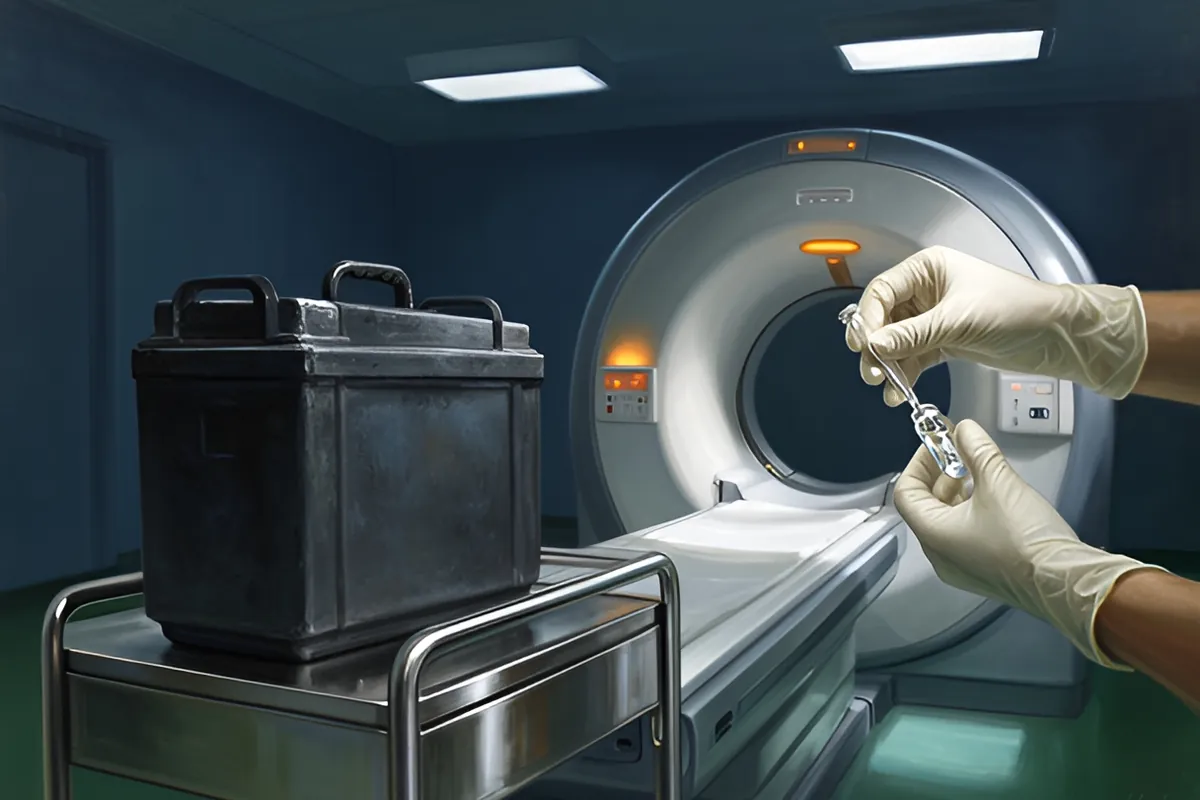
Smoke detectors contain americium-241 (DOE Explains...Isotopes). The isotope sits in a small sealed source inside an ionization chamber, where it keeps a steady current of charged particles flowing. When smoke enters the chamber, it interrupts that current and the alarm sounds. The source is sealed inside the housing, and disposal rules vary by location, so manufacturers and local waste authorities provide the guidance that applies.
Food, Water and Product Checks
Food and water authenticity checks rely on isotope ratios (Education). The ratio of heavy to light isotopes in a plant or in groundwater depends on local climate, geology, and growing conditions. A laboratory compares the measured ratio in a product against the range expected for its claimed origin. A mismatch suggests the label may be wrong. This approach is used to verify the geographic origin of foods and the source of bottled water.
Archaeology, Geology and Forensics
Archaeology, geology and forensics use isotope data (Education). Archaeologists date organic remains and reconstruct ancient diets. Geologists determine the age of rocks and track the movement of water and minerals underground. Forensic scientists compare isotope ratios in biological and environmental samples to help narrow down where a person or a material came from.
Medicine, Agriculture and Energy
Medicine, agriculture and energy all depend on isotopes (DOE Explains...Isotopes). In medicine, radioisotopes are used for imaging and for therapy, and stable isotopes serve as tracers in metabolic studies. In agriculture, isotope-labeled fertilizers and water trace nutrient uptake, soil processes, and animal nutrition. In energy, isotopes are central to reactor fuel and to fusion research.
Learning the Basics
Isotope basics support later study of chemistry and biology (Isotope Basics). Knowing how atomic number, mass number, and notation fit together makes it easier to follow reaction mechanisms, metabolic pathways, and nuclear chemistry. The isotope concept groups atoms of an element by chemical identity, while the nuclide concept treats each nuclear species on its own terms (Isotope). That distinction returns in advanced courses, in laboratory work, and in any job that involves radiation safety.
Related Guides
- How to Calculate Atomic Mass From Isotopes (Step by Step)
- Periodic Table of Elements: Groups, Periods and Trends
- What Is an Element in Science? Definition and Examples
- Molecule Definition: Types and Examples
- Covalent Bonds: Definition, Types, and Examples
- Ionic Chemical Bond: Definition, Formation, and Examples
- Electronegativity Chart and Trends
- Lewis Structures: How to Draw Lewis Dot Diagrams (H2O, NH3, CO2)
- Phosphate Group: Structure, Charge and Role in DNA and ATP
- Radioactive Iodine for Hyperthyroid Cats: Cost and Results
- Atomic Absorption Spectroscopy: Principle and Uses
- Nucleus Function: Roles of Nucleus and Nucleolus
Frequently Asked Questions
What is an isotope in simple terms?
An isotope is a version of a chemical element that has the same number of protons in its nucleus but a different number of neutrons (Isotope). Because the proton count sets the element's identity, every isotope of carbon still behaves as carbon in chemical reactions. The word comes from the Greek isos, meaning equal, and topos, meaning place, since isotopes of one element occupy the same spot on the periodic table. The extra or missing neutrons change the atom's mass and its nuclear behavior, not its basic chemistry.
How do isotopes of the same element differ from each other?
Isotopes of one element share the same atomic number, so they have identical proton counts and the same number of electrons in the neutral atom. They differ in neutron number, which gives each isotope a distinct mass number (Isotope). Carbon-12, carbon-13, and carbon-14 all carry six protons, with six, seven, and eight neutrons respectively. Chemical properties are virtually the same, while atomic mass and physical properties differ. Neutron number strongly affects nuclear properties such as stability and decay, but its effect on ordinary chemistry is negligible for most elements.
Are all isotopes radioactive?
No. Many isotopes are stable, meaning they do not decay into other elements
References and Further Reading
- Isotope, en.wikipedia.org
- DOE Explains...Isotopes, energy.gov
- Isotope Basics, isotopes.gov
- Education, gml.noaa.gov