Funnel Weaver Spider: Habits and ID
By Dr. Zubair Khalid, DVM, MS, PhD ·
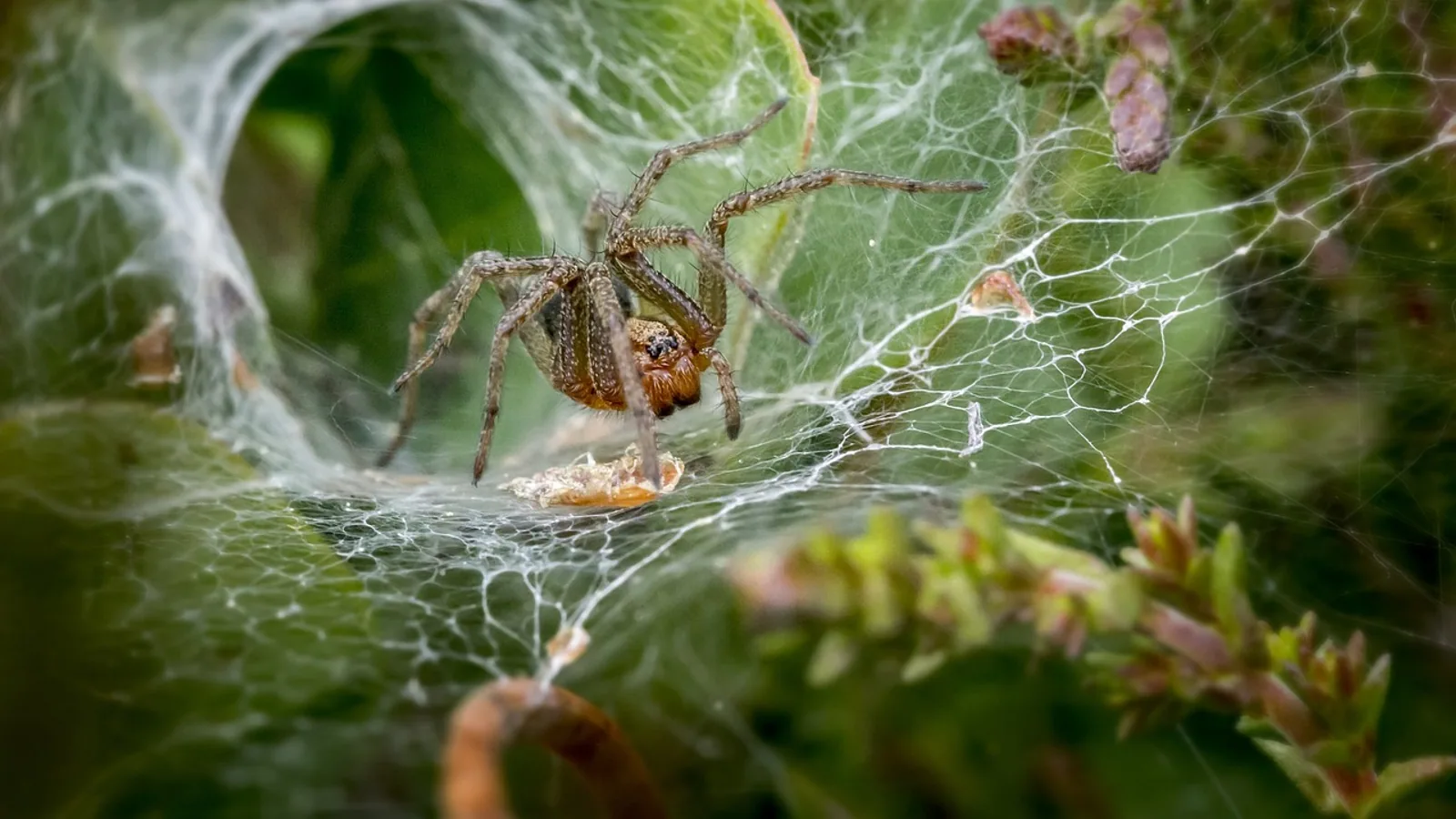
A funnel weaver spider is a harmless, fast-running spider in the family Agelenidae that builds a flat sheet of silk with a funnel-shaped retreat at one edge. You can identify one by its web, its long legs, its eight eyes in two rows, and its habit of darting into the funnel when disturbed.
Most people meet these spiders in the corner of a barn, along a hedge, or in tall grass. The web looks like a small trampoline with a tunnel attached. The spider sits just inside the tunnel mouth, feeling for vibrations. When an insect lands on the sheet, the spider sprints out, grabs it, and drags it back into the funnel. That single behavior, run out on a sheet and retreat into a tunnel, separates true funnel weavers from almost everything else people confuse them with.
This guide covers the family Agelenidae, the common species you are likely to see in North America and Europe, how the web works, how to tell a funnel weaver from a wolf spider, and why the name "funnel-web spider" causes so much unnecessary fear.
What Is a Funnel Weaver Spider?
A funnel weaver is any spider in the family Agelenidae, a large group found on every continent except Antarctica. The name comes from the shape of the web, not from the spider's body. Agelenids are sometimes called funnel spiders, sheet-web weavers, or grass spiders. In North America, the most familiar genus is Agelenopsis, whose species are often called grass spiders. In Europe, Agelena labyrinthica is the classic example, and its common name in older texts is literally the labyrinth spider.
The family is old, widespread, and species-rich. A 2025 taxonomic review of just one agelenid genus, Ageleradix, described three new species and provided a key to all nine known species in that group alone [1]. That gives you a sense of scale. Agelenidae is not a small club. It is a major branch of the spider tree, and new species are still being described.
The North American genus Agelenopsis has been studied in detail using mitochondrial DNA markers, including cytochrome oxidase I (COI) and 16S ribosomal RNA [2]. Those markers are standard tools for telling closely related spider species apart. The work showed that about half of the Agelenopsis species examined formed clean, well-supported groups, while the rest clustered into species groups rather than neat single branches. The authors interpreted this as recent speciation, meaning some of these spiders are still in the process of splitting into distinct species. For you as an observer, this matters for one practical reason: identifying a funnel weaver to species level from a photograph is often unreliable. Genus level is usually achievable. Species level often is not.
Agelenopsis is also closely related to another North American genus, Barronopsis, which was once treated as a subgenus. The two are reciprocally monophyletic, meaning each is a complete branch of its own, though more sampling is needed to confirm whether they are sister groups [2]. In plain terms, they are cousins, not the same animal, and both build funnel webs.
The Web: A Sheet With a Funnel
The web of a funnel weaver is the single most useful identification feature because it is far easier to see than the spider. The structure has two parts.
The first part is a horizontal sheet of non-sticky silk, often with a slight funnel or bowl shape, stretched between grass stems, hedge branches, fence rails, or the framing of a barn wall. The sheet is not gluey. It is a tripwire system. Insects walking or landing on it shake the silk, and the spider reads those vibrations.
The second part is the retreat, a tubular funnel that narrows as it goes back. The funnel usually leads into a crack, a curled leaf, a gap between boards, or a crevice in a wall. The spider rests inside with its front legs touching the sheet. This is the "funnel" in funnel weaver, and it is the reason the web is sometimes called the web of a funnel web spider, a phrase that unfortunately collides with the name of a completely different and genuinely dangerous family.
The sheet is usually built low, within a meter or so of the ground, but barn-dwelling species will build at head height in corners where two walls meet. Webs are often rebuilt or repaired, and spiders tend to reuse the same favorable site. A study of Agelena labyrinthica exposed to mercury in drinking water found that treated spiders changed where they placed their webs compared with controls, while the shape, structure, color, and size of the webs stayed the same [3]. Control spiders showed what the authors described as episodic-like memory, returning to weave their webs in the same corner across five separate time periods. The takeaway for an observer is that a funnel weaver at a good site is likely to be a repeat resident. If you find a web in a barn corner in June, check the same corner in August.
Habits and Daily Behavior
Funnel weavers are ambush predators, not hunters. They do not stalk prey across the floor like a wolf spider. They wait.
Most species are nocturnal or crepuscular, meaning they are most active at dusk and through the night. During the day the spider usually sits deep in the funnel, out of sight. If you want to see one, go out with a flashlight after dark and look for the sheet. The spider will often be visible at the funnel mouth, legs spread across the silk.
Prey is anything that lands on the sheet and is small enough to subdue. That includes flies, moths, mosquitoes, gnats, small beetles, and ants. The spider detects the insect through vibration, runs out, bites, and usually carries the prey back into the funnel to eat. Agelenids are fast. Their legs are long and their running speed on flat ground is one of the reasons people sometimes mistake them for wolf spiders.
Funnel weavers are also prey themselves. Birds, lizards, wasps, and other spiders take them. The funnel retreat is a defense against exactly that pressure. When a predator approaches, the spider drops into the tunnel and disappears.
Life cycle is seasonal in temperate regions. Most agelenids overwinter as subadults or juveniles, mature in spring or summer, mate, and lay eggs in a silk sac. Females of some species guard the egg sac inside or near the funnel. After hatching, spiderlings disperse, often by ballooning on silk threads carried by air currents. Adults typically die with the first hard frost, leaving eggs or juveniles to carry the line forward.
How to Identify a Funnel Weaver
Identification works best as a checklist. No single feature is decisive, but the combination is.
Web and location
The web is a flat or slightly curved sheet with a tubular retreat at one edge. It is usually built in vegetation, along a wall base, in a hedge, in tall grass, or in the corner of a barn, shed, or garage. If you see a sheet web with a tunnel, you are almost certainly looking at an agelenid.
Body shape
Funnel weavers have an elongated body with a distinct separation between the cephalothorax (the fused head and chest) and the abdomen. The abdomen is oval and usually marked with longitudinal stripes or chevron patterns in brown, tan, and gray. The overall impression is slender compared with a jumping spider and less robust than a wolf spider.
Legs
The legs are long and thin, with visible spines. They are roughly uniform in color, often banded. Funnel weavers run with the front legs extended forward, feeling the silk.
Eyes
Agelenids have eight eyes arranged in two roughly horizontal rows of four. The eyes are small and the arrangement is compact, sitting at the front of the cephalothorax. This is different from the wolf spider eye pattern, which is a distinctive three-row layout with two large forward-facing eyes. The eye arrangement is one of the fastest ways to sort the two families if you have the spider in hand or a clear close-up photo.
The eyes themselves are anatomically interesting. A detailed electron microscopy study of Agelena labyrinthica found that the main eyes (the anterior median eyes) have a retina split into two regions with differently arranged photoreceptor cells [4]. The central region has sensory cells with light-sensitive rhabdomeres on two, three, or four sides, while the ventral region has cells with rhabdomeres on two opposite sides only. The ventral rhabdomeres are arranged in long tangential rows in the most ventral part and radially toward the center. All sensory cells are wrapped by unpigmented pigment cell processes, and a small muscle attaches laterally to each eye cup, allowing mainly rotational eye movement [4]. The study also found efferent nerve fibers forming synapses along the distal region of the receptor cells, which suggests some level of signal control at the eye itself [4]. The optical resolution of these eyes is limited by the relatively small number of visual cells, which fits the behavioral picture: these spiders rely far more on vibration than on vision.
Color
Most funnel weavers are brown, tan, or gray with darker markings. Some have a pale stripe down the middle of the cephalothorax. None of the common North American or European species are brightly colored. If you see a vivid green or yellow spider on a sheet web, it is probably something else.
Funnel Weaver vs. Wolf Spider vs. Funnel-Web Spider
The three names get tangled constantly. They describe three different animals with three different risk profiles. The table below separates them.
| Feature | Funnel weaver (Agelenidae) | Wolf spider (Lycosidae) | Australian funnel-web (Atracidae) |
|---|---|---|---|
| Web type | Horizontal sheet with a tubular retreat funnel | None for hunting. Females carry an egg sac and young. Some make a silk-lined burrow | Silk-lined burrow with radiating trip lines, no sheet |
| Eye arrangement | Eight eyes in two rows of four, small and compact | Eight eyes in three rows, two large forward-facing eyes | Eight eyes in two rows, small, clustered at the front |
| Body shape | Slender, elongated, long thin legs | Stout, robust, shorter legs, powerful build | Medium to large, glossy dark, robust, smooth carapace |
| Hunting style | Sit-and-wait ambush on the sheet | Active ground hunter, chases prey | Ambush from burrow, especially after rain |
| Danger to humans | Not medically significant in North America or Europe | Not medically significant | Medically significant. Some species produce dangerous venom |
| Where you find it | Grass, hedges, barn corners, wall bases | Ground, leaf litter, under logs, open floor | Eastern Australia, burrows in soil, often suburban gardens |
The critical point is the last row of the danger column. A funnel weaver spider in a US or European barn is not the same animal as an Australian funnel-web spider. They share part of a common name and nothing else that matters to your safety. The Australian family Atracidae is the one with medically significant venom, and it is geographically restricted to Australia. If you are in North America or Europe, you will not encounter one in your shed.
The wolf spider confusion is more common and less dangerous. Both are brown, both are fast, and both are large enough to notice. The web settles it. A wolf spider does not build a sheet with a funnel. If there is a sheet web, it is not a wolf spider.
The Barn Funnel Weaver and Other Common Names
The barn funnel weaver spider is a name applied to agelenids that live in and around buildings, particularly barns, sheds, garages, and outbuildings. These spiders take advantage of the same architecture people do: corners, wall bases, window frames, and gaps between boards. A barn corner offers shade, shelter from rain, and a steady supply of flies and moths. From the spider's perspective, a barn is an excellent habitat.
The term "barn spider" is looser and is applied to several different spiders depending on region, including some orb weavers. If someone says "barn spider" and points at a sheet web with a tunnel, they mean a barn funnel weaver. If they point at a round orb web, they mean something else entirely.
Penn State Extension documents the barn funnel weaver spider as a common household-adjacent species, noting its sheet web and funnel retreat and its harmless nature [5]. That is consistent with the broader picture for the family. Agelenids are nuisance guests at worst. They do not damage property, they do not infest food, and they do not pose a medical risk in North America or Europe.
Are Funnel Weavers Dangerous?
No. Funnel weaver spiders in North America and Europe are not medically significant. Bites are rare, and when they happen they are typically mild, comparable to a minor bee sting or an ant bite, with localized redness and slight swelling that resolves on its own.
There are good reasons bites are rare. Funnel weavers are not aggressive toward people. They flee into the funnel when disturbed. Their fangs are small relative to their body size, and they are built to subdue insects, not vertebrates. Most bites happen when a spider is trapped against skin, for example when someone reaches into a corner without looking or puts on a shoe that has been sitting in a garage.
The fear around "funnel web spiders" comes almost entirely from the Australian family Atracidae, which is a separate lineage with venom that can be dangerous to humans. That family is not present in North America or Europe. The similar name is a coincidence of web shape, not a shared hazard. If you live in the United States, Canada, or Europe, a funnel weaver in your barn is not a medical concern.
It is also worth separating funnel weavers from another spider with a confusing name, the brown recluse. Brown recluses are in a different family (Sicariidae), have a different eye arrangement (six eyes in three pairs), do not build sheet webs, and have a genuinely medically significant bite. A brown spider on a sheet web with a funnel is not a recluse.
Why Funnel Weavers Matter in the Ecosystem
Funnel weavers are generalist predators of flying and crawling insects. A single barn funnel weaver with a well-placed web can intercept a steady stream of flies, moths, and mosquitoes over a season. In agricultural and garden settings, agelenids contribute to natural pest suppression alongside other web-building and hunting spiders.
They are also useful study animals. Because they build predictable webs in accessible places, agelenids are used in research on behavior, memory, and environmental toxicology. The mercury exposure study on Agelena labyrinthica is one example, showing that a pollutant can alter web placement behavior even when the physical structure of the web stays normal [3]. The eye anatomy work on the same species is another, showing a retina with two functionally distinct regions and a level of neural control at the eye that is more complex than a simple light sensor [4].
For a homeowner, the practical ecosystem point is simple. A funnel weaver in the corner of a shed is doing free pest control. Unless the web is somewhere you cannot tolerate, leaving it alone costs you nothing.
Common Mistakes and Limitations
The first mistake is assuming "funnel web spider" means the dangerous Australian spider. It usually does not. In North America and Europe, the phrase almost always refers to a harmless agelenid. The dangerous family is geographically restricted to Australia.
The second mistake is identifying a spider by color alone. Funnel weavers are brown. So are wolf spiders, brown recluses, and dozens of other species. Color is the weakest identification feature. Use the web first, then the eye arrangement, then body shape.
The third mistake is trying to identify a funnel weaver to species from a phone photo. The genus-level work on Agelenopsis shows that several species are only recently diverged and are difficult to separate even with DNA data [2]. Field identification to species is often not realistic, and that is normal, not a failure.
The fourth mistake is killing every brown spider near a doorway. Most of them are harmless, and many are actively reducing insect numbers around your home.
The fifth mistake is assuming a bite diagnosis without seeing the spider. Bite reports are frequently attributed to spiders that were never identified. If a bite is severe, spreading, or accompanied by systemic symptoms, the spider is not the main question. The medical evaluation is.
A limitation worth stating plainly: individual reactions to any bite vary, and a bite that seems minor can still warrant a medical opinion if symptoms progress. This guide describes the general behavior of a family of spiders. It does not replace an in-person assessment by a physician if someone is unwell after a bite.
Frequently Asked Questions
What does a funnel weaver spider look like?
A funnel weaver is a slender brown or tan spider with long thin legs, an oval abdomen often marked with stripes, and eight small eyes in two rows of four. The most reliable identification feature is its web, a flat sheet with a tubular retreat funnel at one edge.
Is a funnel weaver spider dangerous?
No. Funnel weaver spiders in North America and Europe are not medically significant. Bites are rare, usually mild, and typically happen only when a spider is trapped against skin.
What is the difference between a funnel weaver and an Australian funnel-web spider?
They are different families with different venom and different geography. Funnel weavers (Agelenidae) are harmless and found worldwide. Australian funnel-web spiders (Atracidae) have medically significant venom and live in Australia.
Do funnel weaver spiders bite humans?
They can, but they rarely do. Funnel weavers are not aggressive and retreat into the funnel when disturbed. Most bites occur when a spider is pressed against skin by accident.
What is a barn funnel weaver spider?
It is a common name for agelenid spiders that live in and around buildings such as barns, sheds, and garages. They build sheet webs with funnel retreats in corners and along wall bases.
How do I tell a funnel weaver from a wolf spider?
Look at the web and the eyes. Funnel weavers build a sheet web with a funnel and have eight eyes in two rows of four. Wolf spiders do not build a sheet web for hunting and have eight eyes in three rows with two large forward-facing eyes.
Do funnel weaver spiders eat mosquitoes?
Yes, they eat a wide range of small flying and crawling insects, including mosquitoes, flies, gnats, and moths that land on the sheet web.
Should I remove a funnel weaver web from my house?
Usually no. Funnel weavers are harmless and provide free pest control. If a web is in a spot you need to use, moving the spider or sweeping the web is a reasonable option, and the spider will relocate.
Related Articles
- Are Spider Plants Toxic To Cats
- Build study habits biology
- SPIDER vs. PICo for Qualitative Biology Research
- How to Build a Dissertation Writing Habit in 30 Days
- The Biology Study Habit Tracker
- SPIDER framework ecology conservation research question
- False Black Widow Spider: ID and Bite
- Black Widow Spider Bite in Pets: Signs and First Aid
Sources
- Review of the genus Ageleradix Xu & Li, 2007 (Araneae, Agelenidae), with descriptions of three new species.
- Speciation history of the North American funnel web spiders, Agelenopsis (Araneae: Agelenidae): phylogenetic inferences at the population-species interface.
- Bioaccumulation of mercury and its effects on survival, development and web-weaving in the funnel-web spider Agelena labyrinthica (Araneae: Agelenidae).
- Fine structure of the anterior median eyes of the funnel-web spider Agelena labyrinthica (Araneae: Agelenidae).
- Barn Funnel Weaver Spider