Fiddler Crab: Habitat, Behavior, and Care Basics
By Dr. Zubair Khalid, DVM, MS, PhD ·
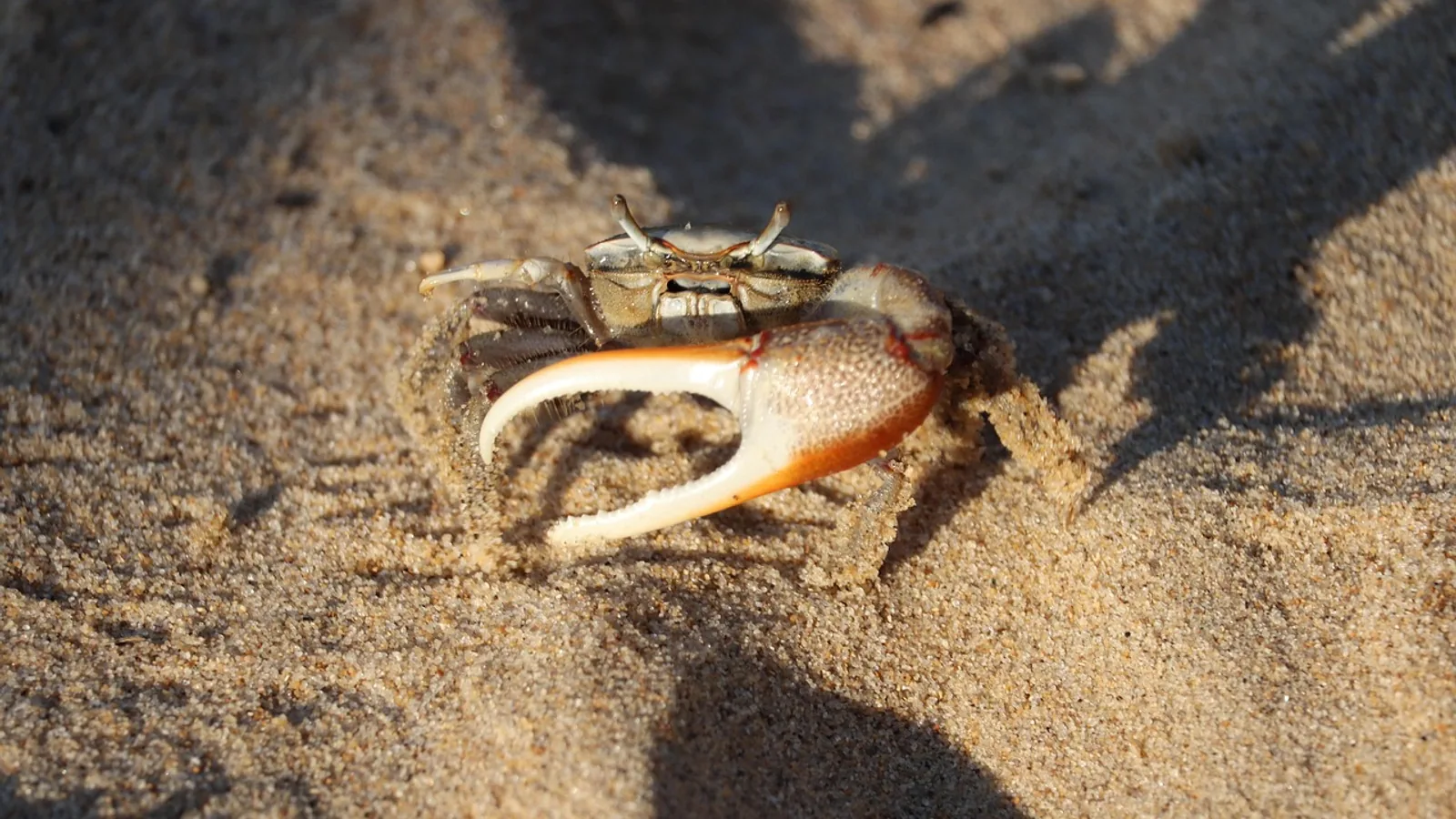
A fiddler crab is a small semiterrestrial crab in the genus Uca that lives on intertidal mudflats and in mangroves and is best known for the single oversized claw carried by adult males. That claw, called the major cheliped, is used to wave at females, fight rival males, and sometimes regulate body temperature, while the crab's smaller feeding claw picks through sediment for detritus and tiny organisms.
Fiddler crabs matter to biology students and hobbyists for three reasons. First, they are one of the clearest textbook examples of sexual dimorphism and sexual selection in the animal kingdom, because the male's claw can weigh nearly as much as the rest of his body. Second, they are ecological engineers of the intertidal zone, aerating sediment and moving nutrients as they burrow. Third, they are increasingly common in captivity, where they demand brackish water, warm temperatures, and a deep sand or mud substrate that most beginners underestimate. This guide covers their global distribution, their behavior, and the concrete parameters needed to keep them alive.
What Is a Fiddler Crab?
Fiddler crabs belong to the family Ocypodidae, within the infraorder Brachyura (the true crabs), and are grouped in the genus Uca. They are small, with most adults measuring roughly 2 to 4 centimeters across the carapace, though body size varies widely by species and sex. Males are generally larger than females in many populations, a pattern documented in the Amazon mangrove species Uca maracoani, where males also showed lower mortality and longer lifespans than females [1].
The name "fiddler" comes from the male's feeding motion. He sweeps his small minor claw across the mud and brings food to his mouth, and the repeated back-and-forth movement resembles a bow drawing across a fiddle. The large claw is held out to the side and looks like the instrument itself.
Taxonomy and the Genus Uca
The genus Uca has been reorganized repeatedly as molecular data accumulated. Researchers have proposed new subgenera to accommodate species that do not fit older groupings. Uca panamensis, a Central American species that lives on stony rather than sandy or muddy ground, was placed in its own subgenus, Uca (Petruca), based on mitochondrial 16S rDNA, cytochrome oxidase subunit I, and nuclear 28S rDNA evidence [2]. Similarly, the Taiwanese species Uca formosensis was assigned to a new subgenus, Uca (Xeruca), after morphological and molecular analysis [3].
For a student, the practical takeaway is that "fiddler crab" is a broad common name covering dozens of species across several subgenera. Care requirements and behavior can differ between them, so identifying the species matters.
Global Distribution and Habitat
Fiddler crabs occur on coastlines worldwide, from temperate salt marshes to tropical mangroves. They are restricted to intertidal zones, the strip of shore alternately covered and exposed by tides, because they need both wet sediment to keep their gills and book lungs functional and exposed mud to feed.
Mudflats, Mangroves, and Salt Marshes
The typical fiddler crab habitat is soft, fine sediment. In the western Atlantic, Uca rapax and Uca maracoani occupy mangrove forests and estuaries, where vast muddy intertidal zones support dense populations [1][4]. In mid-Atlantic North America, Uca pugilator builds burrows in open salt marsh areas high on the shore, where food is scarcer but breeding success is higher [5]. In the Indo-Pacific, species such as Tubuca urvillei live in mangrove areas that are regularly flooded and exposed to agricultural runoff [6].
Not every fiddler crab wants mud. Uca panamensis is unusual in living in stony habitats rather than sandy or muddy substrates [2]. This exception shows that the group is more ecologically flexible than the common "mudflat crab" label suggests.
Salinity and the Estuarine Gradient
Fiddler crabs are estuarine animals, meaning they live where freshwater meets seawater. Salinity varies along that gradient, and species sort themselves accordingly. Uca maracoani shows a notable preference for euhaline conditions, meaning near-full-strength seawater, and reproduction peaks in the dry season when salinity rises above 12 parts per thousand [1]. Other species tolerate more dilute water. In Mayotte, Tubuca urvillei was studied under both full-strength seawater and diluted seawater to model how runoff affects mangrove crabs [6].
This natural range is why captive fiddler crabs need brackish water rather than either fresh water or full marine salinity. The target specific gravity for captivity is 1.005 to 1.015, which sits in the low end of the brackish range.
Sexual Dimorphism: The Male's Enlarged Claw
The defining feature of a fiddler crab is the male's single hypertrophied claw. In reproductively active male sand fiddler crabs, Uca pugilator, this claw serves as both a weapon to defend breeding burrows and an ornament to attract females [5]. The asymmetry is extreme. One claw is normal-sized and used for feeding, and the other is massively enlarged and used for display and combat.
Waving Displays and Combat
Male fiddler crabs wave the major claw in species-specific patterns to attract females and signal to rival males. Waving and combat were both observed in a seminatural mangrove exhibit housing Uca rapax and Uca tangeri, confirming that these behaviors persist in captivity when the environment allows them [7]. In the wild, males congregate in open, unvegetated marsh areas and perform these displays, a pattern that has been compared to lekking behavior in birds and mammals [8].
Combat matters because burrow ownership drives mating success. Females strongly prefer to mate with males controlling burrows in open areas high on the shore [5]. Males fight to hold those burrows.
Claw Regeneration and Its Trade-offs
When a male loses his major claw, it regrows in a different shape. Regenerated claws, called leptochelous claws, have less muscle mass and longer fingers than unregenerated brachychelous claws, making them weaker weapons [9]. However, the slender shape dissipates heat more efficiently. In the field, more than 60 percent of males in unshaded microhabitats had regenerated claws, compared with 18 percent in shaded microhabitats, suggesting that the "loser" claw shape offers a thermoregulatory advantage in hot, exposed areas [9].
Female Morphology and Behavior
Females have two small feeding claws and no enlarged weapon. They are not defenseless, though. In Uca annulipes, males defend their female neighbors against male intruders but not against female intruders, a behavior interpreted as both pre-copulatory mate-guarding and a territorial coalition [10]. Females also defend territories essential for survival, and they sometimes mate with their immediate neighbors [10].
Male and Female Fiddler Crab Comparison
| Trait | Male | Female |
|---|---|---|
| Major claw | One greatly enlarged claw (major cheliped) | Absent, both claws small and used for feeding |
| Claw function | Waving display, combat, possible heat dissipation | Feeding only |
| Body size | Often larger, with lower mortality and longer lifespan in some species [1] | Generally smaller |
| Primary behavior | Waving, fighting for burrows, mate attraction | Foraging, territory defense, mate choice |
| Burrow use | Defends breeding burrows in open, high-shore areas [5] | Defends territory for survival, mates with neighbors [10] |
| Claw regeneration | Regenerated claws are weaker but shed heat faster [9] | Not applicable, no enlarged claw |
Behavior in the Wild and in Captivity
Fiddler crabs are active when the tide is out. They emerge from burrows to feed, court, and fight, then retreat underground when water returns. This rhythm shapes everything about how they behave.
Burrowing and the Intertidal Rhythm
Every fiddler crab needs a burrow. The burrow provides protection from predators, a refuge from heat and desiccation, and a stable microclimate. Burrow sediment also hosts a distinct bacterial community. A mesocosm experiment on Uca panacea found that carapace and gut microbial assemblages respond to whether surface or burrow sediment was present, showing that the burrow is not just a hole but a microbial habitat [11].
In captivity, the absence of a proper burrowing substrate is one of the most common causes of stress and death. Sand or mud deep enough for the crab to construct a tunnel is essential.
Daily Activity Patterns
Wild fiddler crabs typically emerge in large numbers around the ebbing tide. In a seminatural mangrove enclosure with an asymmetric tidal regime, Uca rapax and Uca tangeri showed a different pattern. Numbers were lowest in the early morning and highest in the early afternoon, and visitor numbers did not significantly affect the pattern [7]. The authors suggested the shift may relate to the enclosure's asymmetric tidal schedule rather than the wild pattern.
This finding matters for keepers. Fiddler crabs in captivity may not follow the same schedule as wild crabs, and a consistent light and tide cycle helps them settle.
Feeding: Detritivores at Work
Fiddler crabs are detritivores. They scoop up sediment with the minor claw, then use specialized mouthparts to sort out organic particles, bacteria, and tiny organisms, and reject the mineral grains. This makes them deposit feeders as well as detritivores, and it means their nutritional needs are met by a living, organically rich substrate rather than by pellets alone.
A food supplementation experiment on two sympatric species, Austruca annulipes and Gelasimus vocans, found that both spent most of their time feeding when the tide was out, prioritizing immediate food intake over hoarding [12]. The semiterrestrial intertidal lifestyle gives them only a finite window to feed, so they make the most of it.
Because they ingest sediment, fiddler crabs also ingest whatever is in it. Uca rapax exposed to polystyrene fragments 180 to 250 micrometers in size retained microplastics in the gills, stomach, and hepatopancreas [13]. This is a reminder that substrate quality matters in captivity.
Sensory Biology and Vision
Fiddler crabs have apposition compound eyes, the standard brachyuran design, but with unusual features. In Uca vomeris, the flat corneal facet lenses provide the main focusing power, and the ommatidium contains the typical eight retinular cells, including a distal R8 cell whose microvilli are not aligned in a uniform direction [14]. The main rhabdom shows the crustacean pattern of alternating horizontal and vertical microvilli bands [14]. These adaptations support the visual acuity fiddler crabs need for detecting waving neighbors and predators across a flat mudflat.
Care Basics: Water, Temperature, and Substrate
Captive fiddler crabs are not difficult animals, but they fail quickly when kept like tropical fish. They need brackish water, warm air, and a deep substrate.
Water Parameters
Fiddler crabs require brackish water with a specific gravity of 1.005 to 1.015. Specific gravity is a measure of water density relative to pure water, and in this range it corresponds to roughly 7 to 20 parts per thousand salinity, which matches the dilute estuarine conditions many species occupy. Fresh water is wrong for them, and full-strength seawater is too salty for most species kept in captivity.
Provide both a water area and a land area. Fiddler crabs are semiterrestrial, so they need to leave the water to feed and to regulate their body temperature. A shallow water section with a gentle slope up to damp sand or mud works well.
Temperature
Keep fiddler crabs at 24 to 28 degrees Celsius (roughly 75 to 82 degrees Fahrenheit). This range sits inside the preferred body temperatures measured for Uca panacea, which fell between 21.1 and 28.6 degrees Celsius [15]. Note that the thermal optimum for locomotion in that species was higher, 30 to 40 degrees Celsius, but the crabs preferred cooler temperatures, a mismatch the authors flagged as unresolved [15].
Heat is a real constraint. Operative environmental temperatures for Uca panacea frequently reached the critical thermal maximum of 41.8 degrees Celsius, especially in unvegetated microhabitats, forcing the crabs to behaviorally thermoregulate to stay active during the day [15]. That is why a shaded retreat and a deep burrow matter. The same species can acclimate to new temperature regimes within about 9 days, shifting its critical thermal limits by 2 to 4 degrees Celsius after exposure to 20 or 35 degrees Celsius [15].
Substrate for Burrowing
Fiddler crabs need sand or mud substrate deep enough to burrow. A substrate depth of at least 10 to 15 centimeters is a reasonable starting point for small species, with more depth being better. The sediment should be kept damp but not submerged, because the crabs need to construct and maintain tunnels.
Do not use gravel. Fiddler crabs cannot shape gravel into stable burrows, and coarse material can damage their mouthparts during feeding.
Diet in Captivity
Because fiddler crabs are detritivores, they need a substrate that supports microbial and organic growth. A mature, organically rich sand or mud substrate lets them feed the way they do in the wild. Supplemental feeding can include finely ground algae-based foods and small amounts of fish food, but the substrate itself is the primary food source.
Social Housing and Space
Fiddler crabs are not solitary, but they are territorial. In the wild, males fight over burrows and females defend their own territories [5][10]. In captivity, crowding increases aggression. Provide enough surface area that each crab can establish a burrow and a feeding area, and expect some chasing and claw displays as the group sorts out a hierarchy.
Common Mistakes and Limitations
Beginners make predictable errors with fiddler crabs. Avoiding these is most of the battle.
Keeping them in fresh water. Fiddler crabs are estuarine animals. Fresh water stresses them and shortens their lives. Use brackish water at specific gravity 1.005 to 1.015.
Skipping the land area. A fully aquatic setup drowns the concept. These crabs are semiterrestrial and need to leave the water.
Using shallow or gravel substrate. Burrowing is not optional. Provide deep sand or mud.
Overlooking heat. Fiddler crabs can overheat quickly in a small enclosure with a heat lamp and no shade. Provide a temperature gradient and a shaded retreat.
Assuming all species are the same. Uca panamensis lives on stone, not mud [2], and salinity preferences vary by species [1]. Match care to the species you have.
Ignoring what goes into the substrate. Fiddler crabs ingest sediment and can retain microplastics in their organs [13]. Keep the substrate clean and avoid contaminated source material.
Expecting breeding. Copulation was not observed in a seminatural mangrove exhibit even though waving and combat occurred [7]. Breeding in captivity is uncommon and poorly documented.
Individual animals can have specific health problems that no general guide can address. A veterinarian experienced with aquatic invertebrates is the right resource for a sick crab.
Quick Review
- Fiddler crabs are genus Uca, family Ocypodidae, living in intertidal mudflats and mangroves worldwide.
- Males have one greatly enlarged claw used for waving displays, combat, and possibly heat dissipation.
- Females have two small feeding claws and defend territories, sometimes with male neighbors as allies.
- Captive fiddler crabs need brackish water at specific gravity 1.005 to 1.015 and temperatures of 24 to 28 degrees Celsius.
- They are detritivores and need deep sand or mud substrate for burrowing.
- Preferred body temperatures for Uca panacea ranged from 21.1 to 28.6 degrees Celsius, well below the species' thermal optimum [15].
- Microplastics can accumulate in fiddler crab organs, so substrate quality matters [13].
Frequently Asked Questions
What kind of water do fiddler crabs need?
Fiddler crabs need brackish water with a specific gravity of 1.005 to 1.015. This matches the dilute estuarine conditions they occupy in the wild. Fresh water and full-strength seawater are both unsuitable for long-term care.
How big do fiddler crabs get?
Most fiddler crabs reach roughly 2 to 4 centimeters across the carapace, though size varies by species and sex. Males are often larger than females, a pattern documented in Uca maracoani populations in Amazon mangroves [1].
Why does a male fiddler crab have one big claw?
The enlarged claw is used for waving displays to attract females and for combat with rival males over breeding burrows [5]. If the claw is lost and regenerates, it grows back in a weaker but more heat-efficient shape [9].
Can fiddler crabs live in fresh water?
No. Fiddler crabs are estuarine animals that require brackish water. Some species tolerate more dilute conditions than others, but fresh water is not appropriate for long-term housing.
What do fiddler crabs eat?
Fiddler crabs are detritivores and deposit feeders. They sift organic particles, bacteria, and tiny organisms out of sediment using specialized mouthparts. In captivity, a mature, organically rich sand or mud substrate is the foundation of their diet.
Do fiddler crabs need land in their tank?
Yes. Fiddler crabs are semiterrestrial and must leave the water to feed and thermoregulate. A setup should include a shallow water area and a sloped land area with deep sand or mud for burrowing.
Related Articles
- Amphibian Water Quality and Habitat Basics
- Cichlid Care Basics for Beginners
- Wild Chickens: Behavior, Habitat, and Management of Feral Flocks
- Betta Fish Natural Habitat and Behavior: Beyond the Bowl
- Foal Care Basics for New Owners
- Horse Hoof Care and Lameness Basics
- Fisher Animal: Facts, Habitat, and Behavior
- Genets: Animal Facts, Habitat, and Behavior
- Caracal Cat: Facts, Habitat, and Behavior
Sources
- Influence of environmental patterns on the population structure and secondary production of the fiddler crab Uca maracoani (Latreille) in the Amazon mangroves.
- Uca (Petruca), a new subgenus for the rock fiddler crab Uca panamensis (Stimpson, 1859) from Central America, with comments on some species of the American broad-fronted subgenera.
- Uca (Xeruca), a new subgenus for the Taiwanese fiddler crab Uca formosensis Rathbun, 1921 (Crustacea: Decapoda: Ocypodidae), based on morphological and molecular evidence.
- Secondary production of the fiddler crab Uca rapax from mangrove areas under anthropogenic eutrophication in the Western Atlantic, Brazil.
- Sexual selection and the physiological consequences of habitat choice by a fiddler crab.
- A multi-scale integrative approach to study the impact of a common pesticide, the dimethoate, on a mangrove fiddler crab Tubuca urvillei.
- Behavioral patterns of two fiddler crab species Uca rapax and Uca tangeri in a seminatural mangrove system.
- An evaluation of lekking behavior in the fiddler crab Uca spp.
- Losers can win: Thermoregulatory advantages of regenerated claws of fiddler crab males for establishment in warmer microhabitats.
- Safe sex: male-female coalitions and pre-copulatory mate-guarding in a fiddler crab.
- Key colonist pools and habitat filters mediate the composition of fiddler crab-associated bacterial communities.
- Larder Hoarding Versus Immediate in situ Food Consumption in Two Fiddler Crab Species: Is it an Evolutionarily Stable Strategy?
- Ingested microplastics (>100 μm) are translocated to organs of the tropical fiddler crab Uca rapax.
- Functional anatomy of the fiddler crab compound eye (Uca vomeris: Ocypodidae, Brachyura, Decapoda).
- Thermal ecology of the fiddler crab Uca panacea: Thermal constraints and organismal responses.