Caracal Cat: Facts, Habitat, and Behavior
By Dr. Zubair Khalid, DVM, MS, PhD ·
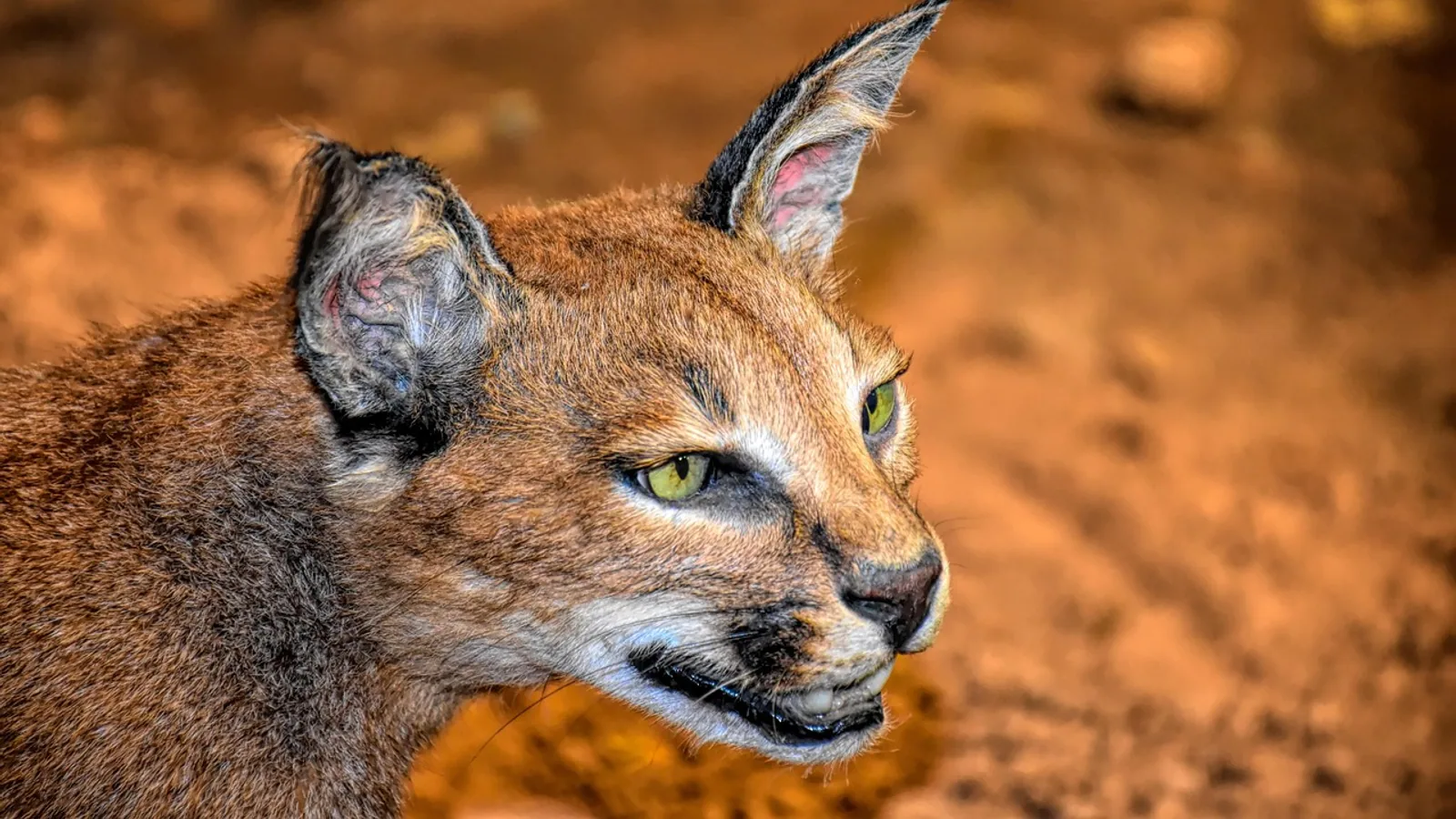
The caracal cat is a medium-sized wild felid, Caracal caracal, native to Africa, the Middle East, and parts of India and Central Asia. Adults typically weigh 8 to 18 kg (about 18 to 40 lb) and are built like sprinters, with long legs, a short tail, and black tufts at the tips of the ears.
This article profiles what is actually documented about the caracal. That means anatomy supported by dissection and imaging studies, diet records compiled from stomach and scat analysis, movement data from GPS collars, and genetics from free-ranging populations. Much of the strongest recent work comes from South Africa, where caracals live at the edge of one of the continent's largest cities. That setting makes them an unusually well-studied example of how a wild cat negotiates roads, gardens, and livestock.
What Is a Caracal Cat?
A caracal is a wild cat, not a domestic breed. It belongs to the family Felidae and sits in a lineage that geneticists place close to the serval and the African golden cat. The genus name Caracal is now used in formal taxonomy, and the accepted species name is Caracal caracal.
Three features separate a caracal from a house cat at a glance:
- Long legs relative to body length. Caracals are leggy, high-shouldered cats.
- Black ear tufts up to about 5 cm long that rise from the outer edge of each ear tip.
- A plain coat. Adults are reddish tan to tawny, with white around the eyes, muzzle, and chin. There are no tabby stripes on the body.
The "caracal cat" search phrase is common enough that it is worth stating plainly: a caracal is not a large domestic cat and not a hybrid like the Savannah cat. It is its own species with its own husbandry and conservation context.
Size, Weight, and Body Plan
A caracal is roughly the size of a medium dog, with a shoulder height near 40 to 45 cm and a head plus body length around 60 to 90 cm. The tail adds another 23 to 31 cm. Weight ranges from about 8 to 18 kg, with males generally heavier than females.
The body plan is engineered for acceleration. A 2011 comparative muscle study sampled the vastus lateralis, longissimus dorsi, and gluteus medius muscles of lions and caracals and found that both species have predominantly type IIx muscle fibers (50 to 80 percent of fibers) [1]. Type IIx fibers contract quickly and tire quickly. They are the fiber type you want in a cat that must cover ground in a short burst, not one that runs a marathon.
The same study measured enzyme activity that tracks energy use. Caracals showed low oxidative capacity compared with human runners but high glycolytic capacity, with lactate dehydrogenase activity of 346 units versus 227 in lions and 55 in humans [1]. Translation: caracal muscle is geared to burn sugar anaerobically for explosive speed, and it is even more extreme in that direction than lion muscle in this sample.
The Ear Tufts: What They Do and Do Not Do
The black ear tufts are the caracal's trademark, and they are widely misdescribed online. The honest position is that the function is not confirmed.
Three ideas appear in the literature and in field accounts:
- Signaling. Tufts may help caracals communicate with each other, since ear position and tuft angle are visible at distance.
- Camouflage disruption. The tufts may break up the otherwise smooth outline of the head against dry grass.
- Hearing. This is the weakest claim. There is no experimental evidence that the tufts focus sound or improve hearing.
What the ear does demonstrably support is fine positioning of pinnae for locating prey, a trait shared across felids. People who describe tufts as "antennas for hearing" are repeating folklore, not a research finding.
Hunting Behavior and Diet
Caracals are generalist predators with a broad menu. A 2023 review compiled 63 sources from 26 countries spanning 1842 to 2021 and found that caracal diet records included 151 prey species [2]. That number deserves emphasis. A predator with 151 documented prey species is not a specialist.
Prey records span:
- Rodents and other small mammals
- Hares and rabbits
- Birds, from small passerines to larger ground birds
- Reptiles
- Insects
- Ungulates, including small antelope
- Livestock and domestic animals in some landscapes
The same review compared caracals with jungle cats (Felis chaus) where the two species overlap. Caracals ate more diverse prey and took prey of greater average body mass than jungle cats did, and the authors suggest this broad, opportunistic feeding helps the two species coexist rather than compete head-on [2].
Body mass in the diet is the important variable. Caracals are capable of taking prey items approaching or exceeding their own size, which is where the dramatic field accounts come from. In parts of the Western Cape, caracals are documented preying on small antelope such as common duiker and on livestock, and camera trap work in that region found temporal separation between caracal activity and small antelope activity, with a temporal overlap index of 0.59 between the two [3]. Overlap near 0.6 means the two are active at overlapping but not identical times, which is consistent with prey avoiding peak predator hours.
The 3-Meter Leap and Bird Catching
Caracals are famous for leaping into the air to strike birds in flight. They can launch vertically up to about 3 meters from a crouch. No other cat of comparable size does this as consistently.
The mechanics fit the muscle data. A caracal does not pursue birds across the sky. It waits, sometimes in cover, and then converts stored elastic energy and a fast-twitch muscle burst into one vertical effort. The paw strike, not a bite, is often the first contact, and the bird is pinned or knocked down before the killing bite.
This same leaping ability can be redirected. Caracals in Southern Africa are noted for snatching birds out of the air in short, vertical pounces, sometimes catching two birds in sequence when the first attempt fails.
Range and Habitat
The caracal has one of the widest distributions of any African felid. Its range covers:
- Sub-Saharan Africa, from the Cape north to the Sahel
- North Africa, including the Atlas Mountains region
- The Arabian Peninsula and the Middle East
- Central Asia, Pakistan, and parts of India
Within that range, caracals use many habitat types. Records exist from dry savanna, semidesert, scrub, and open woodland, and the species shows up in montane and forest-edge settings as well. The common thread is cover plus prey.
A national park survey in southern Ethiopia recorded Caracal caracal among the medium and large mammals present, and listed it as globally near threatened at the time of the study [4]. More importantly for habitat use, that survey found dense forest held the highest species diversity of medium and large mammals, with forest, wooded grassland, grassland, riverine forest, and farmland all sampled separately [4]. Caracals appear in multiple habitat types within a single protected area rather than being locked to one vegetation class.
Caracals at the Urban Edge
One of the best-studied caracal populations lives in and around Cape Town, South Africa. A 2023 study fitted GPS collars to 25 adult and subadult caracals in urban and wildland-dominated subregions [5]. The results cut against a common assumption. Caracals did not become more nocturnal in urban areas. Instead, they increased their selection for proximity to urban areas as the proportion of urban land increased [5]. In other words, these cats moved toward the city edge rather than shifting to a more strictly nocturnal schedule.
Human-modified landscapes also change what a caracal encounters. A study of tick-borne pathogens in 57 caracals across three South African regions found that all tested individuals were infected with at least one tick-borne pathogen [6]. Urban edge caracals showed much higher co-infection rates than rangeland animals (81 percent versus 15 percent and 0 percent in the two rangeland populations), and an Anaplasma species previously described in South African domestic dogs was found in 88 percent of urban edge caracals [6]. Cats living close to dogs, gardens, and dense host populations pick up pathogens accordingly.
A separate serology study of free-ranging Cape Town caracals found Toxoplasma gondii antibody seroprevalence of 83 percent (24 of 29 animals) between 2014 and 2017, substantially higher than in sympatric feral domestic cats [7]. Toxoplasma gondii is the parasite that causes toxoplasmosis, and oocysts are shed in cat feces. High exposure in an urban caracal population signals heavy environmental contamination, not cancer or a genetic condition.
How the Caracal Differs From the Domestic Cat
The two animals share a family, and that is roughly where the similarity ends in practice. A domestic cat, Felis catus, is a small, often striped or patched animal adapted to living with humans. A caracal is a wild predator with a different body, a different diet, and a different biology.
Comparison Table
| Trait | Caracal (Caracal caracal) | Serval (Leptailurus serval) | Domestic cat (Felis catus) |
|---|---|---|---|
| Typical adult weight | 8 to 18 kg | About 9 to 18 kg | About 3 to 5 kg |
| Habitat | Savanna, scrub, semidesert, open woodland, mountain and urban-edge landscapes across Africa, the Middle East, and parts of Asia | Wet grasslands and reed beds, mostly sub-Saharan Africa | Human-associated, worldwide |
| Hunting style | Stalk then sprint and a vertical leap up to about 3 m, with occasional bird strikes in the air | Tall-grass stalker, uses long legs and hearing to pounce on rodents and birds | Stalk and pounce at small scale, often on rodents, birds, and insects |
| Leg length | Long, high-shouldered | Longest legs relative to body size of any cat | Short to moderate |
| Ear tufts | Present, black, up to about 5 cm | Not tufted, very large rounded ears | Absent |
| Coat pattern | Plain reddish tan with white facial markings | Tawny with black spots and stripes | Highly variable, often tabby |
The serval comparison matters because the two species are often confused. The distinguishing features are the ears and the coat. A serval has very large, rounded ears set close together and a spotted and striped coat. A caracal has tufted ears and a plain coat. Weight ranges overlap, so size alone is a poor separator.
Vision, Blood Supply, and the Water-Detection Claim
One study examined the arterial circulation at the base of the caracal brain using corrosion casts, latex injection, and CT imaging on 14 postmortem specimens from zoos [8]. The caracal's arrangement formed a figure-eight pattern and included a rostral communicating artery [8]. The authors connect that artery to an increased ability to detect dehydration in the forebrain, which matters for an animal that lives in dry environments [8].
Read that finding carefully. It is an anatomical observation with a functional interpretation, not a controlled test of thirst detection. The safe statement is that caracal brain vasculature differs from that of other felids studied and may support responses to water stress. The same study also noted that the extracranial segment of the internal carotid artery is obliterated in adult caracals, a feature shared with other members of Felidae [8].
Conservation Status and Threats
Caracals are listed as Least Concern globally on the IUCN Red List, but some regional populations are under real pressure. The threats that show up repeatedly in the literature are habitat loss, hunting, and road or human-caused mortality.
The Cape Peninsula population is the clearest documented case. A 2024 genomic study estimated the isolated Cape Peninsula caracal population at roughly 50 individuals [9]. Over the past about 75 years, migration into the population was low, at an estimated 1.3 effective migrants per generation, and inbreeding was elevated, with a mean FROH of 0.20 [9]. FROH is the fraction of the genome in runs of homozygosity, which is a measure of how much identical DNA an animal inherited from both parents.
Inbreeding at that level is not automatically fatal, but it narrows the gene pool. The same study used an eco-evolutionary simulation and found that if migration rates stay the same, the population is expected to decline, with a low projected extinction risk [9]. If migration drops or human-caused mortality rises, extinction risk climbs sharply [9]. The practical takeaway is that connectivity and reduced human-caused death are the two levers.
Disease as a Conservation Factor
Pathogens are part of the picture. Metagenomic sampling of rectal swabs from five deceased Cape Town caracals identified ten novel papillomavirus genomes, the first papillomaviruses described from the species [10]. These fell into six new types, Caracal caracal papillomavirus 1 through 6, spanning two phylogenetically distinct genera [10]. Four of the five caracals shared at least one virus type with another animal [10].
Papillomaviruses infect epithelial cells, which are the cells that line surfaces like skin and mucous membranes, and they can cause hyperplastic or neoplastic lesions. Hyperplastic means an abnormal increase in cell number. Neoplastic means a new abnormal growth. Most described felid papillomaviruses come from domestic cats, with only one type previously identified across the five wild felid species studied at the time [10]. The caracal findings widen the known diversity of these viruses in wild cats and raise an obvious question about whether domestic cats and caracals share viruses at the urban edge.
Caracals and Local Knowledge
Caracals are conflict-prone animals in parts of their range, which makes them a good subject for comparing scientific and community observation. A 2021 study combined camera trapping, track surveys, and semi-structured interviews with local pastoralists in northern Kenya to compare how scientists and Indigenous and local knowledge holders assessed carnivore abundance and trends [11]. The species examined included caracal, cheetah, jackal, lion, leopard, spotted hyena, and striped hyena.
The study found points of agreement that highlighted conservation priorities and points of disagreement that suggested either limits in scientific sampling or social and psychological factors shaping what people report [11]. The useful conclusion for anyone working on caracal conservation is that local observation and camera data answer different questions. Neither replaces the other.
Common Mistakes and Limitations
Several errors come up repeatedly when people write or talk about caracals.
- Calling the ear tufts hearing aids. There is no experimental support for the tufts improving hearing. Treat the function as uncertain, with signaling and outline disruption as live hypotheses.
- Assuming a caracal is a big house cat. The muscle fiber data, the 8 to 18 kg weight range, and the 3-meter leap describe an animal with a hunting style and strength budget nothing like a domestic cat's [1].
- Confusing caracal and serval. Look at the ears first (tufted versus very large and rounded), then the coat (plain versus spotted).
- Treating the 151 prey species figure as a single study. It is a review compiled from 63 sources across 26 countries over roughly 180 years, so it describes the species' known breadth, not what one cat eats in one season [2].
- Expecting caracals to be strictly nocturnal in cities. GPS data from Cape Town showed caracals did not become more nocturnal in urban areas [5].
- Reading the brain artery finding as proof of thirst detection. It is an anatomical finding with a proposed function, not a behavioral experiment [8].
- Assuming a single small population is safe because the species is Least Concern. The Cape Peninsula population is about 50 animals with low migration and elevated inbreeding [9].
One more limitation is worth stating plainly. Individual animals vary in health and behavior, and the research summarized here describes populations. Anyone dealing with an individual caracal, whether in a zoo, a rehabilitation setting, or a research project, needs a veterinarian or a qualified wildlife professional for that specific animal.
Frequently Asked Questions
How big is a caracal cat?
A caracal typically weighs 8 to 18 kg and stands about 40 to 45 cm at the shoulder. Males are generally heavier than females.
What do caracals eat?
Caracals are generalist predators. A review of 63 sources spanning 1842 to 2021 recorded 151 prey species in caracal diet records, ranging from rodents and birds to small antelope [2].
Why do caracals have ear tufts?
The function is not confirmed. Proposed roles include signaling between cats and breaking up the head outline. There is no experimental evidence that the tufts improve hearing.
Can a caracal really jump 3 meters?
Yes, a caracal can leap roughly 3 meters vertically from a crouch, which is how it strikes birds in the air. Its muscle is dominated by fast-twitch type IIx fibers suited to short explosive efforts [1].
How is a caracal different from a serval?
The ears and coat separate them. A caracal has black ear tufts and a plain tawny coat. A serval has very large rounded ears with no tufts and a spotted, striped coat.
How is a caracal different from a domestic cat?
A caracal is larger, longer-legged, tufted, and unpatterned compared with a domestic cat. It is also a wild species with a wild predator's diet and energy demands.
Where do caracals live?
Caracals occur across sub-Saharan Africa, North Africa, the Arabian Peninsula, the Middle East, Central Asia, and parts of India. They use savanna, scrub, semidesert, open woodland, and increasingly urban-edge habitat.
Are caracals endangered?
The species is listed as Least Concern globally, but some populations are isolated and inbred. One Cape Peninsula population of about 50 animals shows low migration and elevated inbreeding, and is projected to decline if conditions do not change [9].
Related Articles
- Facts About Cats: Surprising Health and Behavior Insights
- Wild Chickens: Behavior, Habitat, and Management of Feral Flocks
- Betta Fish Natural Habitat and Behavior: Beyond the Bowl
- Biology Facts
- Dog Food Nutrition Facts
- Calico Cat: Fascinating Facts and Genetics Explained
- Fisher Animal: Facts, Habitat, and Behavior
- Genets: Animal Facts, Habitat, and Behavior
- Fiddler Crab: Habitat, Behavior, and Care Basics
Sources
- Fiber type and metabolic characteristics of lion (Panthera leo), caracal (Caracal caracal) and human skeletal muscle.
- A review of caracal and jungle cat diets across their geographical ranges during 1842-2021.
- Investigating the effects of management practice on mammalian co-occurrence along the West Coast of South Africa.
- Diversity and habitat association of medium and large mammals in Gibe Sheleko National Park, Southern Ethiopia.
- Anthropogenic activities and age class mediate carnivore habitat selection in a human-dominated landscape.
- Molecular detection of tick-borne pathogens in caracals (Caracal caracal) living in human-modified landscapes of South Africa.
- High Seroprevalence of Toxoplasma gondii in an Urban Caracal (Caracal caracal) Population in South Africa.
- The Arteries of the Encephalon Base in Caracal (Caracal caracal; Felidae; Carnivora).
- The influence of gene flow on population viability in an isolated urban caracal population.
- Two Lineages of Papillomaviruses Identified from Caracals (Caracal caracal) in South Africa.
- Convergences and divergences between scientific and Indigenous and Local Knowledge contribute to inform carnivore conservation.