Bumble Bees: Biology, Behavior and Pollination
By Dr. Zubair Khalid, DVM, MS, PhD ·
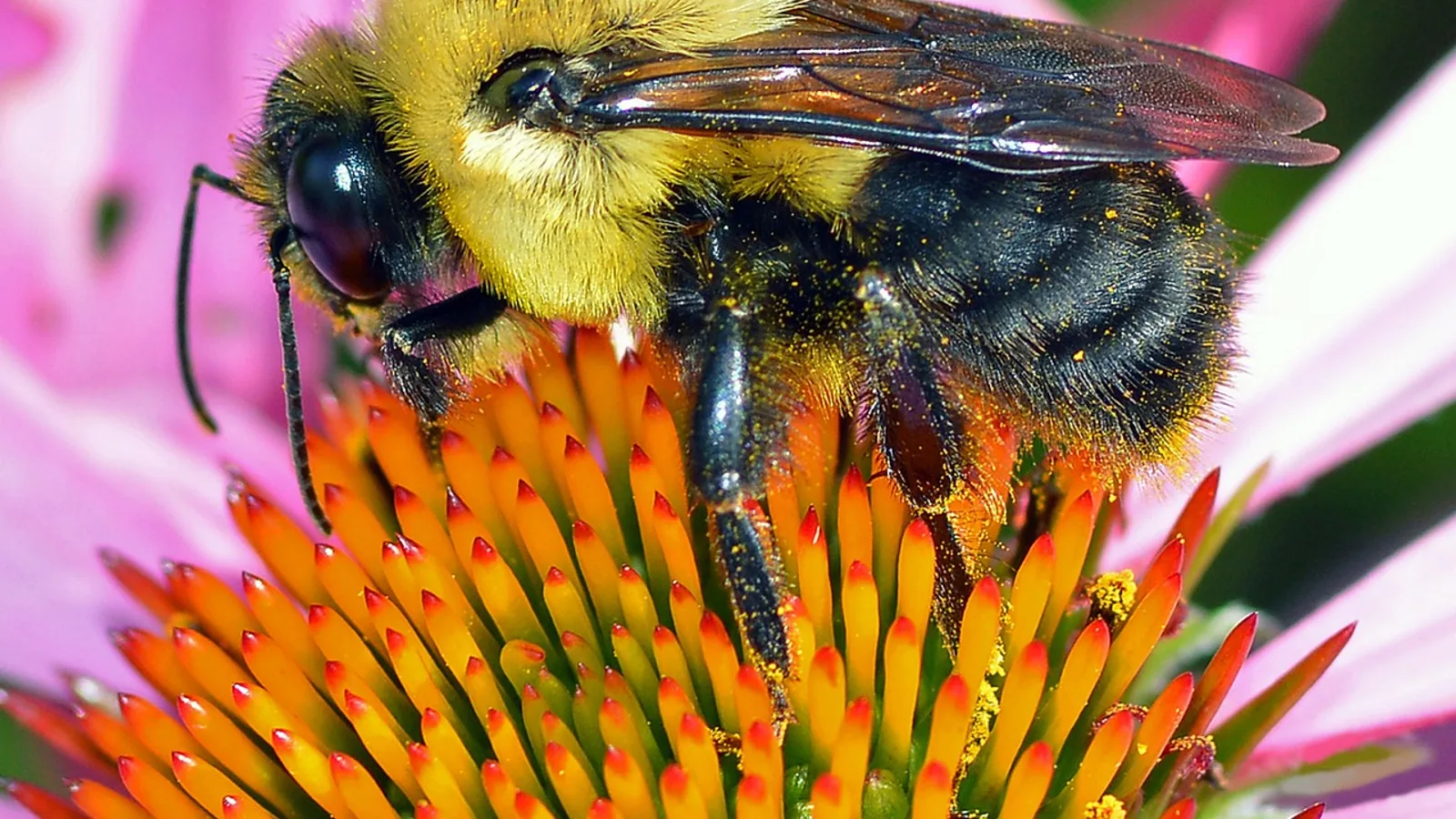
Bumble bees are large, fuzzy, social bees in the genus Bombus that live in annual colonies founded each spring by a single overwintered queen. They are not honey bees. They make no honey crop, they cannot survive as a permanent colony, and their colonies number in the tens to hundreds rather than the tens of thousands.
That single distinction explains most of what makes a bumble bee insect so useful to gardeners, farmers, and ecologists. A bumble bee colony is a seasonal organism. It is born in spring, grows through summer, and dies in autumn, leaving only new queens to overwinter and start again. Along the way, the workers pollinate wildflowers and crops, including tomatoes and blueberries that honey bees often cannot pollinate efficiently because they require buzz pollination.
This guide covers the annual colony cycle, the anatomy and physiology that let bumble bees fly in cold weather, how bumble bees differ from honey bees and solitary bees, and what the research says about their decline.
What Is a Bumble Bee?
A bumble bee insect is a member of the family Apidae, the same family that contains honey bees, stingless bees, and orchid bees. Within Apidae, bumble bees sit in the tribe Bombini. Roughly 265 species of Bombus are known worldwide, and they are native to the Americas, Europe, Asia, and northern Africa. They are absent from Australia and Antarctica as natives, though a few species have been introduced elsewhere for greenhouse pollination.
Bumble bees are sometimes described as "primitively eusocial." Eusocial means a colony has overlapping generations, cooperative brood care, and a division of labor in which some individuals forgo their own reproduction to raise the offspring of others. "Primitively" refers to the fact that the division of labor is modest compared with honey bees. A bumble bee queen is not so physically distinct from her workers, colonies are small, and the queen retains a strong behavioral role throughout the colony's life. Bumble bee societies have an annual life cycle and are used as a physiological model for comparing social bees with the highly eusocial honey bees [1].
Three features separate bumble bees from other bees at a glance:
- Size and fuzz. Bumble bees are robust and densely covered in branched hairs, which trap pollen and insulate the body.
- Social, but seasonal. A colony lasts one growing season.
- Buzz pollination. Many bumble bees can vibrate their flight muscles to shake pollen out of flowers that hold it tightly.
Bumble Bee Anatomy in Plain Language
You do not need a dissection to identify the working parts of a bumble bee. The body divides into three regions: head, thorax, and abdomen.
- Head. Two large compound eyes, three small simple eyes (ocelli) on top, two antennae for smell and touch, and mouthparts that include a tongue (proboscis) for lapping nectar. Bumble bee tongues vary in length by species, which is one reason different species visit different flowers.
- Thorax. The flight engine. Two pairs of wings and three pairs of legs attach here, powered by large flight muscles. The thorax is the fuzziest part of the bee and the part that contacts a flower's reproductive structures most directly.
- Abdomen. Contains the digestive tract, the wax glands used to build nest structures, and the sting in females. The abdomen also carries the visible color bands used to identify species.
- Pollen baskets. Unlike honey bees, bumble bees do not have tidy pollen baskets (corbiculae) on the hind legs. Instead, they pack pollen into moistened masses on the hind legs and carry loose pollen in their body hair.
A labeled anatomy diagram is the standard way to teach this, and the key point for pollination is simple: a bumble bee's entire body is a pollen-collecting surface, not just a pair of leg baskets.
The Annual Colony Cycle
The bumble bee life cycle is the single most important fact for anyone trying to understand these insects. It is a one-year loop, not a persistent hive.
flowchart TD
    A[Mated queen overwinters] --> B[Emerges in spring]
    B --> C[Founds nest alone]
    C --> D[Lays first eggs]
    D --> E[Workers emerge]
    E --> F[Colony grows]
    F --> G[Males and new queens]
    G --> H[Mating flights]
    H --> I[Mated queens overwinter]
    I --> A
    G --> J[Old colony dies in autumn]
Stage 1: Overwintering Queens
Only mated queens survive winter. They dig into loose soil, leaf litter, or rotting wood and enter a dormant state. Sperm stored from autumn mating is retained in a special organ called the spermatheca and used to fertilize eggs the following spring. Sperm quality matters: in Bombus terrestris, artificially inseminated queens varied in hibernation success, longevity, and fitness depending on which males sired them, and multiply inseminated queens performed worse than singly inseminated queens [2]. This is one of the clearest demonstrations that events before winter shape the entire next season.
Stage 2: Nest Founding in Spring
A queen emerges in spring, feeds on early flowers, and searches for a nest site. She typically chooses an abandoned rodent burrow, a cavity under a shed, or a clump of dense grass. She then builds a small wax cup, fills it with pollen and nectar, lays a clutch of eggs on top, and incubates the brood by shivering her flight muscles.
This solitary phase is the most vulnerable part of the cycle. The queen does everything: foraging, brood incubation, and defense. Conservation assessments have to account for this stage separately because the habitat a founding queen needs (undisturbed ground, early-season flowers, nesting cavities) differs from what a mature colony needs [3].
Stage 3: Worker Emergence and the Social Transition
When the first workers emerge, the colony changes fundamentally. In Bombus impatiens, queens with workers added to the nest showed increased ovary activation, accelerated egg laying, elevated juvenile hormone titers, and lower mortality compared with solitary queens [4]. The arrival of workers is not just extra labor. It is a physiological trigger that converts the queen from a forager-brooder into a reproductive specialist.
The same transition runs in reverse. Queens with workers prematurely added reduce their brood-feeding behavior and increase egg laying. Queens that lose their workers revert to feeding brood and laying fewer eggs. Brood-feeding and egg-laying behaviors are negatively correlated, and the queen's brain gene expression shifts with her social environment [5]. In other words, the colony regulates the queen, not just the other way around.
Stage 4: Colony Growth
With workers foraging, the colony grows. Workers take over nursing, foraging, nest construction, and defense. Colony size varies enormously by species. In captive rearing of 15 western North American Bombus species, nest initiation rates ranged from 5 to 76.1 percent and establishment rates from 0 to 54.6 percent, with days to nest initiation varying from 8.4 to 27.7 days and days to establishment from 32.7 to 47 days [6]. Bombus griseocollis had the highest nest success across an 11-year period, while B. huntii and B. vosnesenskii produced more worker and drone cells than B. griseocollis, B. occidentalis, and B. vancouverensis [6].
This variation matters. A "typical" bumble bee colony does not exist. A mature colony may contain a few dozen workers in some species and a few hundred in others. It will not reach the tens of thousands typical of a honey bee hive.
Stage 5: Reproductive Phase and Colony Death
Late in the season, the colony switches from producing workers to producing males and new queens (gynes). New queens leave the nest, mate, feed heavily to build fat reserves, and find a place to overwinter. Males die after mating. The old queen, the workers, and any remaining brood die as temperatures fall. The nest is abandoned and is not reused.
Worker physiology tracks this seasonal shift. In Bombus impatiens, workers that emerged early in the colony cycle had higher egg laying and ovarian activation, smaller body size, lower mass, and less fat body lipid, while late-emerging workers showed the opposite pattern and greater cold tolerance. Gene expression shifted from a reproductive-like profile to a diapause-like profile as the colony aged [7]. The colony carries an internal seasonal clock even when kept in constant captivity.
Bumble Bees vs Honey Bees vs Solitary Bees
People often use "bee" as if it means one insect. It does not. The table below compares the three groups most often confused.
| Trait | Bumble Bees (Bombus) | Honey Bees (Apis) | Solitary Bees |
|---|---|---|---|
| Social structure | Annual colony, primitively eusocial | Perennial colony, highly eusocial | None, each female nests alone |
| Colony size | Tens to hundreds | Tens of thousands | One female per nest |
| Queen | Wild-mated, overwinters alone | Managed or wild, colony persists | Each female is reproductive |
| Nest site | Rodent burrows, cavities, grass clumps | Managed hives or tree cavities | Ground, stems, wood tunnels |
| Honey storage | None of commercial value | Yes | None |
| Body hair | Dense and branched, heavy pollen load | Moderate | Variable, often sparse |
| Buzz pollination | Yes, many species | No | Some species, limited |
| Cold foraging | Yes, can forage in cool conditions | Limited below about 10 to 12 C | Limited |
| Sting | Can sting, usually docile | Can sting, defensive near hive | Mostly cannot sting |
| Commercial use | Greenhouse pollination | Honey, pollination, hive products | Minor, some managed species |
| Life span of colony | One season | Years | One season |
The practical takeaway: if you see a large, fuzzy bee working a tomato flower in cool spring weather, it is almost certainly a bumble bee. If you see thousands of bees streaming from a box, they are honey bees.
Why Bumble Bees Are Not Honey Bees
Bumble bees do not make harvestable honey. They store small amounts of nectar in wax pots to fuel brood incubation, but the colony does not survive winter, so there is no reason to accumulate a large surplus. This is why there is no bumble bee beekeeping industry in the honey sense. Commercial bumble bee rearing exists, but its product is pollination, not honey.
Buzz Pollination and Crop Value
Buzz pollination (also called sonication) is the ability to grab a flower's anthers and vibrate flight muscles at a specific frequency, shaking pollen loose. Tomato, blueberry, eggplant, pepper, and kiwi flowers hold their pollen inside poricidal anthers, which release it only through small pores. Honey bees cannot sonicate effectively, so they collect little pollen from these flowers.
Bumble bees can. Their elongated proboscis, tolerance of varied weather, densely furred bodies, and buzz-pollination capacity make them valuable pollinators of wild plants and crops [8]. In cherry orchards in northern China, Bombus terrestris worked longer hours and carried more pollen than the Chinese honey bee Apis cerana cerana, and bee-pollinated trees had higher fruit set and yield [9]. Bumble bees also showed two daily foraging peaks versus one for honey bees, a difference that reflects their different thermal strategies [9].
Foraging Behavior Inside a Colony
Bumble bee foraging is not random. Radio-frequency identification tracking of B. terrestris workers showed that 65.07 percent of adult workers participated in foraging, most began their first foraging trip between 3 and 5 days of age, and workers that did not start foraging within their first 12 days stayed inside the hive for life [10]. Foraging peaked from 7:00 to 10:00 AM and 2:00 to 5:00 PM in August, and shifted to midday in October as temperatures changed [10].
Foragers also take days off. In tomato greenhouses, B. terrestris foragers showed a rotation of constant housing, foraging, and day-off periods, and day-off rotation appeared to be a strategy that prolonged survival time [8]. This task rotation is one of the ways a small colony maintains itself across a long season.
Queens and workers do not forage the same way. Queens foraged more cautiously than their workers and learned a foraging task faster, a pattern that makes sense given that the foundress is irreplaceable early in the colony's life [11].
Thermoregulation and Cold-Weather Foraging
Bumble bees are endothermic. They generate heat by shivering their flight muscles and can maintain a thoracic temperature well above ambient air temperature. This is why they can fly in cool, cloudy, and windy conditions that ground honey bees. It also lets them incubate brood: a founding queen sits on her egg clump and shivers to keep it warm.
The cost is high energy demand. A bumble bee colony is limited by both carbohydrate (nectar) and protein (pollen) supply, and these are complementary resources, not substitutes. In B. terrestris, supplemental feeding experiments along a landscape gradient showed that colony growth and reproductive performance depend on a continuous supply of both nectar and pollen, and that more seminatural habitat reduced the proportion of pollen foragers relative to all foragers [12]. In other words, when flowers are scarce, colonies must send out more foragers just to keep up.
Thermoregulation is also a target of pesticides. Field-realistic imidacloprid exposure impaired colony thermoregulation in bumble bees, including construction of the insulating wax canopy, and disrupted nursing and social networks inside the nest [13]. A colony that cannot hold its temperature cannot incubate brood efficiently.
Commercial Rearing and Greenhouse Pollination
Commercial bumble bee colonies are reared in factories and shipped to greenhouses, primarily for tomato pollination. This industry exists because buzz pollination is not optional for tomatoes. A single B. terrestris colony placed in a tomato greenhouse can replace hours of manual vibration pollination.
Commercial rearing has also raised conservation concerns. B. terrestris has been introduced outside its native range, and where it establishes, it can affect native species. In Chile, the invasive B. terrestris robs nectar from Fuchsia magellanica by piercing flowers rather than pollinating them. Nectar robbing reduced nectar production rates by a factor of four and standing crop by 2.9 times, and native hummingbird pollinators reduced their visits as robbing increased. Seed set was not significantly affected in that study, but the behavioral disruption to the plant's pollinator community was clear [14]. Researchers studying cherry pollination with B. terrestris in China noted that the risk of biological invasion by exotic bumble bees should not be overlooked before widespread use [9].
For growers, the practical implication is to use species native to the region where possible and to follow regional guidance on moving colonies.
Threats and Documented Declines
Bumble bee declines are documented across multiple regions and have several interacting causes.
Habitat loss. Bumble bees need a mosaic of habitats across the season: early-season flowers for founding queens, mid-season flowers for colony growth, nesting cavities, and overwintering sites. The U.S. Fish and Wildlife Service listed the rusty patched bumble bee (Bombus affinis) under the Endangered Species Act in 2017, the first social insect listed, and assessment methods now evaluate each life-cycle stage separately because each faces different threats [3].
Pesticides. Neonicotinoids at field-realistic concentrations disrupt in-nest behavior, nursing, social networks, and thermoregulation in bumble bees [13]. Automated tracking studies show that both neonicotinoid and butenolide insecticides produce diverse sublethal effects on foraging and in-nest behavior at environmentally realistic concentrations [15]. Bumble bees express hundreds of detoxification and stress-response genes, including cytochrome P450s, glutathione S-transferases, and glycosidases, and expression varies by life stage, which helps explain why different stages respond differently to the same chemical [16].
Pathogens and parasites. Wild bumble bee queens carry complex parasite communities. In one study of Bombus pratorum, 67 percent of 160 spring queens were parasitized by one or more members of a five-species parasite community, and impacts ranged from highly virulent to undetectable under benign conditions [17]. Multiple infections are common, and the presence of high-impact parasites can shape which other parasites persist in the population.
Resource limitation. Colony growth and reproduction depend on continuous nectar and pollen supply, and landscapes with less seminatural habitat force colonies to work harder for the same resources [12].
Common Mistakes and Limitations
- Assuming every large bee is a bumble bee. Carpenter bees, some solitary bees, and even large flies can look similar at a glance. Body hair density, wing shape, and behavior separate them.
- Expecting a bumble bee nest to last. Colonies die in autumn. A nest that appears abandoned in October is behaving normally.
- Treating bumble bees as honey bee substitutes. They cannot be managed like hives, they store no harvestable honey, and their colonies cannot be overwintered as a unit.
- Ignoring the solitary founding phase. Conservation plans that only protect summer forage miss the queens that need early flowers and undisturbed ground in spring [3].
- Assuming one insecticide is safe because it is not a neonicotinoid. Butenolides marketed as bee-safe still produced measurable behavioral effects in automated tracking studies [15].
- Judging colony health by worker count alone. Colony size varies widely by species, and nest success rates in captive rearing ranged from 5 to 76.1 percent depending on species [6].
- Assuming a single stressor is the cause of decline. Habitat, pesticides, pathogens, and resource limitation interact.
Individual colonies and local populations vary, and any specific management decision for a farm, garden, or restoration project should be checked against local guidance and, where relevant, a professional entomologist or extension specialist.
Frequently Asked Questions
Do bumble bees make honey?
No. Bumble bees store small amounts of nectar in wax pots to feed brood, but they do not produce a harvestable honey crop. The colony dies each autumn, so there is no need to accumulate a winter surplus.
How big does a bumble bee colony get?
Colony size varies by species and typically ranges from tens to a few hundred workers. It does not approach the tens of thousands of workers found in a honey bee hive.
Can bumble bees sting?
Yes, female bumble bees can sting, but they are generally docile and rarely sting away from the nest. Males cannot sting because they lack a modified ovipositor.
What is buzz pollination?
Buzz pollination is the vibration of flight muscles to shake pollen out of flowers with poricidal anthers, such as tomatoes and blueberries. Honey bees cannot do this efficiently, which is why bumble bees are used in tomato greenhouses [8].
Why can bumble bees fly in cold weather?
They are endothermic and generate heat by shivering their flight muscles, maintaining a thoracic temperature above ambient air. This lets them forage in cool, cloudy, and windy conditions that keep honey bees in the hive.
Do bumble bees die in winter?
The colony dies, but mated queens survive winter in soil or leaf litter and start new nests in spring. Only the queen overwinters.
Are bumble bees endangered?
Some species are. The rusty patched bumble bee was listed under the Endangered Species Act in 2017, and declines have been documented from habitat loss, pesticides, and pathogens [3].
What flowers attract bumble bees?
Bumble bees visit a wide range of flowers across the season, and colony growth depends on both nectar and pollen. A continuous supply of diverse blooms from early spring through late summer supports founding queens, growing colonies, and new queens preparing to overwinter [12].
Related Articles
- Managed Bumblebee Production for Crop Pollination
- Beekeeping in Greenhouses: Pollination Services and Hive Management
- Lighting and Night Operations in the Apiary: Safety and Bee Behavior
- Pollination Service Contracts and Colony Readiness
- Stick Insect Diet: What Do Stick Insects Eat?
- Hive Stands for Pollination Services: Transport and Setup
- Asian Giant Hornet: Biology and Identification
- Lemmings: Biology, Behavior, and Population Cycles
- Moles: Anatomy, Diet, and Tunnel-Building Behavior
Sources
- Caste differences in the association between dopamine and reproduction in the bumble bee Bombus ignitus.
- Sperm influences female hibernation success, survival and fitness in the bumble-bee Bombus terrestris.
- Project-specific bumble bee habitat quality assessment.
- An organizing feature of bumble bee life history: worker emergence promotes queen reproduction and survival in young nests.
- Social regulation of maternal traits in nest-founding bumble bee (Bombus terrestris) queens.
- Variation in North American bumble bee nest success and colony sizes under captive rearing conditions.
- Shift in worker physiology and gene expression pattern from reproductive to diapause-like with colony age in the bumble bee Bombus impatiens.
- Foraging behavior and work patterns of Bombus terrestris (Hymenoptera: Apidae) in response to tomato greenhouse microclimate.
- Foraging Behaviors and Comparative Yield Effects of Bumblebee (Bombus terrestris Linnaeus) and Chinese Honeybee (Apis cerana cerana Fabricius) to Cherry (Prunus pseudocerasus 'Hongdeng') in Northern China.
- Insights into adult worker foraging dynamics within a Bombus terrestris (Hymenoptera: Apidae) colony.
- Changes in learning and foraging behaviour within developing bumble bee (Bombus terrestris) colonies.
- Limitation of complementary resources affects colony growth, foraging behavior, and reproduction in bumble bees.
- Neonicotinoid exposure disrupts bumblebee nest behavior, social networks, and thermoregulation.
- Nectar robbing by the invasive bumblebee Bombus terrestris (Apidae) changes the behavior of native flower visitors of Fuchsia magellanica Lam. (Onagraceae) but not seed set.
- Ethomics for Ecotoxicology: Automated Tracking Reveals Diverse Effects of Insecticides on Bumble Bee Foraging and In-Nest Behavior.
- Detoxification and stress response genes expressed in a western North American bumble bee, Bombus huntii (Hymenoptera: Apidae).
- The life-history impact and implications of multiple parasites for bumble bee queens.