Monty Hall Problem Explained With Examples
By Dr. Zubair Khalid, DVM, MS, PhD ·
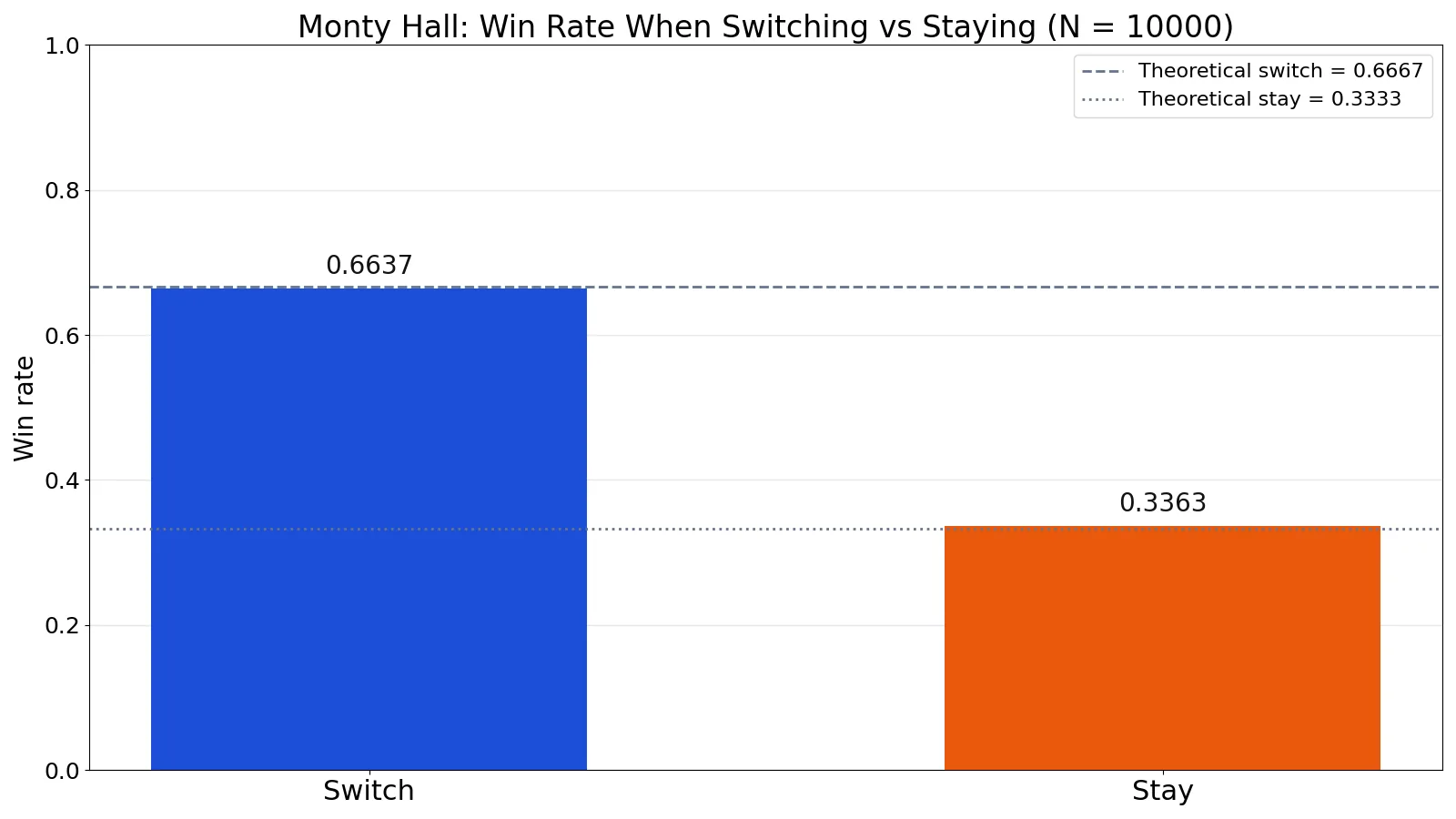
The Monty Hall problem asks whether you should switch doors after the host reveals a goat. Switching wins with probability $2/3$, staying wins with probability $1/3$. The reason is that your first pick is wrong two-thirds of the time, and the host's reveal hands you that advantage.
Quick Answer
- Three doors hide one car and two goats. You pick one door.
- The host, who knows where the car is, opens a different door to show a goat [1].
- Switching wins whenever your first pick was wrong, which happens with probability $2/3$ [1].
- Staying wins only when your first pick was right, which happens with probability $1/3$ [1].
- A simulation of 10,000 games gave a switch win rate of 0.6637 and a stay win rate of 0.3363, close to the theoretical values.
What the Monty Hall Problem Means
In plain terms, the Monty Hall problem is a probability puzzle based on the game show Let's Make a Deal, named after its original host, Monty Hall [2]. You face three doors. Behind one is a car, behind the other two are goats. You choose a door, the host opens one of the remaining doors to reveal a goat, and then you decide whether to keep your door or switch to the last unopened one [3].
The precise statistical definition adds the rules that make the answer work. The prize is placed randomly, with probability $1/3$ behind each door. You pick a door at random. The host always reveals a goat behind one of the two doors you did not pick. If your first pick happens to be correct, the host chooses randomly between the two remaining doors, with probability $1/2$ each [1]. Under these rules the problem has a single correct answer.
The puzzle is a veridical paradox. The solution is counterintuitive enough to seem absurd, yet it is demonstrably true [2]. It became famous after Marilyn vos Savant published and solved a reader's version in her "Ask Marilyn" column in Parade magazine in 1990 [2].
How It Works
The mechanism is a partition of the sample space into two cases.
$$P(\text{switch wins}) = P(\text{initial pick wrong}) = \frac{2}{3}$$
$$P(\text{stay wins}) = P(\text{initial pick correct}) = \frac{1}{3}$$
Each symbol means the following.
- $P(\text{initial pick correct})$ is the chance your first door hides the car. With three equally likely doors, this is $1/3$.
- $P(\text{initial pick wrong})$ is the chance your first door hides a goat. This is $2/3$.
- $P(\text{switch wins})$ is the chance you get the car by changing doors after the reveal.
- $P(\text{stay wins})$ is the chance you get the car by keeping your first door.
The key step is that the host never opens the car door and never opens your door. The host always reveals a goat, so switching wins exactly when your initial pick was wrong. Your first pick is wrong with probability $2/3$, so switching wins with probability $2/3$ [1].
Think of it this way. When you first choose, you are betting that your door hides the car, a $1/3$ bet. The other two doors together hold the car with probability $2/3$. The host's reveal does not move the car. It only tells you which of those two doors is a goat, so the full $2/3$ chance concentrates on the one door you can switch to.
Worked Example
The table below shows ten illustrative Monty Hall games. Doors are numbered 0, 1, and 2. Each row records where the car was, your initial pick, the door the host revealed, your strategy, and the outcome.
| game | car_door | initial_pick | revealed_door | strategy | outcome |
|---|---|---|---|---|---|
| 1 | 0 | 1 | 2 | switch | win |
| 2 | 1 | 2 | 0 | switch | win |
| 3 | 2 | 0 | 1 | switch | win |
| 4 | 0 | 0 | 1 | stay | win |
| 5 | 1 | 2 | 0 | switch | win |
| 6 | 2 | 1 | 0 | switch | win |
| 7 | 0 | 2 | 1 | switch | win |
| 8 | 1 | 1 | 2 | stay | win |
| 9 | 2 | 2 | 0 | stay | win |
| 10 | 0 | 1 | 2 | switch | win |
Notice the pattern. Every switch row has an initial pick that differs from the car door, and every stay row has an initial pick that matches it. That is the whole logic in miniature.
Now scale it up. The steps below come from a simulation of 10,000 games.
- Number of simulated games: $N = 10000$.
- Probability the car is behind the initially picked door: $P(\text{initial pick correct}) = 1/3 = 0.3333$.
- Probability the car is behind one of the other two doors: $P(\text{initial pick wrong}) = 2/3 = 0.6667$.
- The host always reveals a goat, so switching wins exactly when the initial pick was wrong: $P(\text{switch wins}) = 0.6667$.
- Staying wins exactly when the initial pick was correct: $P(\text{stay wins}) = 0.3333$.
- Simulated switch wins out of $N$: $6637 / 10000 = 0.6637$.
- Simulated stay wins out of $N$: $3363 / 10000 = 0.3363$.
- Difference between simulated and theoretical switch rate: $0.6637 - 0.6667 = -0.0030$.
The simulation lands within 0.003 of the theoretical value, which is ordinary sampling noise at this sample size.
import numpy as np
rng = np.random.default_rng(42)
N = 10000
car  = rng.integers(0, 3, size=N)
pick = rng.integers(0, 3, size=N)
switch_wins = int((pick != car).sum())
stay_wins   = int((pick == car).sum())
print(switch_wins / N, stay_wins / N)
Output:
0.6637 0.3363If you want to test your own numbers, the Probability Calculator handles the basic fractions quickly.
How to Interpret It
Read the result as a statement about strategy, not about any single game. Over many plays, a player who always switches wins about two-thirds of the time. A player who always stays wins about one-third of the time. The gap is the value of the information the host gives you.
The reveal is not random noise. The host knows where the car is and is constrained by the rules, so the act of opening a goat door carries information about the doors you did not choose. That is why the probability of your original door stays at $1/3$ while the other unopened door absorbs the remaining $2/3$.
This is also a clean example of conditional probability, where the probability of winning given the reveal depends on how the reveal was generated [4]. Change the host's rule and the answer changes, which is the same reasoning behind the third variable problem in observational data.
When to Use It (and when not to)
Use the Monty Hall setup when you want to teach or test a few ideas.
- Teaching conditional probability and how new information updates beliefs.
- Showing why simulation is a practical check on intuition [5].
- Explaining why a host who knows the answer changes the odds.
- Practicing the difference between prior and posterior probability.
Do not apply the $2/3$ answer outside the stated rules.
- If the host does not know where the car is and opens a door at random, the reveal can show the car, and the advantage disappears.
- If the host opens a door only sometimes, or only when you pick correctly, the probabilities change.
- If there are more than three doors, the arithmetic changes with the number of doors and the host's behavior.
- If the host is trying to manipulate you, treat the setup as a game theory problem, not a fixed probability.
Monty Hall Problem vs the Three Prisoners Problem
The Monty Hall problem is mathematically equivalent to the three prisoners problem, described by Martin Gardner in Scientific American in 1959 [2]. The surface story differs, but the probability structure is the same.
| Feature | Monty Hall problem | Three prisoners problem |
|---|---|---|
| Setting | Game show with doors | Prisoners and a pardon |
| Random event | Car placement | Who receives the pardon |
| Reveal | Host opens a goat door | Guard names a prisoner who will be executed |
| Decision | Switch or stay | Whether to swap fates |
| Switch advantage | $2/3$ | $2/3$ |
Both are also related to the older Bertrand's box paradox [2]. If you understand one, you understand the others.
Common Mistakes
- Believing the two remaining doors are equally likely. The fix is to track how the host chose which door to open. The host's constraint is what breaks the symmetry.
- Forgetting that the host knows where the car is. If the host opened doors at random, the answer would differ. The fix is to state the host's rule before computing anything.
- Thinking the reveal changes your original door's probability. Your door was chosen when three doors were live, so it stays at $1/3$. The fix is to separate the prior from the posterior.
- Assuming the answer is $1/2$ because two doors remain. Two doors do remain, but they were not created equally. The fix is to condition on the host's behavior.
- Applying the $2/3$ result to a different game. Variants with different host rules give different answers. The fix is to re-derive the probability for the actual rules.
- Trusting intuition over a simulation. Many people, including trained mathematicians, get this wrong on first pass [5]. The fix is to run the numbers.
Limitations
The $2/3$ answer holds only under the standard rules. It assumes the prize is placed at random, you pick at random, the host always reveals a goat, and the host opens a random goat door when both are available [1]. Relax any of these and the answer can change, sometimes to $1/2$ and sometimes to something else entirely.
The problem also cannot tell you what a real host would do. On an actual game show, the host might offer a switch for reasons of drama, and the offer itself could carry information. The puzzle is a clean probability model, not a description of television production. Treat it as a teaching tool for conditional probability, not as advice for a specific contestant.
Frequently Asked Questions
Why does switching win two-thirds of the time?
Your first pick is wrong two-thirds of the time. The host always reveals a goat and never reveals the car, so whenever your first pick was wrong, the remaining unopened door must hide the car. Switching therefore wins in exactly the two-thirds of games where your first pick was wrong [1].
Does the host's knowledge really matter?
Yes. If the host opened a door at random and it happened to show a goat, the remaining doors would be equally likely, and switching would not help. The host's knowledge and the rule that a goat is always revealed are what concentrate the $2/3$ probability on the switch door.
What if there are more than three doors?
The arithmetic depends on the number of doors and how many the host opens. With more doors, the advantage of switching is usually larger at first, then shrinks as doors are removed. The safe approach is to re-derive the probability from the exact rules instead of reusing the three-door answer.
Is the Monty Hall problem the same as the three prisoners problem?
Mathematically, yes. The Monty Hall problem is closely related to the three prisoners problem and to Bertrand's box paradox [2]. The stories differ, but the underlying probability structure and the $2/3$ result are the same.
Can I check the answer myself?
Yes, and simulation is the easiest route. Run many games in code, always switch in half and always stay in the other half, then compare the win rates [5]. A run of 10,000 games gave 0.6637 for switching and 0.3363 for staying, which matches the theoretical $2/3$ and $1/3$ within sampling error.
References
- [](https://www.stat.berkeley.edu/pub/users/stark/SticiGui/Text/montyHall.htm)
- Monty Hall problem - Wikipedia
- "The Monty Hall Problem" by Brian Johnson
- Conditional Probability and the Monty Hall Problem : Networks Course blog for INFO 2040/CS 2850/Econ 2040/SOC 2090
- The Monty Hall Problem