Vet Assistant vs Vet Tech: Duties, Training, Pay and Licensing
By Dr. Zubair Khalid, DVM, MS, PhD ·
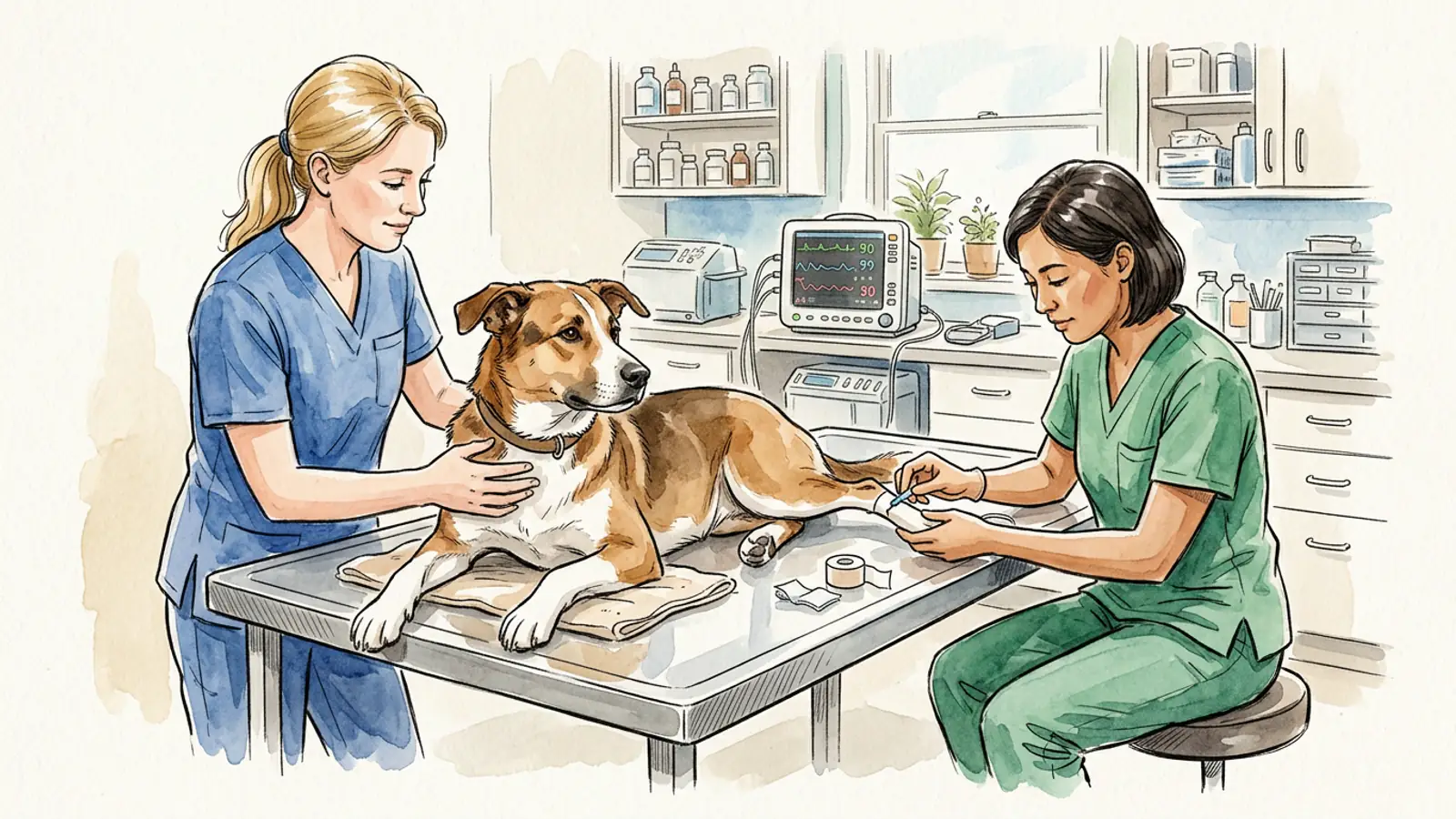
A veterinary technician is a credentialed professional who completes an AVMA CVTEA accredited degree, passes the Veterinary Technician National Examination, and is licensed or certified by a state board. A veterinary assistant is an unlicensed support role trained on the job or through a short certificate program, with duties that vary by state practice act.
The difference between a vet tech and a vet assistant is the single most common source of confusion in veterinary hiring, and it matters for pay, legal scope of practice, and career trajectory. This article breaks down the veterinary assistant vs veterinary technician comparison across duties, education, credentialing, compensation, and long-term outlook, with notes on how the same roles are structured in the UK, Canada, and Australia.
This article is educational and is not a substitute for veterinary diagnosis or treatment.
Key Takeaways
- A veterinary technician is a credentialed professional who completes an AVMA CVTEA accredited degree, passes the Veterinary Technician National Examination, and is licensed or certified by a state board.
- A veterinary assistant is an unlicensed support role trained on the job or through a short certificate program, with duties that vary by state practice act.
- Anesthesia monitoring is the clearest dividing line between the two roles, since credentialed technicians are trained across preassessment, anesthetic planning, monitoring, and transfer of care to discharge.
- The US Bureau of Labor Statistics reports a median annual wage of $38,150 for veterinary assistants and $47,380 for veterinary technologists and technicians as of May 2025.
- Neither role may diagnose, prescribe, or perform surgery, since those three acts are reserved for the licensed veterinarian.
The Core Difference in One Paragraph
A credentialed veterinary technician holds a two-year associate degree or a four-year bachelor degree from a program accredited by the AVMA Committee on Veterinary Technician Education and Activities (CVTEA), passes the Veterinary Technician National Examination (VTNE), and then meets state requirements for credentialing. Depending on the state, that credential is titled Certified Veterinary Technician (CVT), Registered Veterinary Technician (RVT), Licensed Veterinary Technician (LVT), or Licensed Veterinary Medical Technician (LVMT). A veterinary assistant has no license and no national examination. Assistants learn through on-the-job training or through programs such as the NAVTA Approved Veterinary Assistant designation. The scope of what an assistant may legally perform is set by each state's practice act, and it varies widely.
That structural difference drives everything else: what tasks each role can legally perform, what each earns, and how each career path develops.
Vet Tech Duties: What a Credentialed Technician Can Do
Veterinary technicians are trained in anesthesia and pain management fundamentals as part of their accredited curriculum [1]. In practice, that training translates into a defined set of clinical responsibilities.
Anesthesia and Monitoring
Anesthesia monitoring is the clearest dividing line between the two roles. Credentialed technicians are trained to be involved across the entire anesthesia and analgesia planning and implementation process, including preassessment, anesthetic planning, monitoring and management, and transfer of care to discharge [1]. A team-based approach that integrates credentialed technicians with the veterinarian for the full anesthesia process improves both workflow and patient safety [1].
This is not a peripheral duty. A 2025 clinical commentary in the Journal of the American Veterinary Medical Association describes technician involvement in developing balanced, patient-specific anesthesia drug protocols as a systematic collaboration with the veterinarian, aimed at optimizing outcomes for both patient and practice [2]. A companion article in the same series identifies underutilization of credentialed technicians as a major factor in the high attrition rate among them [2].
Imaging, Laboratory, and Clinical Procedures
Technician training covers the technical procedures that underpin diagnosis: taking radiographs, running laboratory work, placing intravenous catheters, performing dental cleanings, and delivering nursing care. The legal boundary is consistent across states in one respect: technicians work under veterinarian supervision and may not diagnose, prescribe, or perform surgery. Those three acts are reserved for the licensed veterinarian.
The Underutilization Problem
The gap between what technicians are trained to do and what they are allowed to do in practice is well documented. The persistent underutilization of veterinary technician skills and knowledge is described as a primary driver of career attrition within 5 to 7 years [1]. Graduates of AVMA-accredited programs are trained in anesthesia and pain management, yet their full capabilities are often untapped [1].
This matters to anyone choosing between the two roles. The technician credential opens a wider scope, but whether a given practice actually lets you use it depends on the hospital's culture and staffing model.
Academic and Teaching Roles
Technicians also work outside private practice. Academic veterinary technicians support preclinical laboratories in DVM curricula, and a teaching technician float team model has been used to provide teaching support across core laboratory courses while creating skill development and advancement opportunities for team members [3]. A qualitative study of 34 academic veterinary technicians across 12 accredited US colleges of veterinary medicine found that they have great passion for and dedication to their profession, and overwhelmingly want their voices heard and their skillsets both utilized and respected [4]. The same study identified impostor syndrome and the educator role as unique challenges of working in academia [4].
Veterinary Assistant Duties: The Support Foundation
Veterinary assistants handle restraint, kennel care, cleaning, feeding, and general support tasks. Their allowed duties vary by state practice act, and in many states the assistant role is defined by what it does not do rather than by a positive list.
Assistants are integral to daily operations. A 2025 survey study in Frontiers in Veterinary Science describes veterinary technicians and assistants as integral to the daily operations of veterinary practices and as potential key advocates for sustainability within the profession [5].
Assistants also participate in client-facing and prescribing-adjacent workflows. In a national survey of 337 veterinary support staff, including technicians, nurses, assistants, client care representatives, and hospital managers, 43.4 percent reported frequent involvement in the antimicrobial drug prescribing process, and 34.9 percent said advice regarding the need for antimicrobial drugs was routinely provided by staff to pet owners prior to veterinary consultation [6]. That finding is a useful illustration of how far assistant duties can extend into clinical communication, and it also shows why role clarity matters.
Comparison Table: Vet Assistant vs Vet Tech
| Feature | Veterinary Assistant | Veterinary Technician |
|---|---|---|
| License required | No | Yes, in states with credentialing |
| Typical credential | NAVTA Approved Veterinary Assistant or on-the-job training | CVT, RVT, LVT, or LVMT depending on state |
| Education | On-the-job training or short certificate program | Two-year associate or four-year bachelor degree from an AVMA CVTEA accredited program |
| National exam | None | Veterinary Technician National Examination (VTNE) |
| Anesthesia monitoring | Varies by state practice act | Core trained responsibility [1] |
| Radiographs, lab work, IV catheters, dental cleanings | Varies by state practice act | Standard scope under veterinarian supervision |
| Diagnose, prescribe, perform surgery | Not permitted | Not permitted |
| Median annual wage (BLS) | $38,150 (May 2025) | $47,380 (May 2025) |
| Employment change projected 2025 to 2035 | 9 percent | 9 percent |
| Work setting | Kennel, exam room, treatment area, front desk support | Treatment area, surgery, imaging, laboratory, specialty services |
Training and Credentialing Pathways
Becoming a Veterinary Technician
The pathway has four steps. Complete an AVMA CVTEA accredited program, which is either a two-year associate degree or a four-year bachelor degree. Pass the VTNE. Apply for state credentialing. Maintain the credential through continuing education as the state requires.
The credential name depends on where you work. States use Certified Veterinary Technician, Registered Veterinary Technician, Licensed Veterinary Technician, or Licensed Veterinary Medical Technician. The underlying qualification is the same accredited degree plus the national examination, and the title difference is administrative rather than a difference in training depth.
Becoming a Veterinary Assistant
There is no national licensing requirement. Assistants typically enter the field through on-the-job training, and some complete a certificate program such as the NAVTA Approved Veterinary Assistant pathway. Because there is no licensure, the ceiling on what an assistant may do is set by the state practice act and by the supervising veterinarian's judgment.
The Veterinary Nurse Title Initiative
The veterinary nurse title initiative is a push to align the credentialed technician title with the international norm. In the UK, qualified veterinary nurses are listed on the Royal College of Veterinary Surgeons register as Registered Veterinary Nurses (RVNs). In Canada, the credential is Registered Veterinary Technician, or RVT. In Australia, the role is generally called a veterinary nurse. The US credentialing structure is functionally equivalent but uses the technician title in most states, and the initiative seeks to bring the terminology in line with the rest of the English-speaking veterinary world.
Pay: What the Bureau of Labor Statistics Reports
The US Bureau of Labor Statistics reports a median annual wage of $38,150 for veterinary assistants and laboratory animal caretakers and $47,380 for veterinary technologists and technicians, both as of May 2025. The gap of roughly $9,200 reflects the credential, the scope of practice, and the legal accountability that comes with licensure.
Pay varies by setting. Specialty and emergency hospitals, academic institutions, and practices that fully utilize technician skills tend to pay above the median. Food animal and mixed practices present a different picture. A 2026 paper in the American Association of Bovine Practitioners Conference Proceedings reports that economic analysis suggests return on investment for hiring support staff in livestock practice ranges from $80,000 to $150,000 annually per DVM, with additional intangible benefits including continuity of care, safer working conditions, and improved job satisfaction [7]. That figure describes the return to the practice, not the wage paid to the individual, but it explains why well-run practices can afford to pay above median for strong support staff.
The same paper notes that delegation of non-DVM tasks such as herd reports, inventory, and client communication frees veterinarians to focus on clinical decision-making and leadership, and that thoughtful integration of RVTs and veterinary assistants is a catalyst for sustainable growth rather than a cost burden [7].
Why Technicians Are Underpaid Relative to Training
The underutilization problem has a direct financial dimension. A 2022 study in the Journal of the American Veterinary Medical Association analyzed 409 mixed and companion animal practices from the 2020 AVMA Practice Owner Survey. Each 10 percent increase in total veterinarian hours worked per week was associated with a mean revenue increase of approximately 9 percent. A one-unit increase in total technician hours used to support one hour of veterinarian work was associated with a 20.5 percent increase in revenue, but with no change in productivity. The same increase in nonmedical staff hours was associated with a 17.0 percent increase in revenue and a 14.4 percent increase in productivity. The optimal staff-to-veterinarian labor ratio for revenue was 9:1 for veterinary technicians and 8:1 for nonmedical staff [8].
That 20.5 percent revenue figure is a measurable argument for hiring technicians.
Job Outlook for Both Roles
The Bureau of Labor Statistics projects 9 percent employment growth for veterinary assistants and laboratory animal caretakers and 9 percent for veterinary technologists and technicians over the 2025 to 2035 decade. BLS describes both as much faster than the average for all occupations, reflecting sustained demand for veterinary services.
The outlook differs in quality, not just quantity. Assistant roles are more numerous and easier to enter, which means more competition for each position and less wage leverage. Technician roles are harder to fill because of the education and credentialing barrier, and the attrition problem compounds the shortage. The 5 to 7 year attrition window for credentialed technicians [1] means practices are continuously replacing experienced staff, which creates openings but also signals a retention problem that new entrants should understand before committing to a two-year degree.
Working Conditions and Wellbeing
Both roles carry occupational health risks that are not always discussed in career guides.
Client-Perpetrated Aggression
A 2026 cross-sectional survey of 647 veterinary professionals found that nearly all respondents, 99.8 percent, reported lifetime exposure to client verbal abuse. The study compared veterinary technicians and assistants, customer service representatives, veterinarians, and managers across practice settings and ownership structures. Despite role differences in exposure frequency, psychological consequences were consistent across groups [9].
This finding applies to both roles in this comparison. Assistants who work the front desk or handle euthanasia conversations face the same client-facing pressure as technicians, and the psychological toll does not track neatly with credential level.
Psychological Distress and Protective Factors
A 2024 study of 868 veterinary staff in Portugal, including veterinarians, veterinary nurses, veterinary assistants, and veterinary administrative staff, examined life satisfaction as a predictor of psychological distress. Life satisfaction negatively predicted psychological distress, and compassion satisfaction and resilience mediated the relationship. Compassion satisfaction explained 59 percent of the effect of life satisfaction on psychological distress, and resilience explained 6.4 percent [10].
The practical implication is that the pleasure of helping others is a measurable protective factor. That is relevant to career choice because it suggests that roles with more direct patient contact and more visible impact may be more sustainable over time, regardless of credential.
How the Roles Differ in the UK, Canada, and Australia
The US structure is not universal, and the terminology differences are significant enough to confuse anyone researching the field internationally.
United Kingdom
The credential is Registered Veterinary Nurse (RVN), regulated by the Royal College of Veterinary Surgeons. The RCVS sets standards for registration and maintains the register. The role is closer in scope to the US credentialed technician than to the US assistant. The title veterinary nurse itself is not yet protected in UK law, and the RCVS has called for statutory protection as part of reform of the Veterinary Surgeons Act.
Canada
The credential is Registered Veterinary Technician or Technologist, or RVT, in most provinces. Provincial associations and regulatory bodies oversee the profession, and the Canadian Veterinary Medical Association accredits veterinary technology programs. The RVT scope of practice is broadly comparable to the US credentialed technician role.
Australia
The role is generally called a veterinary nurse. The Veterinary Nurses Council of Australia is the national professional body for veterinary nurses. As in the UK, the nurse title is used rather than technician.
The veterinary nurse title initiative in the US is an attempt to align with this international pattern. The underlying qualification, an accredited program plus a national examination plus state credentialing, already matches the international model. The title is the remaining difference.
Common Myths and Misconceptions
Myth: Vet techs and vet assistants do the same job, and the titles are interchangeable
They are not interchangeable. The technician credential requires an accredited degree and a national examination. The assistant role requires neither. In states with credentialing, a practice cannot delegate technician-scope tasks to an uncredentialed employee.
Myth: Vet techs can diagnose and prescribe
Technicians may not diagnose, prescribe, or perform surgery. They work under veterinarian supervision and execute the diagnostic and treatment plan the veterinarian establishes. The anesthesia protocol example is instructive: technicians are trained to contribute to protocol development in collaboration with the veterinarian [2], but the veterinarian retains clinical authority.
Myth: Vet assistants are just kennel staff
Assistant duties include restraint, kennel care, cleaning, and feeding, but the role extends further in many practices. The national survey finding that 43.4 percent of support staff reported frequent involvement in the antimicrobial prescribing process, and that 34.9 percent said staff routinely advised pet owners on antimicrobial need before consultation, shows how much clinical communication assistants can absorb [6]. Whether that is appropriate is a separate question, but it is the reality of the role.
Myth: A bachelor degree in veterinary technology pays more than an associate degree
The credential is the same either way. Both associate and bachelor graduates sit the VTNE and qualify for state credentialing. A bachelor degree may open academic, teaching, or specialty pathways, and academic veterinary technicians report wanting their skillsets utilized and respected [4], but the entry-level clinical wage is set by the credential, not the degree level.
Myth: You need a license to work as a veterinary assistant
No license is required. Assistants learn on the job or through programs such as NAVTA Approved Veterinary Assistant. The absence of licensure is exactly why assistant duties vary so much by state.
Practical Implications for Career Choice
If you want the widest legal scope, the highest pay band, and a defined professional identity, the technician pathway is the answer. The cost is two to four years of education, a national examination, and state credentialing maintenance. The risk is underutilization: you may graduate trained in anesthesia and pain management [1] and find yourself doing tasks below your training level. The 5 to 7 year attrition window [1] is the outcome of that mismatch, not a reflection of the training itself.
If you want to enter the field quickly, test whether veterinary medicine suits you, and build experience before committing to a degree, the assistant pathway is the answer. The cost is a lower wage ceiling and a scope of practice that depends on your state and your employer. The advantage is that you can start earning immediately and decide later whether to pursue the technician credential.
Either way, the revenue data favors support staff. The 20.5 percent revenue increase associated with technician hours [8] and the $80,000 to $150,000 annual return on investment per DVM in livestock practice [7] both show that well-utilized support staff are financially valuable. The question for a new entrant is whether the practice you join will utilize you at that level.
Limitations and When to Contact a Veterinarian
This article covers career structure, not clinical care. Individual scope-of-practice questions depend on your state practice act and should be directed to your state veterinary board, not to a veterinarian.
Frequently Asked Questions
What is the main difference between a vet tech and a vet assistant?
A vet tech is credentialed through an accredited degree, the VTNE, and state requirements, while a vet assistant is unlicensed and trained on the job or through a certificate program.
Do vet techs get paid more than vet assistants?
Yes. The Bureau of Labor Statistics reports a median annual wage of $47,380 for veterinary technologists and technicians and $38,150 for veterinary assistants and laboratory animal caretakers as of May 2025.
Can a veterinary assistant monitor anesthesia?
It depends on the state. Anesthesia monitoring is a core trained responsibility of credentialed technicians, and whether an assistant may help monitor anesthesia under veterinarian supervision is set by each state practice act.
How long does it take to become a vet tech?
Two years for an associate degree or four years for a bachelor degree from an AVMA CVTEA accredited program, followed by the VTNE and state credentialing.
How long does it take to become a vet assistant?
There is no fixed requirement. Many assistants start working with no formal training and learn on the job, while others complete a short certificate program.
What does CVT, RVT, LVT, and LVMT mean?
They are state-specific titles for the same credential: Certified, Registered, Licensed Veterinary Technician, and Licensed Veterinary Medical Technician.
Can a vet tech prescribe medication?
No. Technicians may not diagnose, prescribe, or perform surgery. Those acts are reserved for the licensed veterinarian.
What is the veterinary nurse title initiative?
It is a US effort to align the credentialed technician title with the international norm, where the UK uses Registered Veterinary Nurse, Canada uses RVT, and Australia uses veterinary nurse.
Related Articles
- Veterinary Assistant Career Path: Training, Certification, and Clinic Roles
- Veterinary Technician (LVT/RVT) Career Guide: Education, Salary, and Scope of Practice
- How to Become a Certified Veterinary Technician
- State-by-State Veterinary Technician Credentialing
- VTNE Study Guide 2025: How to Pass the Veterinary Technician National Exam on
- Veterinary Dosage Calculation Practice Problems With Answers
- Needle Gauge and Syringe Size Chart for Veterinary Use
Sources
- Are there benefits to using a team-based approach to developing balanced anesthesia drug protocols in veterinary practice? Part 1.
- Are there benefits to using a team-based approach to developing balanced anesthesia drug protocols in veterinary practice? Part 2.
- Creating a teaching technician team for support of veterinary student training laboratories
- A qualitative study of the roles, motivations, and challenges of academic veterinary technicians.
- Environmentally sustainable management practices support veterinary staff wellbeing
- Veterinary support staff knowledge and perceptions of antimicrobial drug use, resistance, and stewardship in the United States
- Utilizing RVTs and veterinary assistants to elevate livestock practice
- Nonveterinarian staff increase revenue and improve veterinarian productivity in mixed and companion animal veterinary practices in the United States.
- Client-perpetrated aggression is endemic across the veterinary workforce: Experiences across clinical, administrative, and leadership roles
- Life satisfaction, psychological distress, compassion satisfaction and resilience: when the pleasure of helping others protects veterinary staff from emotional suffering