Veterinary Dosage Calculation Practice Problems With Answers
By Dr. Zubair Khalid, DVM, MS, PhD ·
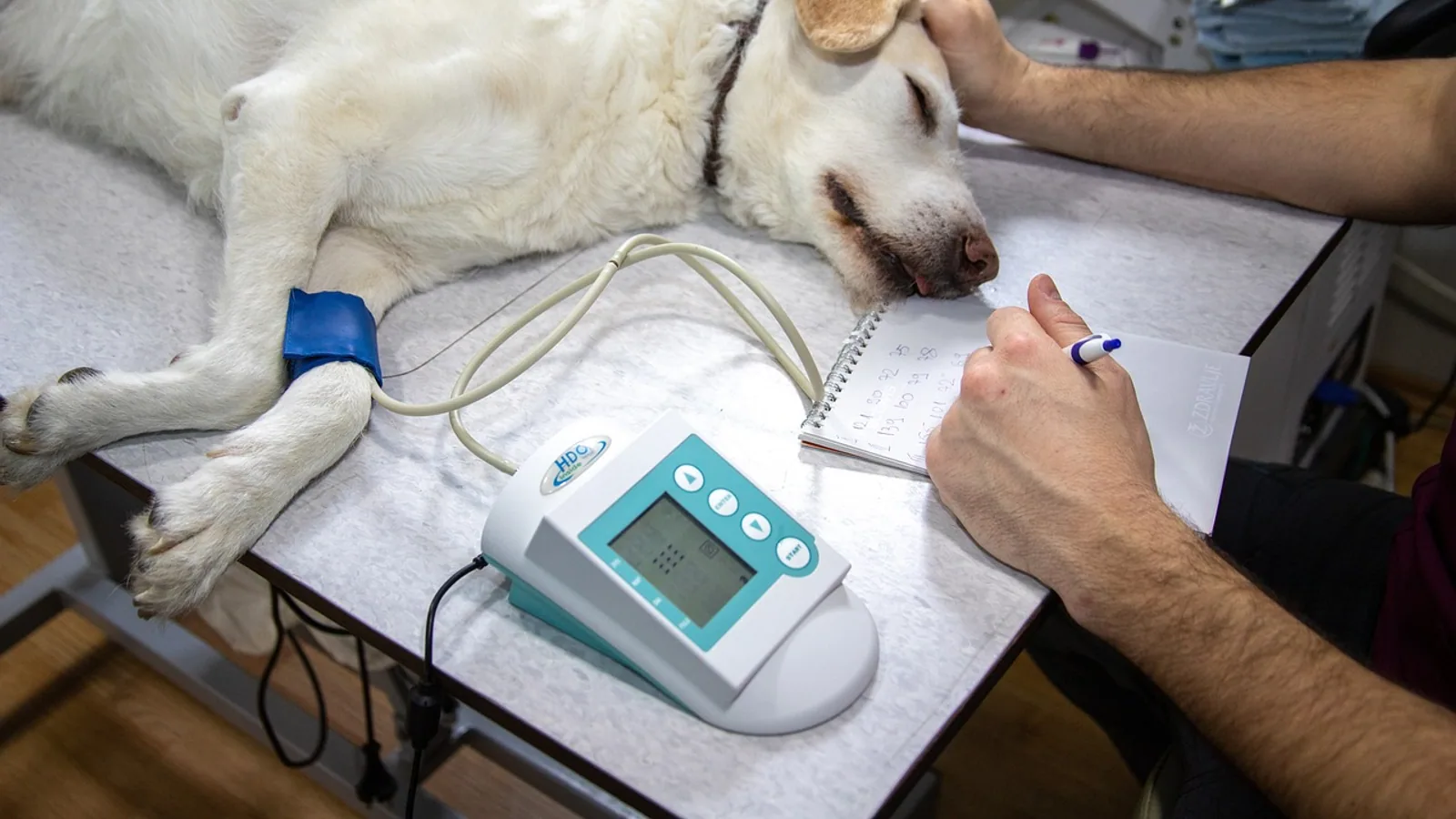
Veterinary dosage calculation practice problems build one skill: converting a patient's weight into a dose, then converting that dose into a volume you can actually draw into a syringe or count out as tablets. Every problem in this article follows the same four-step chain, and every answer is worked line by line so you can see exactly where a decimal point or a unit label can go wrong.
The 12 problems below cover pounds to kilograms, mg/kg dosing, percent solutions, ratio solutions, micrograms, tablet counts, fluid rates, and a dextrose dilution. The numbers are teaching examples only. They are not dosing recommendations for any drug in any species, and every real calculation must be checked against the drug label, the hospital formulary, and a licensed veterinarian before anything is administered.
This article is educational and is not a substitute for veterinary diagnosis or treatment.
Key Takeaways
- Veterinary dosage calculation practice problems teach the four-step chain of converting patient weight to a dose, then converting that dose to a measurable volume or tablet count.
- Wrong dose errors accounted for 63% of reported medication errors in a study across six community veterinary clinics, and 80% of those were calculation errors.
- The core formulas are weight in kg equals pounds divided by 2.2, dose in mg equals weight in kg times dose in mg/kg, and volume in mL equals dose in mg divided by concentration in mg/mL.
- A percent solution converts at 1% equals 10 mg/mL, so 2% lidocaine is 20 mg/mL and treating 2% as 2 mg/mL causes a tenfold overdose.
- For dilutions, C1V1 = C2V2 gives 25 mL of 50% dextrose for 500 mL of 2.5%, but you must remove 25 mL from the bag first to keep the final volume at 500 mL.
Why Dosage Calculation Errors Matter in Veterinary Practice
A wrong dose is the most common medication error type reported during the perianesthetic period in small animal general practice. In a prospective observational study across six community veterinary clinics, wrong dose errors accounted for 63% of all reported medication errors, and 80% of those wrong dose errors were calculation errors [1]. That single finding explains why vet tech math practice is not a classroom formality. The arithmetic is the last barrier between a drug label and a patient.
The human nursing literature reinforces the same point from the education side. Approximately 41% of all medication errors are attributed to improper dose calculations, and mean scores on medication dosage calculation tests for nursing students have been reported in the range of 35% to 71% [2]. Those figures come from nursing education research, not veterinary-specific data, but the underlying arithmetic is identical, and veterinary teams draw on the same evidence base when designing math training.
What the research consistently shows is that calculation ability is trainable and that specific teaching methods move the needle. A randomized controlled trial of screen-based simulation for medication administration and dosage calculation found that the simulation group outperformed the paper-and-pencil control group on both a knowledge post-test and an objective structured clinical examination [3]. A separate quasi-experimental study using dimensional analysis to teach infusible medication calculations in an intensive care setting reported improved post-test scores in the intervention group [4]. Experiential teaching strategies have also been shown to reduce calculation errors compared with traditional lecture methods in baccalaureate nursing students [5].
The pattern across this literature is that calculation competence responds to structured, repeated, feedback-rich practice. Reading worked problems and then solving them yourself is the cheapest version of that practice. A study of ChatGPT-assisted dosage calculation training found that post-training knowledge scores rose from roughly 50% to roughly 77%, with unanswered questions dropping sharply, which suggests that immediate feedback on practice attempts is a major driver of improvement [6].
One caution from the education literature: not all digital tools produce equal gains. A systematic review of digital technology for medication dosage calculation found that web-based courses were the most commonly used intervention but had limited impact on skill development [7]. Passive content delivery is weak. Active problem solving with correction is strong.
The Core Formulas You Need Before You Start
Every calculation in this article reduces to a small set of conversions and one or two proportional relationships. Learn these cold before attempting the problems.
Pounds to kilograms
Divide the weight in pounds by 2.2.
Weight in kg = weight in lb ÷ 2.2
A 44 lb dog is 44 ÷ 2.2 = 20 kg. A 22 lb dog is 10 kg. A 10 lb cat is about 4.5 kg. This is the single most common place for a catastrophic error, because a dose calculated on a pounds figure instead of a kilograms figure will be roughly 2.2 times too high.
Dose in milligrams
Multiply the patient's weight in kilograms by the dose rate in mg/kg.
Dose in mg = weight in kg × dose in mg/kg
A 20 kg dog at 5 mg/kg needs 100 mg. The dose rate always comes from the drug label, a formulary, or a veterinarian's order. It is never something you invent.
Volume to draw up
Divide the dose in milligrams by the concentration in mg/mL.
Volume in mL = dose in mg ÷ concentration in mg/mL
A 100 mg dose from a 50 mg/mL solution is 100 ÷ 50 = 2 mL.
Percent solutions
A percent solution is weight per volume, and the conversion is fixed: 1% = 10 mg/mL.
- 1% lidocaine = 10 mg/mL
- 2% lidocaine = 20 mg/mL
- 50% dextrose = 500 mg/mL
- 2.5% dextrose = 25 mg/mL
The mental shortcut is to move the decimal point one place to the right. A 0.5% solution is 5 mg/mL. A 5% solution is 50 mg/mL.
Ratio solutions
A ratio written as 1:X means 1 gram of drug per X milliliters of solution. For epinephrine 1:1000, that is 1 g in 1000 mL, which equals 1 mg/mL.
- 1:1000 = 1 mg/mL
- 1:10,000 = 0.1 mg/mL
Epinephrine 1:10,000 is simply 1:1000 diluted tenfold.
Micrograms
1 mg = 1000 mcg. To convert micrograms to milligrams, divide by 1000. To convert milligrams to micrograms, multiply by 1000.
A dose of 125 mcg is 0.125 mg. A concentration of 0.5 mg/mL is 500 mcg/mL. Microgram and milligram confusion is another high-consequence error, because the two unit labels look similar on a handwritten order and the numeric difference is a factor of 1000.
Dimensional analysis
Dimensional analysis, sometimes called the factor-label method, sets up the problem as a chain of fractions arranged so that unwanted units cancel. Instead of memorizing separate formulas for mg/kg, percent solutions, and drip rates, you write one continuous equation and let the units tell you whether to multiply or divide.
The structure looks like this for a basic dose-to-volume problem:
Volume (mL) = dose rate (mg/kg) × weight (kg) × (1 mL / concentration in mg)
For a 20 kg dog at 5 mg/kg with a 50 mg/mL drug:
Volume = (5 mg/kg) × (20 kg) × (1 mL / 50 mg)
The kg cancels, the mg cancels, and you are left with mL. Multiply the numerators, divide by the denominator: 100 ÷ 50 = 2 mL.
Dimensional analysis is particularly useful for multi-step problems like infusion rates, where you are converting mcg/kg/min into mL/h through a concentration. A quasi-experimental study of nursing students in an intensive care unit found that teaching infusible medication calculations with dimensional analysis improved calculation skills compared with conventional instruction [4]. The method is worth learning as a self-checking habit even if you prefer the stepwise formulas.
A note on tablet counts
Tablets are calculated the same way as liquids, but the final division uses mg per tablet instead of mg per mL.
Tablets = dose in mg ÷ concentration in mg per tablet
A 300 mg dose from 100 mg tablets is 3 tablets. If the answer is not a whole number or a clean half, the formulation is usually wrong for that patient and a different product or a compounded liquid should be considered. Splitting tablets beyond a halving score is unreliable.
Reference Table: The 12 Practice Cases at a Glance
| # | Patient | Dose rate | Drug concentration | Weight (kg) | Dose | Volume or count |
|---|---|---|---|---|---|---|
| 1 | 44 lb dog | 5 mg/kg | 50 mg/mL | 20 kg | 100 mg | 2 mL |
| 2 | 4.5 kg cat | 0.2 mg/kg | 2 mg/mL | 4.5 kg | 0.9 mg | 0.45 mL |
| 3 | 30 kg dog | 10 mg/kg | 100 mg tablets | 30 kg | 300 mg | 3 tablets |
| 4 | 15 kg dog | 2 mg/kg | 2% lidocaine (20 mg/mL) | 15 kg | 30 mg | 1.5 mL |
| 5 | 25 kg dog | 5 mcg/kg | 0.5 mg/mL (500 mcg/mL) | 25 kg | 125 mcg | 0.25 mL |
| 6 | 12 kg dog | 0.01 mg/kg | epinephrine 1:1000 (1 mg/mL) | 12 kg | 0.12 mg | 0.12 mL |
| 7 | 8 kg dog | 12.5 mg/kg | oral suspension 25 mg/mL | 8 kg | 100 mg | 4 mL |
| 8 | 500 mL bag | 2.5% target from 50% stock | C1V1 = C2V2 | n/a | n/a | 25 mL stock |
| 9 | 10 kg dog | 60 mL/kg/day | maintenance fluid | 10 kg | 600 mL/day | 25 mL/h |
| 10 | 25 mL/h | drip set conversion | 60 and 15 drops/mL sets | n/a | n/a | 25 and 6 drops/min |
| 11 | 20 kg dog | 2 mcg/kg/min | infusion | 20 kg | 40 mcg/min | 2.4 mg/h |
| 12 | 30 tablets | 1 tablet twice daily | n/a | n/a | n/a | 15 days |
Practice Problems With Worked Answers
Work each problem on paper before reading the answer. The learning happens in the attempt, not in the reading.
Problem 1: Basic mg/kg to volume
A 44 lb dog needs a drug at 5 mg/kg. The drug is supplied at 50 mg/mL. How many milliliters do you draw up?
Step 1, convert weight. 44 ÷ 2.2 = 20 kg.
Step 2, calculate the dose. 20 kg × 5 mg/kg = 100 mg.
Step 3, convert to volume. 100 mg ÷ 50 mg/mL = 2 mL.
Answer: 20 kg, 100 mg, 2 mL.
Problem 2: Small patient, small decimal
A 4.5 kg cat needs a drug at 0.2 mg/kg. The drug is supplied at 2 mg/mL. How many milliliters do you draw up?
Step 1, weight is already in kilograms. 4.5 kg.
Step 2, calculate the dose. 4.5 kg × 0.2 mg/kg = 0.9 mg.
Step 3, convert to volume. 0.9 mg ÷ 2 mg/mL = 0.45 mL.
Answer: 0.9 mg, 0.45 mL.
This problem is where decimal placement matters most. If you misplace the dose rate as 2 mg/kg instead of 0.2 mg/kg, you get 9 mg and 4.5 mL, a tenfold overdose. Always write the dose rate with its decimal point clearly and re-read it before calculating.
Problem 3: Tablets instead of liquid
A 30 kg dog needs a drug at 10 mg/kg. The drug is supplied as 100 mg tablets. How many tablets?
Step 1, weight is 30 kg.
Step 2, calculate the dose. 30 kg × 10 mg/kg = 300 mg.
Step 3, convert to tablets. 300 mg ÷ 100 mg per tablet = 3 tablets.
Answer: 300 mg, 3 tablets.
Problem 4: Percent solution
A 15 kg dog needs lidocaine at 2 mg/kg. The available lidocaine is a 2% solution. How many milliliters?
Step 1, convert the percent solution. 2% = 20 mg/mL.
Step 2, calculate the dose. 15 kg × 2 mg/kg = 30 mg.
Step 3, convert to volume. 30 mg ÷ 20 mg/mL = 1.5 mL.
Answer: 2% lidocaine is 20 mg/mL, the dose is 30 mg, and the volume is 1.5 mL.
The trap here is treating 2% as 2 mg/mL. That error produces a tenfold overdose. Percent solutions are always converted to mg/mL before you divide.
Problem 5: Micrograms
A 25 kg dog needs a drug at 5 mcg/kg. The drug is supplied at 0.5 mg/mL. How many milliliters?
Step 1, convert the concentration to micrograms. 0.5 mg/mL × 1000 = 500 mcg/mL.
Step 2, calculate the dose. 25 kg × 5 mcg/kg = 125 mcg.
Step 3, convert to volume. 125 mcg ÷ 500 mcg/mL = 0.25 mL.
Answer: 125 mcg, 0.25 mL.
You can also work this in milligrams. 125 mcg = 0.125 mg, and 0.125 mg ÷ 0.5 mg/mL = 0.25 mL. Both routes give the same answer. Pick one and stay consistent within a single calculation.
Problem 6: Ratio solution
A 12 kg dog needs epinephrine at 0.01 mg/kg. The available epinephrine is 1:1000. How many milliliters?
Step 1, convert the ratio. 1:1000 = 1 mg/mL.
Step 2, calculate the dose. 12 kg × 0.01 mg/kg = 0.12 mg.
Step 3, convert to volume. 0.12 mg ÷ 1 mg/mL = 0.12 mL.
Answer: epinephrine 1:1000 is 1 mg/mL, the dose is 0.12 mg, and the volume is 0.12 mL.
Note how small this volume is. Volumes under about 0.1 mL are difficult to measure accurately in a standard syringe, which is one reason dilute preparations exist. If a calculated volume is too small to measure reliably, that is a signal to check whether a more dilute concentration is available or whether the order should be clarified. Do not attempt to eyeball a fraction of a syringe graduation.
Problem 7: Oral suspension
An 8 kg dog needs an oral drug at 12.5 mg/kg. The suspension is 25 mg/mL. How many milliliters?
Step 1, weight is 8 kg.
Step 2, calculate the dose. 8 kg × 12.5 mg/kg = 100 mg.
Step 3, convert to volume. 100 mg ÷ 25 mg/mL = 4 mL.
Answer: 100 mg, 4 mL.
Oral suspensions must be shaken before measuring because the drug can settle. A dose measured from an unshaken bottle may be substantially weaker or stronger than the label concentration suggests.
Problem 8: Dilution with C1V1 = C2V2
You need 500 mL of 2.5% dextrose, and you have a 50% dextrose stock solution. How much stock do you add?
Step 1, set up the dilution equation. C1V1 = C2V2, where C1 is the stock concentration, V1 is the stock volume, C2 is the final concentration, and V2 is the final volume.
Step 2, substitute. 50% × V1 = 2.5% × 500 mL.
Step 3, solve. V1 = (2.5 × 500) ÷ 50 = 1250 ÷ 50 = 25 mL.
Answer: 25 mL of 50% dextrose.
Step 4, the practical step that is easy to forget. You are adding 25 mL of stock to a 500 mL bag, which would bring the total volume to 525 mL and dilute the final concentration below target. Remove 25 mL from the 500 mL bag first, then add the 25 mL of 50% dextrose. The bag returns to 500 mL at the correct 2.5% concentration.
This is the classic dilution error in practice. The math is right and the bag is still wrong because the removal step was skipped.
Problem 9: Maintenance fluid rate
A 10 kg dog needs fluids at an example maintenance rate of 60 mL/kg/day. What is the daily volume and the hourly rate?
Step 1, daily volume. 10 kg × 60 mL/kg/day = 600 mL/day.
Step 2, hourly rate. 600 mL ÷ 24 h = 25 mL/h.
Answer: 600 mL/day, 25 mL/h.
The 60 mL/kg/day figure is a teaching number used here for arithmetic practice. Real maintenance rates vary with species, age, cardiac status, renal function, and ongoing losses, and they are set by the veterinarian managing the case. Never carry a textbook fluid rate into a patient without confirming the order.
Problem 10: Drip rate conversion
You are running fluids at 25 mL/h. What is the drip rate with a 60 drops/mL set, and with a 15 drops/mL set?
Step 1, convert hours to minutes. 25 mL/h ÷ 60 min/h = 0.4167 mL/min.
Step 2, apply the 60 drops/mL set. 0.4167 mL/min × 60 drops/mL = 25 drops/min.
Step 3, apply the 15 drops/mL set. 0.4167 mL/min × 15 drops/mL = 6.25 drops/min, which rounds to about 6 drops/min.
Answer: 25 drops per minute with the 60 drops/mL set, about 6 drops per minute with the 15 drops/mL set.
This problem shows why the drop factor matters. The same fluid rate produces a fourfold difference in drops per minute depending on the administration set. Always read the drop factor printed on the packaging. Gravity drip counting is also inherently imprecise, and a study of voluntary medication error reports in community veterinary clinics found that wrong dose errors clustered around the premedication, sedation, and maintenance stages of anesthesia, which are exactly the stages where infusions are running [1].
Problem 11: Weight-based infusion rate
A 20 kg dog needs a drug at 2 mcg/kg/min. What is the dose per minute, per hour, and per hour in milligrams?
Step 1, dose per minute. 20 kg × 2 mcg/kg/min = 40 mcg/min.
Step 2, dose per hour. 40 mcg/min × 60 min/h = 2400 mcg/h.
Step 3, convert to milligrams. 2400 mcg ÷ 1000 = 2.4 mg/h.
Answer: 40 mcg/min, 2400 mcg/h, 2.4 mg/h.
Converting to mg/h is usually the last step before you divide by the drug concentration to get mL/h. A drug at 1 mg/mL would run at 2.4 mL/h. A drug at 0.1 mg/mL would run at 24 mL/h. The concentration is what determines the pump setting, and it is the number most often misread.
Problem 12: Days of supply
A patient is sent home with 30 tablets to be given as one tablet twice daily. How many days will the supply last?
Step 1, daily consumption. 1 tablet × 2 doses per day = 2 tablets/day.
Step 2, divide the supply. 30 tablets ÷ 2 tablets/day = 15 days.
Answer: 15 days.
Days-of-supply calculations matter for client communication and for controlled substance documentation. If the answer comes out to a fraction of a day, round down and tell the client the exact last full day of dosing.
Common Mistakes and How to Catch Them
The error patterns below account for most calculation failures in practice, and each one has a built-in check.
Pounds versus kilograms
This is the highest-consequence error. A dose calculated on a pounds figure is 2.2 times too high. The check is simple: a 44 lb dog is 20 kg, and 20 is less than half of 44. If your kilogram figure is larger than your pound figure, you multiplied instead of divided. Weigh every patient in kilograms when possible, and if the scale reads in pounds, convert immediately and write the kilogram figure on the record.
Milligrams versus micrograms
A factor of 1000 separates these units, and the abbreviations look similar on a handwritten order. Write mcg instead of the Greek letter mu whenever there is any chance of misreading, and convert everything to a single unit before calculating. If a dose in micrograms produces a volume that seems absurdly large or small, check the unit conversion first.
Decimal slips
Misplacing a decimal point changes the dose by a factor of 10. The defense is to estimate the expected answer before calculating. A 20 kg dog at 5 mg/kg should need roughly 100 mg, which from a 50 mg/mL solution is roughly 2 mL. If your arithmetic gives 0.2 mL or 20 mL, the estimate flags the error before the syringe is filled.
Wrong concentration
Labels list multiple concentrations for the same drug. Epinephrine comes as 1:1000 and 1:10,000. Lidocaine comes as 1% and 2%. Dextrose comes as 5%, 50%, and several strengths in between. Read the concentration on the actual vial in your hand, not the concentration you remember from the last case. A study of calculation contributors identified medication calculation frequency as one of the three most common themes affecting ability, which means infrequently used drugs are where concentration errors concentrate [2].
Skipping the removal step in dilutions
Covered in Problem 8. The math can be perfect and the bag still wrong.
Rounding too early
Carry full precision through the calculation and round only at the final step. Rounding a drip rate to a whole number at an intermediate stage can shift the final answer enough to matter over a long infusion.
Not rechecking an independent calculation
Two people calculating the same problem separately and comparing answers catches most errors. This is standard practice for high-risk drugs and for any dose that looks unusual.
What the Education Research Says About Building This Skill
Calculation competence is not a fixed trait. It responds to instruction, practice volume, and feedback quality, and the research identifies several factors that predict who will struggle.
A retrospective analysis of a dosage calculation exam found that four factors distinguished students who passed on the first attempt from those who failed: high school grade point average, first-semester college grade point average, critical thinking score, and gender [8]. The practical value of that finding is that at-risk students can be identified early and given additional support before they reach a clinical setting.
Basic numeracy is directly associated with medication calculation competence. In a cross-sectional study of 111 undergraduate nursing students, higher basic numeracy scores were associated with better medication calculation performance, and students who rated the quality of their mathematics teaching as good or higher had significantly higher competence than those who rated it poor or fair [9]. Mathematics anxiety was associated with lower competence in unadjusted analysis, though the association weakened after adjustment [9]. A separate systematic review of medication calculation assessment anxiety found that anxiety can stem from personal circumstances and prior math experiences, and that interventions targeting self-efficacy can improve performance [10].
The teaching method matters as much as the practice volume. A gamified contest format used to evaluate pediatric medication calculation competence in 224 nursing students found that mathematical competence was the main predictor of the final score, explaining roughly 61% of the variance [11]. A cross-sectional assessment of basic mathematical skills in baccalaureate nursing students found scores that compared unfavorably with studies from other countries, which the authors framed as a call for global educational reform in how calculation is taught [12].
On the intervention side, a program evaluation across 13 semesters found that a standardized, experiential dosage calculation initiative integrating instruction, simulation, and assessment was associated with significantly higher first-attempt pass rates, with post-implementation semesters consistently meeting or exceeding the program benchmark [13]. A national survey of prelicensure programs in the United States confirmed that teaching and evaluation methods for dosage calculation remain inconsistent across programs, and that failing a calculation exam can delay progression by a semester or more or lead to dismissal [14]. Virtual simulation integrated into a web-based dosage calculation course produced improvement in lower-performing students, though higher-performing students found the repetition unnecessary [15].
The consistent message is that deliberate practice with immediate correction works, that passive review does not, and that the students who need the most practice are often the ones least likely to seek it out.
Practical Implications for Veterinary Teams
For veterinary technicians, assistants, and students, the implications are operational.
Build a personal check habit. Estimate the answer before calculating, calculate, then compare. If the estimate and the calculation disagree by more than a rounding margin, stop and find the discrepancy before drawing anything up.
Write units on every line. A number without a unit is not a dose. Writing mg/kg, kg, mg, and mL at each step makes unit errors visible.
Convert to a single unit system at the start. If the order is in micrograms and the label is in milligrams, convert one to the other before doing anything else.
Use dimensional analysis as a cross-check. Even if you were taught the stepwise formulas, setting the problem up as a chain of fractions with units that cancel is an independent verification method. The evidence for dimensional analysis in infusion calculations is favorable [4].
Practice the drugs you rarely use. Frequency of calculation is one of the identified contributors to calculation ability [2], and rare drugs are where concentration errors cluster.
Document the calculation. Recording the weight, dose rate, concentration, and final volume on the treatment sheet creates an audit trail and lets a second person verify the work.
Limitations and When to Contact a Veterinarian
Every number in this article is a practice figure chosen to make the arithmetic clean. None of them are dosing recommendations. Real dose rates, concentrations, fluid rates, and infusion protocols are set by a licensed veterinarian for a specific patient, and they change with species, age, weight, organ function, concurrent medications, and clinical status.
Contact a veterinarian immediately if a medication error is suspected, including a wrong dose, a wrong concentration, a wrong route, or a dose given to the wrong patient. Signs that warrant urgent evaluation after a suspected dosing error include vomiting, tremors, excessive sedation, agitation, difficulty breathing, collapse, or any sudden change in behavior or consciousness. Do not wait for symptoms to appear before calling. Many drug errors are manageable when identified early and far more dangerous when discovered hours later.
For routine questions about a prescribed dose, the prescribing veterinarian or the dispensing pharmacy is the correct first contact. Do not adjust a dose based on a calculation you performed yourself unless a veterinarian has confirmed the change.
Frequently Asked Questions
How do I convert pounds to kilograms for a veterinary dose?
Divide the weight in pounds by 2.2. A 44 lb dog is 20 kg. Do this conversion before any other step, and write the kilogram figure on the record so nobody downstream repeats the conversion.
What is the formula for calculating a drug dose in milligrams?
Multiply the patient's weight in kilograms by the dose rate in mg/kg. A 20 kg dog at 5 mg/kg needs 100 mg.
How do I convert a dose in milligrams to a volume in milliliters?
Divide the dose in milligrams by the drug concentration in mg/mL. A 100 mg dose from a 50 mg/mL solution is 2 mL.
What does a 2 percent solution mean in mg/mL?
A 2% solution is 20 mg/mL. The general rule is that 1% equals 10 mg/mL, so you move the decimal point one place to the right.
How do I convert epinephrine 1:1000 to mg/mL?
Epinephrine 1:1000 is 1 mg/mL. A 1:X ratio means 1 gram of drug per X milliliters, so 1:1000 is 1 g in 1000 mL, which is 1 mg/mL.
How many micrograms are in a milligram?
There are 1000 micrograms in 1 milligram. Divide micrograms by 1000 to get milligrams, or multiply milligrams by 1000 to get micrograms.
How do I calculate a dextrose dilution?
Use C1V1 = C2V2. To make 500 mL of 2.5% dextrose from 50% stock, you need 25 mL of stock. Remove 25 mL from the 500 mL bag first, then add the stock, so the final volume stays at 500 mL.
What is the most common veterinary dosage calculation mistake?
Pounds and kilograms confusion is the highest-consequence error, followed by milligrams and micrograms confusion and decimal point slips. Estimating the expected answer before calculating catches most of these.
Related Articles
- Zoonotic Disease Screening in Exotic Pets
- Gabapentin Dosage Calculator for Cats & Dogs: Veterinary Dosage Guide
- Benadryl (Diphenhydramine) Dosage Calculator for Dogs: Veterinary Dosage Guide
- Clavamox Feline Dosage & Administration Calculator: Veterinary Dosage Guide
- Can I Give My Dog Benadryl? Dosage, Safety, and When to Call the Vet
- Trazodone Anxiety & Post-Surgery Dose Calculator: Veterinary Dosage Guide
- Cephalexin Weight-Based Antibiotic Dose Calculator: Veterinary Dosage Guide
- Needle Gauge and Syringe Size Chart for Veterinary Use
- How to Calculate a Constant Rate Infusion (CRI) in Veterinary Patients
- DEA Forms 222, 41 and 106 for Veterinary Clinics
Sources
- Incidence and type of voluntary reported perianesthetic medication errors in community veterinary clinics in Calgary, Canada.
- The contributors to dosage calculation ability and its applicability to nursing education: An integrative review.
- The effects of screen-based simulation on nursing students' acquisition of medication administration and dosage calculation skills: a randomized controlled trial.
- Effects of Dimensional Analysis on Infusible Medication Calculation Skills Among Nursing Students in an Intensive Care Unit.
- Experiential Teaching Increases Medication Calculation Accuracy Among Baccalaureate Nursing Students.
- The Effect of ChatGPT-Assisted Medication Dosage Calculation Training on Accuracy, Time, and Learning Satisfaction Among Nursing Students: A Quasi-Experimental Study.
- Medication dosage calculation among nursing students: does digital technology make a difference? A literature review.
- Identifying Nursing Students at Risk to Fail a Dosage Calculation Exam.
- Associations Between Numeracy, Mathematics Anxiety, Perceived Teaching Quality and Medication Calculation Competence Among Undergraduate Nursing Students: A Cross-Sectional Study.
- Medication math dosage assessment anxiety in undergraduate nursing students: A systematic review.
- Evaluation of Paediatric Nursing Students' Medication Calculation Competence: An Observational Study Using a Gamified Contest.
- An Indispensable Requirement for Medical Dosage Calculation: Basic Mathematical Skills of Baccalaureate Nursing Students.
- Innovative Educational Strategies to Improve Dosage Calculation Competency in a Nursing Program.
- A National Survey of Medication Dosage Calculation Teaching Methods and Competency Criteria on Nursing Student Success: Recommendations for Nurse Educators.
- Integration of Virtual Simulation Into a Web-Based Nursing Dosage Calculation Course.