Is Money Tree Toxic to Cats? Leaves, Sap, and Types
By Dr. Zubair Khalid, DVM, MS, PhD ·
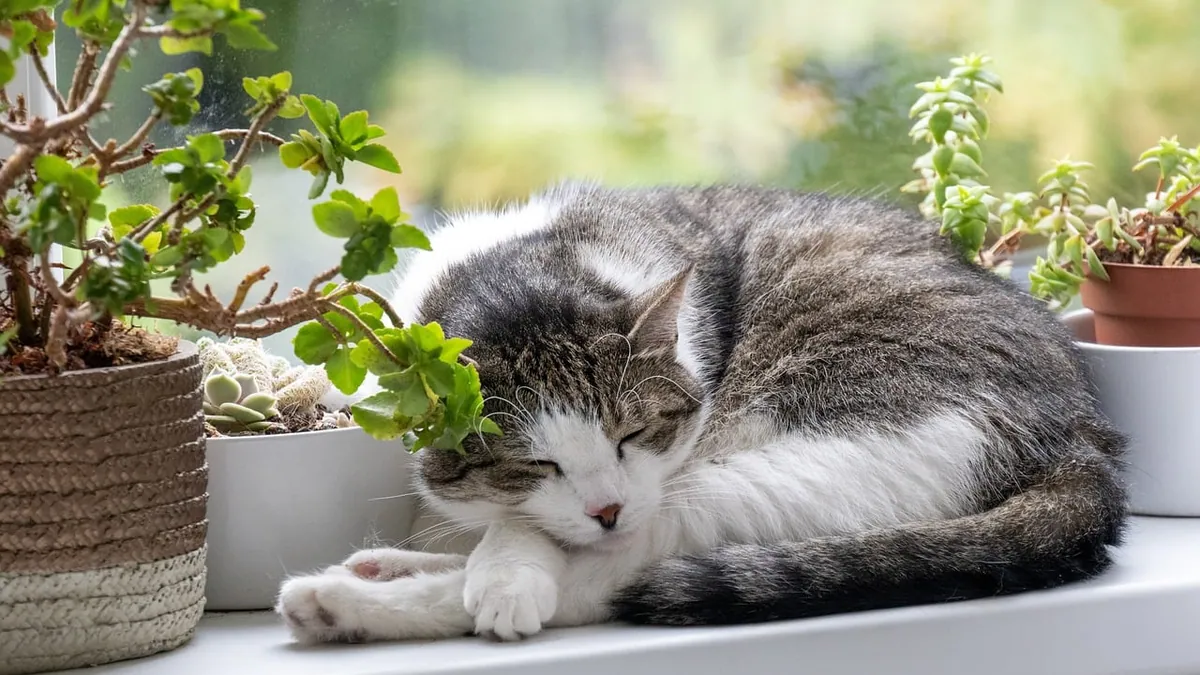
Is money tree harmful to cats? For the true money tree, Pachira aquatica, the answer is no. The ASPCA lists this plant as non-toxic to cats, dogs, and horses, with no toxic principles identified [1]. Most of the alarm about "money trees" comes from other plants that share the same nickname but belong to different species. This article is educational and is not a substitute for veterinary diagnosis or treatment.
Quick Answer
- Pachira aquatica, the plant sold as a money tree or Chinese money tree, is non-toxic to cats [1].
- The ASPCA lists no toxic principles for this plant, though it does note that nausea, vomiting, and loose stool can occur after ingestion [1].
- Braided money trees and bamboo money trees are the same Pachira aquatica species, so they carry the same non-toxic status [1].
- The name "money plant" is also used for unrelated species that can be toxic, so identify your plant before you relax.
- If your cat eats any plant and then vomits, drools, or acts unwell, call your veterinarian or the ASPCA Animal Poison Control Center at (888) 426-4435.
Is Money Tree Harmful to Cats? The Short Answer
No. The money tree sold in garden centers and grocery stores is Pachira aquatica, a tropical plant in the Malvaceae family. The ASPCA classifies it as non-toxic to cats, dogs, and horses, and lists no toxic principles [1]. That means there is no known poison in the plant that targets your cat's body.
This is good news for a common houseplant. Money trees are popular because they tolerate indoor light and grow slowly, which makes them easy to keep on a shelf or windowsill. Many cats will bat at the leaves or chew a leaf tip out of curiosity. In most cases, that causes nothing more than a passing upset stomach.
The confusion starts with names. "Money tree," "money plant," "Chinese money tree," and "bamboo money tree" get attached to several different species. Only one of them is Pachira aquatica. The others may be toxic, and a few are seriously so. If you are not sure which plant you own, treat it as unidentified until you confirm the species.
For a broader look at which houseplants put cats at risk, see Plants Toxic To Cats.
Is Chinese Money Tree Toxic to Cats?
No, not when the plant is Pachira aquatica. The ASPCA record for money tree lists "Money Plant" as an additional common name and gives Pachira aquatica as the scientific name, with non-toxicity for cats [1]. "Chinese money tree" is simply another nickname people use for the same plant.
The trouble is that "Chinese money plant" is also a nickname for Pilea peperomioides, a small plant with round, coin-shaped leaves. Pilea is a different species with a different safety profile. If your plant has flat, round leaves on thin stems and grows in a small pot, you may have a Pilea, not a Pachira. If it has five or more narrow leaflets fanning out from one point, like a hand, you likely have a Pachira.
Both plants are often sold as good-luck gifts, which is why the names blur together. The safest move is to check the nursery tag or take a clear photo of the leaves and trunk and ask your veterinarian or a poison control service to help you identify it.
Is Money Tree Leaves Toxic to Cats?
The leaves of Pachira aquatica are not toxic to cats [1]. There is no listed toxic principle in the plant, so the leaves do not contain a known cat poison.
That does not mean eating leaves is harmless in a practical sense. Plant material is fiber your cat cannot digest well. A cat that chews and swallows several leaves may vomit or pass loose stool. The ASPCA notes nausea, vomiting, and loose stool as possible clinical signs after ingestion of this plant [1]. These signs reflect stomach upset, not poisoning.
A single chewed leaf usually causes nothing at all. A cat that eats a large amount, or that already has a sensitive stomach, may have a messy day. Watch for repeated vomiting, refusal to eat, or lethargy, and call your veterinarian if any of those appear.
Is Money Tree Sap Toxic to Cats?
The sap of Pachira aquatica is not listed as toxic to cats [1]. The plant has no identified toxic principles, so there is no known toxin in the sap.
Sap can still irritate. Many plants, including non-toxic ones, have sticky or slightly irritating sap. If sap gets on your cat's paws or coat, your cat may lick it off during grooming. A small amount is unlikely to cause problems. If sap gets in the eyes, flush with plain water and call your veterinarian, because eye irritation is painful and can worsen quickly.
If your cat bites a stem and sap drips onto the floor, wipe it up. Sticky residue can collect dust and hair, and some cats will lick at it repeatedly.
Is Braided Money Tree Toxic to Cats?
No. A braided money tree is the same species, Pachira aquatica, just trained so several trunks weave together as they grow [1]. The braiding is a growing technique, not a different plant. The non-toxic classification applies to the whole plant, including the braided trunk and leaves [1].
One practical note about braided trees: the trunks are often held together with ties, wire, or clips. Those materials, not the plant, are the bigger hazard. A cat chewing on a plastic tie or wire could swallow a piece and develop a bowel obstruction. Check the base of your braided tree and remove any loose ties you can reach.
Is Bamboo Money Tree Toxic to Cats?
No. "Bamboo money tree" is another nickname for Pachira aquatica, and it is non-toxic to cats [1]. The name comes from the thick green trunk, which looks a little like bamboo.
Do not confuse this with lucky bamboo, which is a completely different plant. Lucky bamboo (Dracaena sanderiana) is not a true bamboo and is not the same as a bamboo money tree. The two plants look similar in a vase or pot, so check the label carefully. If you are unsure which one you have, keep it out of your cat's reach until you confirm.
The Toxic Principle and What It Does in the Body
Pachira aquatica has no identified toxic principle [1]. There is no specific molecule in the plant that poisons cats, which is why the ASPCA lists it as non-toxic.
When a cat eats plant material, the effects come from mechanical and digestive irritation. Chewing fibrous leaves can irritate the mouth and stomach lining. Swallowed plant matter sits in the stomach and can trigger a vomit reflex. Some cats drool after tasting a bitter or unfamiliar plant. These are normal body responses to eating something that is not food.
This is very different from plants that contain real toxins. Some plants damage the kidneys, some affect the heart, and some cause severe gastrointestinal injury. If you want to understand how plant poisonings work in cats and which plants are genuinely dangerous, see What Plants Can Be Toxic To Cats.
Signs to Watch For and Their Timeline
Signs after eating a money tree are usually mild and stomach-related. The ASPCA lists nausea, vomiting, and loose stool as possible clinical signs [1].
Most cats that eat a small amount show nothing. If signs do appear, they typically start within a few hours of ingestion. Vomiting may happen once or twice and then stop. Loose stool may follow over the next day. A cat that vomits once and then eats, drinks, and plays normally is usually fine to monitor at home.
Call your veterinarian if vomiting repeats more than a few times, if your cat stops eating, if there is blood in the vomit or stool, or if your cat seems painful or dull. These signs are not typical for a non-toxic plant and may point to a different cause, including a toxic plant your cat got into instead.
What to Do Right Now
If you saw your cat eat part of a money tree, stay calm. Remove your cat from the plant and put the plant out of reach. Check your cat's mouth for any stems, ties, or wire that could be stuck.
Call your veterinarian, the ASPCA Animal Poison Control Center at (888) 426-4435, or Pet Poison Helpline at (855) 764-7661 if you are unsure what your cat ate or if signs are developing. Have the plant's name ready, or send a photo. Tell the veterinarian how much you think your cat ate and when.
Do not induce vomiting unless a veterinarian tells you to. Forcing vomiting can cause harm, especially if a cat swallowed a sharp stem or a foreign object. It is also unnecessary for a plant with no toxic principle.
Offer water and keep your cat quiet. Do not give human medications, milk, or home remedies. If your cat is vomiting, do not push food right away. Let your veterinarian guide you.
Veterinary Treatment
Treatment depends on what your cat actually ate and how your cat feels. For a confirmed Pachira aquatica ingestion with mild signs, a veterinarian may simply recommend monitoring at home.
If your cat is vomiting or dehydrated, the veterinarian may give fluids under the skin or into a vein. Anti-nausea medication and a bland diet may be used to settle the stomach. Blood work is not usually needed for a non-toxic plant, but your veterinarian may recommend it if your cat has other health problems or if the history is unclear.
If your cat swallowed a tie, wire, or a large piece of stem, the plan changes. Your veterinarian may take X-rays to look for a foreign object. Surgery or endoscopy may be needed if an object is stuck or blocking the bowel. This is why the hardware on a braided tree matters more than the plant itself.
Doses of any medication are calculated by your veterinarian based on your cat's weight and health. Never give a medication on your own.
Outlook
The outlook for a cat that ate a Pachira aquatica leaf or stem is excellent. With no toxic principle in the plant, serious poisoning is not expected [1]. Most cats recover fully with rest and a little time.
Cats that develop vomiting or loose stool usually improve within a day or two. If signs last longer, or if your cat stops eating, a veterinary visit is needed to rule out other causes.
The outlook is also good for cats treated for a swallowed foreign object, as long as the problem is caught early. Watch your cat closely for the first 24 to 48 hours after any plant ingestion.
Prevention and Safer Alternatives
The simplest prevention is placement. Put your money tree where your cat cannot reach it. A tall shelf, a hanging planter, or a room your cat does not enter all work well. Cats can jump, so a high spot is only safe if there is no nearby launch point.
Give your cat something better to chew. Cat grass, a catnip plant, or a safe chew toy can redirect the urge to nibble plants. Boredom and curiosity drive a lot of plant chewing, so play sessions and puzzle feeders help too.
If you want a plant collection that is safe around cats, choose species with a known non-toxic listing. Check every new plant before you bring it home, and keep the tag. If you are building a cat-safe indoor garden, House Plants Toxic To Cat is a useful starting point for what to avoid.
Finally, teach everyone in the house the plant's real name. A plant labeled "money plant" could be a safe Pachira or a toxic species. Knowing the scientific name prevents confusion when you need to make a fast call.
Limitations and When to Contact a Veterinarian
This article covers the typical case of a cat eating a Pachira aquatica money tree. Individual cases need a veterinarian who can examine your cat and ask about the full picture. If you are not certain of the plant's identity, treat the situation as urgent until you confirm it.
Contact your veterinarian the same day if your cat vomits more than once, has loose stool that lasts more than a day, refuses food, or seems less active than usual.
Go to an emergency clinic now if your cat has repeated vomiting, trouble breathing, tremors, weakness, collapse, a swollen or painful belly, or if you think your cat swallowed a tie, wire, or large stem. These signs are not expected from a money tree and suggest another cause.
Schedule a routine visit if your cat keeps chewing plants and you want help choosing safe ones, or if your cat has a chronic stomach problem that plant eating seems to trigger.
Frequently Asked Questions
Do I need to take my cat to the vet after it chews a money tree leaf?
Not always. A single chewed leaf from a Pachira aquatica usually causes no signs, and the plant has no toxic principle [1]. Call your veterinarian if your cat vomits repeatedly, stops eating, or acts unwell.
Can a money tree make my cat throw up?
It can, even though it is non-toxic. The ASPCA lists nausea, vomiting, and loose stool as possible signs after ingestion [1]. This is stomach upset from eating plant fiber, not poisoning.
Is lucky bamboo the same as a bamboo money tree?
No. Lucky bamboo is a different plant from a different genus, and it is not the same as Pachira aquatica. The names sound alike, so check the label or ask the seller before you assume your plant is safe.
What should I do if I do not know which "money plant" I have?
Keep it away from your cat and identify it first. Send a clear photo of the leaves, stems, and any flowers to your veterinarian or a poison control service. Do not wait for signs to appear before asking for help.
Are there other names for the safe money tree I should look for?
Yes. Look for Pachira aquatica on the tag. It may also be sold as Malabar chestnut, Guiana chestnut, or saba nut. Any of these names points to the same non-toxic species [1].
Related Articles
- Plants Toxic To Cats
- What Plants Can Be Toxic To Cats
- What Plants Are Toxic To Cats With Pictures
- House Plants Toxic To Cat
- House Plants Toxic To Cats With Pictures
- House Plants Toxic To Cats Pictures
- Is a Pachira Money Tree Toxic to Cats? Braided Plant Safety
- Is Money Tree Toxic to Dogs? Pachira Safety
- Are Fake Plants Poisonous to Cats?
References
- Toxic and Non-toxic Plants: Money Tree. ASPCA Animal Poison Control Center.