Healthy vs. Unhealthy Rabbit Poop: A Visual Chart
By Dr. Zubair Khalid, DVM, MS, PhD ·

Healthy rabbit poop consists of round, uniform, fibrous pellets produced in large numbers every day, along with soft, sticky cecotropes that the rabbit eats directly from the anus and almost never leaves behind. Any other shape, texture, color, or volume is a warning sign, and two changes in particular, true diarrhea and no droppings at all for roughly twelve hours, are emergencies that require a same-day veterinary visit according to House Rabbit Society guidance [rabbit.org].
Rabbits produce droppings constantly, which makes feces one of the most reliable daily health indicators any pet owner has. This rabbit poop chart explained below covers every common dropping type, the biology behind what you are seeing, and the rabbit care checklist steps that keep the digestive tract running normally. A written chart works the same way a medical checklist does, as a fast screening tool that separates routine findings from signs that need professional evaluation. Medicine uses this red flag approach across nearly every specialty, from back pain [1] to cancer screening [2], and a simple, well-structured checklist is one of the most effective ways for a non-specialist to catch a problem early [3].
This article is educational and is not a substitute for veterinary diagnosis or treatment.
Why Rabbit Poop Is Such a Powerful Health Signal
Rabbits are hindgut fermenters. Their digestive tract is built around a large cecum, a fermentation chamber where bacteria break down the fiber in grass hay into nutrients the rabbit can absorb. The Merck Veterinary Manual's exotic and laboratory animal resources describe this cecal fermentation as the foundation of rabbit digestion, which is why fiber intake and fecal output rise and fall together.
That biology produces two completely different kinds of droppings, and confusing them is the single most common mistake owners make.
- Fecal pellets. These are the round, dry, waste droppings you find scattered around the enclosure. A healthy adult rabbit produces hundreds per day. They should be consistent in size, brown to dark brown, and light enough to crush easily, with visible bits of hay fiber inside.
- Cecotropes. These are nutrient-dense droppings produced by the cecum. They look like tiny, glossy, dark clusters, often described as resembling a raspberry or a bunch of grapes. A healthy rabbit eats cecotropes directly as they are passed, a behavior called cecotrophy, and reabsorbs the B vitamins and protein they contain. VCA Animal Hospitals notes that owners of healthy rabbits rarely see cecotropes at all, because the rabbit consumes them immediately.
Because the gut never really shuts down in a healthy rabbit, the volume of droppings is as meaningful as their appearance. A rabbit that is eating well cannot stop producing pellets for long without something being wrong. When output slows or stops, the most feared diagnosis is gastrointestinal stasis, a condition the Merck Veterinary Manual identifies as one of the most common and serious digestive emergencies in pet rabbits.
The Rabbit Poop Chart
This table is the rabbit poop chart interpretation in its most condensed form. Each row links the appearance you see to the most common explanation and the action it calls for.
| What you see | What it usually means | What to do |
|---|---|---|
| Round, uniform, pea-sized, fibrous pellets, plentiful and consistent | Normal fecal output | Continue your current diet and routine |
| Small, squished, irregular, or oddly shaped pellets | Insufficient hay, early gut slowdown, dehydration, or pain | Increase grass hay, encourage water intake, call your veterinarian if it lasts more than a day or two |
| Pellets strung together in chains or coated in fur | The rabbit is swallowing fur during grooming and passing it through | Groom the rabbit regularly, especially during shedding season, and ask your veterinarian about hairball risk |
| Soft, shiny, grape-like clusters left on the floor, on bedding, or stuck to the rabbit | Excess cecotropes, often called cecotrope dysfunction or cecotorrhea, usually linked to a diet that is too rich or too low in hay | Rebalance the diet toward hay, reduce pellets and treats, keep the rear end clean, and consult your veterinarian if it persists |
| Truly liquid or pudding-like stool, especially with a foul smell | True diarrhea, which in rabbits can signal serious intestinal disease | Contact an exotic animal veterinarian the same day, this is an emergency |
| Mucus, slime, or blood on or around droppings | Intestinal irritation, parasites, or inflammation | Schedule a veterinary examination promptly, sooner if the rabbit also acts ill |
| Droppings containing grit, litter, plastic, or other foreign material | The rabbit is eating non-food items from its environment | Remove the material, review bedding and litter choices, and call your veterinarian if output changes |
| No droppings at all for around twelve hours | Suspected gastrointestinal stasis, a life-threatening slowdown or stoppage of the gut | Emergency veterinary care immediately, per House Rabbit Society guidance |
What follows is the rabbit poop chart explained row by row, with the biology and practical detail behind each appearance.
Normal fecal pellets
Normal pellets are round, dry, and fibrous, with a rough, slightly crumbly surface like a cocoa puff. When you press one between a gloved finger or a paper towel, it crushes and you can see undigested hay fiber inside. Size should be consistent from pellet to pellet, and the daily pile should be large. Owners who scoop litter boxes daily quickly learn their rabbit's normal volume, and that baseline is exactly what makes the chart useful. A drop in quantity often appears before any other symptom.
Color varies somewhat with diet. A rabbit eating dark leafy greens may pass darker pellets, and a rabbit eating mostly pale hay may pass lighter ones. The texture and uniformity matter more than the exact shade.
Cecotropes
Cecotropes are not a health problem. They are a health requirement. The cecum manufactures them on a schedule, and the rabbit harvests them directly. Finding the occasional soft cluster is not alarming, and a rabbit that is overweight, arthritic, or recovering from surgery may physically struggle to reach them. If you regularly find intact cecotropes, the issue is usually mechanical access or a diet that is producing too many of them, not the droppings themselves.
Small, squished, or irregular pellets
Shrunken or malformed pellets are often the earliest visible sign that something is off. Common drivers include too little grass hay, reduced water intake, dental pain that makes chewing hay uncomfortable, or general discomfort from another illness. VCA Animal Hospitals lists changes in fecal output among the earliest clues owners can act on. Treat this row as an early warning, not a diagnosis, and use it to prompt a hay increase, a water check, and closer observation.
Pellets strung together with fur
Rabbits groom themselves and each other constantly, and they swallow hair. Most of that hair passes through the gut and appears woven between pellets. Regular fur on droppings is common during a molt, but heavy fur content raises the long-term risk of a trichobezoar, a hair mass that can contribute to blockage. The Rabbit Welfare Association and Fund recommends frequent grooming, particularly for long-haired breeds and during heavy sheds, as a standard part of any rabbit care checklist for exactly this reason.
Excess cecotropes left uneaten
When cecotropes appear as sticky smears on bedding, on the rabbit's hindquarters, or left on the floor overnight, the usual explanation is dietary. Too many pellets, too many sugary treats, too little hay, or too little exercise can shift cecal fermentation and produce more, softer cecotropes than the rabbit wants to eat. Rebalancing toward unlimited grass hay is the standard first step, and most mild cases improve within days. Persistent cecotorrhea, however, deserves a veterinary workup, because dental disease, obesity, arthritis, and other conditions can all limit a rabbit's ability to consume its cecotropes.
True diarrhea
True diarrhea, meaning liquid or pudding-like stool rather than soft clusters, is one of the most dangerous signs on the chart. The Merck Veterinary Manual emphasizes that severe diarrhea in rabbits can reflect serious enteric disease and can dehydrate a rabbit rapidly. This row has no home-care workaround. Contact an exotic animal veterinarian immediately.
No droppings at all
An absent fecal output is the most urgent row. House Rabbit Society advises owners to treat a rabbit that has neither eaten nor passed droppings for about twelve hours as a veterinary emergency. Gastrointestinal stasis can follow dental pain, dehydration, stress, surgery, an unsuitable diet, or another illness, and it becomes progressively harder to reverse the longer it continues. If you are unsure whether the rabbit has passed anything, confine it to a clean area where fresh output is easy to see and call your veterinarian.
Red Flags, and Why the Chart Is Built This Way
The structure of this rabbit poop chart borrows directly from how clinicians screen for serious disease. In medical practice, a red flag is a finding during assessment that raises concern for a serious underlying condition and prompts referral to a higher level of care, and studies of physician practice show that the presence of such findings reliably drives decisions to escalate [1]. The same vocabulary appears across specialties, from cancer diagnosis in primary care [2] to pain assessment, because the underlying logic is universal. Most findings are benign. A small, well-defined subset signals danger, and those are the ones a chart must highlight.
Three lessons from the clinical literature apply directly to this chart.
First, red flags are screening tools, not diagnoses. A systematic review of red flags in thoracolumbar pain found high false-positive rates and generally low diagnostic accuracy when individual signs were tested against serious pathology [4]. A single squished pellet does not mean your rabbit has gastrointestinal stasis. What the chart measures is pattern and persistence, which is why several rows include a time threshold.
Second, the observer matters as much as the tool. Research on patient encounters shows that useful warning signs often arrive as subtle shifts in routine, described in the literature as contextual red flags, and that they only help when someone notices them and asks about them [5]. You are the one who knows that the litter box looked lighter this morning. That observation is data.
Third, awareness is the bottleneck. Surveys repeatedly find that caregivers recognize common warning signs far better than rare ones, and that awareness correlates with education and access to good information [6], [7]. Public health research on where people get preventive health information shows that online channels and social media now dominate, which makes well-constructed charts and guides genuinely useful, while also making it easy to absorb inaccurate content [8]. The same research on online symptom checkers found that automated tools vary widely in whether they even ask about red flag symptoms, so no app or quiz replaces an examination by a veterinarian [9].
Common Myths About Rabbit Poop
Myth: A rabbit that eats its droppings is sick. The opposite is true. Eating cecotropes is normal, necessary behavior. A rabbit that stops doing it, leaving clusters behind, is the one with a problem.
Myth: Soft droppings always mean diarrhea. Soft, sticky, grape-like cecotropes and true liquid diarrhea are different findings with very different urgency. The chart separates them deliberately. VCA Animal Hospitals makes the same distinction in its client materials, and conflating the two leads owners to underreact to diarrhea or overreact to a stray cecotrope.
Myth: Poop problems are always diet problems. Diet is the most common cause, but dental disease, pain, dehydration, stress, and systemic illness all change fecal output. The Merck Veterinary Manual's rabbit resources describe multiple non-dietary causes of decreased gut motility. If a chart-guided diet correction does not resolve the change, a veterinary examination is the next step, not another food switch.
Myth: Rabbit poop is dangerous to touch or have in the house. Healthy rabbit fecal pellets are dry, fibrous, and low risk when handled with ordinary hygiene such as washing your hands after cleaning the litter box. Routine litter box hygiene is part of standard small mammal care advice from VCA Animal Hospitals.
The Rabbit Care Checklist That Keeps the Chart Green
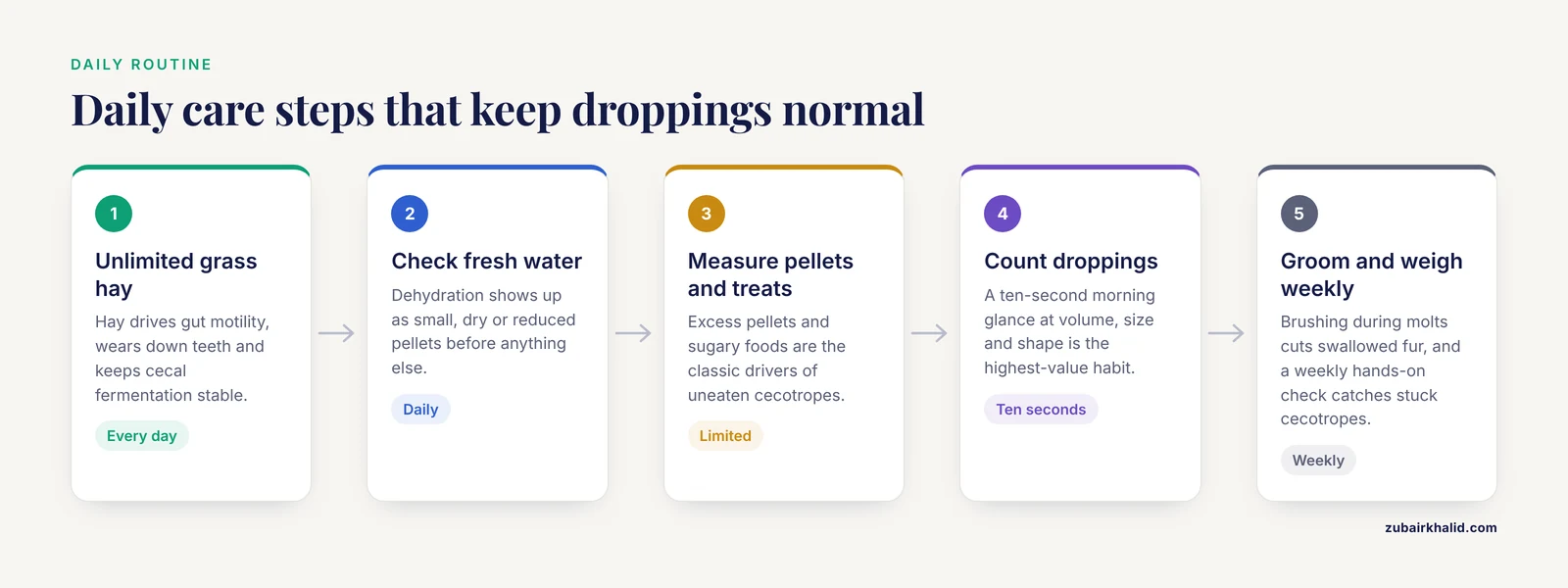
Dropping quality is downstream of daily care, so a functional rabbit care checklist covers the inputs that produce normal output.
- Unlimited grass hay, every day. Hay drives gut motility, wears down continuously growing teeth, and keeps cecal fermentation stable. The Rabbit Welfare Association and Fund positions hay and grass as the bulk of the daily diet, which aligns with the fiber-centered feeding model the Merck Veterinary Manual describes for rabbits.
- Fresh water, checked daily. Dehydration shows up in the chart as small, dry, or reduced pellets before it shows up anywhere else.
- Measured pellets and limited treats. Excess pellets and sugary foods are the classic drivers of uneaten cecotropes.
- Daily dropping count. A ten-second glance at the litter box each morning, noting volume, size, and shape, is the single highest-value habit on this list.
- Regular grooming. Brushing during molts reduces swallowed fur and keeps the fur-chains row of the chart quiet.
- Weekly hands-on check. Weigh the rabbit, feel the abdomen gently if the rabbit tolerates it, and inspect the rear end for stuck-on cecotropes, which can cause skin problems if left in place.
- Stable routine. Rabbits are sensitive to change. Travel, new pets, and household disruption can slow the gut, so a stressful week is a good week to count droppings extra carefully.
How this compares for guinea pig owners
Anyone searching for a guinea pig care guide alongside this rabbit poop chart will find the logic transfers almost completely. Guinea pigs are also hindgut fermenters that practice cecotrophy, produce round oval pellets as waste, and pass soft cecotropes they consume directly. The same red flags apply, particularly no droppings combined with not eating, which is treated as an emergency in guinea pigs just as it is in rabbits. The main chart difference is scale, since guinea pig droppings are smaller and more oval than rabbit pellets. VCA Animal Hospitals covers both species in its small mammal resources and applies the same monitoring principle to each, watch the output daily, and treat a silent gut as urgent.
What Is Still Uncertain
Some boundaries of current knowledge deserve honest framing. The exact boundary between a benign diet-driven change and early disease can be blurry in an individual rabbit, and the same pellet appearance can have several explanations. Clinical research on red flags generally confirms that individual signs perform better as prompts for further assessment than as definitive tests [4], and the research on how clinicians and caregivers actually use warning signs shows real variation in knowledge and practice [1], [10], [6]. There is also no standardized, peer-reviewed scoring system for rabbit fecal output the way there is for some other species, so this chart reflects the converging advice of veterinary teaching resources and rabbit-specific welfare organizations rather than a validated instrument. Where a precise threshold is given, such as the twelve-hour emergency rule, it is a widely taught practical guideline rather than a laboratory-derived number.
Limitations and When to Contact a Veterinarian
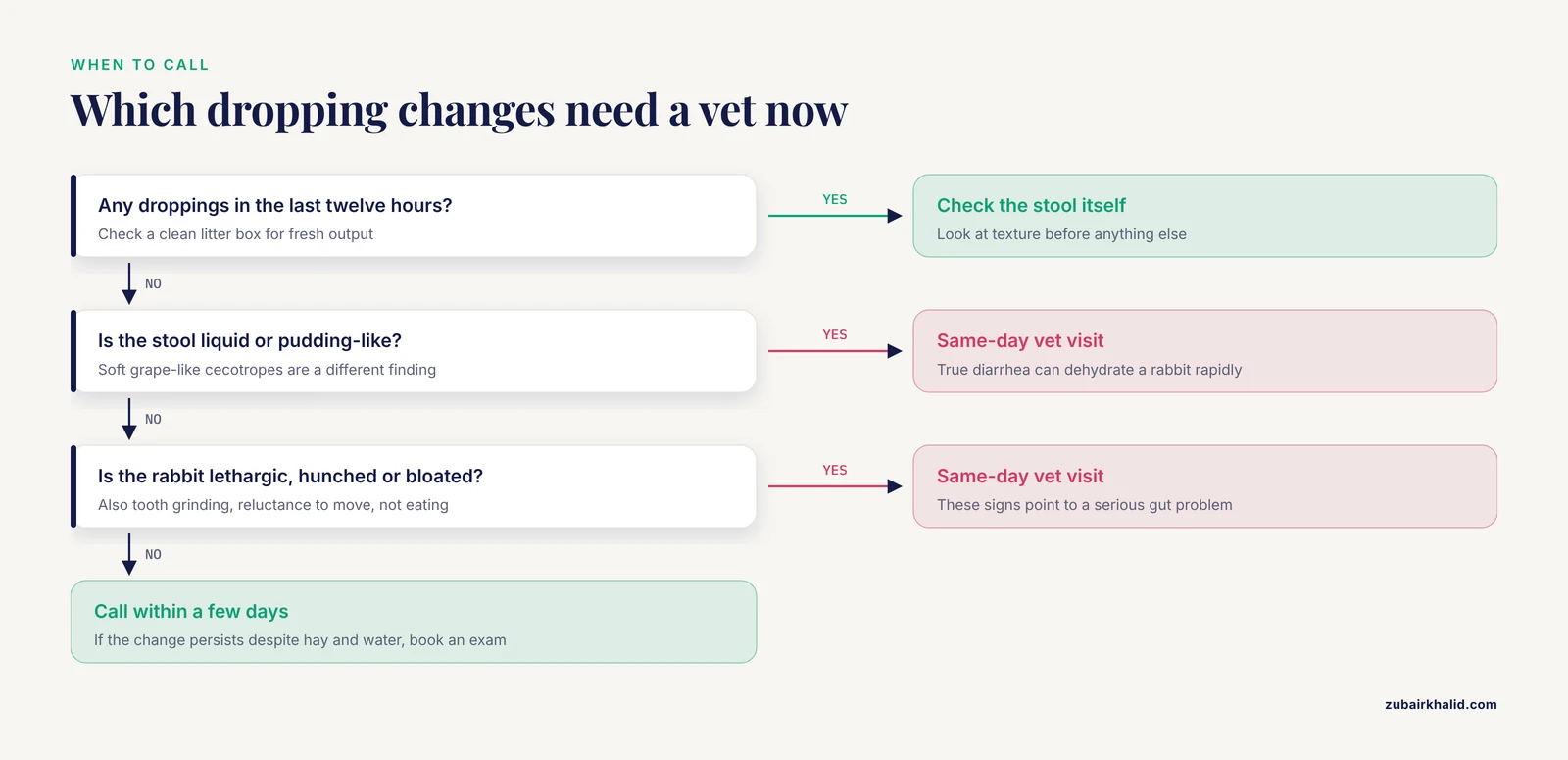
This article describes patterns, not diagnoses. Every individual case needs a veterinarian, and rabbits hide illness well, so what looks mild at home can be advanced by the time other symptoms appear.
Contact a veterinarian the same day, or go to an emergency clinic if one is not available, for any of the following.
- No droppings for around twelve hours, especially if the rabbit is also eating less, per House Rabbit Society guidance.
- True liquid or pudding-like diarrhea at any age.
- Droppings with visible blood.
- A rabbit that is lethargic, hunched, grinding its teeth in pain, reluctant to move, or has a bloated or gassy-feeling abdomen.
- A rabbit that has stopped eating or is chewing but not swallowing.
Contact a veterinarian within a few days, sooner if things worsen, for any of the following.
- Small, squished, or irregular pellets persisting more than a day or two despite adequate hay and water.
- Repeatedly uneaten cecotropes or a persistently messy rear end.
- Heavy fur content in droppings during a molt.
- Mucus or slime on droppings.
- Any change in dropping pattern that does not match your rabbit's normal baseline and does not resolve with basic diet correction.
If you use an online quiz or app as a first pass, remember that research on automated symptom checkers found inconsistent handling of red flag questions, and treat such tools as triage aids rather than answers [9]. A veterinarian with rabbit experience, sometimes called an exotics vet, is the right endpoint for every serious row on this chart.
Frequently Asked Questions
What does healthy rabbit poop look like?
Healthy rabbit poop is round, pea-sized or slightly larger, uniform, dry, and fibrous, with visible hay flecks inside and a surface that crushes easily. A healthy rabbit produces hundreds of these pellets daily and also passes soft, glossy cecotropes that it eats immediately, so you should rarely find any.
What are cecotropes and why does my rabbit eat them?
Cecotropes are nutrient-rich droppings produced in the cecum, and the rabbit eats them directly to reabsorb B vitamins, protein, and other nutrients. This behavior is normal and essential, and finding many uneaten cecotropes is a sign of a problem, usually dietary.
Why are my rabbit's pellets small and squished?
Small or misshapen pellets usually mean the gut is slowing down, most often because of too little hay, dehydration, or pain such as dental disease. Increase grass hay and water access, watch closely, and call your veterinarian if the change lasts more than a day or two.
What does rabbit poop stuck together with fur mean?
Pellets joined by hair mean your rabbit is swallowing fur during grooming and passing it through the digestive tract. It is common during shedding, but frequent grooming reduces the swallowed hair load and lowers the risk of hair-related blockages.
Is soft rabbit poop always diarrhea?
No. Soft, sticky, grape-like cecotropes are a normal product of the cecum, while true diarrhea is liquid or pudding-like stool and is a genuine emergency in rabbits. The distinction between the two is one of the most important parts of rabbit poop chart interpretation.
How long can a rabbit go without pooping before it is an emergency?
About twelve hours without eating and without droppings is the widely taught emergency threshold from House Rabbit Society. Gastrointestinal stasis progresses quickly, so do not wait to see if the situation improves on its own.
Can changing the diet fix mushy cecotropes?
Often yes. Shifting toward unlimited grass hay, reducing pellets and sugary treats, and increasing exercise resolves many mild cases within days. Persistent cecotrope problems deserve a veterinary examination, because dental pain, obesity, and arthritis can prevent a rabbit from eating its cecotropes.
Is rabbit poop the same as guinea pig poop?
The systems are very similar. Both species are hindgut fermenters that produce round fibrous waste pellets plus cecotropes they eat directly, so the same chart logic applies. Guinea pig droppings are smaller and more oval, and any guinea pig care guide treats a silent gut and true diarrhea as emergencies just as rabbit care does.
Sources
- Management of Low Back Pain in Primary Health-Care Settings: Physician’s Awareness and Practices Based on Red Flags
- Recognizing Gynecological Cancer in Primary Care: Risk Factors, Red Flags, and Referrals
- Red Flags for Early Referral for Infant Mental Health: Content Validation of a Tool
- The diagnostic value of Red Flags in thoracolumbar pain: a systematic review
- Listening to the Patient: A Typology of Contextual Red Flags in Disease Management Encounters.
- Parental Awareness of Developmental Red Flags and Early Stimulation Practices in Infants Aged 0-12 Months: A Cross-sectional Study from South India
- Awareness of ocular red flags and emergencies among the population of Saudi Arabia: A cross-sectional study
- Preventive health care information and social media: Consumer preferences
- Evaluating the use of red flags by online symptom checkers
- ASSESSMENT OF KNOWLEDGE, ATTITUDE AND PRACTICE OF RED FLAGS RELATED TO ACUTE LOW BACK PAIN AMONG PRIMARY HEALTH CARE PHYSICIAN, MINISTRY OF HEALTH, JEDDAH 2013-2014.