How to Litter Train a Rabbit or Guinea Pig
By Dr. Zubair Khalid, DVM, MS, PhD ·
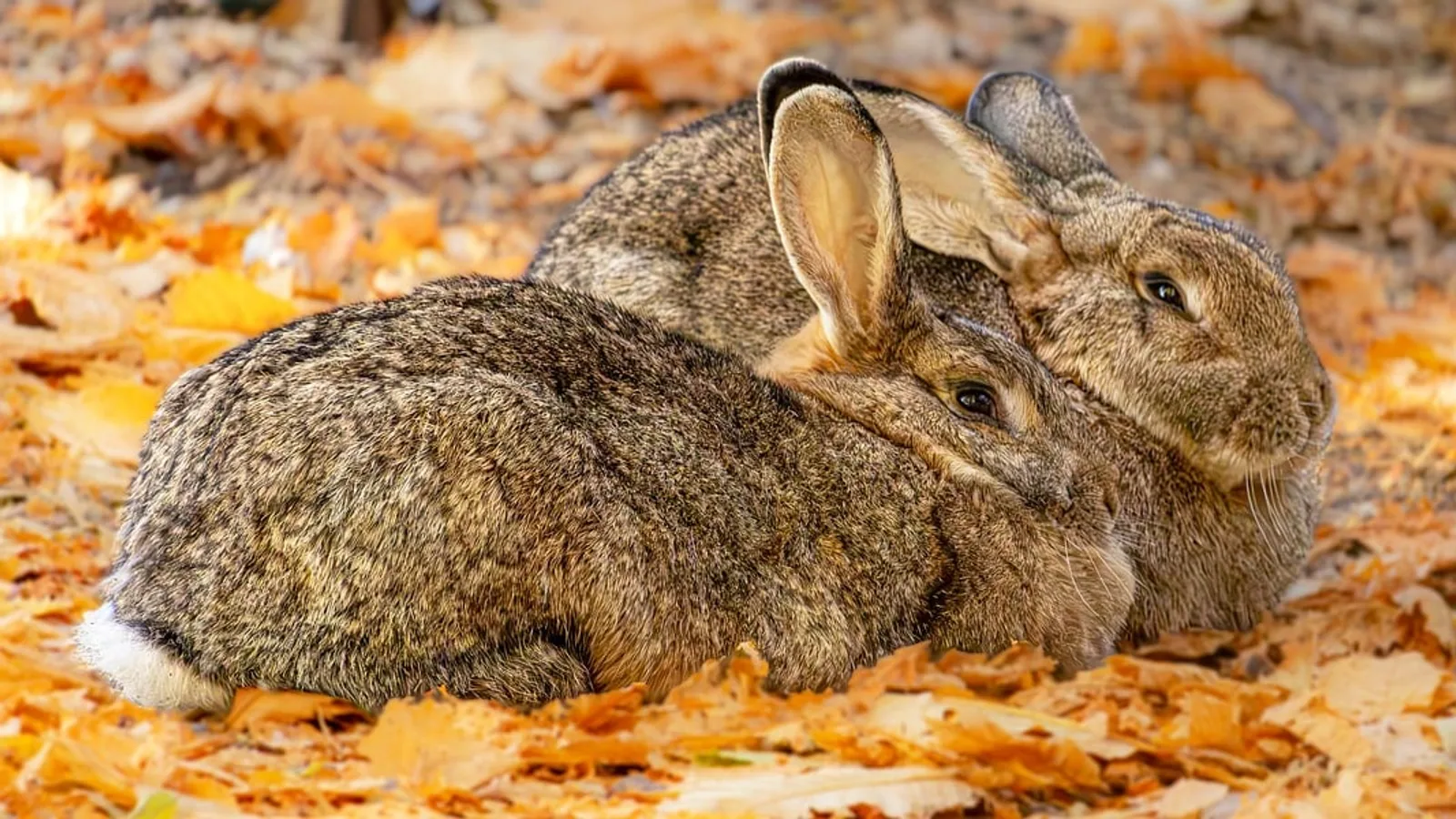
You can litter train a rabbit or guinea pig by placing a litter box in the corner your pet already uses for urine and droppings, filling it with a safe, paper-based or aspen litter, and moving every stray dropping into that box until your pet connects the location with the toilet spot. Rabbits learn this quickly and can reach near-perfect reliability once they are spayed or neutered. Guinea pigs can learn to urinate and pass most droppings in one corner, but they rarely achieve the consistency of a trained rabbit, so expect partial success and plan cleaning around it.
Litter training is one of the highest-value skills you can teach a small mammal. It keeps the enclosure drier, cuts cleaning time, reduces urine scald and foot problems, and makes free-roam time for a rabbit far more practical. The method differs between the two species because rabbits and guinea pigs are not interchangeable animals, as the next section explains.
This article is educational and is not a substitute for veterinary diagnosis or treatment.
Litter Training at a Glance
| Step | Rabbit | Guinea Pig |
|---|---|---|
| 1. Pick the box | Medium cat-size box or corner pan with one lower entry side | Shallow corner pan or small tray that fits the cage corner |
| 2. Pick the litter | Paper-based pellet, compressed paper, or aspen. No clumping clay, no pine or cedar shavings, no scented products | Paper-based bedding or aspen shavings in the tray. No clumping clay, cedar, or scented products |
| 3. Place the box | Where your rabbit already urinates and drops, often a corner away from food and water | The corner your guinea pig already uses, usually opposite the hay and water |
| 4. Add scent cues | Place a few of your rabbit's droppings and some urine-soaked paper in the box | Place droppings and a little soiled bedding in the tray |
| 5. Restrict space first | Keep the rabbit in a small pen or single room until the box is used reliably, then expand | Work within the cage first, then extend to a play pen |
| 6. Reward and redirect | Praise and a small food reward when the box is used. Move stray droppings into the box | Same approach, with lower expectations |
| 7. Clean correctly | Scoop soiled litter daily, wash the box weekly, use enzyme cleaner on accidents | Change the tray daily or twice daily because guinea pigs sit in it |
| 8. Reassess problems | Sudden lapses mean a medical or stress check, not punishment | Persistent failure is usually normal behavior, but rule out urinary pain |
Print this table, set up tonight, and start with a single box in the corner your pet already favors.
Why Rabbits and Guinea Pigs Are Trained Differently
Rabbits and guinea pigs look like similar small herbivores, but decades of comparative physiology research show they are biologically distinct animals. Cardiac studies conducted on guinea pig, rabbit, and other species' tissues document different electrical behavior between the two hearts [1], [2], [3]. Research on the autonomic nervous system likewise shows species-specific serotonin receptor profiles in rabbit and guinea pig brain cortex [4] and species-specific adrenoceptor responses in guinea pig and rabbit small arteries [5]. A study of toxin skin reactivity in both species found wide individual variation among animals, which reflects how much normal biological variation exists even within one species [6].
For an owner, the practical translation is simple. A method tuned to one species will not transfer perfectly to the other, and individual pets vary. Rabbits are territorial animals that naturally return to one or a few latrine spots, which is the instinct that makes litter training so effective. Guinea pigs lack that strong territorial latrine drive. They tend to eliminate where they happen to be, with a mild preference for corners, so training builds a habit rather than redirecting an instinct.
There is another point worth knowing about the evidence base itself. Guinea pigs are among the most heavily used laboratory animals in biomedical research, including developmental and reproductive toxicology studies [7], so most published guinea pig data describes laboratory conditions rather than living-room habitats. For daily pet husbandry, the guidance below draws on clinical resources such as the Merck Veterinary Manual, VCA Animal Hospitals, the House Rabbit Society, and the Rabbit Welfare Association and Fund, the organizations that publish care recommendations for owned rabbits and guinea pigs.
The Biology That Makes Litter Training Possible
Understanding four biological facts will make every step below feel obvious instead of arbitrary.
Rabbits and guinea pigs are hindgut fermenters that produce large volumes of droppings. Their digestive systems process a high-fiber grass diet continuously, so a healthy animal passes droppings many times per hour. This volume is why the litter box matters so much and why a digestive slowdown is an emergency.
Both species practice cecotrophy. As the Merck Veterinary Manual describes for these species, they produce soft cecal droppings, called cecotropes, which they eat directly from the anus to recover nutrients. You will sometimes find uneaten cecotropes mashed into litter or bedding. They look like small dark clusters of soft berries and are normal, not diarrhea.
Rabbits like to eat and eliminate at the same time. Rabbits often pass droppings and urine while munching hay. This is the reason a hay rack above or beside the litter box is the single most effective training aid for a rabbit.
Urine marking is territorial. An intact rabbit, and to a lesser extent an intact guinea pig, will spray and scatter droppings to claim space. This behavior fades substantially after spaying or neutering, which is why altered animals are far easier to train.
How to Litter Train Your Rabbit or Guinea Pig, Step by Step
The following sequence answers the most common version of this question, how to litter train your rabbit or guinea pig, in the order you should actually do it. Work through it over one to three weeks.
Step 1: Choose the location before you choose the product
Watch your pet for two days. Rabbits almost always select a corner away from their sleeping and feeding area. Guinea pigs favor a corner, usually one away from the water bottle and hay. Put the box exactly where the habit already exists. Moving the pet to your preferred corner instead of meeting their choice is the most common reason training stalls.
Step 2: Set up the box correctly
For a rabbit, use a box large enough for the rabbit to turn around in and sit in for a while, because rabbits often linger and eat hay in the box. A corner pan with one higher back and one lower entry side works well in a cage. For a guinea pig, use a shallow tray or corner pan with low sides so the animal can step in easily. Fill it with one to two inches of safe litter, enough to absorb urine without being so deep that a small animal cannot move comfortably.
Place the hay supply at or beside the box for a rabbit. For a guinea pig, keep hay at the opposite end so the toilet corner stays drier, and accept that the corner preference is the cue you are building on.
Step 3: Seed the box with scent
Put a handful of your pet's droppings and a little urine-soaked litter or paper into the fresh box. Scent cues communicate the destination faster than any other signal. Place the droppings in the box, never press the animal's nose into them, which teaches nothing and frightens the animal.
Step 4: Restrict space, then expand gradually
Training succeeds in a small area and fails in a large one. Keep a rabbit in an exercise pen or a single bunny-proofed room with the box until the box is used consistently for several days, then expand the area one stage at a time. Add a second box when the space grows beyond one room or to a second floor. For a guinea pig, train inside the enclosure first, then offer a play pen with a second tray once the cage corner is established.
Step 5: Reward and redirect, never punish
When your pet uses the box, offer calm praise and, for a rabbit, a small piece of appropriate vegetable or herb. When you find droppings elsewhere, simply lift them into the box. The scent trail builds the association. If you see urine starting in the wrong place, gently herd the animal toward the box instead of startling or scolding. Punishment after the fact teaches the animal to fear you, not to change the habit.
Step 6: Clean the box on a schedule that matches the species
Scoop a rabbit box daily and wash it weekly with plain soap and hot water, replacing the litter fully. A rabbit box that smells strongly of ammonia will push the rabbit to alternatives. Change a guinea pig tray daily, or twice daily in warm weather, because guinea pigs sit in the tray and wet fur invites skin problems. For accidents outside the box, blot the area and treat it with an enzyme cleaner so the scent marker disappears. Avoid ammonia-based household cleaners, which smell like urine to the animal.
Step 7: Neuter or spay when your veterinarian advises it
Altered rabbits are markedly easier to litter train because the hormonal drive to mark territory is removed. The House Rabbit Society and the Rabbit Welfare Association and Fund both emphasize desexing as part of responsible rabbit ownership, and your veterinarian can also discuss the significant health benefits, including prevention of uterine disease in does. Discuss timing with your own veterinarian rather than following a fixed age rule from the internet.
Equipment and Supplies: Selection Criteria
You need four items. Choose by criteria, not by brand.
The box. For rabbits, prioritize floor area over depth. The rabbit must enter without jumping and sit fully inside. For guinea pigs, prioritize low entry height and a footprint that fits the corner without blocking traffic. Avoid boxes with high slick sides that a guinea pig cannot climb past.
The litter. Safe choices for both species are unscented paper-based litters and kiln-dried aspen products. Three categories are off the list. First, clumping clay cat litter, which can cause life-threatening intestinal blockage when swallowed, a realistic risk because rabbits nibble in the box. Second, pine and cedar shavings, whose aromatic oils are associated with respiratory and liver concerns in small mammals in the published exotic-animal literature summarized by the Merck Veterinary Manual. Third, any heavily scented or dusty product, because both species have sensitive airways.
Hay presented at the box. For rabbits this is a training tool, not just food. A rack that hangs over the box or a hay feeder beside it turns the rabbit's natural habit into a training advantage.
Cleaning supplies. White vinegar dissolves dried urine scale on the box. An enzyme cleaner removes accident odor from floors and rugs. A small hand brush and dustpan made droppings relocation effortless during the training weeks.
Litter Training Tips That Actually Move the Needle
These tips answer the practical follow-up owners ask after reading the basics.
- Follow the animal, not the plan. If your rabbit picks a different corner than you chose, move the box. Winning quickly beats fighting for weeks.
- Use several boxes in a large space. A free-roam rabbit in a whole floor often needs two or three boxes, just as a large home needs more than one bathroom.
- Keep the box in the enclosure during bonding. If you are introducing a second rabbit, the box is a known neutral territory, and it should remain in place so the pair's new shared latrine forms there.
- Refresh, do not sterilize. Leave a small amount of clean, unscented scent behind when you wash the box. A box that smells completely of detergent can invite re-marking.
- Manage deep bedding during training. A deep, absorbent bed inside a large cage gives a guinea pig too many comfortable toilet options. During the training weeks, keep bedding depth moderate and confine the inviting options to the tray.
- Handle age realistically. Young rabbits learn fast but their habits wobble during adolescence, when hormones drive marking. Re-training after desexing usually restores reliability. Older animals with arthritis need a box with a very low entry, and a lapse in an older pet deserves a veterinary check before you assume it is behavioral.
- Protect the hay-hutch connection. Never place the box where the rabbit sleeps, and never make the sleeping area the toilet area. Rabbits keep these zones separate, and soiling of the sleeping spot signals the setup needs rearranging.
Common Mistakes When You Litter Train a Guinea Pig or Rabbit
Reading the common mistakes list before you start saves weeks. These are the errors seen most often in practice.
Using cat litter by default. Clumping clay litter is designed to swell. In a species that eats while it eliminates, that property is a GI obstruction risk. This single mistake causes more avoidable emergencies than any other on this list.
Giving too much space too soon. A rabbit released into an entire apartment on day two will establish its own latrine network across the rugs. Restrict, succeed, then expand.
Cleaning with ammonia products. Ammonia smells like a competitor's urine mark. It can either repel the animal from the box or trigger extra marking, and the fumes irritate small-mammal airways. Use vinegar and enzyme products.
Punishing accidents. Rubbing a rabbit's nose in droppings, shouting, or tapping the animal teaches fear. Fear makes elimination problems worse and damages the bond you need for handling and grooming.
Expecting rabbit-level results from a guinea pig. Owners who litter train a guinea pig expecting a rabbit outcome often conclude the animal is dirty. The animal is normal. Guinea pigs generally manage urine and some droppings in the tray while continuing to pass droppings wherever they walk. Build your cleaning routine around that reality.
Ignoring the shape of the problem. Stray droppings scattered along a wall edge or around a doorway in an intact rabbit are territorial marking, not training failure. Neutering addresses marking. Repetition alone will not.
Letting the box become disgusting. A saturated box is a deterrent, not a toilet. Daily maintenance is part of training, not an afterthought.
Missing the medical signal. A previously reliable pet that suddenly stops using the box may have urinary pain, GI discomfort, or arthritis. Lapse plus any other sign means a veterinary appointment, not more training.
Troubleshooting a Training Plateau
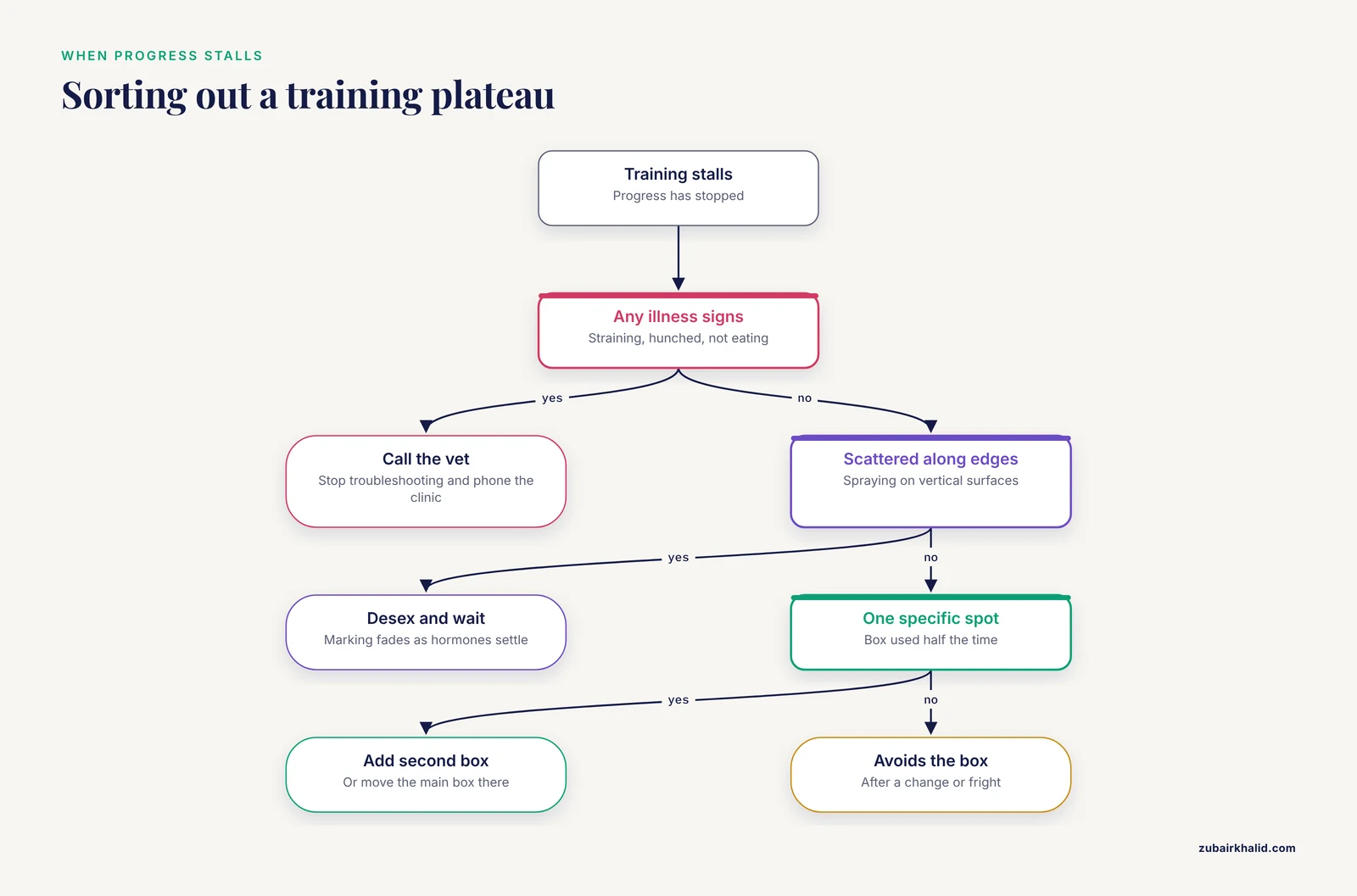
When progress stalls, diagnose the category before changing anything.
Territorial marking. Pattern, scattered droppings along boundaries, spraying on vertical surfaces, more intense in intact animals. Answer, desexing plus patience while hormones settle.
Location conflict. Your pet uses the box half the time and one specific spot the rest of the time. Answer, put a second box on that spot or move the main box there.
Box aversion. The animal avoids the box after a change, such as a new litter brand, a move, or a frightening event near the box. Answer, return to the previous litter, relocate the box to a quieter corner, and rebuild with scent seeding.
Surface preference. The rabbit targets one rug or one soft bed. Answer, remove or rotate that item during training weeks, cover the target area with a litter-appropriate surface such as a tray, and add a box nearby.
Congestion and crowding. The enclosure offers too many comfortable corners or the box sits in a draft, beside loud equipment, or in the only walkway. Answer, simplify the space and improve the box's location.
Pain or illness. Any lapse accompanied by straining, hunched posture, reduced appetite, smaller or fewer droppings, or wetness around the rear end is a veterinary case. Stop troubleshooting and call your clinic.
Hygiene, Safety, and Welfare During and After Training
Litter training connects directly to two welfare issues that veterinary organizations emphasize for small mammals.
Respiratory health. Both rabbits and guinea pigs are obligate nasal breathers with sensitive airways. Dusty litter, scented products, and ammonia accumulation from a neglected tray all work against them. Spot clean daily, ventilate the room, and keep the box in the enclosure rather than enclosed in an unventilated cabinet.
Skin and foot health. A guinea pig that sits in a wet tray develops urine scald and is at risk of painful foot problems such as bumblefoot, a condition the Merck Veterinary Manual describes in small mammals kept on wet or abrasive surfaces. Daily tray changes, dry bedding, and solid, cushioned flooring outside the tray are the prevention.
Rabbit care checklist connection. If you are assembling a full rabbit care checklist, litter training sits alongside unlimited grass hay, appropriate leafy greens, daily exercise time, chew items for dental wear, desexing, and routine health checks by a rabbit-savvy veterinarian. A reliably used litter box makes each of the other items easier to monitor, because changes in urine output, dropping size, and cecotrope production show up in one place.
Guinea pig care guide connection. Within a complete guinea pig care guide, the toilet tray sits beside daily vitamin C supply from appropriate vegetables or supplements, since guinea pigs cannot synthesize their own vitamin C and depend on dietary intake, a fact highlighted in VCA Animal Hospitals' small mammal resources. Daily tray cleaning also doubles as a daily health check, because you will notice reduced output, unusual urine color, or sludge immediately.
Limitations and When to Contact a Veterinarian
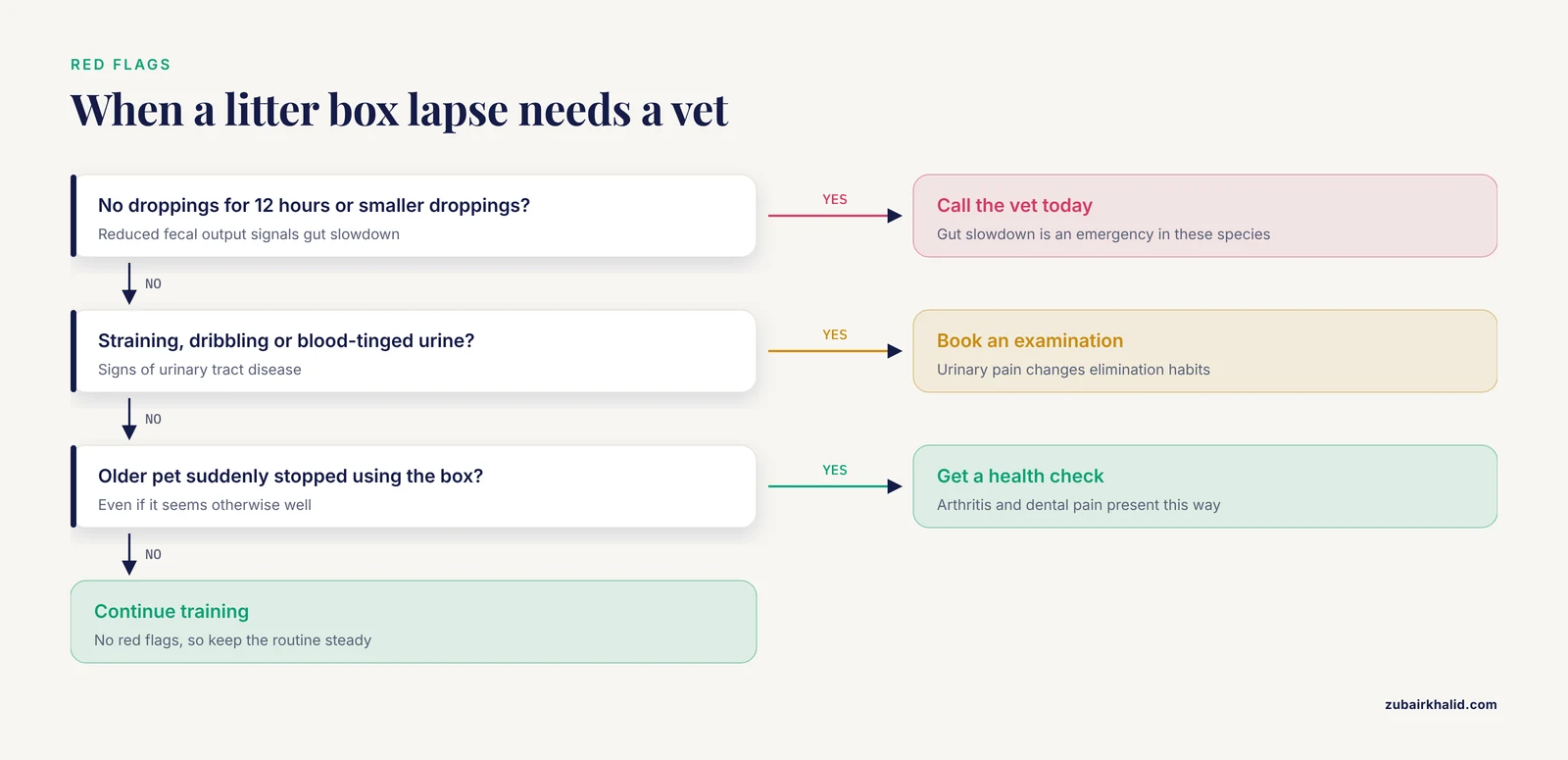
Every animal is an individual, and this article describes typical patterns rather than a diagnosis of your pet. Any persistent problem deserves an in-person examination by a veterinarian experienced with rabbits or guinea pigs.
Contact a veterinarian promptly, the same day if possible, for any of the following:
- No droppings for 12 hours or visibly smaller, fewer, or misshapen droppings, because reduced fecal output signals gut slowdown, an emergency in hindgut-fermenting herbivores
- Straining to urinate, frequent small urinations, urine dribbling, crying during urination, or blood-tinged urine
- A complete refusal to eat or a rabbit or guinea pig that sits hunched and quiet
- Diarrhea or truly watery feces, which is distinct from normal soft cecotropes
- Wet, inflamed, or foul-smelling skin around the genitals or underside, suggesting urine scald
- A sudden loss of litter box habits in a previously reliable animal, especially an older one, even when the animal seems otherwise well
- Any suspected pregnancy, before you make housing or handling changes
These signs overlap with common problems such as urinary tract disease, GI stasis, and dental pain that present as behavioral change. A same-day call is cheaper than an overnight crisis in every sense.
Frequently Asked Questions
How long does litter training take?
Most rabbits learn the basics within one to two weeks and become highly reliable within a few weeks to a few months, especially after desexing. Guinea pigs typically show partial improvement over two to four weeks and remain partly inconsistent for life. Individual variation is wide, so treat these as ranges, not promises.
Can guinea pigs be litter trained as reliably as rabbits?
No. Guinea pigs learn a preferred toilet corner and often use it for urine and some droppings, but they do not develop the strong latrine drive rabbits have. Plan on a tray that catches a good share of waste while you still clean scattered droppings.
What litter is safe for rabbits and guinea pigs?
Unscented paper-based litter and kiln-dried aspen are the standard safe choices for both species. Avoid clumping clay cat litter, which can obstruct the gut if eaten, and avoid pine and cedar shavings and scented or dusty products, which are associated with respiratory problems in small mammals.
Does spaying or neutering really help litter training?
Yes, and the effect is strongest in rabbits. Intact rabbits mark territory with scattered droppings and sprayed urine, behavior driven by reproductive hormones. After desexing, marking drops sharply and box reliability improves. Ask your veterinarian about the right timing for your individual animal.
Should I use more than one litter box?
Use one box while your pet is learning in a small space. Add a second box when the rabbit gains access to additional rooms or floors, and consider a second tray for a guinea pig play pen. Multiple boxes in a large territory prevent accidents simply by shortening the distance to a toilet.
Why did my trained rabbit suddenly stop using the litter box?
A sudden lapse in a previously reliable rabbit is a medical question until proven otherwise. Urinary pain, gut slowdown, dental discomfort, and arthritis all present as changed elimination habits. Call your veterinarian, especially if you also see reduced droppings, reduced appetite, straining, or a hunched posture.
Where should the litter box go in the enclosure?
Put it in the corner your pet already uses, which for rabbits is usually a corner away from food and sleeping areas and for guinea pigs is usually a corner away from the hay and water. For a rabbit, place hay at or over the box. Never place the box where your pet sleeps.
Can I use pine or cedar shavings in the litter box?
No. Pine and cedar shavings release aromatic oils that are linked to respiratory and other health concerns in small mammals in the exotic-animal veterinary literature. Choose unscented paper-based litter or kiln-dried aspen instead, and discuss any bedding product you are unsure about with your veterinarian.
Sources
- Electrophysiological properties of a new antiarrhythmic agent, bisaramil on guinea-pig, rabbit and canine cardiac preparations
- 7-oxo-PgI2 induced late appearing and long-lasting electrophysiological changes in the heart in situ of the rabbit, guinea-pig, dog and cat.
- Electrophysiological Effects of Nipradilol (K-351) on Isolated Rabbit Hearts and Guinea Pig Ventricular Muscles
- Species differences in presynaptic serotonin autoreceptors: mainly 5-HT1B but possibly in addition 5-HT1D in the rat, 5-HT1D in the rabbit and guinea-pig brain cortex
- Role of alpha-adrenoceptors in constrictor responses of rat, guinea-pig and rabbit small arteries to neural activation.
- Variation in Susceptibility to Diphtheria Toxin Among Guinea Pigs and Rabbits and Accuracy of Various Methods of Toxinantitoxin Titration
- The guinea pig as an animal model for developmental and reproductive toxicology studies.